BDH-CQ — a 150M-parameter system that learns a puzzle rule from the worked examples in front of it and does its thinking as numbers, never as words

2 months ago

When an AI shows you its reasoning, that reasoning is text. The model writes each step out and reads it back before carrying on. A system called BDH-CQ, from a company called Pathway, keeps every step as numbers inside itself.

Ask

Ask about this presentation

Answers are generated from this presentation.

Chapters

  1. 0:00BDH-CQ
  2. 0:13The worked examples are the only place the rule exists
  3. 0:39The model that finishes a puzzle is identical to the one that started it
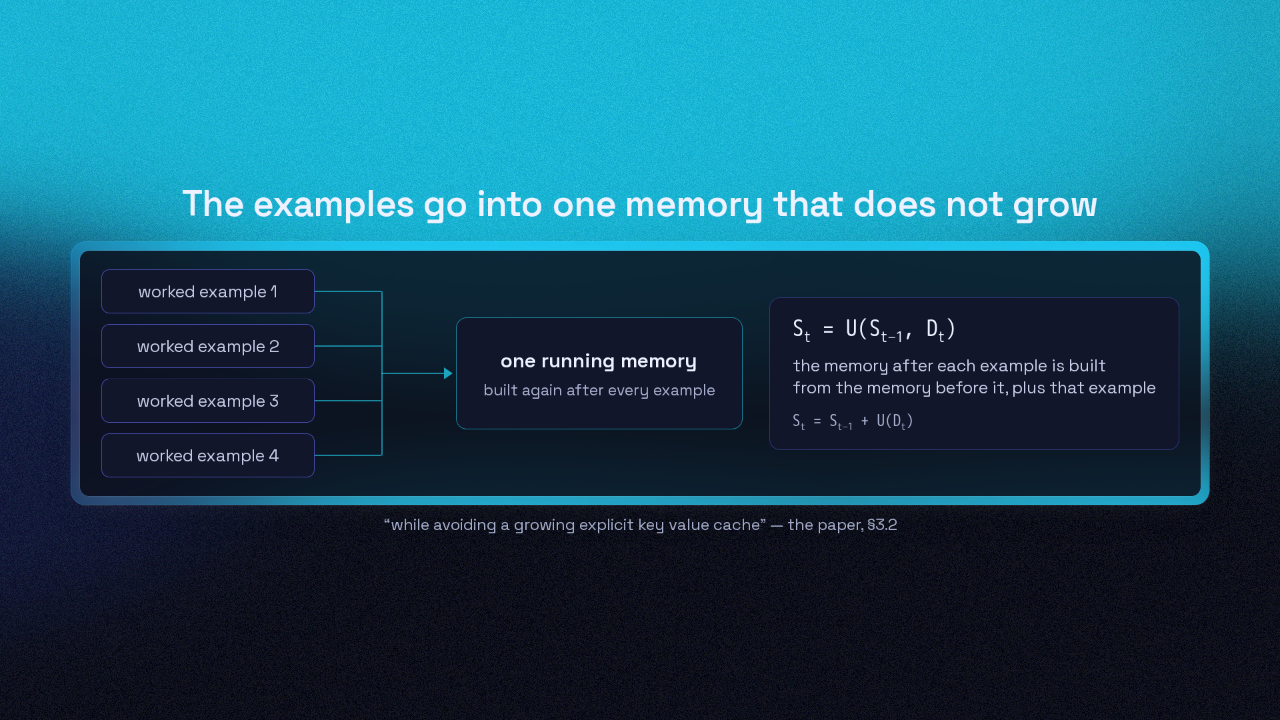
  4. 0:58The examples go into one memory that does not grow
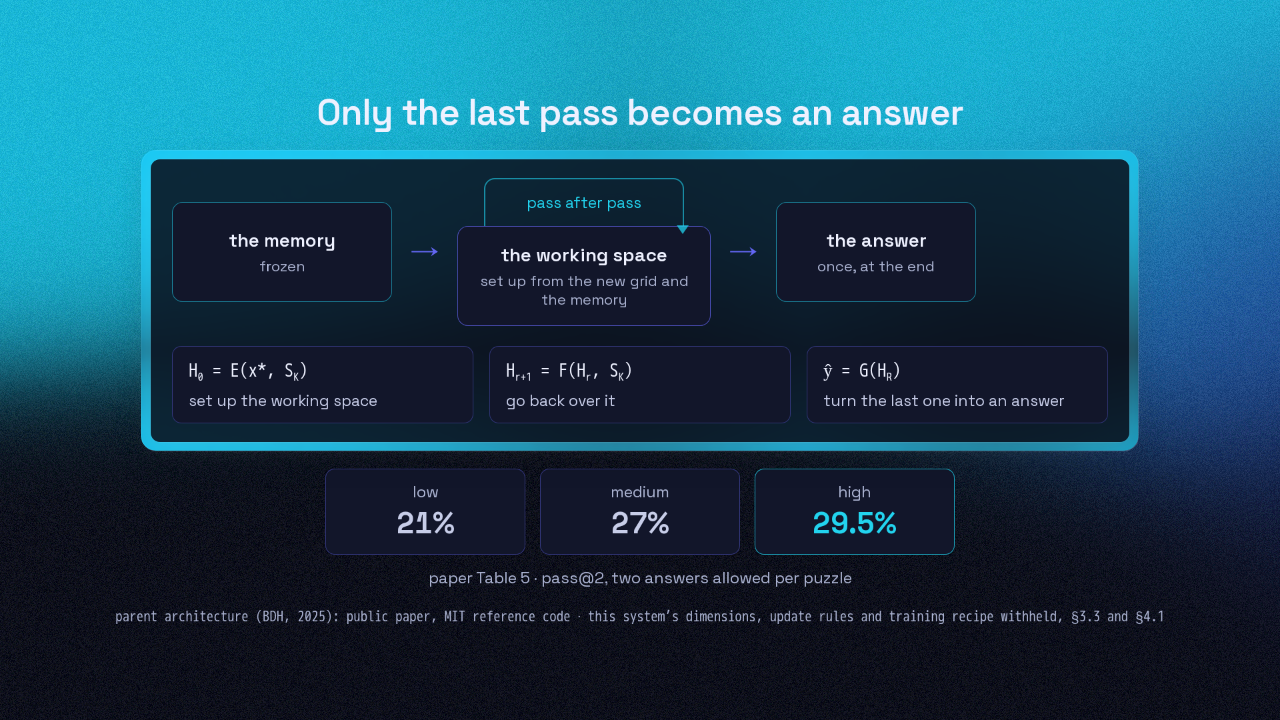
  5. 1:28Only the last pass becomes an answer
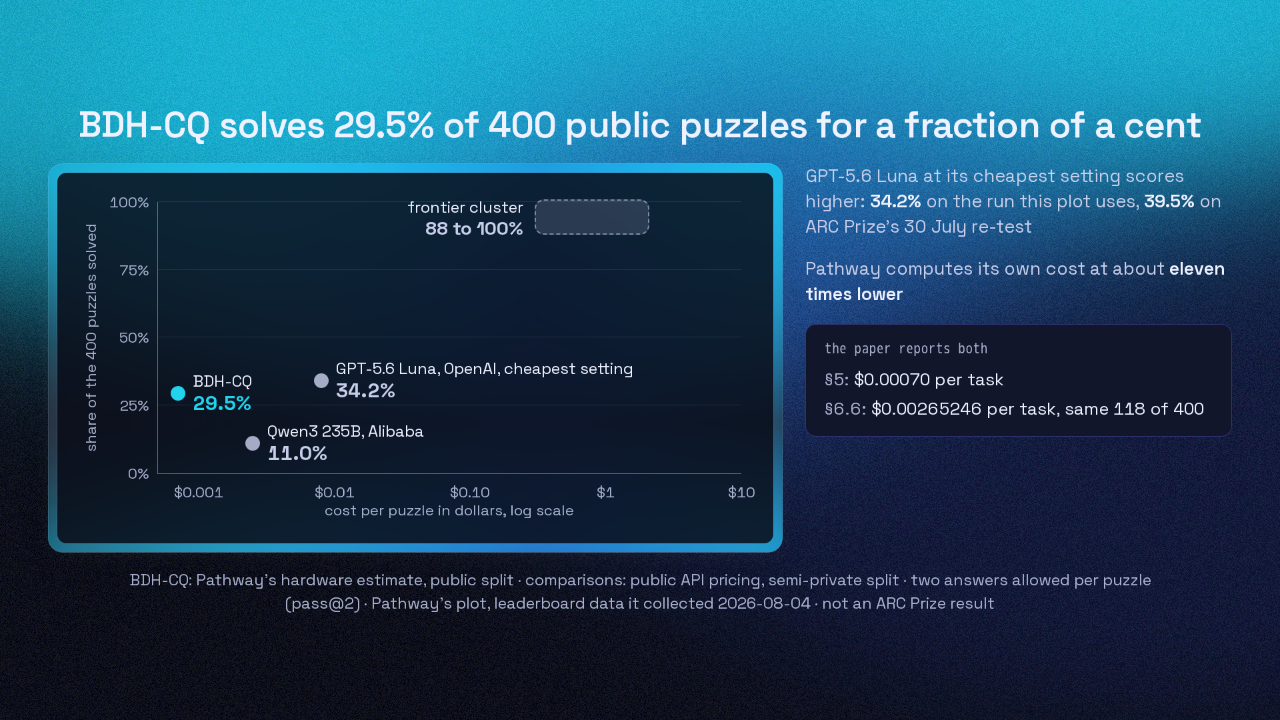
  6. 2:13BDH-CQ solves 29.5% of 400 public puzzles for a fraction of a cent
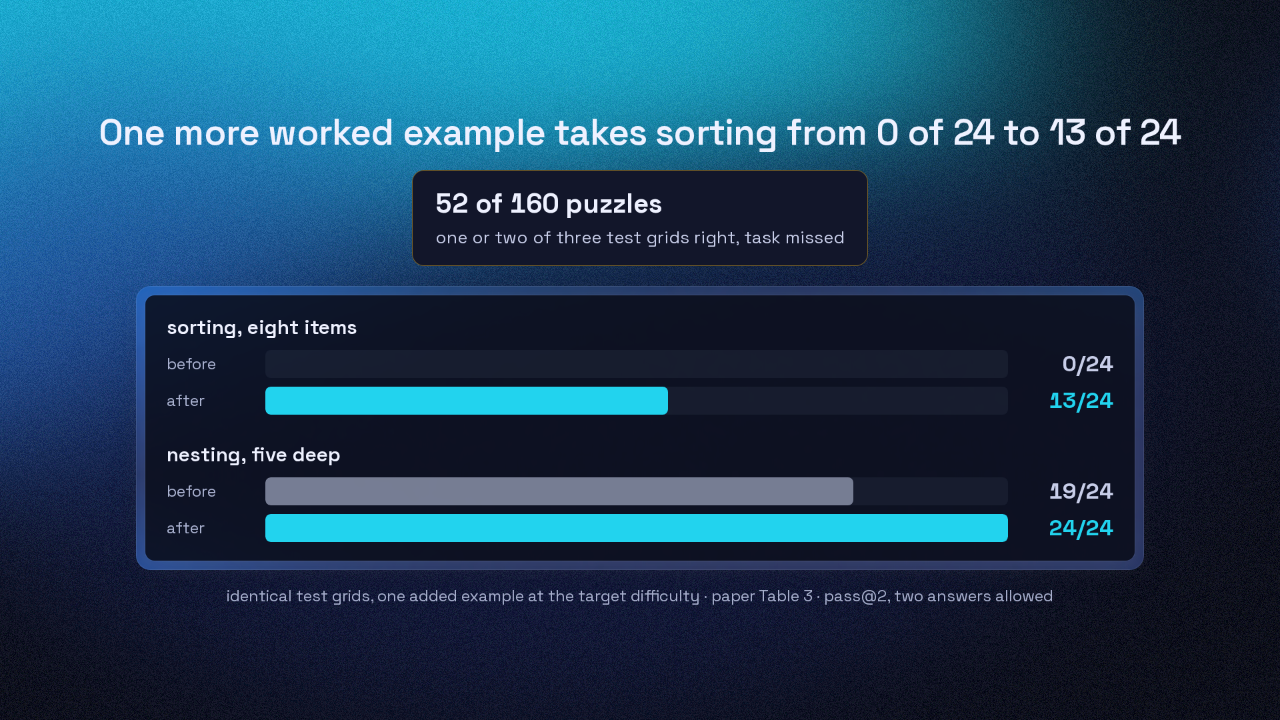
  7. 2:43One more worked example takes sorting from 0 of 24 to 13 of 24
  8. 3:15The reasoning stays as numbers inside the model until the last pass turns it into an answer
Show transcript

BDH-CQ

It learns the rule from the examples in front of it, then answers without writing its thinking down.
Pathway, with Bielik AI and NYU arXiv, 10 Aug 2026 coloured grid puzzles no weights, no code, no demo

When an AI shows you its reasoning, that reasoning is text. The model writes each step out and reads it back before carrying on. A system called BDH-CQ, from a company called Pathway, keeps every step as numbers inside itself.

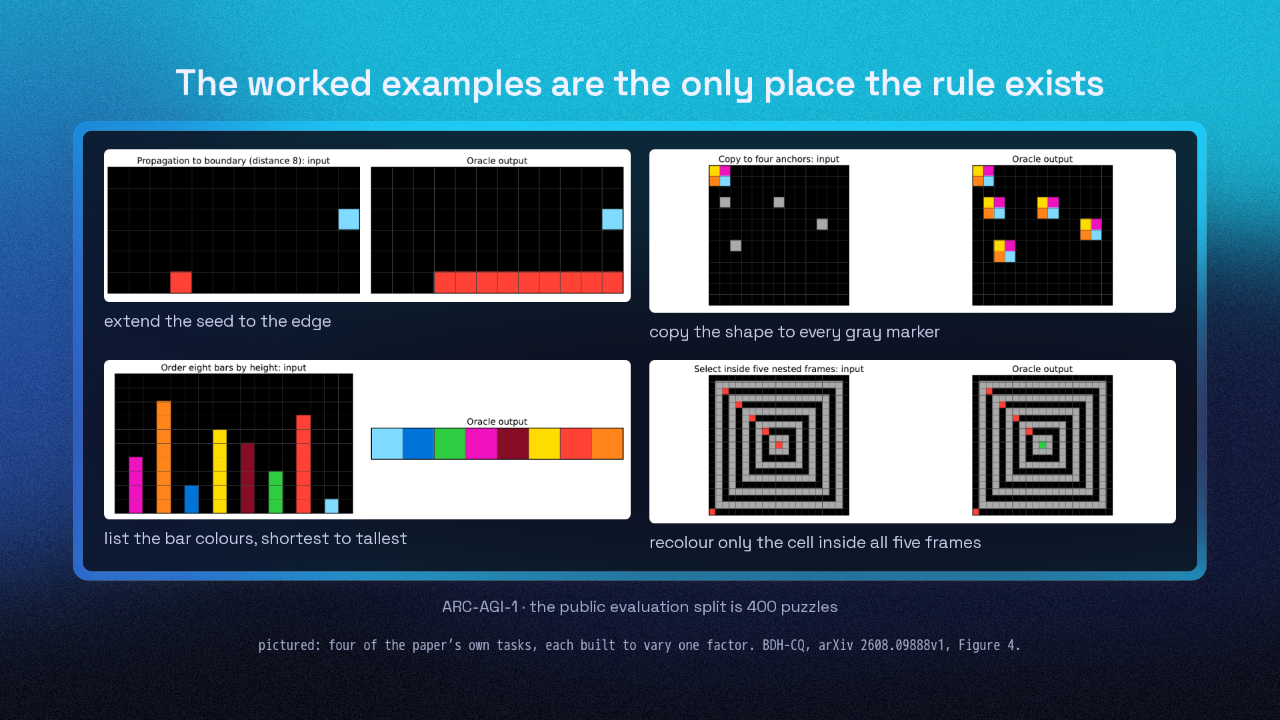
The worked examples are the only place the rule exists

a held-out input and its correct output: a seed cell, extended to the boundary
extend the seed to the edge
a held-out input and its correct output: a motif copied onto every gray anchor
copy the shape to every gray marker
a held-out input and its correct output: eight bar colours ordered shortest to tallest
list the bar colours, shortest to tallest
a held-out input and its correct output: only the cell inside every nested frame recoloured
recolour only the cell inside all five frames
ARC-AGI-1 · the public evaluation split is 400 puzzles
pictured: four of the paper’s own tasks, each built to vary one factor. BDH-CQ, arXiv 2608.09888v1, Figure 4.

The puzzles BDH-CQ solves are small grids of coloured squares. Each puzzle hands you a few worked examples: here is a grid, here is what it should turn into. Then you get a new grid to do yourself. The rule is different in every puzzle, and the rule is never written down. You work it out from the examples, usually three of them. BDH-CQ is a hundred and fifty million parameters, the adjustable numbers a model is made of. Pathway has published the paper and nothing else: no weights, no code, no demo.

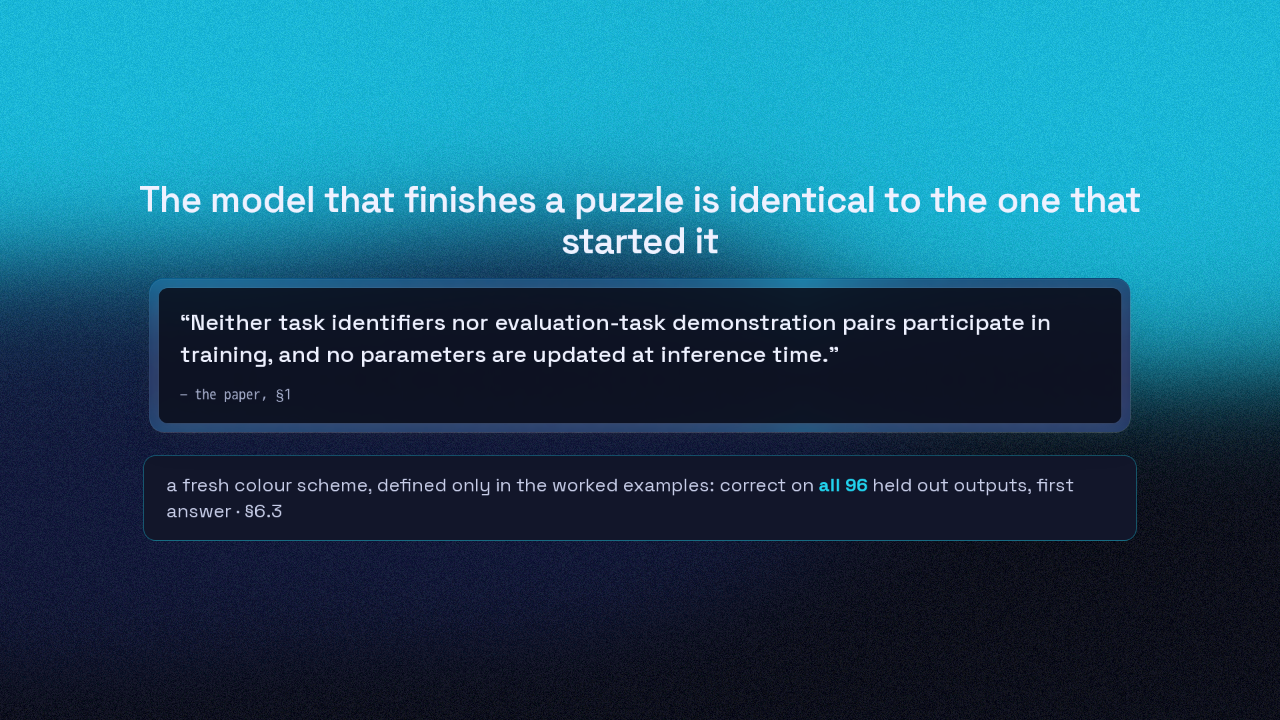
The model that finishes a puzzle is identical to the one that started it

“Neither task identifiers nor evaluation-task demonstration pairs participate in training, and no parameters are updated at inference time.”
— the paper, §1
a fresh colour scheme, defined only in the worked examples: correct on all 96 held out outputs, first answer · §6.3

Pathway kept all four hundred of these puzzles out of training, and their worked examples too. BDH-CQ meets every puzzle cold. It works the rule out while it answers, and the numbers inside the model stay exactly as they were. Some of the other systems on this test work a different way. They train on the evaluation puzzles, and each puzzle carries an identity the model has seen before.

The examples go into one memory that does not grow

worked example 1
worked example 2
worked example 3
worked example 4
one running memory
built again after every example
St = U(St−1, Dt)
the memory after each example is built
from the memory before it, plus that example
St = St−1 + U(Dt)
“while avoiding a growing explicit key value cache” — the paper, §3.2

Paste examples into a chatbot and the chatbot keeps the whole pile, and reads all of it again for every new word it produces. BDH-CQ folds each worked example into a single running memory, one example at a time. The memory after the third example is built from the memory after the second, plus the third example. The simplest version the paper spells out is one you can picture: take what each example contributes and add it onto what is already there. The memory does not grow as the examples arrive. Pathway's own reason for building the memory this way is the cost. There is no growing pile to re-read.

Only the last pass becomes an answer

the memory
frozen
→
pass after pass
the working space
set up from the new grid and the memory
→
the answer
once, at the end
H0 = E(x*, SK)
set up the working space
Hr+1 = F(Hr, SK)
go back over it
ŷ = G(HR)
turn the last one into an answer
low
21%
medium
27%
high
29.5%
paper Table 5 · pass@2, two answers allowed per puzzle
parent architecture (BDH, 2025): public paper, MIT reference code · this system’s dimensions, update rules and training recipe withheld, §3.3 and §4.1

With every example folded in, BDH-CQ builds a second space to work in, out of the new grid and that memory. Then it goes back over that working space, pass after pass. Each pass is built from the pass before it and from that same memory, and the memory stays frozen. The passes in between stay as numbers. There is no writing out and no reading back. How much refinement to do is a dial, set at answer time. BDH-CQ solves twenty one percent of the puzzles at the low setting, twenty seven percent at medium, and twenty nine and a half percent at high. The leaderboard allows two answers per puzzle, and those scores use both. Pathway published the architecture family BDH-CQ is built on last year, with code anyone can read, and keeps this system's dimensions, update rules and training recipe private.

BDH-CQ solves 29.5% of 400 public puzzles for a fraction of a cent

share of the 400 puzzles solved
cost per puzzle in dollars, log scale
0% 25% 50% 75% 100% $0.001 $0.01 $0.10 $1 $10
Qwen3 235B, Alibaba
11.0%
BDH-CQ
29.5%
GPT-5.6 Luna, OpenAI, cheapest setting
34.2%
frontier cluster
88 to 100%
GPT-5.6 Luna at its cheapest setting scores higher: 34.2% on the run this plot uses, 39.5% on ARC Prize’s 30 July re-test
Pathway computes its own cost at about eleven times lower
the paper reports both
§5: $0.00070 per task
§6.6: $0.00265246 per task, same 118 of 400
BDH-CQ: Pathway’s hardware estimate, public split · comparisons: public API pricing, semi-private split · two answers allowed per puzzle (pass@2) · Pathway’s plot, leaderboard data it collected 2026-08-04 · not an ARC Prize result

On the four hundred public puzzles of the first version of the ARC test, BDH-CQ gets a hundred and eighteen right. The systems at the top of this test solve close to ninety percent of those puzzles, and OpenAI's GPT-5.6 Luna scores higher than BDH-CQ at its cheapest setting. Pathway works its own cost out from hardware time, at an assumed three dollars an hour for the chip. The systems on the same chart are priced off what they charge to use. Pathway reports its own figure twice: seven hundredths of a cent in one section, a quarter of a cent in another, for the same score.

One more worked example takes sorting from 0 of 24 to 13 of 24

52 of 160 puzzles
one or two of three test grids right, task missed
sorting, eight items
before 0/24
after 13/24
nesting, five deep
before 19/24
after 24/24
identical test grids, one added example at the target difficulty · paper Table 3 · pass@2, two answers allowed

Across a hundred and sixty puzzles with three test grids each, fifty two of those puzzles had one or two grids right and still counted as missed. The authors read those partial successes as a rule the model inferred but did not apply to every grid. What decides whether a rule carries is what you show it. On a different family of puzzles, the researchers held the test grids byte for byte identical and changed only the examples. Add one worked example at the difficulty being tested, and sorting eight items goes from zero correct out of twenty four grids to thirteen. Nesting five levels deep goes from nineteen of twenty four grids to all twenty four.

The reasoning stays as numbers inside the model until the last pass turns it into an answer

arxiv.org/abs/2608.09888
Pathway paper only no weights, no code, no demo

So the thinking happens as numbers, and the answer is the first part of it anyone can read. Every published evaluation of this system is Pathway's own, and there are no weights, no code and no demo. The authors name the harder second version of this test as their next target.


Up next

2:58

Apodex 1.1 mini · the same file, run alone and run as a team

@ai-ml-today · 1 month ago

3:09

Ornith-1.5 · an open model trained on problems it wrote for itself

@ai-ml-today · 1 month ago

3:08

MOSS-VL · an open 11B video model trained to decide, after every frame, whether to speak or stay silent

@ai-ml-today · 1 month ago

3:29

Qwen3.8-27B · a 27B open model anyone can download averages 84.3 across real desktop jobs on Qwen’s own run, and loses the widest row on its own card by nine points

@ai-ml-today · 1 month ago

3:15

MiLMMT-46-v1.0 · Xiaomi finished training an open translator on sentences that had no translation attached, and the scores it now leads on are produced by the two models that graded it

@ai-ml-today · 1 month ago

3:29

Muse Glimmer 30B, Meta’s open agent model, and the second tiny model that guesses sixteen words ahead so it runs fast on one consumer graphics card

@ai-ml-today · 2 months ago

3:05

JoyAI-Video-Edit, JD’s open 16B model that edits a video while the video is still playing, at about 30 frames a second on one Nvidia B200

@ai-ml-today · 2 months ago

3:26

Inkling-Small, Thinking Machines’ 12B-active / 276B open mixture-of-experts model that out-reasons its own 3.5× bigger flagship

@ai-ml-today · 2 months ago

3:42

Maple-Preview, DeepGrove’s 20-billion-parameter ternary reasoning model that runs on a Mac mini

@ai-ml-today · 2 months ago

3:16

Hunyuan3D-Buffalo, Tencent’s one model that builds, understands, and edits 3D from words

@ai-ml-today · 2 months ago

3:28

MiniMax H3, an open model that makes a video and its soundtrack in one pass

@ai-ml-today · 2 months ago

3:37

DiffusionGemma, Google’s open model that writes text a whole block at a time

@ai-ml-today · 2 months ago