

Hunyuan3D-Buffalo, Tencent’s one model that builds, understands, and edits 3D from words

2 months ago

One AI model now builds a 3D object from a sentence, and then changes it when you describe the change. Tencent’s Hunyuan team calls it Hunyuan3D-Buffalo. The same model also understands the shapes it makes, well enough to answer questions about them and point to their parts.

Ask

Ask about this presentation

Answers are generated from this presentation.

Chapters

  1. 0:00Hunyuan3D-Buffalo, one model that builds, understands, and edits 3D from words
  2. 0:14Four 3D jobs, now handled by one model
  3. 0:36One shared brain instead of four separate tools
  4. 0:58One brain reads the shape and steers the generator
  5. 1:35Editing is generation, holding everything else still
  6. 2:18Picked most often in Tencent’s own four-way vote
  7. 2:44The paper is out; the weights are not
  8. 2:59One brain builds it, reads it, and edits it
Show transcript

Hunyuan3D-Buffalo, one model that builds, understands, and edits 3D from words

Hunyuan3D-Buffalo

Tencent’s paper on one model that builds, understands, and edits 3D from words.
Tencent Hunyuan3D paper · weights not yet released text to 3D shape understand · generate · edit · part

One AI model now builds a 3D object from a sentence, and then changes it when you describe the change. Tencent’s Hunyuan team calls it Hunyuan3D-Buffalo. The same model also understands the shapes it makes, well enough to answer questions about them and point to their parts.

Four 3D jobs, now handled by one model

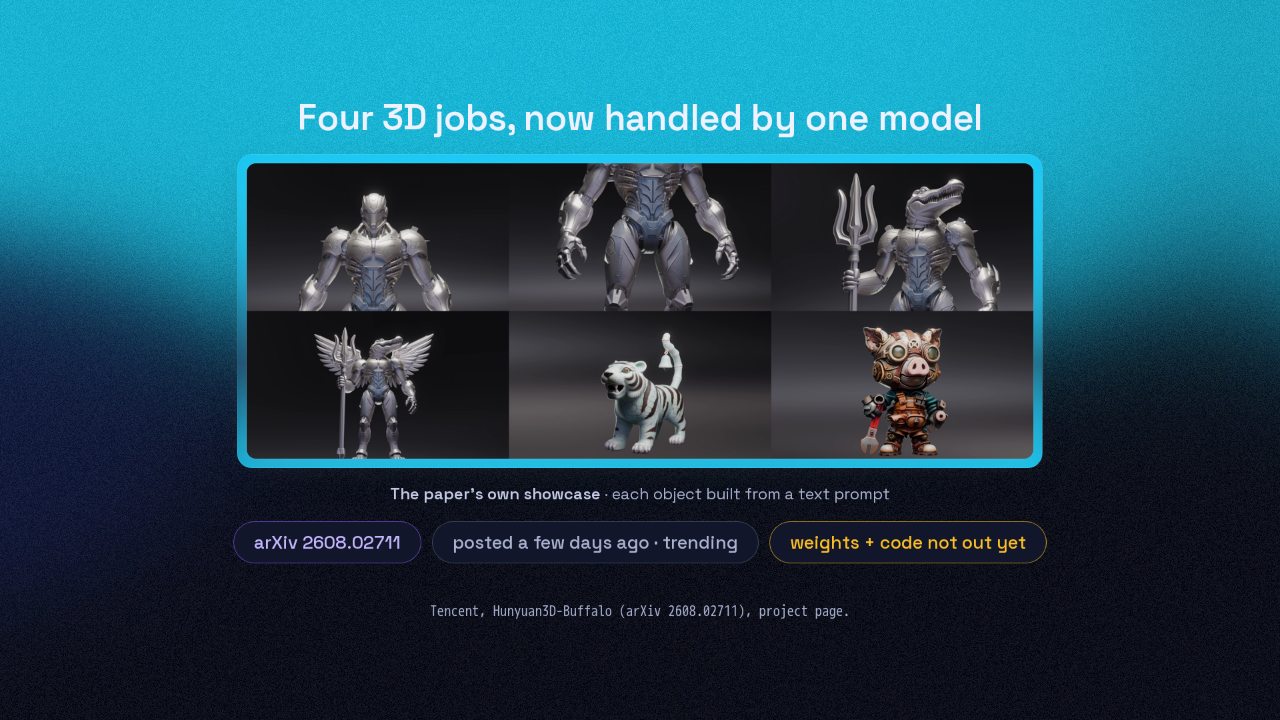
The paper’s own showcase · each object built from a text prompt
arXiv 2608.02711 posted a few days ago · trending weights + code not out yet
Tencent, Hunyuan3D-Buffalo (arXiv 2608.02711), project page.

Until now, four 3D jobs each needed their own tool: understanding a 3D object and answering questions about it, building a new one from a prompt, editing one from an instruction, and pulling out a named part. Hunyuan3D-Buffalo does all four with one model. It comes from a research paper Tencent posted a few days ago, now trending on the AI paper boards. The weights and code are not out yet, so you can study how it works, not run it.

One shared brain instead of four separate tools

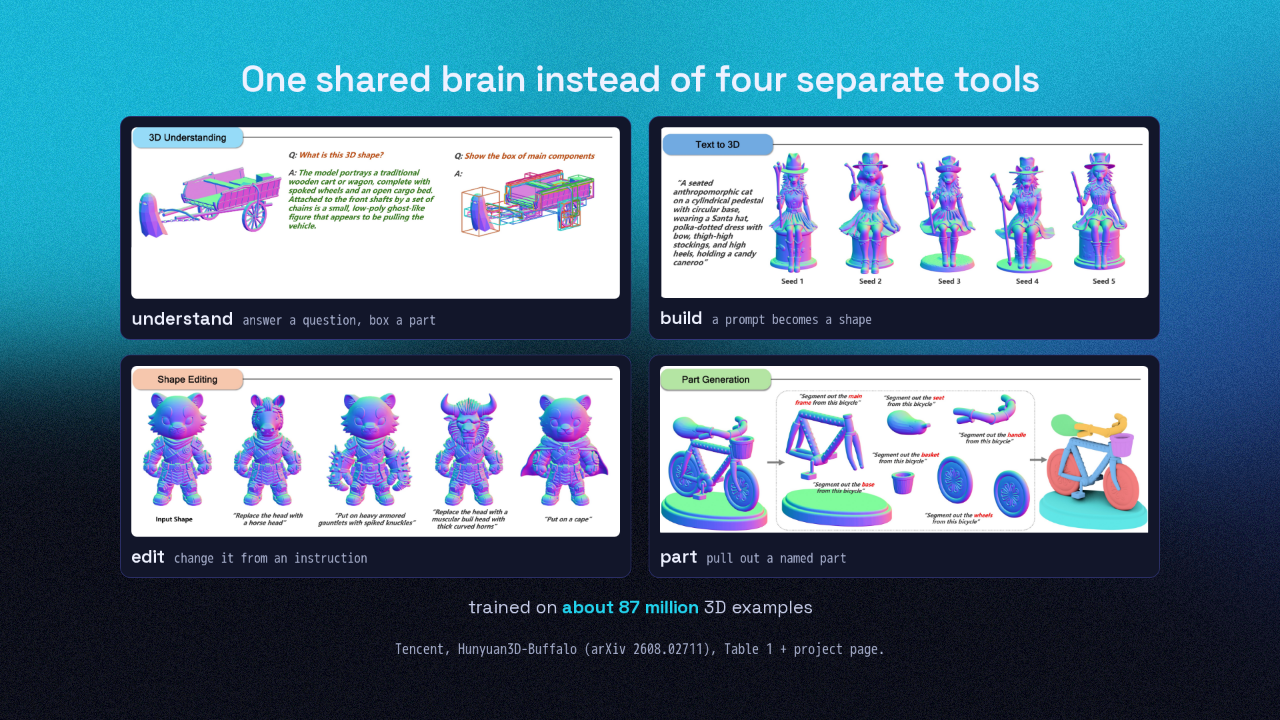
Understanding a 3D shape by answering a question and boxing a part
understandanswer a question, box a part
Building 3D shapes from a text prompt
builda prompt becomes a shape
Editing a 3D shape from an instruction
editchange it from an instruction
Generating and segmenting named parts of a 3D object
partpull out a named part
trained on about 87 million 3D examples
Tencent, Hunyuan3D-Buffalo (arXiv 2608.02711), Table 1 + project page.

The real advance is coverage: one model covers all four jobs at once, where each used to need its own specialist system. It works because at the center sits one brain that reads pictures and words together, and Tencent taught it to read 3D too. They wired that brain to a second model that only builds 3D shapes, and trained it all on about 87 million 3D examples, a huge set, since good 3D data is the bottleneck.

One brain reads the shape and steers the generator

the brain reads pictures, words, and 3D the generator builds the 3D shape
vision-language base Qwen2.5-VL · generator base Hunyuan3D-2.1 · a shape is compressed to 512 tokens, plus 133 tokens for writing coordinates
Tencent, Hunyuan3D-Buffalo (arXiv 2608.02711), §4.1 / §4.2.

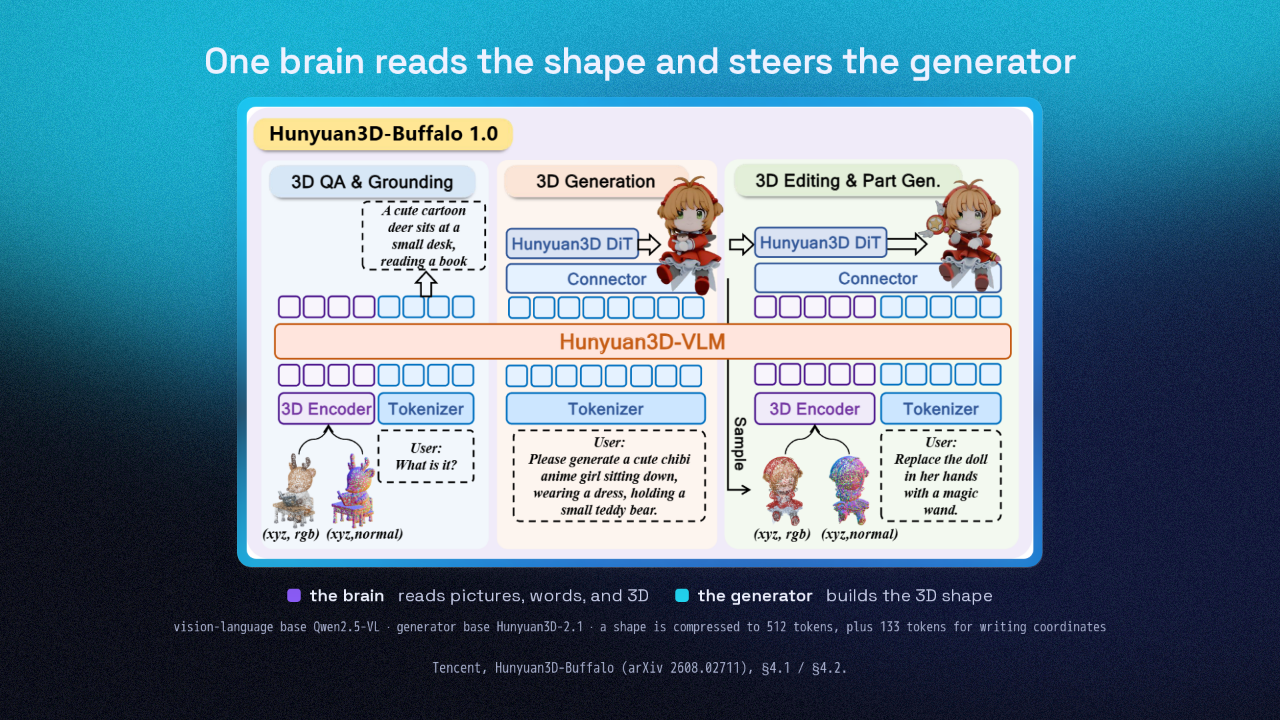
The brain starts from an existing model that already reads pictures and text. To give the brain a sense of 3D, a small encoder turns a shape into a short description: its geometry, the surface and which way it faces, plus its color. They also gave the brain extra words for writing coordinates, so it can point to a part by drawing a box around it. With just that, the brain can understand a shape and answer questions, all by generating text. To build something new, the brain’s read of your words passes through a small connector into a 3D generator, a model that starts from a rough, noisy blob and sharpens it into a shape. So one brain reads the shape and steers the building of one.

Editing is generation, holding everything else still

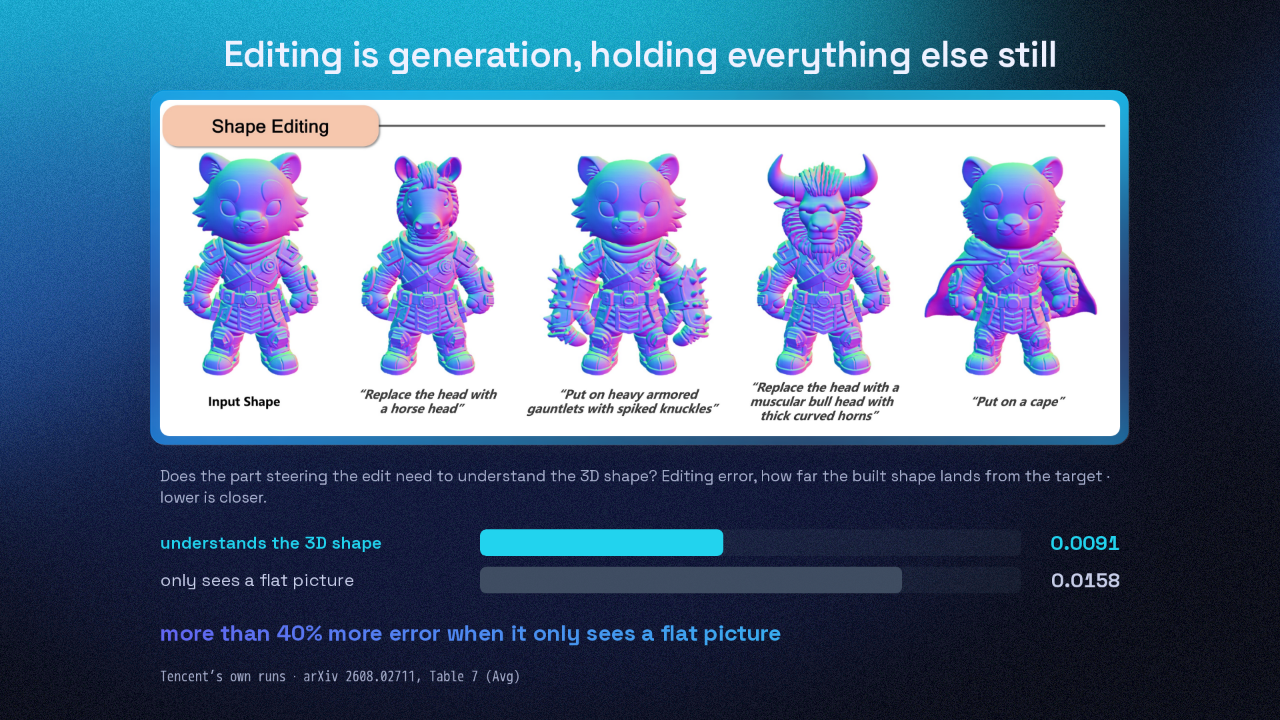
Does the part steering the edit need to understand the 3D shape? Editing error, how far the built shape lands from the target · lower is closer.
understands the 3D shape0.0091
only sees a flat picture0.0158
more than 40% more error when it only sees a flat picture
Tencent’s own runs · arXiv 2608.02711, Table 7 (Avg)

The last job, editing, reuses that same generator instead of a separate tool. Tencent reframes editing as generation: hand the generator the shape you already have, and tell it to build this again, changing only the part you asked about and keeping the rest. Building or pulling out a named part works the same way. So editing is just generation from an object you already have. One test shows why the design holds up. Tencent asked whether the part steering the edit really needs to understand the 3D shape, or could get by looking at a flat picture of it. Swapping the 3D-aware brain for a plain image reader raised the editing error by more than forty percent, and the result landed noticeably further from the target. Making the reading and the building one brain is what makes the editing good.

Picked most often in Tencent’s own four-way vote

Text to 3D · Tencent’s own human eval · 100 prompts · 4-way preference share (a tie is allowed) · random baseline 25%.
Buffalo56.6%
Omni12318.4%
TRELLIS14.4%
Universe3D8.3%
8.4%3M
28.6%15M
57.5%50M
The share climbs as training data grows · same study, 3 to 50 million examples
Tencent, Hunyuan3D-Buffalo (arXiv 2608.02711), Table 5 + Table 6.

On building 3D objects from text, Tencent ran a preference test: they showed people a prompt and the results from four systems and asked which was best. Buffalo’s result was picked about 57 percent of the time, against 18, 14, and 8 percent for the three earlier systems. That is a share of a four-way vote, in Tencent’s own study on a hundred prompts, not an absolute quality score and not an independent test. And the more 3D data they trained on, the higher that share climbed.

The paper is out; the weights are not

paperarxiv.org/abs/2608.02711
project pagetencent-hunyuan.github.io/Hunyuan3D-Buffalo1.0
weights + code not yet released
A paper to read, not a model to download. If that changes, the license will be worth reading closely.
Tencent, Hunyuan3D-Buffalo · release state re-checked 2026-08-06.

The paper is on arXiv, and the project page has the demo reel and the pipeline diagram. The links are on screen. The weights and code are not out yet, so this is a paper to read, not a model to download. If that changes, the license will be worth reading closely.

One brain builds it, reads it, and edits it

type a sentence, get a 3D object, then change it by describing the change
Tencent Hunyuan3D arXiv 2608.02711

Four 3D jobs used to need four separate tools. Hunyuan3D-Buffalo does them with one model, because the same brain that reads a shape also drives the generator, and editing is just building it again while holding the rest still. The payoff is structural: building, understanding, and editing 3D become one problem instead of four.


Up next

2:58

Apodex 1.1 mini · the same file, run alone and run as a team

@ai-ml-today · 1 month ago

3:09

Ornith-1.5 · an open model trained on problems it wrote for itself

@ai-ml-today · 1 month ago

3:08

MOSS-VL · an open 11B video model trained to decide, after every frame, whether to speak or stay silent

@ai-ml-today · 1 month ago

3:29

Qwen3.8-27B · a 27B open model anyone can download averages 84.3 across real desktop jobs on Qwen’s own run, and loses the widest row on its own card by nine points

@ai-ml-today · 1 month ago

3:15

MiLMMT-46-v1.0 · Xiaomi finished training an open translator on sentences that had no translation attached, and the scores it now leads on are produced by the two models that graded it

@ai-ml-today · 1 month ago

3:31

BDH-CQ — a 150M-parameter system that learns a puzzle rule from the worked examples in front of it and does its thinking as numbers, never as words

@ai-ml-today · 2 months ago

3:29

Muse Glimmer 30B, Meta’s open agent model, and the second tiny model that guesses sixteen words ahead so it runs fast on one consumer graphics card

@ai-ml-today · 2 months ago

3:05

JoyAI-Video-Edit, JD’s open 16B model that edits a video while the video is still playing, at about 30 frames a second on one Nvidia B200

@ai-ml-today · 2 months ago

3:26

Inkling-Small, Thinking Machines’ 12B-active / 276B open mixture-of-experts model that out-reasons its own 3.5× bigger flagship

@ai-ml-today · 2 months ago

3:42

Maple-Preview, DeepGrove’s 20-billion-parameter ternary reasoning model that runs on a Mac mini

@ai-ml-today · 2 months ago

3:28

MiniMax H3, an open model that makes a video and its soundtrack in one pass

@ai-ml-today · 2 months ago

3:37

DiffusionGemma, Google’s open model that writes text a whole block at a time

@ai-ml-today · 2 months ago