A 4B open model beats GPT-5 at finding when things happen in video
A four billion parameter open model just beat GPT-5 at finding when something happens in a video. It is called VideoChat3. MCG-NJU shipped the weights under Apache two point oh.
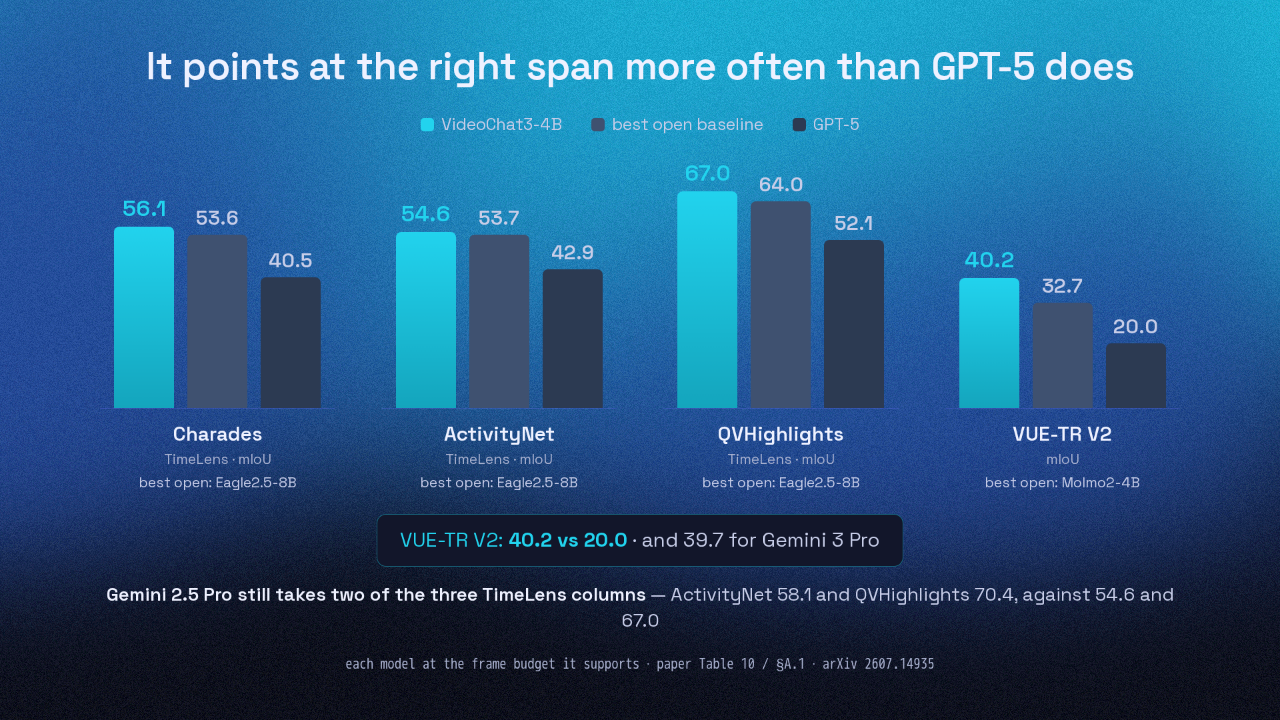
It points at the right span more often than GPT-5 does
That task is temporal grounding. You describe a moment. The model points at the span where it happens. You have scrubbed a timeline hunting for one shot. On Charades, VideoChat3 scores fifty six point one. GPT-5 scores forty point five. On VUE-TR it roughly doubles GPT-5. Gemini two point five Pro still takes two of the three TimeLens tests.
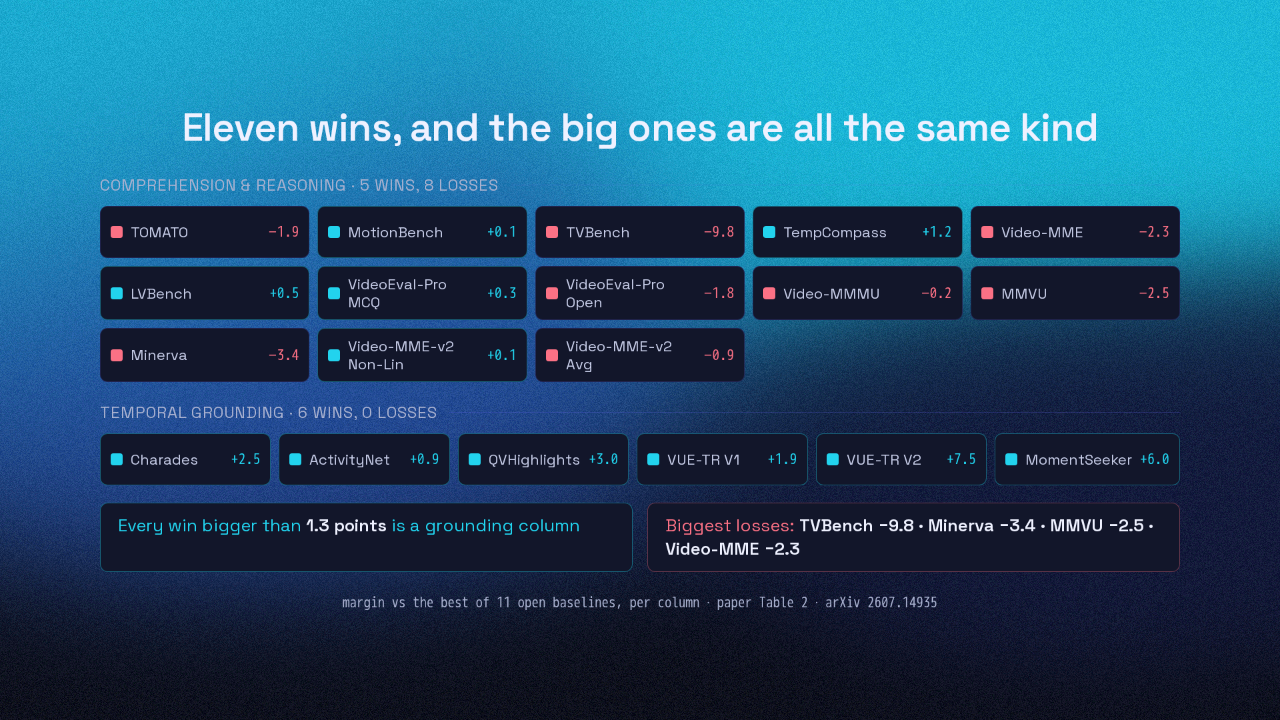
Eleven wins, and the big ones are all the same kind
The full table runs nineteen columns. VideoChat3 wins eleven and loses eight. All six grounding columns are wins. Six of the eight losses are comprehension. Ask it what happened. GPT-5 pulls away. On Video-MME it is eighty three point three against seventy point one. The big wins all sit in one block. The reason sits upstream of the language model.
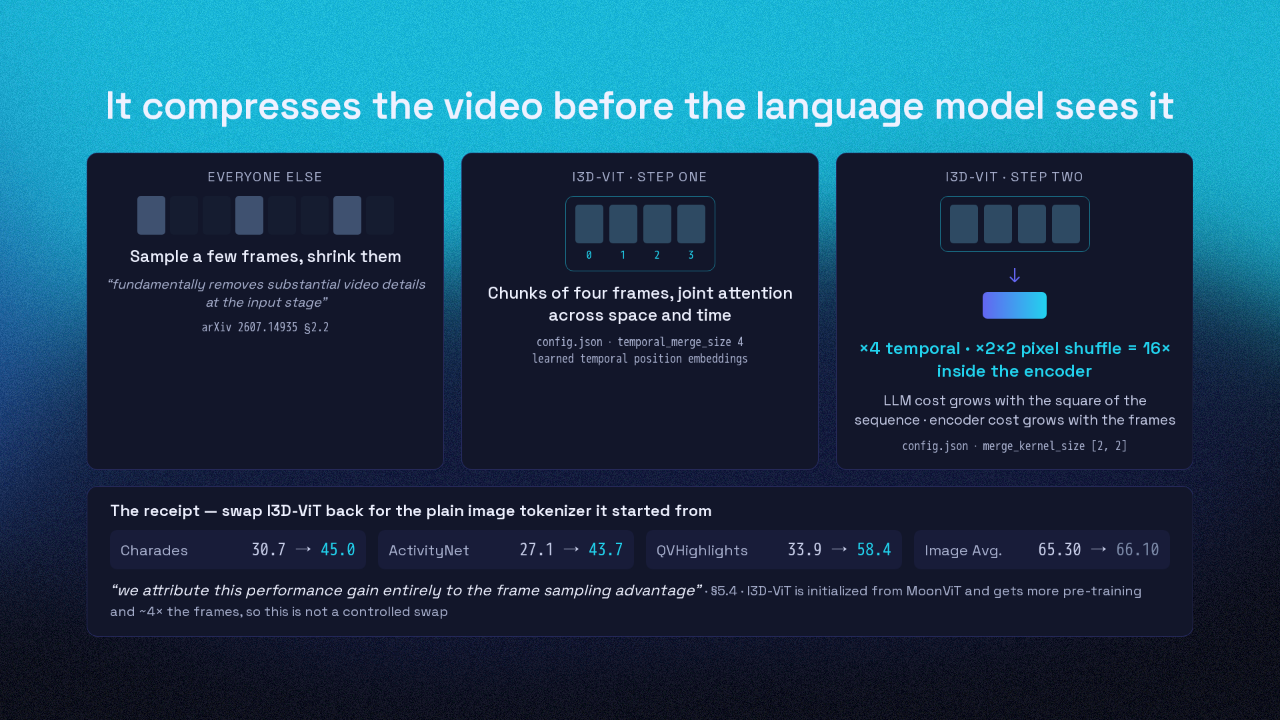
It compresses the video before the language model sees it
learned temporal position embeddings
inside the encoder
Video costs tokens. The language model has little room. So everyone samples a few frames and shrinks them. You throw the frames away before the model ever looks. VideoChat3 compresses inside the vision encoder instead. It groups the video into chunks of four frames. Those frames attend to each other across space and time. Then it pools along time. That is sixteen fold compression. It all happens inside the encoder. The language model's cost grows with the square of the sequence. The encoder's cost grows with the frame count. Move the work early, and the language model reads half the visual tokens. Swap that encoder for the plain image one it started from, and Charades grounding falls from forty five to thirty one. The image scores barely move. Four frames now cost what one used to, so the model watches about four times as many. The authors credit exactly that. You cannot time a moment you never saw.
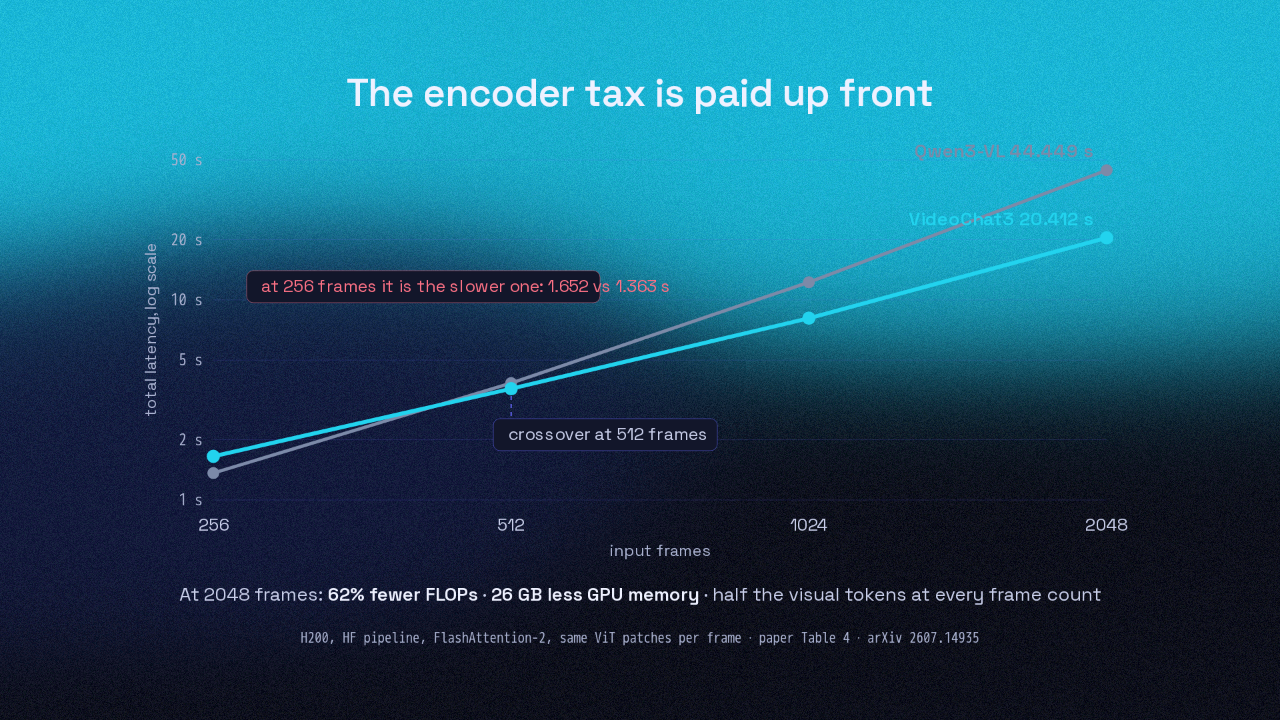
The encoder tax is paid up front
You pay for that heavier encoder. At two hundred fifty six input frames, VideoChat3 is slower than Qwen3-VL. The crossover lands at five hundred twelve frames. At two thousand forty eight frames, VideoChat3 finishes in twenty seconds. Qwen3-VL takes forty four.
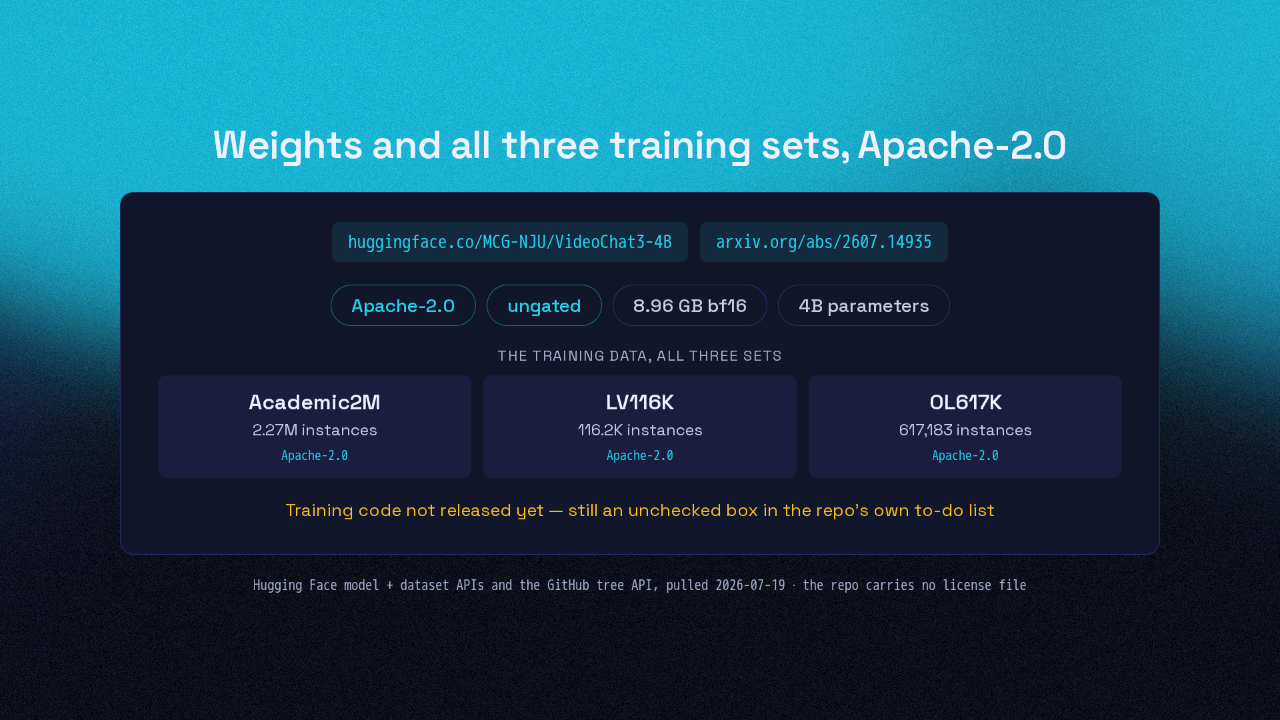
Weights and all three training sets, Apache-2.0
The weights are on Hugging Face under Apache two point oh, ungated. All three training sets shipped too, also Apache two point oh. The training code has not. It is still an unchecked box on their own to-do list. The data was the expensive part. That part is already there.
Ask a video model when, not just what
Ask a video model when, not just what. There is now a four billion parameter open answer. Every number here comes from the authors' own run. Nobody outside the lab has re-run it. And people are pulling the training data more than twenty times as often as the model.











