A 21M Model Just Out-Mapped Google's AlphaEarth

2 months ago

A twenty-one-million-parameter open model, built by an academic team at Cambridge, just out-mapped Google DeepMind's flagship Earth model. It's called TESSERA v2, and how they got there is stranger than the result.

Ask

Ask about this presentation

Answers are generated from this presentation.

Chapters

  1. 0:00Slide 1
  2. 0:11One learned vector for every 10-meter pixel of the planet
  3. 0:22Pretraining loss barely predicts the skill
  4. 0:39Best composite of any system on the 29-task suite
  5. 0:56Sixteen numbers keep about 92% of the score
  6. 1:11What the number doesn't tell you
  7. 1:28Read it now, run v2 soon
  8. 1:36Slide 8
Show transcript

Slide 1

A 21M Model Just Out-Mapped Google's AlphaEarth
A 21-million-parameter open model, distilled from a 1B-parameter teacher.
TESSERA v2 Cambridge · ucam-eo code MIT · v1 weights CC0 Sentinel-1 + Sentinel-2 · 10 m students 1M to 44M · teacher 1B

A twenty-one-million-parameter open model, built by an academic team at Cambridge, just out-mapped Google DeepMind's flagship Earth model. It's called TESSERA v2, and how they got there is stranger than the result.

One learned vector for every 10-meter pixel of the planet

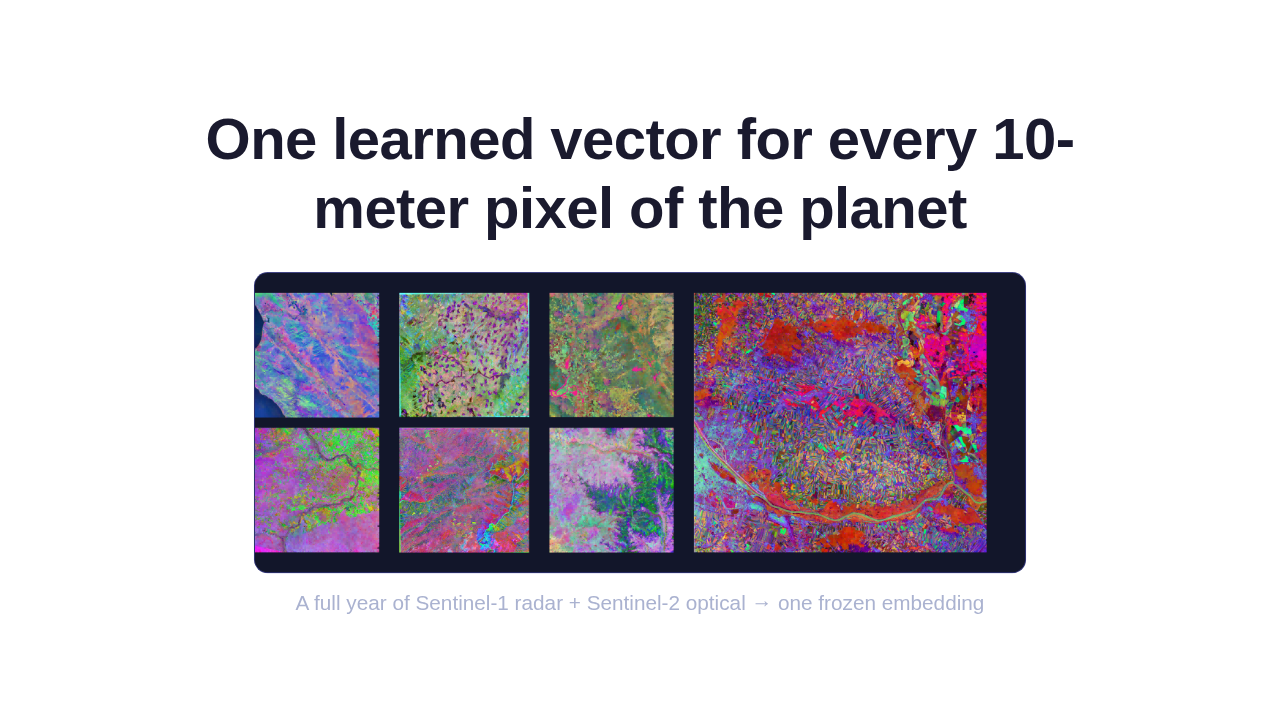
False-color rendering of a real TESSERA embedding field over land
A full year of Sentinel-1 radar + Sentinel-2 optical → one frozen embedding

TESSERA's unit isn't a satellite tile. It's a single ten-meter pixel. It takes a full year of radar and optical observations and squeezes them into one frozen vector you can probe for any map.

Pretraining loss barely predicts the skill

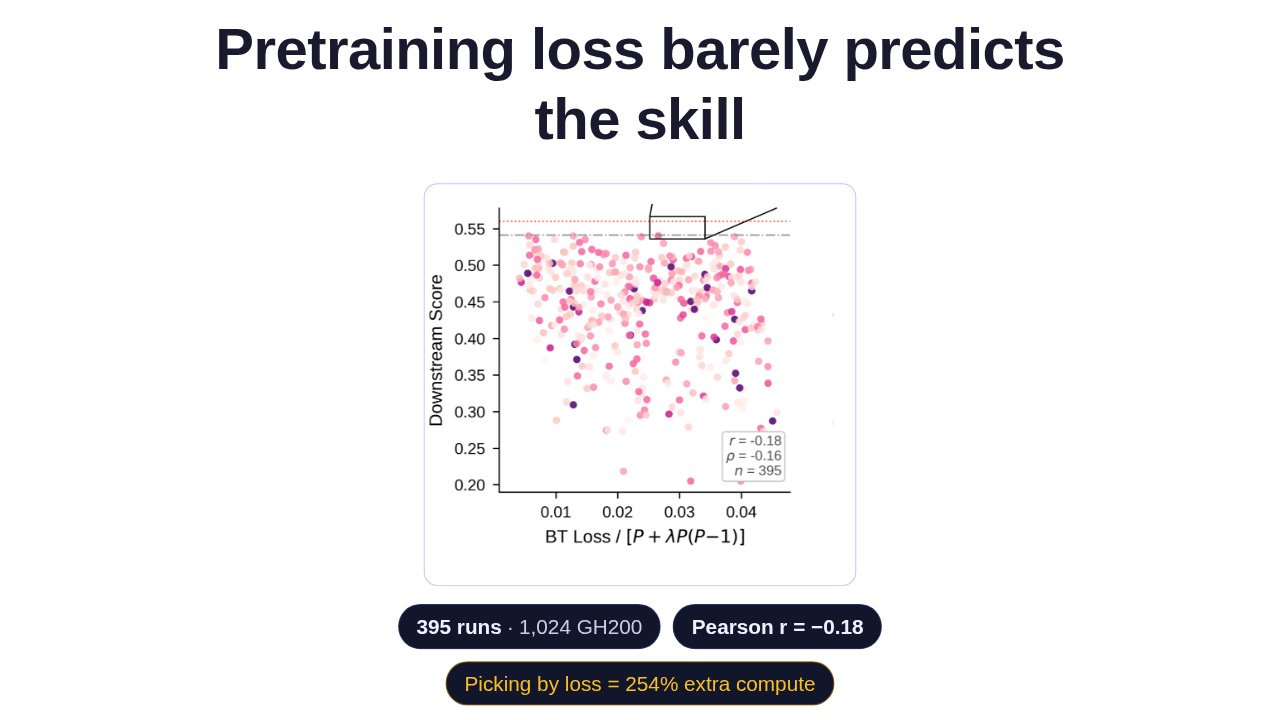
Scatter of downstream score against pretraining loss across 395 runs, r = -0.18
395 runs · 1,024 GH200 Pearson r = −0.18 Picking by loss = 254% extra compute

Across three hundred and ninety-five controlled runs on a thousand GH200 chips, pretraining loss barely predicted downstream skill. The correlation was negative zero point one eight. Chasing a lower loss can cost about two and a half times more compute for the same result, so they built the scaling law around downstream performance instead.

Best composite of any system on the 29-task suite

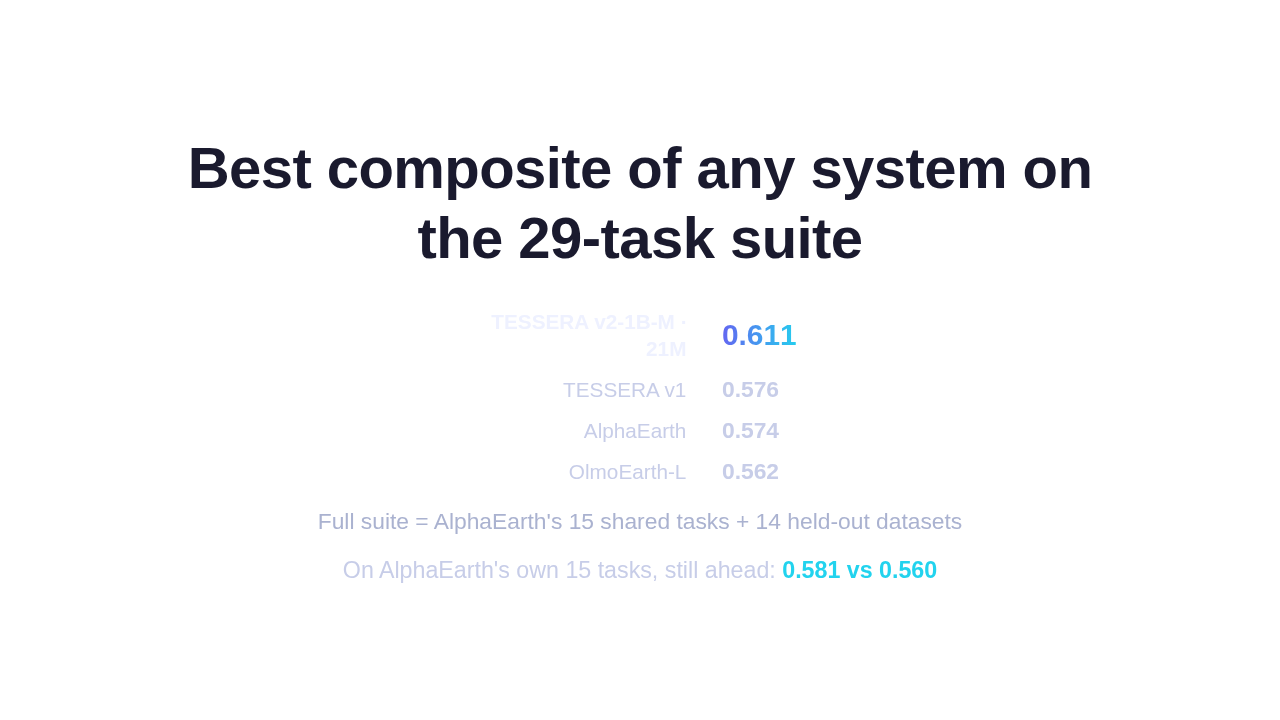
TESSERA v2-1B-M · 21M
0.611
TESSERA v1
0.576
AlphaEarth
0.574
OlmoEarth-L
0.562
Full suite = AlphaEarth's 15 shared tasks + 14 held-out datasets
On AlphaEarth's own 15 tasks, still ahead: 0.581 vs 0.560

On the full twenty-nine-task benchmark, the twenty-one-million-parameter model scores zero point six one one. The best composite of any system they tested, ahead of TESSERA v1, AlphaEarth, and OlmoEarth. And on AlphaEarth's own fifteen tasks, it still wins, zero point five eight one to zero point five six.

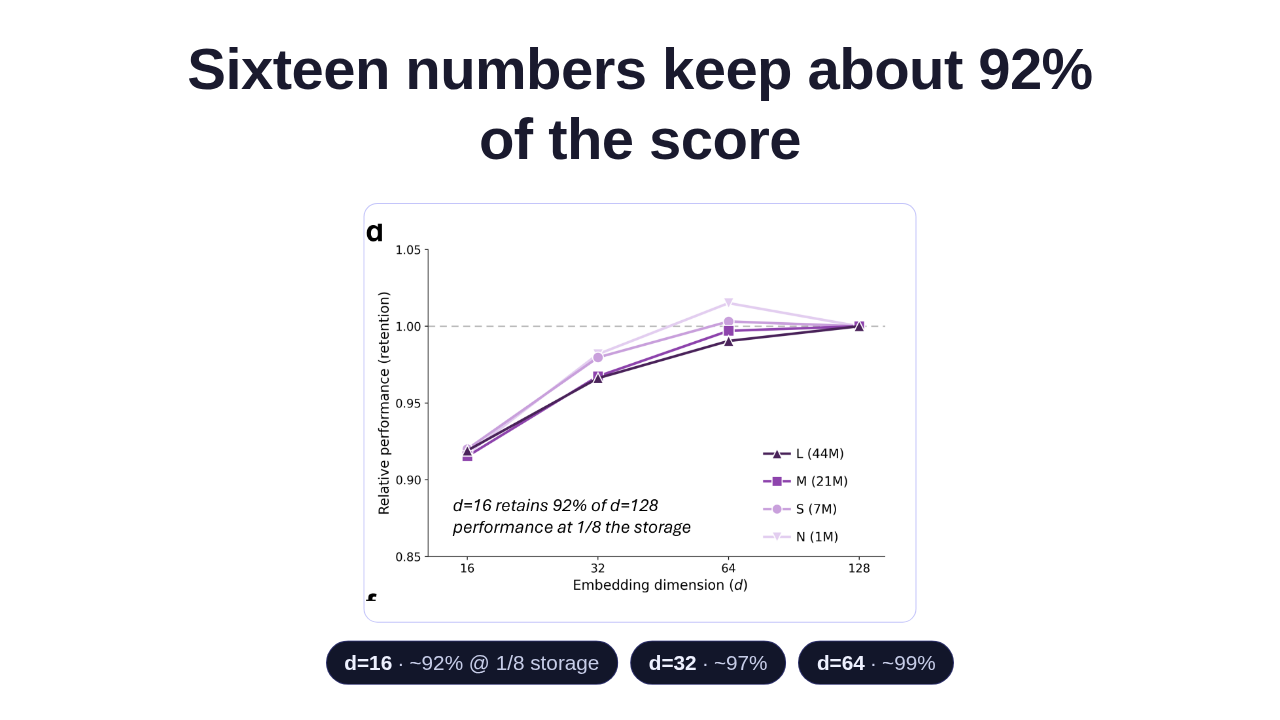
Sixteen numbers keep about 92% of the score

Retention curve: the d=16 prefix keeps about 92% of the full-dimension score
d=16 · ~92% @ 1/8 storage d=32 · ~97% d=64 · ~99%

How does a model this small compete? They distill a one-billion-parameter teacher into nested embeddings. The first sixteen numbers alone keep about ninety-two percent of the full score, at one-eighth the storage. The naive version fails; distilling against a fixed teacher supplies the ordering.

What the number doesn't tell you

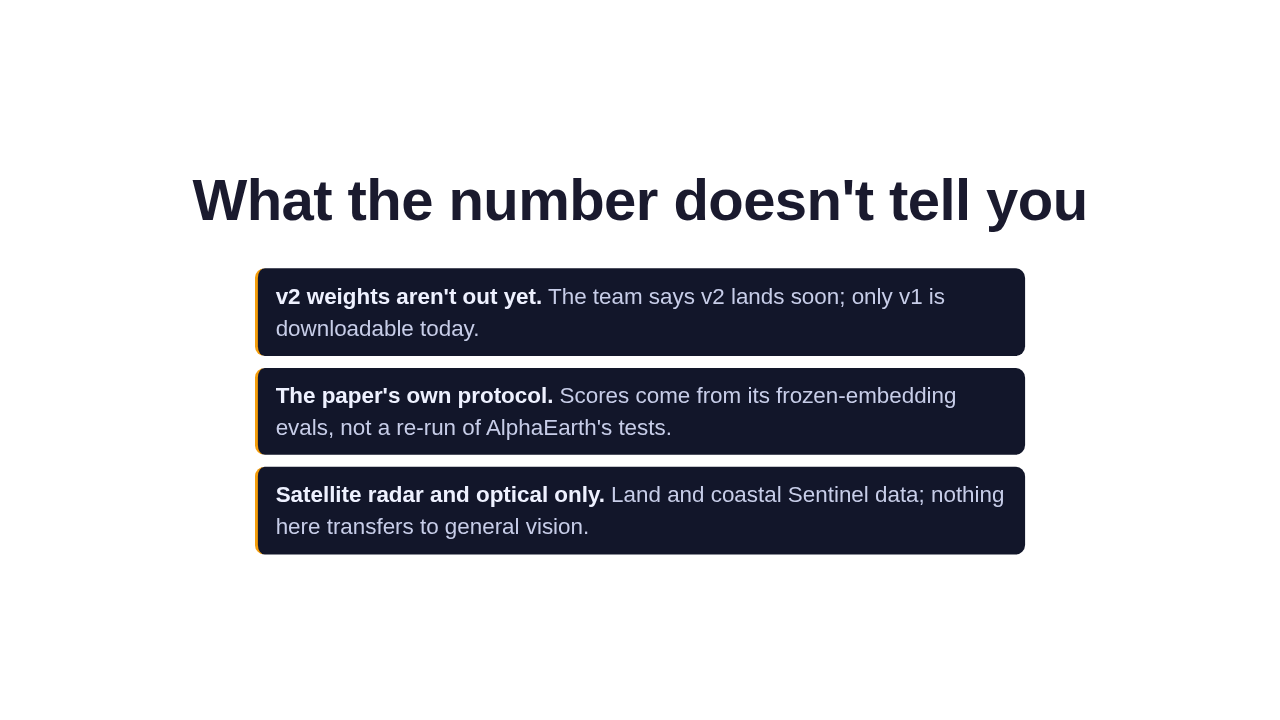
v2 weights aren't out yet. The team says v2 lands soon; only v1 is downloadable today.
The paper's own protocol. Scores come from its frozen-embedding evals, not a re-run of AlphaEarth's tests.
Satellite radar and optical only. Land and coastal Sentinel data; nothing here transfers to general vision.

Three honest caveats. The v2 weights aren't out yet. The team says v2 lands soon, but today you can only grab version one. The scores come from the paper's own protocol, not a re-run of Google's internal tests. And this is satellite radar and optical only. Nothing here transfers to general vision.

Read it now, run v2 soon

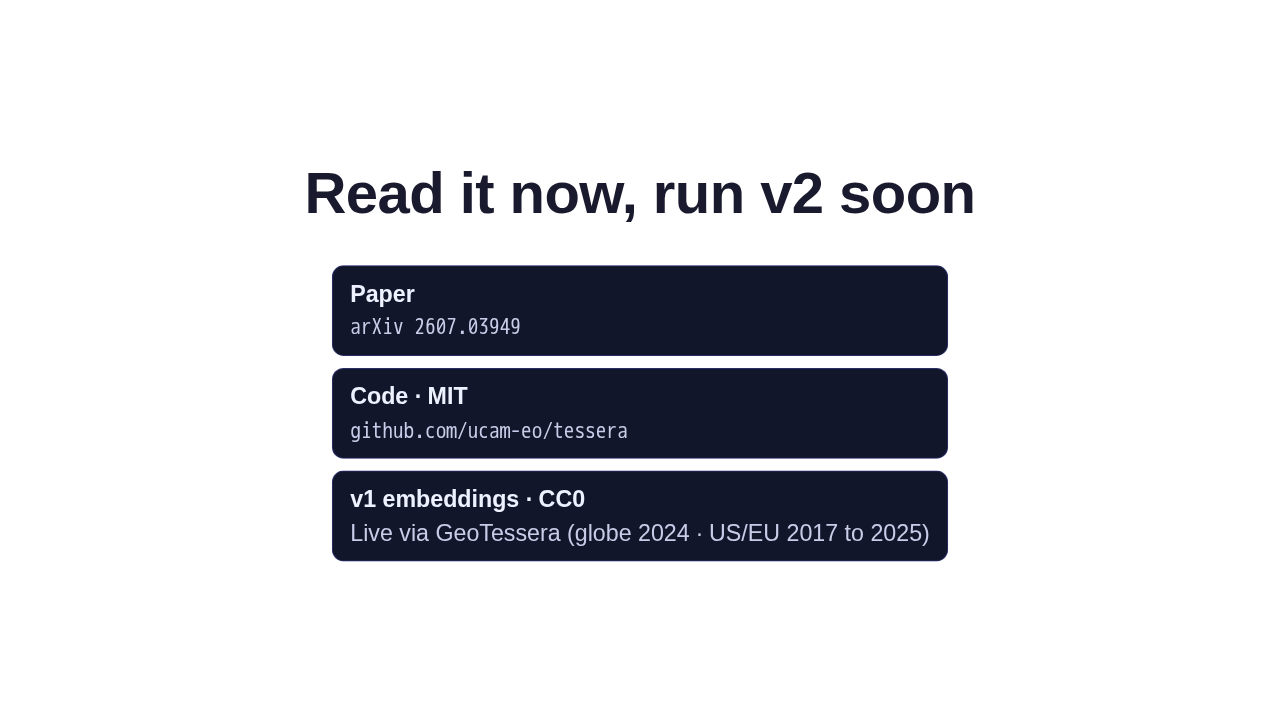
Paper arXiv 2607.03949
Code · MIT github.com/ucam-eo/tessera
v1 embeddings · CC0 Live via GeoTessera (globe 2024 · US/EU 2017 to 2025)

The paper's on arXiv today, and the code is MIT-licensed. Version one's embeddings are already free through GeoTessera, and the v2 weights land at the same repo when they're ready.

Slide 8

TESSERA v2
Optimize for the task you care about, not the number that's easy to watch.
arXiv 2607.03949 · github.com/ucam-eo/tessera

The lesson underneath the maps: optimize for the task you actually care about, not the number that's easy to watch. That's how twenty-one million parameters caught a Google flagship.


Up next

2:58

Apodex 1.1 mini · the same file, run alone and run as a team

@ai-ml-today · 1 month ago

3:09

Ornith-1.5 · an open model trained on problems it wrote for itself

@ai-ml-today · 1 month ago

3:08

MOSS-VL · an open 11B video model trained to decide, after every frame, whether to speak or stay silent

@ai-ml-today · 1 month ago

3:29

Qwen3.8-27B · a 27B open model anyone can download averages 84.3 across real desktop jobs on Qwen’s own run, and loses the widest row on its own card by nine points

@ai-ml-today · 1 month ago

3:15

MiLMMT-46-v1.0 · Xiaomi finished training an open translator on sentences that had no translation attached, and the scores it now leads on are produced by the two models that graded it

@ai-ml-today · 1 month ago

3:31

BDH-CQ — a 150M-parameter system that learns a puzzle rule from the worked examples in front of it and does its thinking as numbers, never as words

@ai-ml-today · 2 months ago

3:29

Muse Glimmer 30B, Meta’s open agent model, and the second tiny model that guesses sixteen words ahead so it runs fast on one consumer graphics card

@ai-ml-today · 2 months ago

3:05

JoyAI-Video-Edit, JD’s open 16B model that edits a video while the video is still playing, at about 30 frames a second on one Nvidia B200

@ai-ml-today · 2 months ago

3:26

Inkling-Small, Thinking Machines’ 12B-active / 276B open mixture-of-experts model that out-reasons its own 3.5× bigger flagship

@ai-ml-today · 2 months ago

3:42

Maple-Preview, DeepGrove’s 20-billion-parameter ternary reasoning model that runs on a Mac mini

@ai-ml-today · 2 months ago

3:16

Hunyuan3D-Buffalo, Tencent’s one model that builds, understands, and edits 3D from words

@ai-ml-today · 2 months ago

3:28

MiniMax H3, an open model that makes a video and its soundtrack in one pass

@ai-ml-today · 2 months ago









