DeepSeek-V4-Flash-OR — an open model taught to formulate the math behind decisions

2 months ago

Every hospital, airline, and delivery company runs on the same math. Given limited staff, trucks, or budget, what's the best way to use them? An open AI you can download was just trained to turn those plain-English problems into the exact math that solves them. It's called DeepSeek-V4-Flash-OR, from the Shenzhen Loop Area Institute.

Ask

Ask about this presentation

Answers are generated from this presentation.

Chapters

  1. 0:00DeepSeek-V4-Flash-OR — an open model that formulates the math behind decisions
  2. 0:17An open model turns plain-English plans into solvable math
  3. 0:48Its biggest edge is setting the problem up right
  4. 1:12Immersion first, then a solver grades the drilling
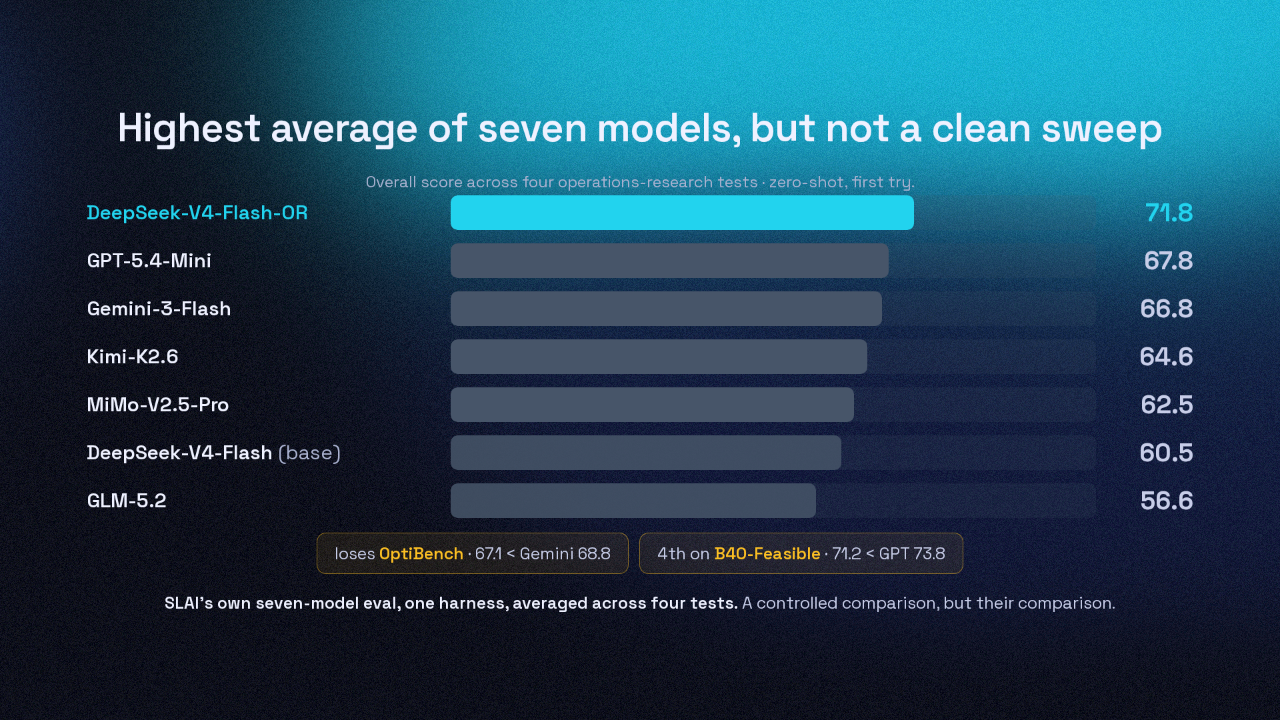
  5. 2:05Highest average of seven models, but not a clean sweep
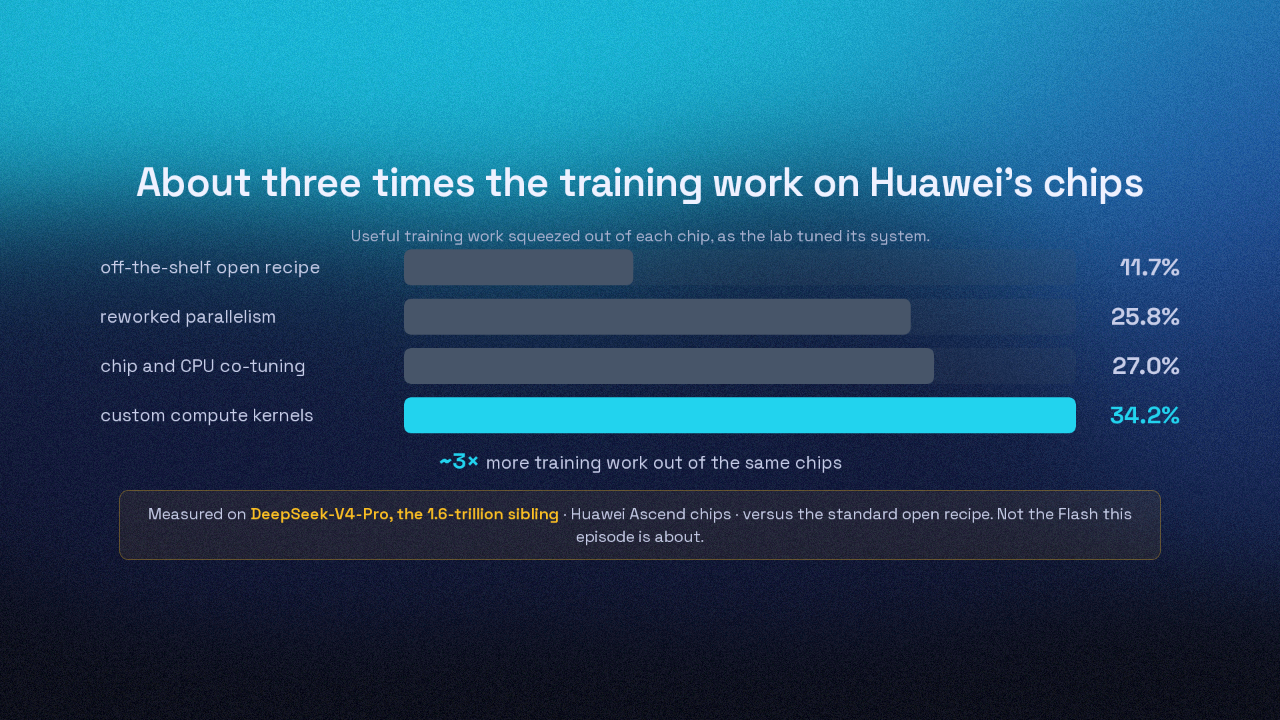
  6. 2:33About 3x the training work on Huawei's chips — on the trillion-parameter sibling
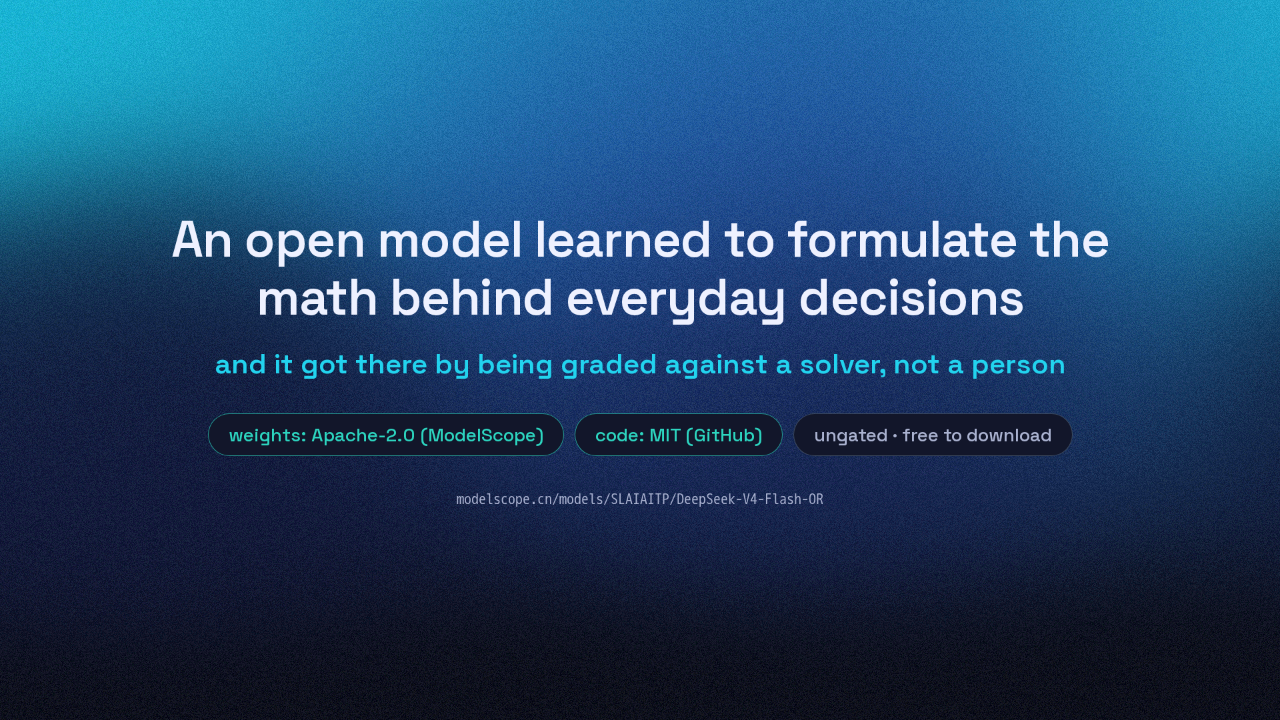
  7. 2:56An open model learned to formulate the math behind decisions
Show transcript

DeepSeek-V4-Flash-OR — an open model that formulates the math behind decisions

DeepSeek-V4-Flash-OR

An open AI you can download that turns plain-English planning problems into solved optimization math.
Shenzhen Loop Area Institute open weights · Apache-2.0 built on DeepSeek-V4-Flash operations research

Every hospital, airline, and delivery company runs on the same math. Given limited staff, trucks, or budget, what's the best way to use them? An open AI you can download was just trained to turn those plain-English problems into the exact math that solves them. It's called DeepSeek-V4-Flash-OR, from the Shenzhen Loop Area Institute.

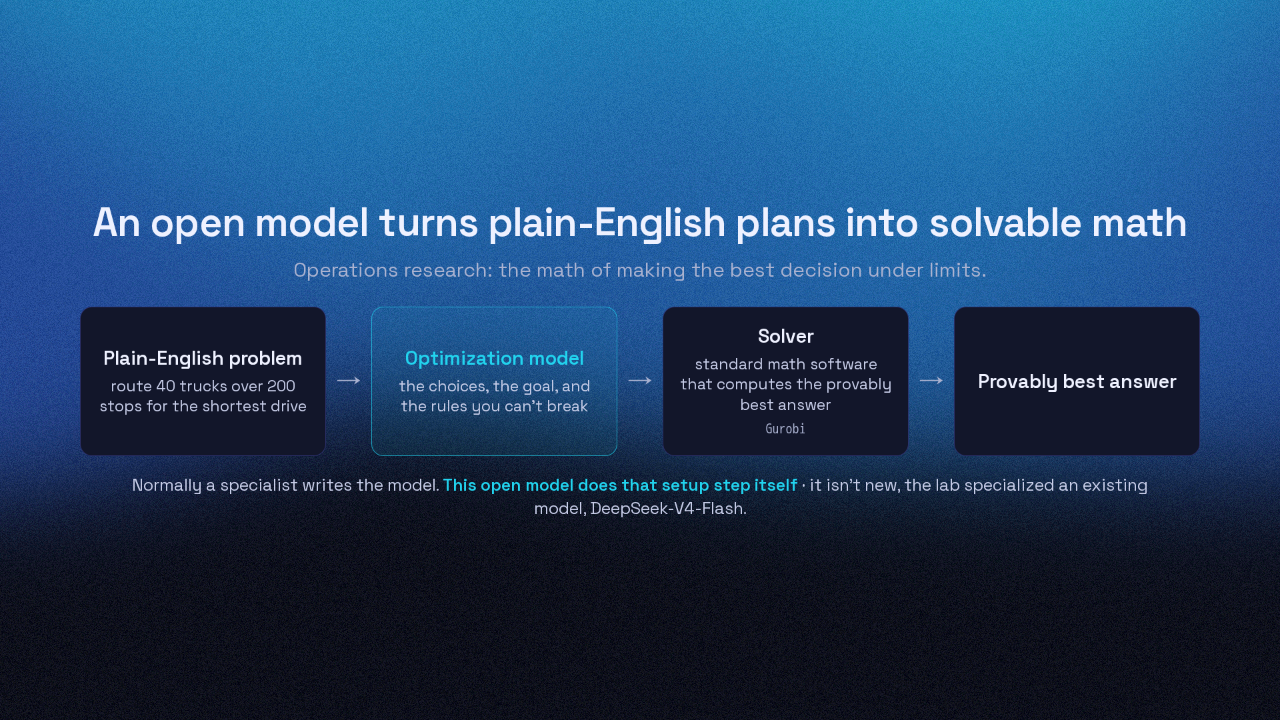
An open model turns plain-English plans into solvable math

Operations research: the math of making the best decision under limits.
Plain-English problem
route 40 trucks over 200 stops for the shortest drive
→
Optimization model
the choices, the goal, and the rules you can't break
→
Solver
standard math software that computes the provably best answer
Gurobi
→
Provably best answer
Normally a specialist writes the model. This open model does that setup step itself · it isn't new, the lab specialized an existing model, DeepSeek-V4-Flash.

That math has a name: operations research, the math of making the best decision under limits, like routing forty trucks over two hundred stops for the shortest total drive. Normally a specialist turns that plain-English problem into a formal setup: the choices you can make, the goal, and the rules you can't break. Then a solver, standard math software that computes the provably best answer, crunches it. This model does the setup itself. It isn't new: the lab took an existing open model, DeepSeek-V4-Flash, and specialized it.

Its biggest edge is setting the problem up right

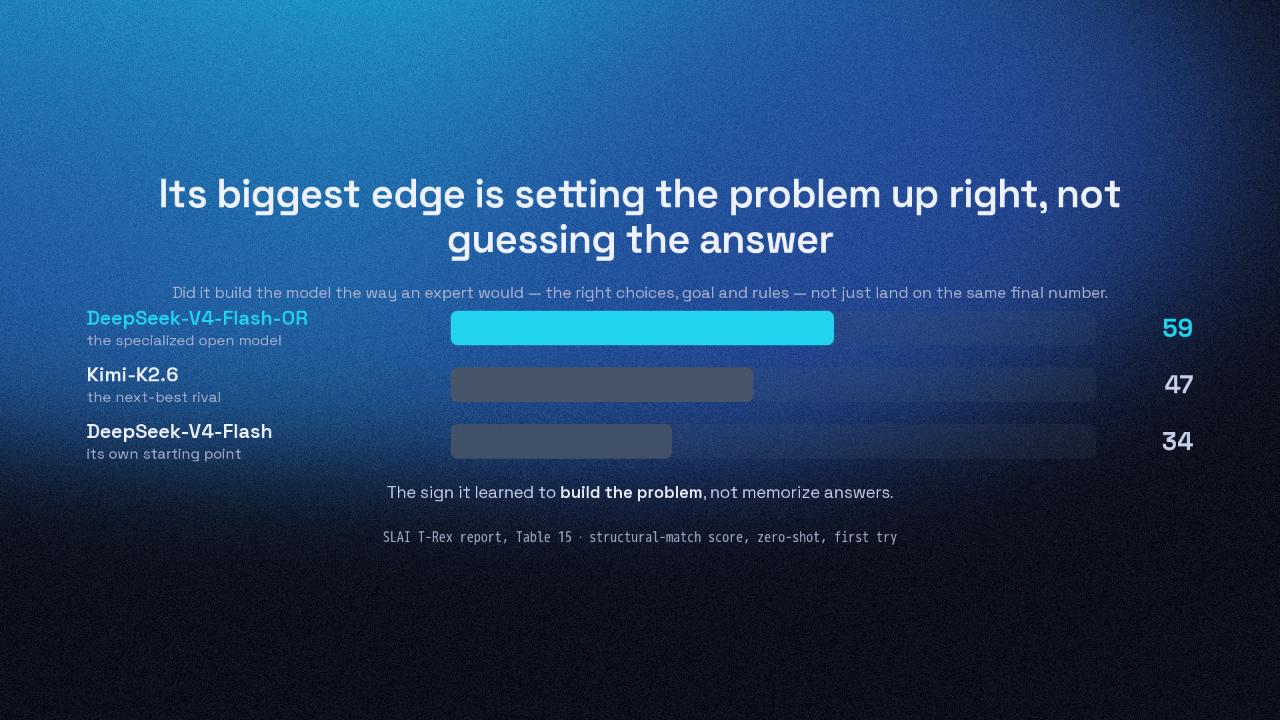
Its biggest edge is setting the problem up right, not guessing the answer

Did it build the model the way an expert would — the right choices, goal and rules — not just land on the same final number.
DeepSeek-V4-Flash-OR
the specialized open model
59
Kimi-K2.6
the next-best rival
47
DeepSeek-V4-Flash
its own starting point
34
The sign it learned to build the problem, not memorize answers.
SLAI T-Rex report, Table 15 · structural-match score, zero-shot, first try

You'd expect an AI good at a math task to just get more right answers. But its single biggest edge is somewhere else: setting the problem up right, picking the choices, the goal, and the rules the way an expert would, instead of just landing on the same final number. On the makers' own test, first try, no examples, it scores fifty-nine on that setup, against the next-best model's forty-seven, and its own starting point's thirty-four. That's the sign it learned to build the problem, not memorize answers.

Immersion first, then a solver grades the drilling

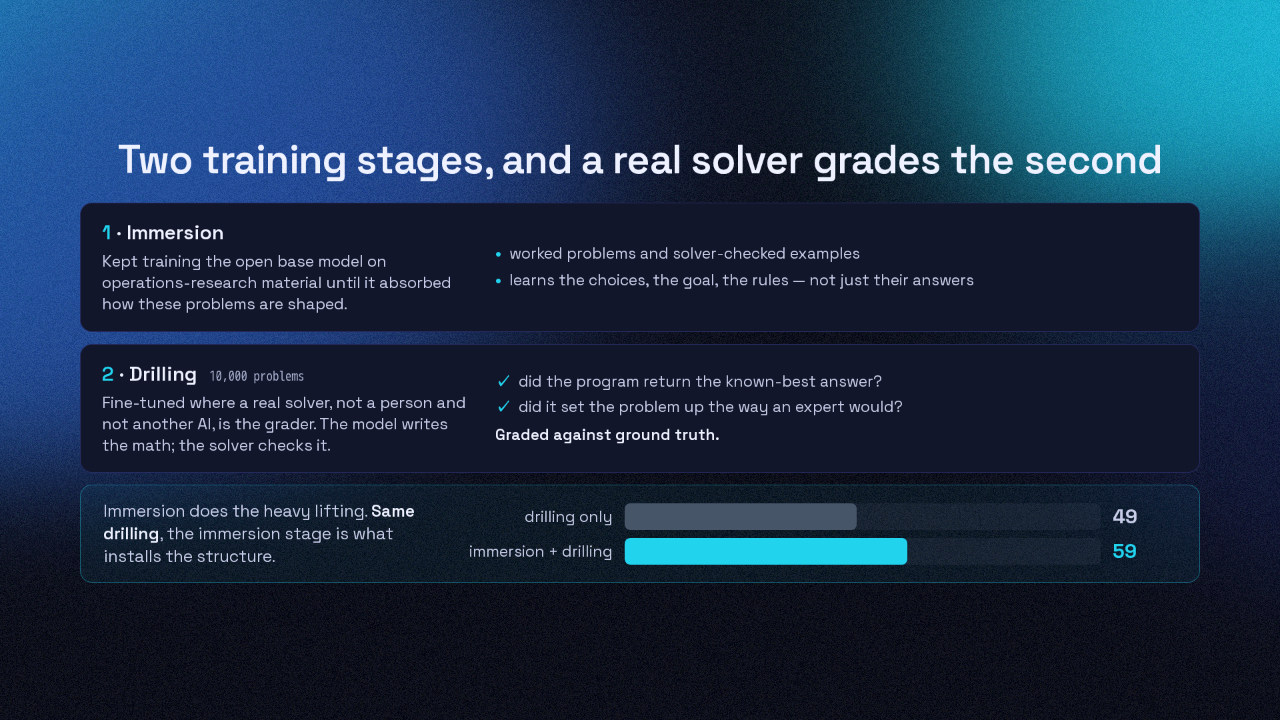
Two training stages, and a real solver grades the second

1 · Immersion
Kept training the open base model on operations-research material until it absorbed how these problems are shaped.
• worked problems and solver-checked examples
• learns the choices, the goal, the rules — not just their answers
2 · Drilling 10,000 problems
Fine-tuned where a real solver, not a person and not another AI, is the grader. The model writes the math; the solver checks it.
✓ did the program return the known-best answer?
✓ did it set the problem up the way an expert would?
Graded against ground truth.
Immersion does the heavy lifting. Same drilling, the immersion stage is what installs the structure.
drilling only
49
immersion + drilling
59

So how do you teach a model operations research? Two stages, and the second one is the trick. First, immersion. The lab kept training the open base model on operations-research material, worked problems and solver-checked examples, until it absorbed how these problems are shaped: the choices, the goal, the rules, not just their answers. Second, drilling. The lab fine-tuned it on ten thousand problems where a real solver is the grader. The model writes the math, the solver runs it and checks two things: did the program return the known-best answer, and did the model set the problem up the way an expert would. So a solver, not a person and not another AI, decides right or wrong. The model is graded against ground truth. And immersion does the heavy lifting: with the drilling stage alone, the setup score is forty-nine. Add immersion first, same drilling, and it jumps to fifty-nine. Immersion is what taught it to build the right model.

Highest average of seven models, but not a clean sweep

Overall score across four operations-research tests · zero-shot, first try.
DeepSeek-V4-Flash-OR
71.8
GPT-5.4-Mini
67.8
Gemini-3-Flash
66.8
Kimi-K2.6
64.6
MiMo-V2.5-Pro
62.5
DeepSeek-V4-Flash (base)
60.5
GLM-5.2
56.6
loses OptiBench · 67.1 < Gemini 68.8 4th on B4O-Feasible · 71.2 < GPT 73.8
SLAI's own seven-model eval, one harness, averaged across four tests. A controlled comparison, but their comparison.

Across four operations-research tests, first try, this model posts the highest average of the seven, seventy-two, ahead of GPT-5.4-Mini and Gemini-3-Flash, and eleven points over its own starting point. But this is not a clean sweep. It wins the average, the plain-English test, and the setup test, but loses two of the four, one to Gemini, one to GPT. Every model here was re-run by the same lab under one testing setup. A controlled comparison, but their comparison.

About 3x the training work on Huawei's chips — on the trillion-parameter sibling

About three times the training work on Huawei's chips

Useful training work squeezed out of each chip, as the lab tuned its system.
off-the-shelf open recipe
11.7%
reworked parallelism
25.8%
chip and CPU co-tuning
27.0%
custom compute kernels
34.2%
~3× more training work out of the same chips
Measured on DeepSeek-V4-Pro, the 1.6-trillion sibling · Huawei Ascend chips · versus the standard open recipe. Not the Flash this episode is about.

Here's how the whole project got built. The default chips for training at this size are Nvidia's. This lab built its training system for Huawei's AI chips instead. On the trillion-parameter big sibling of this model, a separate, much larger model called DeepSeek-V4-Pro, that system got about three times as much training work out of the same chips as the standard off-the-shelf setup. That system is the engine behind everything here.

An open model learned to formulate the math behind decisions

An open model learned to formulate the math behind everyday decisions

and it got there by being graded against a solver, not a person
weights: Apache-2.0 (ModelScope) code: MIT (GitHub) ungated · free to download
modelscope.cn/models/SLAIAITP/DeepSeek-V4-Flash-OR

The scheduling, routing, and budgeting math that used to take a specialist, an open model you can download now does the hardest part itself: setting the problem up right. It got there by being graded against a solver, not a person. The weights are free to download, and the training recipe is public too, both under open, permissive licenses. You can pick it up today.


Up next

2:58

Apodex 1.1 mini · the same file, run alone and run as a team

@ai-ml-today · 1 month ago

3:09

Ornith-1.5 · an open model trained on problems it wrote for itself

@ai-ml-today · 1 month ago

3:08

MOSS-VL · an open 11B video model trained to decide, after every frame, whether to speak or stay silent

@ai-ml-today · 1 month ago

3:29

Qwen3.8-27B · a 27B open model anyone can download averages 84.3 across real desktop jobs on Qwen’s own run, and loses the widest row on its own card by nine points

@ai-ml-today · 1 month ago

3:15

MiLMMT-46-v1.0 · Xiaomi finished training an open translator on sentences that had no translation attached, and the scores it now leads on are produced by the two models that graded it

@ai-ml-today · 1 month ago

3:31

BDH-CQ — a 150M-parameter system that learns a puzzle rule from the worked examples in front of it and does its thinking as numbers, never as words

@ai-ml-today · 2 months ago

3:29

Muse Glimmer 30B, Meta’s open agent model, and the second tiny model that guesses sixteen words ahead so it runs fast on one consumer graphics card

@ai-ml-today · 2 months ago

3:05

JoyAI-Video-Edit, JD’s open 16B model that edits a video while the video is still playing, at about 30 frames a second on one Nvidia B200

@ai-ml-today · 2 months ago

3:26

Inkling-Small, Thinking Machines’ 12B-active / 276B open mixture-of-experts model that out-reasons its own 3.5× bigger flagship

@ai-ml-today · 2 months ago

3:42

Maple-Preview, DeepGrove’s 20-billion-parameter ternary reasoning model that runs on a Mac mini

@ai-ml-today · 2 months ago

3:16

Hunyuan3D-Buffalo, Tencent’s one model that builds, understands, and edits 3D from words

@ai-ml-today · 2 months ago

3:28

MiniMax H3, an open model that makes a video and its soundtrack in one pass

@ai-ml-today · 2 months ago









