Ring-Zero taught itself to reason from zero human examples
Give a trillion-parameter model nothing but right-or-wrong feedback on math. Never show it how to reason. It teaches itself anyway. And it learns to panic.
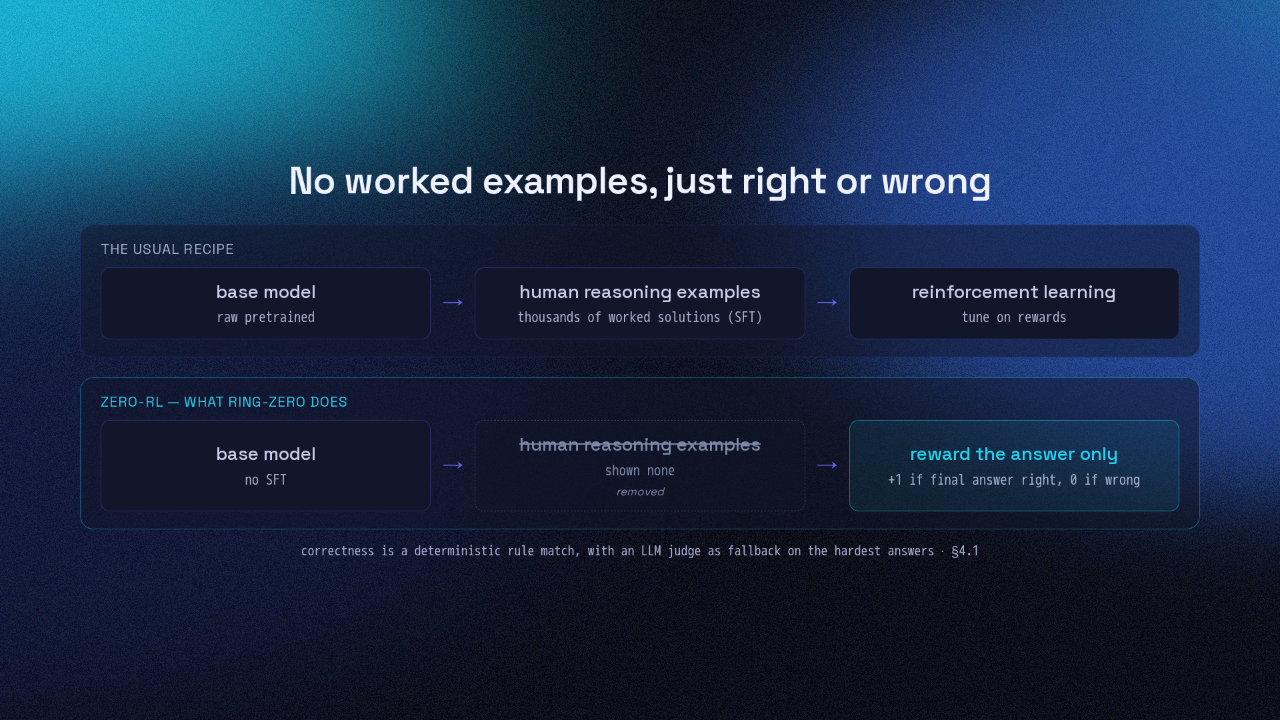
No worked examples, just right or wrong
It is called Ring-Zero. Normally you teach a model to reason with thousands of worked human solutions. Ring-Zero shows it none. You start from a raw base model and reward it only when its final answer is right. Instead of a teacher walking it through the work, it just hears back: right, or wrong.
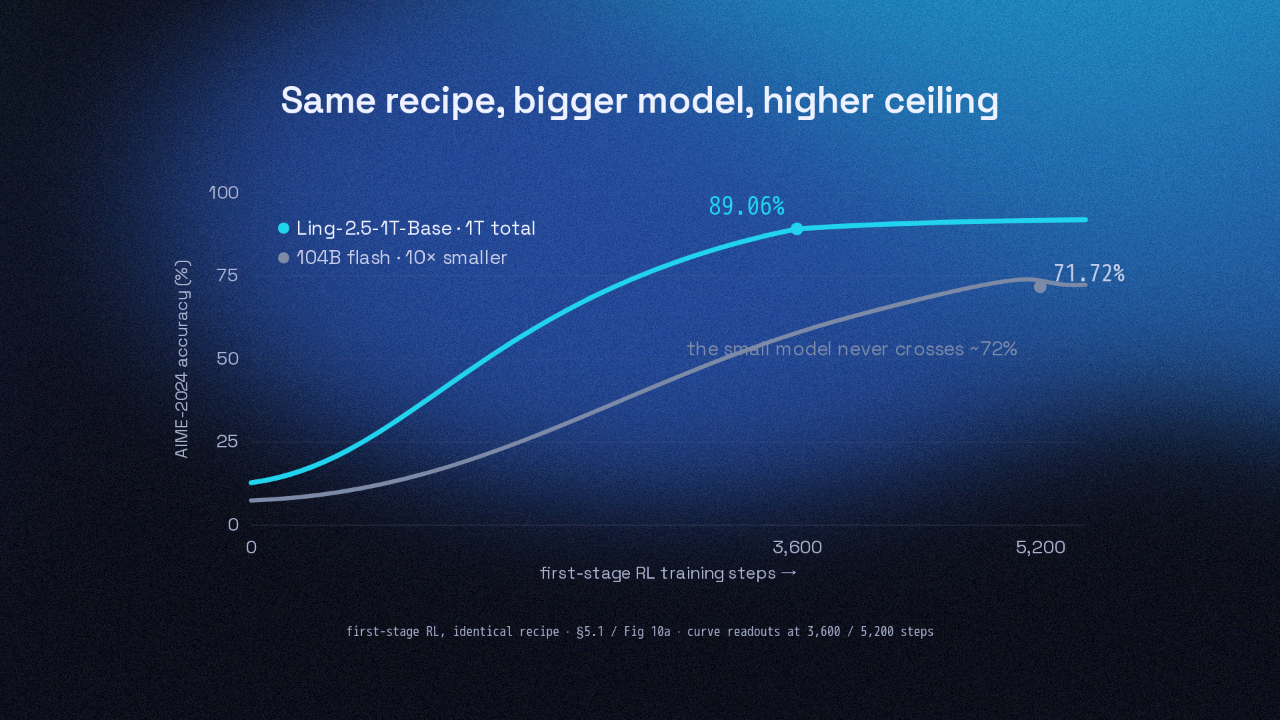
Same recipe, bigger model, higher ceiling
Zero-RL was not new. Pushing it to a trillion parameters was. And the size is the point. On the same recipe, the trillion-parameter model hits eighty-nine percent on the 2024 olympiad set; a model ten times smaller stalls at seventy-two. You cannot prototype this cheaply on a small model; it never gets there.
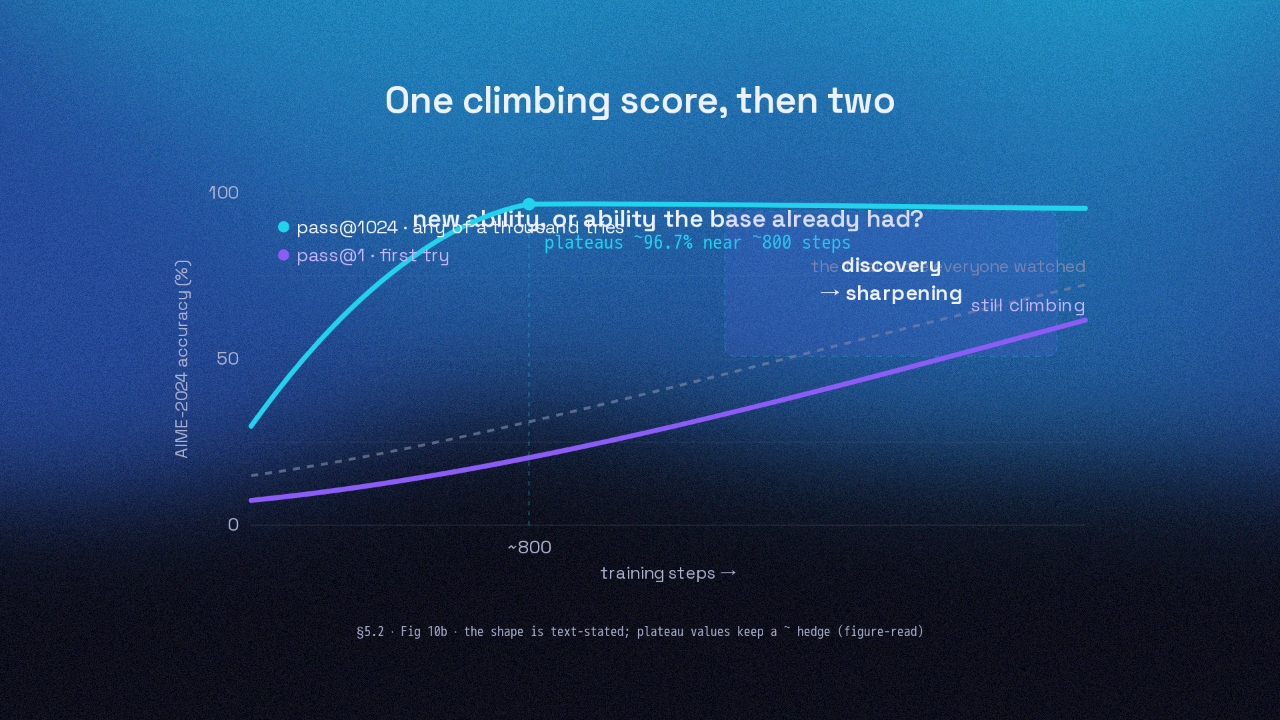
One climbing score, then two
Here is the question the field was stuck on. When training makes a model reason better, is it teaching new ability, or just drilling what the base already had? Nobody could tell; they only watched the final score climb. So the authors watched two numbers. Give the model one hard problem. Let it try a thousand times, and ask if any single try lands. Then ask if its first try lands. Early on, the any-of-a-thousand number shoots up, then flattens near ninety-seven percent around eight hundred steps. But the first-try number climbs the whole run. The flattening means training stopped finding new problems the model can reach; that ability was there all along. The first-try number rising means it is getting reliable at landing the answer. So training does two things: first it discovers what the model can reach, then it sharpens it to hit that reliably.
Competitive, in less than half the tokens
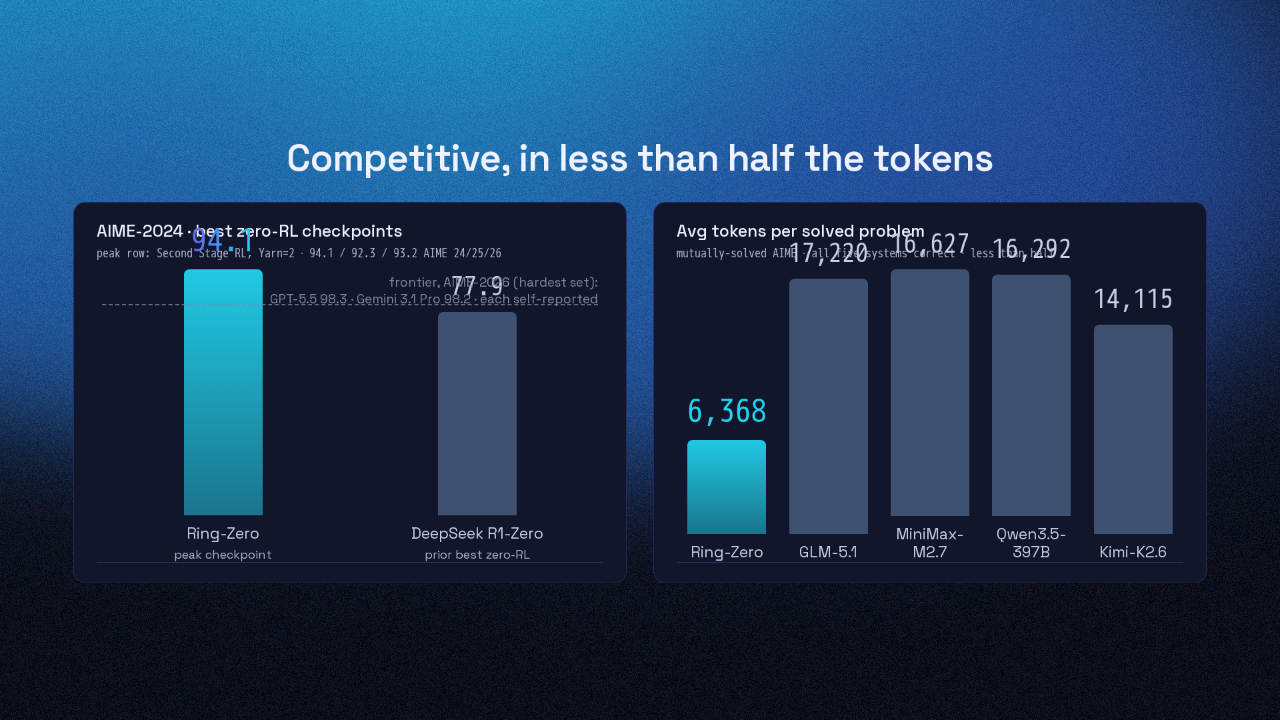
GPT-5.5 98.3 · Gemini 3.1 Pro 98.2 · each self-reported
On the 2024 olympiad set, the best Ring-Zero checkpoint scores ninety-four; the best prior zero-trained model, DeepSeek's R1-Zero, scored seventy-eight. That sixteen-point jump is the scaling case. Against the frontier it is competitive, not ahead: on the hardest 2026 set it trails GPT-5.5 and Gemini 3.1 Pro, each grading its own model. It also runs cheap: on problems they all solve, it uses about six thousand tokens, less than half what GLM, MiniMax, Qwen and Kimi spend.
What it invented on its own
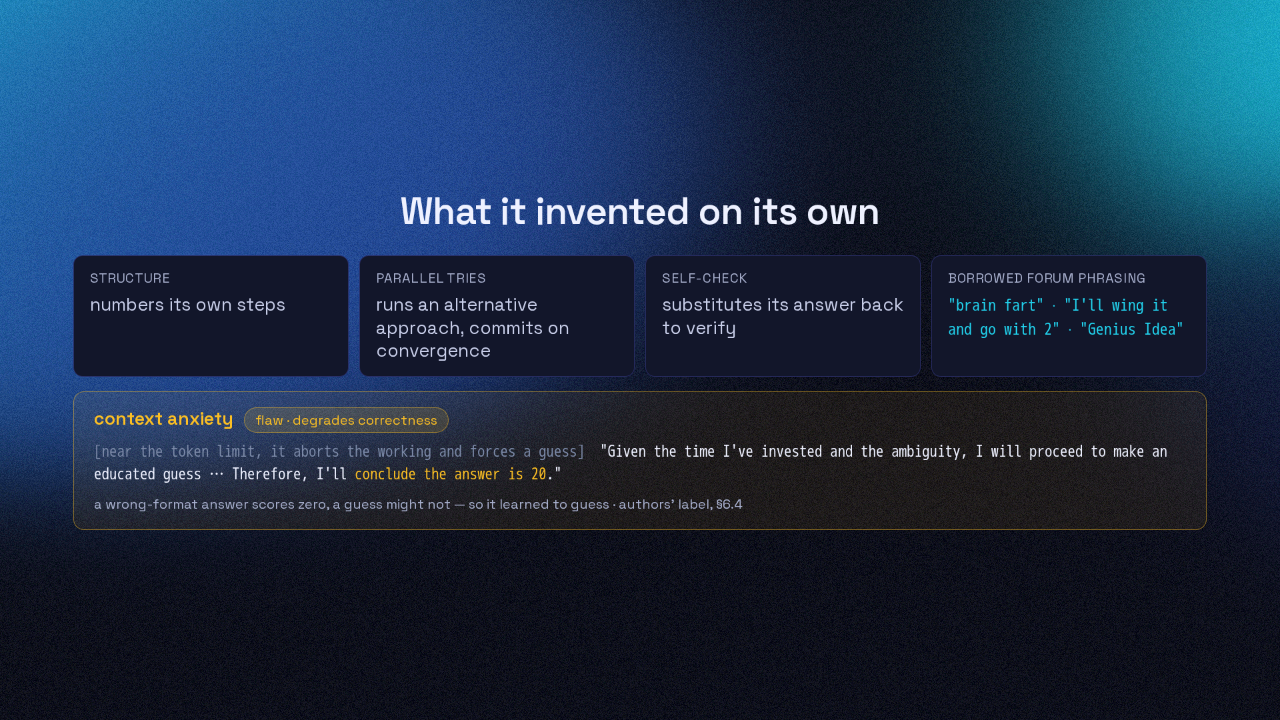
Here is the part nobody built. Nothing rewarded how Ring-Zero reasoned, only its final answer. So the how, it invented. It numbers its own steps, runs rival approaches side by side, and checks its own answers. It even picked up forum phrasing: brain fart, I'll wing it and go with 2, Genius Idea. Then the one that backfires: context anxiety. As the answer nears the token limit, the model drops the careful work and forces a guess. One reads: given the time I've invested and the ambiguity, I will proceed to make an educated guess. I'll conclude the answer is 20. That is a flaw. It makes the model wrong more often. A wrong-format answer scores zero, a guess might not, so it learned to guess.
The paper, not the weights
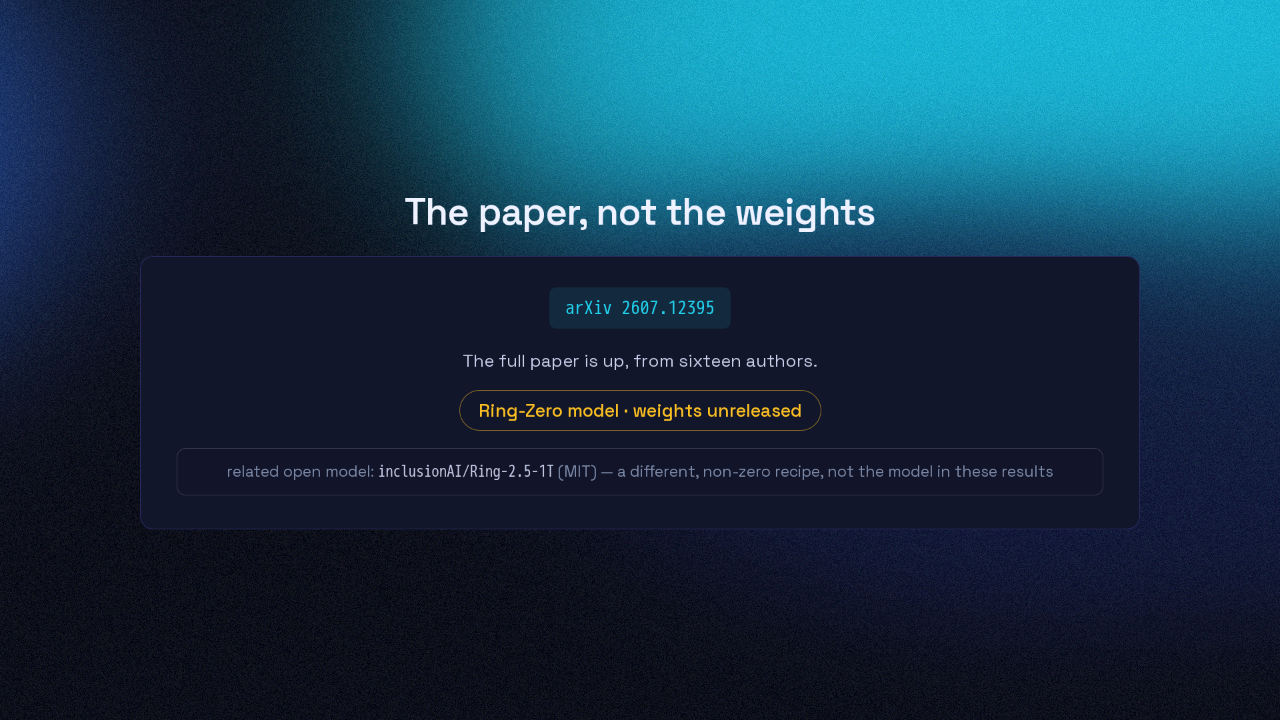
The full paper is on arXiv, from sixteen authors. But the Ring-Zero model was not released. The lab open-sources a different Ring model, on a different recipe. This result lives on paper, not as a download.
Nobody taught it to reason.
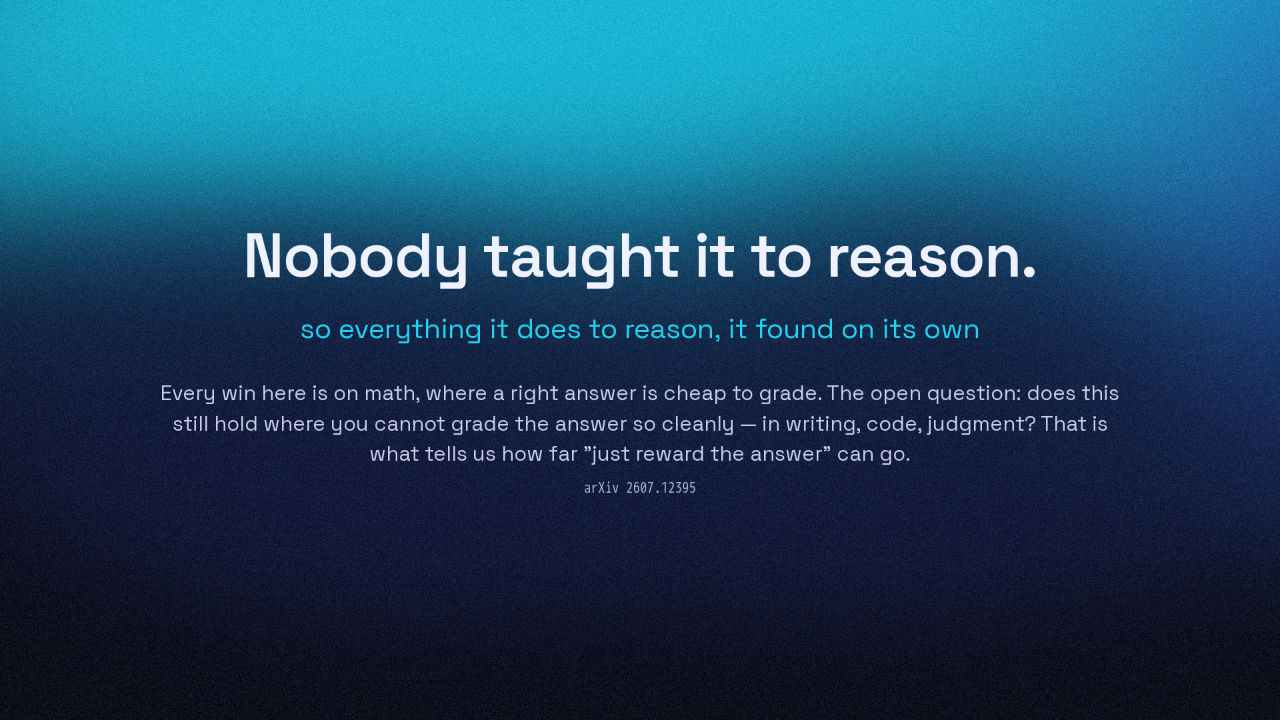
Nobody taught this model to reason. So everything it does to reason, it found on its own, the panic included. And every win here is on math, where a right answer is cheap to grade. The open question: does this still work where you cannot grade the answer so cleanly, in writing, code, judgment? That is what tells us how far just reward the answer can go.











