Muse Glimmer 30B, Meta’s open agent model, and the second tiny model that guesses sixteen words ahead so it runs fast on one consumer graphics card

2 months ago

Ask an AI a question and it types the answer one word at a time. Meta just released Muse Glimmer, an open model that gets around that by guessing ahead.

Ask

Ask about this presentation

Answers are generated from this presentation.

Chapters

  1. 0:00Muse Glimmer 30B
  2. 0:09Meta squeezed a 30B model down to fit a 24 GB card
  3. 0:34It wins at using tools and loses at driving a desktop
  4. 1:05The second model fills sixteen blanks in one pass
  5. 1:27The big model checks all sixteen guesses in one pass
  6. 1:56The guesser reads five snapshots from inside the big model
  7. 2:333.1 times on an RTX 5090
  8. 3:09Every word still has to pass the big model
Show transcript

Muse Glimmer 30B

A second model guesses sixteen words ahead so this one runs on one graphics card.
Meta Apache-2.0 · ungated text and images in, text out about 30B parameters

Ask an AI a question and it types the answer one word at a time. Meta just released Muse Glimmer, an open model that gets around that by guessing ahead.

Meta squeezed a 30B model down to fit a 24 GB card

Meta’s last open weights language model shipped April 2025
the same thirty billion parameters
over 55 GB
at full size
→
under 20 GB
each number squeezed
to about 4 bits
what shares one 24 GB graphics card
the model 16.76 GB
the guesser 1.63 GB
the part that reads images 1.40 GB
about 4 GB of headroom left for the model’s working memory
Meta’s figures · 1.0% average drop across 15 benchmarks on the 24 GB build · 0.2% on the 32 GB build
Meta, Muse Glimmer launch post and model card.

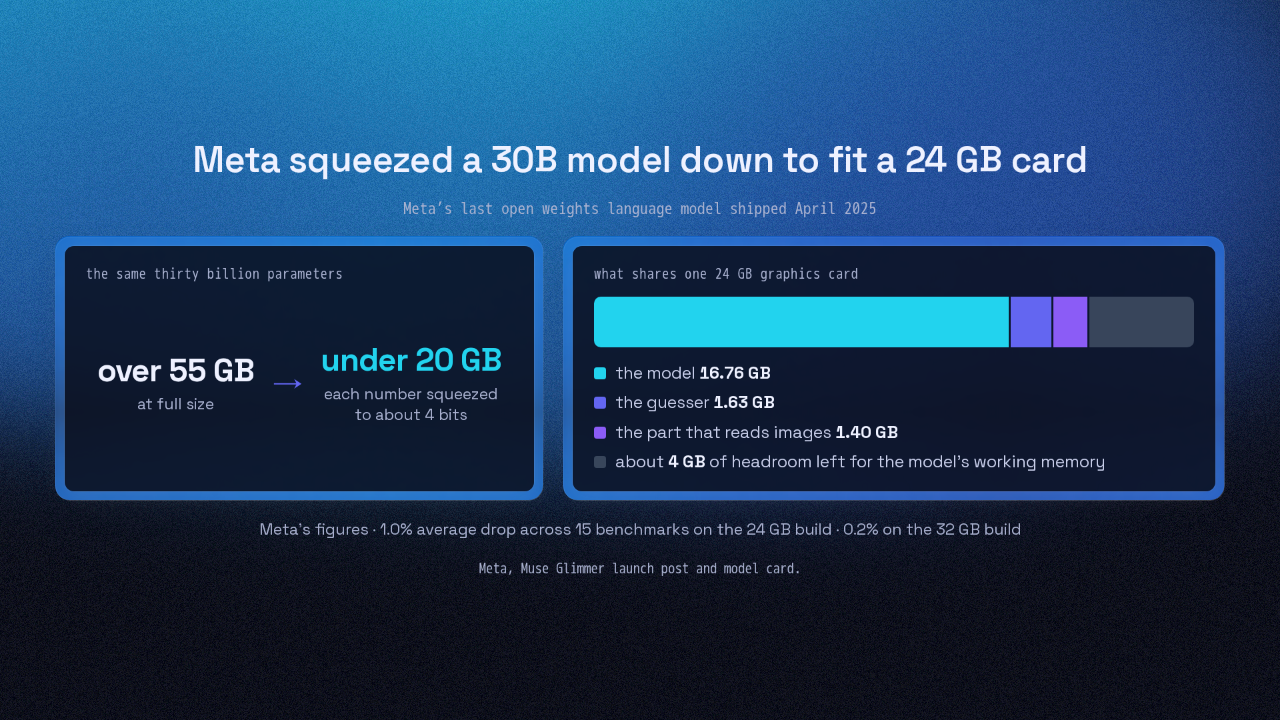
Muse Glimmer is Meta's first open weights language model since April of last year. Its thirty billion parameters, the numbers it learned in training, would need over fifty-five gigabytes of memory at full size. That is more than any graphics card a person can buy. So Meta squeezed each number to about four bits, which puts the model under twenty gigabytes. On a twenty-four gigabyte card that leaves room for its working memory, the part that reads images, and a second model that guesses.

It wins at using tools and loses at driving a desktop

Muse Glimmer 30B Qwen 3.6 27B Gemma 4 31B
Across 22 comparable tests, 12 go to Muse Glimmer and 10 go to a rival
Using outside tools MCP Atlas
Muse Glimmer75.5
Qwen 3.662.5
Gemma 454.2
Research browsing DeepSearch QA
Muse Glimmer74.6
Qwen 3.671.1
Gemma 461.7
Long documents AA-LCR
Muse Glimmer80.0
Qwen 3.673.3
Gemma 468.3
Driving a desktop OSWorld
Muse Glimmer65.9
Qwen 3.675.6
Command line TerminalBench 2.1
Muse Glimmer51.7
Qwen 3.660.7
Meta’s table, rivals run in thinking mode and given their best published scores · long documents and command line measured by Artificial Analysis, the other three by Meta
Artificial Analysis rates it 35 on its own index · Qwen 38 · Gemma 30

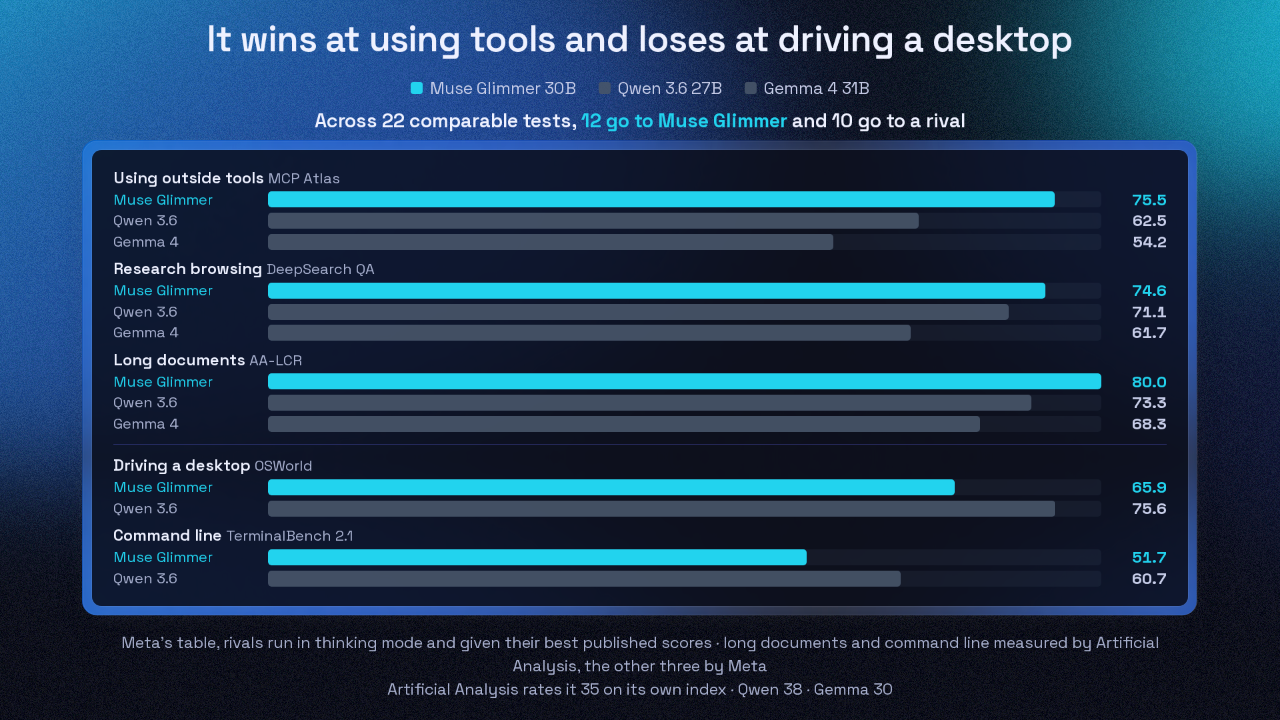
Meta ran Muse Glimmer against two rival open models its own size, Google's Gemma four and Alibaba's Qwen three point six. Across twenty-two tests, Muse Glimmer wins twelve and loses ten. The wins cluster in one place: using outside tools, searching, and long documents. The losses cluster in another, and both go to Qwen: driving a desktop, and working at a command line. That is Meta's own table, and Meta gave each rival its best published score. Artificial Analysis, the outside firm that measured eight of those rows, puts Muse Glimmer at thirty-five overall, just behind Qwen at thirty-eight.

The second model fills sixteen blanks in one pass

config.json, as shipped
num_hidden_layers: 5five layers deep
block_size: 16sixteen blanks per guess
mask_token_id: 201818the marker for a blank
safetensors index
2,555,985,152 parametersabout a twelfth the size of the big model
sixteen empty slots, filled in one pass
meta-models/Muse-Glimmer-30B-assistant, config.json.

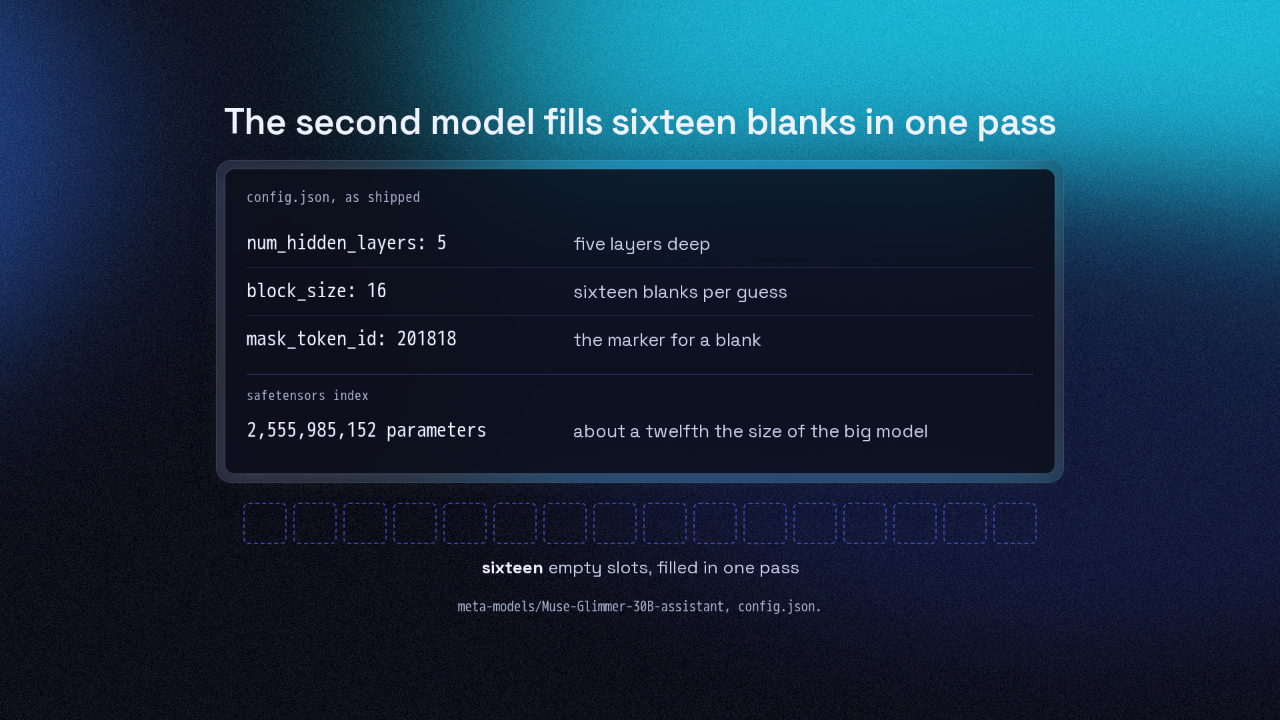
That second model ships in its own repository. It carries two and a half billion parameters across five layers, about a twelfth the size of the big one. It has one job: guess what the big model is about to say. And it guesses a block at a time. It lays down sixteen empty slots and fills every one of them in a single pass. Sixteen is what ships in the file, and what Meta measured.

The big model checks all sixteen guesses in one pass

one trip through the big model’s memory
1 word out
16 words out
the guesserfills the block
the big modelgrades the block
kept corrected dropped one block, drawn as an example · how much of a block holds varies by prompt
Meta, Muse Glimmer model card · arXiv 2602.06036, section 4.1.

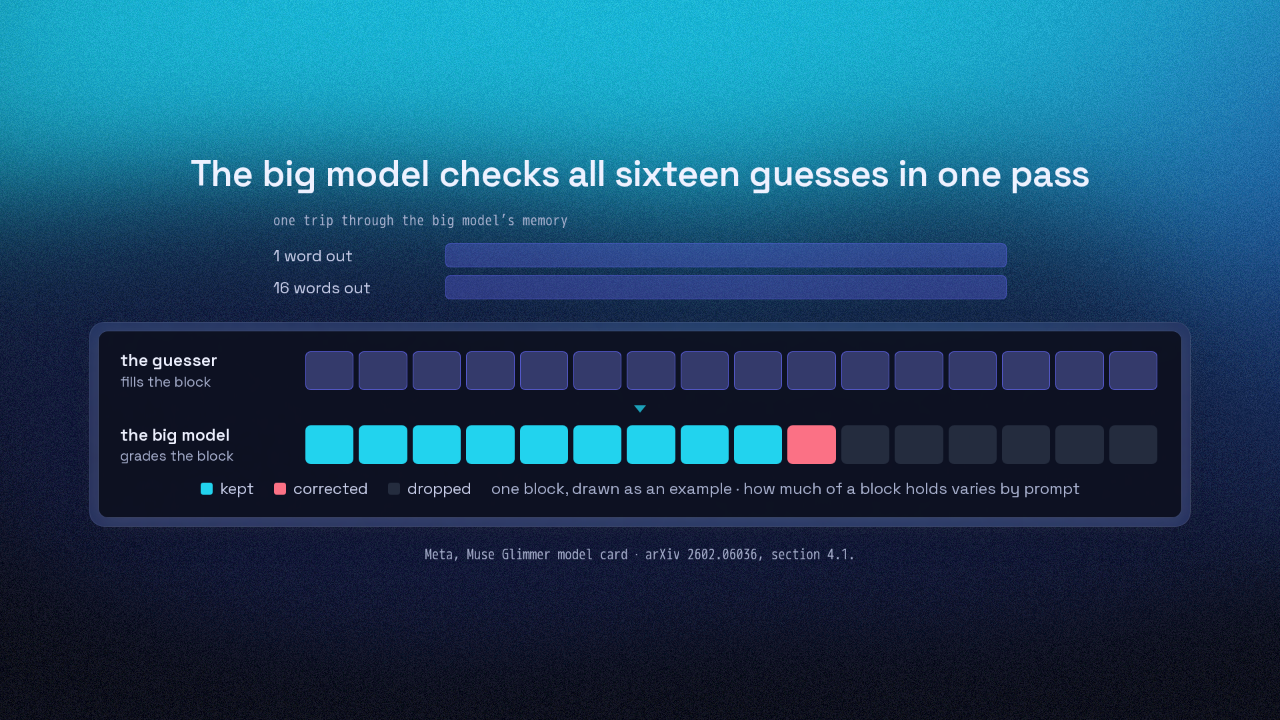
To produce a single word, the graphics card pulls the whole model through its memory. Its arithmetic sits waiting for most of that trip. Checking sixteen words costs the card barely more than checking one. So the guesser hands over sixteen words at once. The big model then grades the whole block at once. It keeps the run of words it agrees with, corrects the first word it disagrees with, and carries on. Every word that survives is a word the big model approved. So you read the answer the big model would have given on its own. A bad guess costs a little time and leaves that answer alone.

The guesser reads five snapshots from inside the big model

the big model · 52 layers
113253749
one summary of what the big model is thinking
layer 1layer 2layer 3layer 4layer 5
the guesser · 5 layers
target_layer_ids: [1, 13, 25, 37, 49] of 52 layers · shipped config.json
one pass through the guesser
1 word guessed
16 words guessed

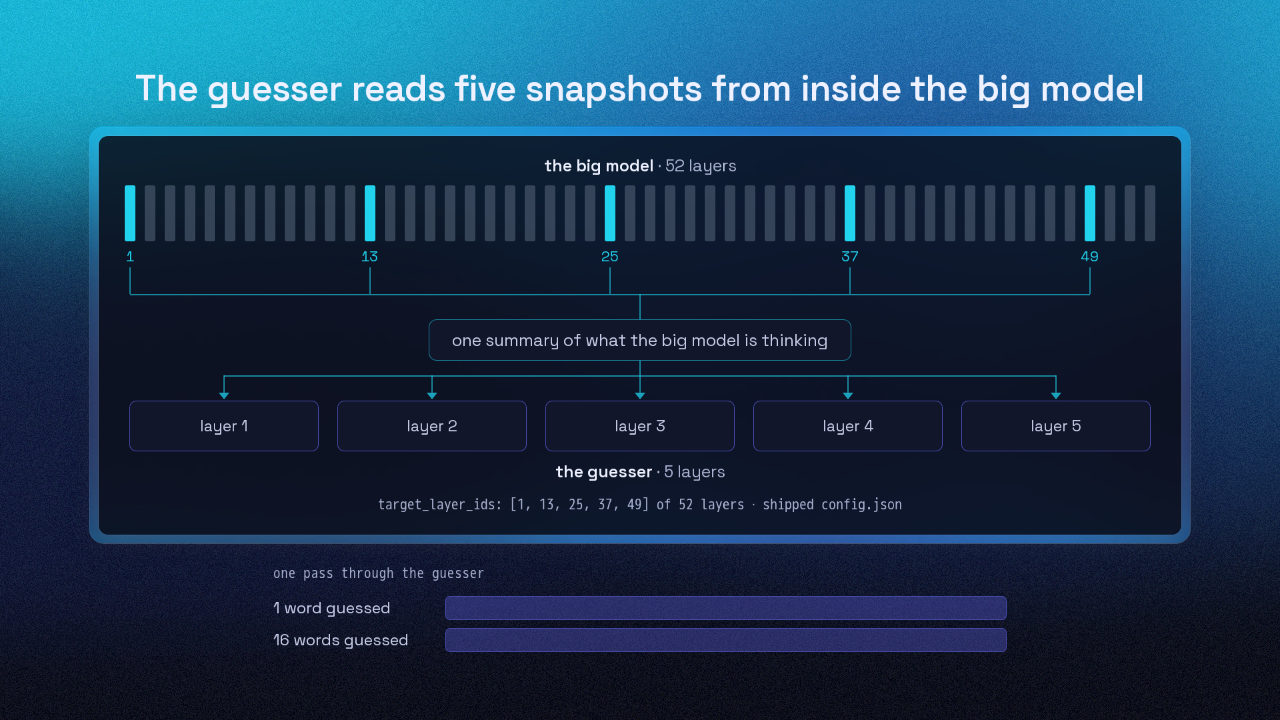
A guesser working from the words alone has to predict the future from scratch, and it guesses badly. The researchers who designed this one trained exactly that version, a five-layer guesser with no window into the big model, and they call its speedups modest. So Muse Glimmer wires the guesser into the big model's insides. While the big model reads your question, Muse Glimmer taps a summary of what that model is thinking from five of its fifty-two layers. That summary goes into the working memory of every layer of the guesser. Guessing a block of sixteen costs about what guessing one word costs. So the guesser can afford to be deeper, and depth is what makes its guesses good enough to keep.

3.1 times on an RTX 5090

3.1× on an RTX 5090. 1.5 to 1.8× on a Mac.

tokens per second, roughly words per second
Nvidia RTX 5090llama.cpp3.1×
before74.9
with the guesser233.4
Apple M5 MaxExecuTorch1.8×
before26.6
with the guesser50.2
Apple M4 MaxExecuTorch1.5×
before23.7
with the guesser37.8
Meta’s measurements · 24 GB build · batch size 1 · greedy decoding · llama.cpp on Nvidia, ExecuTorch on Apple

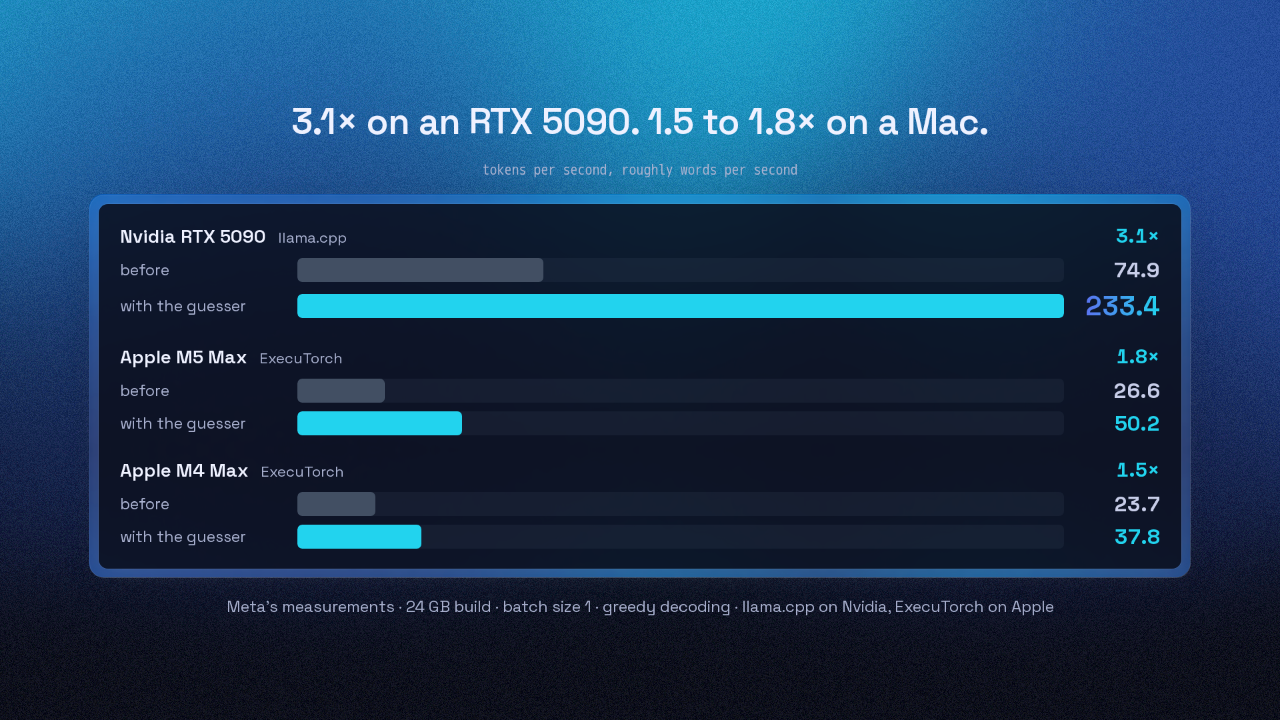
A token is a chunk of text about the size of a word. On an RTX five thousand ninety, a two thousand dollar Nvidia graphics card, Muse Glimmer goes from about seventy-five tokens a second to two hundred and thirty-three. Same answer, three point one times quicker. On Apple laptops Meta measured smaller gains on different software. One point eight times on an M five Max, one and a half on an M four Max. All of it is Meta's own measurement, one request at a time. AMD has published its own hands-on numbers, up to fifty-three tokens a second on a Radeon card. The before and after pair the three point one is made of, only Meta has published.

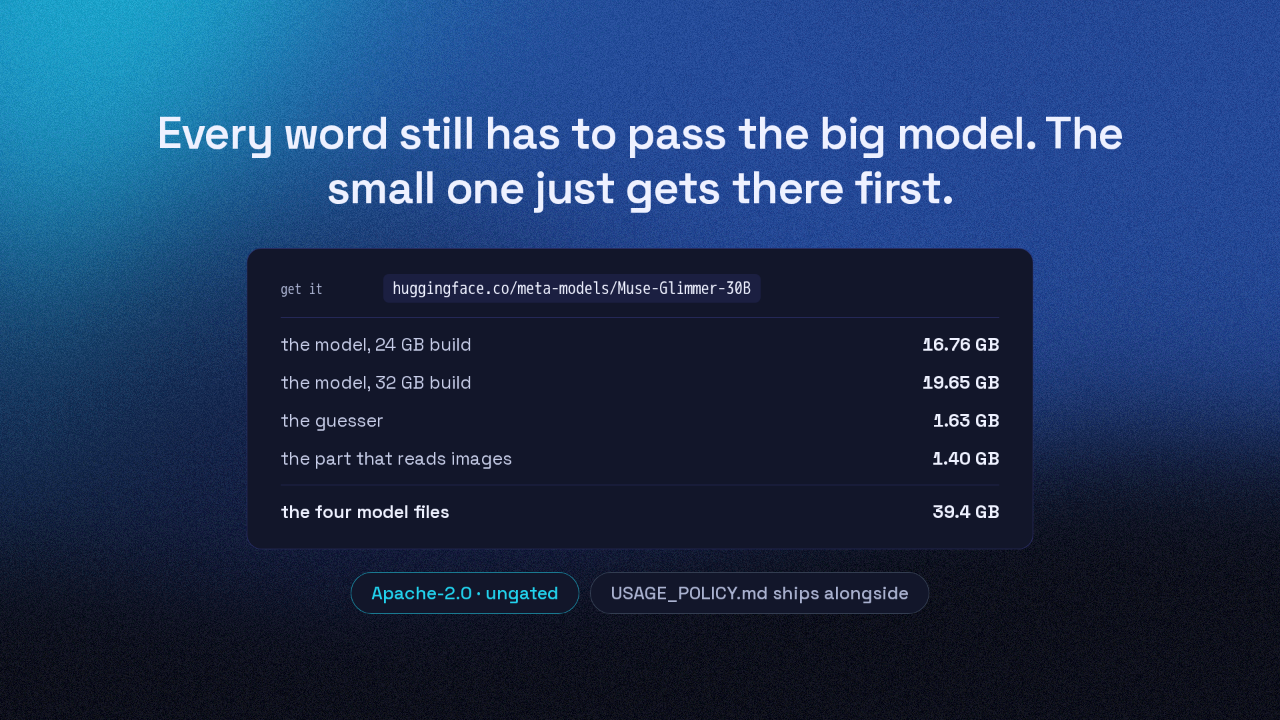
Every word still has to pass the big model

Every word still has to pass the big model. The small one just gets there first.

get ithuggingface.co/meta-models/Muse-Glimmer-30B
the model, 24 GB build16.76 GB
the model, 32 GB build19.65 GB
the guesser1.63 GB
the part that reads images1.40 GB
the four model files39.4 GB
Apache-2.0 · ungated USAGE_POLICY.md ships alongside

So the dribble of one word at a time is a memory problem, and the fix is a guess that gets checked. Both squeezed builds and the guesser sit on Hugging Face under Apache two point oh, ungated. Meta says tuned support for running models at home lands in the coming days, so these numbers are the floor.


Up next

2:58

Apodex 1.1 mini · the same file, run alone and run as a team

@ai-ml-today · 1 month ago

3:09

Ornith-1.5 · an open model trained on problems it wrote for itself

@ai-ml-today · 1 month ago

3:08

MOSS-VL · an open 11B video model trained to decide, after every frame, whether to speak or stay silent

@ai-ml-today · 1 month ago

3:29

Qwen3.8-27B · a 27B open model anyone can download averages 84.3 across real desktop jobs on Qwen’s own run, and loses the widest row on its own card by nine points

@ai-ml-today · 1 month ago

3:15

MiLMMT-46-v1.0 · Xiaomi finished training an open translator on sentences that had no translation attached, and the scores it now leads on are produced by the two models that graded it

@ai-ml-today · 1 month ago

3:31

BDH-CQ — a 150M-parameter system that learns a puzzle rule from the worked examples in front of it and does its thinking as numbers, never as words

@ai-ml-today · 2 months ago

3:05

JoyAI-Video-Edit, JD’s open 16B model that edits a video while the video is still playing, at about 30 frames a second on one Nvidia B200

@ai-ml-today · 2 months ago

3:26

Inkling-Small, Thinking Machines’ 12B-active / 276B open mixture-of-experts model that out-reasons its own 3.5× bigger flagship

@ai-ml-today · 2 months ago

3:42

Maple-Preview, DeepGrove’s 20-billion-parameter ternary reasoning model that runs on a Mac mini

@ai-ml-today · 2 months ago

3:16

Hunyuan3D-Buffalo, Tencent’s one model that builds, understands, and edits 3D from words

@ai-ml-today · 2 months ago

3:28

MiniMax H3, an open model that makes a video and its soundtrack in one pass

@ai-ml-today · 2 months ago

3:37

DiffusionGemma, Google’s open model that writes text a whole block at a time

@ai-ml-today · 2 months ago