MOSS-Transcribe: a 0.9B open model that labels who said what

2 months ago

A point-nine-billion-parameter open model takes long, multi-speaker audio and returns a transcript that already knows who said what. That's MOSS-Transcribe-Diarize, and it does the whole thing in a single pass.

Ask

Ask about this presentation

Answers are generated from this presentation.

Chapters

  1. 0:00Slide 1
  2. 0:11One pass in, a speaker-labeled transcript out.
  3. 0:23No separate diarizer — who-spoke falls out of the same stream.
  4. 0:39Lowest cpCER of any non-Pro system, all four suites
  5. 1:081st place on the transcription task — not the lab's own scoreboard.
  6. 1:21The honest catch: whose numbers, and the one cell it loses.
  7. 1:43Slide 7
Show transcript

Slide 1

MOSS-Transcribe: a 0.9B open model that labels who said what
Speaker-labeled transcription in a single pass
MOSS-Transcribe-Diarize OpenMOSS / MOSI.AI Apache-2.0 0.9B 50+ languages audio-text-to-text 65k downloads on Hugging Face

A point-nine-billion-parameter open model takes long, multi-speaker audio and returns a transcript that already knows who said what. That's MOSS-Transcribe-Diarize, and it does the whole thing in a single pass.

One pass in, a speaker-labeled transcript out.

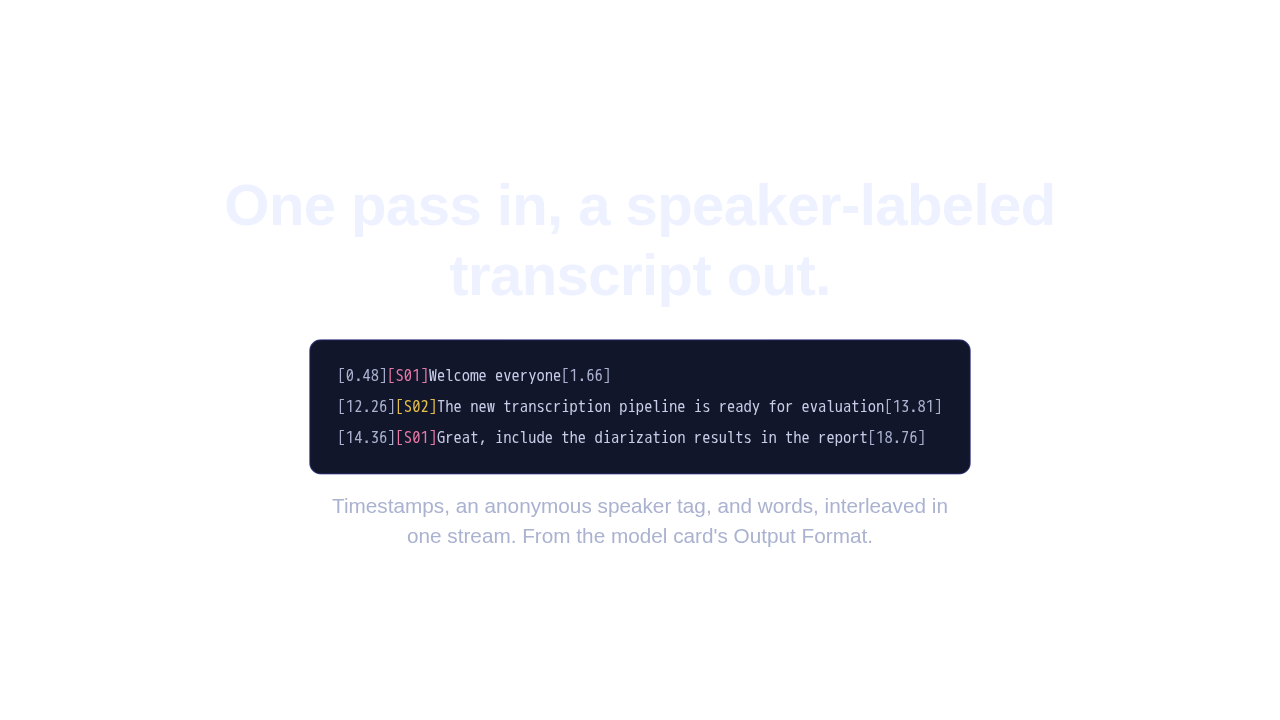
[0.48][S01]Welcome everyone[1.66]
[12.26][S02]The new transcription pipeline is ready for evaluation[13.81]
[14.36][S01]Great, include the diarization results in the report[18.76]
Timestamps, an anonymous speaker tag, and words, interleaved in one stream. From the model card's Output Format.

Feed it a meeting or a podcast, up to ninety minutes, in fifty or more languages. Back comes one stream: start and end times, a speaker tag like S-oh-one, and the words, all interleaved.

No separate diarizer — who-spoke falls out of the same stream.

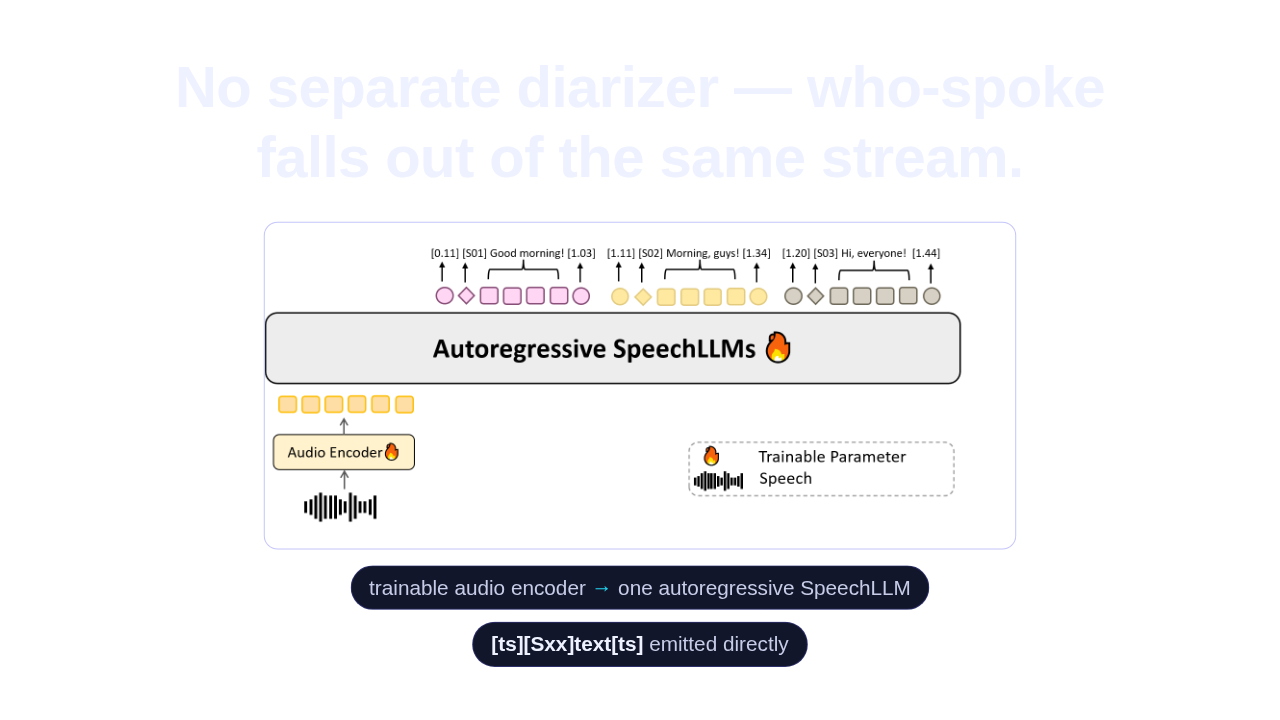
MOSS architecture: a trainable Audio Encoder feeds a single Autoregressive SpeechLLM that emits interleaved timestamp, speaker tag and text tokens, color-coded per speaker
trainable audio encoder → one autoregressive SpeechLLM [ts][Sxx]text[ts] emitted directly

Normally this is two systems: one to transcribe, a second to work out who spoke and stitch it back together. Here it's one. A trainable audio encoder feeds a single speech model that emits the timestamps, the speaker, and the text directly, so who-spoke falls out of the same stream.

Lowest cpCER of any non-Pro system, all four suites

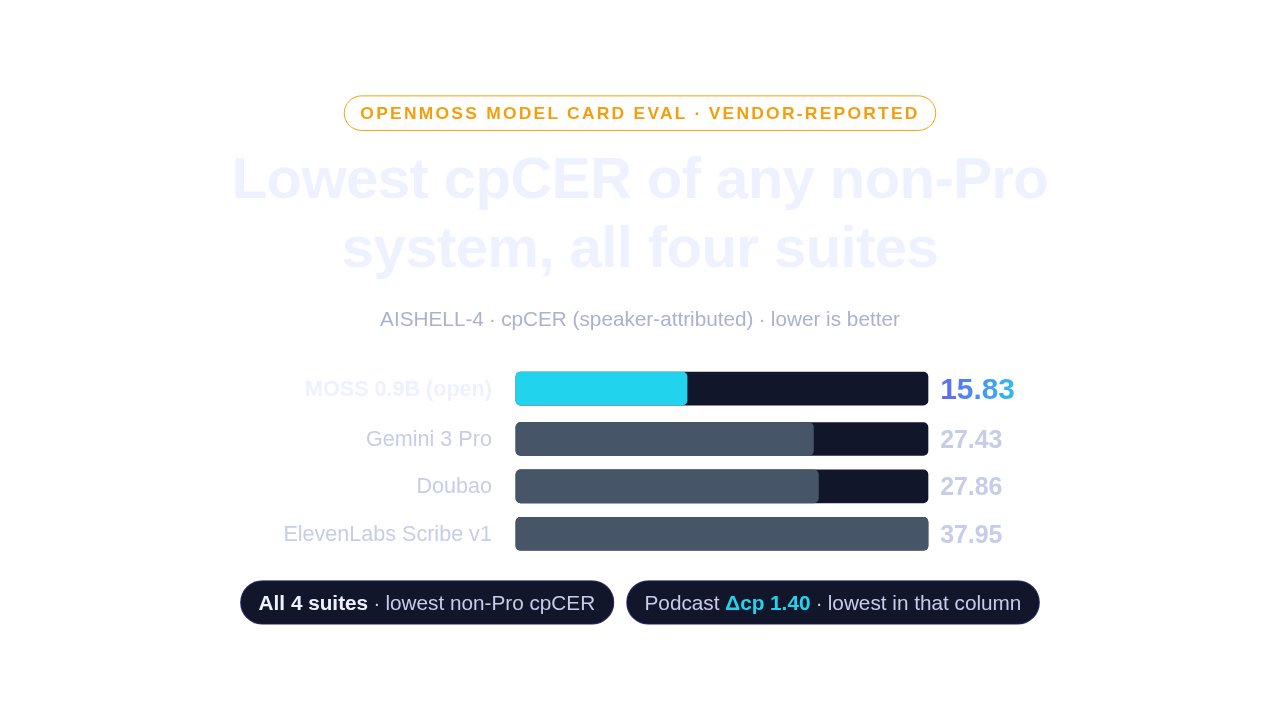
OpenMOSS model card eval · vendor-reported
AISHELL-4 · cpCER (speaker-attributed) · lower is better
MOSS 0.9B (open)
15.83
Gemini 3 Pro
27.43
Doubao
27.86
ElevenLabs Scribe v1
37.95
All 4 suites · lowest non-Pro cpCER Podcast Δcp 1.40 · lowest in that column

On OpenMOSS's own benchmark, the result is the surprise. Take AISHELL-4, a hard Mandarin meeting set. The metric is cpCER: character error once you also have to get who-spoke right, lower is better. MOSS scores fifteen point eight. Gemini 3 Pro, on the same eval, twenty-seven point four. Across all four suites the open model has the lowest speaker-attributed error of any non-Pro system, and on podcasts its diarization penalty is the smallest in the column, under even the closed Pro tier.

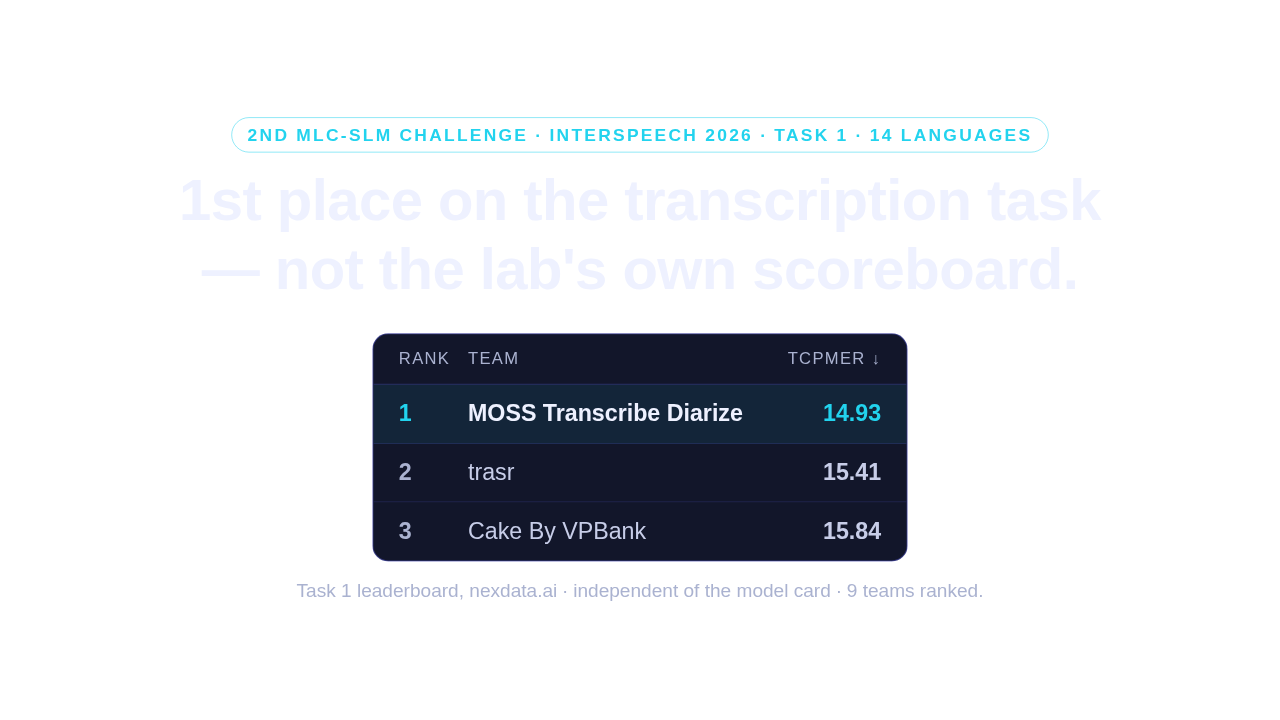
1st place on the transcription task — not the lab's own scoreboard.

2nd MLC-SLM Challenge · INTERSPEECH 2026 · Task 1 · 14 languages
Rank
Team
tcpMER ↓
1
MOSS Transcribe Diarize
14.93
2
trasr
15.41
3
Cake By VPBank
15.84
Task 1 leaderboard, nexdata.ai · independent of the model card · 9 teams ranked.

One result here isn't the lab's own. At the second MLC-SLM challenge, part of Interspeech, MOSS took first place on the transcription and diarization task, across fourteen languages, on an independent leaderboard.

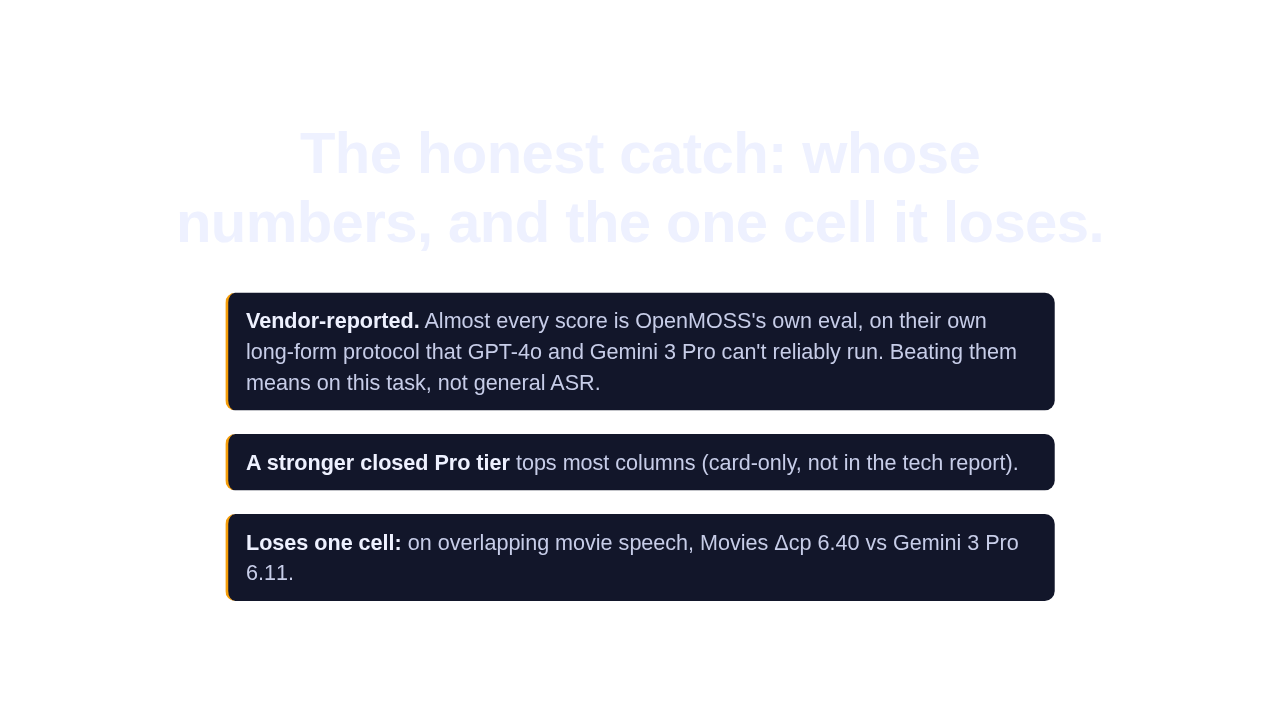
The honest catch: whose numbers, and the one cell it loses.

Vendor-reported. Almost every score is OpenMOSS's own eval, on their own long-form protocol that GPT-4o and Gemini 3 Pro can't reliably run. Beating them means on this task, not general ASR.
A stronger closed Pro tier tops most columns (card-only, not in the tech report).
Loses one cell: on overlapping movie speech, Movies Δcp 6.40 vs Gemini 3 Pro 6.11.

Now the honest part. Almost every number here is OpenMOSS's own eval, run on their own long-form protocol, one the report admits GPT-4o and Gemini can't reliably handle, so beating them means on this task, not general speech recognition. There's also a stronger closed Pro tier that tops most columns. And it doesn't win everything: on overlapping movie speech, its diarization still trails Gemini 3 Pro.

Slide 7

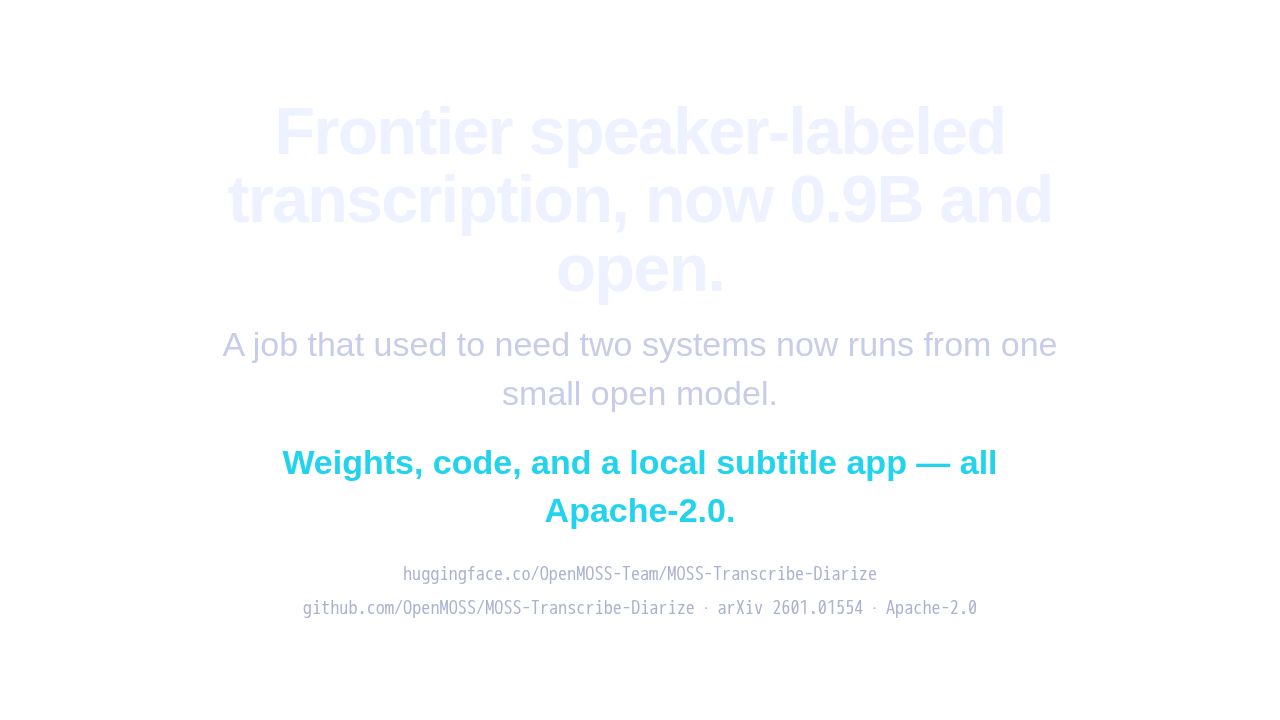
Frontier speaker-labeled transcription, now 0.9B and open.
A job that used to need two systems now runs from one small open model.
Weights, code, and a local subtitle app — all Apache-2.0.
huggingface.co/OpenMOSS-Team/MOSS-Transcribe-Diarize
github.com/OpenMOSS/MOSS-Transcribe-Diarize · arXiv 2601.01554 · Apache-2.0

So a job that used to need two systems now runs from one small open model. Weights, code, and a local subtitle app, all Apache-2.0.


Up next

2:58

Apodex 1.1 mini · the same file, run alone and run as a team

@ai-ml-today · 1 month ago

3:09

Ornith-1.5 · an open model trained on problems it wrote for itself

@ai-ml-today · 1 month ago

3:08

MOSS-VL · an open 11B video model trained to decide, after every frame, whether to speak or stay silent

@ai-ml-today · 1 month ago

3:29

Qwen3.8-27B · a 27B open model anyone can download averages 84.3 across real desktop jobs on Qwen’s own run, and loses the widest row on its own card by nine points

@ai-ml-today · 1 month ago

3:15

MiLMMT-46-v1.0 · Xiaomi finished training an open translator on sentences that had no translation attached, and the scores it now leads on are produced by the two models that graded it

@ai-ml-today · 1 month ago

3:31

BDH-CQ — a 150M-parameter system that learns a puzzle rule from the worked examples in front of it and does its thinking as numbers, never as words

@ai-ml-today · 2 months ago

3:29

Muse Glimmer 30B, Meta’s open agent model, and the second tiny model that guesses sixteen words ahead so it runs fast on one consumer graphics card

@ai-ml-today · 2 months ago

3:05

JoyAI-Video-Edit, JD’s open 16B model that edits a video while the video is still playing, at about 30 frames a second on one Nvidia B200

@ai-ml-today · 2 months ago

3:26

Inkling-Small, Thinking Machines’ 12B-active / 276B open mixture-of-experts model that out-reasons its own 3.5× bigger flagship

@ai-ml-today · 2 months ago

3:42

Maple-Preview, DeepGrove’s 20-billion-parameter ternary reasoning model that runs on a Mac mini

@ai-ml-today · 2 months ago

3:16

Hunyuan3D-Buffalo, Tencent’s one model that builds, understands, and edits 3D from words

@ai-ml-today · 2 months ago

3:28

MiniMax H3, an open model that makes a video and its soundtrack in one pass

@ai-ml-today · 2 months ago









