MiniMax H3, an open model that makes a video and its soundtrack at once
MiniMax H3
Most AI video gets its sound added afterward, in separate tools. MiniMax’s H3 makes the picture and its soundtrack together, in a single pass. H3 is an open-weights model from MiniMax, the Chinese lab behind the Hailuo video product, and the weights dropped this week.
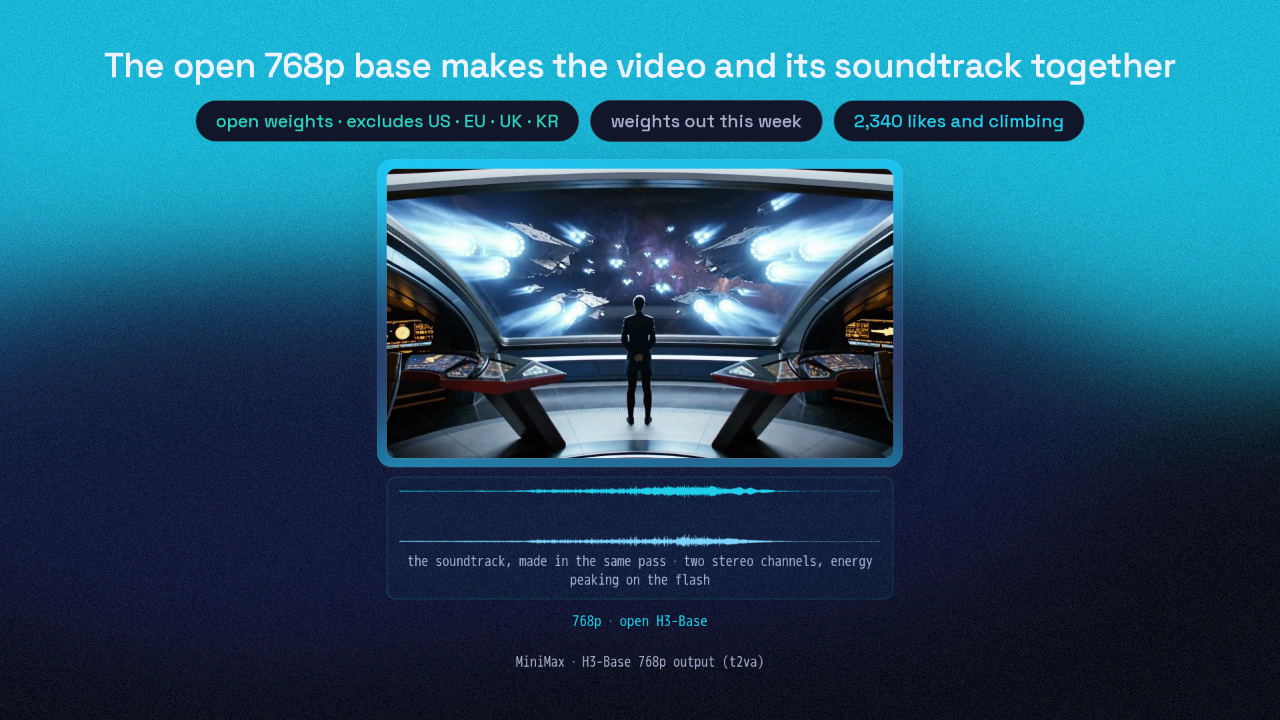
The open 768p base makes the video and its soundtrack together


So here is a clip H3 made. A boom lands right on the flash, and the picture and the sound line up on their own, because the model made them in one pass. MiniMax released the 768p base this week, a modest resolution, and the weights are yours to download. The license carves it out of the United States, the European Union, the United Kingdom and Korea, so for most people here H3 is a capability to watch, not weights to run. Still, it is one of the most-liked new models on Hugging Face, where open models are shared.
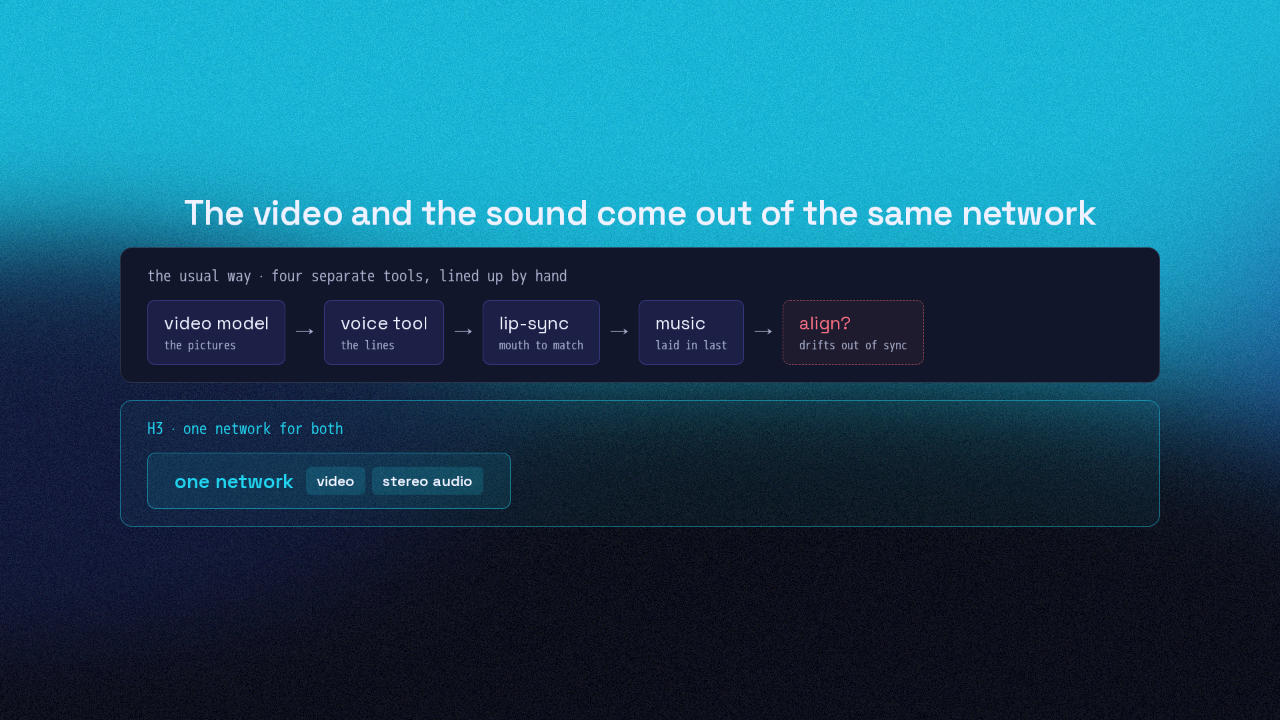
The video and the sound come out of the same network
The novelty is where the sound comes from. The usual way is a stack of separate tools. A video model makes the pictures. A voice tool speaks the lines. A lip-sync tool pushes the mouth to match. A fourth step lays in the music. Four separate tools, lined up by hand at the end. That is why AI clips drift out of sync. H3 uses one network for both.
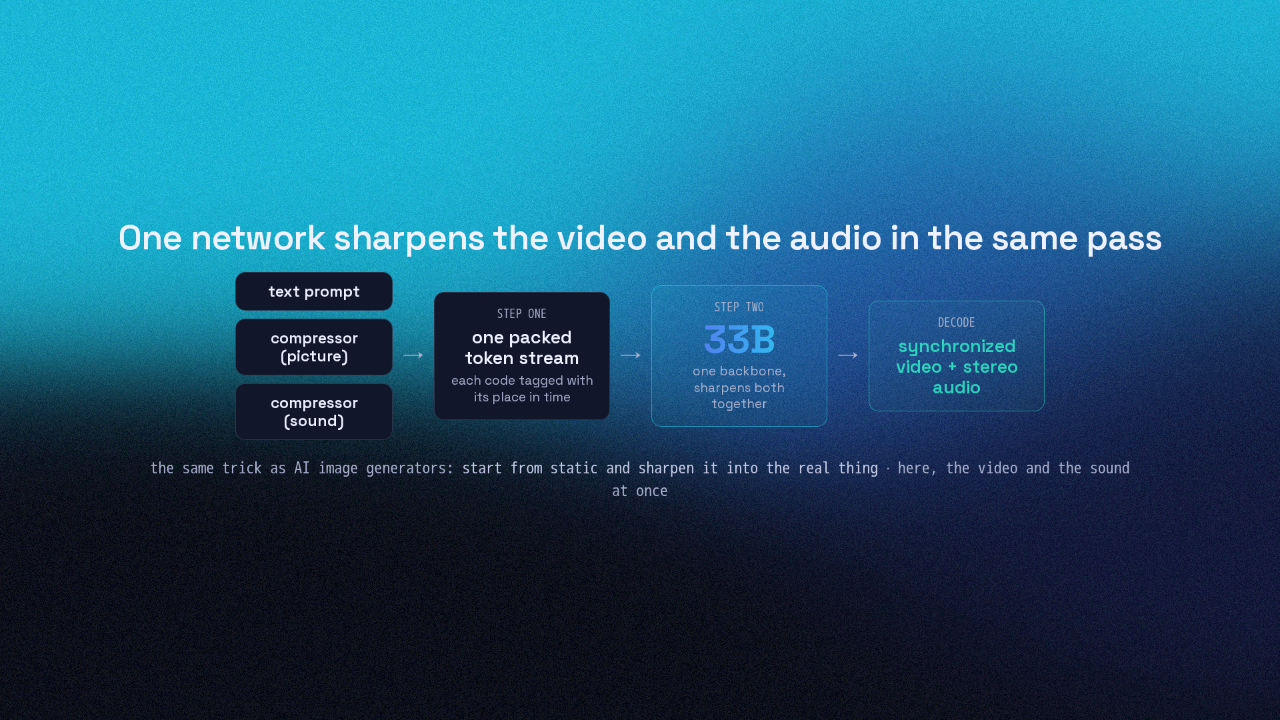
One network sharpens the video and the audio in the same pass
Here is the machinery. Step one: everything becomes tokens. A token is a short numerical stand-in for a piece of content. Two compressors do the squeezing: one turns the pictures into a stream of these codes, the other turns the sound into its own. An existing open model reads your text prompt, and it all packs into one shared sequence, each code tagged with its place in time. Step two: one backbone sharpens the stream. This is the trick behind AI image generators: they start from static and sharpen it into the real thing. Here a single thirty-three-billion-parameter network, the same kind behind chatbots, sharpens the video and audio codes together, in one pass. The compressors run in reverse, and out come the frames and a stereo soundtrack, in sync.
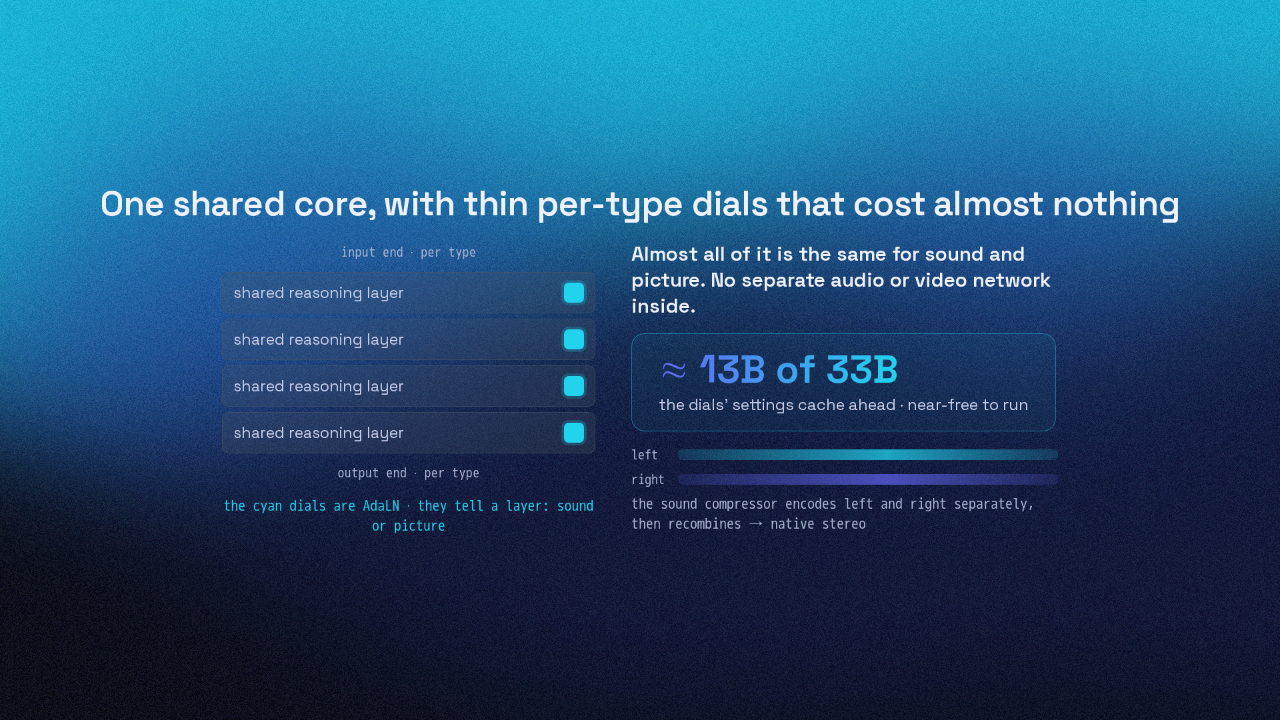
One shared core, with thin per-type dials that cost almost nothing
So how does one network handle both at once? Almost all of it does not know the difference. The reasoning layers are the same for sound and picture. There is no separate audio and video network inside. The only parts that tell them apart are the input and output ends, plus a small set of dials on each layer that the card calls AdaLN. Those dials tell a layer whether it is handling sound or picture. They hold about thirteen of the thirty-three billion parameters, but their settings can be cached ahead of time, so they cost almost nothing to run. Stereo comes from the same design. The sound compressor encodes the left and right channels separately, then recombines them.
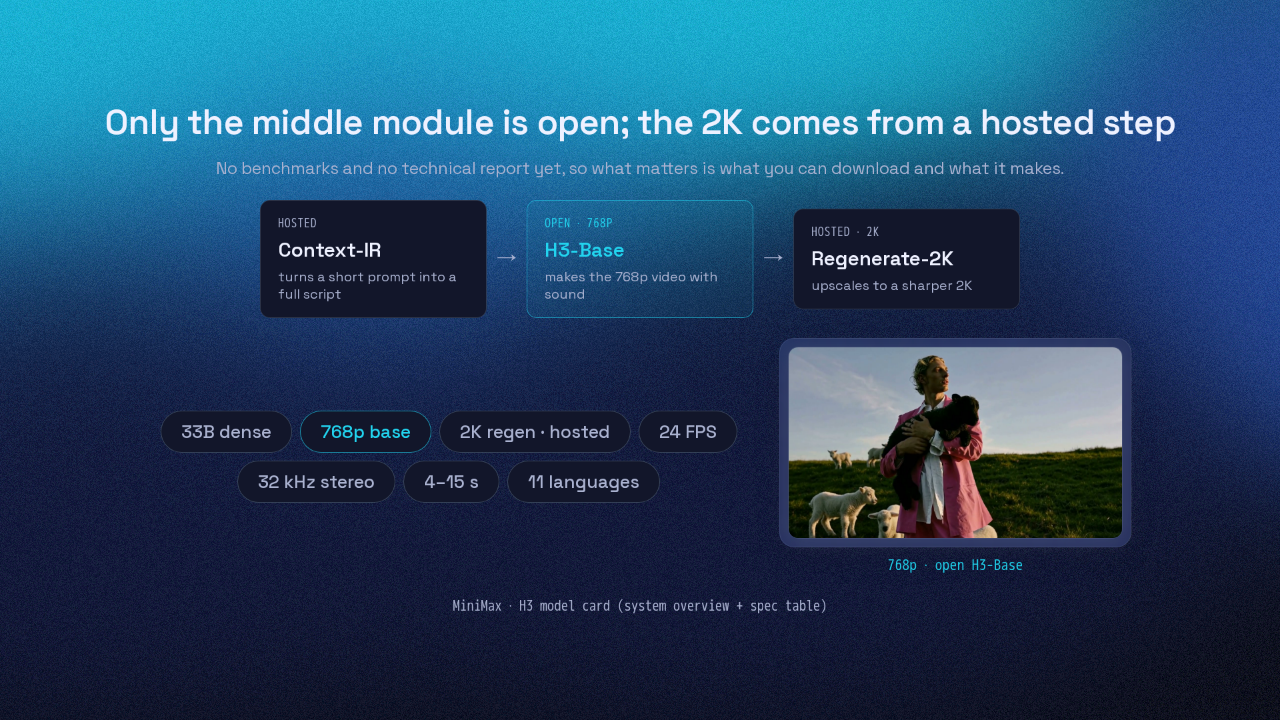
Only the middle module is open; the 2K comes from a hosted step

There are no benchmarks and no technical report yet, so what matters is what you can download and what it makes. The system has three modules, and only the middle one is open. A hosted front end turns your short prompt into a full script. The open H3-Base turns that into a 768p video with sound. A hosted step then upscales it to 2K, a sharper resolution, so the flashy two-K demos are partly that hosted product. The open part makes clips of four to fifteen seconds, at twenty-four frames a second, in stereo, with dialogue in eleven languages.
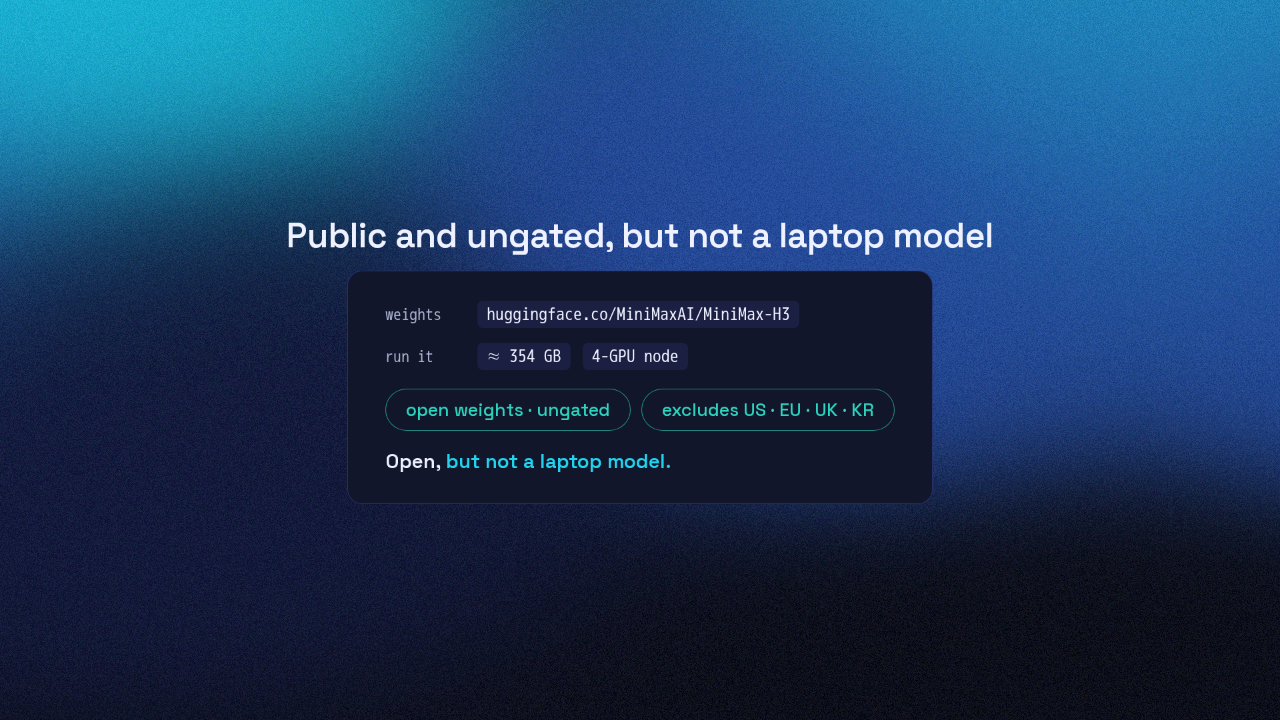
Public and ungated, but not a laptop model
The H3-Base weights are public and ungated on Hugging Face, under MiniMax’s own community license, with the same territorial carve-out. Running it is the real cost: about three hundred and fifty gigabytes of weights, on a machine with four data-center graphics chips. It is open, but it is not a laptop model. The link is on screen.
An open model that makes the sound with the picture, at 768p today
AI video usually gets its sound afterward. H3 makes the picture and its soundtrack in one pass, one network sharpening the video and the sound together. What makes this interesting is not a leaderboard score. It is an open model that makes the sound with the picture, at 768p today, with the 2K still hosted.