Mage-VL — a 4B open model that watches video the way your phone compresses it
Mage-VL
Watching video is brutally expensive for an AI. A clip is thousands of near-identical frames, and it has to look at every one. Microsoft just opened a small model that skips most of that work by borrowing the trick your phone uses to shrink video. It's called Mage-VL.
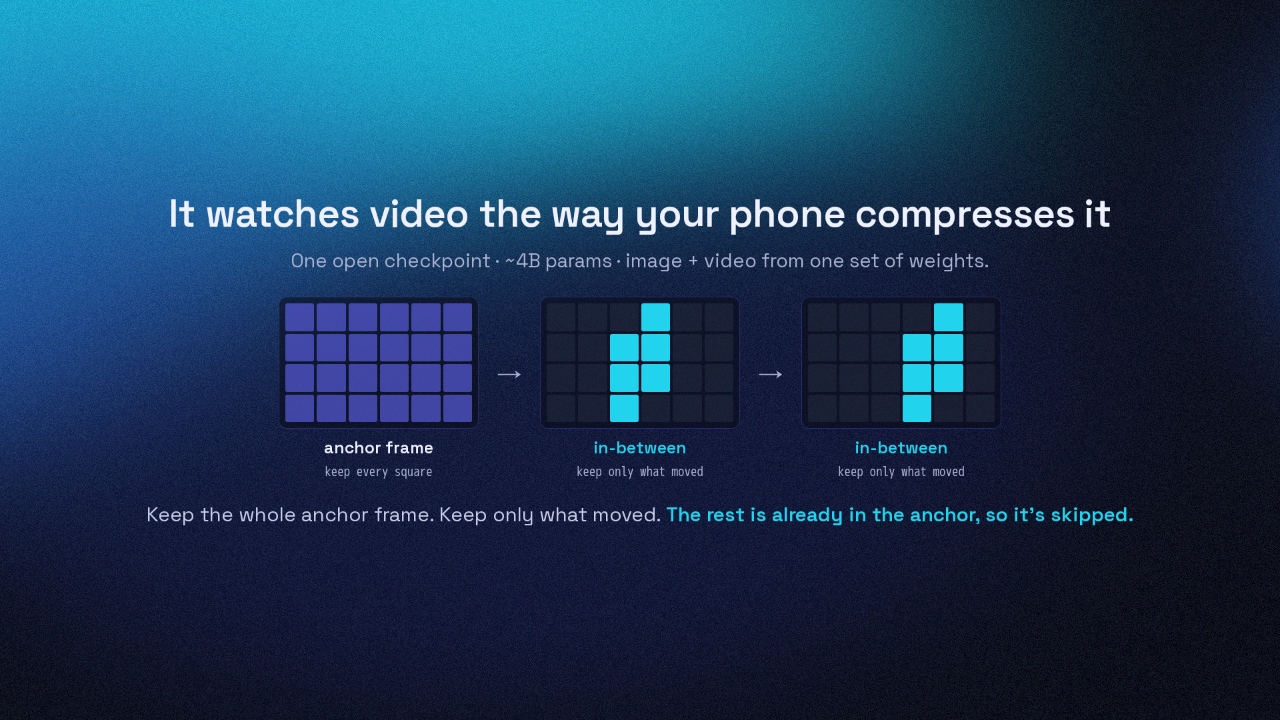
It watches video the way your phone compresses it
Mage-VL is a single open model, about four billion parameters, small as these go. It reads images and video from one set of weights. The trick is how it looks at video. A video file is already compressed. Your phone doesn't save every frame in full. It saves one full picture, an anchor frame, then, for the frames right after, only the parts that moved. Everything else is copied from that anchor. Mage-VL reuses that same split to decide what to look at. Keep the whole anchor frame. From the frames in between, keep only what moved. The rest, it skips.
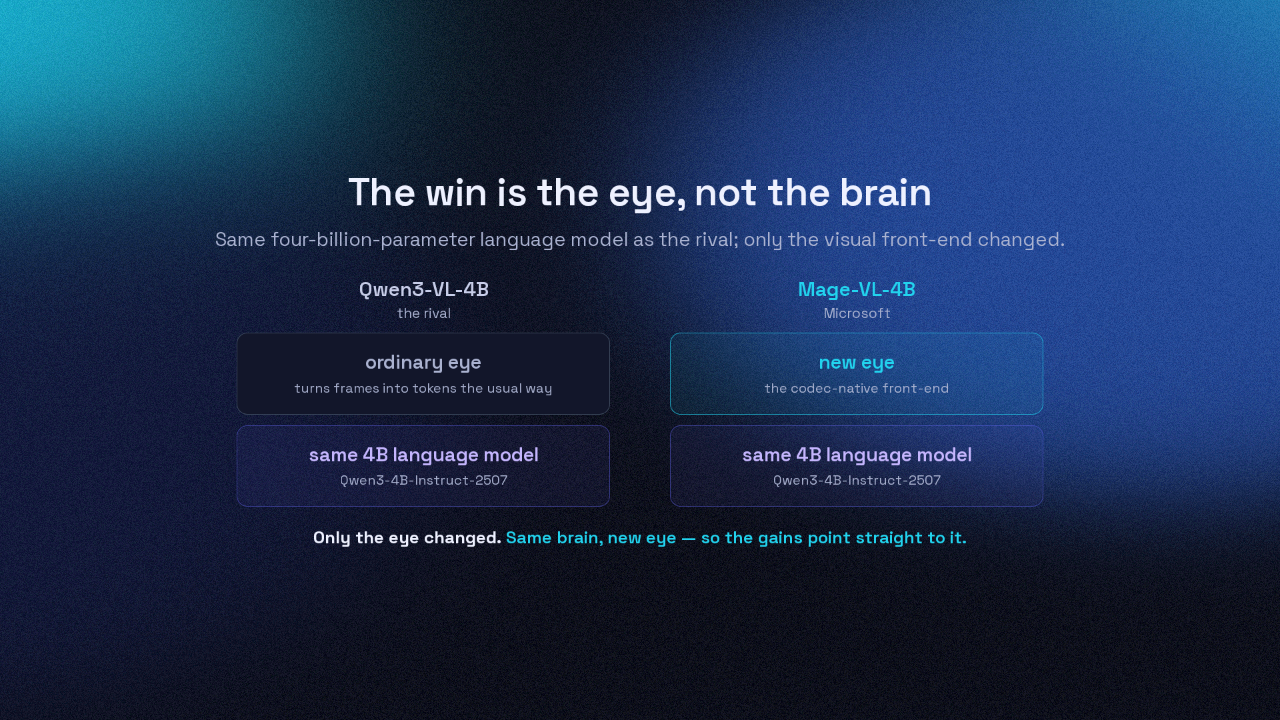
The win is the eye, not the brain
You'd expect a better video AI to come from a bigger or smarter language model. That's not what happened. Microsoft took an otherwise-identical rival, Qwen3-VL-4B, built on the very same four-billion-parameter language model, and changed exactly one thing: the model's eye, the part that turns pictures into something it can reason about. Same brain, new eye. And that new eye is where all the gains come from. Only one part moved, so you can point to what caused them.
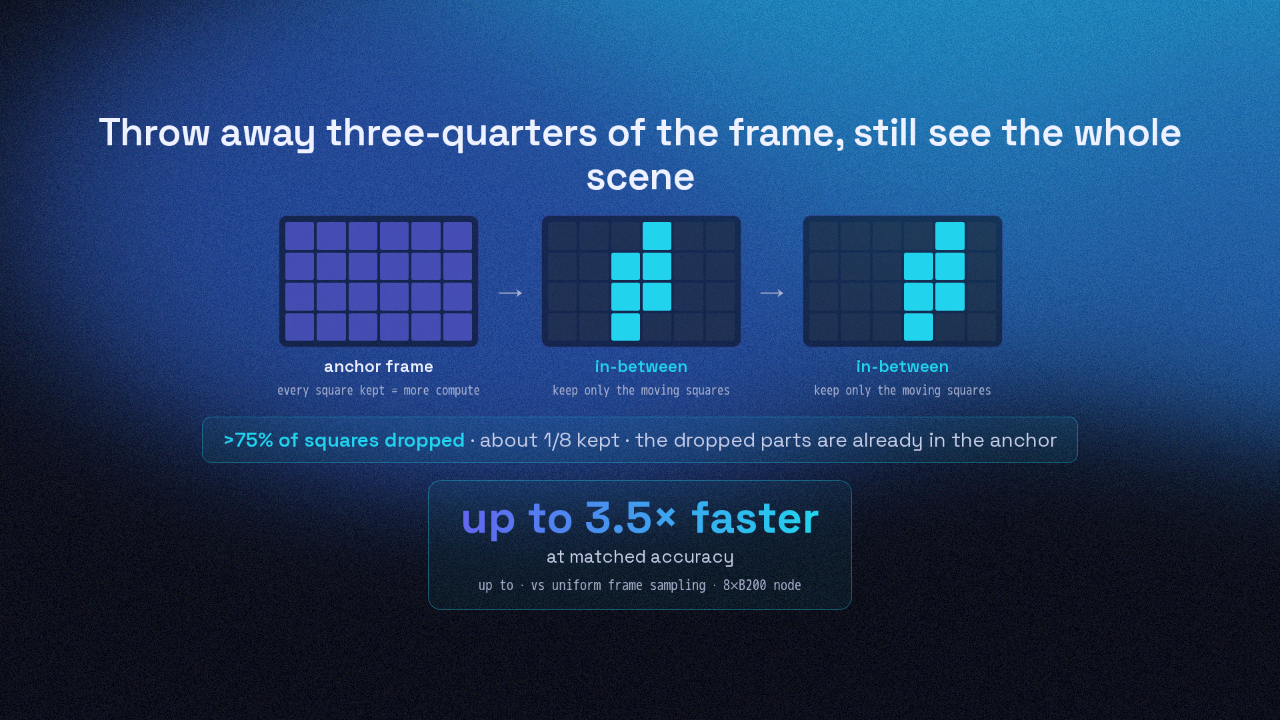
Throw away three-quarters of the frame, still see the whole scene
So why doesn't skipping most of the video leave it blind? Because of what it skips. First, how the eye sees at all. It chops every frame into a grid of little squares and studies them one at a time. Every square it keeps is more compute, and a long video is thousands of near-identical frames, so keeping every square is what makes watching so expensive. Now the split. On an anchor frame, it keeps every square. The whole picture, nothing lost. On the frames in between, it keeps only the squares the compression already flagged as moving, a player running, the ball crossing, and drops the rest. The dropped parts are already in the anchor. So the model still sees the whole scene and every bit of motion, while looking at over three-quarters fewer squares. Often an eighth or less. The same budget now watches far longer video, and at answer time it runs up to three and a half times faster than the usual trick of sampling frames evenly, with no drop in accuracy, Microsoft reports. It spends effort only where the video itself changed.
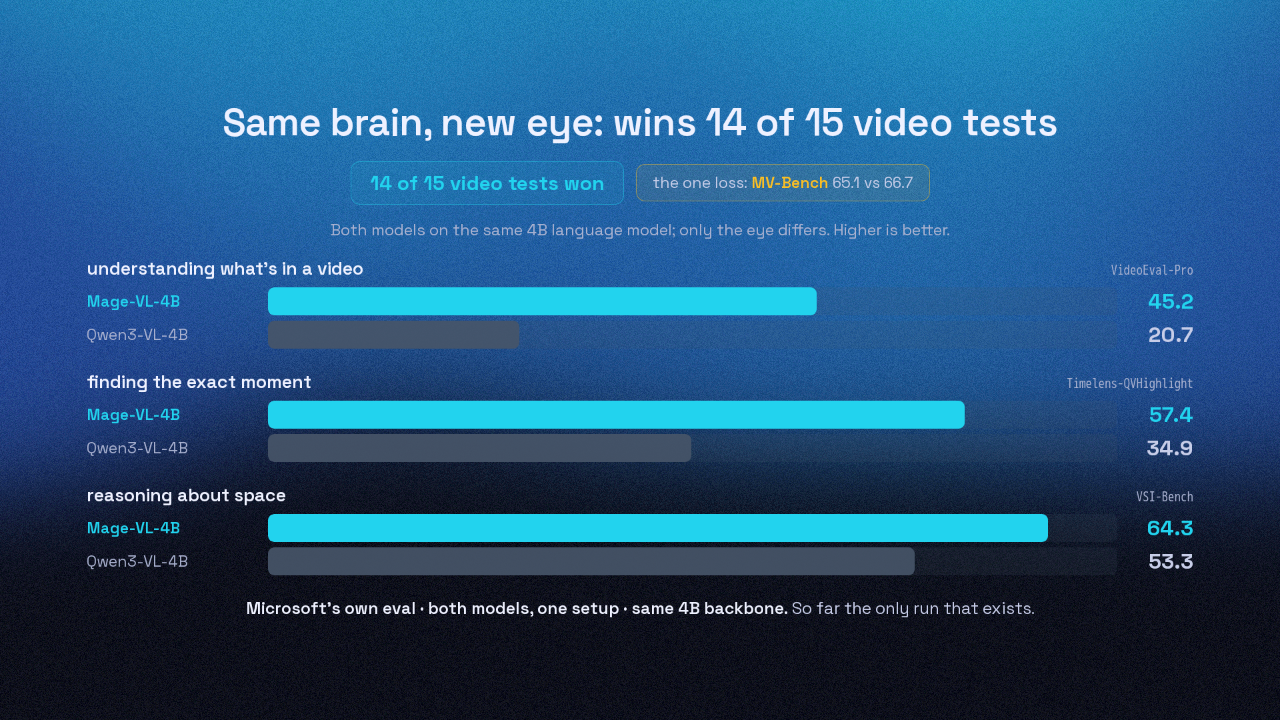
Same brain, new eye: wins 14 of 15 video tests
With that same language model held fixed, the new eye wins fourteen of the fifteen video tests Microsoft ran. It takes every test of tracking, timing, and space, and loses only one video-understanding benchmark. On a hard test of understanding what's in a clip, it roughly doubles the rival, forty-five to twenty-one. On finding the exact moment something happens, it climbs from thirty-five to fifty-seven. On reasoning about space in a scene, fifty-three to sixty-four. Every one of these is Microsoft's own number, both models run through one setup, and so far it's the only run that exists. The point isn't the leaderboard. It's that changing only the eye moved all of them.
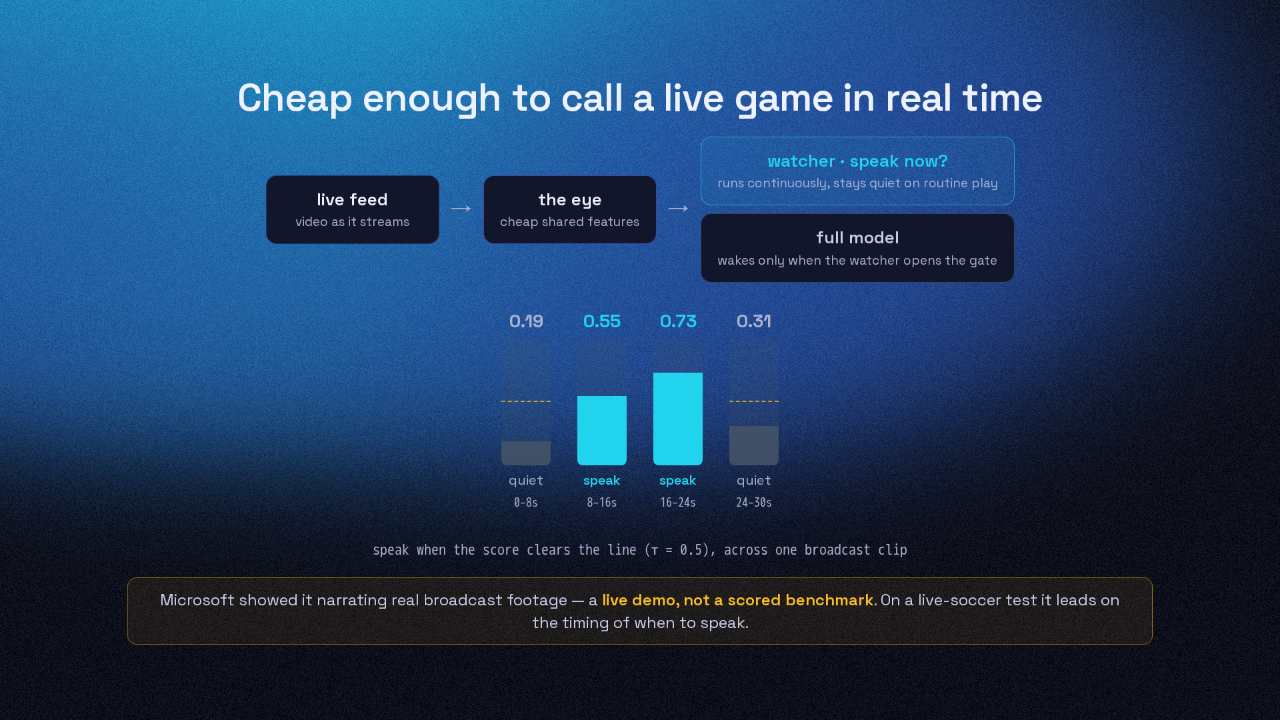
Cheap enough to call a live game in real time
And because the eye is so cheap, the same weights can watch a live feed as it streams, not just a finished clip. A second, lightweight watcher rides on top. It scores the incoming video, stays quiet through routine play, and wakes the full model only when something worth saying happens. So the model can follow a whole match and speak only at the moments that matter. Microsoft showed it narrating real broadcast footage, a live demo, not a scored benchmark. And on a live-soccer test, it leads on the timing measures for when to speak.
Look at video the way a codec already compresses it
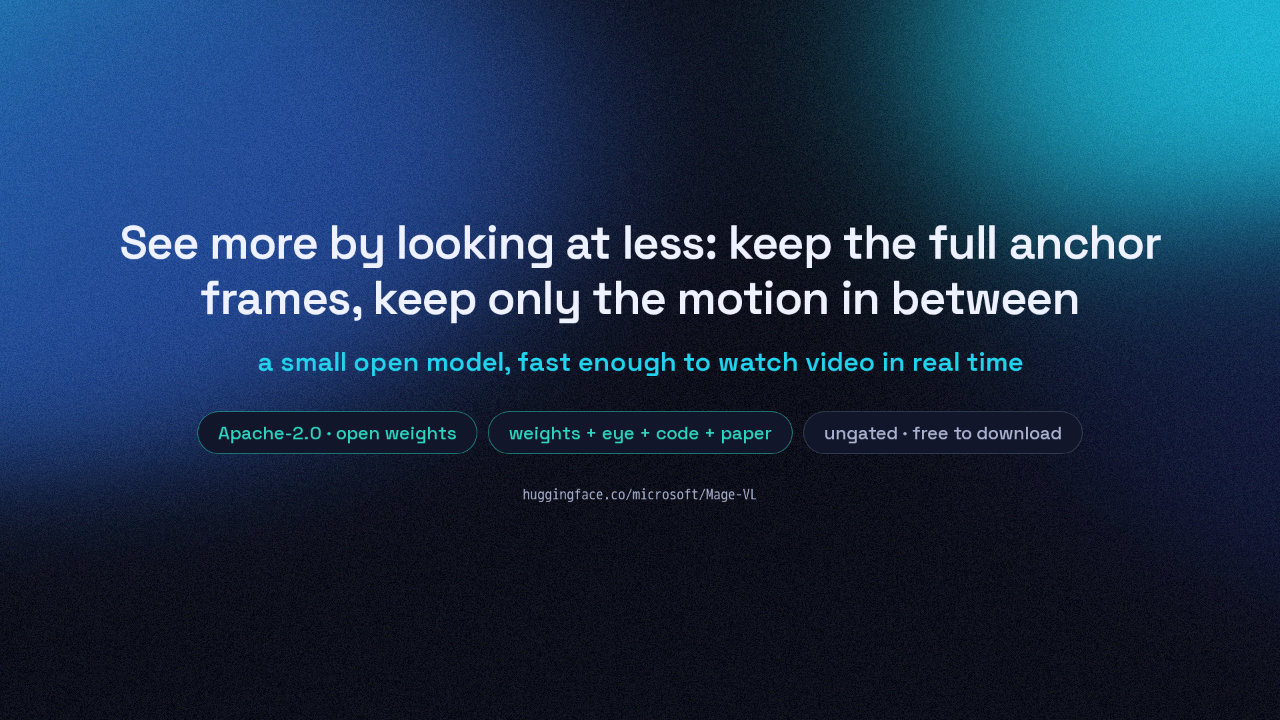
See more by looking at less: keep the full anchor frames, keep only the motion in between
Teach a model to look at video the way a codec already compresses it, full anchor frames, only the motion in between, and a small open model sees more while looking at far less. And it's all open. The model, its standalone eye, the code, and the paper, under a permissive Apache-2.0 license. You can download it today.











