Laguna S 2.1 — poolside's open-weight coding model that got good by practicing, not by being big

2 months ago

poolside just released a coding AI you can download and run yourself, for free. It's called Laguna S 2.1, and it holds its own against models several times its size on real programming work. The surprising part isn't how big it is. It's how it learned.

Ask

Ask about this presentation

Answers are generated from this presentation.

Chapters

  1. 0:00Laguna S 2.1 — poolside's open-weight coding model
  2. 0:13118 billion numbers, 8 billion awake per word
  3. 0:37It practiced on about 409,000 real software tasks
  4. 1:05Letting it think between actions more than doubles its bug-fixing
  5. 1:57Tops multilingual bug-fixing at 8B active — frontier still ahead
  6. 2:40Open, ungated, and free to build on
  7. 3:05The lever wasn't a bigger model
Show transcript

Laguna S 2.1 — poolside's open-weight coding model

Laguna S 2.1

poolside's open-weight coding model.
poolside OpenMDW-1.1 · open + ungated agentic coding 118B total · 8B active per word

poolside just released a coding AI you can download and run yourself, for free. It's called Laguna S 2.1, and it holds its own against models several times its size on real programming work. The surprising part isn't how big it is. It's how it learned.

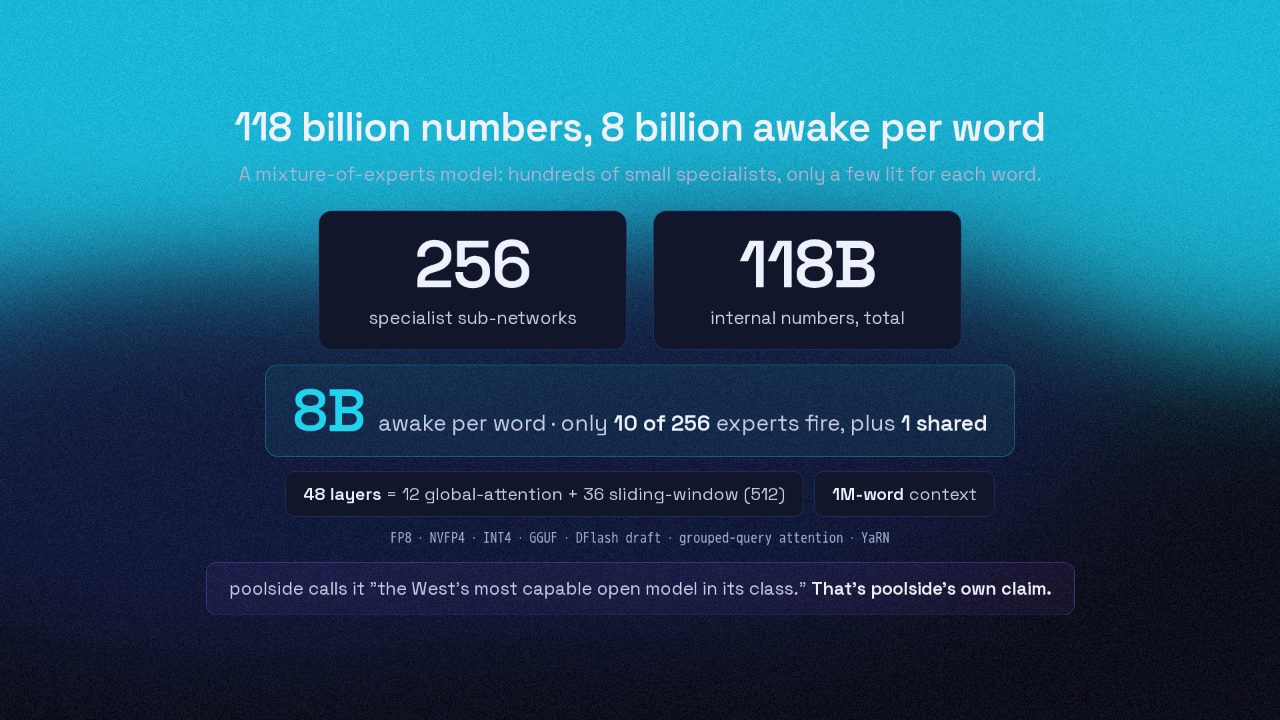
118 billion numbers, 8 billion awake per word

A mixture-of-experts model: hundreds of small specialists, only a few lit for each word.
256
specialist sub-networks
118B
internal numbers, total
8B awake per word · only 10 of 256 experts fire, plus 1 shared
48 layers = 12 global-attention + 36 sliding-window (512) 1M-word context
FP8 · NVFP4 · INT4 · GGUF · DFlash draft · grouped-query attention · YaRN
poolside calls it "the West's most capable open model in its class." That's poolside's own claim.

Laguna is a mixture-of-experts model. Instead of one big network, it's built as hundreds of small specialist sub-networks. Together they hold a hundred and eighteen billion internal numbers, the values it learned in training. But for each word, the model wakes only about eight billion of them, routing that word to a handful of specialists instead of running the whole thing. poolside calls it the West's most capable open model in its class. That's poolside's own claim.

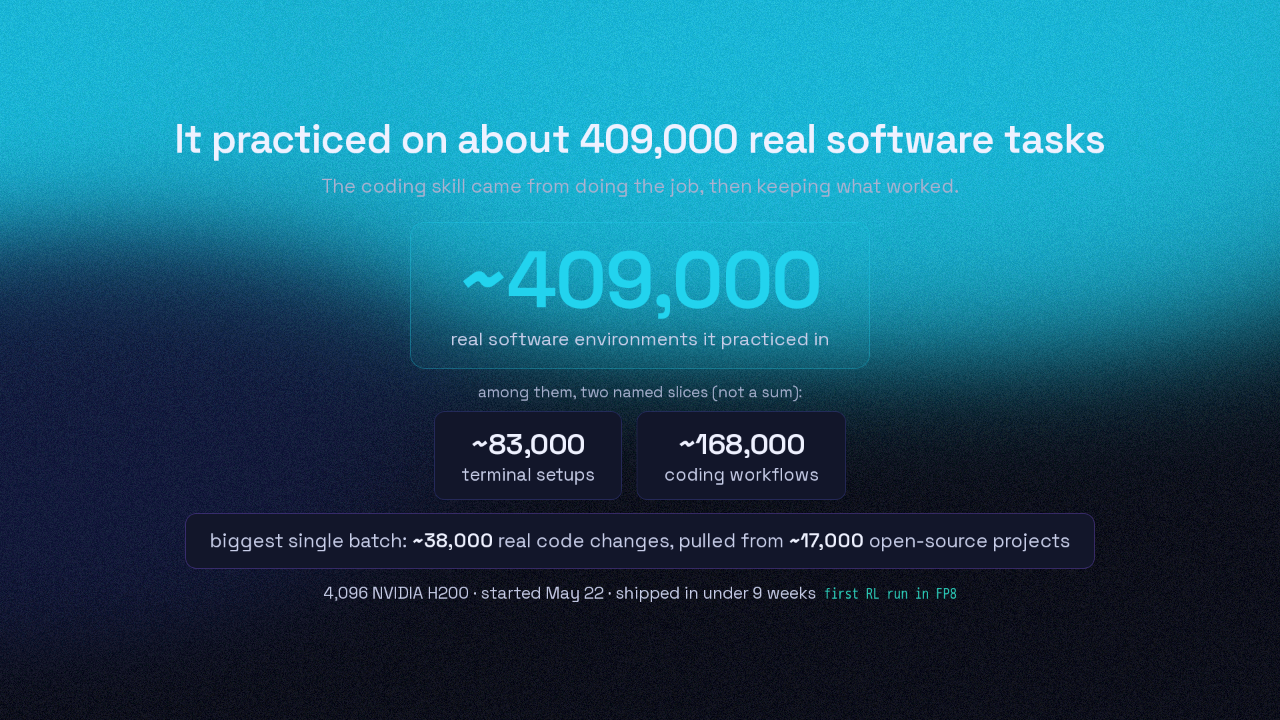
It practiced on about 409,000 real software tasks

The coding skill came from doing the job, then keeping what worked.
~409,000
real software environments it practiced in
among them, two named slices (not a sum):
~83,000 terminal setups
~168,000 coding workflows
biggest single batch: ~38,000 real code changes, pulled from ~17,000 open-source projects
4,096 NVIDIA H200 · started May 22 · shipped in under 9 weeks first RL run in FP8

Here's what's new. The coding skill didn't come from size. It came from practice. poolside had the model attempt real software tasks, about four hundred and nine thousand of them. The biggest batch was thirty eight thousand real code changes, pulled from seventeen thousand open-source projects. The model tried each task, and poolside rewarded it only when the result actually worked. It's like an apprentice who learns by doing the job, not by reading about it.

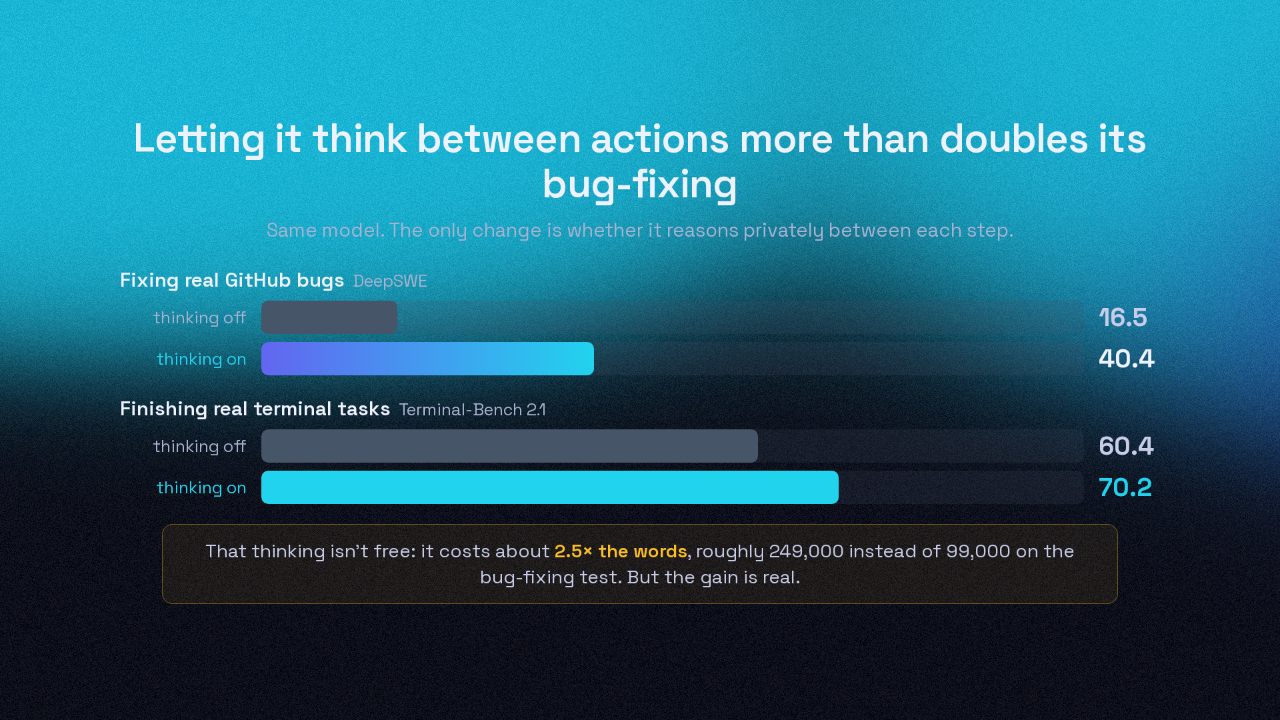
Letting it think between actions more than doubles its bug-fixing

Same model. The only change is whether it reasons privately between each step.
Fixing real GitHub bugsDeepSWE
thinking off
16.5
thinking on
40.4
Finishing real terminal tasksTerminal-Bench 2.1
thinking off
60.4
thinking on
70.2
That thinking isn't free: it costs about 2.5× the words, roughly 249,000 instead of 99,000 on the bug-fixing test. But the gain is real.

Learning by doing comes down to two things. The first is the training. The model wrote code, ran it, and kept the version that passed, the one that matched what a real developer had committed. The reward came from code that actually ran, not from text describing it. The second is what happens when you actually run the model, and it's the surprising part. Between each step, it thinks. It reasons privately, runs a command, reads the result, then reasons again. That private reasoning is where most of the skill turns out to live. Turn the thinking on versus off, on a test that has it fix real GitHub bugs, and the score more than doubles, from sixteen point five to forty point four. On finishing real terminal tasks, it climbs from about sixty to seventy. That thinking isn't free. It costs about two and a half times as many words, roughly two hundred and fifty thousand instead of a hundred thousand on the bug-fixing test. But the gain is real.

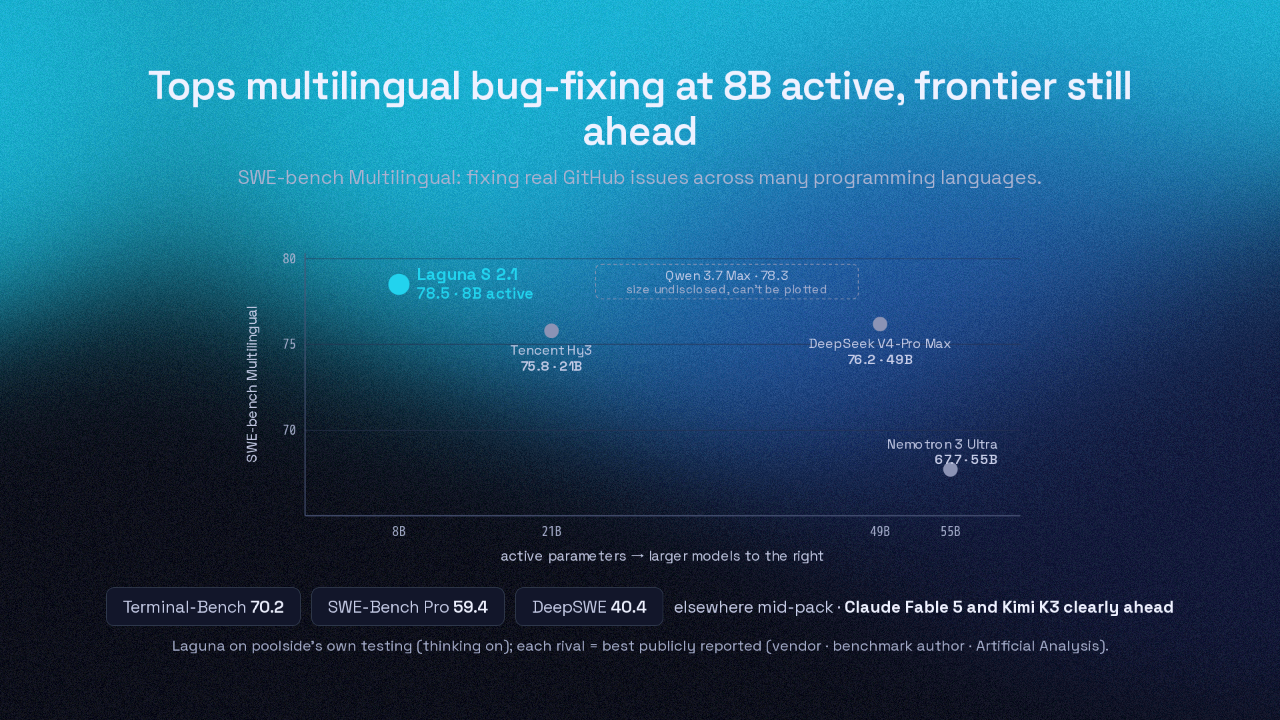
Tops multilingual bug-fixing at 8B active — frontier still ahead

Tops multilingual bug-fixing at 8B active, frontier still ahead

SWE-bench Multilingual: fixing real GitHub issues across many programming languages.
80 75 70 8B 21B 49B 55B active parameters → larger models to the right SWE-bench Multilingual Qwen 3.7 Max · 78.3 size undisclosed, can't be plotted Tencent Hy3 75.8 · 21B DeepSeek V4-Pro Max 76.2 · 49B Nemotron 3 Ultra 67.7 · 55B Laguna S 2.1 78.5 · 8B active
Terminal-Bench 70.2 SWE-Bench Pro 59.4 DeepSWE 40.4 elsewhere mid-pack · Claude Fable 5 and Kimi K3 clearly ahead
Laguna on poolside's own testing (thinking on); each rival = best publicly reported (vendor · benchmark author · Artificial Analysis).

There's one test where Laguna comes out on top. It's called SWE-bench Multilingual. It has models fix real GitHub issues across many programming languages. Laguna scores seventy eight point five, the best in the group. It edges out Qwen 3.7 Max and beats every larger open model: DeepSeek at forty nine billion active parameters, Tencent's Hy3 at twenty one billion, Nvidia's Nemotron at fifty five billion. Laguna does it on eight billion. So it's best in its weight class at this kind of coding, not best overall. Elsewhere it sits mid-pack, and the closed frontier, models like Claude Fable 5 and Kimi K3, is clearly ahead. These are poolside's own scores, each rival measured at its best public number.

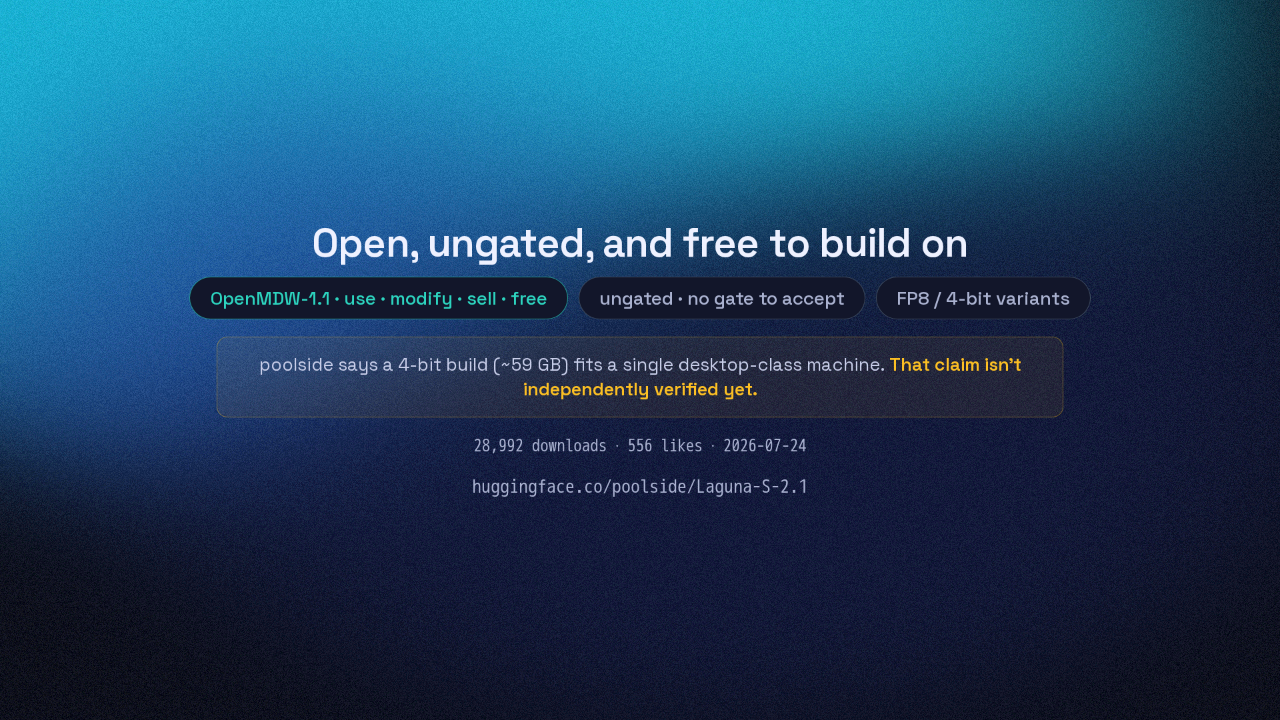
Open, ungated, and free to build on

OpenMDW-1.1 · use · modify · sell · free ungated · no gate to accept FP8 / 4-bit variants
poolside says a 4-bit build (~59 GB) fits a single desktop-class machine. That claim isn't independently verified yet.
28,992 downloads · 556 likes · 2026-07-24
huggingface.co/poolside/Laguna-S-2.1

Here's the part that matters if you build. Laguna ships under a license called open M D W: anyone can use it, change it, even sell products built on it, for free, and there's no gate to accept. poolside says a compressed, four-bit version fits on a single desktop-class machine. That claim hasn't been verified outside poolside yet. If it holds, your code never has to leave the building to get this kind of help.

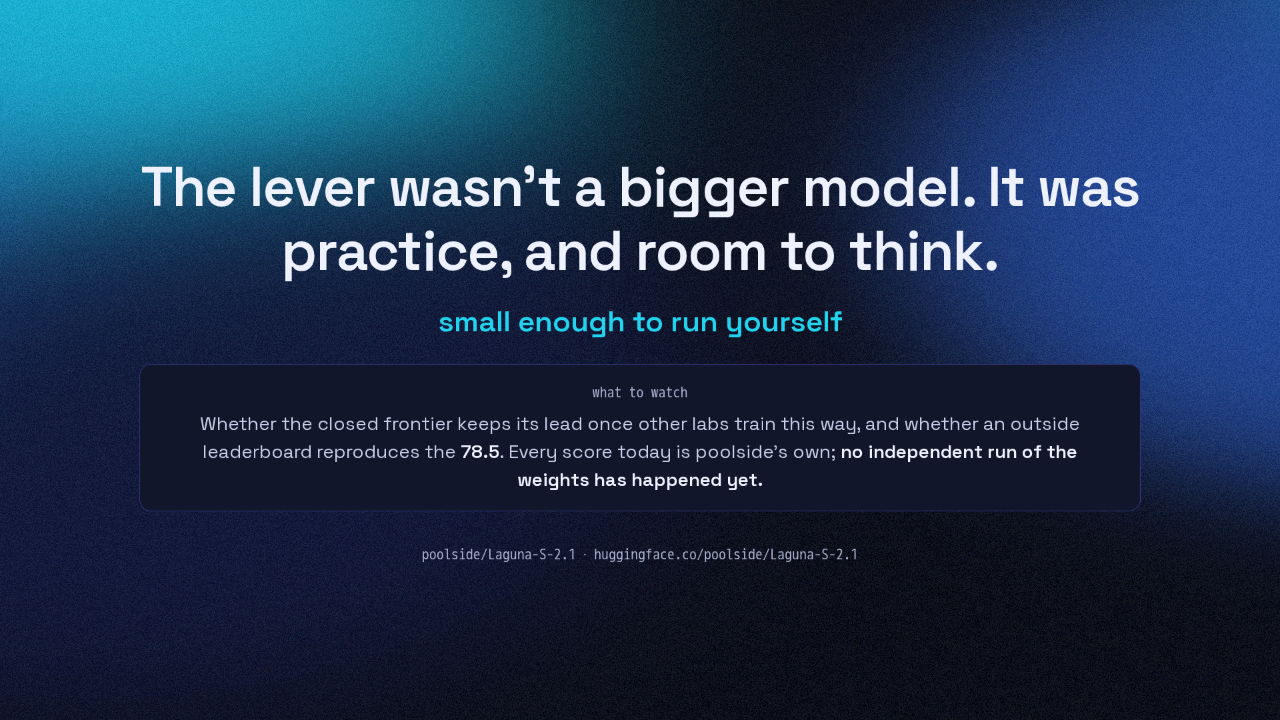
The lever wasn't a bigger model

The lever wasn't a bigger model. It was practice, and room to think.

small enough to run yourself
what to watch Whether the closed frontier keeps its lead once other labs train this way, and whether an outside leaderboard reproduces the 78.5. Every score today is poolside's own; no independent run of the weights has happened yet.
poolside/Laguna-S-2.1 · huggingface.co/poolside/Laguna-S-2.1

What made Laguna good at coding wasn't a bigger model. It was practice on real tasks, and room to think between each step. Two things are worth watching: whether the closed frontier keeps its lead once other labs train this way, and whether an outside leaderboard reproduces that multilingual win. Every score today comes from poolside's own testing, and an independent run of the weights hasn't happened yet.


Up next

2:58

Apodex 1.1 mini · the same file, run alone and run as a team

@ai-ml-today · 1 month ago

3:09

Ornith-1.5 · an open model trained on problems it wrote for itself

@ai-ml-today · 1 month ago

3:08

MOSS-VL · an open 11B video model trained to decide, after every frame, whether to speak or stay silent

@ai-ml-today · 1 month ago

3:29

Qwen3.8-27B · a 27B open model anyone can download averages 84.3 across real desktop jobs on Qwen’s own run, and loses the widest row on its own card by nine points

@ai-ml-today · 1 month ago

3:15

MiLMMT-46-v1.0 · Xiaomi finished training an open translator on sentences that had no translation attached, and the scores it now leads on are produced by the two models that graded it

@ai-ml-today · 1 month ago

3:31

BDH-CQ — a 150M-parameter system that learns a puzzle rule from the worked examples in front of it and does its thinking as numbers, never as words

@ai-ml-today · 2 months ago

3:29

Muse Glimmer 30B, Meta’s open agent model, and the second tiny model that guesses sixteen words ahead so it runs fast on one consumer graphics card

@ai-ml-today · 2 months ago

3:05

JoyAI-Video-Edit, JD’s open 16B model that edits a video while the video is still playing, at about 30 frames a second on one Nvidia B200

@ai-ml-today · 2 months ago

3:26

Inkling-Small, Thinking Machines’ 12B-active / 276B open mixture-of-experts model that out-reasons its own 3.5× bigger flagship

@ai-ml-today · 2 months ago

3:42

Maple-Preview, DeepGrove’s 20-billion-parameter ternary reasoning model that runs on a Mac mini

@ai-ml-today · 2 months ago

3:16

Hunyuan3D-Buffalo, Tencent’s one model that builds, understands, and edits 3D from words

@ai-ml-today · 2 months ago

3:28

MiniMax H3, an open model that makes a video and its soundtrack in one pass

@ai-ml-today · 2 months ago









