Kimi K3 — the open model that reaches the closed frontier
Kimi K3
A model you can download for free just pulled level with the best paid AI from OpenAI and Anthropic on a real set of tasks. This is Kimi K3, from Moonshot. The surprising part is how you fit something with trillions of internal numbers onto real computers at all.
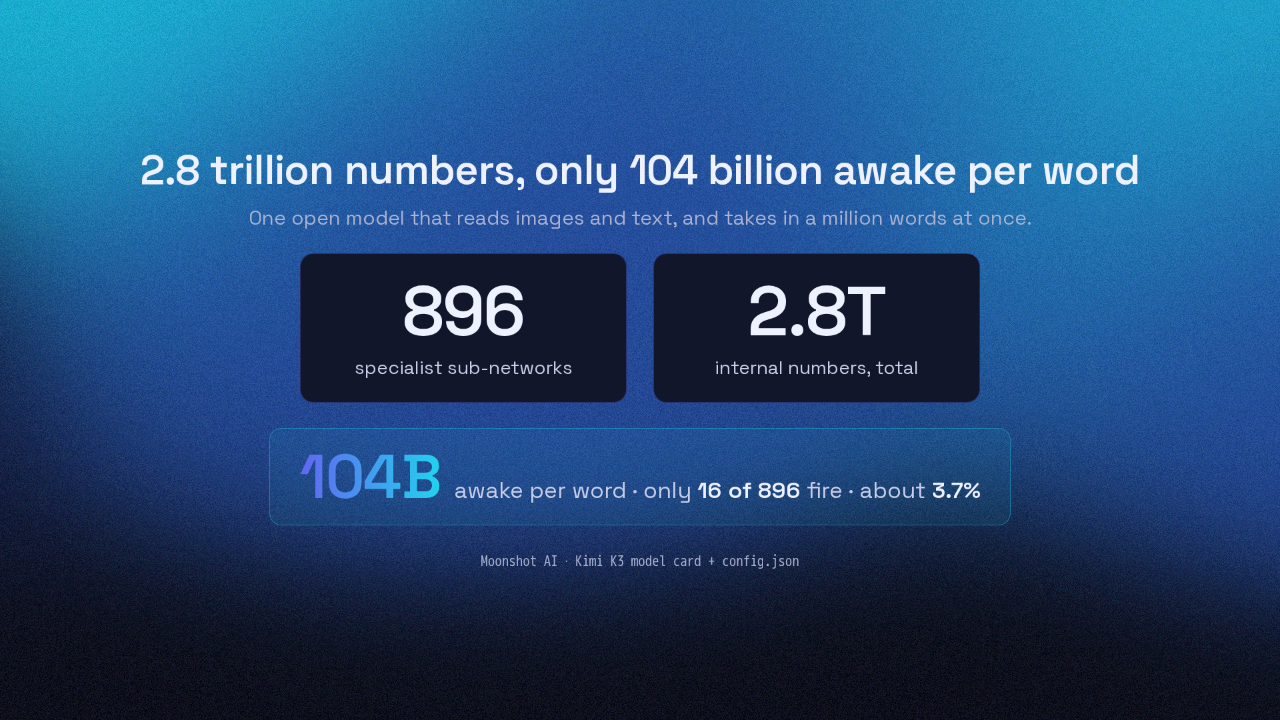
2.8 trillion numbers, only 104 billion awake per word
Kimi K3 is built as hundreds of small specialist sub-networks. Together they hold two-point-eight trillion internal numbers. But for each word, the model wakes only about a hundred and four billion of them. Kimi K3 also reads images, not just text, and takes in a million words at once, about a small library's worth.
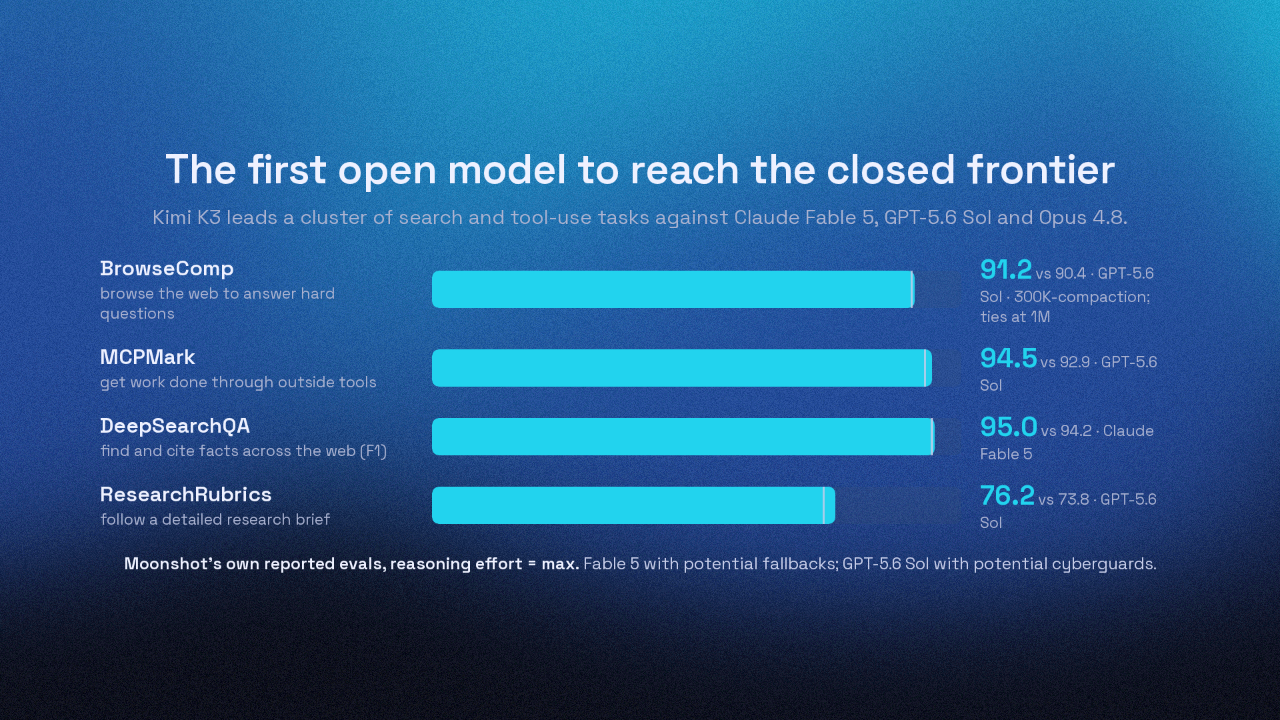
The first open model to reach the closed frontier
The strongest models have been paid and closed. Kimi K3 is the first open model you can download that trades blows with that closed frontier. On Moonshot's own reported tests, at maximum effort, it wins a real cluster of tasks that use web search and outside tools. It tops BrowseComp, an AI browsing the web to answer hard questions, just past GPT-5.6.
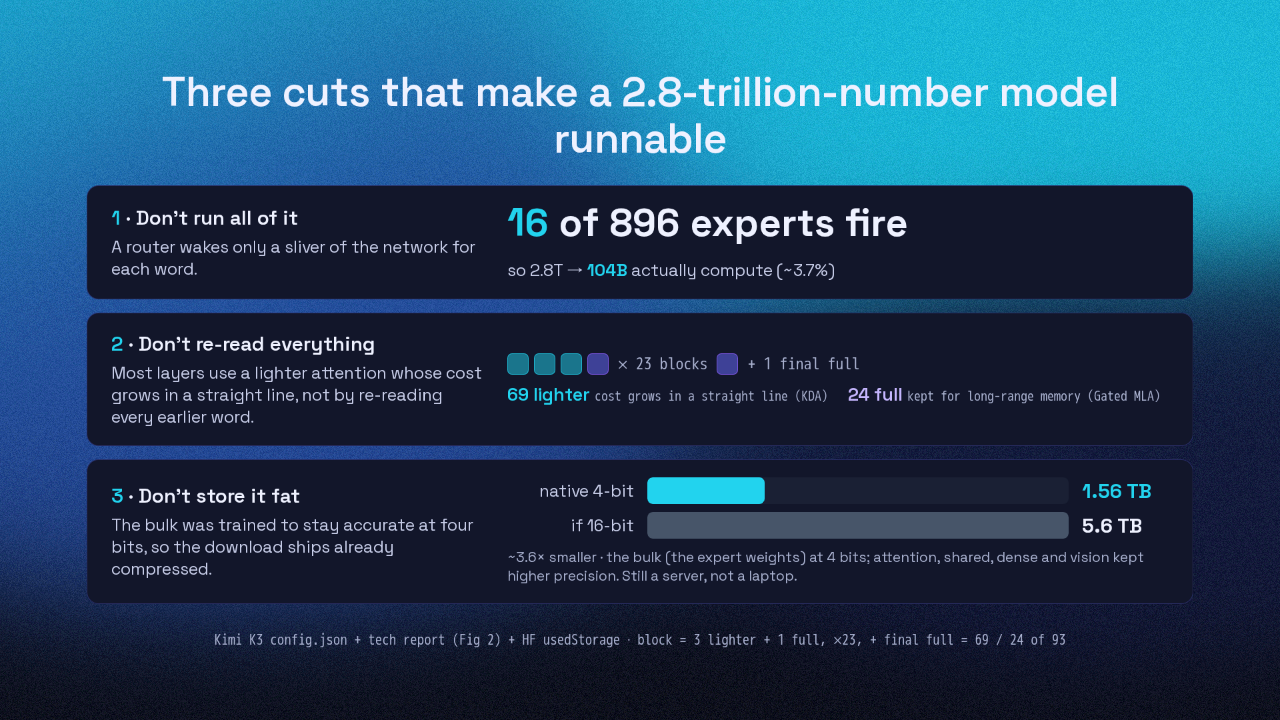
Three cuts that make a 2.8-trillion-number model runnable
So how do you train and run a model with trillions of internal numbers at all? Three cuts. First, don't run all of it. For each word, a router wakes just sixteen of eight hundred and ninety-six sub-networks. So only about a hundred and four billion numbers actually compute. Second, don't re-read everything. Normal attention re-reads every earlier word for each new word, and that explodes at a million words. So on sixty-nine of its ninety-three layers, Kimi K3 uses a lighter kind of attention whose cost grows in a straight line. Third, don't store it fat. The bulk of the model was trained to stay accurate at four bits instead of sixteen. So the download ships already compressed, about one-and-a-half terabytes instead of five-point-six. That's still a server, not a laptop.
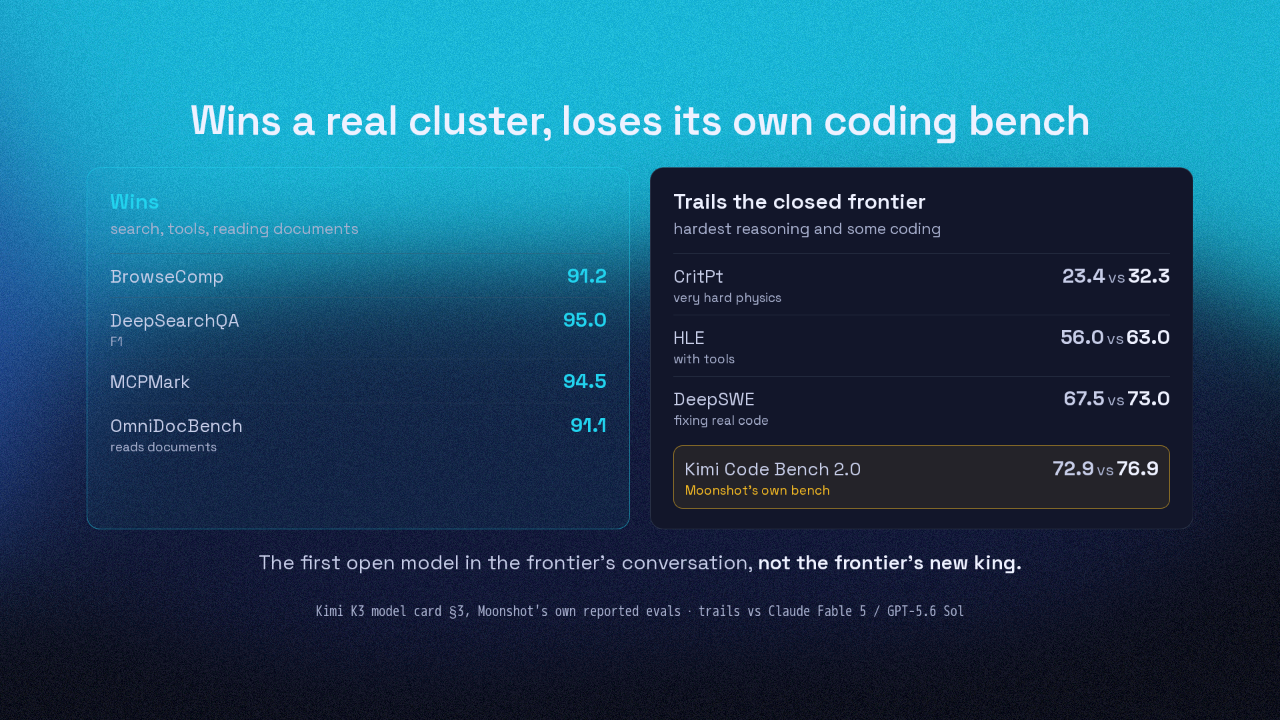
Wins a real cluster, loses its own coding bench
Those wins cluster in one place, using web search, outside tools, and reading documents. On the hardest reasoning and some coding, Kimi K3 trails the closed frontier. On CritPt, a set of very hard physics problems, it scores twenty-three to GPT-5.6's thirty-two. And on Moonshot's own coding benchmark, Kimi Code Bench, it loses, seventy-three to Claude Fable 5's seventy-seven. So it's the first open model in the frontier's conversation, not the frontier's new king.
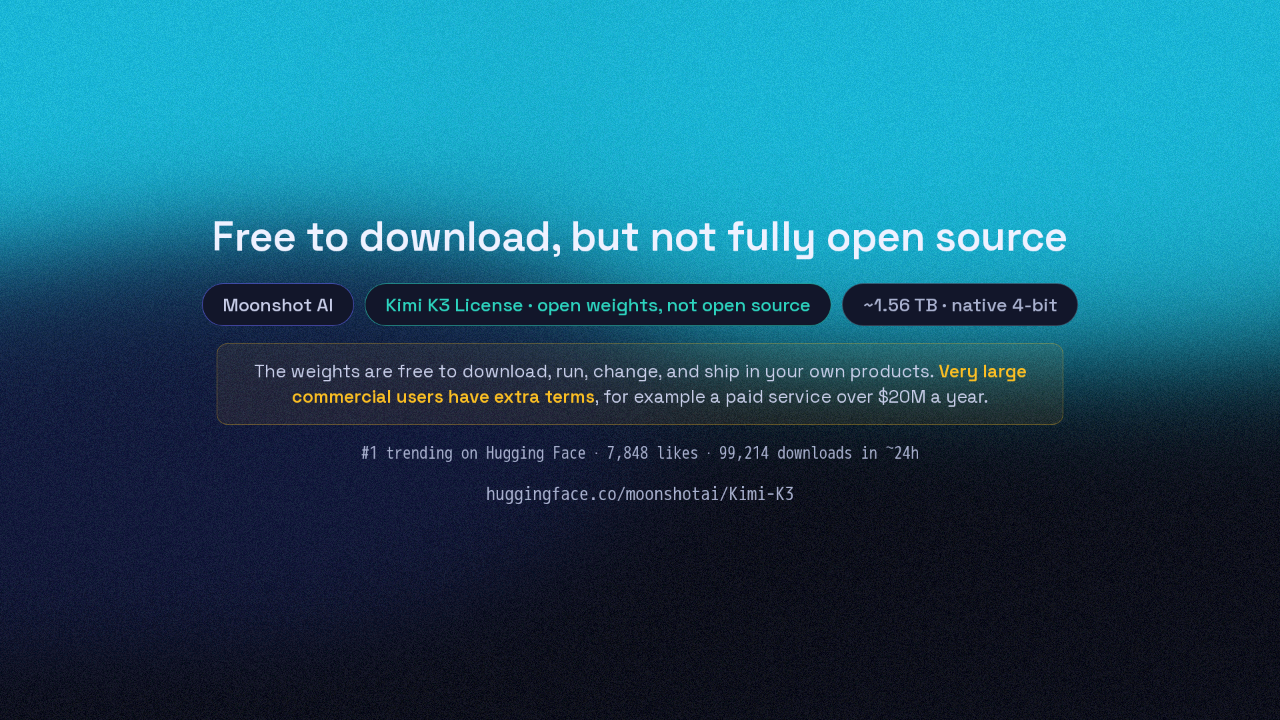
Free to download, but not fully open source
The weights are free to download, run, change, and even ship in your own products. But Kimi K3 is not fully open source. Its license adds extra terms for very large commercial users. So Moonshot calls it open weights, not open source.
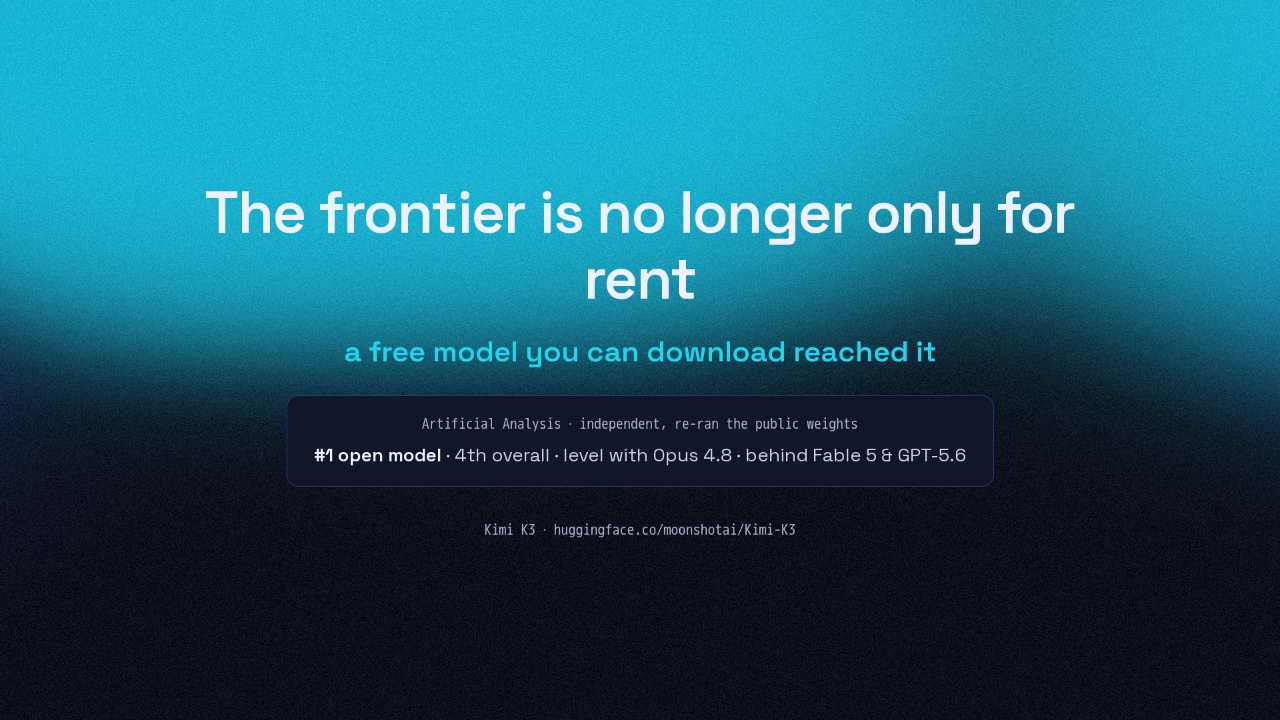
The frontier is no longer only for rent
So the frontier is no longer only something you rent from a company's servers. A free model you can download reached that frontier. And an independent board, Artificial Analysis, re-ran the public weights and landed in the same place: the top open model, level with Opus 4.8, still behind the very best.











