
DiffusionGemma, Google’s open model that writes text a whole block at a time

2 months ago

Every chatbot you have used writes its answer one word at a time. Google DeepMind’s DiffusionGemma writes a whole block of words at once, and sharpens them together. It is an open Gemma model, one you can download and run yourself, and the way it writes is borrowed from AI image generators.

Ask

Ask about this presentation

Answers are generated from this presentation.

Chapters

  1. 0:00DiffusionGemma, Google’s open model that writes text in parallel
  2. 0:14About 1,500 word-pieces a second on one chip, at a real accuracy cost
  3. 0:45A whole block at once, instead of one word at a time
  4. 1:15About 20 word-pieces filled in on each pass, across a 256-word canvas
  5. 1:52Built by converting Gemma 4, on under a tenth of its training data
  6. 2:26Behind its parent across the board, closest on knowledge and furthest on math
  7. 3:04Open weights on Hugging Face, the report on arXiv
  8. 3:16The speed is real, and so is the cost in accuracy
Show transcript

DiffusionGemma, Google’s open model that writes text in parallel

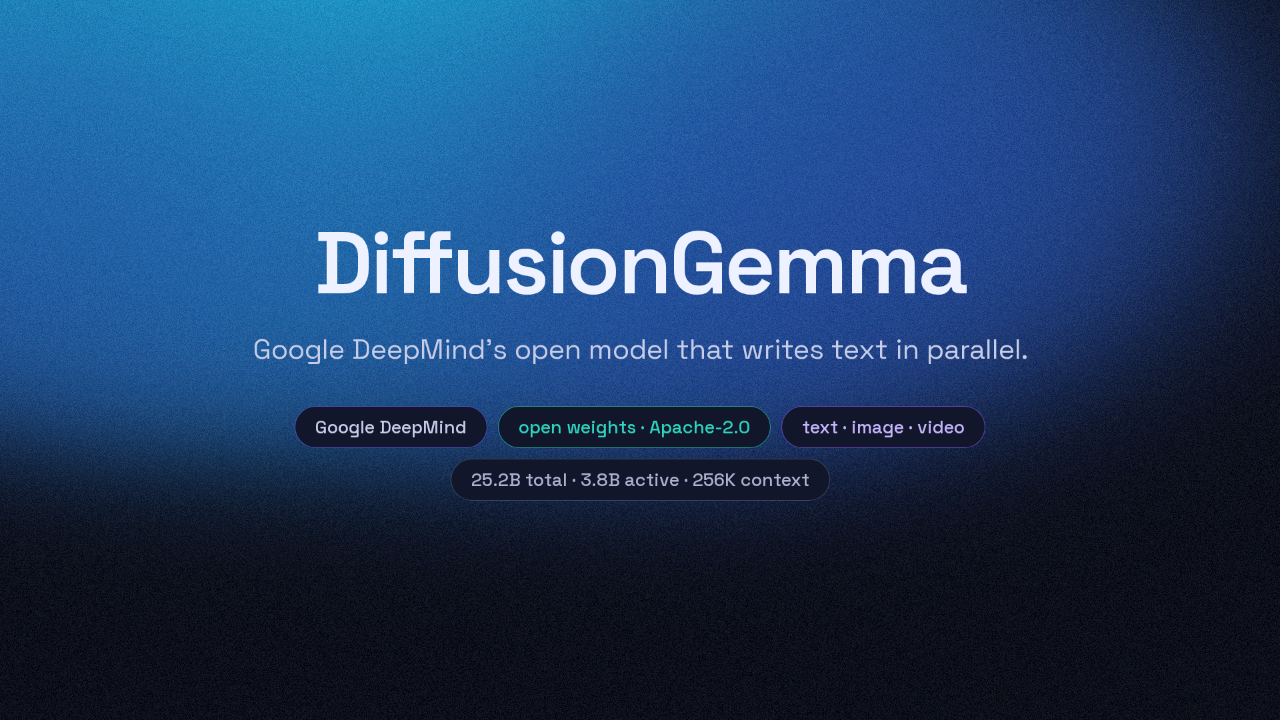
DiffusionGemma

Google DeepMind’s open model that writes text in parallel.
Google DeepMind open weights · Apache-2.0 text · image · video 25.2B total · 3.8B active · 256K context

Every chatbot you have used writes its answer one word at a time. Google DeepMind’s DiffusionGemma writes a whole block of words at once, and sharpens them together. It is an open Gemma model, one you can download and run yourself, and the way it writes is borrowed from AI image generators.

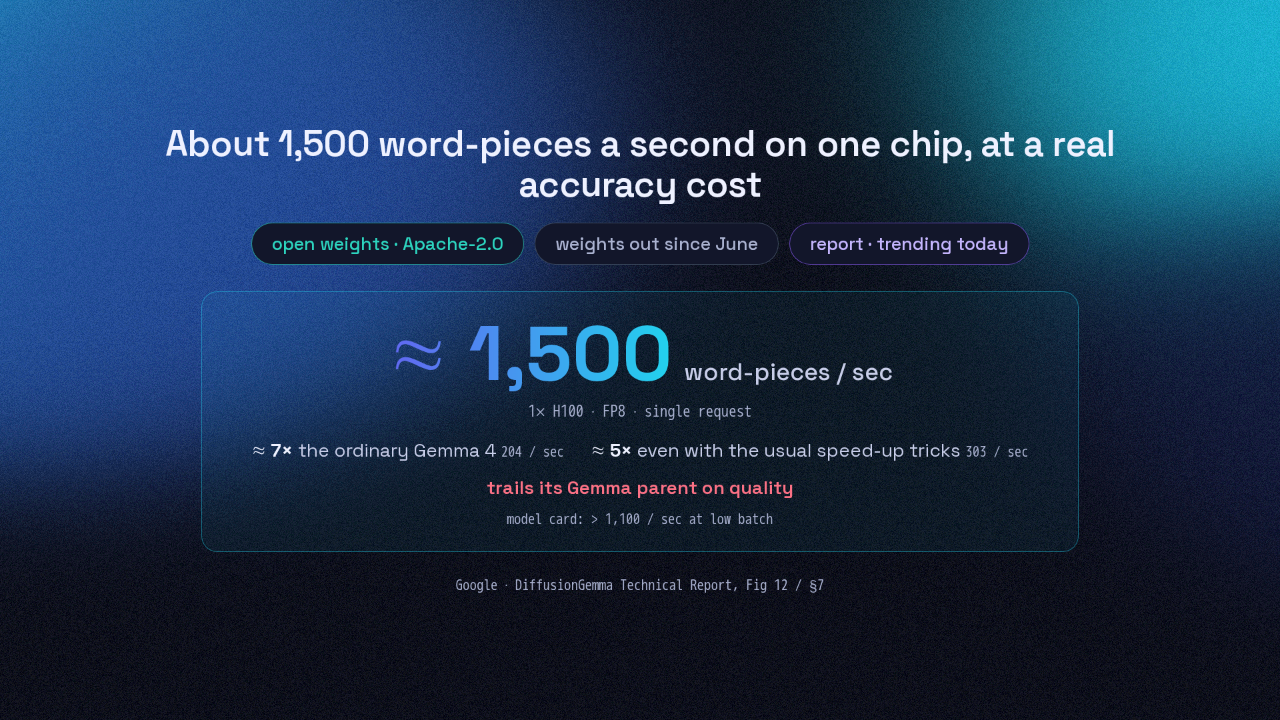
About 1,500 word-pieces a second on one chip, at a real accuracy cost

open weights · Apache-2.0 weights out since June report · trending today
≈ 1,500word-pieces / sec
1× H100 · FP8 · single request
≈ 7× the ordinary Gemma 4 204 / sec ≈ 5× even with the usual speed-up tricks 303 / sec
trails its Gemma parent on quality
model card: > 1,100 / sec at low batch
Google · DiffusionGemma Technical Report, Fig 12 / §7

DiffusionGemma is an open model from Google DeepMind, under Apache-2.0, so anyone can download and build on it. The weights have been out since June. What is new this week is the technical report that explains how the model works. The report is trending today. On one data-center graphics chip, answering a single request, Google reports about 1,500 word-pieces a second. A word-piece is just a small chunk of text. That is about seven times the ordinary Gemma it was built from. But it is less accurate than that same Gemma, and that trade is the whole story.

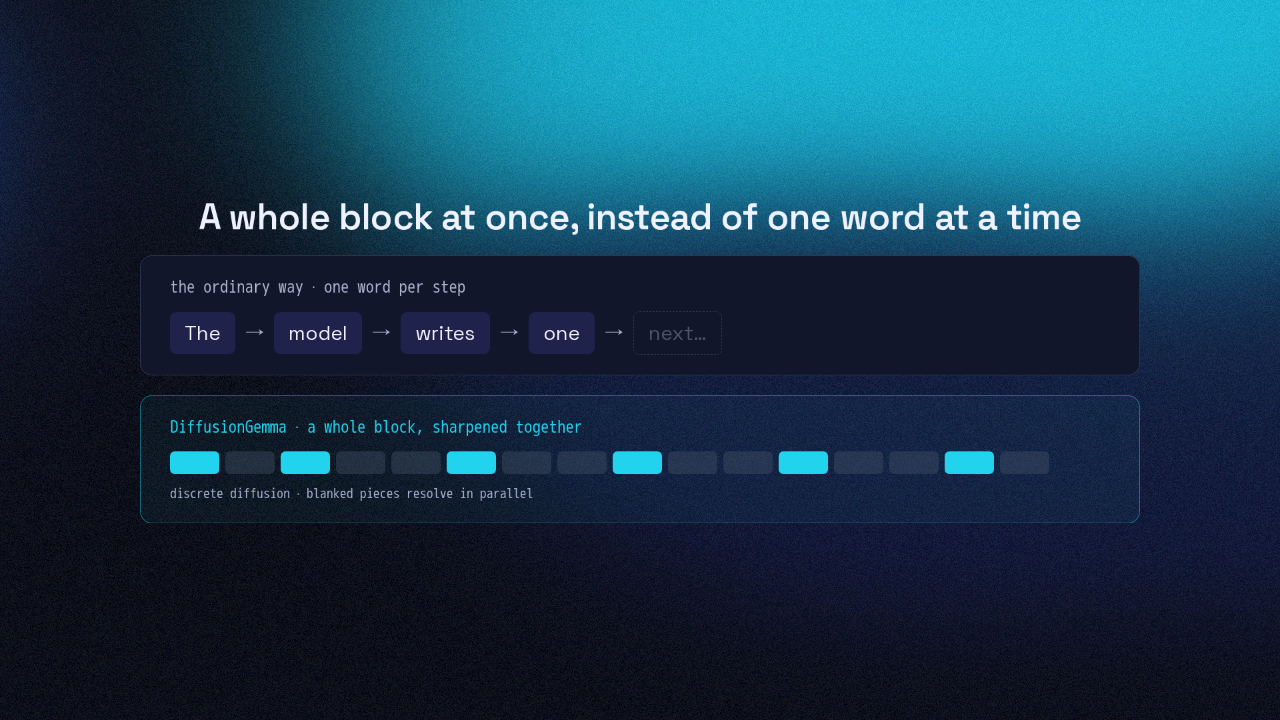
A whole block at once, instead of one word at a time

the ordinary way · one word per step
The→ model→ writes→ one→ next…
DiffusionGemma · a whole block, sharpened together
discrete diffusion · blanked pieces resolve in parallel

What is genuinely new is how it writes. Every chatbot works the same way, one word at a time. The model predicts a word, feeds it back, predicts the next, and the sentence grows only left to right. That is the speed bottleneck. DiffusionGemma borrows the idea behind AI image generators. An image generator starts from a rough, noisy picture and sharpens it over a few passes. DiffusionGemma does the same thing with words. Google calls it discrete diffusion decoding.

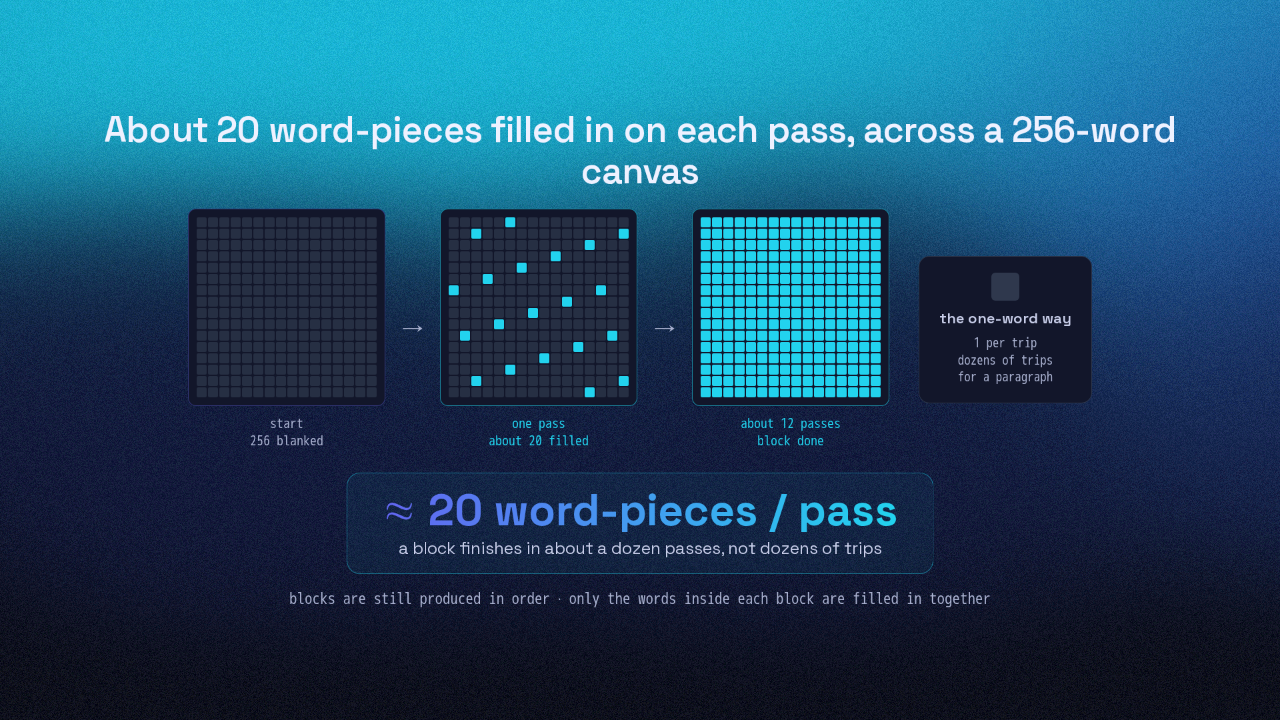
About 20 word-pieces filled in on each pass, across a 256-word canvas

start
256 blanked
→
one pass
about 20 filled
→
about 12 passes
block done
the one-word way
1 per trip
dozens of trips
for a paragraph
≈ 20 word-pieces / pass
a block finishes in about a dozen passes, not dozens of trips
blocks are still produced in order · only the words inside each block are filled in together

DiffusionGemma starts each block as a canvas of 256 word-pieces, all blanked out. Then, in one trip through the model, it looks at the whole canvas and fills in its best guess for many positions at once. It repeats that a few times, each pass sharpening the block. Google reports it resolves about 20 word-pieces on every pass, and finishes a block in around a dozen passes. So a paragraph that the one-word way needs dozens of separate trips for takes only a handful. That is where the speed comes from: far fewer trips, the sevenfold jump on one chip from before. The blocks are still produced in order; only the words inside each block are filled in together.

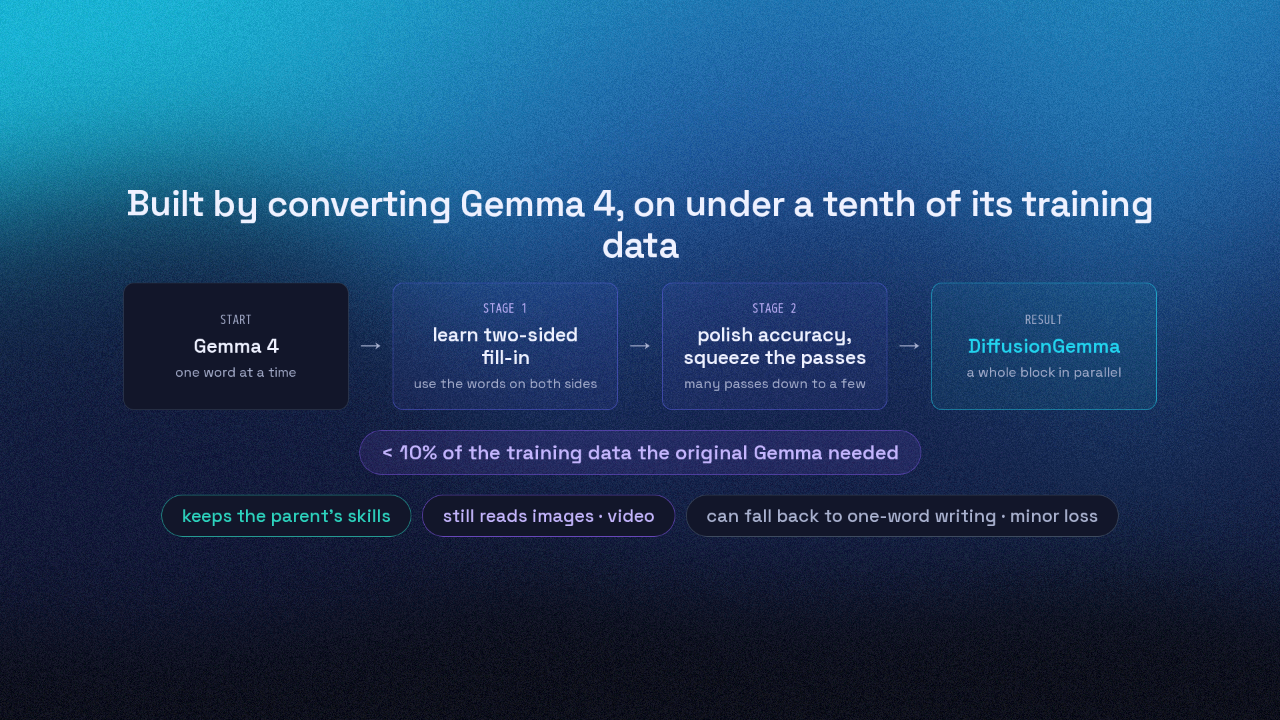
Built by converting Gemma 4, on under a tenth of its training data

START
Gemma 4
one word at a time
→
STAGE 1
learn two-sided fill-in
use the words on both sides
→
STAGE 2
polish accuracy, squeeze the passes
many passes down to a few
→
RESULT
DiffusionGemma
a whole block in parallel
< 10% of the training data the original Gemma needed
keeps the parent’s skills still reads images · video can fall back to one-word writing · minor loss

Google did not train this from scratch. They took the ordinary Gemma 4 and converted its text half to work by diffusion, in two stages, on under 10% of the data the original Gemma needed. Stage one taught it to fill in blanked-out words using the words on both sides. An ordinary chatbot can never do that, because it only sees what came before. Stage two polished accuracy and speed together, squeezing many sharpening passes down to a few. Because it was converted, not rebuilt, it keeps the parent’s skills. It still reads images and video, and can even fall back to ordinary one-word writing with only minor loss.

Behind its parent across the board, closest on knowledge and furthest on math

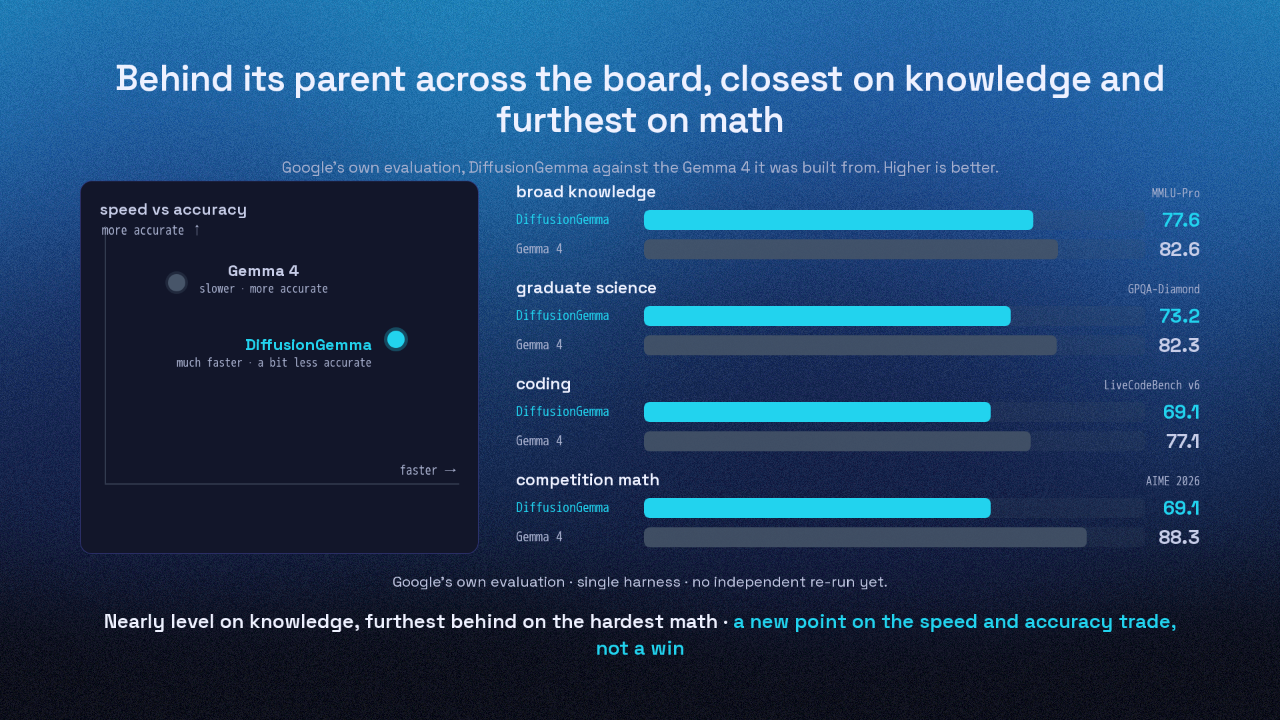
Google’s own evaluation, DiffusionGemma against the Gemma 4 it was built from. Higher is better.
speed vs accuracy
more accurate ↑ faster → Gemma 4slower · more accurate DiffusionGemmamuch faster · a bit less accurate
broad knowledgeMMLU-Pro
DiffusionGemma77.6
Gemma 482.6
graduate scienceGPQA-Diamond
DiffusionGemma73.2
Gemma 482.3
codingLiveCodeBench v6
DiffusionGemma69.1
Gemma 477.1
competition mathAIME 2026
DiffusionGemma69.1
Gemma 488.3
Google’s own evaluation · single harness · no independent re-run yet.
Nearly level on knowledge, furthest behind on the hardest math · a new point on the speed and accuracy trade, not a win

These numbers are all Google’s own reported tests, DiffusionGemma against the ordinary Gemma 4 it was built from. It trails the parent across the board, and the gap is uneven. On broad knowledge it is nearly level, 77.6 to the parent’s 82.6. On graduate-level science questions, 73.2 to 82.3. On coding problems, 69.1 to 77.1. On hard competition math the gap blows open, 69.1 to 88.3. It holds up on broad knowledge, and falls furthest behind on the hardest math. Google’s report frames the result that way itself, a new point on the trade between speed and accuracy, not a win.

Open weights on Hugging Face, the report on arXiv

weightshuggingface.co/google/diffusiongemma-26B-A4B-it
reportarXiv 2608.00146
open weights · Apache-2.0 ungated
1,159 likes · 2.0M downloads on Hugging Face

Everything is out in the open. The weights are on Hugging Face, ungated, under the same permissive Apache-2.0 license. And the technical report, this week’s news, is on arXiv. The links are on screen.

The speed is real, and so is the cost in accuracy

a whole block at once, not one word at a time
open weights · Apache-2.0 arXiv 2608.00146

A chatbot writes one word at a time. DiffusionGemma borrows the trick behind image generators to sharpen a whole block at once, and runs several times faster on a single chip. Google’s own numbers show that speed costs accuracy, most on the hardest reasoning. The interesting part is not a leaderboard. It is a genuinely different way to write text, and the first clear map of what it costs.


Up next

2:58

Apodex 1.1 mini · the same file, run alone and run as a team

@ai-ml-today · 1 month ago

3:09

Ornith-1.5 · an open model trained on problems it wrote for itself

@ai-ml-today · 1 month ago

3:08

MOSS-VL · an open 11B video model trained to decide, after every frame, whether to speak or stay silent

@ai-ml-today · 1 month ago

3:29

Qwen3.8-27B · a 27B open model anyone can download averages 84.3 across real desktop jobs on Qwen’s own run, and loses the widest row on its own card by nine points

@ai-ml-today · 1 month ago

3:15

MiLMMT-46-v1.0 · Xiaomi finished training an open translator on sentences that had no translation attached, and the scores it now leads on are produced by the two models that graded it

@ai-ml-today · 1 month ago

3:31

BDH-CQ — a 150M-parameter system that learns a puzzle rule from the worked examples in front of it and does its thinking as numbers, never as words

@ai-ml-today · 2 months ago

3:29

Muse Glimmer 30B, Meta’s open agent model, and the second tiny model that guesses sixteen words ahead so it runs fast on one consumer graphics card

@ai-ml-today · 2 months ago

3:05

JoyAI-Video-Edit, JD’s open 16B model that edits a video while the video is still playing, at about 30 frames a second on one Nvidia B200

@ai-ml-today · 2 months ago

3:26

Inkling-Small, Thinking Machines’ 12B-active / 276B open mixture-of-experts model that out-reasons its own 3.5× bigger flagship

@ai-ml-today · 2 months ago

3:42

Maple-Preview, DeepGrove’s 20-billion-parameter ternary reasoning model that runs on a Mac mini

@ai-ml-today · 2 months ago

3:16

Hunyuan3D-Buffalo, Tencent’s one model that builds, understands, and edits 3D from words

@ai-ml-today · 2 months ago

3:28

MiniMax H3, an open model that makes a video and its soundtrack in one pass

@ai-ml-today · 2 months ago









