Your AI's mock passes. Then production breaks.

2 months ago

You told your coding agent to wire up Stripe. The mock returned two hundred OK, then production threw a four-oh-four on the next call. Meet FetchSandbox.

Ask

Ask about this presentation

Answers are generated from this presentation.

Chapters

  1. 0:00Slide 1
  2. 0:08An ordinary mock has no memory.
  3. 0:17The whole lifecycle, not one green check.
  4. 0:28One line in your MCP config.
  5. 0:38Every run is a replayable receipt.
  6. 0:51Product, not a feature.
  7. 1:06Free tier, five dollars a month after.
Show transcript

Slide 1

Your AI's mock passes. Then production breaks.
Stateful fakes of 50+ real APIs, right in your IDE.
FetchSandbox Dev Tools API Testing MCP

You told your coding agent to wire up Stripe. The mock returned two hundred OK, then production threw a four-oh-four on the next call. Meet FetchSandbox.

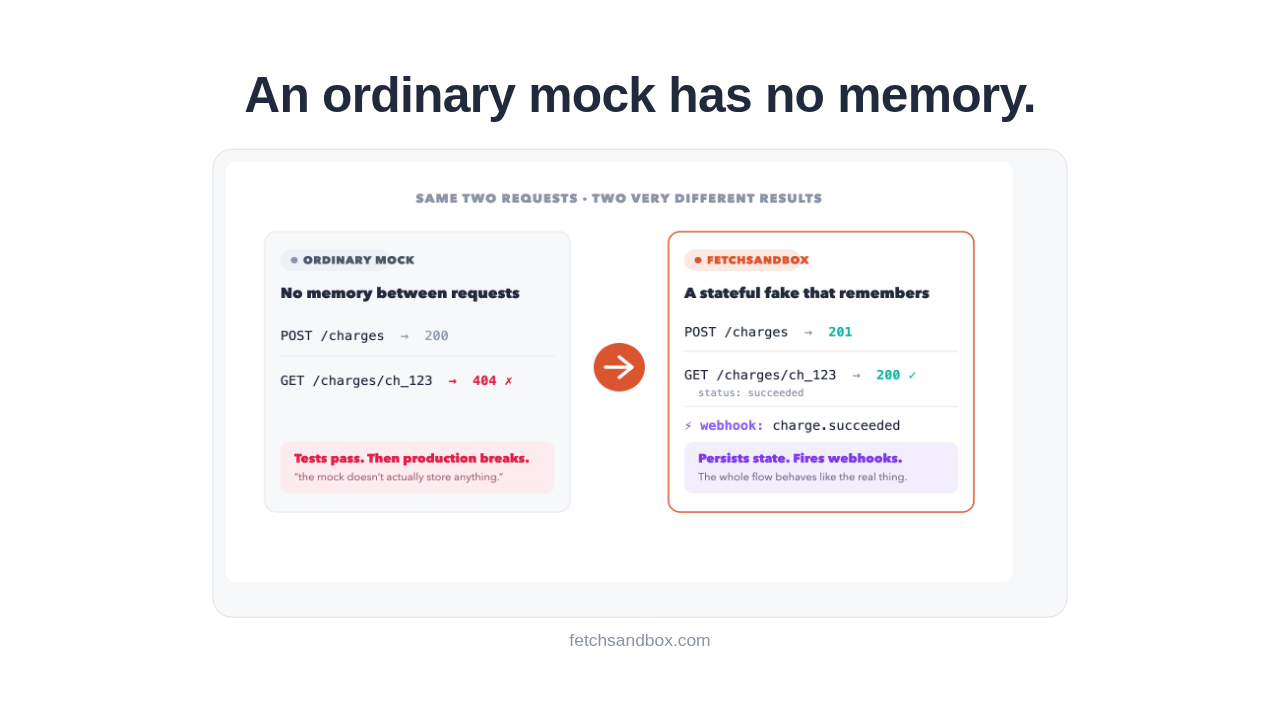
An ordinary mock has no memory.

Same two calls, two results. Ordinary mock: POST slash charges returns 200, then GET slash charges slash ch underscore 123 returns 404 and fails; tests pass, then production breaks. FetchSandbox: POST returns 201, GET returns 200 with status succeeded, and a charge dot succeeded webhook fires; it persists state and fires webhooks.
fetchsandbox.com

Here's why. An ordinary mock keeps no memory between calls, so the second one comes back a four-oh-four. FetchSandbox is a stateful fake of fifty-plus real APIs that actually remembers.

The whole lifecycle, not one green check.

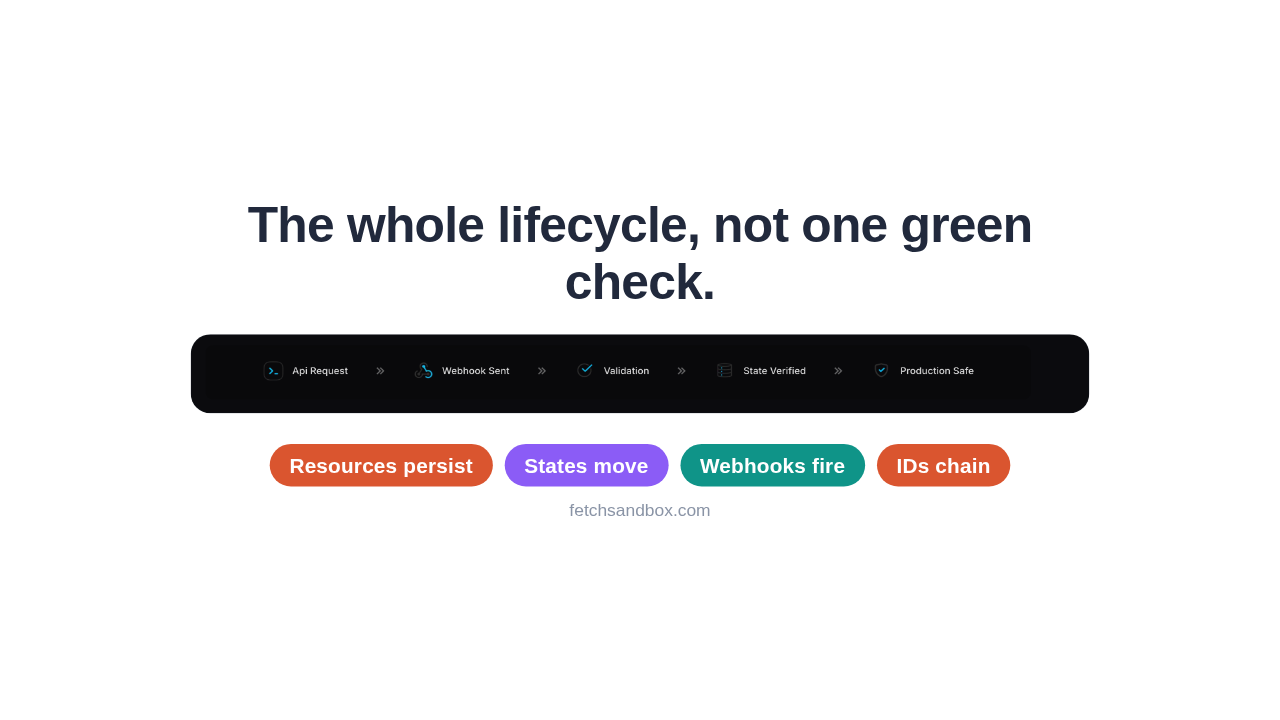
A five-stage lifecycle strip: Api Request, then Webhook Sent, then Validation, then State Verified, then Production Safe.
Resources persist States move Webhooks fire IDs chain
fetchsandbox.com

Stateful means four things a plain mock can't do. What you POST is there on the next GET. Resources move through real states. Webhooks actually fire. And IDs chain. The whole lifecycle, not one green check.

One line in your MCP config.

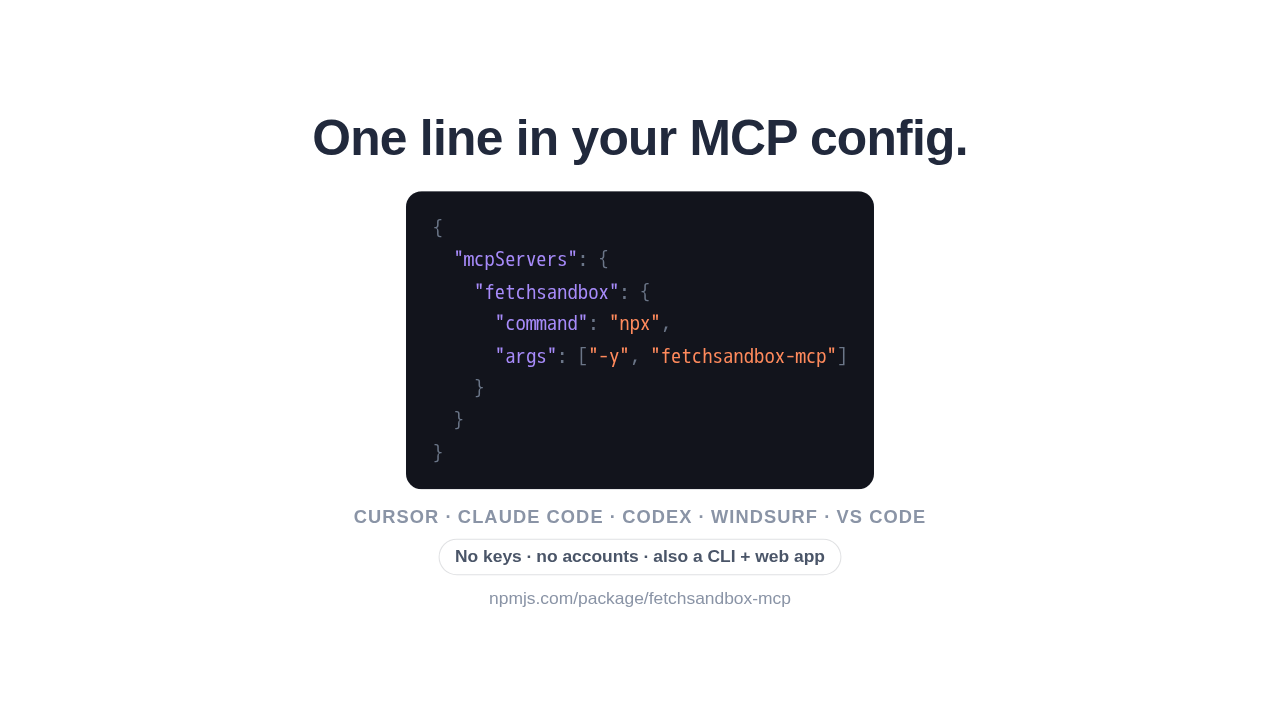
{
  "mcpServers": {
    "fetchsandbox": {
      "command": "npx",
      "args": ["-y", "fetchsandbox-mcp"]
    }
  }
}
Cursor · Claude Code · Codex · Windsurf · VS Code
No keys · no accounts · also a CLI + web app
npmjs.com/package/fetchsandbox-mcp

It installs as an MCP server in one line, no keys, no accounts, into Cursor, Claude Code, and Codex. So the agent that just wrote your integration can test it itself, headless.

Every run is a replayable receipt.

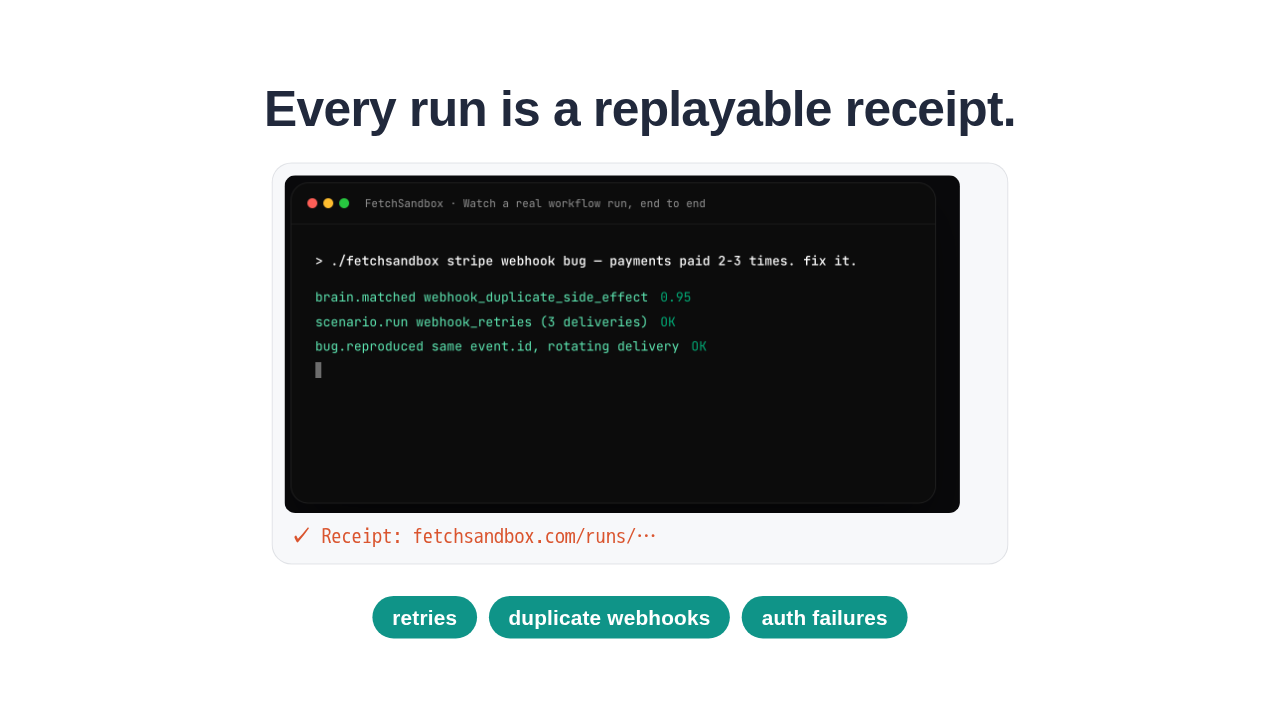
A FetchSandbox terminal running a real workflow: fetchsandbox stripe webhook bug, payments paid two to three times, fix it. It reports brain matched webhook duplicate side effect, scenario run webhook retries three deliveries OK, and bug reproduced same event id rotating delivery OK.
✓ Receipt: fetchsandbox.com/runs/…
retries duplicate webhooks auth failures

And here's the clever part. Every run hands you a replayable receipt link . Drop it in a pull request or Slack, and anyone replays the exact bug, no real API, no burned quota. It even fakes the failures, retries, duplicate webhooks, auth errors.

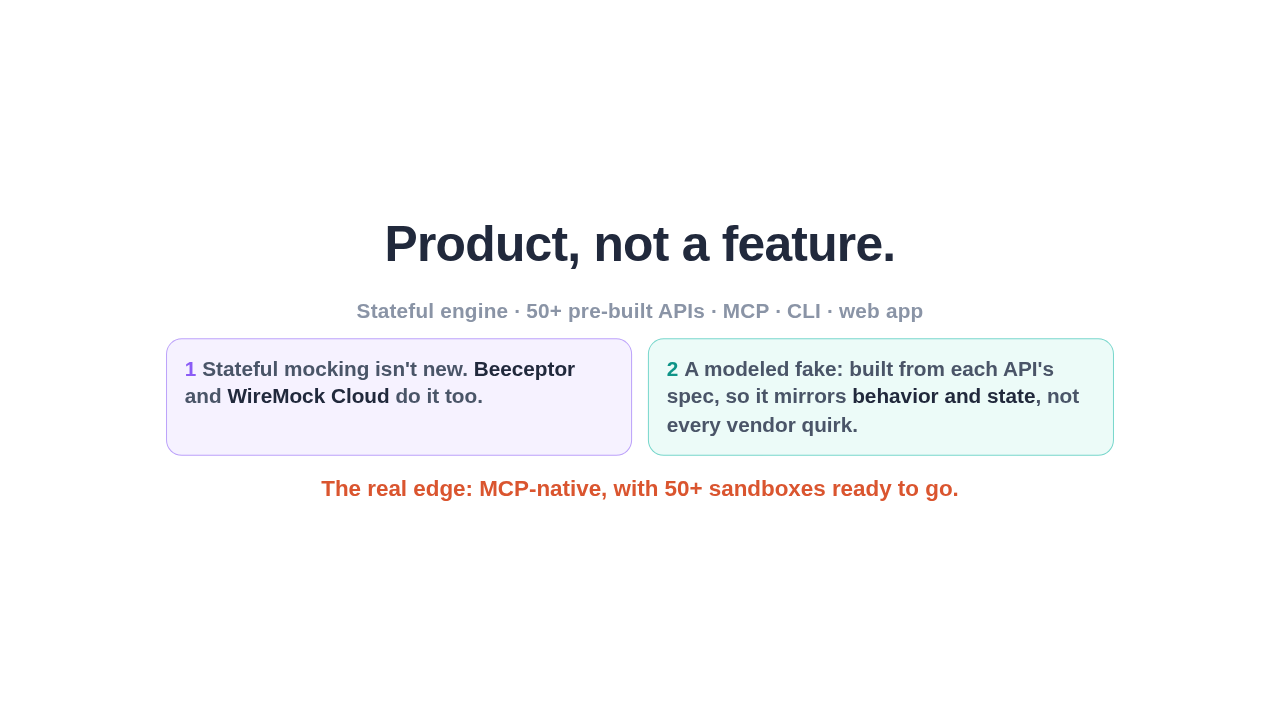
Product, not a feature.

Stateful engine · 50+ pre-built APIs · MCP · CLI · web app
1Stateful mocking isn't new. Beeceptor and WireMock Cloud do it too.
2A modeled fake: built from each API's spec, so it mirrors behavior and state, not every vendor quirk.
The real edge: MCP-native, with 50+ sandboxes ready to go.

So, product or feature? Definitely a product, a real engine with fifty-plus pre-built APIs. But two things worth knowing. Stateful mocking isn't brand new, and it's a modeled fake, so it mirrors behavior and state, not every vendor quirk. Its real edge is being MCP-native, out of the box.

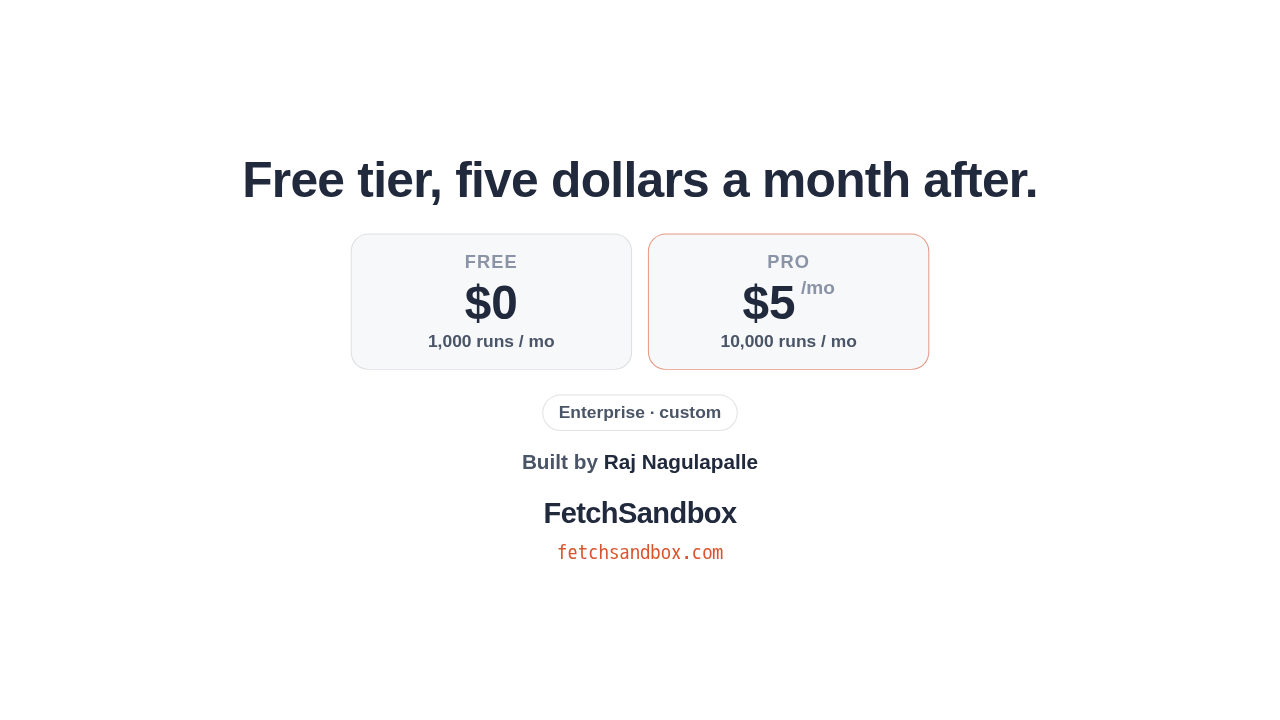
Free tier, five dollars a month after.

Free
$0
1,000 runs / mo
Pro
$5 /mo
10,000 runs / mo
Enterprise · custom
Built by Raj Nagulapalle
FetchSandbox
fetchsandbox.com

Pricing is plain, free tier, five dollars a month after. It's built by Raj Nagulapalle, who spent years wiring API integrations. If your AI writes integrations, this catches the bug before production does.