Every MiMo-V2.6-Pro pay-as-you-go rate, multiplied by ten
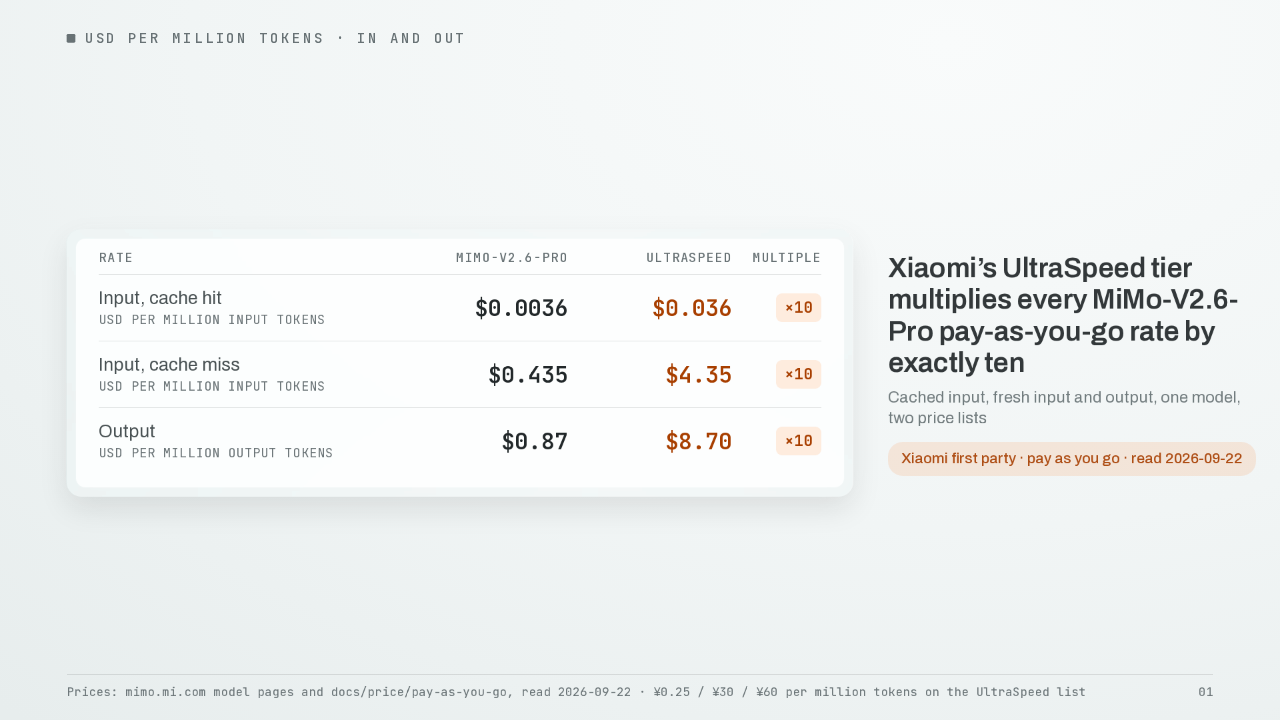
Xiaomi’s UltraSpeed tier multiplies every MiMo-V2.6-Pro pay-as-you-go rate by exactly ten
Cached input, fresh input and output, one model, two price lists
Xiaomi now sells MiMo-V2.6-Pro-UltraSpeed, a second listing of its flagship model, priced ten times higher per token. Tokens are the chunks of text a model reads and writes, about three quarters of a word each, and Xiaomi bills for them by the million. Output on MiMo-V2.6-Pro costs eighty-seven cents per million output tokens, and on MiMo-V2.6-Pro-UltraSpeed, eight dollars and seventy cents per million output tokens. Xiaomi moved the input rates by the same multiple, and not one of the three is rounded. Every one is exactly ten. And Xiaomi calls UltraSpeed a mode of MiMo-V2.6-Pro, with zero compromise on capability.
The claim Xiaomi sells the tier on
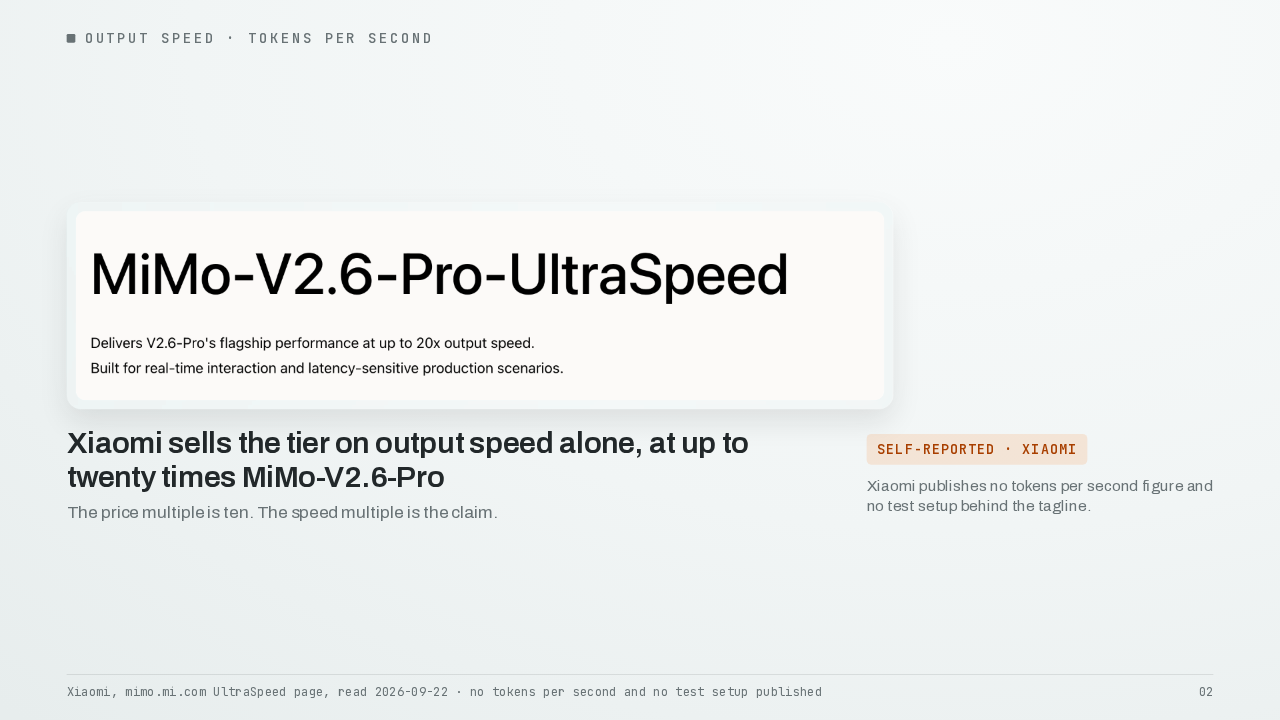
Xiaomi sells the tier on output speed alone, at up to twenty times MiMo-V2.6-Pro
The price multiple is ten. The speed multiple is the claim.
Xiaomi publishes no tokens per second figure and no test setup behind the tagline.
Ten times is the price multiple. Xiaomi advertises a second multiple, for speed. Xiaomi's page sells UltraSpeed on output speed, which is how fast the answer streams back to you, counted in tokens per second. Xiaomi's tagline promises MiMo-V2.6-Pro's flagship performance at up to twenty times output speed. The twenty times figure is Xiaomi's own. Xiaomi publishes no tokens per second figure and no test behind it. If the model underneath is the same, the premium buys one thing, and that thing is waiting time.
The spec card: context, price in, price out, speed, licence
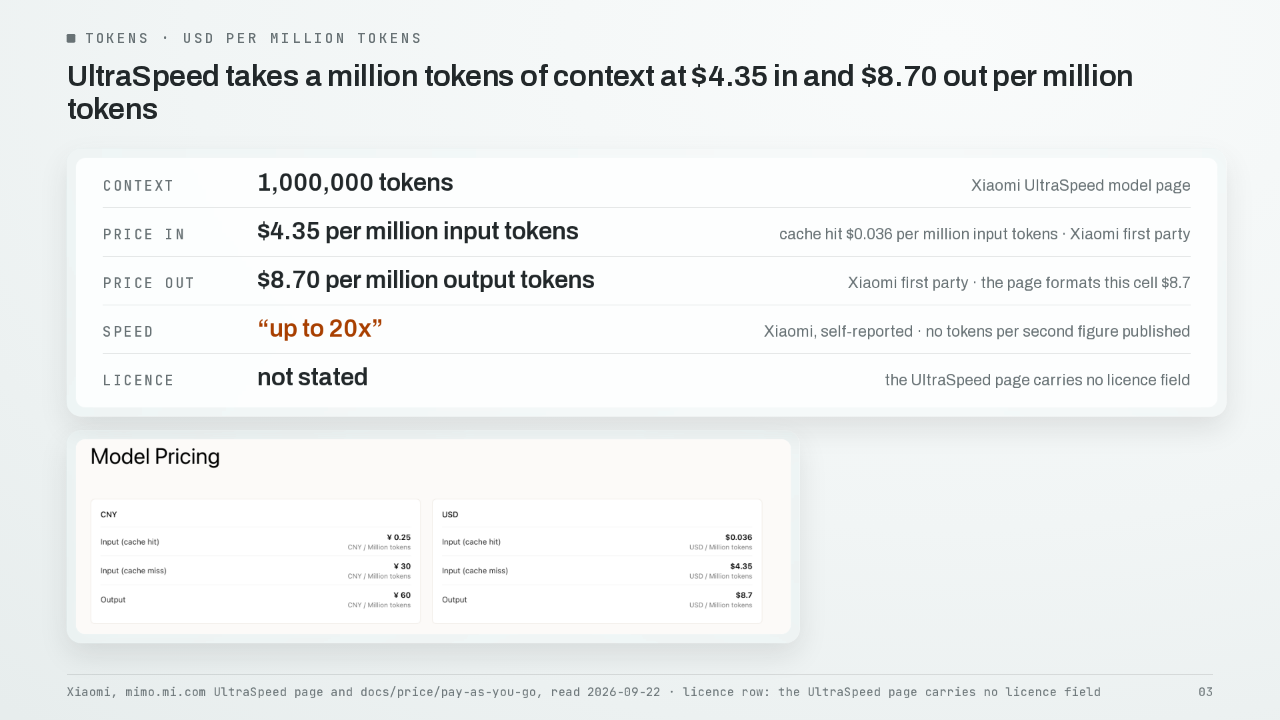
UltraSpeed takes a million tokens of context at $4.35 in and $8.70 out per million tokens
Xiaomi's own pricing page for UltraSpeed, read today, lists every price in yuan with dollars beside it. The context window is one million tokens, the amount of text UltraSpeed can hold in one conversation. Input runs four dollars and thirty-five cents per million input tokens. The speed row is Xiaomi's up to twenty times, which is where a measured tokens per second reading would sit if one existed. The licence row reads not stated, because Xiaomi's UltraSpeed page carries no licence field at all.
OpenRouter says the checkpoint is the same
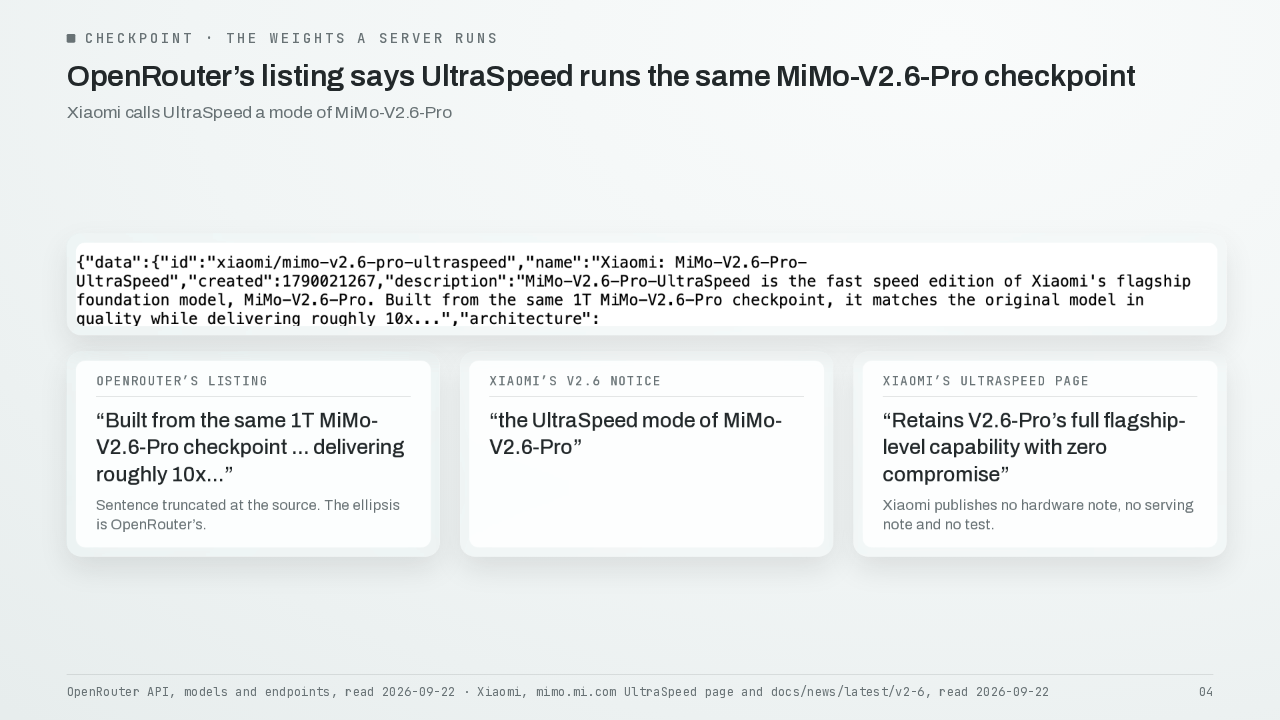
OpenRouter’s listing says UltraSpeed runs the same MiMo-V2.6-Pro checkpoint
Xiaomi calls UltraSpeed a mode of MiMo-V2.6-Pro
A checkpoint is the saved file of a trained model, the weights a server actually runs. The same checkpoint gives you the same brain. OpenRouter is a marketplace that resells access to many models, and OpenRouter's listing describes UltraSpeed as built from the same MiMo-V2.6-Pro checkpoint. Xiaomi uses its own words. Xiaomi's release notice calls UltraSpeed a mode of MiMo-V2.6-Pro, and Xiaomi's page promises full flagship capability with zero compromise. Xiaomi publishes nothing about how UltraSpeed gets faster. There is no hardware note, no serving note, and no test.
The money: ten times the task cost, the same score
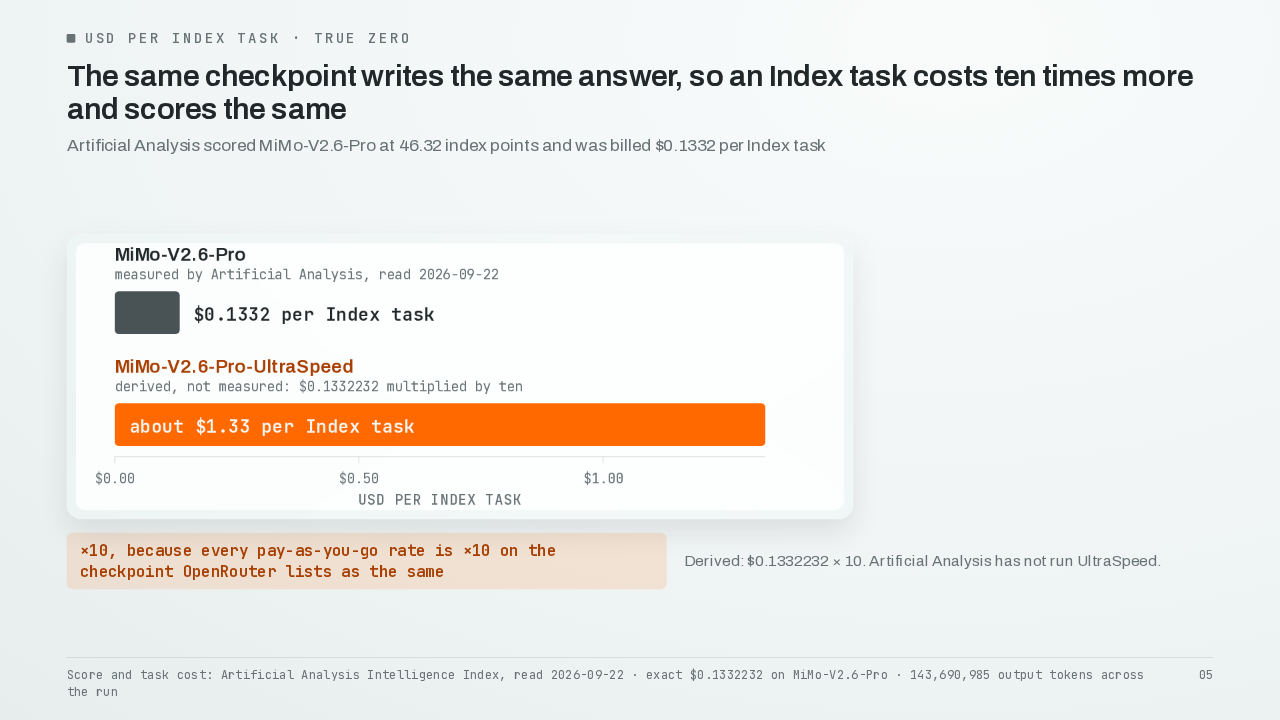
The same checkpoint writes the same answer, so an Index task costs ten times more and scores the same
Artificial Analysis scored MiMo-V2.6-Pro at 46.32 index points and was billed $0.1332 per Index task
Derived: $0.1332232 × 10. Artificial Analysis has not run UltraSpeed.
Artificial Analysis is an independent outfit. Artificial Analysis runs its own set of tasks against every model, scores each one on an Intelligence Index, and records what it was billed to get each task answered. On MiMo-V2.6-Pro, Artificial Analysis scored forty-six point three two index points, and was billed thirteen point three cents per Index task. OpenRouter lists UltraSpeed as that same checkpoint, so UltraSpeed writes the same answers, and the same answers take the same number of tokens to write. Every one of Xiaomi's pay-as-you-go rates is ten times higher, so the same task lands at about one dollar and thirty-three cents per Index task. That figure is derived from Xiaomi's price sheet. Artificial Analysis has not run UltraSpeed. Speed never enters that sum.
The wait: what the fixed premium actually buys
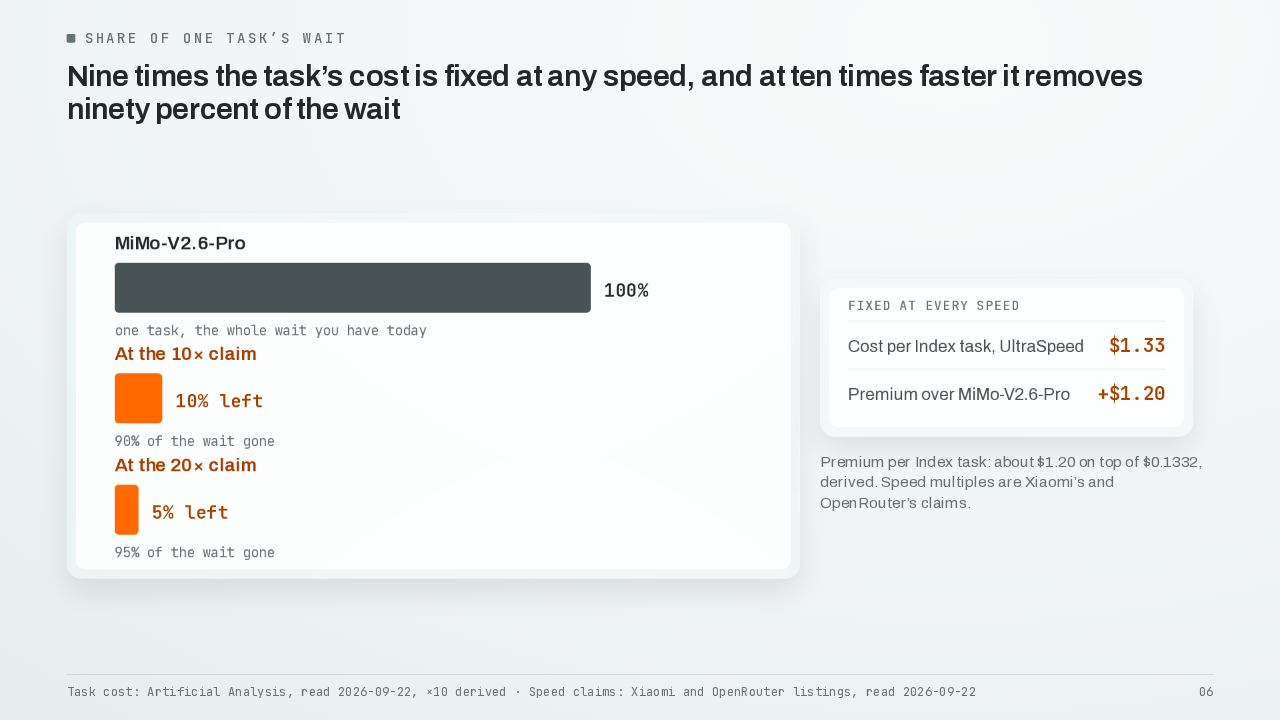
Nine times the task’s cost is fixed at any speed, and at ten times faster it removes ninety percent of the wait
Premium per Index task: about $1.20 on top of $0.1332, derived. Speed multiples are Xiaomi’s and OpenRouter’s claims.
So the premium is a fixed amount. On an Index task it is about one dollar and twenty cents on top of thirteen point three cents, which is nine times what the task costs today. That nine times holds whatever the speed turns out to be. What moves with the speed is the share of the wait that disappears. At ten times faster, ninety percent of the wait is gone. At twenty times faster, ninety-five percent. So going from the lower speed claim to the higher one moves the wait you avoid by five points, and moves your bill by nothing at all. The question you answer is whether one shorter wait is worth nine times what that task costs you today, and you answer it from your own wait.
Who has measured the speed
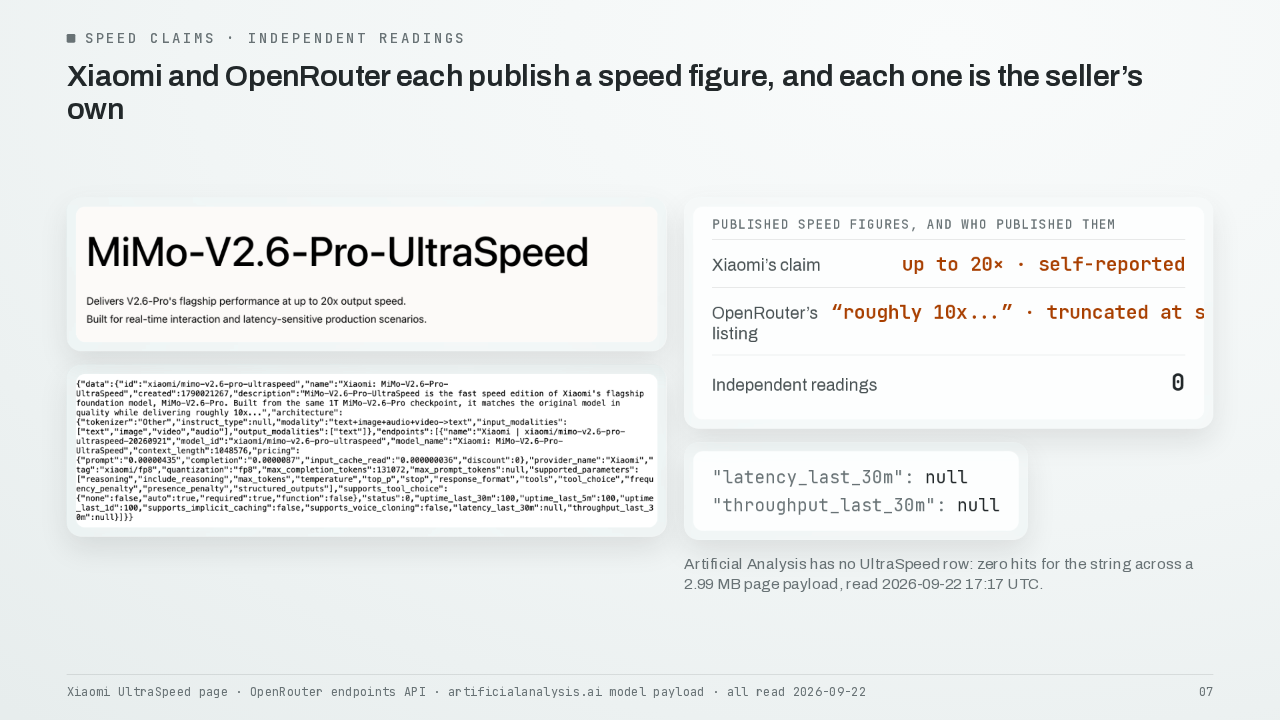
Xiaomi and OpenRouter each publish a speed figure, and each one is the seller’s own
"throughput_last_30m": null
Artificial Analysis has no UltraSpeed row: zero hits for the string across a 2.99 MB page payload, read 2026-09-22 17:17 UTC.
Two speed figures are published, and a seller published both of them. Xiaomi's page says up to twenty times. OpenRouter's listing says roughly ten times, and that sentence is cut off at the source, so the ellipsis belongs to OpenRouter. For an outside reading there are two places to look. Artificial Analysis has no row for UltraSpeed. OpenRouter's throughput field for the UltraSpeed endpoint reads null, the value that field carries before anything has been measured. So the count of independent speed readings today is zero. A single tokens per second reading from an outside lab settles whether either speed-up is real.
The trial price is over
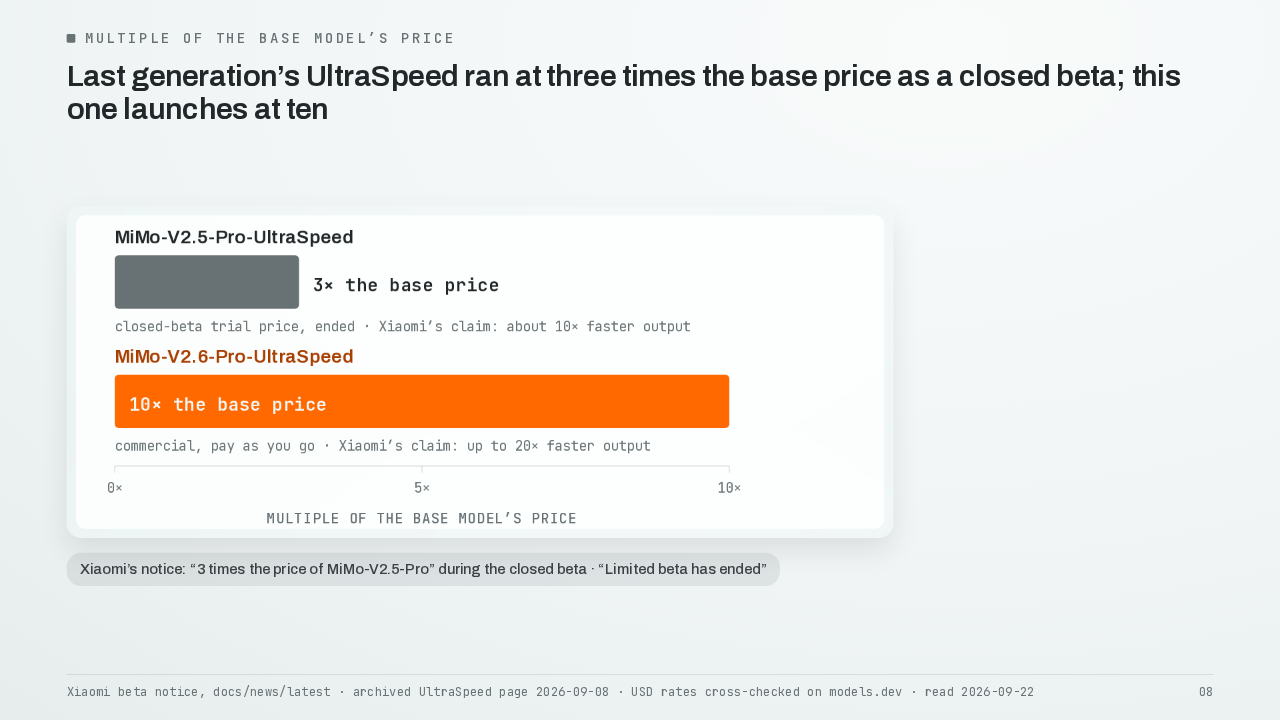
Last generation’s UltraSpeed ran at three times the base price as a closed beta; this one launches at ten
Xiaomi ran an UltraSpeed tier on the previous generation too. Xiaomi's own notice called it a limited-time trial price during a closed beta, at three times the price of MiMo-V2.5-Pro, with output speed approximately ten times faster. Xiaomi then closed that beta, and wrote that the official commercial version would launch soon. This is that commercial version, and it launched at ten times the base price.
What to run: the queue is where the lists separate
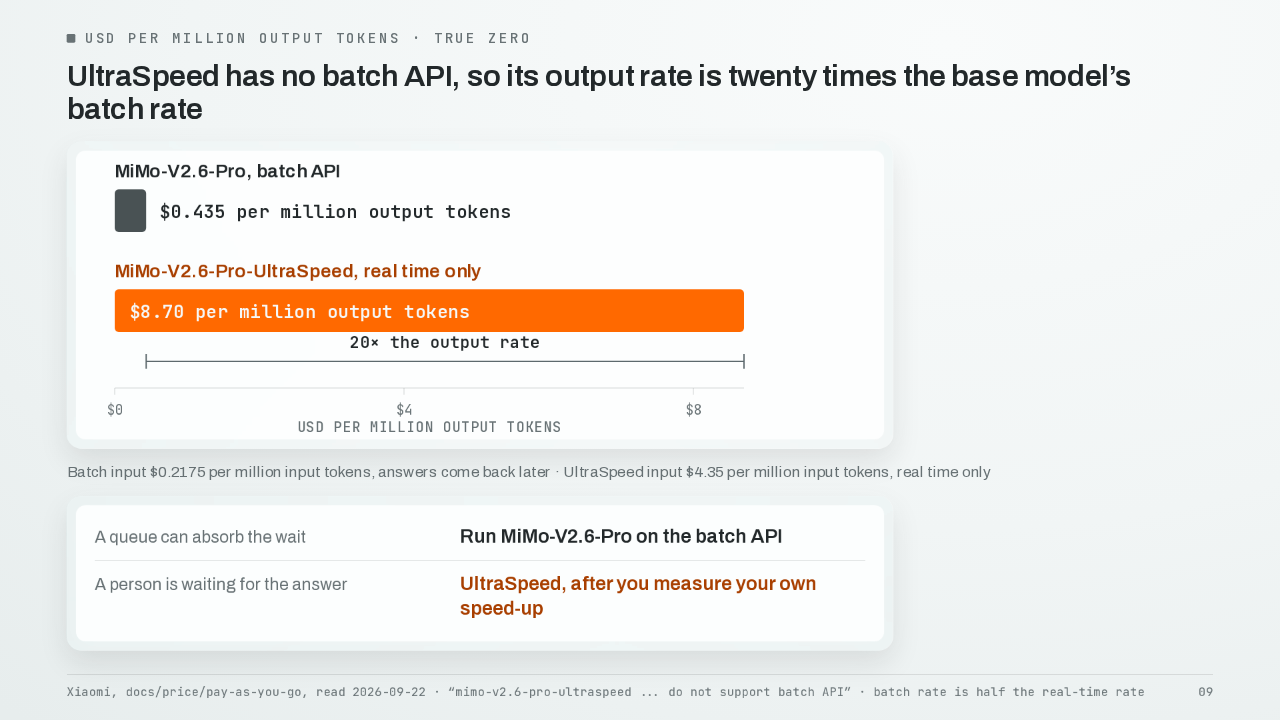
UltraSpeed has no batch API, so its output rate is twenty times the base model’s batch rate
Batch input $0.2175 per million input tokens, answers come back later · UltraSpeed input $4.35 per million input tokens, real time only
Xiaomi also runs a batch API, where you hand a pile of jobs over to be answered later, at half the real-time rate. On MiMo-V2.6-Pro that puts output at forty-three and a half cents per million output tokens, and input at twenty-one and three quarter cents per million input tokens. Xiaomi's own documentation says UltraSpeed does not support the batch API. So a queue of background jobs is the one place where the base model's rate drops and UltraSpeed's stays where it is. Run MiMo-V2.6-Pro for anything a queue can absorb. Keep UltraSpeed for the case where a person is waiting, and measure your own speed-up before you spend on it.
The board, with the new dot placed
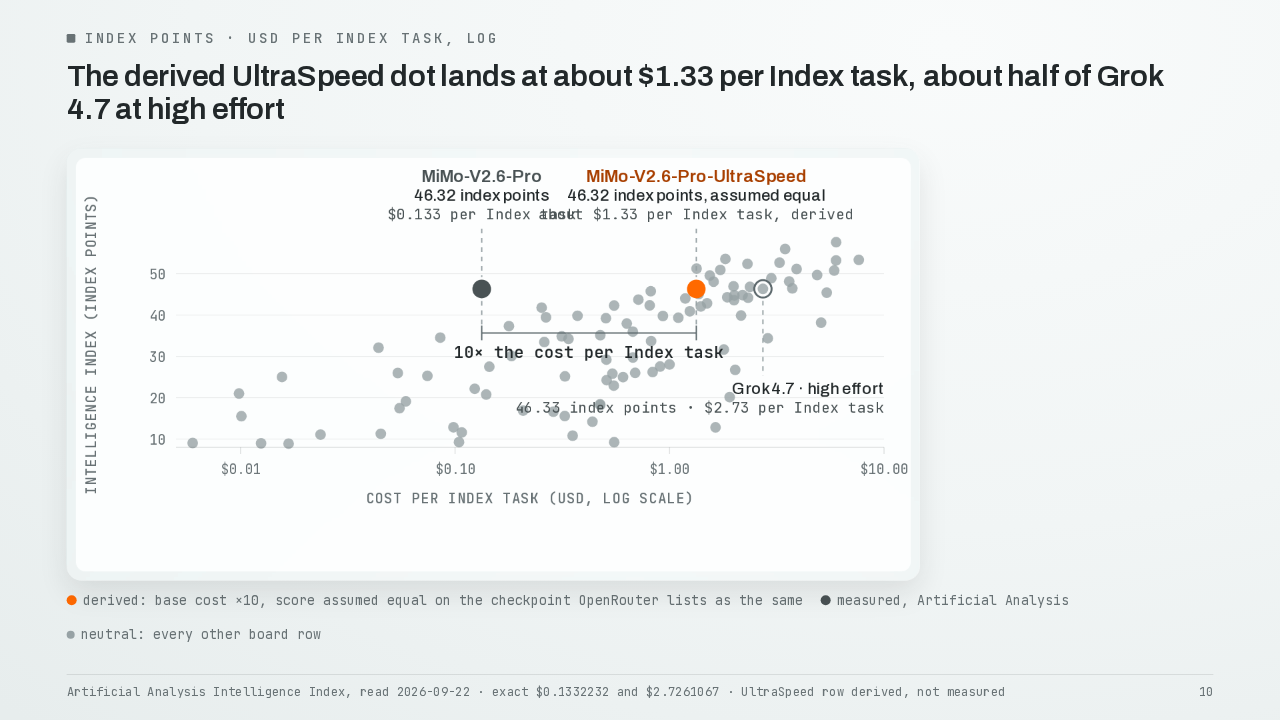
The derived UltraSpeed dot lands at about $1.33 per Index task, about half of Grok 4.7 at high effort
On the Artificial Analysis board, the UltraSpeed dot lands at about one dollar and thirty-three cents per Index task, at the same forty-six point three two index points, because Artificial Analysis has not scored UltraSpeed and OpenRouter lists the same checkpoint underneath. Grok 4.7 at high effort scores forty-six point three three index points, and Artificial Analysis was billed two dollars and seventy-three cents per Index task to run it. Even after the ten times markup, UltraSpeed comes out at about half the price of the model it ties. What the markup buys is time. How much time is still Xiaomi's own number.