Claude Opus 5.5: 20% off the token
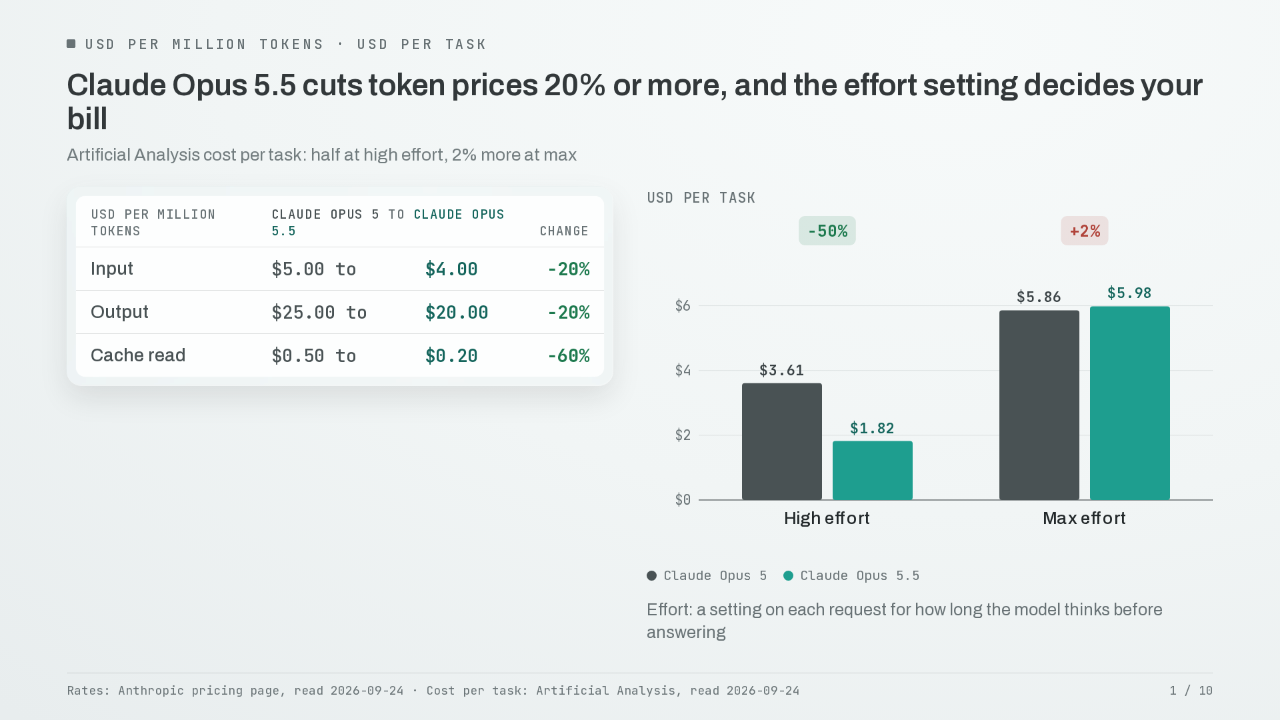
Claude Opus 5.5 cuts token prices 20% or more, and the effort setting decides your bill
Artificial Analysis cost per task: half at high effort, 2% more at max
| USD per million tokens | Claude Opus 5 to Claude Opus 5.5 | change | |
|---|---|---|---|
| Input | $5.00 to | $4.00 | −20% |
| Output | $25.00 to | $20.00 | −20% |
| Cache read | $0.50 to | $0.20 | −60% |
Effort: a setting on each request for how long the model thinks before answering
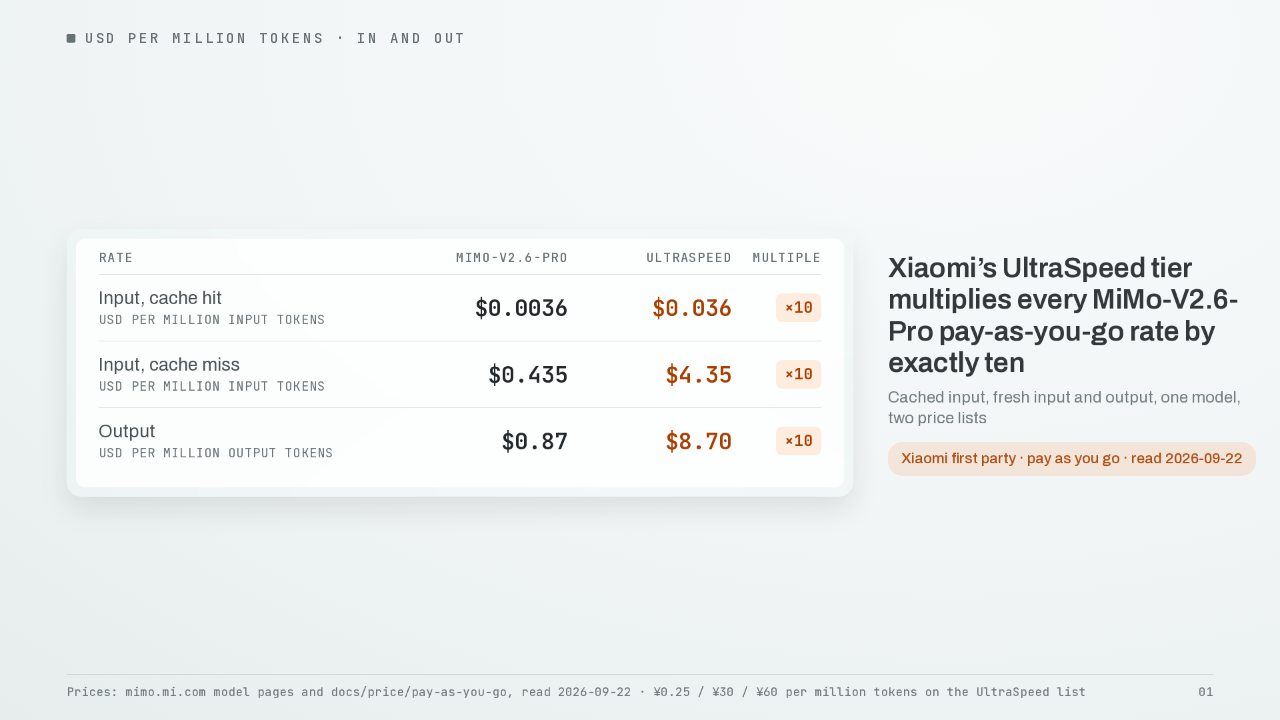
Claude Opus 5.5 cuts token prices by at least twenty percent. One setting decides whether your bill halves or rises. Anthropic charges by the token, a small chunk of text. Input, the text you send, fell from five dollars to four dollars per million tokens. Output, the text the model writes back, fell from twenty-five dollars to twenty dollars per million tokens. Artificial Analysis is an independent company that runs the same tests on every model and records what each task costs. Effort is a setting on each request for how long the model thinks before it answers. At high effort, Artificial Analysis measures Claude Opus 5.5 at one dollar eighty-two per task, against three dollars sixty-one for Claude Opus 5. At max effort, Artificial Analysis measures five dollars ninety-eight per task against five dollars eighty-six. By the end you'll know which setting you're on without picking one.
The spec card
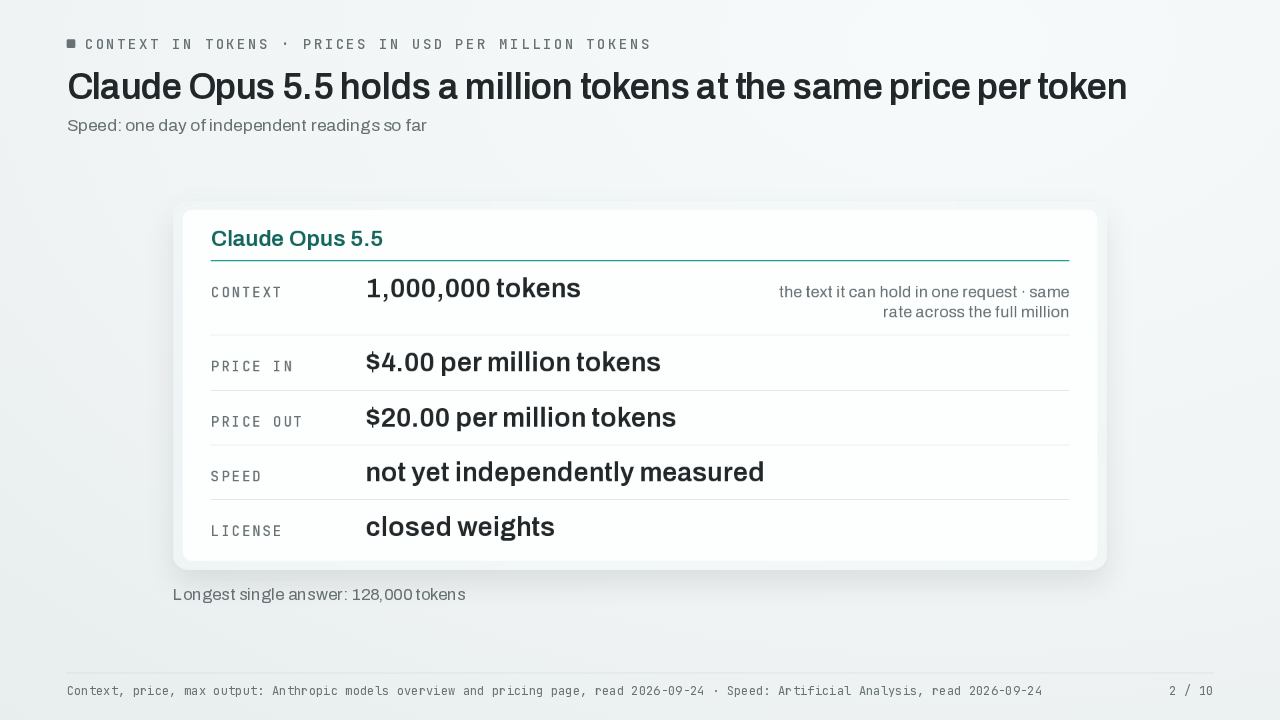
Claude Opus 5.5 holds a million tokens at the same price per token
Speed: one day of independent readings so far
Longest single answer: 128,000 tokens
Claude Opus 5.5's context window, how much text it can hold in one request, is one million tokens, all billed at the same rate per token. Artificial Analysis's speed readings for Claude Opus 5.5 are one day old, so the speed field reads not yet independently measured. Anthropic keeps the weights closed.
Anthropic’s 40%, and a new default
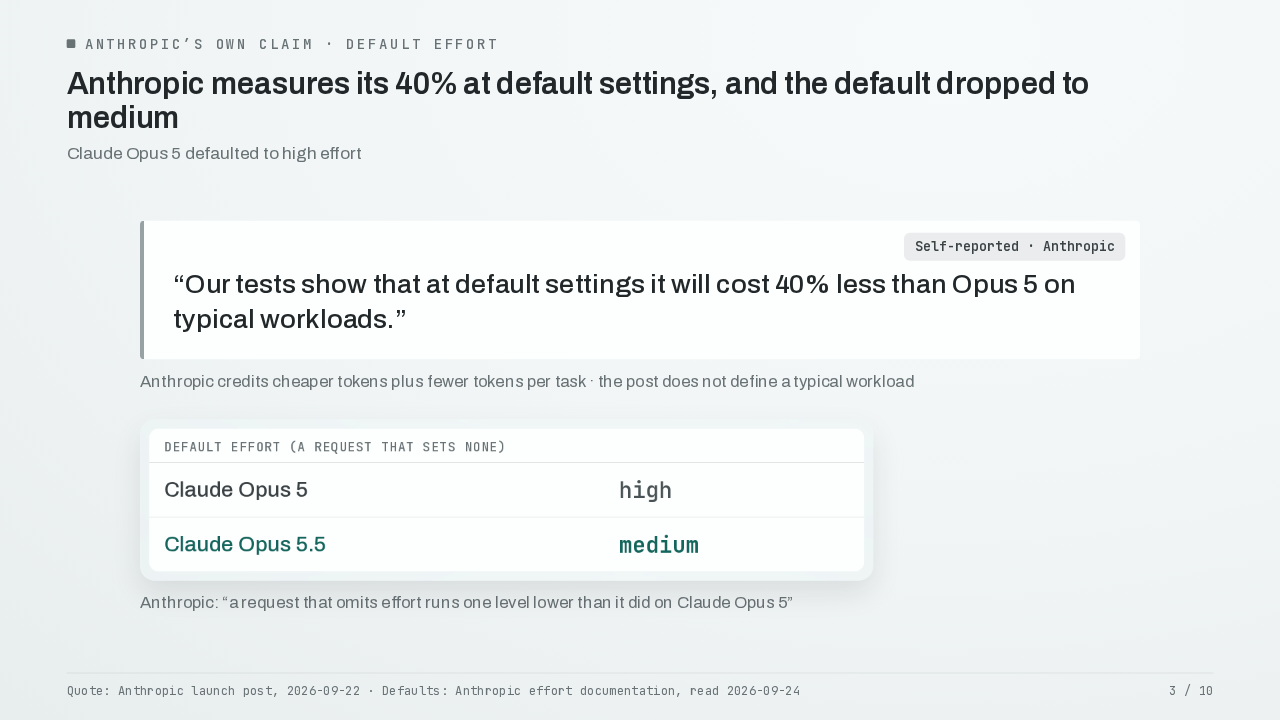
Anthropic measures its 40% at default settings, and the default dropped to medium
Claude Opus 5 defaulted to high effort
“Our tests show that at default settings it will cost 40% less than Opus 5 on typical workloads.”
Anthropic credits cheaper tokens plus fewer tokens per task · the post does not define a typical workload
| Default effort (a request that sets none) | |
|---|---|
| Claude Opus 5 | high |
| Claude Opus 5.5 | medium |
Anthropic: “a request that omits effort runs one level lower than it did on Claude Opus 5”
Anthropic's launch post says, quote, our tests show that at default settings it will cost forty percent less than Opus 5 on typical workloads. The post credits cheaper tokens and fewer tokens per task. The post never defines a typical workload. Anthropic's effort documentation says Claude Opus 5.5 defaults to medium effort, where Claude Opus 5 defaulted to high. So a request that leaves effort unset runs one level lower on Claude Opus 5.5.
Price times tokens
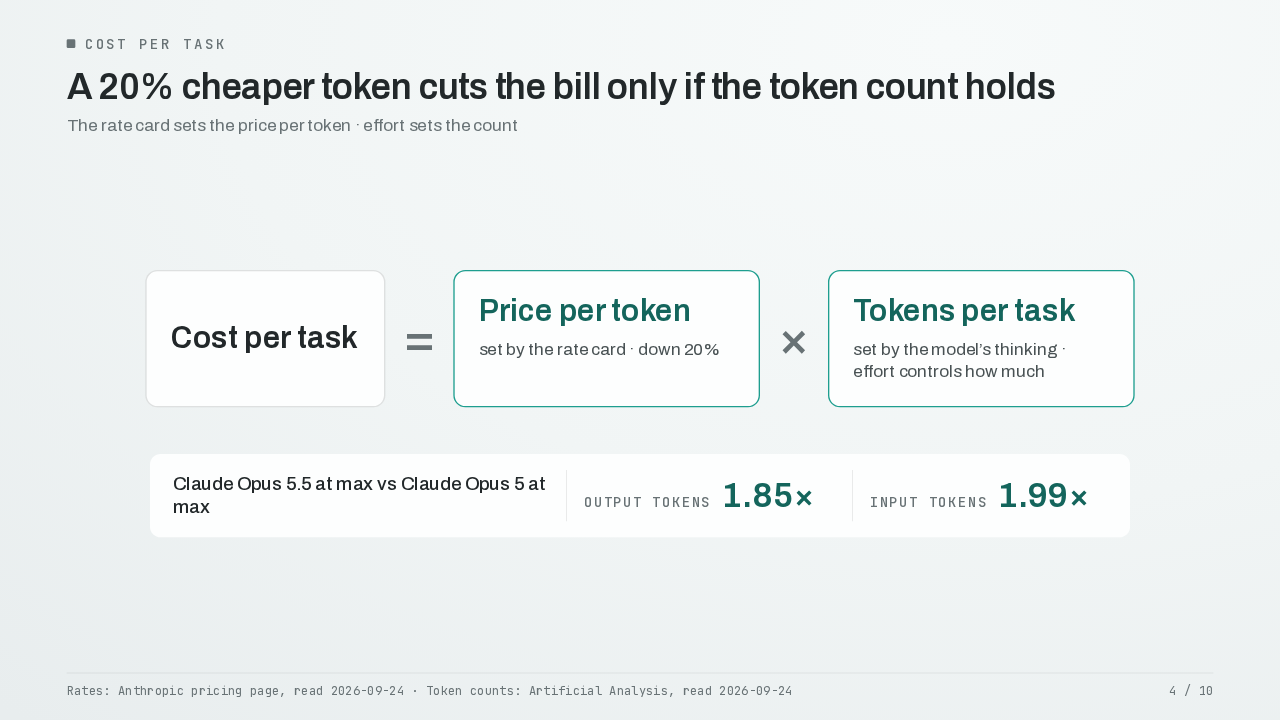
A 20% cheaper token cuts the bill only if the token count holds
The rate card sets the price per token · effort sets the count
The cost of one task is two numbers multiplied. The first number is the price per token, and Anthropic's rate card cut it. The second number is how many tokens the task uses, and effort controls that count. With the same token count, every task on Claude Opus 5.5 would cost at least twenty percent less than on Claude Opus 5.
The cache read: a halved multiplier
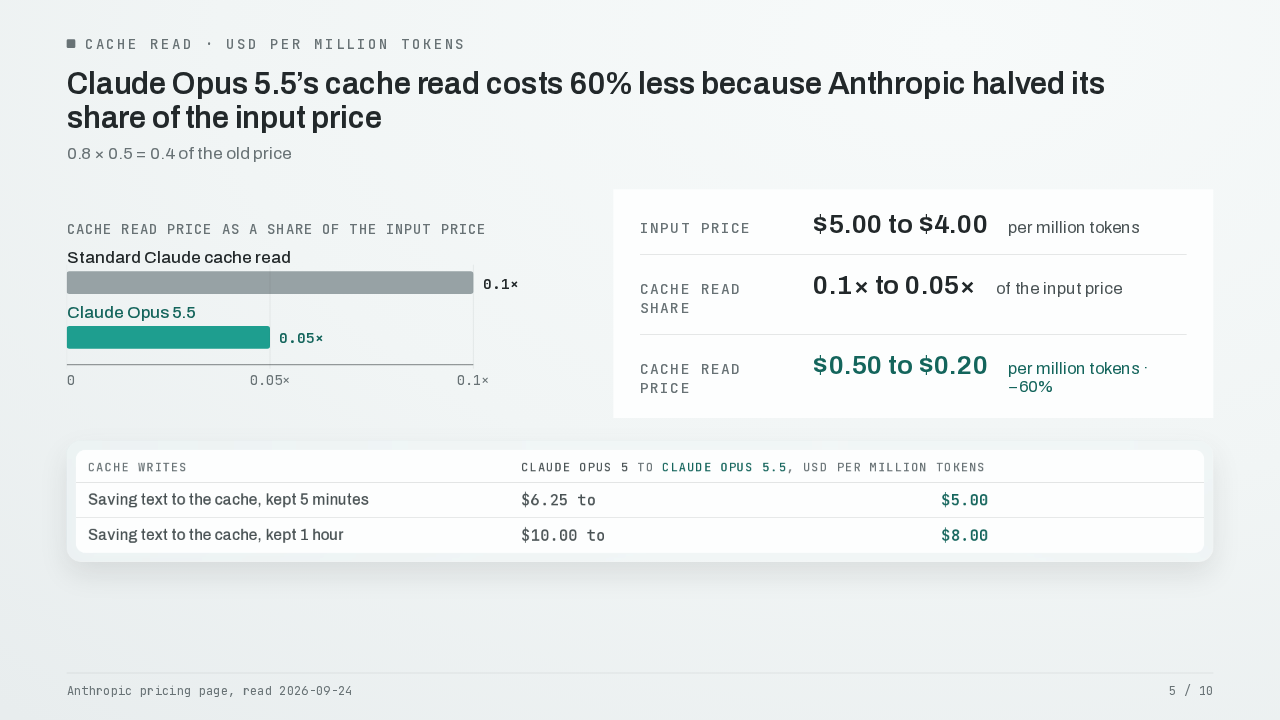
Claude Opus 5.5’s cache read costs 60% less because Anthropic halved its share of the input price
0.8 × 0.5 = 0.4 of the old price
| Cache writes | Claude Opus 5 to Claude Opus 5.5, USD per million tokens | |
|---|---|---|
| Saving text to the cache, kept 5 minutes | $6.25 to | $5.00 |
| Saving text to the cache, kept 1 hour | $10.00 to | $8.00 |
One more price fell further. When a program sends the same long instructions on every step, Anthropic saves that text the first time. Every later send of the saved text is a cache read. A standard cache read costs a tenth of the input price. On Claude Opus 5.5, Anthropic charges a twentieth. Twenty percent off input, times half the share, takes a cache read from fifty cents to twenty cents per million tokens. That is sixty percent off.
Five effort settings, four cheaper
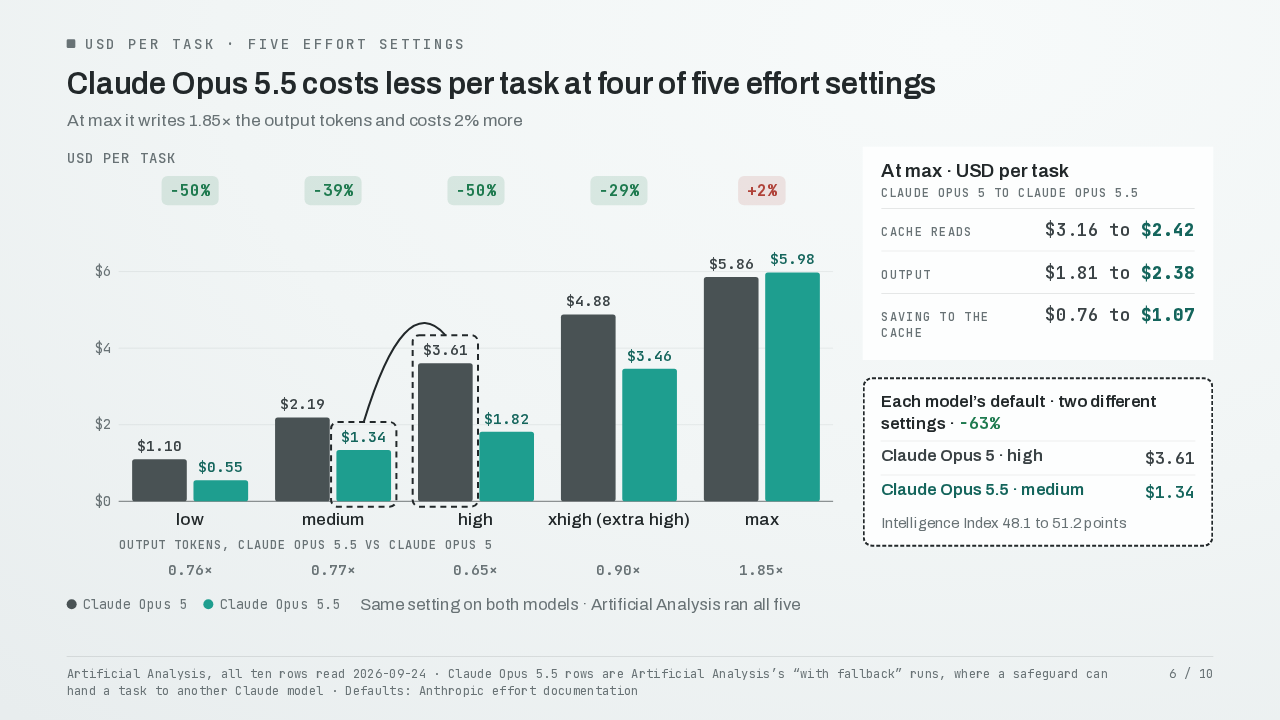
Claude Opus 5.5 costs less per task at four of five effort settings
At max it writes 1.85× the output tokens and costs 2% more
Same setting on both models · Artificial Analysis ran all five
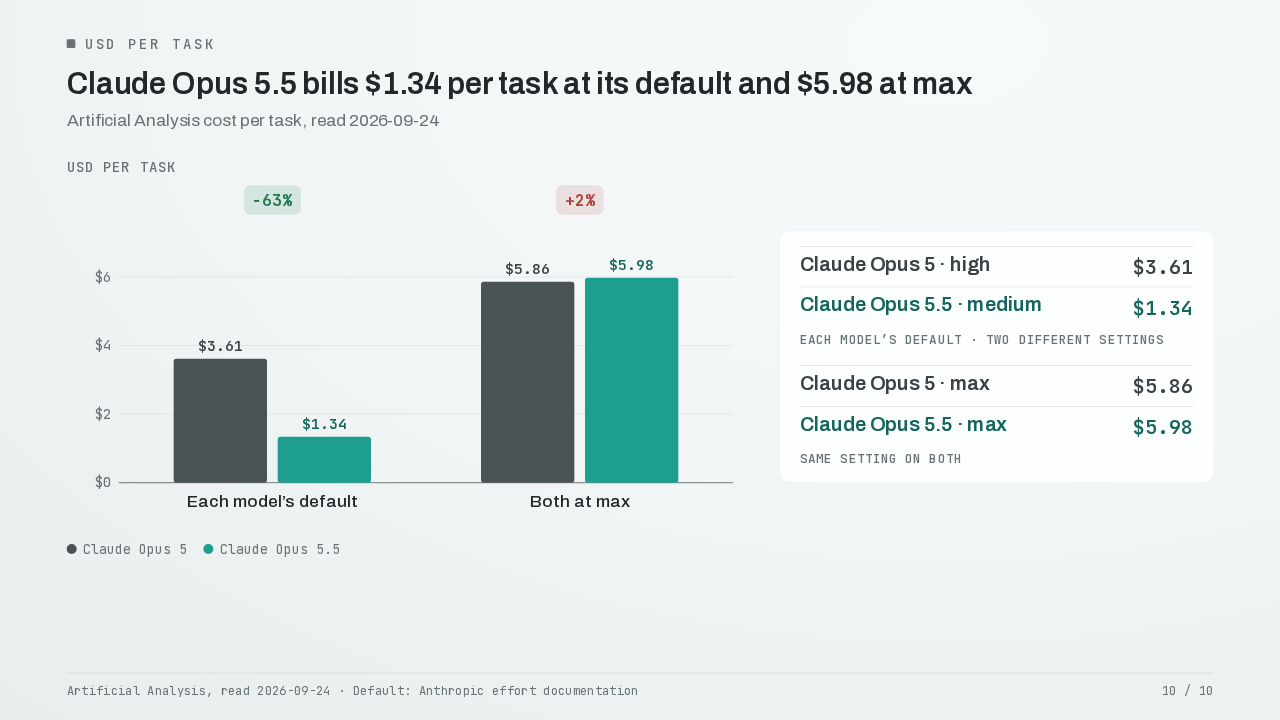
Artificial Analysis ran both models at all five effort settings, from low to max, and compared them at matching settings. Claude Opus 5.5 costs less per task at four of the five: fifty percent less at low, thirty-nine percent less at medium, fifty percent less at high, and twenty-nine percent less at extra high. At high, Claude Opus 5.5 writes sixty-five percent of Claude Opus 5's output tokens. At max, Claude Opus 5.5 writes one point eight five times the output tokens, and reads almost twice the input tokens. The cheaper cache read more than covers the extra reading. At max, Claude Opus 5.5 spends two dollars forty-two per task on cache reads, against three dollars sixteen for Claude Opus 5. The extra output, and the extra text saved to the cache, push the max effort bill two percent above Claude Opus 5's. A request that leaves effort unset runs Claude Opus 5.5 at medium, and ran Claude Opus 5 at high. Those are two different settings, and that pair is what an unchanged request gets. Artificial Analysis measures that pair at three dollars sixty-one per task on Claude Opus 5, and one dollar thirty-four on Claude Opus 5.5. That is sixty-three percent less. The Intelligence Index, the single score Artificial Analysis gives a model across its test set, rises from forty-eight point one to fifty-one point two points.
Scores against cost per task
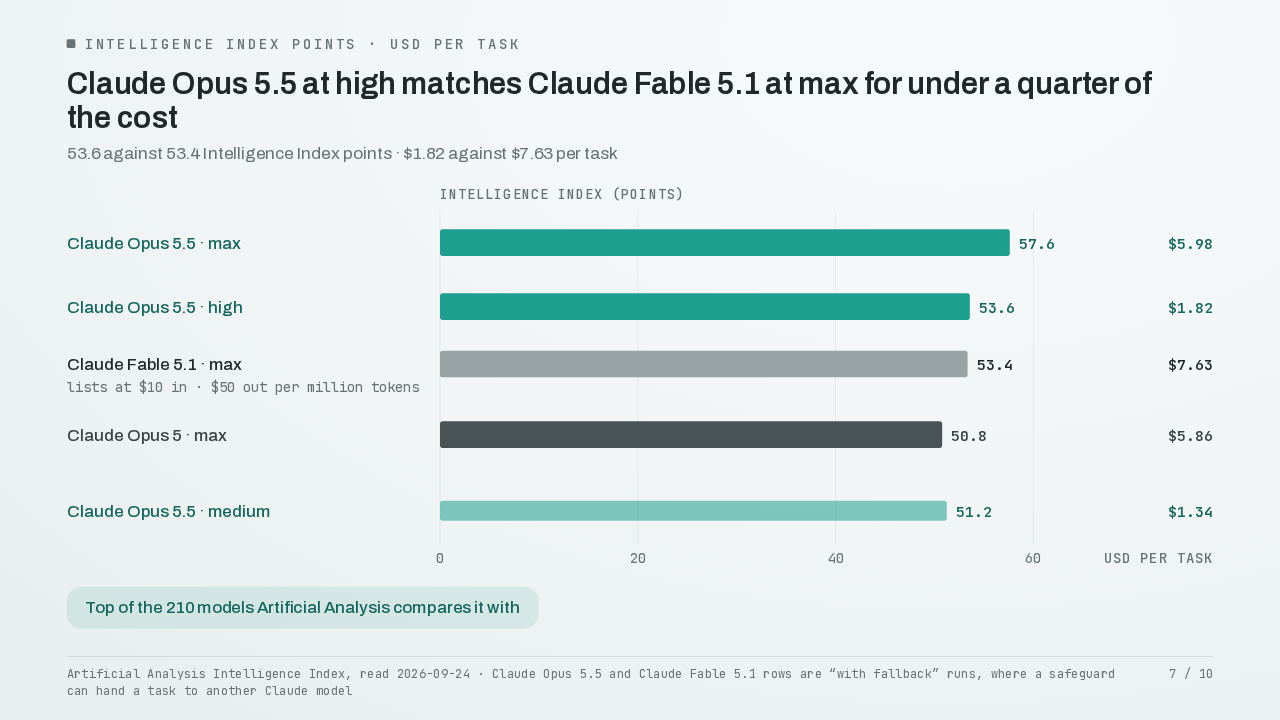
Claude Opus 5.5 at high matches Claude Fable 5.1 at max for under a quarter of the cost
53.6 against 53.4 Intelligence Index points · $1.82 against $7.63 per task
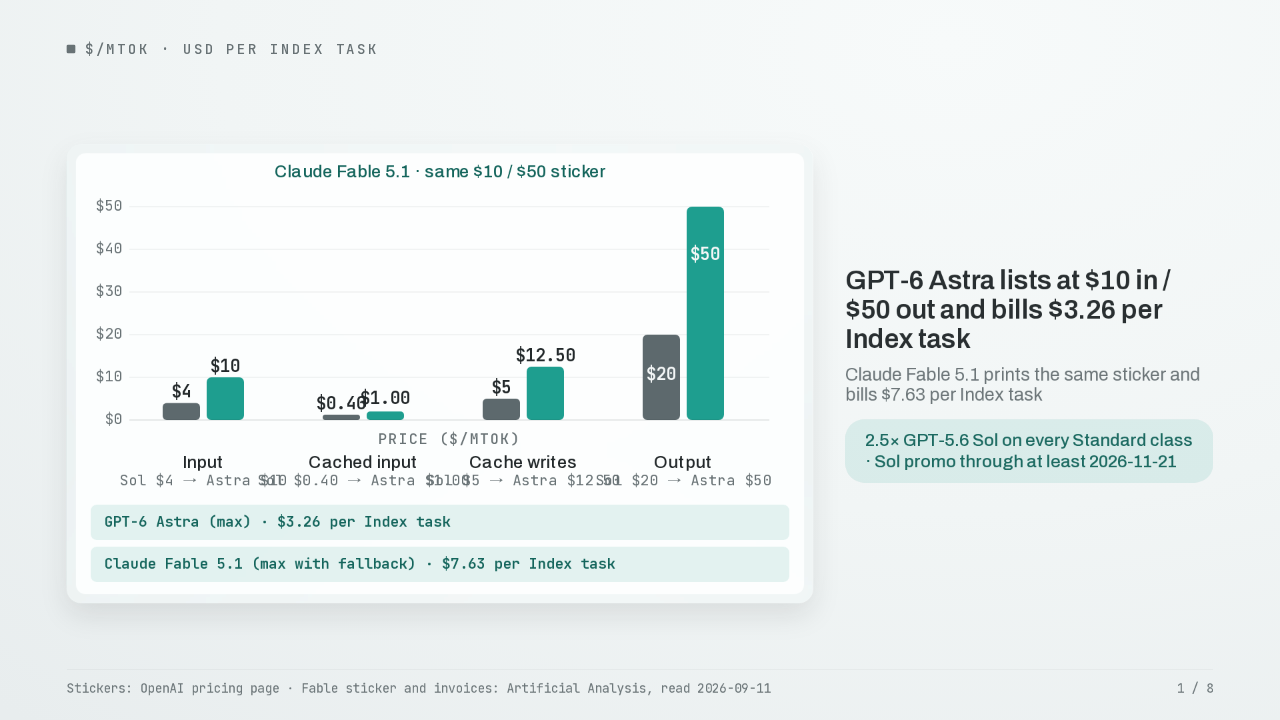
At max effort, Artificial Analysis scores Claude Opus 5.5 at fifty-seven point six Index points, the top of the two hundred and ten models Artificial Analysis compares. Claude Opus 5 scores fifty point eight at max, so Claude Opus 5.5 gains about seven Index points for two percent more per task. Claude Fable 5.1, Anthropic's pricier model at ten dollars in and fifty dollars out per million tokens, scores fifty-three point four Index points at max, for seven dollars sixty-three per task. One setting down, at high, Claude Opus 5.5 matches that score for one dollar eighty-two per task.
The board, with the new dots placed
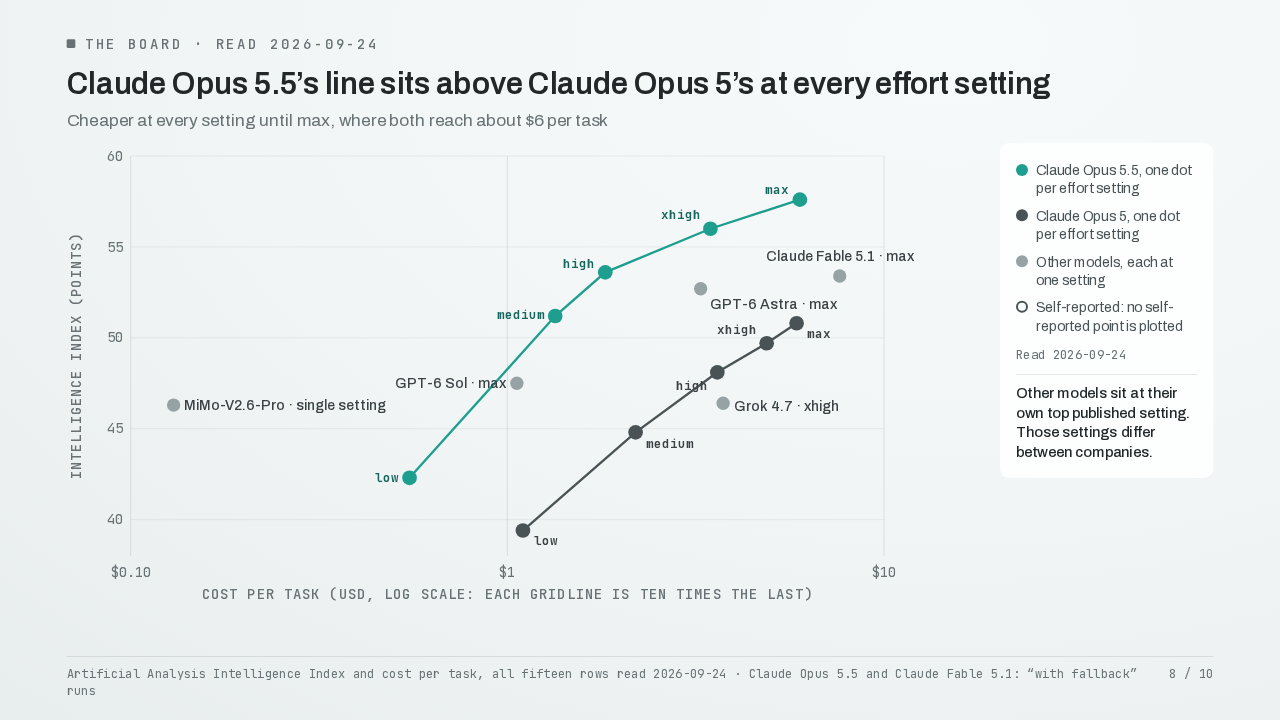
Claude Opus 5.5’s line sits above Claude Opus 5’s at every effort setting
Cheaper at every setting until max, where both reach about $6 per task
Other models sit at their own top published setting. Those settings differ between companies.
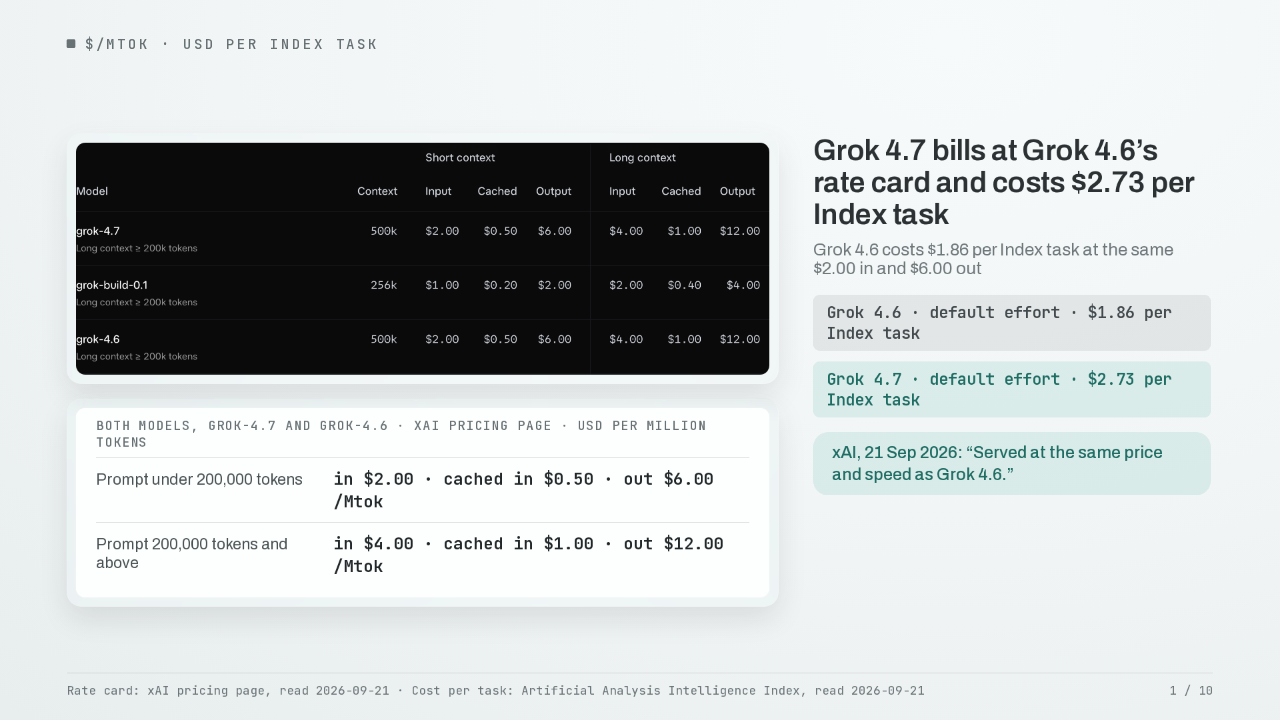
On Artificial Analysis's board, score goes up and cost per task goes right. Each Claude Opus model is a line of five dots, one dot per effort setting. The Claude Opus 5.5 line sits above the Claude Opus 5 line at every setting, and left of it until max, where both reach about six dollars per task. The other dots are Claude Fable 5.1, OpenAI's GPT-6 Astra and GPT-6 Sol, xAI's Grok 4.7 and Xiaomi's MiMo-V2.6-Pro, each at its own top published setting, and those settings differ between companies.
What to run
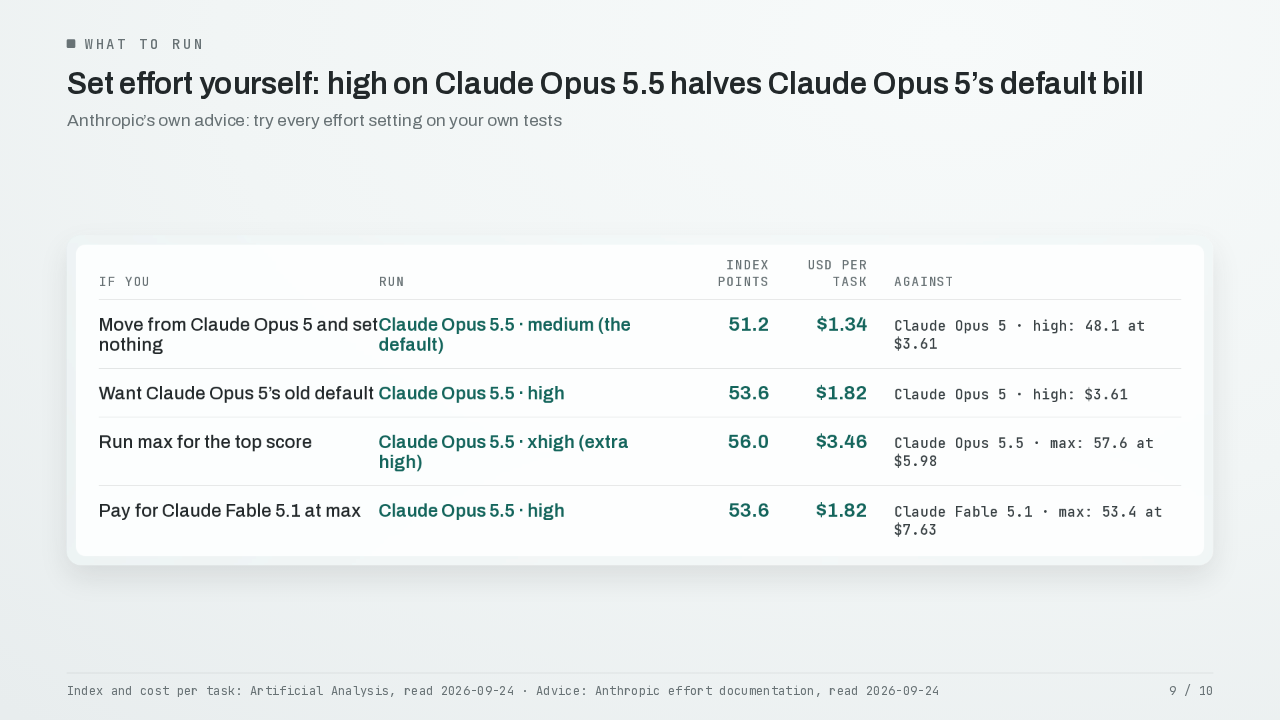
Set effort yourself: high on Claude Opus 5.5 halves Claude Opus 5’s default bill
Anthropic’s own advice: try every effort setting on your own tests
| If you | Run | Index points | USD per task | Against |
|---|---|---|---|---|
| Move from Claude Opus 5 and set nothing | Claude Opus 5.5 · medium (the default) | 51.2 | $1.34 | Claude Opus 5 · high: 48.1 at $3.61 |
| Want Claude Opus 5’s old default | Claude Opus 5.5 · high | 53.6 | $1.82 | Claude Opus 5 · high: $3.61 |
| Run max for the top score | Claude Opus 5.5 · xhigh (extra high) | 56.0 | $3.46 | Claude Opus 5.5 · max: 57.6 at $5.98 |
| Pay for Claude Fable 5.1 at max | Claude Opus 5.5 · high | 53.6 | $1.82 | Claude Fable 5.1 · max: 53.4 at $7.63 |
Here is what I'd run. If you move from Claude Opus 5 and leave effort unset, you land on medium. That is sixty-three percent cheaper per task on Artificial Analysis's test, and one level below what you ran before, so check medium on your own work. For Claude Opus 5's old behaviour, set effort to high. The bill per task still halves. If you run max, try extra high first. Artificial Analysis puts extra high within one point six Index points of max for forty-two percent less per task.
Which setting are you on?
Claude Opus 5.5 bills $1.34 per task at its default and $5.98 at max
Artificial Analysis cost per task, read 2026-09-24
On Claude Opus 5.5, a request with no effort setting runs at medium. Which effort setting are you running Claude Opus on?