Grok 4.7 on Grok 4.6’s rate card
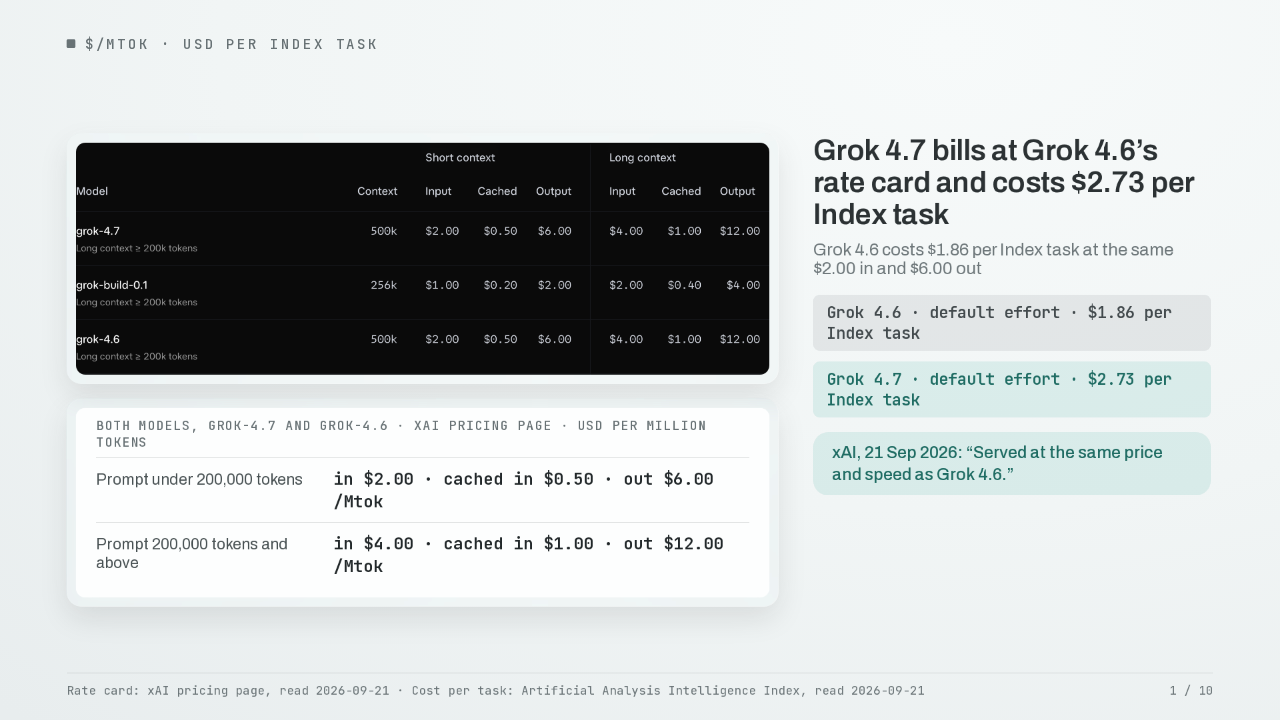
Grok 4.7 bills at Grok 4.6’s rate card and costs $2.73 per Index task
Grok 4.6 costs $1.86 per Index task at the same $2.00 in and $6.00 out
xAI shipped Grok 4.7 today, and it bills at Grok 4.6's exact price list. Artificial Analysis still paid half again as much per task. A rate card is a price list in dollars per million tokens. Cost per task is what Artificial Analysis got billed to finish one test on its Intelligence Index, a score it builds by running the same tests on every model itself. xAI's pricing page lists Grok 4.7 and Grok 4.6 at the same two dollars per million input tokens and six dollars per million output tokens. Artificial Analysis billed one dollar and eighty-six cents per Intelligence Index task on Grok 4.6. On Grok 4.7, Artificial Analysis billed two dollars and seventy-three cents per Index task.
Grok 4.7 spec card
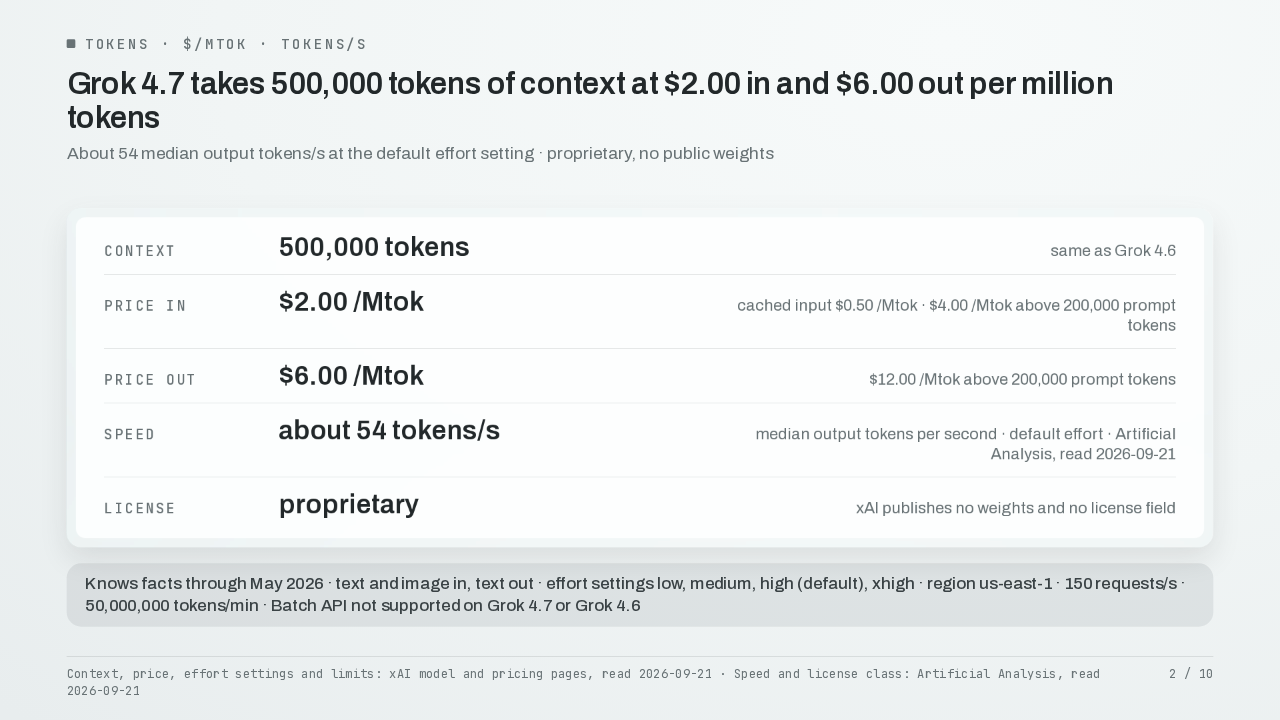
Grok 4.7 takes 500,000 tokens of context at $2.00 in and $6.00 out per million tokens
About 54 median output tokens/s at the default effort setting · proprietary, no public weights
Grok 4.7 takes five hundred thousand tokens of context, the same as Grok 4.6. xAI lists Grok 4.7 at two dollars per million input tokens, fifty cents per million cached input tokens, and six dollars per million output tokens. Artificial Analysis clocks Grok 4.7 today at about fifty-four median output tokens per second, at the default effort setting. The license is proprietary, and xAI publishes no weights.
Artificial Analysis scores both models
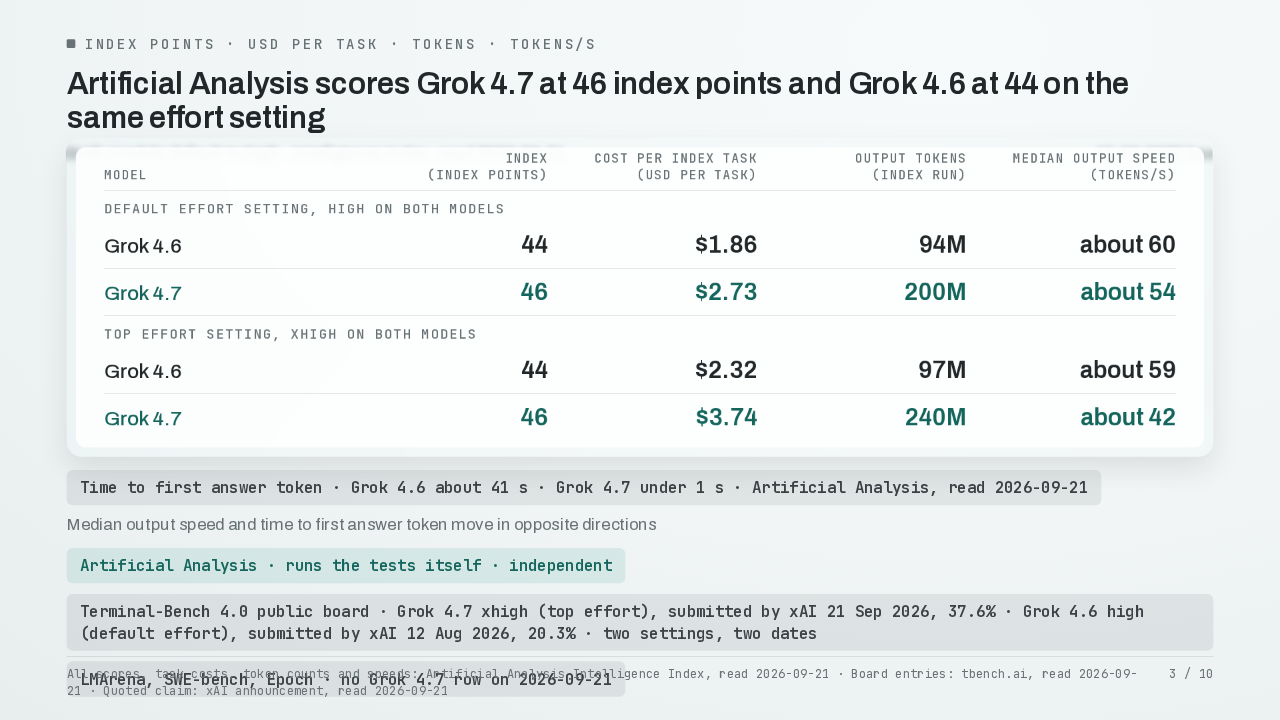
Artificial Analysis scores Grok 4.7 at 46 index points and Grok 4.6 at 44 on the same effort setting
Both models default to high · Intelligence Index, read 2026-09-21
(index points)
(USD per task)
(Index run)
(tokens/s)
Median output speed and time to first answer token move in opposite directions
Both models take a reasoning effort dial, which tells the model how hard to think before it answers, and both default to high. Matched at that default setting, Artificial Analysis scores Grok 4.7 at forty-six index points and Grok 4.6 at forty-four. Median output speed measures about fifty-four tokens per second on Grok 4.7 and about sixty tokens per second on Grok 4.6. xAI's announcement says Grok 4.7 is served at the same price and speed as Grok 4.6. The price half is exact, and the speed half depends on which speed you measure. Artificial Analysis measures the wait before Grok 4.6's first answer token at about forty-one seconds, and the wait before Grok 4.7's first answer token at under one second. Artificial Analysis is the only independent measurement of Grok 4.7 today. Terminal-Bench 4.0, a public board for terminal tasks, does carry a Grok 4.7 row at the top effort setting, and xAI submitted that row.
Grok 4.7 writes 2.13x the output tokens
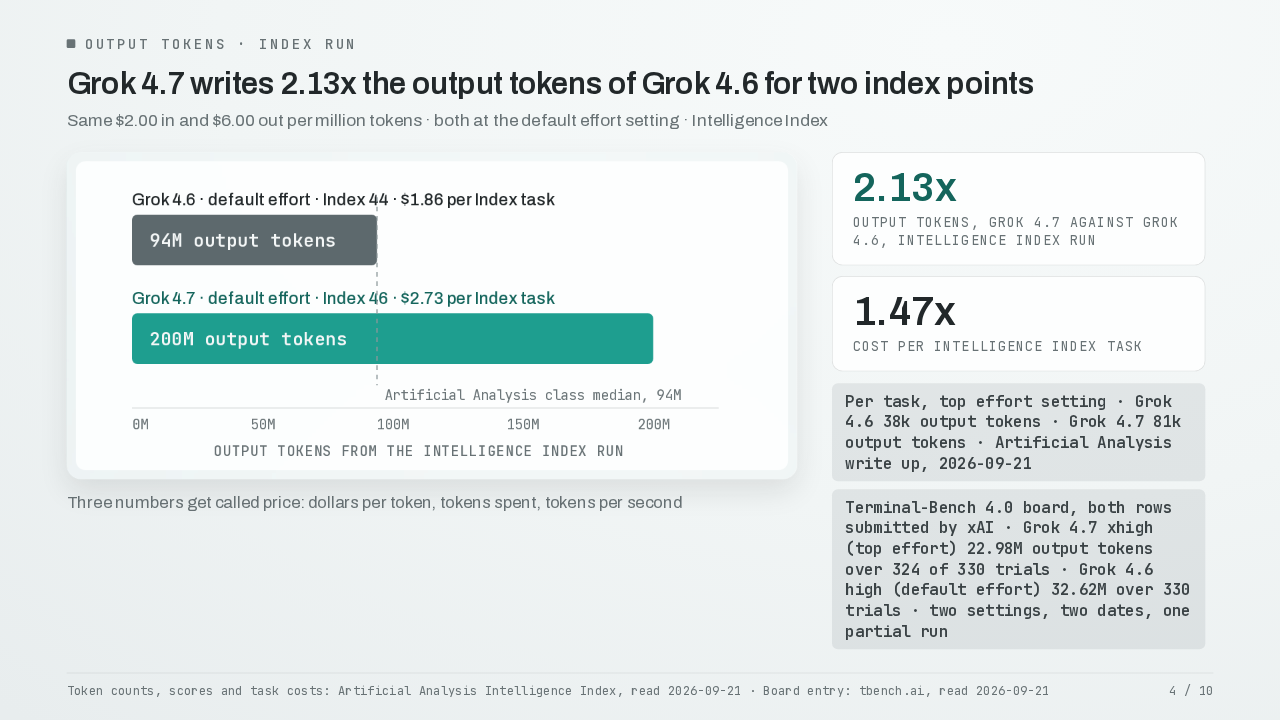
Grok 4.7 writes 2.13x the output tokens of Grok 4.6 for two index points
Same $2.00 in and $6.00 out per million tokens · both at the default effort setting · Intelligence Index
Three numbers get called price: dollars per token, tokens spent, tokens per second
Three different numbers get called price. The first is dollars per token, the rate card, and xAI froze it. The second is how many tokens the model spends to finish the work. The model chooses that number, and pricing pages leave it out. The third is tokens per second, the throughput. A release can freeze the first number and move the other two, and Grok 4.7 did. Output tokens are the text the model writes back, and at six dollars per million they are the expensive half of the bill. Running the Intelligence Index at the same default effort setting, Artificial Analysis measured two hundred million output tokens from Grok 4.7 and ninety-four million output tokens from Grok 4.6. That is two point one three times the output tokens at the same dollars per token. The bill came out one point four seven times higher, for two index points. At the top effort setting Artificial Analysis publishes a per-task count, eighty-one thousand output tokens for Grok 4.7 against thirty-eight thousand for Grok 4.6. Every one of those numbers comes from the Intelligence Index. Terminal-Bench 4.0 runs a different workload. xAI submitted Grok 4.7 to that board at the top effort setting, and Grok 4.6 at the default setting. On that board Grok 4.7 wrote fewer output tokens than Grok 4.6, so how much a model writes depends on the work.
The top effort setting buys nothing
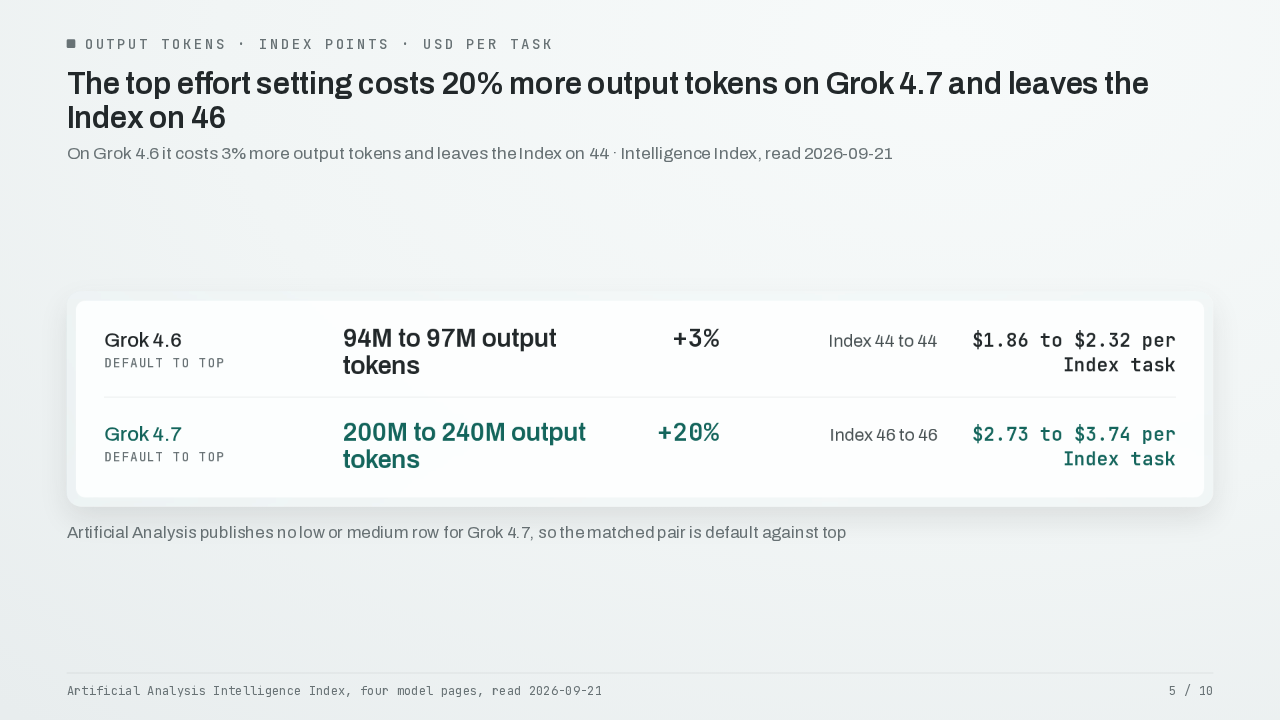
The top effort setting costs 20% more output tokens on Grok 4.7 and leaves the Index on 46
On Grok 4.6 it costs 3% more output tokens and leaves the Index on 44 · Intelligence Index, read 2026-09-21
Artificial Analysis publishes no low or medium row for Grok 4.7, so the matched pair is default against top
Turning Grok 4.6 from its default setting to its top setting costs three percent more output tokens, ninety-four million to ninety-seven million. Grok 4.6's score stays on forty-four index points. Turning Grok 4.7 the same notch costs twenty percent more output tokens, two hundred million to two hundred and forty million. Grok 4.7's score stays on forty-six index points. The price list never changed, and the Intelligence Index bill went up by half, because Grok 4.7 writes about twice as much to answer the same question.
One model, five documented rates
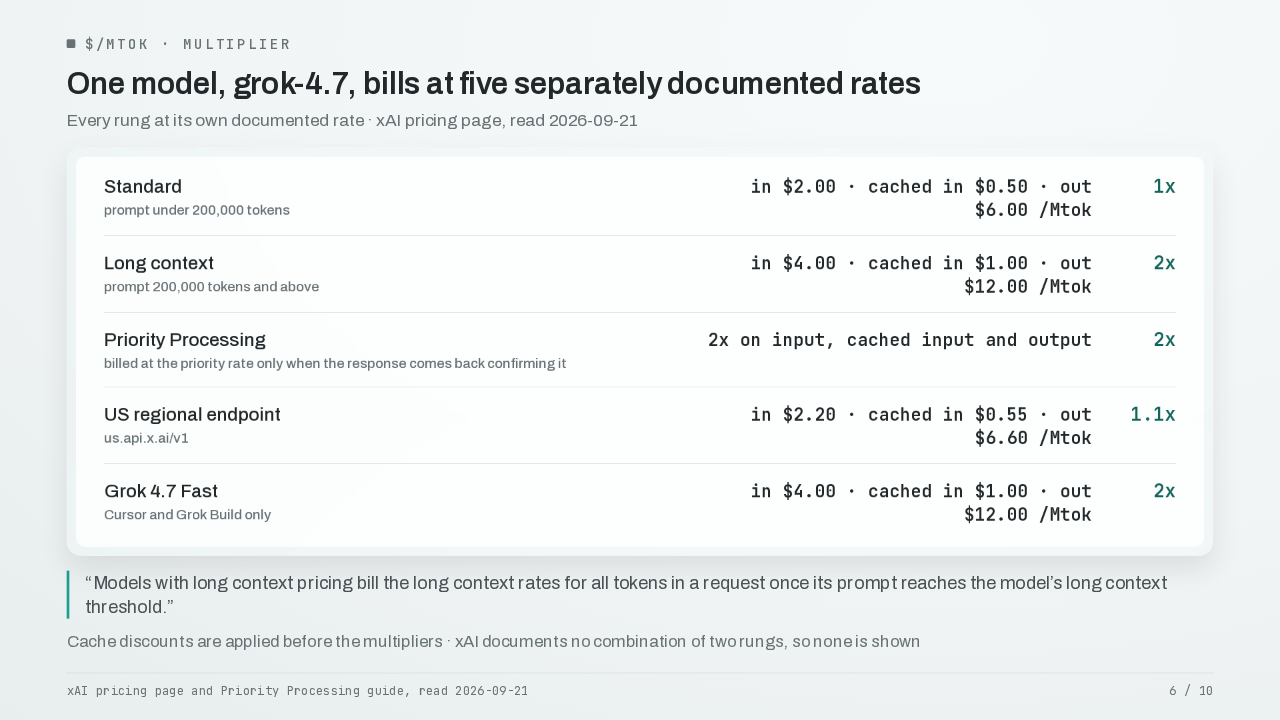
One model, grok-4.7, bills at five separately documented rates
Every rung at its own documented rate · xAI pricing page, read 2026-09-21
Cache discounts are applied before the multipliers · xAI documents no combination of two rungs, so none is shown
The same Grok 4.7 bills at five documented rates. Standard, under two hundred thousand prompt tokens, is two dollars per million input tokens and six dollars per million output tokens. At two hundred thousand prompt tokens and above, the rate doubles to four dollars per million input tokens and twelve dollars per million output tokens. xAI's page says the long context rate applies to the whole request, so a two hundred and one thousand token prompt re-prices the first two hundred thousand tokens too. Priority Processing doubles every token type, the United States regional endpoint adds ten percent to every rate, and Grok 4.7 Fast doubles the standard rates.
The new dot moved right
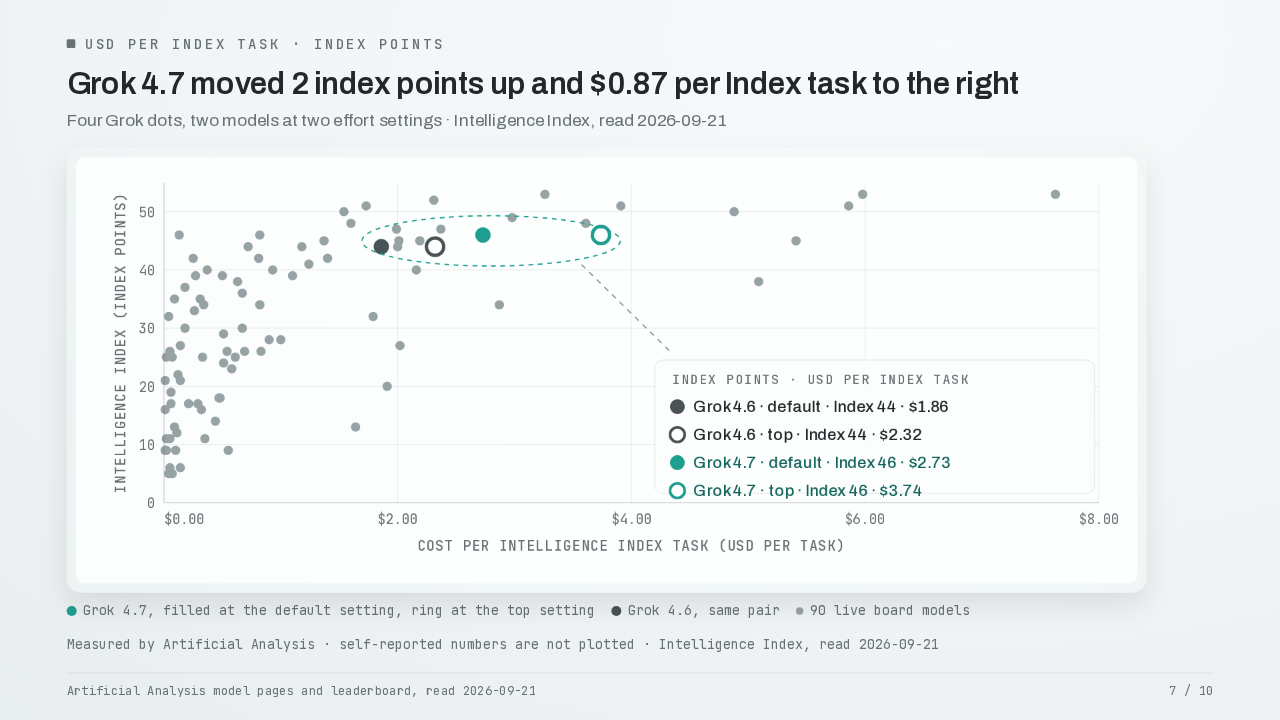
Grok 4.7 moved 2 index points up and $0.87 per Index task to the right
Four Grok dots, two models at two effort settings · Intelligence Index, read 2026-09-21
The board plots the Intelligence Index against cost per Index task, rebuilt from today's numbers. Grok 4.7 at its default setting sits two index points above Grok 4.6 at its default setting, and eighty-seven cents per Index task to the right of it.
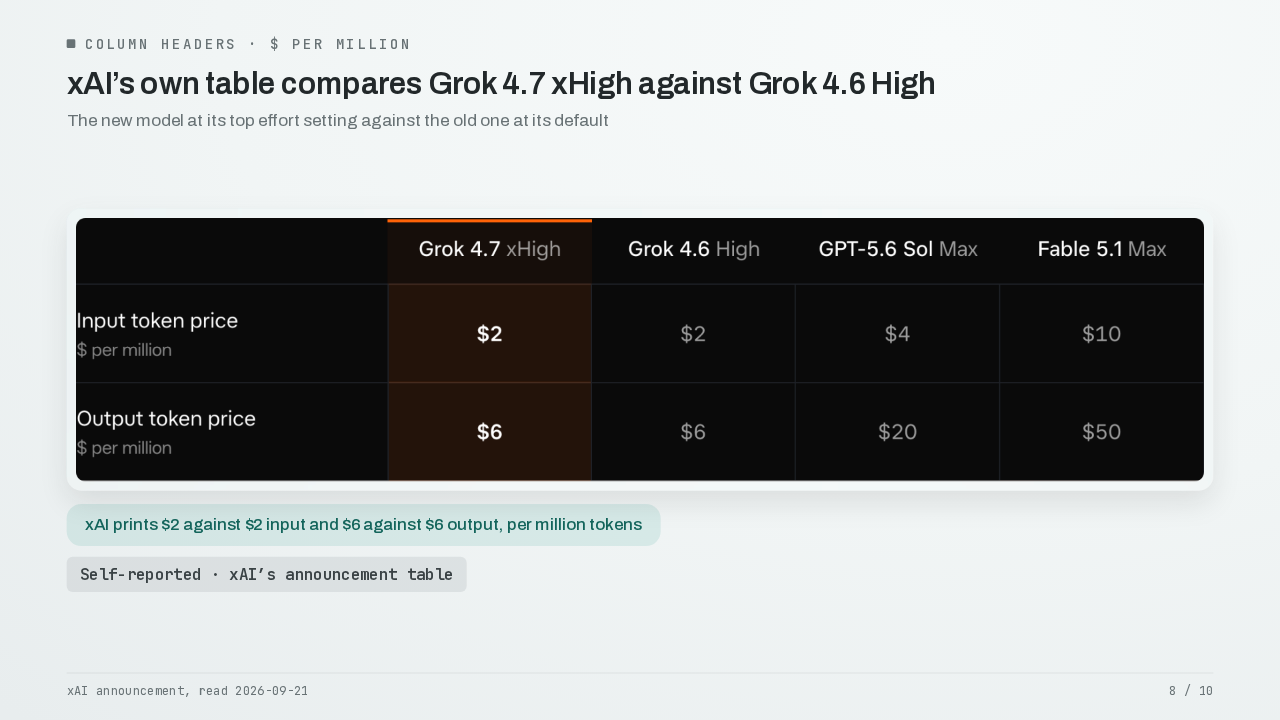
xAI’s own table compares xHigh against High
xAI’s own table compares Grok 4.7 xHigh against Grok 4.6 High
The new model at its top effort setting against the old one at its default
xAI's own comparison table puts Grok 4.7 at its top effort setting, labelled x high, in one column, and Grok 4.6 at high in the next. That is the new model at its top setting against the old one at its default.
What to run, and what it costs
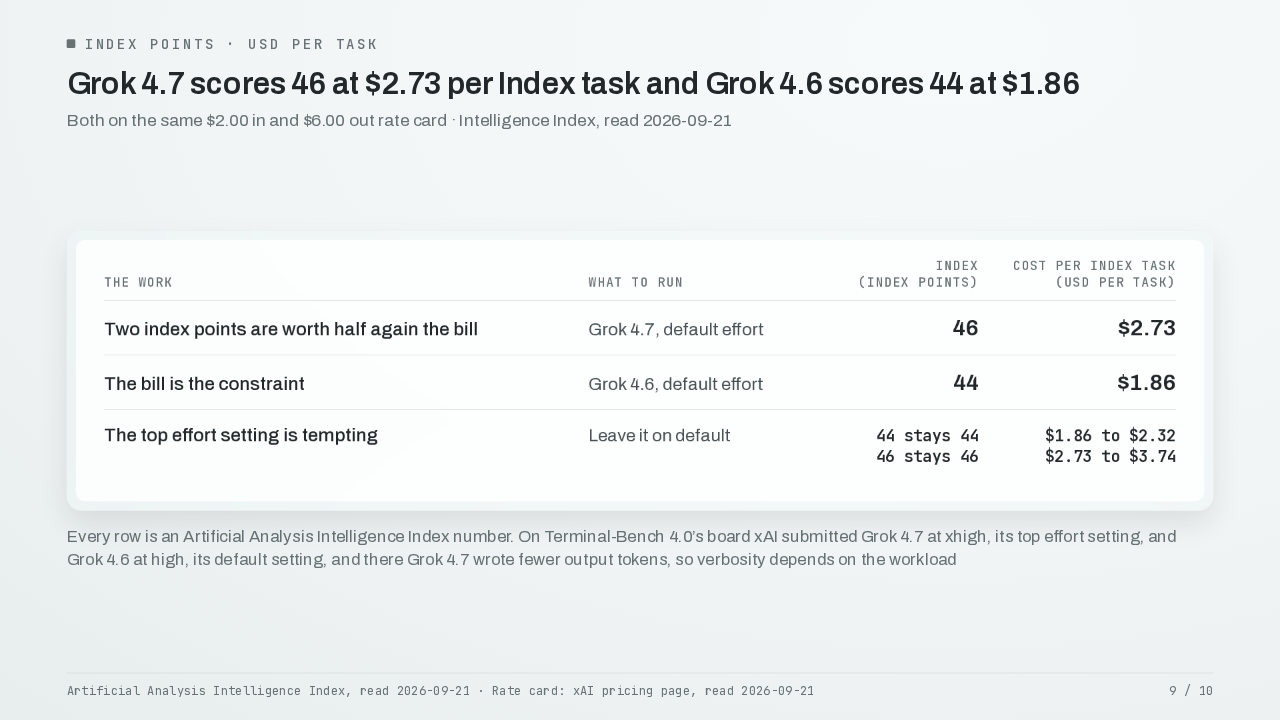
Grok 4.7 scores 46 at $2.73 per Index task and Grok 4.6 scores 44 at $1.86
Both on the same $2.00 in and $6.00 out rate card · Intelligence Index, read 2026-09-21
| The work | What to run | Index (index points) | Cost per Index task (USD per task) |
|---|---|---|---|
| Two index points are worth half again the bill | Grok 4.7, default effort | 46 | $2.73 |
| The bill is the constraint | Grok 4.6, default effort | 44 | $1.86 |
| The top effort setting is tempting | Leave it on default | 44 stays 44 46 stays 46 | $1.86 to $2.32 $2.73 to $3.74 |
Every row is an Artificial Analysis Intelligence Index number. On Terminal-Bench 4.0’s board xAI submitted Grok 4.7 at xhigh, its top effort setting, and Grok 4.6 at high, its default setting, and there Grok 4.7 wrote fewer output tokens, so verbosity depends on the workload
When two index points are worth half again the bill, Grok 4.7 at its default setting scores forty-six index points at two dollars and seventy-three cents per Index task. When the bill is the constraint, Grok 4.6 at its default setting scores forty-four index points at one dollar and eighty-six cents per Index task, on the identical rate card. Artificial Analysis measures no Index change at the top effort setting on either model.
The rate card held, the bill rose
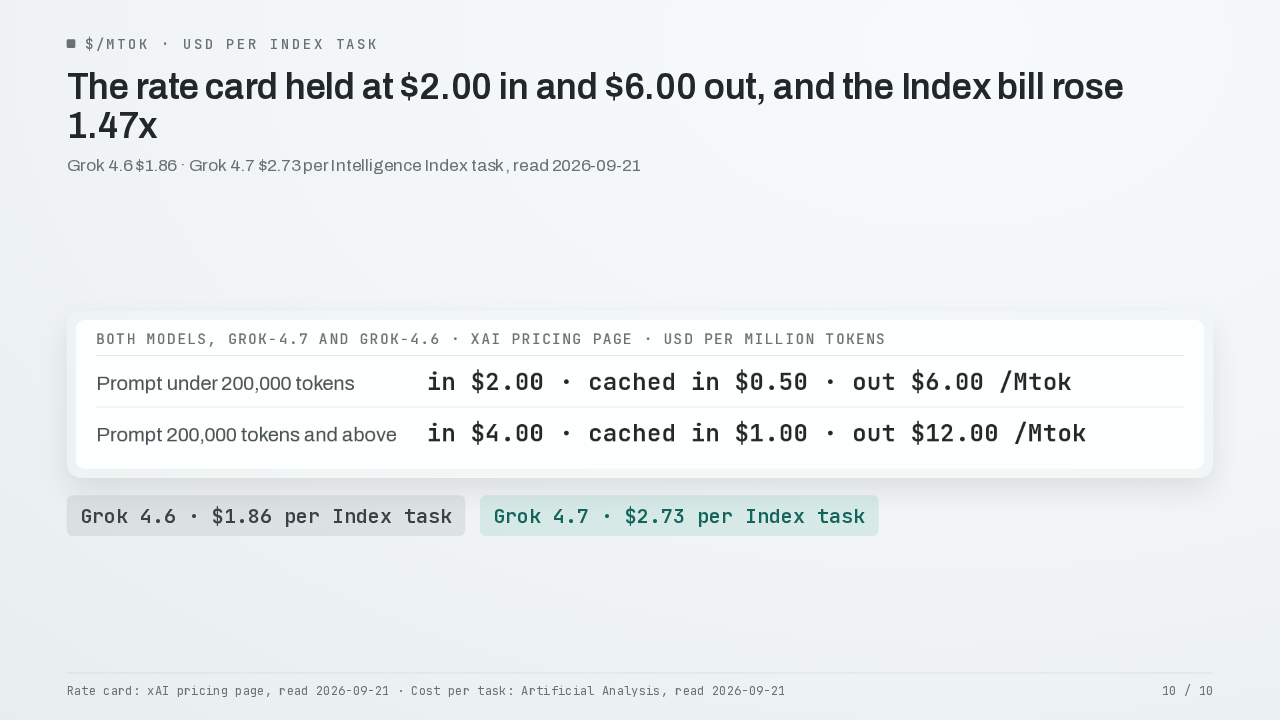
The rate card held at $2.00 in and $6.00 out, and the Index bill rose 1.47x
Grok 4.6 $1.86 · Grok 4.7 $2.73 per Intelligence Index task, read 2026-09-21
xAI said the price is the same, and the price is the same, two dollars per million input tokens and six dollars per million output tokens. Artificial Analysis still billed half again as much per Intelligence Index task, because the rate card prices tokens and Grok 4.7 chooses how many to write.