The cheapest line, redrawn in two days
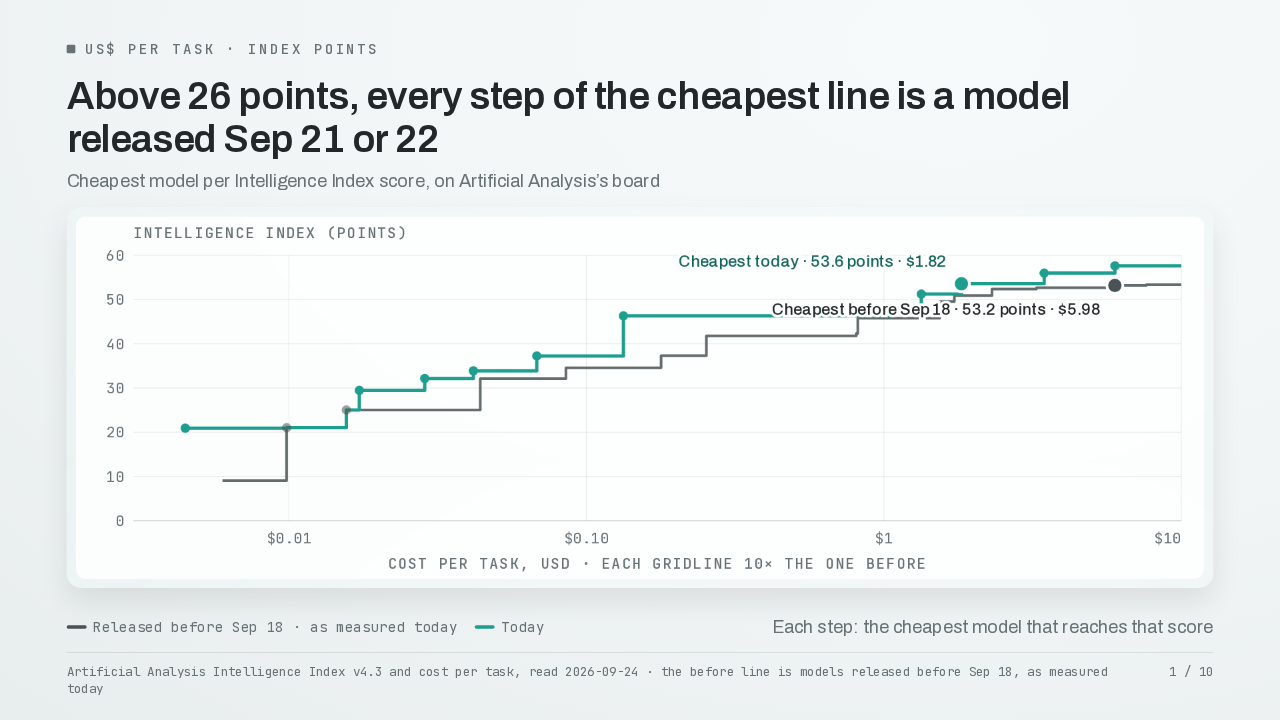
Above 26 points, every step of the cheapest line is a model released Sep 21 or 22
Cheapest model per Intelligence Index score, on Artificial Analysis’s board
Each step: the cheapest model that reaches that score
Claude Opus 5.5, GPT-6 Sol and three more models landed on September twenty-first and twenty-second. They redrew the line of cheapest models for each score. Artificial Analysis is an independent company that runs the same set of tests on every model. Artificial Analysis averages the results into one score, the Intelligence Index, and records what the whole run costs, divided per task. The line climbs in steps. Each step is the cheapest model that reaches that score. The grey line shows the cheapest models released before September eighteenth. Above fifty-three points, the cheapest of those costs five dollars ninety-eight per task. Today the cheapest model above fifty-three points costs a dollar eighty-two. Along the bottom, each gridline marks ten times the cost of the one before it.
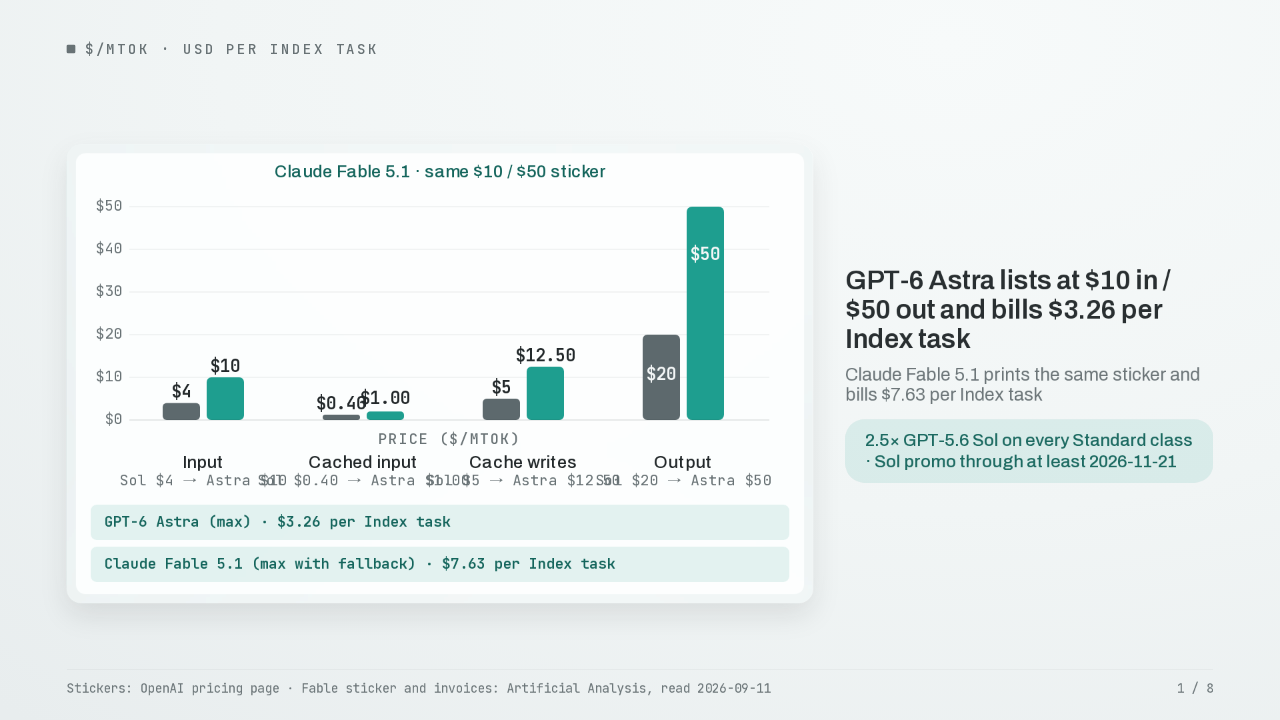
Twice GPT-6 Sol’s token price, a third of Claude Fable 5.1’s cost per task
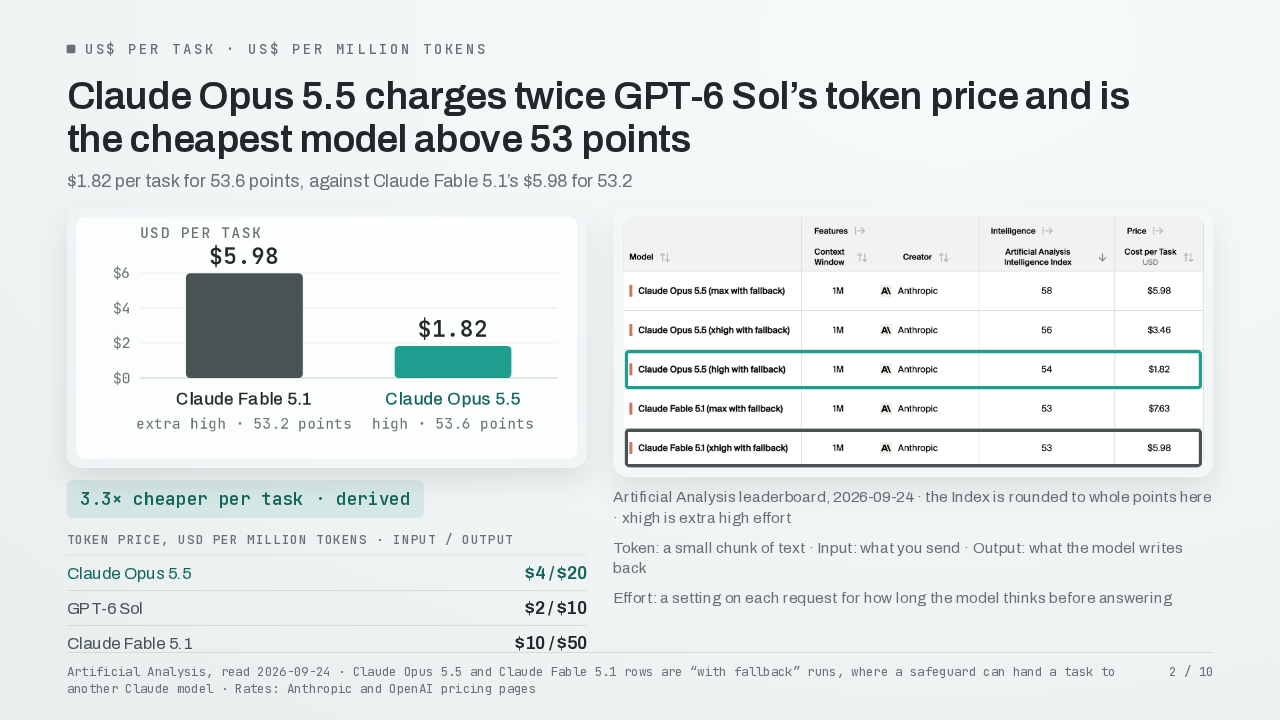
Claude Opus 5.5 charges twice GPT-6 Sol’s token price and is the cheapest model above 53 points
$1.82 per task for 53.6 points, against Claude Fable 5.1’s $5.98 for 53.2
Artificial Analysis leaderboard, 2026-09-24 · the Index is rounded to whole points here · xhigh is extra high effort
Token: a small chunk of text · Input: what you send · Output: what the model writes back
Effort: a setting on each request for how long the model thinks before answering
Providers charge per million tokens, small chunks of text. Input is what you send, and output is what the model writes back. Claude Opus 5.5 charges four dollars per million input tokens and twenty dollars per million output tokens, twice GPT-6 Sol's price. Effort is a setting on each request for how long the model thinks before it answers. At high effort, Claude Opus 5.5 scores fifty-three point six for that dollar eighty-two per task. The older model was Claude Fable 5.1 on extra high effort. Claude Fable 5.1 is Anthropic's pricier model, at ten dollars per million input tokens. Claude Fable 5.1 scores fifty-three point two and costs three point three times as much per task.
Five releases in two days
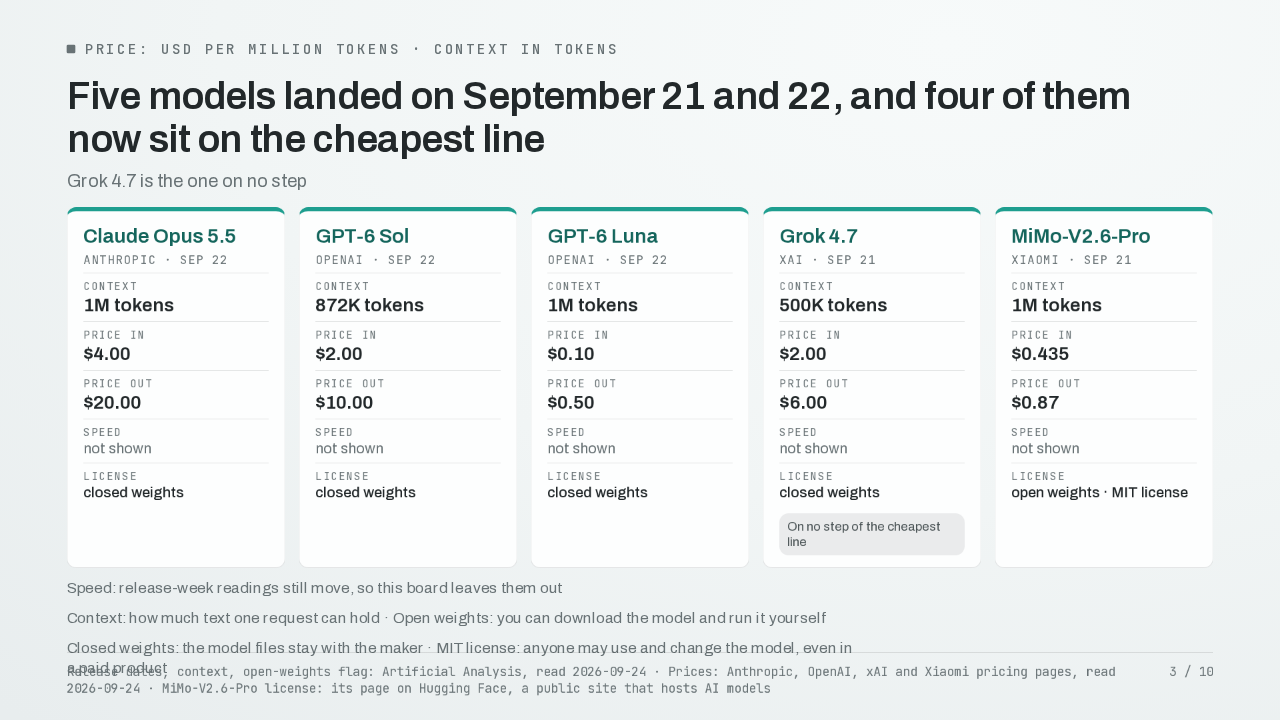
Five models landed on September 21 and 22, and four of them now sit on the cheapest line
Grok 4.7 is the one on no step
Speed: release-week readings still move, so this board leaves them out
Context: how much text one request can hold · Open weights: you can download the model and run it yourself
Closed weights: the model files stay with the maker · MIT license: anyone may use and change the model, even in a paid product
On September twenty-second, Anthropic released Claude Opus 5.5, and OpenAI released GPT-6 Sol and its cheaper sibling, GPT-6 Luna. A day earlier, xAI released Grok 4.7, and Xiaomi, the phone company, released MiMo-V2.6-Pro. MiMo-V2.6-Pro is the one with open weights, so you can download the model and run it yourself. The makers of the other four keep those model files to themselves. Four of those five models now sit on the cheapest line. Grok 4.7 sits on no step of it.
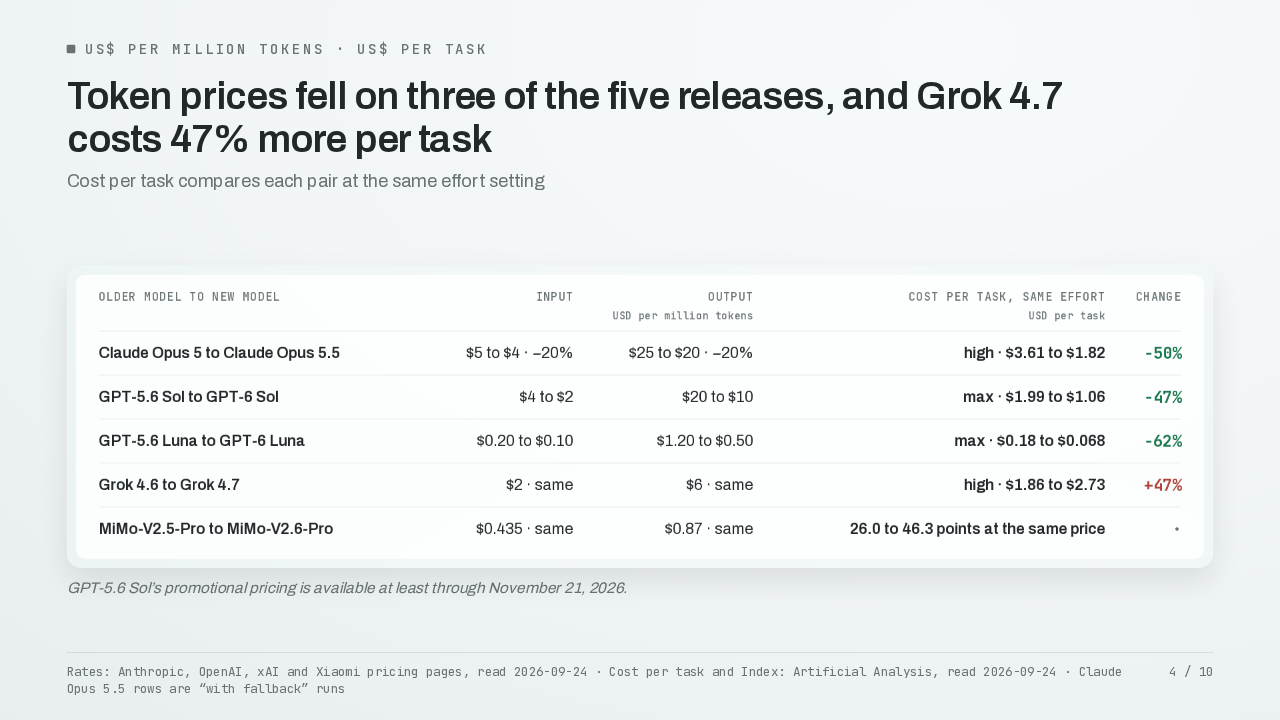
Three prices fell, two held
Token prices fell on three of the five releases, and Grok 4.7 costs 47% more per task
Cost per task compares each pair at the same effort setting
| Older model to new model | Input | Output | Cost per task, same effort | Change |
|---|---|---|---|---|
| USD per million tokens | USD per task | |||
| Claude Opus 5 to Claude Opus 5.5 | $5 to $4 · −20% | $25 to $20 · −20% | high · $3.61 to $1.82 | −50% |
| GPT-5.6 Sol to GPT-6 Sol | $4 to $2 | $20 to $10 | max · $1.99 to $1.06 | −47% |
| GPT-5.6 Luna to GPT-6 Luna | $0.20 to $0.10 | $1.20 to $0.50 | max · $0.18 to $0.068 | −62% |
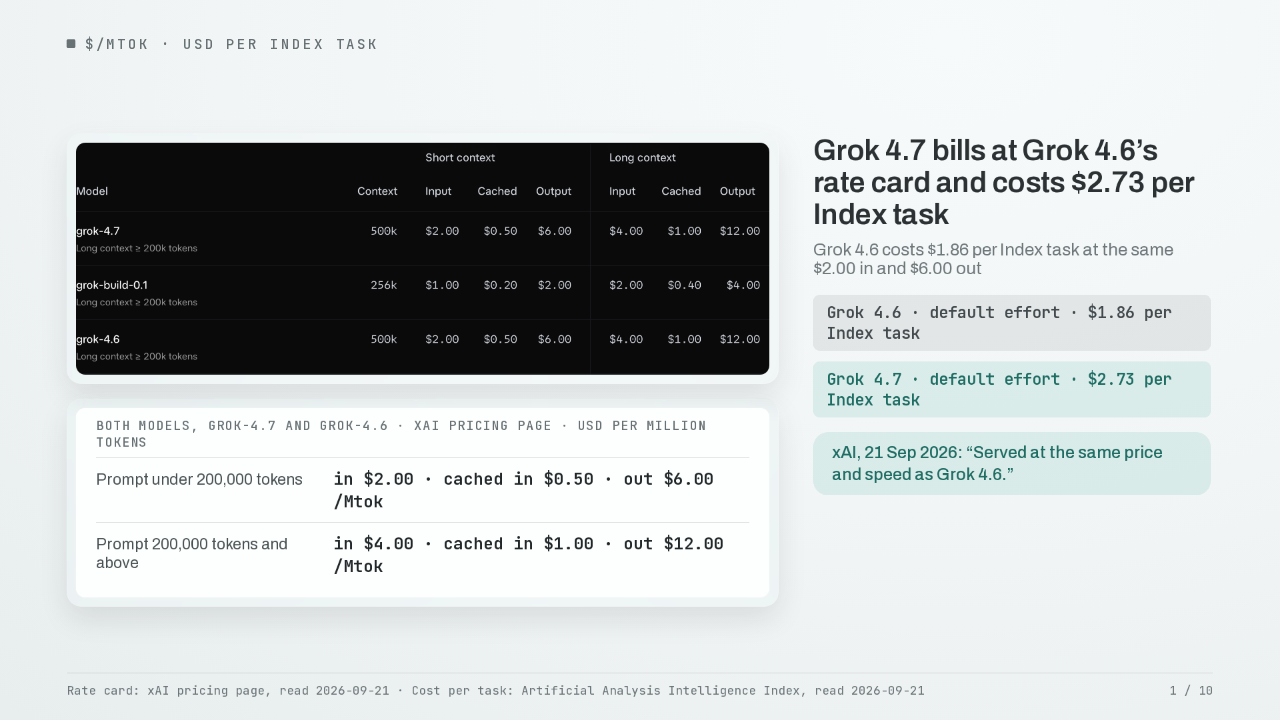
| Grok 4.6 to Grok 4.7 | $2 · same | $6 · same | high · $1.86 to $2.73 | +47% |
| MiMo-V2.5-Pro to MiMo-V2.6-Pro | $0.435 · same | $0.87 · same | 26.0 to 46.3 points at the same price | · |
GPT-5.6 Sol’s promotional pricing is available at least through November 21, 2026.
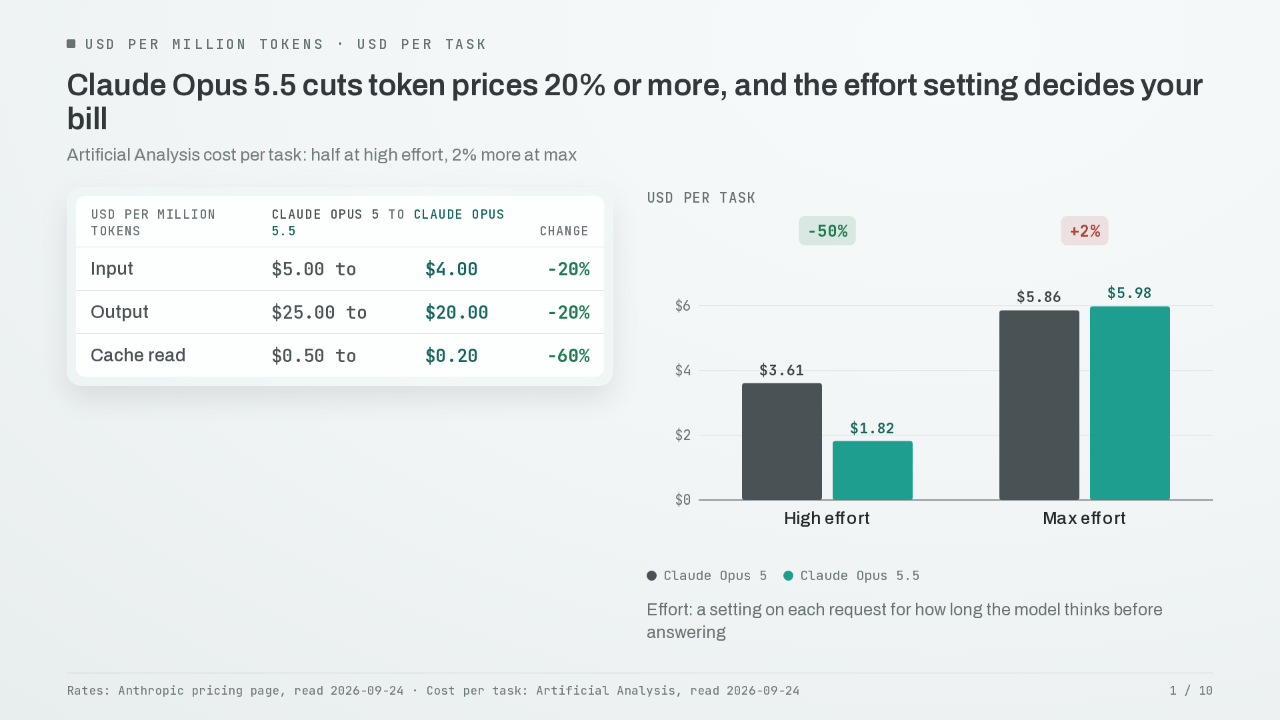
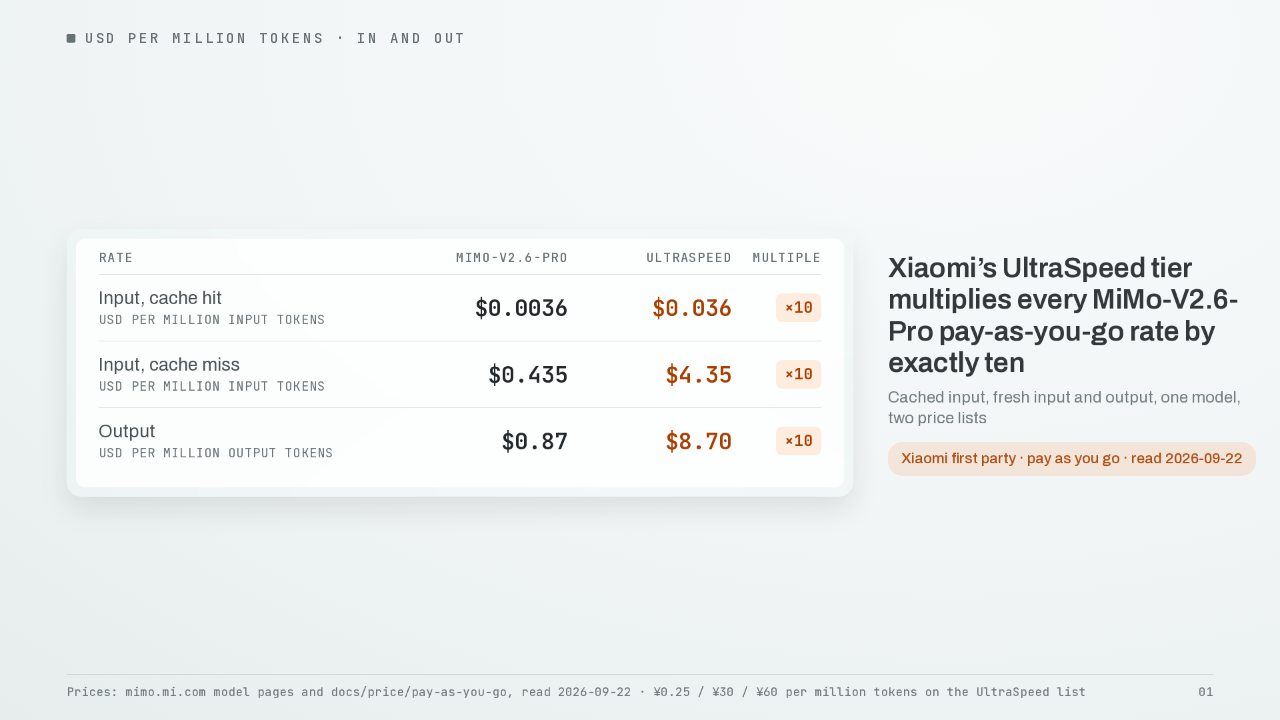
Token prices fell on three of the five releases. Claude Opus 5.5 cut twenty percent on input and output against Claude Opus 5, the model it replaces. GPT-6 Sol halved GPT-5.6 Sol's price. GPT-5.6 Sol's price was itself a promotional rate, and OpenAI says that promotion runs at least through November twenty-first. Grok 4.7 kept Grok 4.6's price, and Artificial Analysis measures Grok 4.7 at forty-seven percent more per task than Grok 4.6 on high effort. MiMo-V2.6-Pro kept MiMo-V2.5-Pro's price, and Artificial Analysis scores MiMo-V2.6-Pro at forty-six points against twenty-six for MiMo-V2.5-Pro.
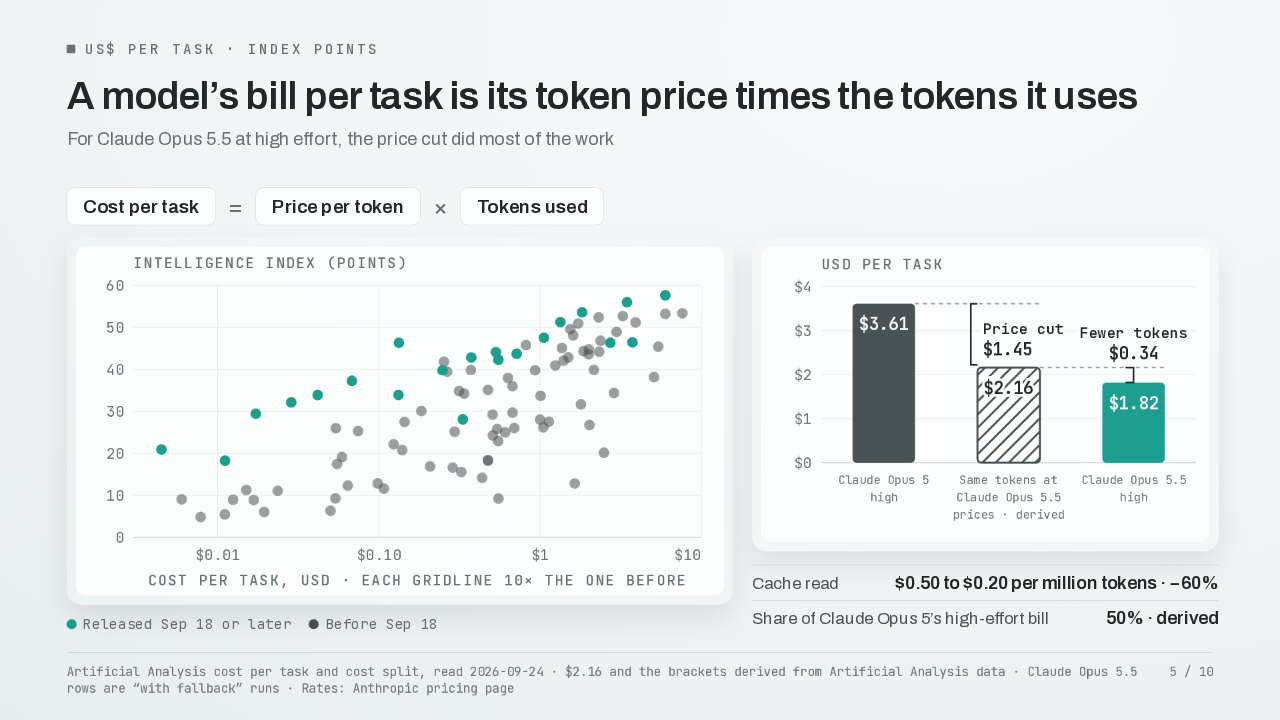
Cost per task is price times tokens
A model’s bill per task is its token price times the tokens it uses
For Claude Opus 5.5 at high effort, the price cut did most of the work
Every dot here is one model on one effort setting, placed by its score and its cost per task. Cost per task is the price per token times the number of tokens the model used. Take Claude Opus 5 against Claude Opus 5.5 at high effort. Artificial Analysis measures three dollars sixty-one per task, down to a dollar eighty-two. Price Claude Opus 5's own tokens at the new rates and the task costs two dollars sixteen. So the price cut saved a dollar forty-five, and fewer tokens saved thirty-four cents. Most of that price cut came from the cache read. A cache read is text a program sends again on every step, like the same long instructions, and Anthropic bills it at a discount. Anthropic cut that rate sixty percent, from fifty cents to twenty cents per million tokens. Cache reads were half of Claude Opus 5's high-effort bill on this test.
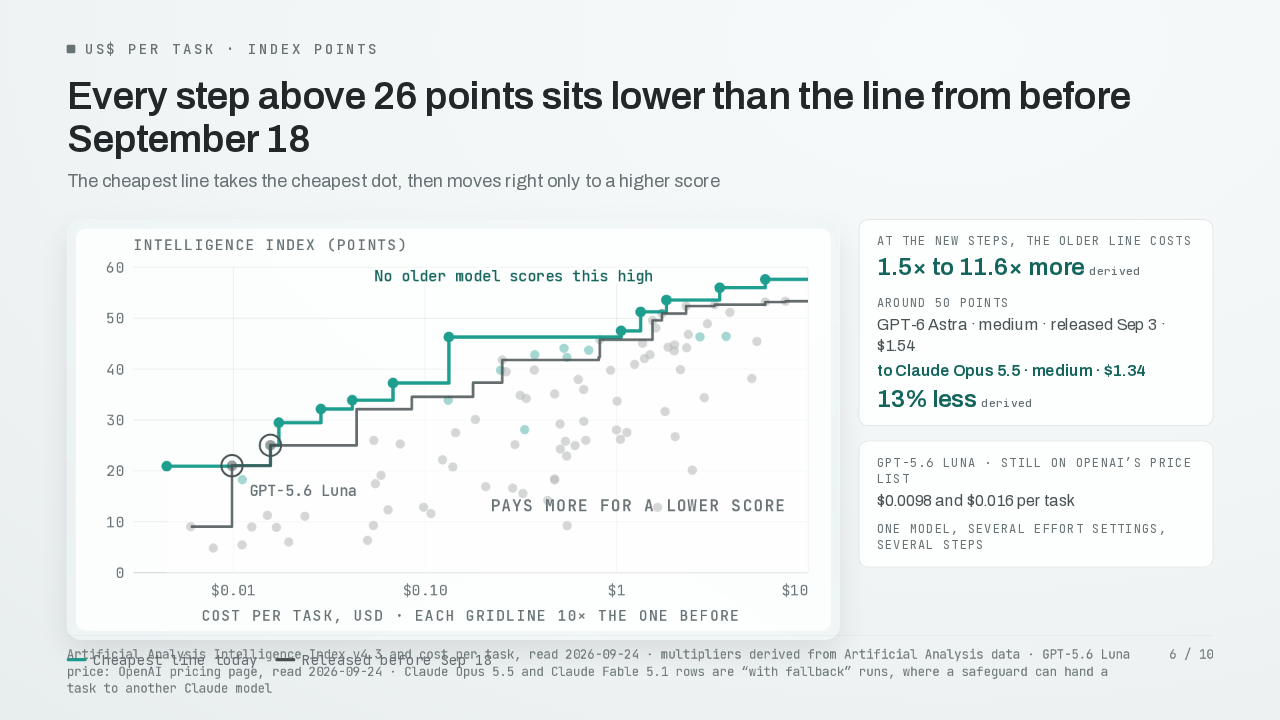
How the cheapest line is drawn
Every step above 26 points sits lower than the line from before September 18
The cheapest line takes the cheapest dot, then moves right only to a higher score
To draw the cheapest line, start at the bottom left and take the cheapest dot. Then move right only to a dot that scores higher. The grey line is the same rule, run on models released before September eighteenth. Up to fifty-three points, the older line costs one and a half to eleven point six times more at each new step. Around fifty points, GPT-6 Astra, an OpenAI model from September third, costs a dollar fifty-four per task on medium effort. Claude Opus 5.5 on medium costs a dollar thirty-four, thirteen percent less. The top three steps start at fifty-three point six points, and no older model scores that high. At twenty-one points and at twenty-five points, the cheapest model is still GPT-5.6 Luna. GPT-5.6 Luna is last generation's model, and OpenAI still sells it. GPT-6 Luna holds five steps and Claude Opus 5.5 holds the top four, one step per effort setting.
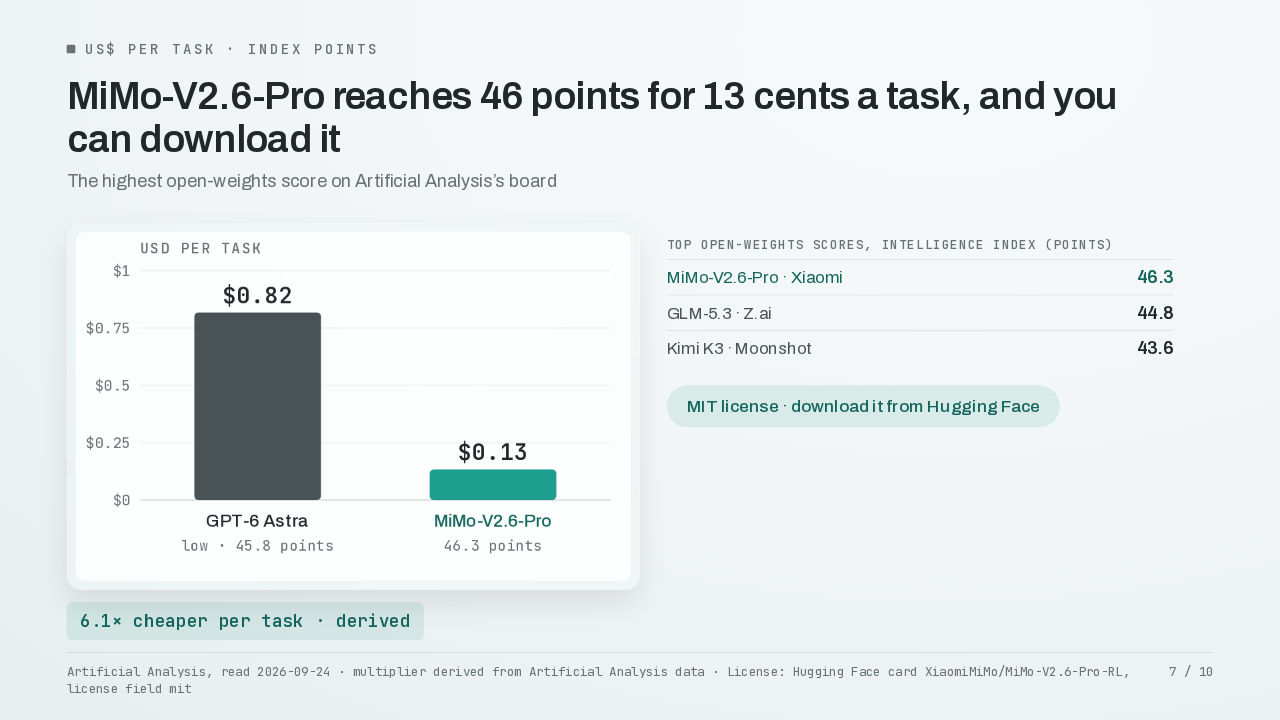
Six times cheaper at 46 points, and you can run it yourself
MiMo-V2.6-Pro reaches 46 points for 13 cents a task, and you can download it
The highest open-weights score on Artificial Analysis’s board
At about forty-six points, GPT-6 Astra on low effort scores forty-five point eight for eighty-two cents per task. MiMo-V2.6-Pro scores forty-six point three for thirteen cents, six point one times less. You can download MiMo-V2.6-Pro and run it yourself. MiMo-V2.6-Pro's forty-six point three is the highest open-weights score on Artificial Analysis's board.
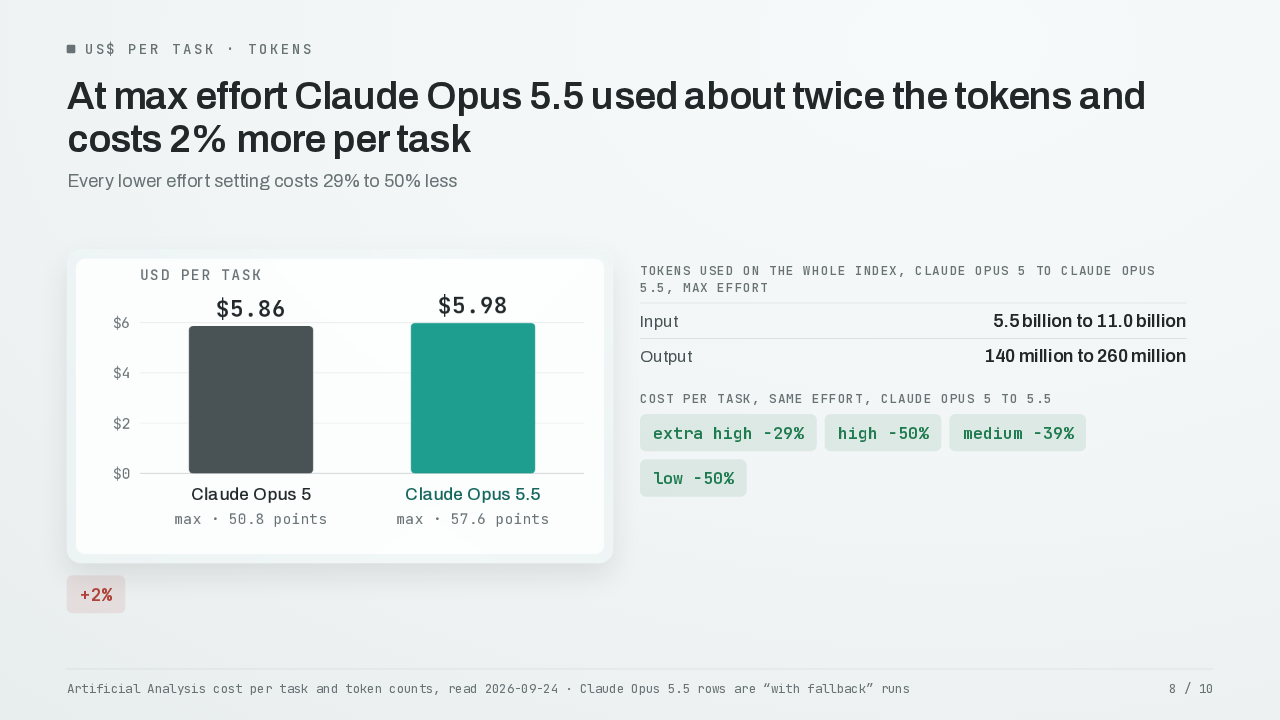
At max effort, Claude Opus 5.5 costs 2% more
At max effort Claude Opus 5.5 used about twice the tokens and costs 2% more per task
Every lower effort setting costs 29% to 50% less
At max effort, the saving disappears. Artificial Analysis measures Claude Opus 5.5 at five dollars ninety-eight per task, against five dollars eighty-six for Claude Opus 5, two percent more. On the full test set, Claude Opus 5.5 read eleven billion input tokens against five and a half billion for Claude Opus 5. Claude Opus 5.5 wrote two hundred and sixty million output tokens against a hundred and forty million for Claude Opus 5. The extra tokens cancel the price cut. At every lower setting, Claude Opus 5.5 costs twenty-nine to fifty percent less.
What to run this week
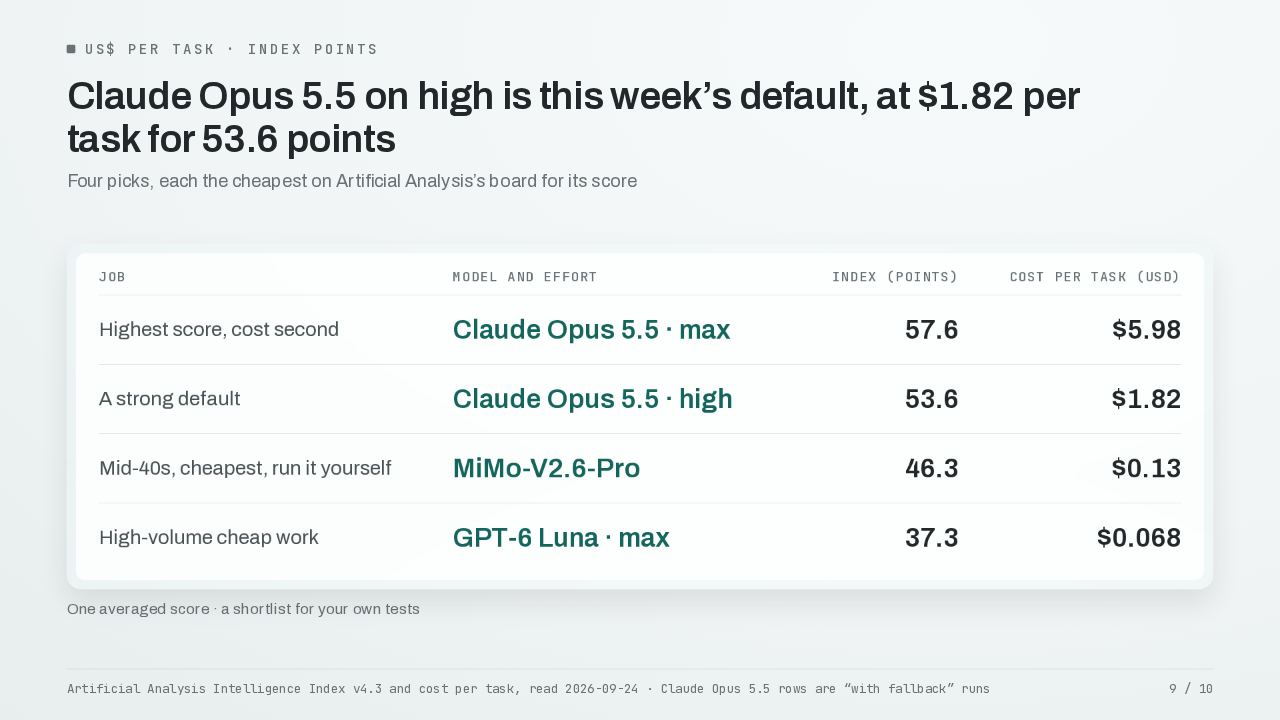
Claude Opus 5.5 on high is this week’s default, at $1.82 per task for 53.6 points
Four picks, each the cheapest on Artificial Analysis’s board for its score
| Job | Model and effort | Index (points) | Cost per task (USD) |
|---|---|---|---|
| Highest score, cost second | Claude Opus 5.5 · max | 57.6 | $5.98 |
| A strong default | Claude Opus 5.5 · high | 53.6 | $1.82 |
| Mid-40s, cheapest, run it yourself | MiMo-V2.6-Pro | 46.3 | $0.13 |
| High-volume cheap work | GPT-6 Luna · max | 37.3 | $0.068 |
One averaged score · a shortlist for your own tests
Here is what I'd run this week. For the highest score, when cost comes second, Claude Opus 5.5 on max scores fifty-seven point six for five dollars ninety-eight per task. For a strong default, Claude Opus 5.5 on high scores fifty-three point six for a dollar eighty-two. For the mid-forties at the lowest cost, on hardware you control, MiMo-V2.6-Pro scores forty-six point three for thirteen cents per task. For high-volume cheap work, GPT-6 Luna on max scores thirty-seven point three for under seven cents per task. All four picks rest on one averaged score, so test them on your own work.
Which step are you on?
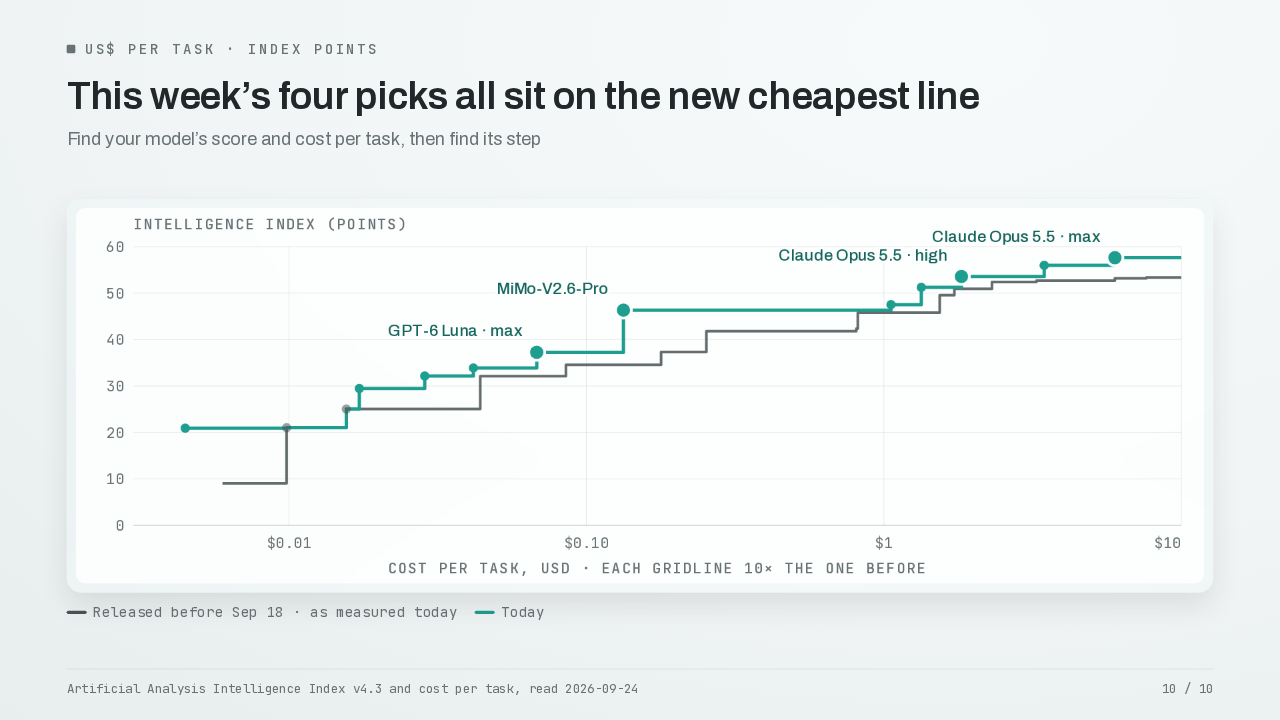
This week’s four picks all sit on the new cheapest line
Find your model’s score and cost per task, then find its step
Every step above twenty-six points on this line belongs to a model released on September twenty-first or twenty-second. Find the model you run today on Artificial Analysis's board. Is it still on a step?