GPT-6.1 Sol: one price halved


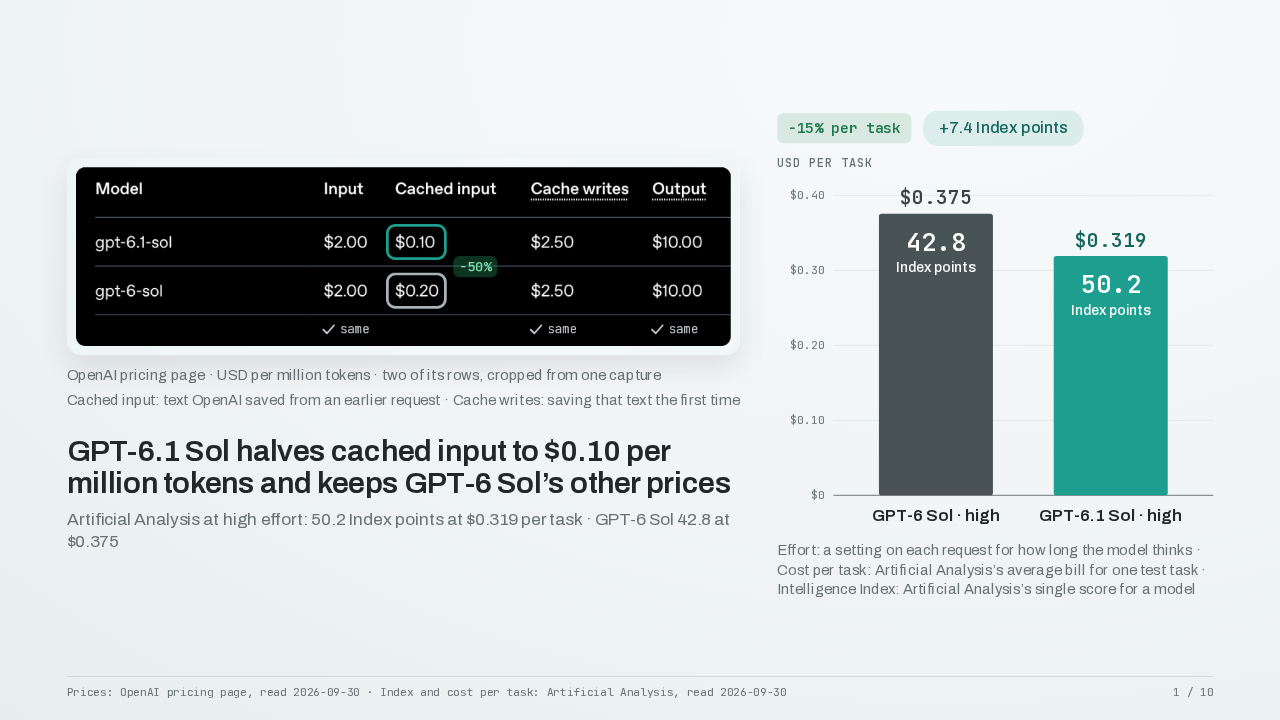
 −50%
−50%OpenAI pricing page · USD per million tokens · two of its rows, cropped from one capture
Cached input: text OpenAI saved from an earlier request · Cache writes: saving that text the first time
GPT-6.1 Sol halves cached input to $0.10 per million tokens and keeps GPT-6 Sol’s other prices
Artificial Analysis at high effort: 50.2 Index points at $0.319 per task · GPT-6 Sol 42.8 at $0.375
Effort: a setting on each request for how long the model thinks · Cost per task: Artificial Analysis’s average bill for one test task · Intelligence Index: Artificial Analysis’s single score for a model
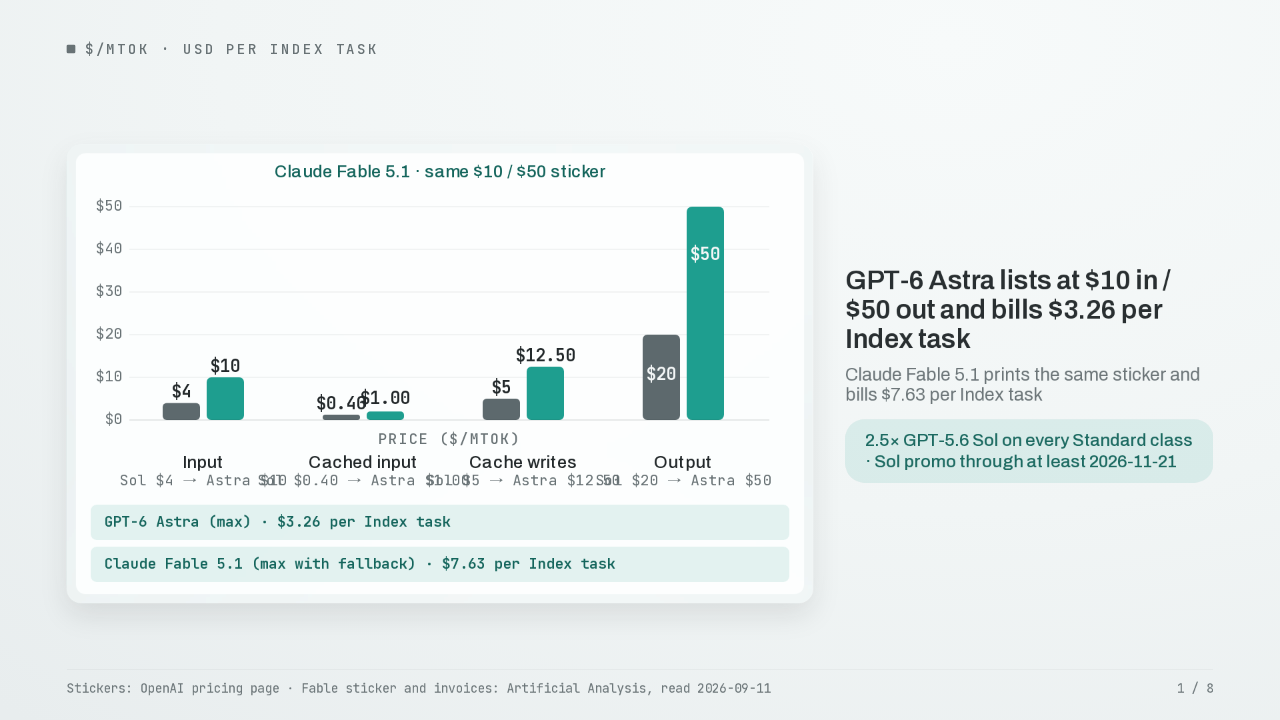
GPT-6.1 Sol has GPT-6 Sol's price list with one price cut in half. OpenAI charges by the token, a small chunk of text. Input, the text you send, costs two dollars per million tokens on both models. Output, the text the model writes back, costs ten dollars per million tokens on both. The price OpenAI halved is cached input, the price for text OpenAI saved from an earlier request. Cached input fell from twenty cents to ten cents per million tokens. Artificial Analysis is an independent company that runs the same tests on every model and records what each task costs. Artificial Analysis's single score for a model is the Intelligence Index. Effort is a setting on each request for how long the model thinks before it answers. At high effort, Artificial Analysis scores GPT-6.1 Sol at fifty point two Index points for about thirty-two cents per task. GPT-6 Sol at high effort scores forty-two point eight Index points for thirty-seven and a half cents per task.
The spec card
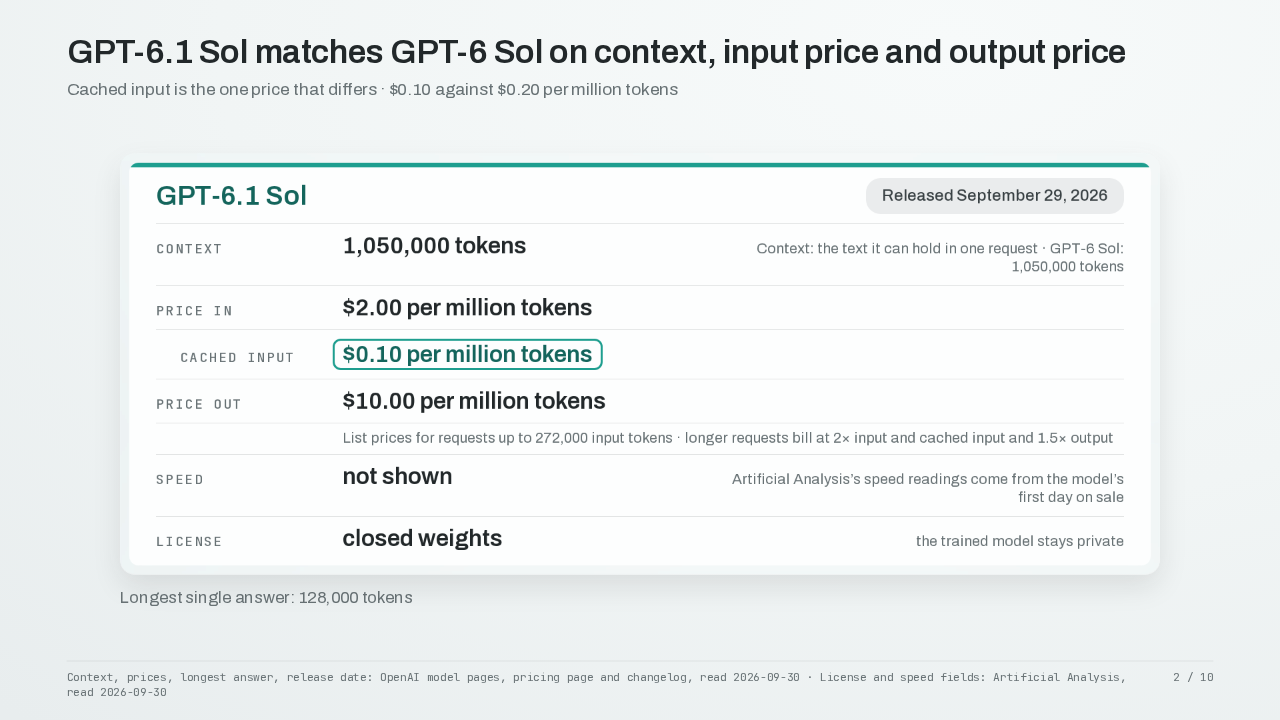
GPT-6.1 Sol matches GPT-6 Sol on context, input price and output price
Cached input is the one price that differs · $0.10 against $0.20 per million tokens
Longest single answer: 128,000 tokens
GPT-6.1 Sol's context window, how much text it can hold in one request, is about a million tokens. Artificial Analysis's speed readings for GPT-6.1 Sol come from its first day on sale, so the speed field reads not shown. OpenAI keeps the weights, the trained model itself, private.
What a long task re-sends
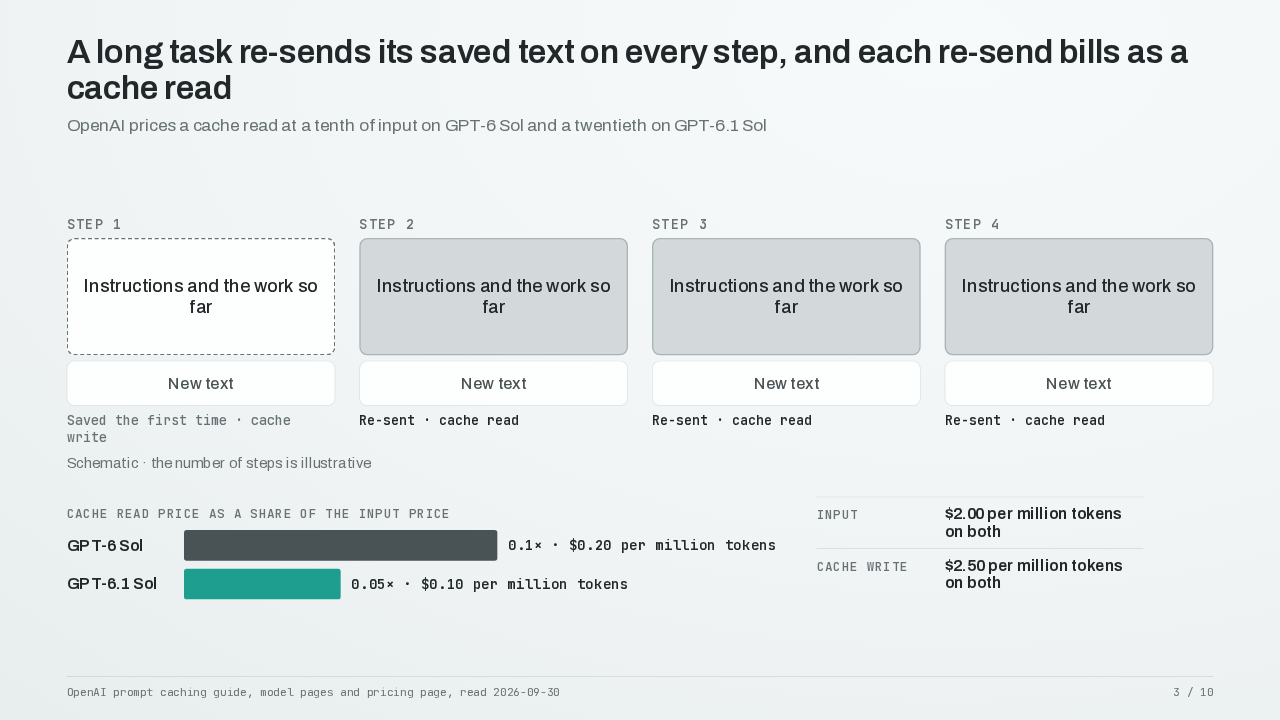
A long task re-sends its saved text on every step, and each re-send bills as a cache read
OpenAI prices a cache read at a tenth of input on GPT-6 Sol and a twentieth on GPT-6.1 Sol
Schematic · the number of steps is illustrative
A long task, like fixing a bug across several files, runs in many steps. On every step, the program running the task sends the model its instructions and all the work so far. OpenAI saves that text the first time the program sends it. Every later send of the saved text is a cache read, and OpenAI bills a cache read at the cached input price. A cache read costs a tenth of the input price on GPT-6 Sol, and a twentieth on GPT-6.1 Sol.
Where GPT-6 Sol’s $0.375 went
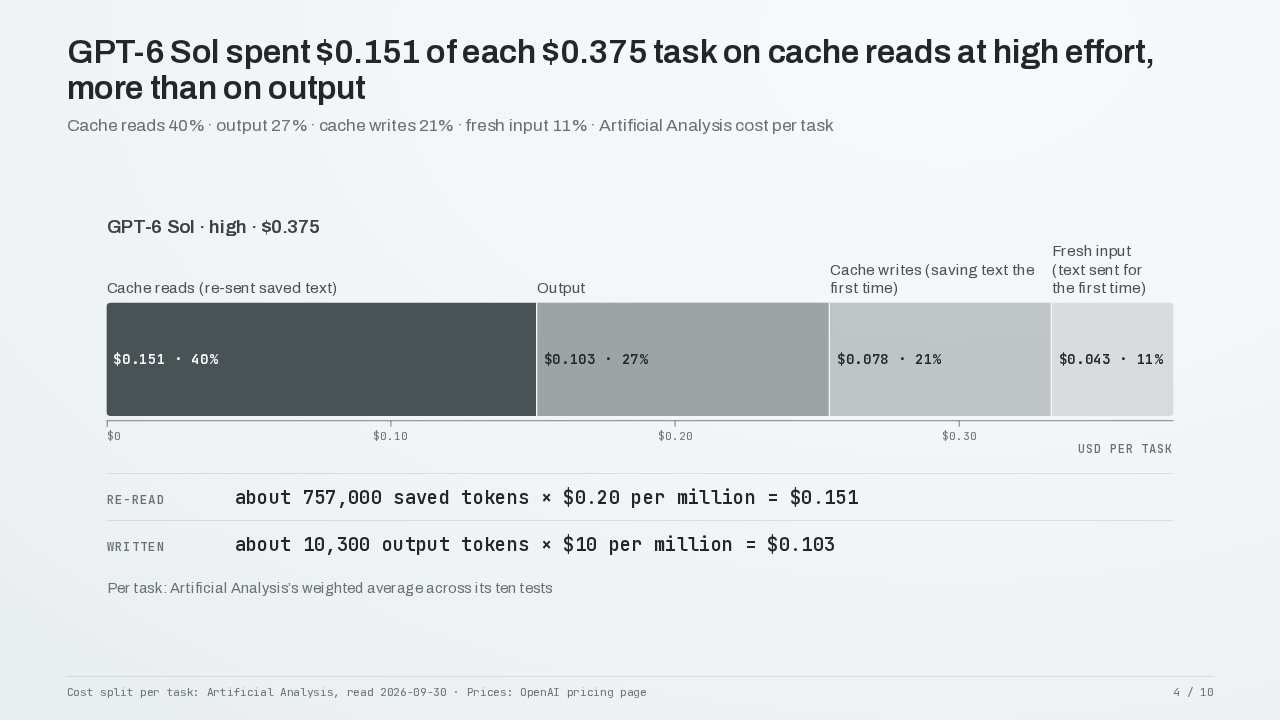
GPT-6 Sol spent $0.151 of each $0.375 task on cache reads at high effort, more than on output
Cache reads 40% · output 27% · cache writes 21% · fresh input 11% · Artificial Analysis cost per task
Per task: Artificial Analysis’s weighted average across its ten tests
On Artificial Analysis's test at high effort, an average GPT-6 Sol task cost thirty-seven and a half cents. Cache reads took about fifteen cents. Output took about ten cents. Cache writes, the charge for saving text the first time, took about eight cents. Fresh input, text sent for the first time, took about four cents. At high effort, cache reads were forty percent of GPT-6 Sol's bill per task, the largest of the four lines. The cheapest price on the list made the largest line, because a task re-reads far more than it writes. At high effort, an average GPT-6 Sol task re-read about seven hundred and fifty thousand saved tokens and wrote about ten thousand output tokens.
The halved line
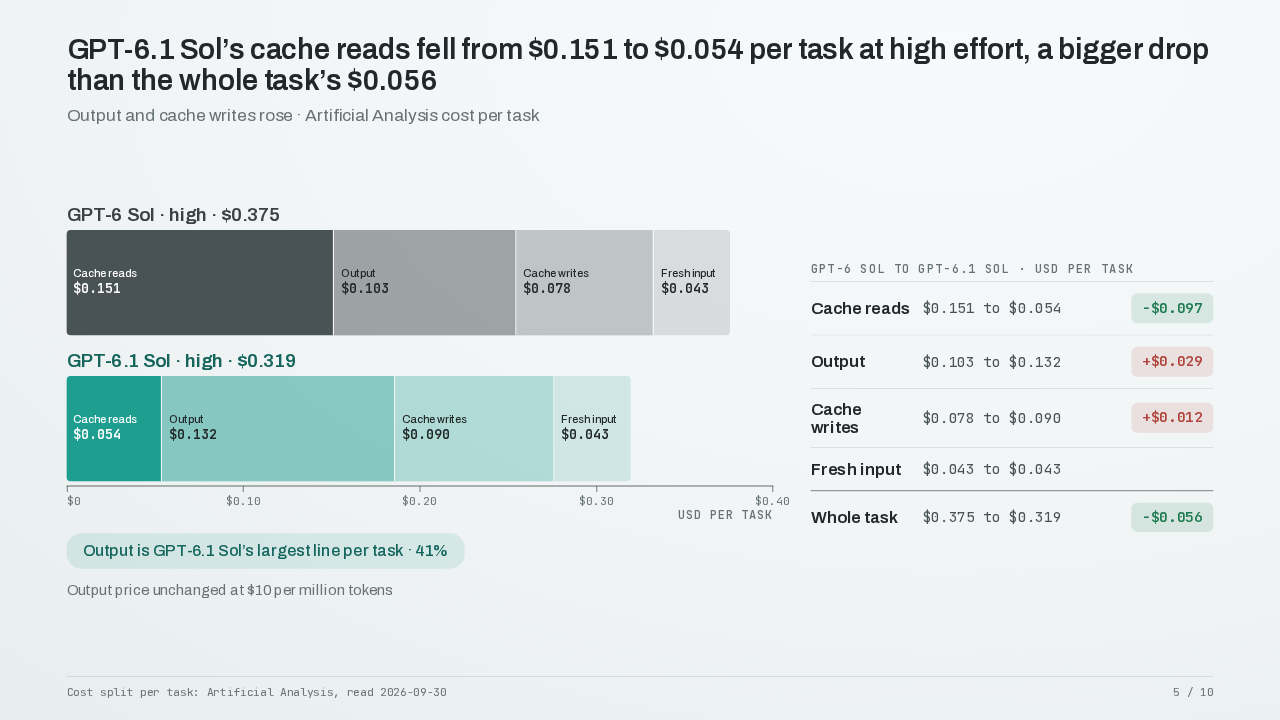
GPT-6.1 Sol’s cache reads fell from $0.151 to $0.054 per task at high effort, a bigger drop than the whole task’s $0.056
Output and cache writes rose · Artificial Analysis cost per task
GPT-6.1 Sol halves the price of cache reads, GPT-6 Sol's largest line per task at high effort. On Artificial Analysis's test at high effort, GPT-6.1 Sol spends about five cents per task on cache reads, against about fifteen cents for GPT-6 Sol. At high effort, the cache-read line fell nine point seven cents per task, and the whole bill per task fell five point six cents, to about thirty-two cents. Two other lines rose at high effort: output, from about ten cents to about thirteen cents per task, and cache writes, from about eight cents to nine cents per task.
Price and volume
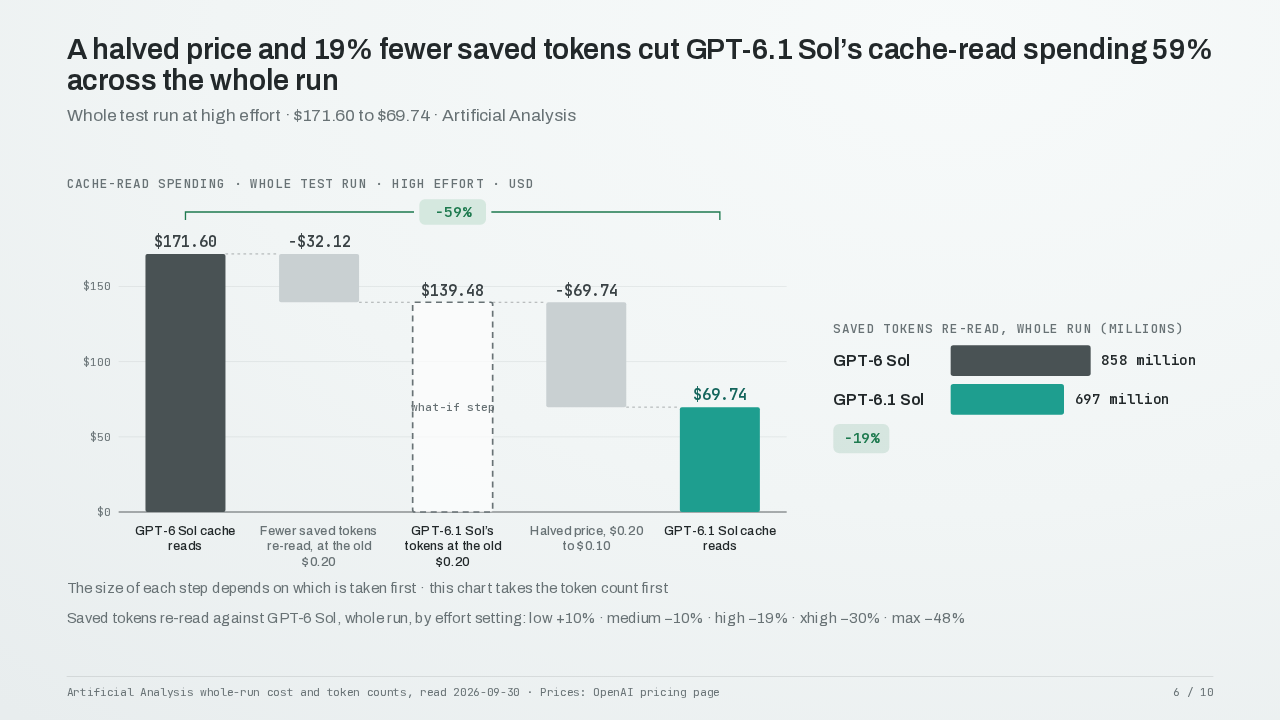
A halved price and 19% fewer saved tokens cut GPT-6.1 Sol’s cache-read spending 59% across the whole run
Whole test run at high effort · $171.60 to $69.74 · Artificial Analysis
The size of each step depends on which is taken first · this chart takes the token count first
Saved tokens re-read against GPT-6 Sol, whole run, by effort setting: low +10% · medium −10% · high −19% · xhigh −30% · max −48%
A halved price alone would cut cache-read spending by fifty percent. Across Artificial Analysis's whole test run at high effort, GPT-6.1 Sol's cache-read spending fell fifty-nine percent, from a hundred and seventy-one dollars sixty to sixty-nine dollars seventy-four. The drop passed fifty percent because GPT-6.1 Sol also re-read less saved text at high effort. Across the whole run, GPT-6.1 Sol re-read six hundred and ninety-seven million saved tokens, against eight hundred and fifty-eight million for GPT-6 Sol. That is nineteen percent fewer saved tokens.
Five effort settings
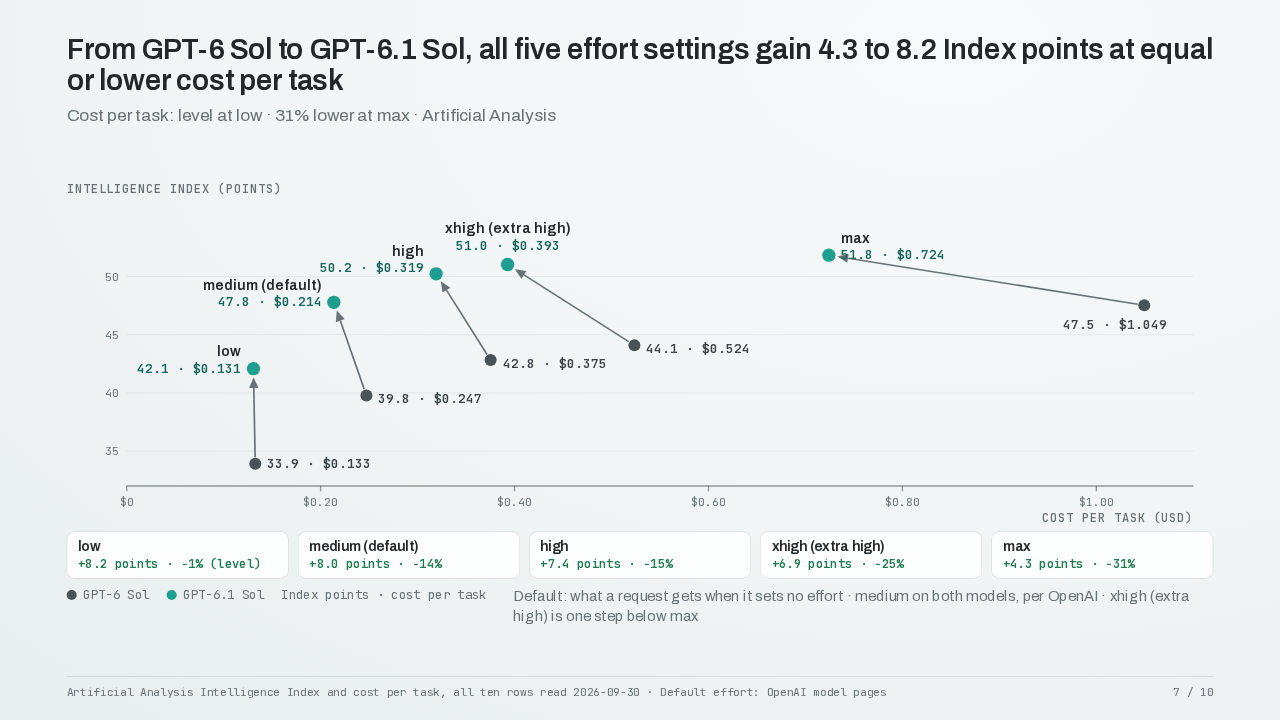
From GPT-6 Sol to GPT-6.1 Sol, all five effort settings gain 4.3 to 8.2 Index points at equal or lower cost per task
Cost per task: level at low · 31% lower at max · Artificial Analysis
Default: what a request gets when it sets no effort · medium on both models, per OpenAI · xhigh (extra high) is one step below max
Artificial Analysis ran both models at five effort settings. GPT-6.1 Sol scores four to eight Index points higher at every setting, for the same cost per task or less. Medium is the setting a request gets when it leaves effort unset. At medium, GPT-6.1 Sol scores forty-seven point eight Index points against GPT-6 Sol's thirty-nine point eight, for about twenty-one cents per task against twenty-five cents. At max effort, GPT-6.1 Sol scores fifty-one point eight Index points against GPT-6 Sol's forty-seven point five, for seventy-two cents per task against one dollar and five cents. The score gap narrows from about eight Index points at low to about four at max. The cost per task is level at low and thirty-one percent lower at max.
The board, with the new dots placed
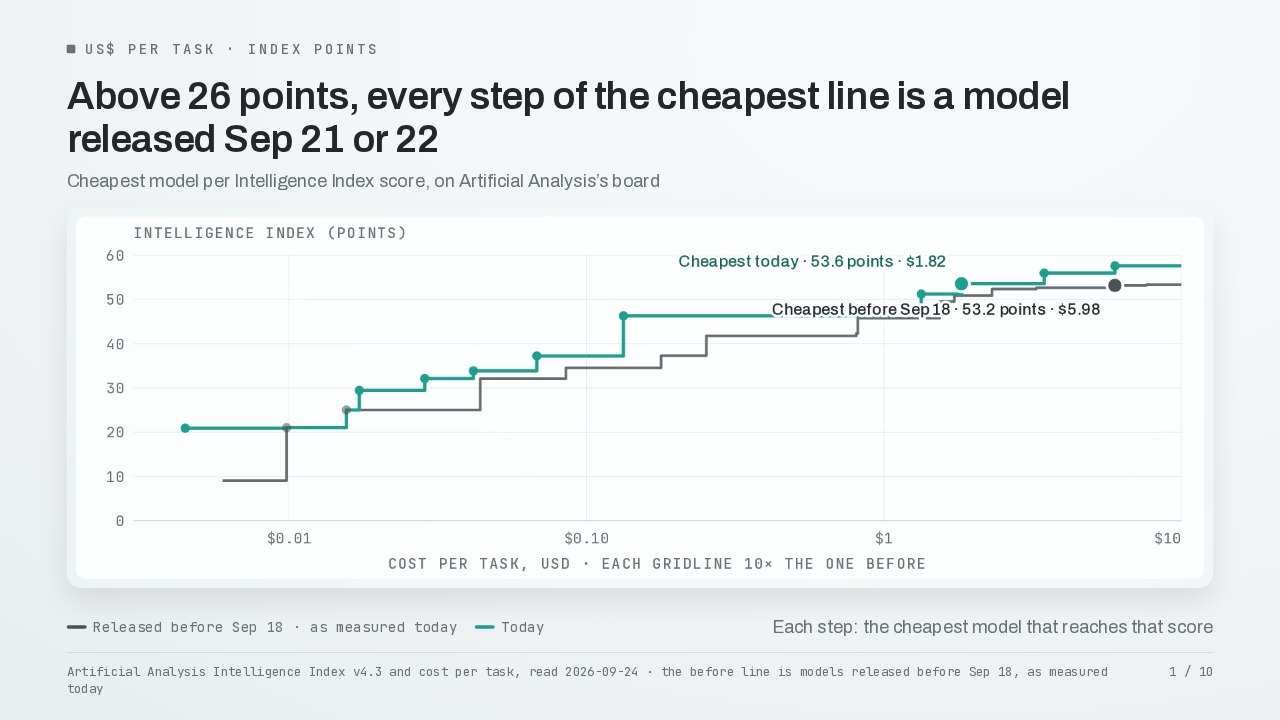
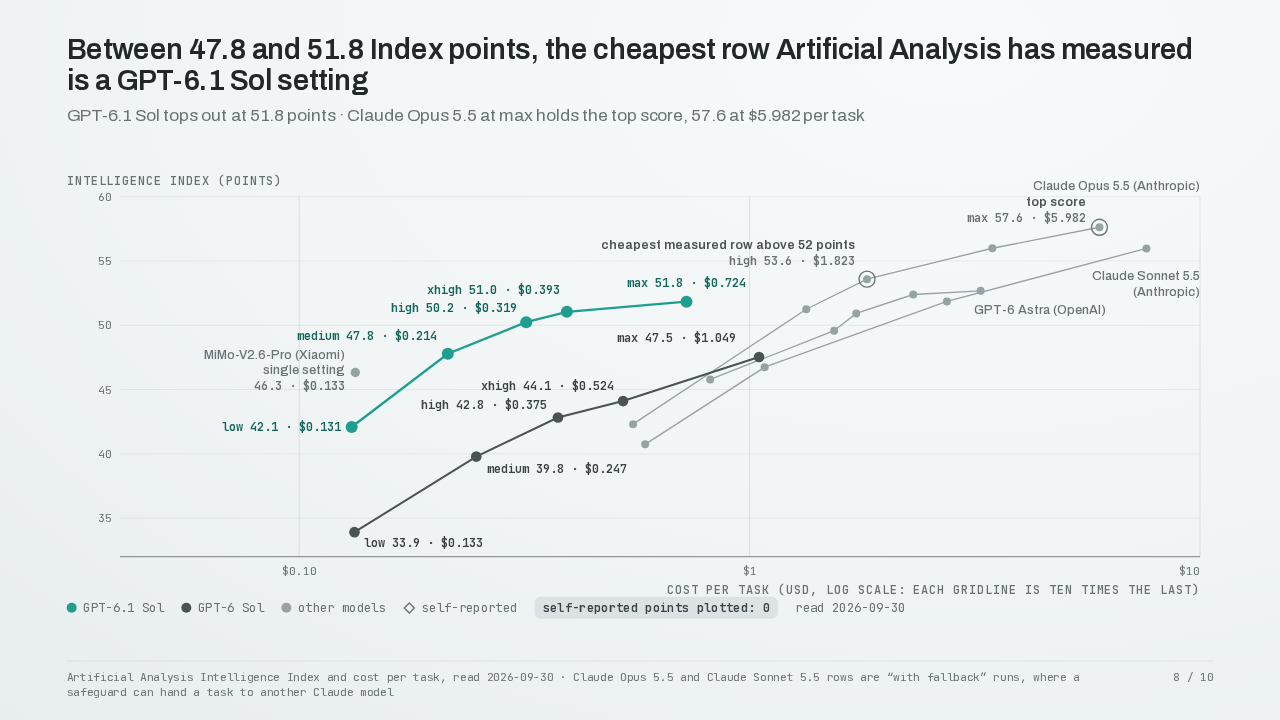
Between 47.8 and 51.8 Index points, the cheapest row Artificial Analysis has measured is a GPT-6.1 Sol setting
GPT-6.1 Sol tops out at 51.8 points · Claude Opus 5.5 at max holds the top score, 57.6 at $5.982 per task
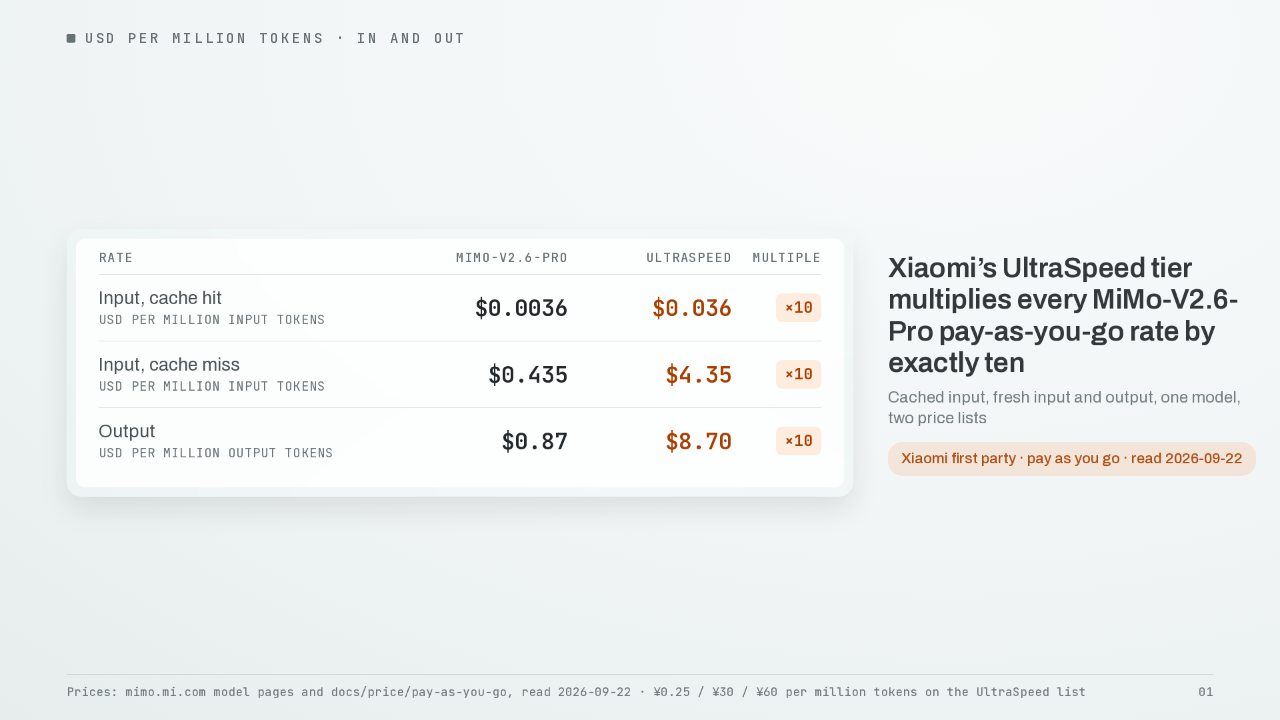
On Artificial Analysis's board, score goes up, cost per task goes right, and each model is a line of dots, one dot per effort setting. From medium effort up to max, each GPT-6.1 Sol dot is the cheapest row Artificial Analysis has measured at that score or higher. The other lines are OpenAI's GPT-6 Astra and Anthropic's Claude Opus 5.5 and Claude Sonnet 5.5. Xiaomi's MiMo-V2.6-Pro sits below GPT-6.1 Sol's medium dot, at forty-six point three Index points against forty-seven point eight, for thirteen cents per task against twenty-one cents.
About 51 points
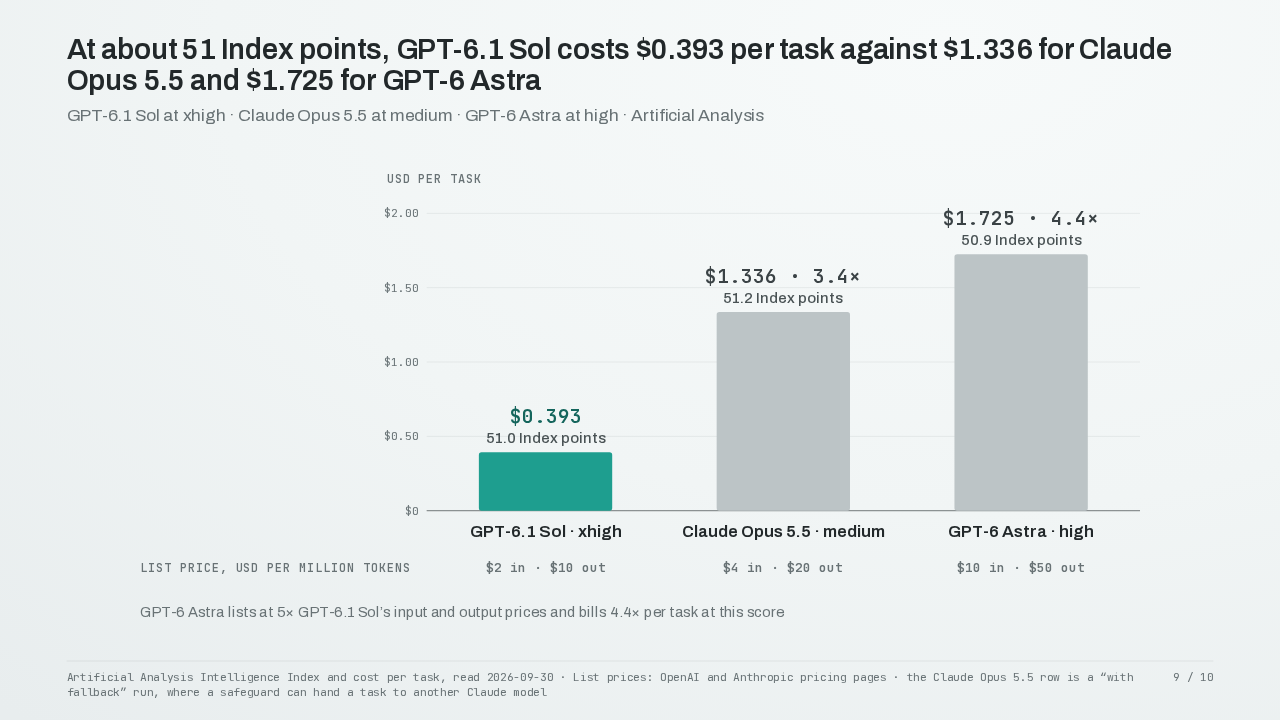
At about 51 Index points, GPT-6.1 Sol costs $0.393 per task against $1.336 for Claude Opus 5.5 and $1.725 for GPT-6 Astra
GPT-6.1 Sol at xhigh · Claude Opus 5.5 at medium · GPT-6 Astra at high · Artificial Analysis
GPT-6 Astra lists at 5× GPT-6.1 Sol’s input and output prices and bills 4.4× per task at this score
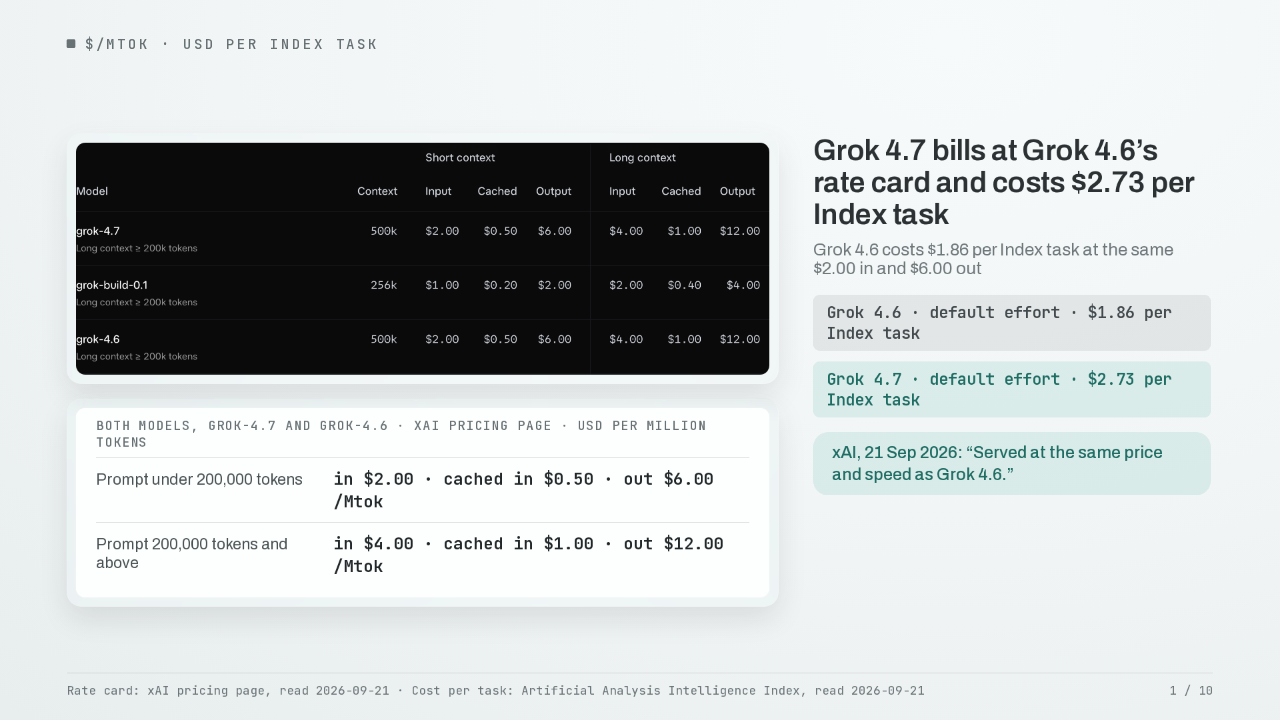
Compare three rows that each score about fifty-one Index points on Artificial Analysis's test. GPT-6.1 Sol at extra high scores fifty-one point zero Index points for thirty-nine cents per task. Claude Opus 5.5 at medium scores fifty-one point two Index points for one dollar thirty-four per task, three point four times GPT-6.1 Sol's cost. GPT-6 Astra, OpenAI's pricier model, scores fifty point nine Index points at high effort for one dollar seventy-three per task, four point four times GPT-6.1 Sol's cost.
What to run
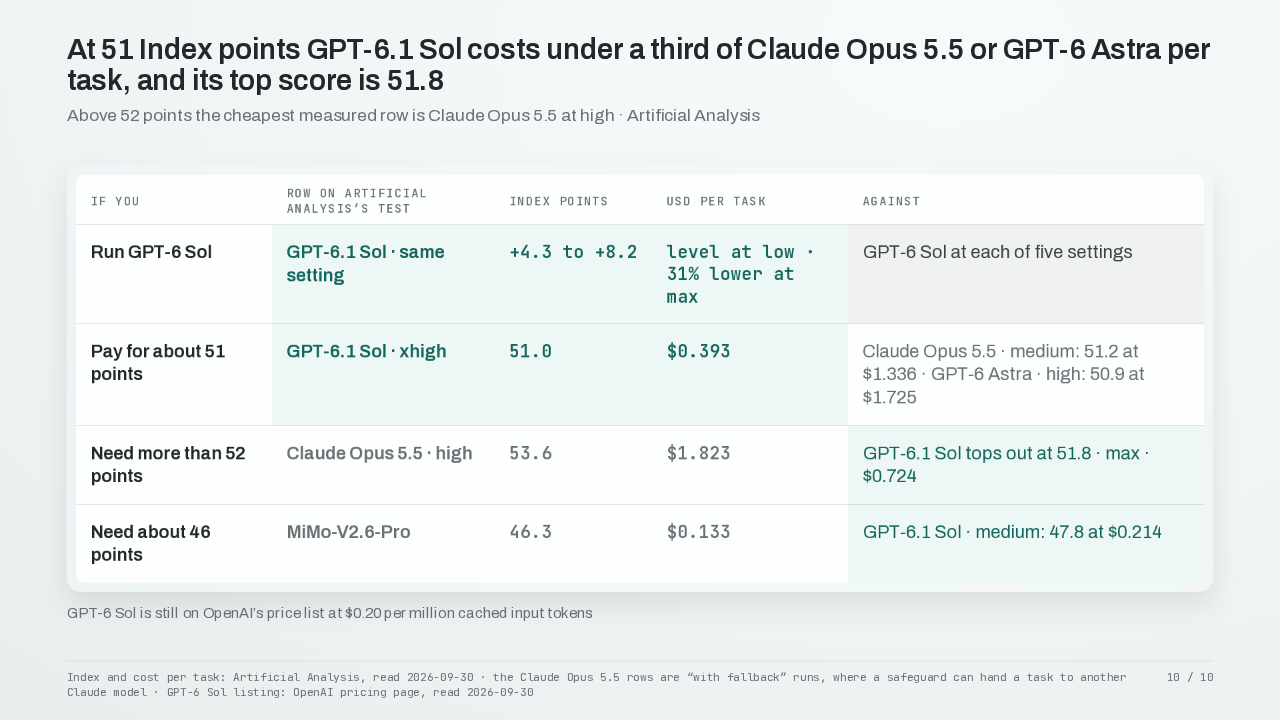
At 51 Index points GPT-6.1 Sol costs under a third of Claude Opus 5.5 or GPT-6 Astra per task, and its top score is 51.8
Above 52 points the cheapest measured row is Claude Opus 5.5 at high · Artificial Analysis
| If you | Row on Artificial Analysis’s test | Index points | USD per task | Against |
|---|---|---|---|---|
| Run GPT-6 Sol | GPT-6.1 Sol · same setting | +4.3 to +8.2 | level at low · 31% lower at max | GPT-6 Sol at each of five settings |
| Pay for about 51 points | GPT-6.1 Sol · xhigh | 51.0 | $0.393 | Claude Opus 5.5 · medium: 51.2 at $1.336 · GPT-6 Astra · high: 50.9 at $1.725 |
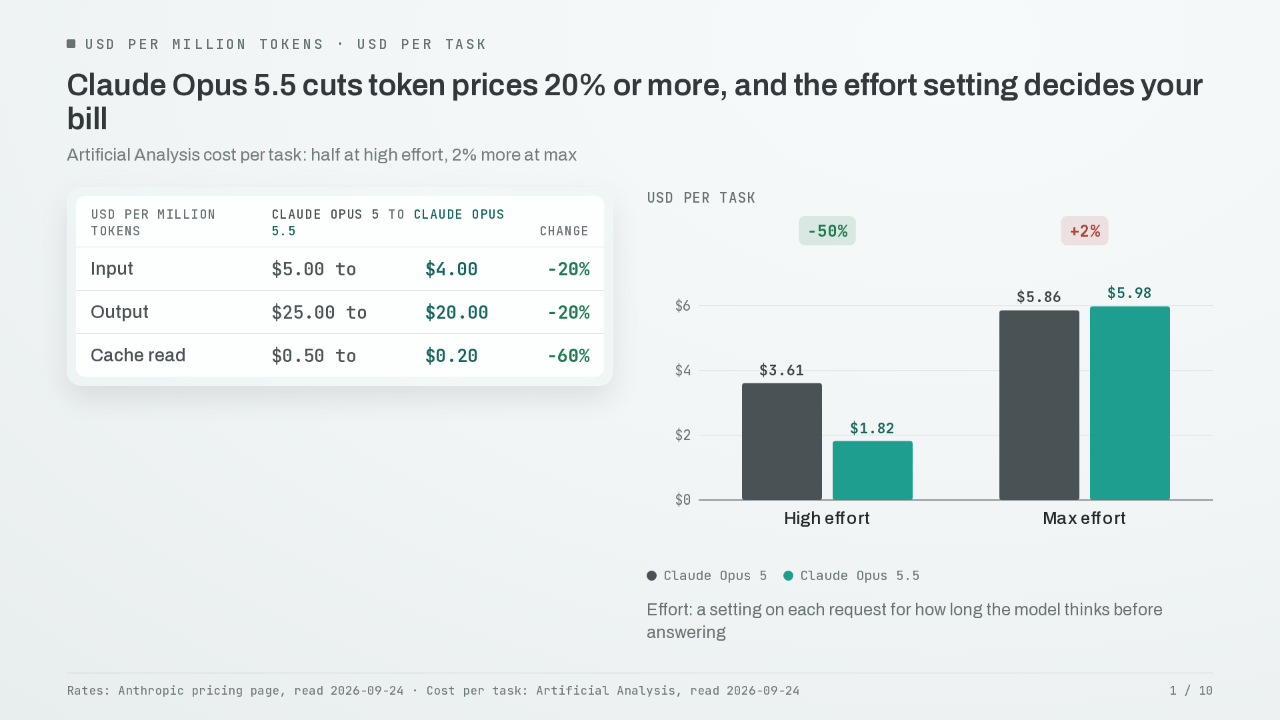
| Need more than 52 points | Claude Opus 5.5 · high | 53.6 | $1.823 | GPT-6.1 Sol tops out at 51.8 · max · $0.724 |
| Need about 46 points | MiMo-V2.6-Pro | 46.3 | $0.133 | GPT-6.1 Sol · medium: 47.8 at $0.214 |
GPT-6 Sol is still on OpenAI’s price list at $0.20 per million cached input tokens
If you run GPT-6 Sol, the same effort setting on GPT-6.1 Sol scores higher on Artificial Analysis's test for the same cost per task or less. If you pay for about fifty-one Index points on Claude Opus 5.5 or GPT-6 Astra, GPT-6.1 Sol at extra high reaches that score for under a third of the cost per task. If you need more than fifty-two Index points, the cheapest row Artificial Analysis has measured is Claude Opus 5.5 at high effort, at one dollar eighty-two per task. These numbers come from one test set at Artificial Analysis. The saving on your own bill depends on how much saved text your requests re-read.