Point2Part splits a 3D model into the parts you point at
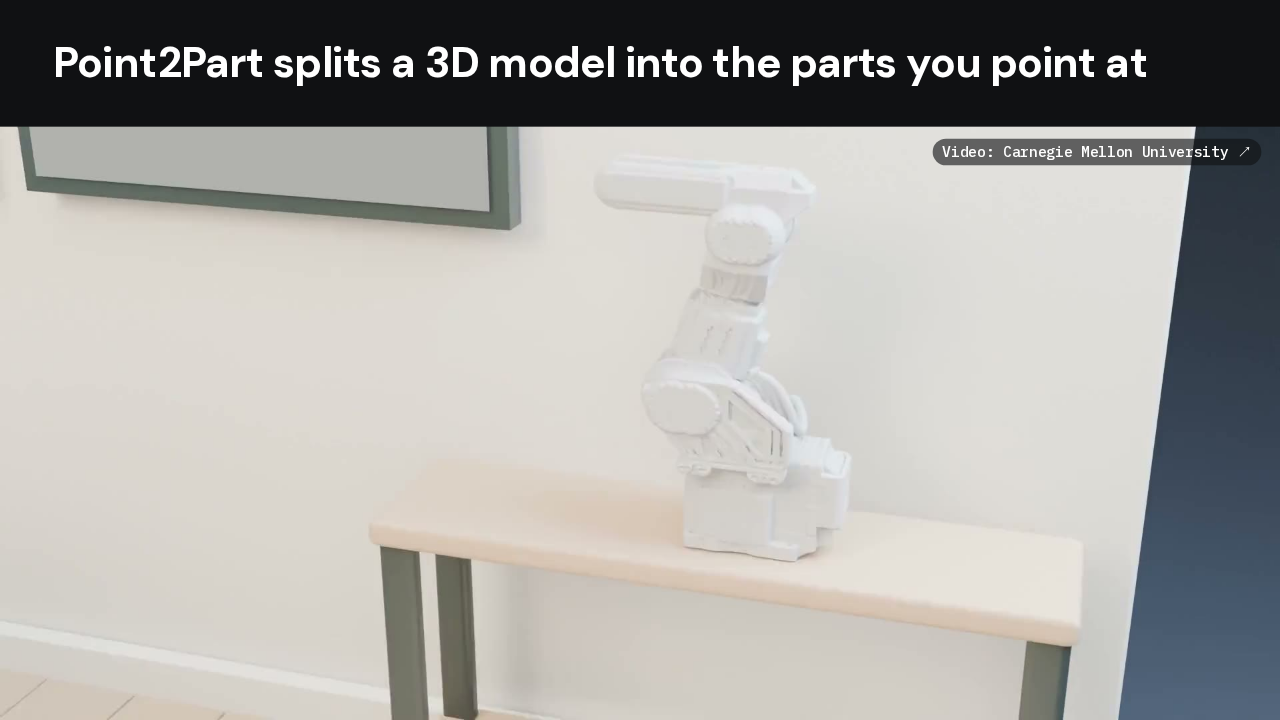
Researchers at Carnegie Mellon University built a model called Point2Part. You give it a 3D model and click one point on each part you want. It splits the whole shape into exactly those parts. Here, the same robot arm comes apart three different ways.
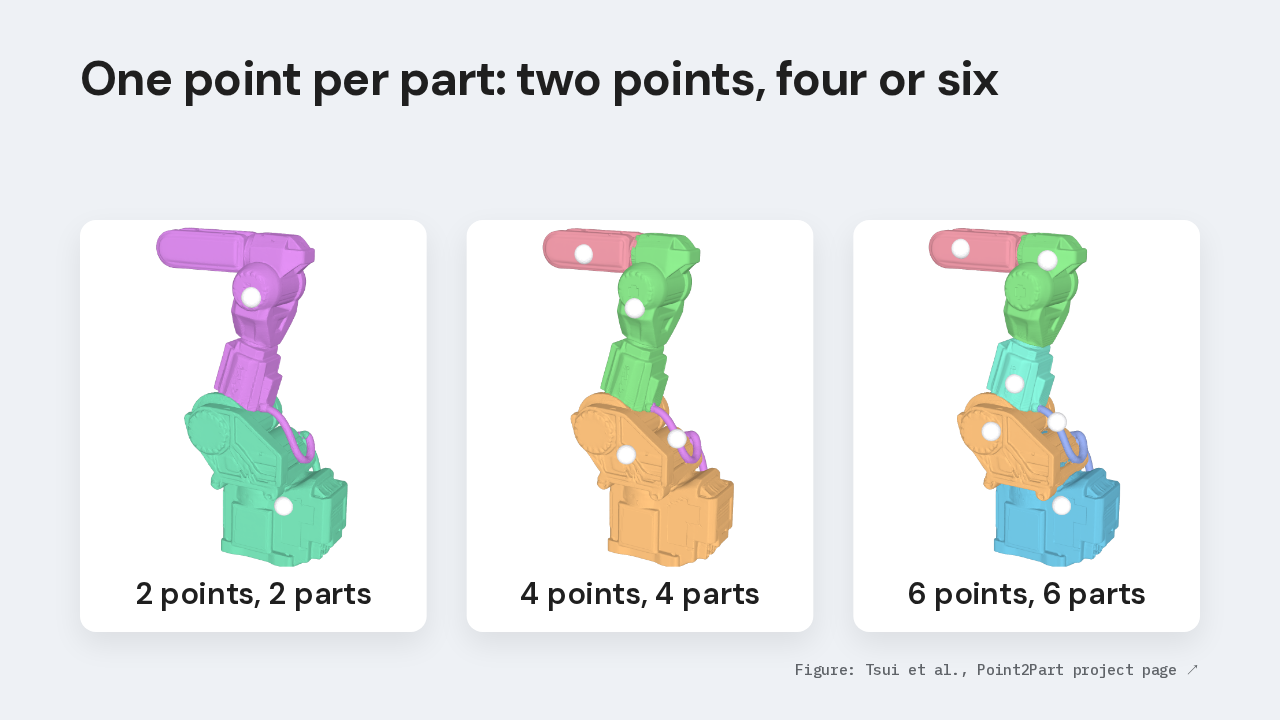
One point per part: two points, four or six


The white dots are the clicks. Two points give two parts: the top half and the base. Four points pull out the tip and the cable. And six split the base into finer pieces too. The shape didn't change, only where you clicked.
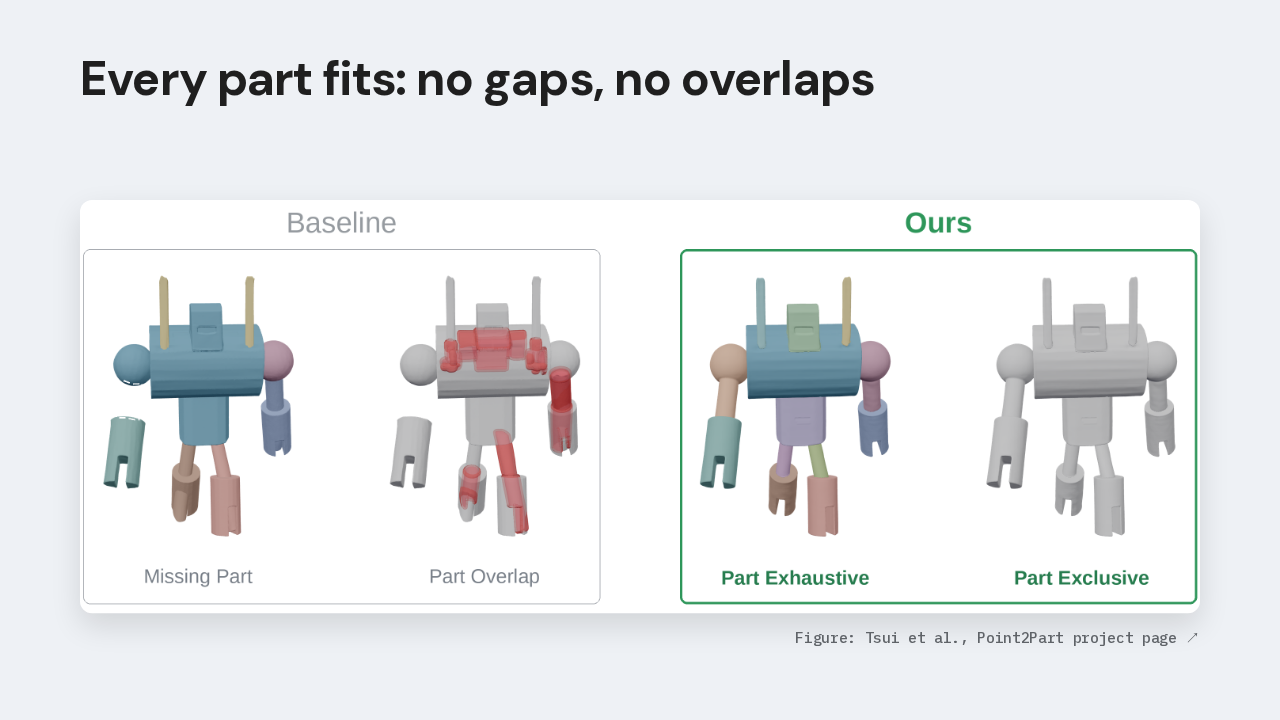
Every part fits: no gaps, no overlaps

That matters because earlier tools build each part on its own. So a part can go missing, or two parts can fill the same space, shown here in red. Point2Part decides every part at once, so nothing is left over and nothing is counted twice. That's what you need to print, swap or animate a single part.
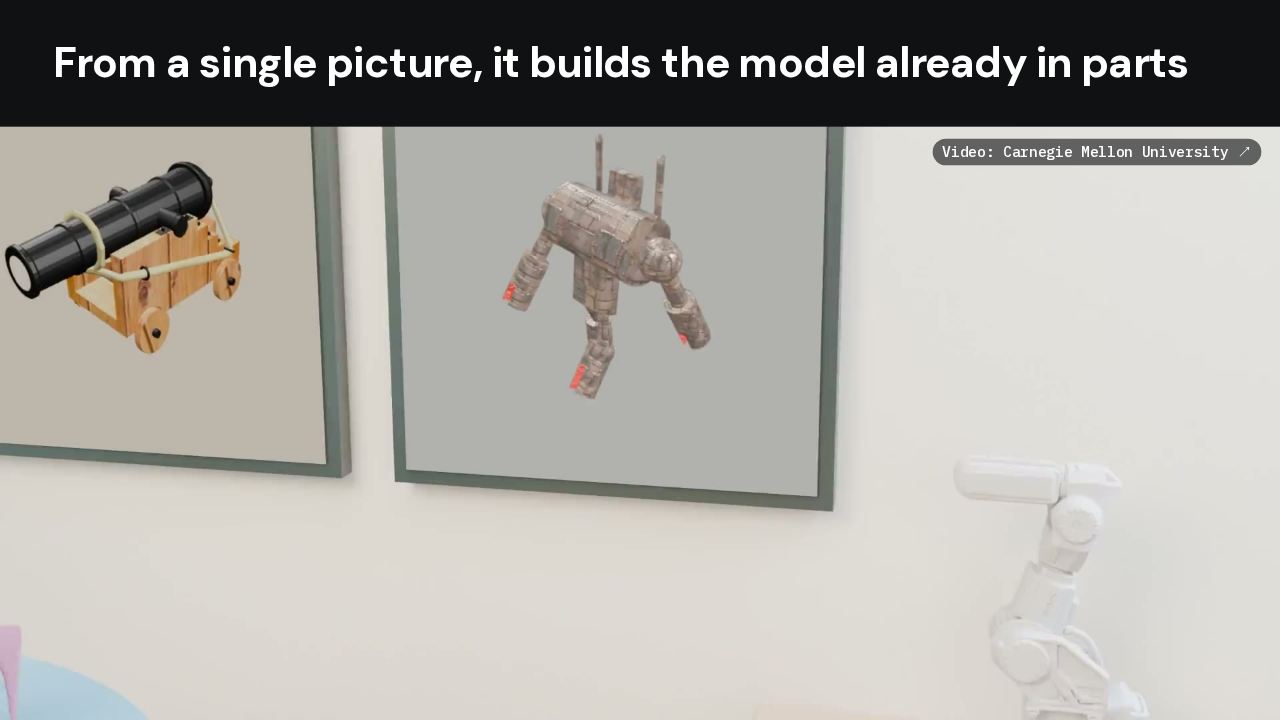
From a single picture, it builds the model already in parts
It also works from a single picture. Give it an image of a toy robot, and it builds the 3D model with the head, arms and legs as separate pieces, each one a closed solid.
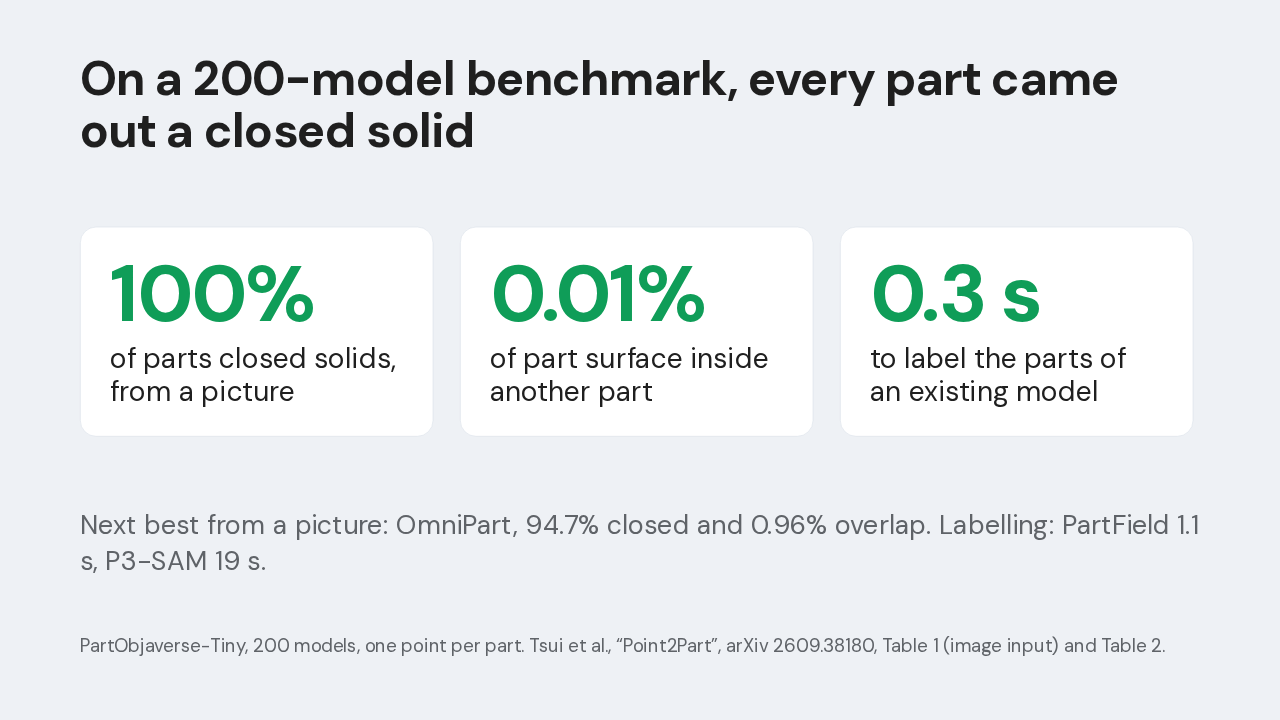
On a 200-model benchmark, every part came out a closed solid
Next best from a picture: OmniPart, 94.7% closed and 0.96% overlap. Labelling: PartField 1.1 s, P3-SAM 19 s.
PartObjaverse-Tiny, 200 models, one point per part. Tsui et al., “Point2Part”, arXiv 2609.38180, Table 1 (image input) and Table 2.
The team tested it on a standard set of 200 models. Built from a picture, every single part came out as a closed solid, the kind you could 3D print. The next best tool managed about 95 percent. Almost no part pokes into another, about a hundredth of a percent of the surface. And to label the parts of a model you already have, it takes about a third of a second.
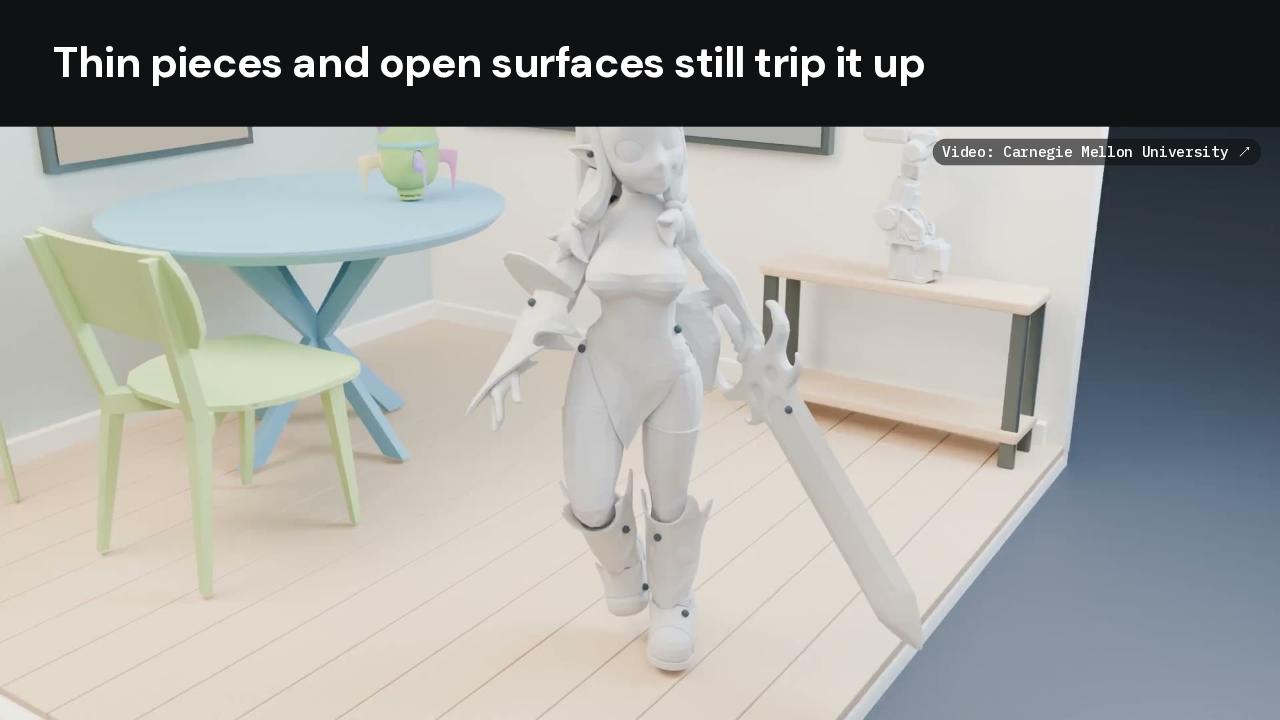
Thin pieces and open surfaces still trip it up
Here it labels a game character in under a third of a second. The authors name the limits. Very thin pieces and large open surfaces, like a sheet or a leaf, don't enclose a solid, so it struggles to split them. And it's built on Tencent's Hunyuan 3D model, so it inherits that model's blind spots.
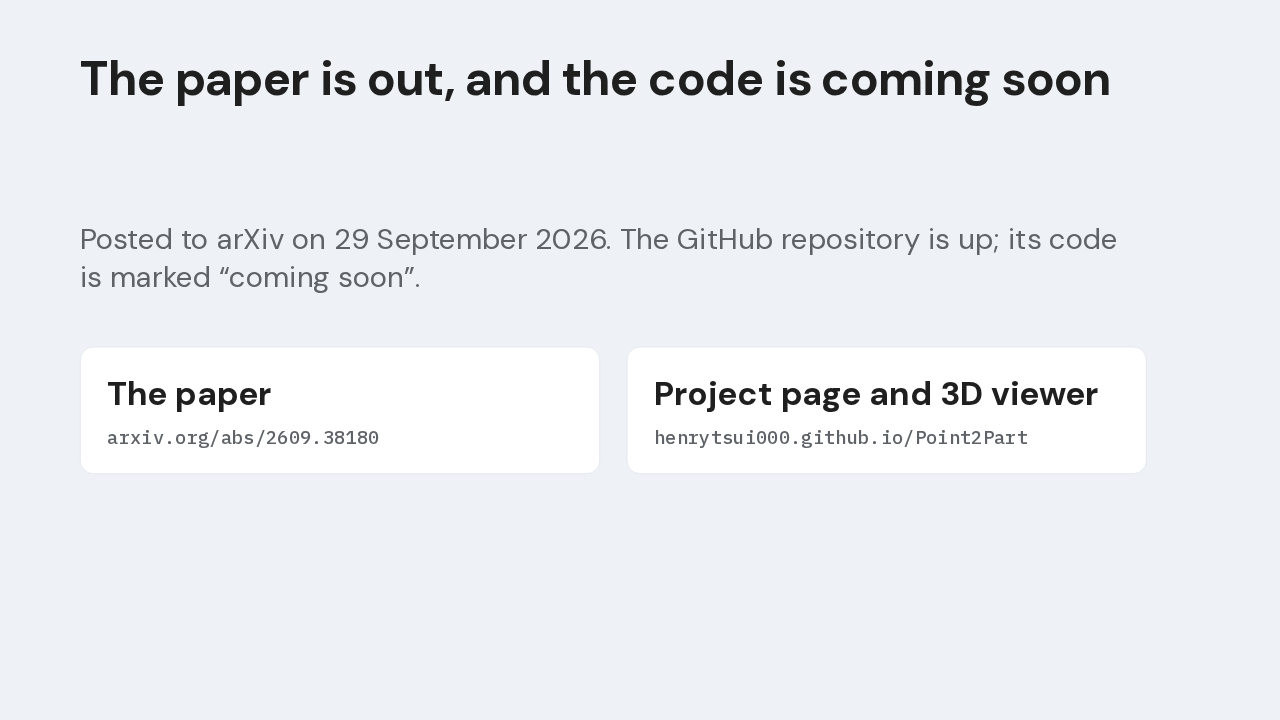
The paper is out, and the code is coming soon
Posted to arXiv on 29 September 2026. The GitHub repository is up; its code is marked “coming soon”.
The paper went up on September 29th. The project's GitHub page is live, with the code marked coming soon. The paper and the project page, where you can spin the models yourself, are linked below.