
A one-line change keeps ByteDance's 4-step video model from going wrong as it trains
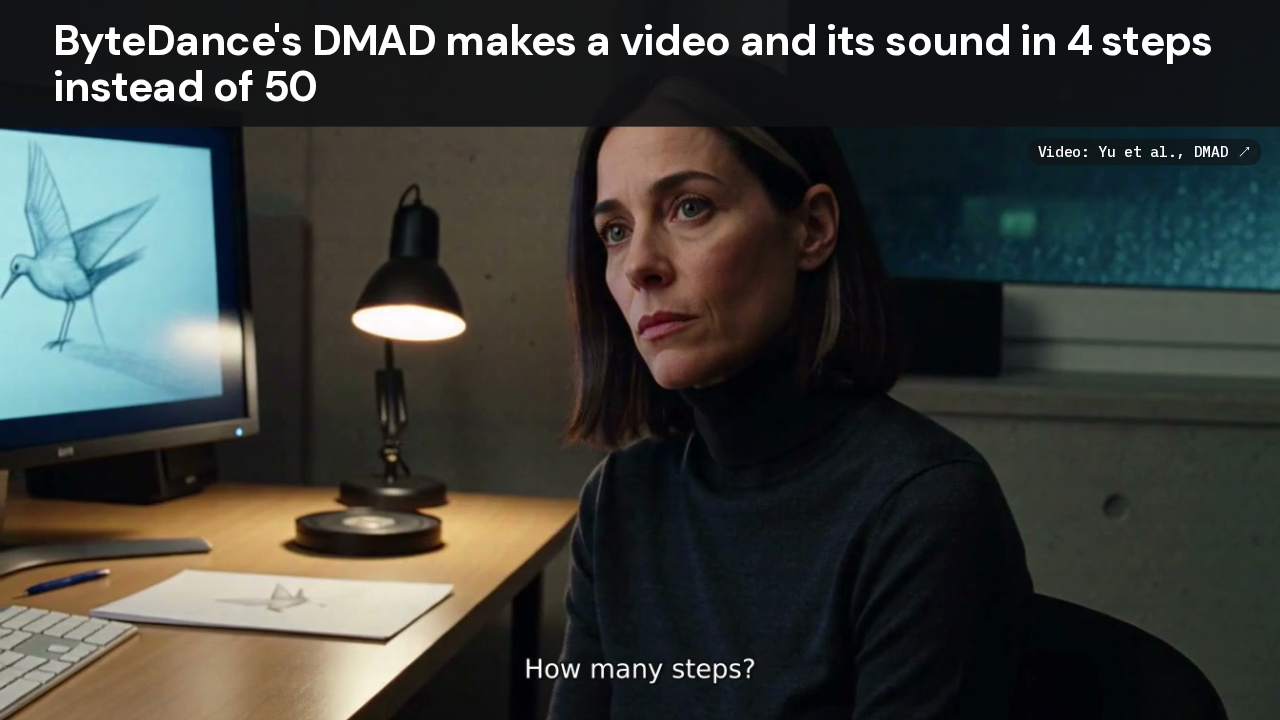
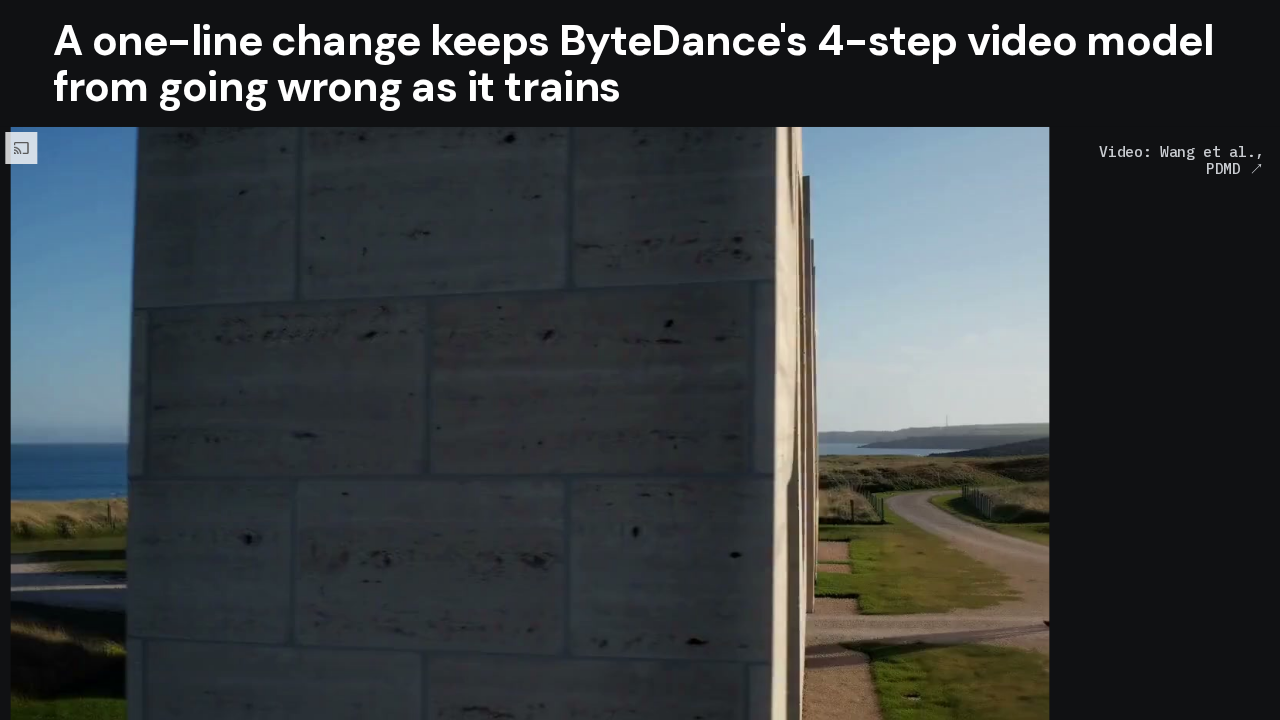
ByteDance and UC San Diego got MiniMax's H3 video model to work in four steps instead of fifty, with one line of code that stops the fast version from drifting as it trains. This fifteen-second clip, sound and all, took four steps.
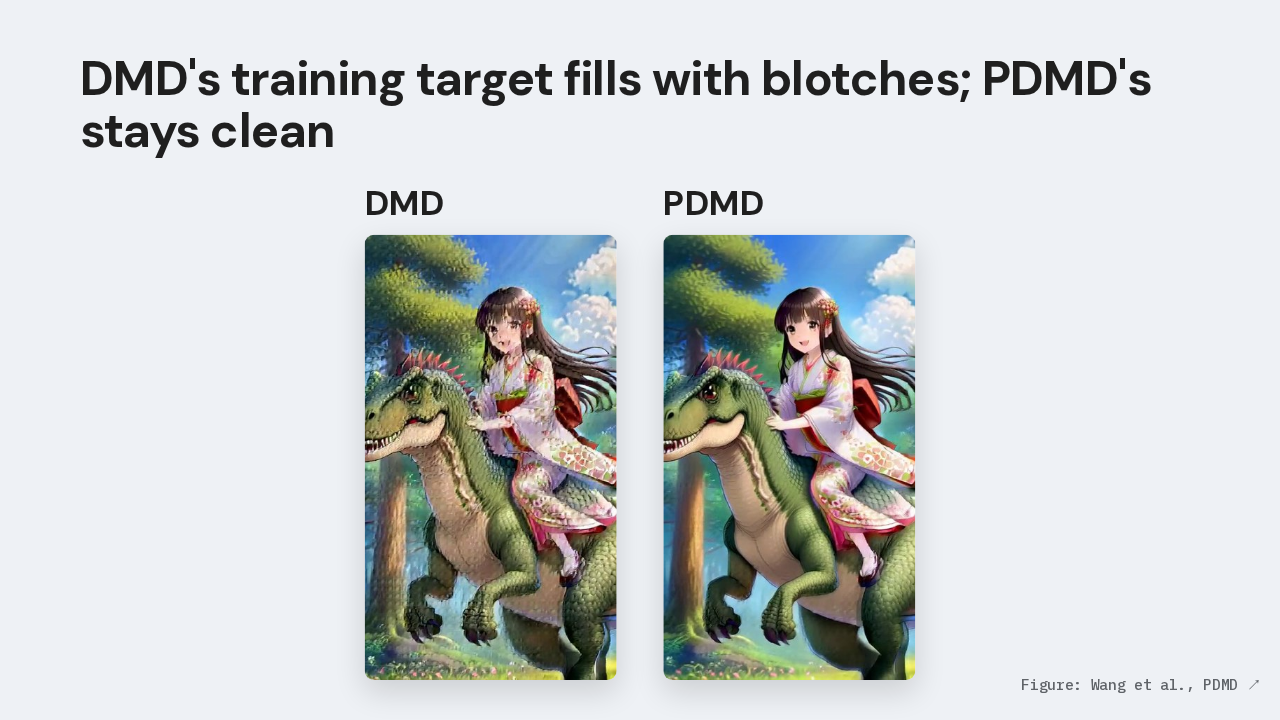
DMD's training target fills with blotches; PDMD's stays clean


Here's the problem it fixes. The usual way to make a model this fast, called DMD, trains it against a second network, a critic, that's always a little wrong. Those errors pile up from one update to the next, and the frames drift toward blotchy, oversaturated textures. On the left is one of DMD's real training targets. On the right, PDMD's, from the same point.
The fix: drop the part of each update that follows the critic's error

# r = x0_critic - x0_student
d = d - (d * r).sum() / r.pow(2).sum() * r
PDMD's whole change to DMD. No extra loss, network, data or model pass.
The fix is one line. Take the gap between where the critic and the student each think the clean frame is. The paper proves that gap is a fair estimate of the critic's error. DMD's update partly points along it. PDMD removes that part and keeps the rest. There's no extra network and no extra loss.
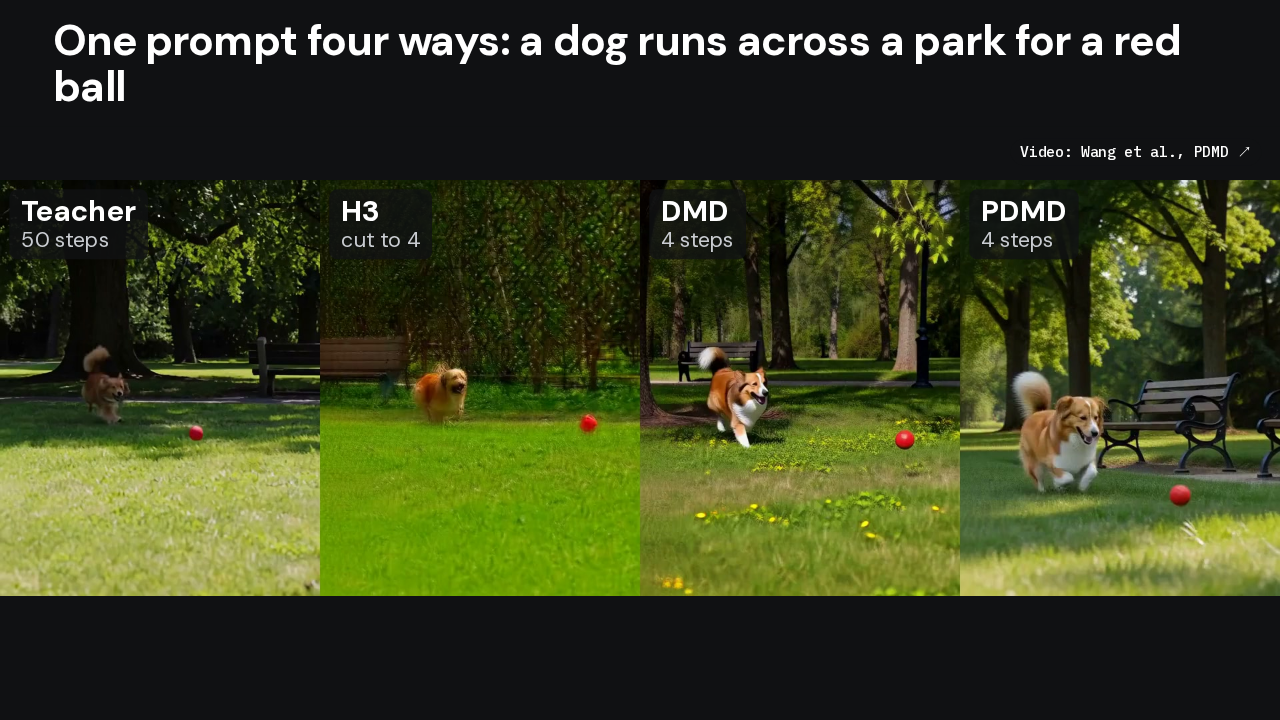
One prompt four ways: a dog runs across a park for a red ball
Here's one benchmark prompt: a dog running across a park for a red ball. The fifty-step original gets it right. Cut straight to four steps, and the picture goes flat and green, and the dog blurs. DMD fixes the blur, but the colours run hot and the fur looks like plastic. PDMD's dog brings the ball back looking like the original's.
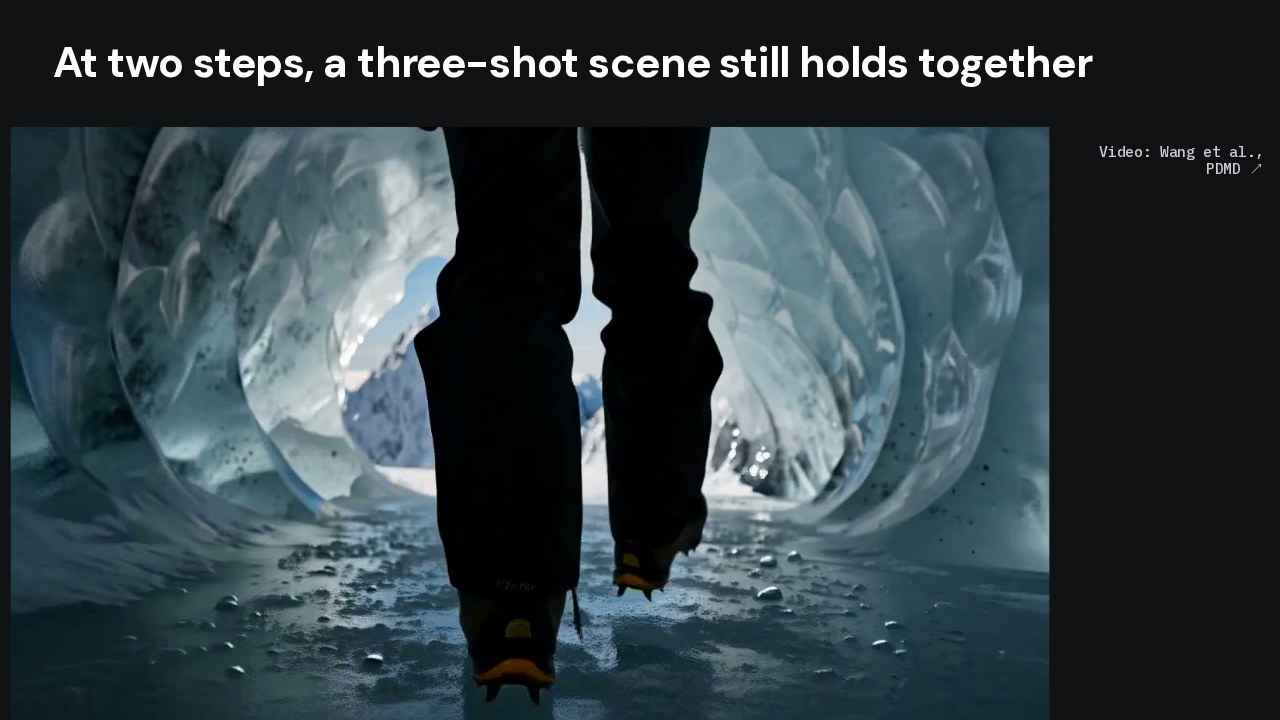
At two steps, a three-shot scene still holds together
They pushed it to two steps as well. This ice-cave scene, three shots and nearly fifteen seconds long, took two passes of the network.
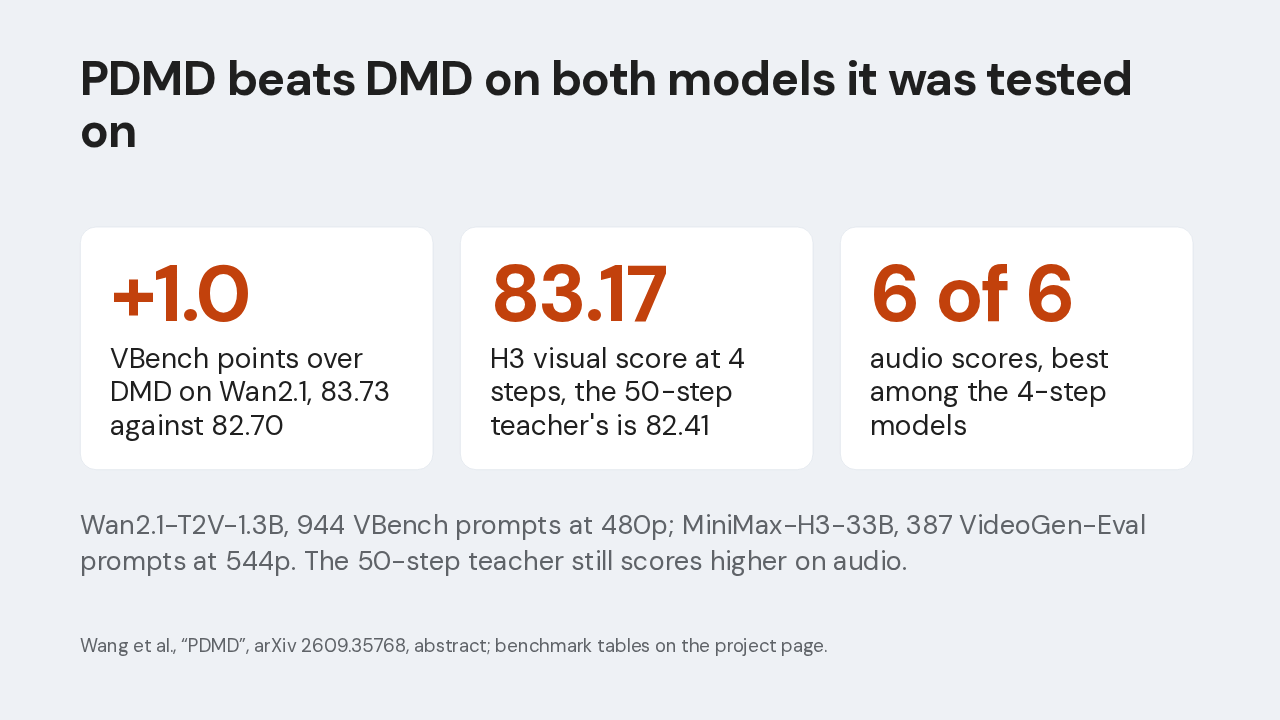
PDMD beats DMD on both models it was tested on
Wan2.1-T2V-1.3B, 944 VBench prompts at 480p; MiniMax-H3-33B, 387 VideoGen-Eval prompts at 544p. The 50-step teacher still scores higher on audio.
Wang et al., “PDMD”, arXiv 2609.35768, abstract; benchmark tables on the project page.
On the smaller WAN model, PDMD scores about one point higher than DMD, and the two differ only by that line. On H3, its four-step picture scores slightly above the fifty-step original's. And on sound, it's the best of the four-step models on all six measures, though the original still sounds better.
The four-step and two-step models are out, and fit a 24 GB graphics card
Posted to arXiv on 28 September 2026 by ByteDance and UC San Diego. Checkpoints on Hugging Face; the inference script runs on one 24 GB GPU.
The paper went up on September 28th. The four-step and two-step checkpoints are on Hugging Face, with a script that runs on one twenty-four gigabyte graphics card. Three days later the same ByteDance team posted DMAD, another way to the same four steps. The paper and the project page are linked below.