A cipher letter to Napoleon's General Marmont, unreadable for 217 years, has been decoded
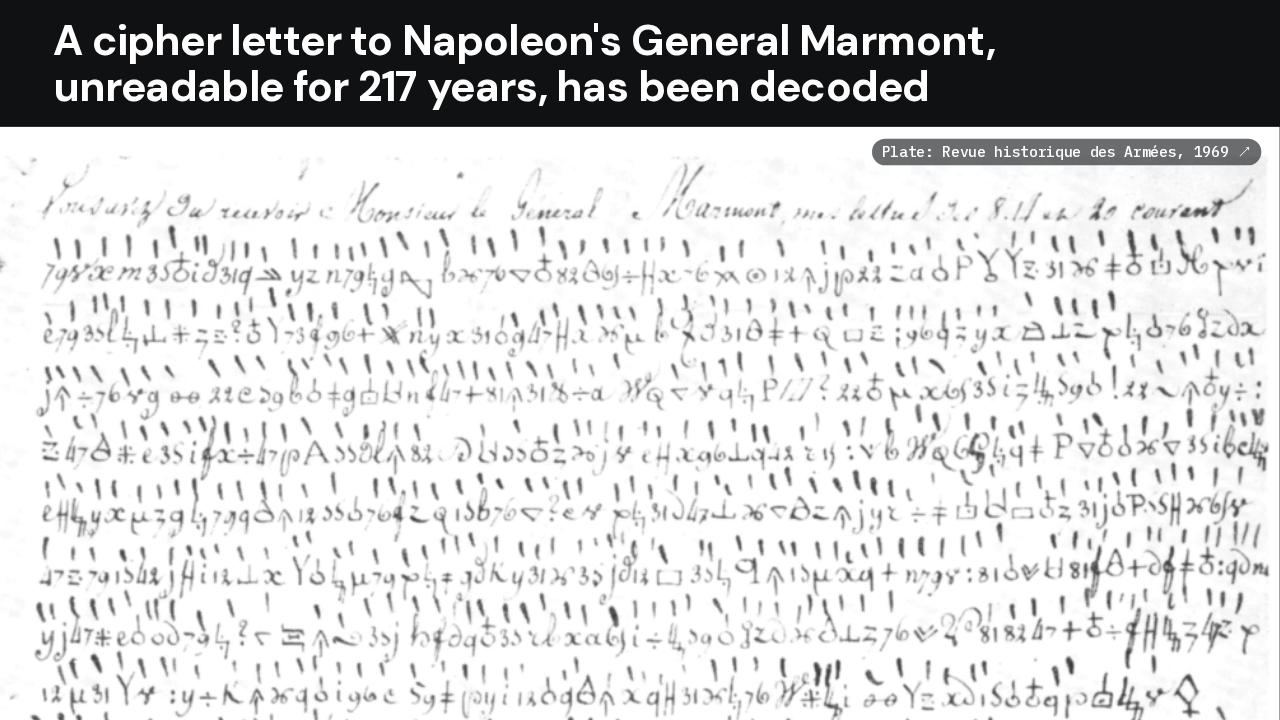
In late March 1809, the headquarters of Eugène, Napoleon's stepson and Viceroy of Italy, sent General Marmont a letter. Its first line is plain French: you must have received, General Marmont, my letters of the 8th, 14th and 20th of this month. Then come 24 rows of numbers, letters and invented signs. The key was lost, and for two centuries nobody could read it. On September 18, 2026, Carter Church published a full reading.
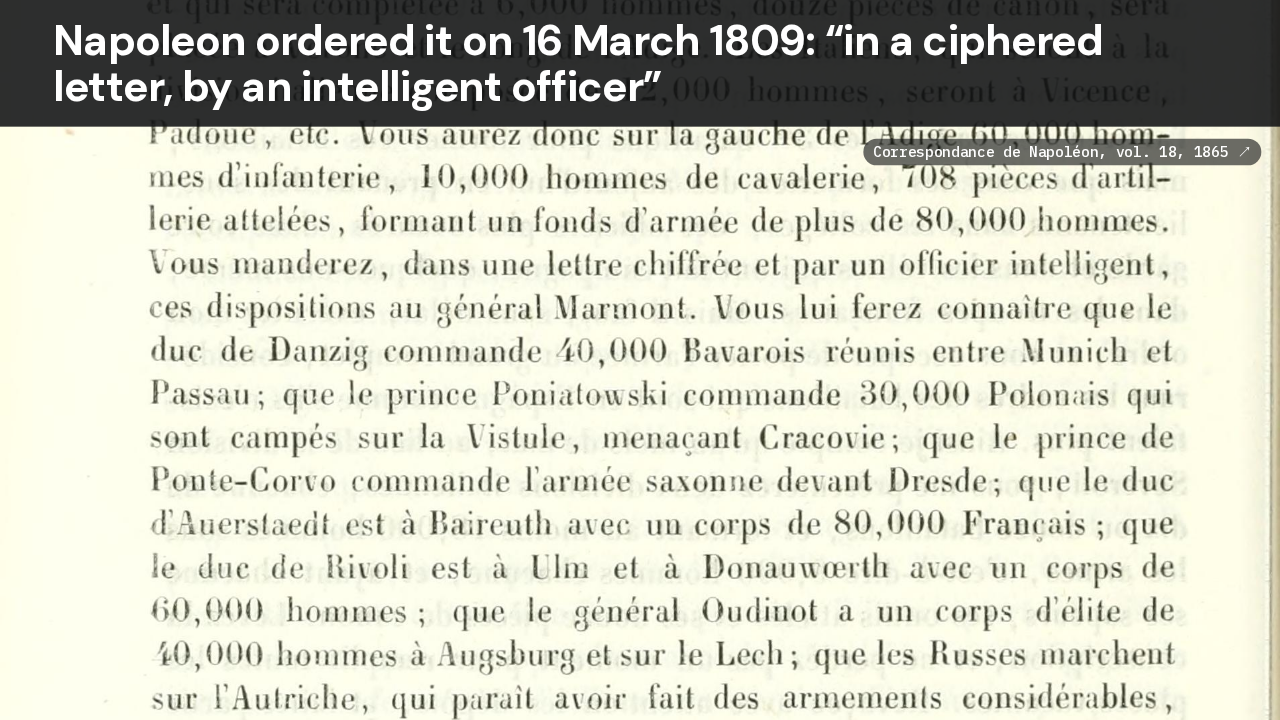
Napoleon ordered it on 16 March 1809: “in a ciphered letter, by an intelligent officer”

The letter was written to order. On March 16, 1809, Napoleon wrote from Paris to Eugène: send, in a ciphered letter, carried by an intelligent officer, these positions to General Marmont. Marmont held about 13,000 men in Dalmatia, across the Adriatic, with Austrian land between him and every other French army. And Austria was about to go to war.
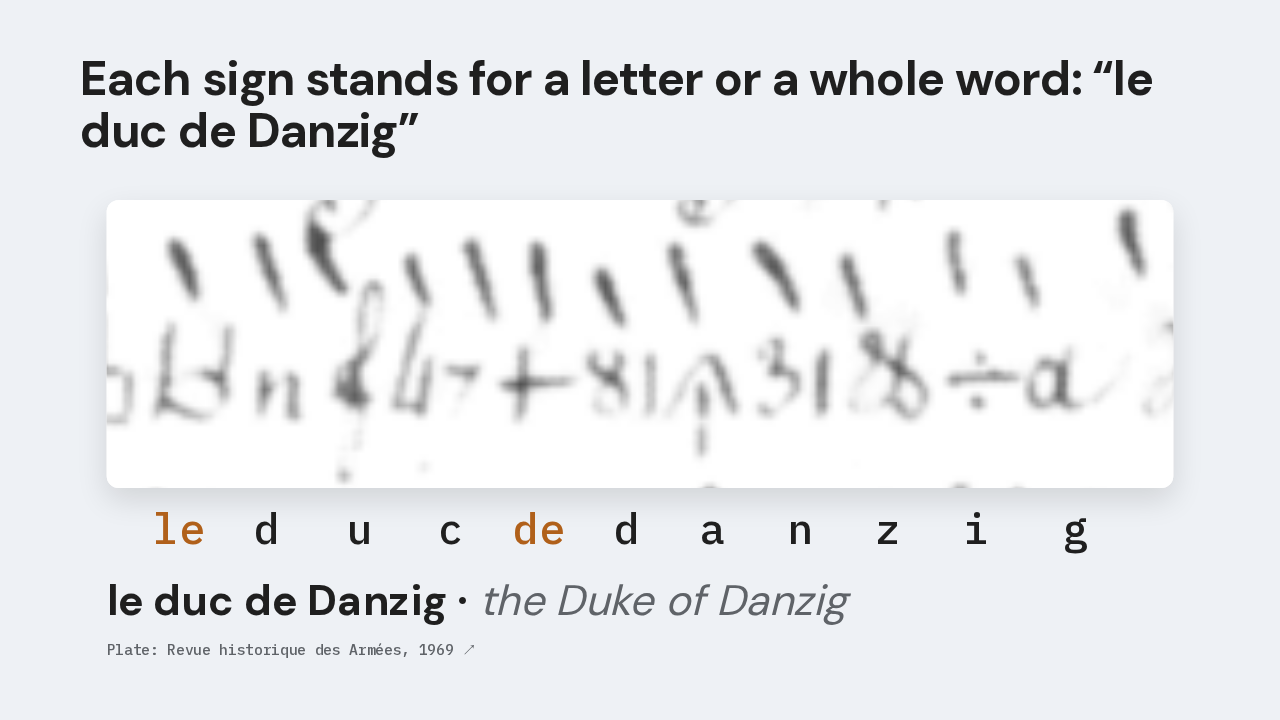
Each sign stands for a letter or a whole word: “le duc de Danzig”

le duc de Danzig · the Duke of Danzig
Here's a piece of row 3: eleven signs. Each one stands for a letter, or for a whole short word. Decoded, they spell le duc de Danzig: the Duke of Danzig. The words le and de each get one sign. And common letters get several signs to choose from, so counting how often each sign turns up tells you almost nothing.
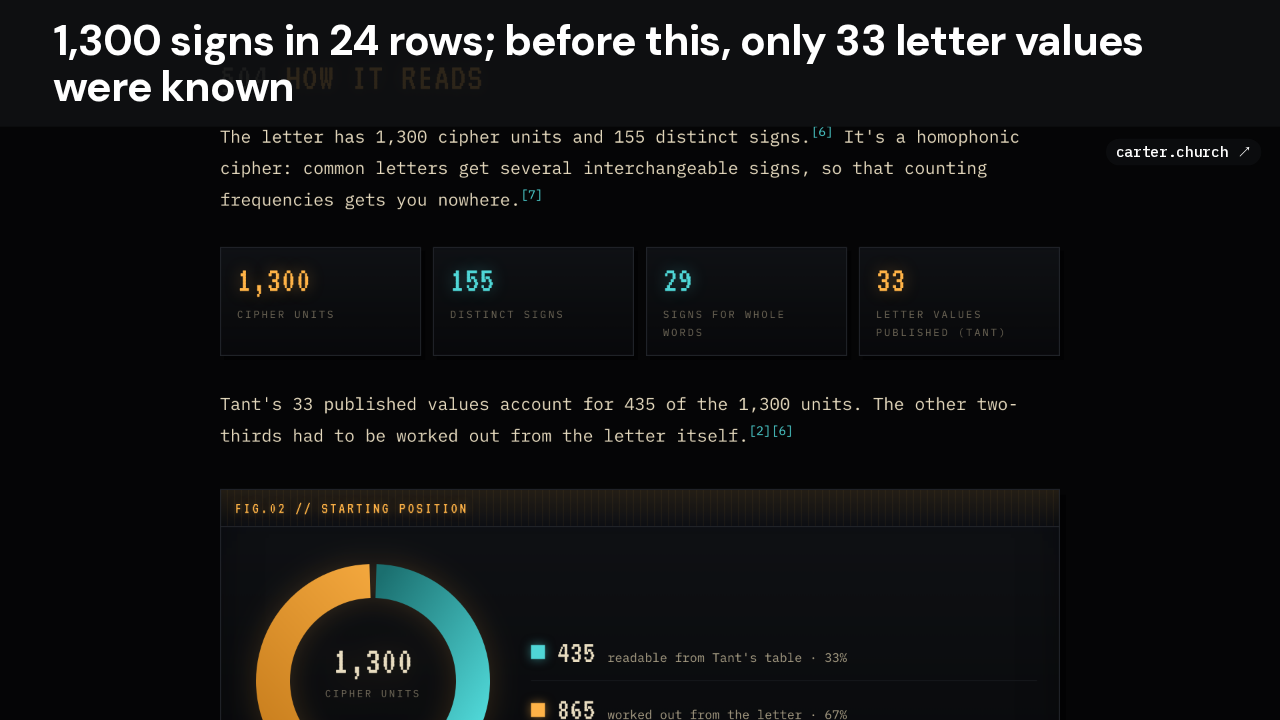
1,300 signs in 24 rows; before this, only 33 letter values were known

The letter runs to 1,300 signs, using more than 150 different ones. 29 of those stand for whole words. And before this, the French cipher historian Daniel Tant had published 33 letter values. Those decode about a third of the letter. The other two thirds had to be worked out from the letter itself.
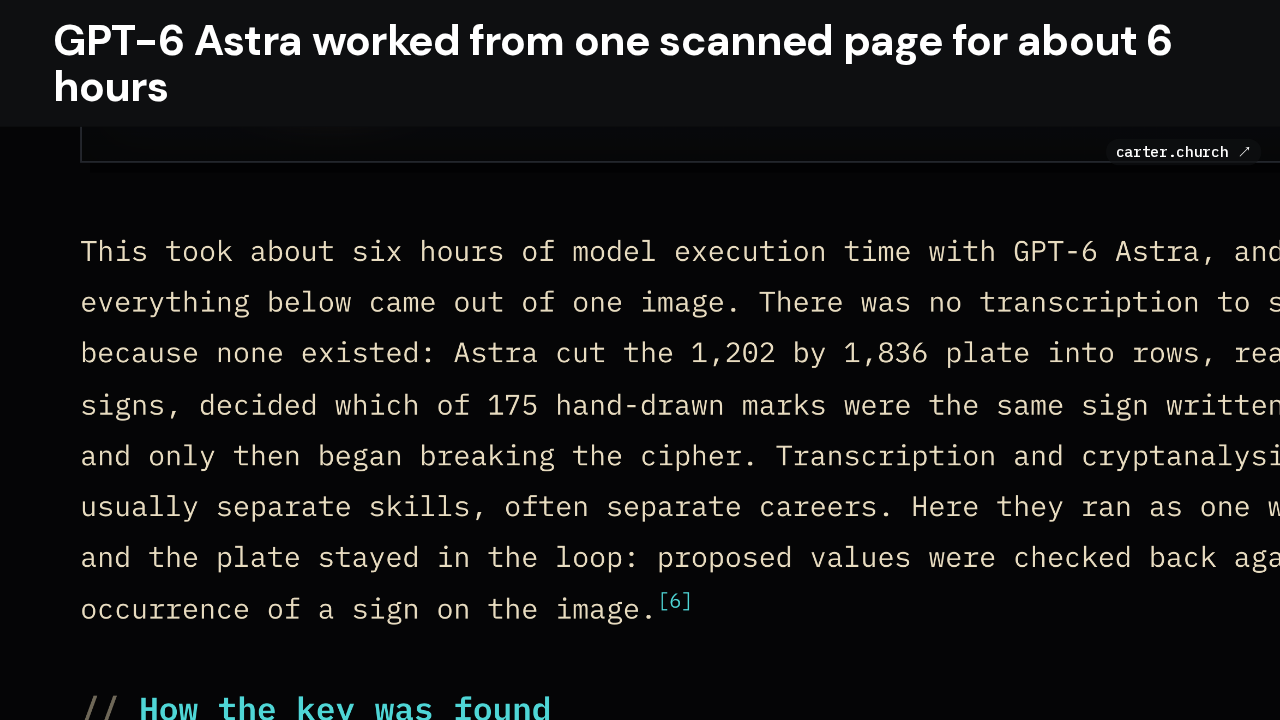
GPT-6 Astra worked from one scanned page for about 6 hours

Church isn't a cryptographer. He set GPT-6 Astra on it, and it ran for about six hours, starting from one scanned image. No transcription existed, so it cut the page into rows, read the signs, and decided which hand-drawn marks were the same sign. Then it searched for the key, scoring each guess against French text. Run again with Napoleon's letters and Marmont's memoirs taken out of that French, it found the same reading.
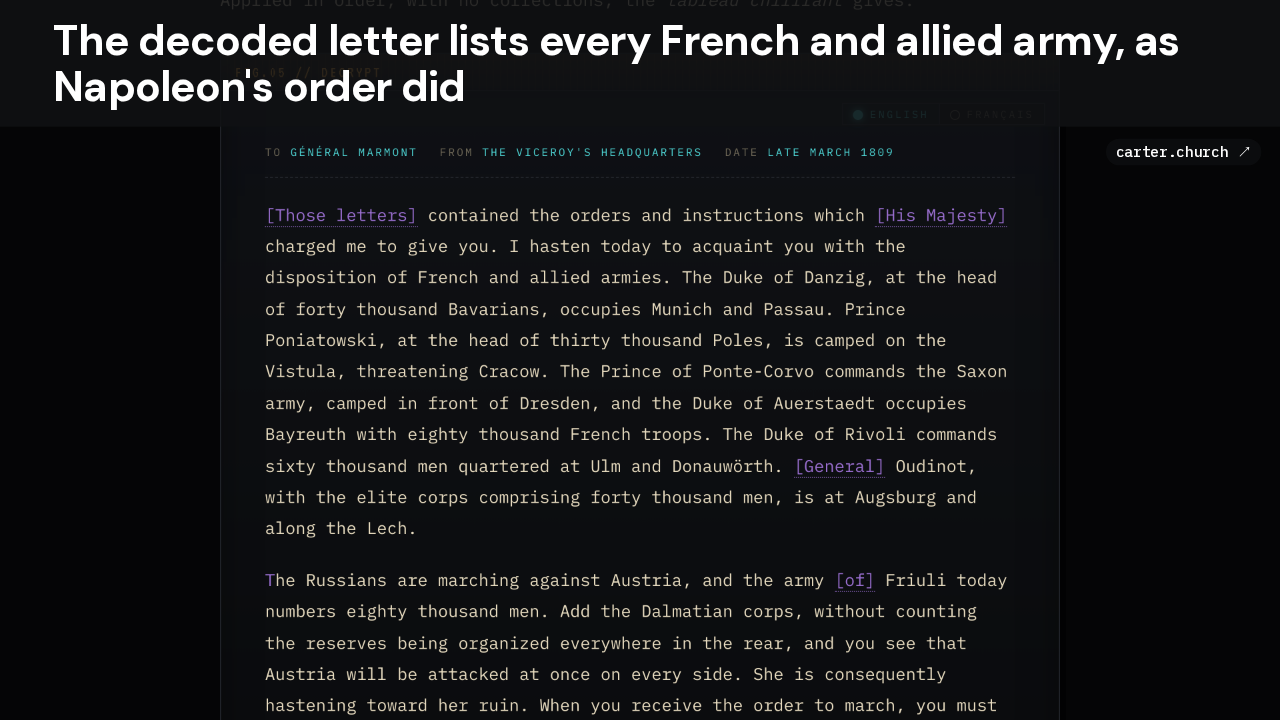
The decoded letter lists every French and allied army, as Napoleon's order did
![The decoded letter in English, from Carter Church's write-up. To Général Marmont, from the Viceroy's headquarters, late March 1809: “[Those letters] contained the orders and instructions which [His Majesty] charged me to give you. I hasten today to acquaint you with the disposition of French and allied armies. The Duke of Danzig, at the head of forty thousand Bavarians, occupies Munich and Passau. Prince Poniatowski, at the head of thirty thousand Poles, is camped on the Vistula, threatening Cracow…”](https://storage.googleapis.com/bisque-presentations/AlY6OT2Cd1YpfqlZ5jsfdWcae933/marmont-cipher-1809-decoded-bab12b/assets/letter-d.png?X-Goog-Algorithm=GOOG4-RSA-SHA256&X-Goog-Credential=firebase-app-hosting-compute%40shell-space.iam.gserviceaccount.com%2F20261016%2Fauto%2Fstorage%2Fgoog4_request&X-Goog-Date=20261016T173234Z&X-Goog-Expires=21600&X-Goog-SignedHeaders=host&X-Goog-Signature=1800502b97f71864da5e8a5b173c715feccc04fabeb684d13b1c1e127f92cb5d5d5718a17c4a17d3053870c566136dd58f2d1c53a01cc0db77592b438fdfd97d19189fad1576411d2a5223d3c0b7e22bf5876da53ad19d2bcc304b88bdfb72c0915bb4d25a5ed7535979b2e32aaf7631867459007b251cc304ab962990b2773a5a6c45d8f8c5adc870eeaaf0375f40571d9d3fc3229242ef9add0af0739aa574ec08323511a0d4c480e2631f548682b3580dda91f13a2c7c825ab599470683c2c8149f908f785b319f71a8fb1b0abfb018785e6998b25e5bae9685152ee33f626bb1e3a8753434fa430775f5ee6cfc72a855a7b25cdcf6fb8bf279d54183c41c)
Here's what it says. The Duke of Danzig, at the head of 40,000 Bavarians, occupies Munich and Passau. It goes through seven forces, in the same order and with the same numbers as Napoleon's instruction. And it ends the list: you see that Austria will be attacked at once on every side.
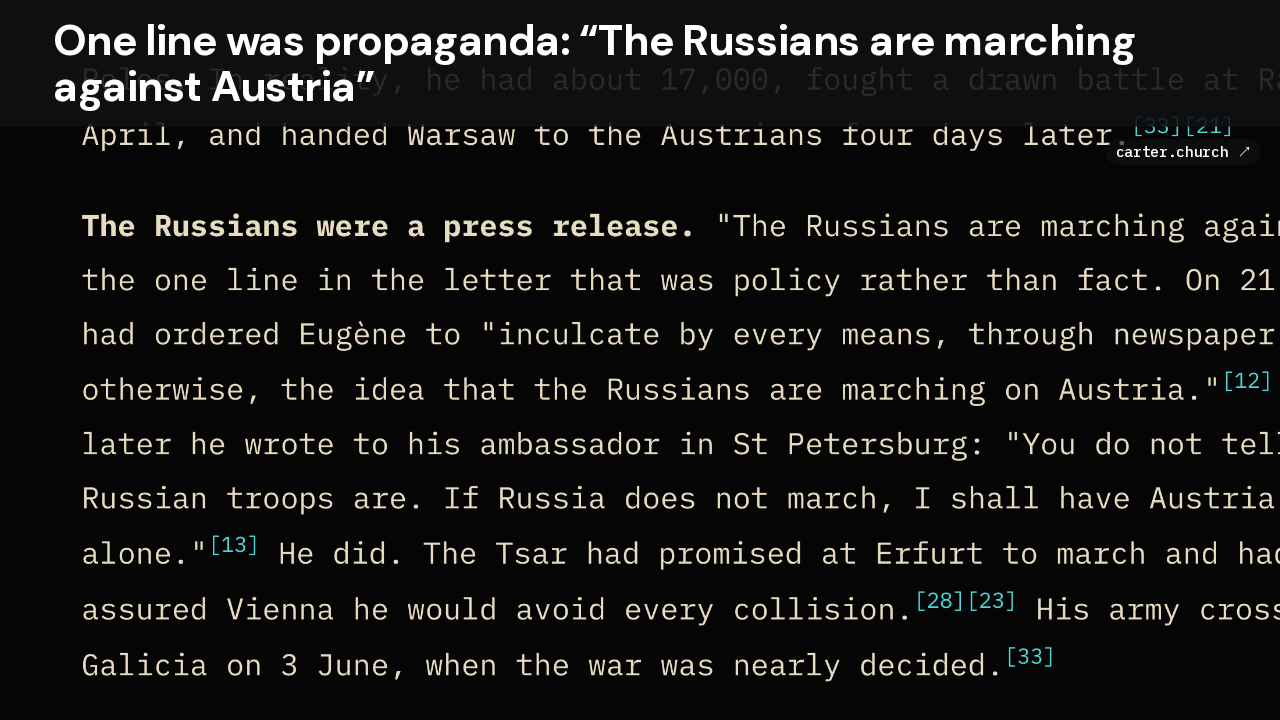
One line was propaganda: “The Russians are marching against Austria”

Austria did attack, crossing into Bavaria on April 10, about two weeks later, and the Austrians came from where the letter placed them. But one line was policy, not fact. On March 21, Napoleon told Eugène to spread, through newspaper articles or otherwise, the idea that the Russians were marching on Austria. Russia's army didn't cross into Galicia until June 3, when the war was nearly decided.
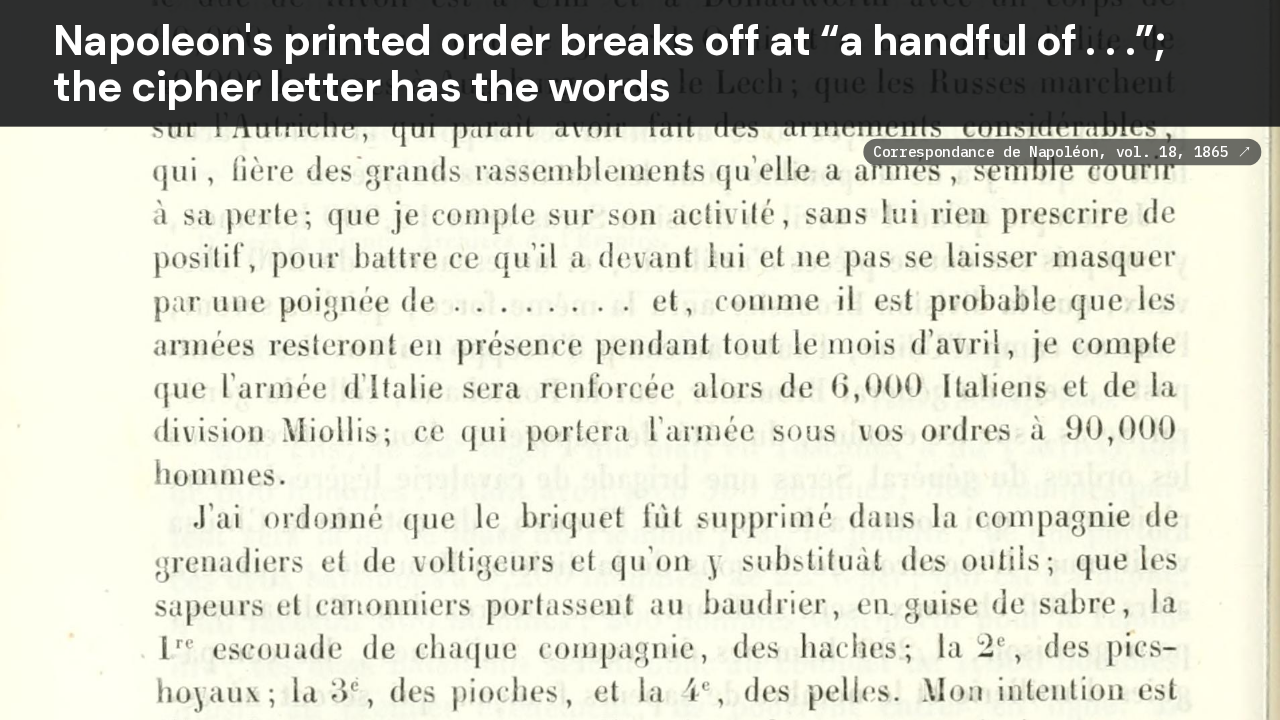
Napoleon's printed order breaks off at “a handful of . . .”; the cipher letter has the words
There's one more find. The 1865 printing of Napoleon's order breaks off mid-sentence. Marmont mustn't let himself be held back by a handful of, and then a row of dots. The cipher letter carries the same sentence with nothing missing: a few troops, or a gathering of rabble. It's Eugène's office passing the order on in its own words, so it isn't proof of Napoleon's exact phrase.
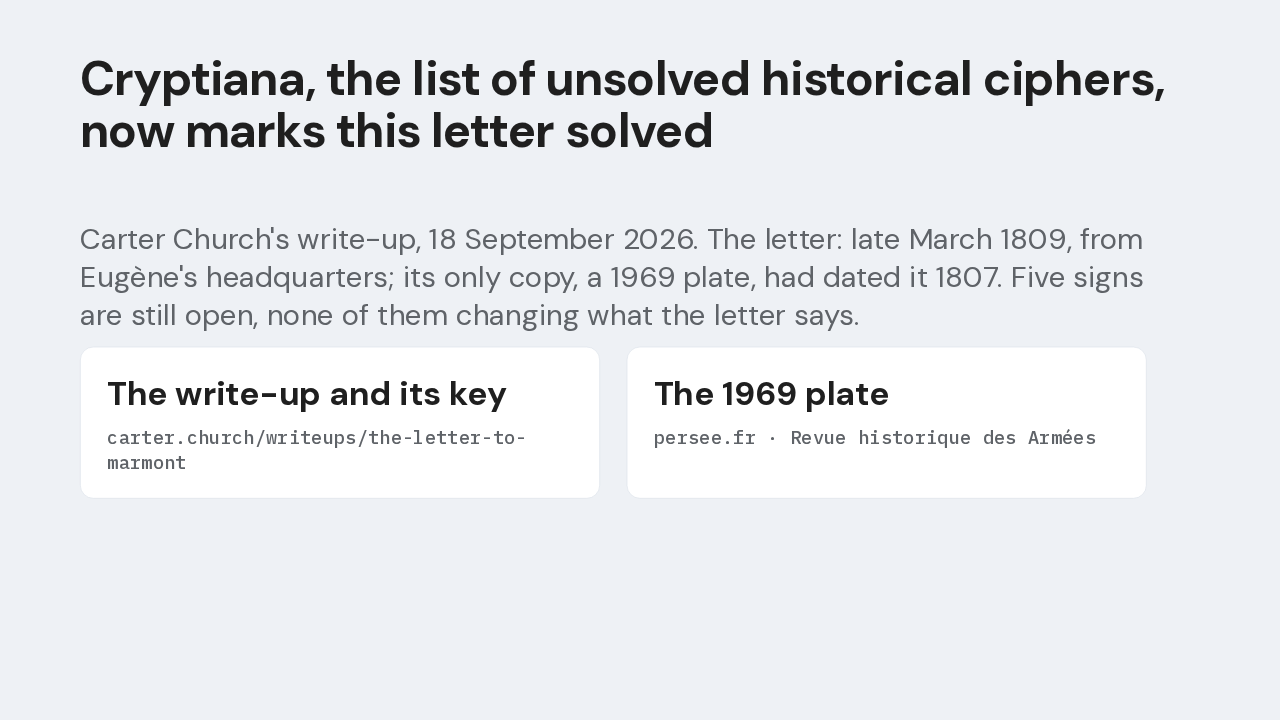
Cryptiana, the list of unsolved historical ciphers, now marks this letter solved
Carter Church's write-up, 18 September 2026. The letter: late March 1809, from Eugène's headquarters; its only copy, a 1969 plate, had dated it 1807. Five signs are still open, none of them changing what the letter says.
Satoshi Tomokiyo's Cryptiana, the standard list of unsolved historical ciphers, now marks the letter solved, and dated 1809 rather than 1807. Five signs are still uncertain, like whether one means His Majesty or the Emperor. None of them changes what the letter says. Church published the reading on September 18, 2026, with the full key and a script that rebuilds it. Both are linked below.