Two papers disprove Grad's 1967 conjecture about the magnetic fields in fusion machines
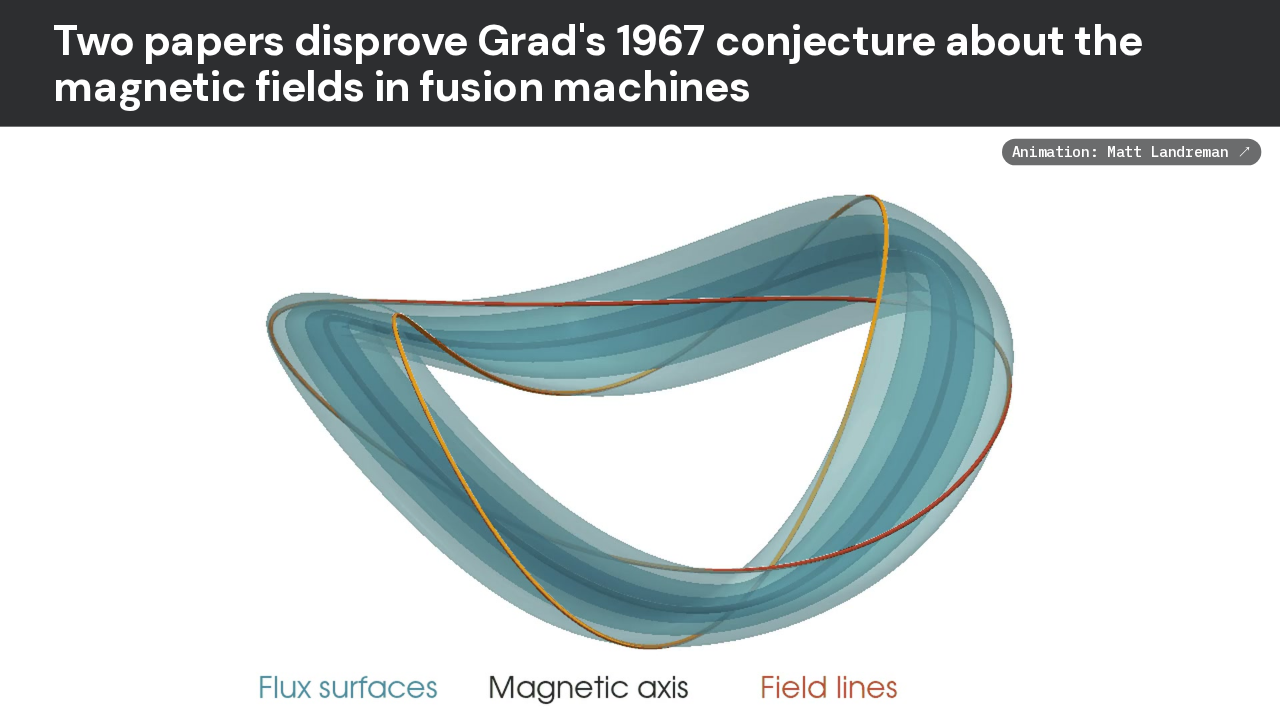
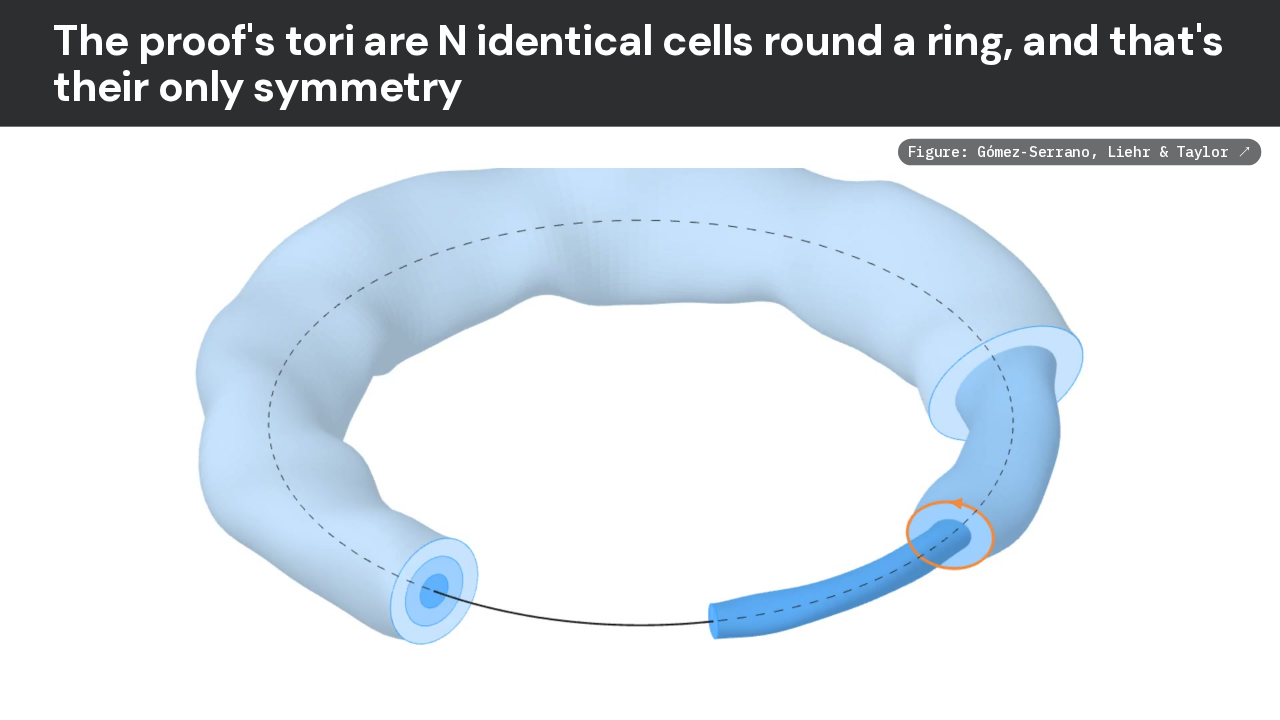
In September 2026, two papers disproved a conjecture about fusion that had stood since 1967. This is one of the counterexamples: magnetic surfaces nested inside each other like layers of a ring-shaped onion, twisted into a shape with none of the symmetries the conjecture said they'd need.
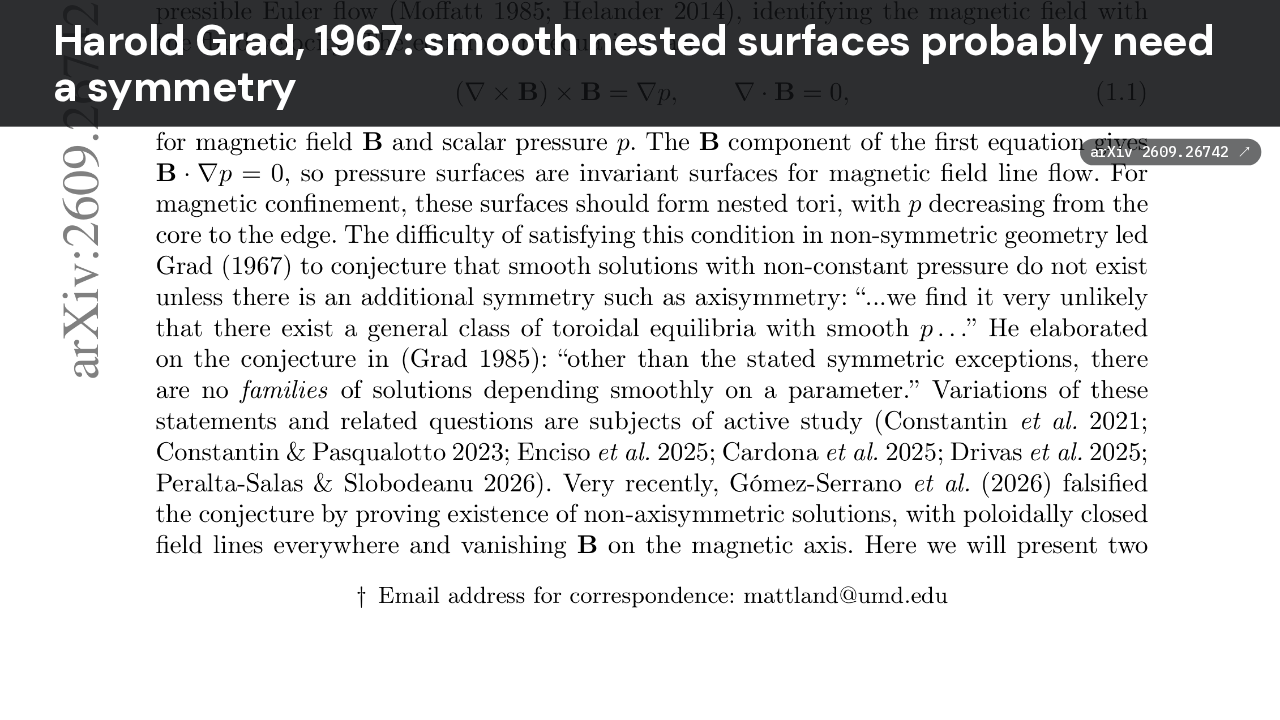
Harold Grad, 1967: smooth nested surfaces probably need a symmetry

A fusion machine holds hot plasma inside a ring of magnetic field. To hold it well, the field should form those nested surfaces, with pressure rising smoothly toward the core. A tokamak is the same all the way around its ring, and the maths works out. A stellarator is deliberately twisted, with no such symmetry. In 1967, the physicist Harold Grad argued that smooth solutions like that probably don't exist without a symmetry. We find it very unlikely, he wrote, that there's a general class of them.
The proof's tori are N identical cells round a ring, and that's their only symmetry
On September 21, Javier Gómez-Serrano, Lukas Liehr and Mitchell Taylor posted a proof that Grad was wrong. Their equilibria are rings built from identical cells; the paper's figure shows eight. Turning the ring by one cell is the only symmetry left: no mirror, no axis to spin around, no helix. And they come in smooth families, which Grad said shouldn't exist either.
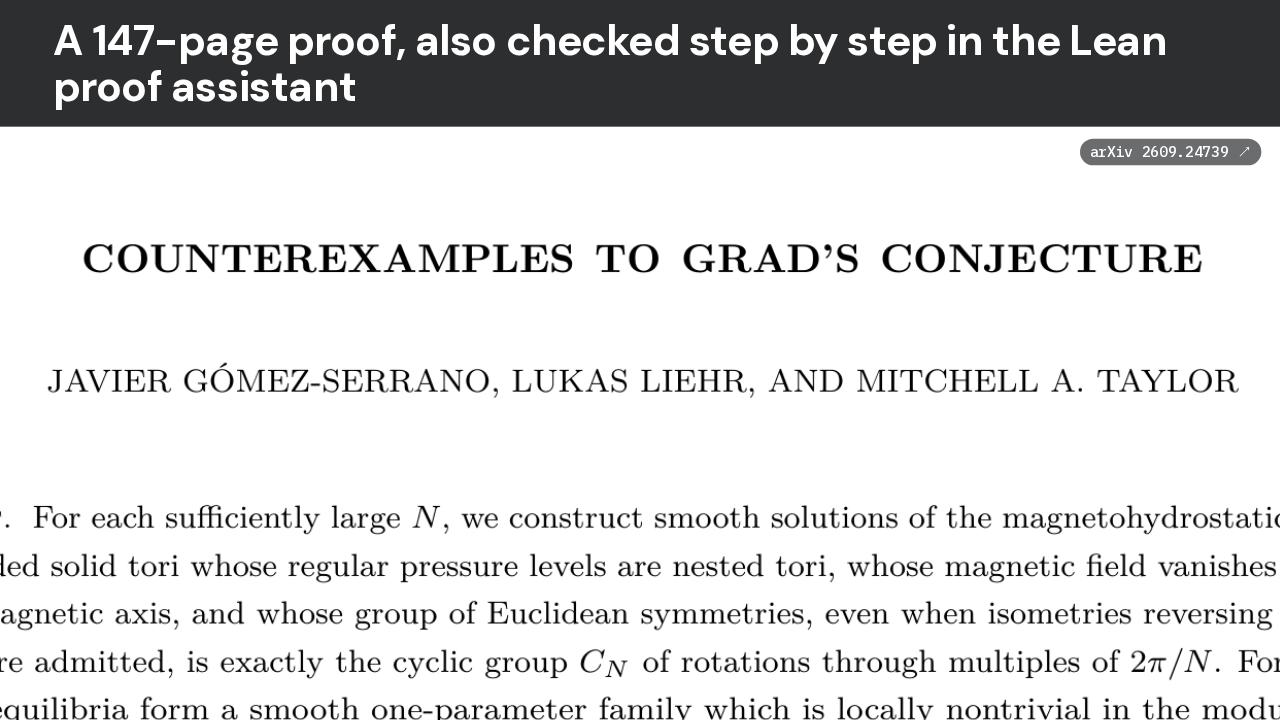
A 147-page proof, also checked step by step in the Lean proof assistant

The paper runs to 147 pages. Its abstract says the solutions have none of the plane reflection, axial or helical symmetries Grad conjectured. And the result is also certified in Lean 4, a proof assistant: software that checks every step of the argument mechanically.
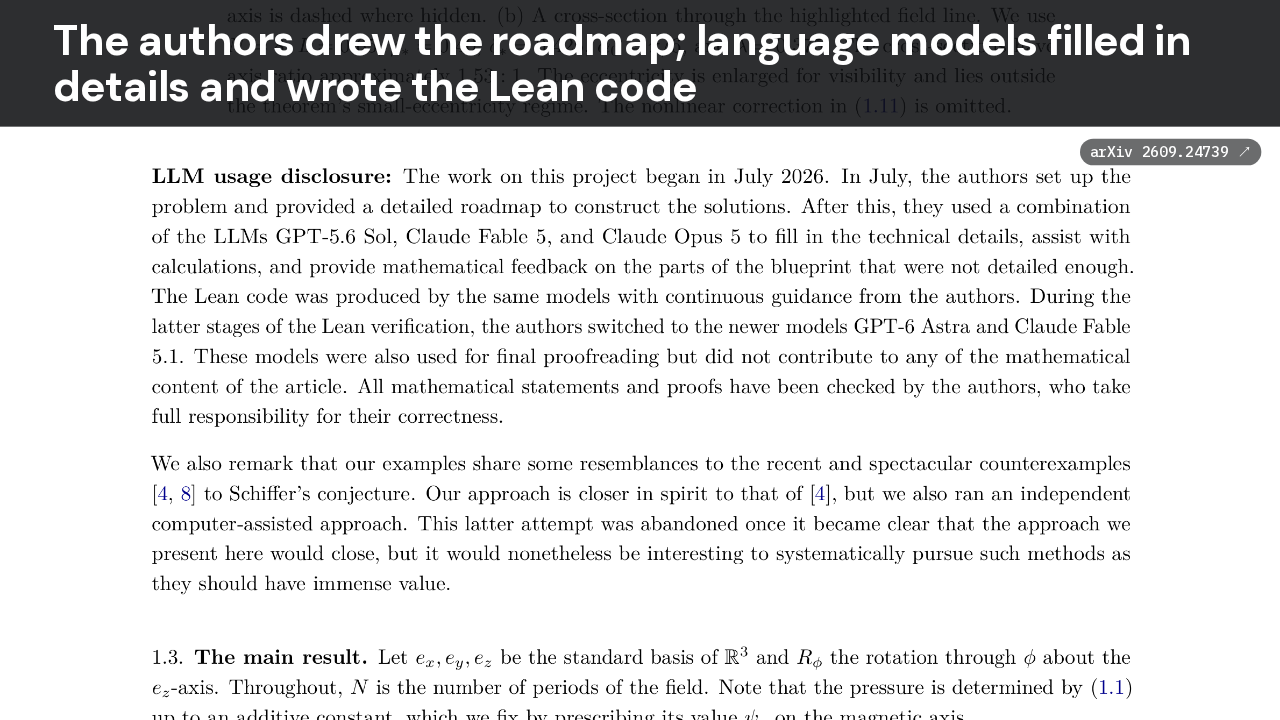
The authors drew the roadmap; language models filled in details and wrote the Lean code

The paper says how it was made. The work began in July 2026. The authors set up the problem and a detailed roadmap. Then language models, GPT 5.6 Sol, Claude Fable 5 and Claude Opus 5, filled in technical details and wrote the Lean code, with the authors guiding them throughout. The authors checked every statement and proof, and take responsibility for them.
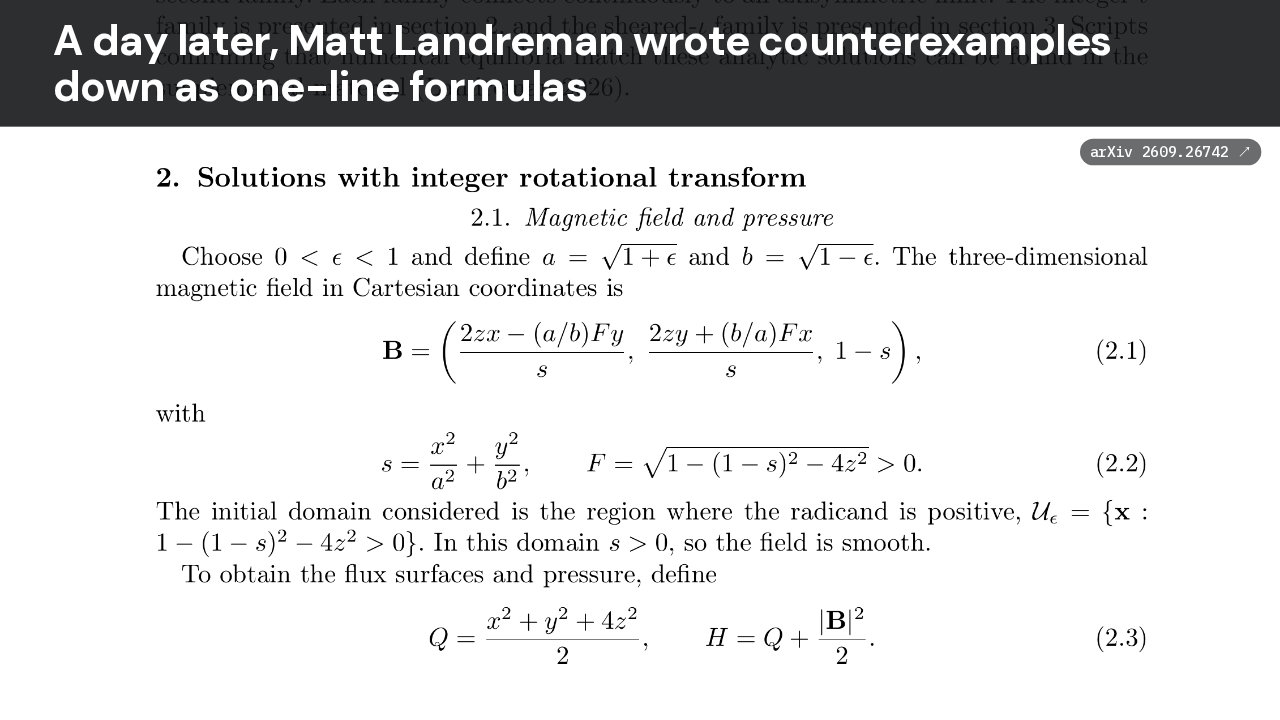
A day later, Matt Landreman wrote counterexamples down as one-line formulas

One day later, on September 22, Matt Landreman at the University of Maryland posted a second paper, with solutions you can write down. Here's the whole magnetic field: one line of ordinary functions of x, y and z, with no approximation. The pressure is smooth everywhere, and its gradient vanishes only on the magnetic axis.
Landreman's first family came from GPT-6 Astra Pro, after 20 minutes of work

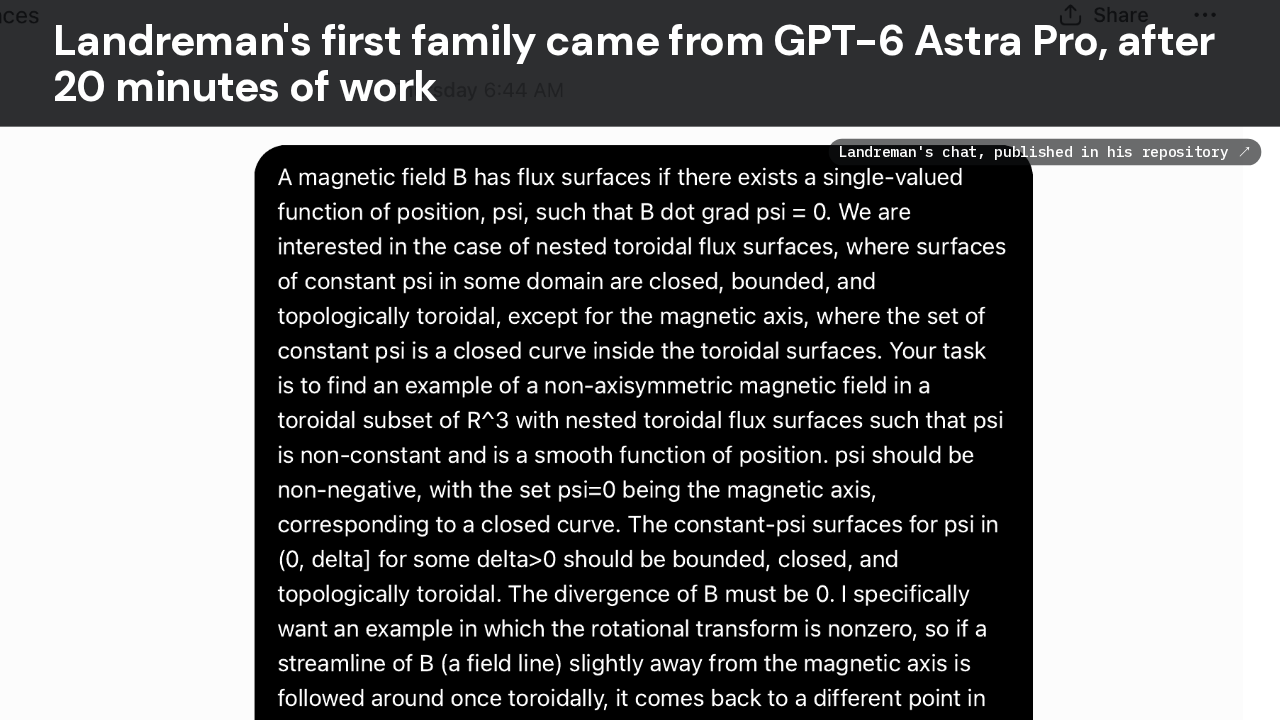
Landreman's paper says these solutions were discovered with GPT-6 Astra Pro, and he published the chats. The request spells out the field he wanted, and ends: this is an open problem, so you'll need to be persistent and creative. The answer came back after 20 minutes and 34 seconds: an exact family of fields with nested surfaces. Landreman then confirmed every equation by hand.
A second family twists by a different amount on every surface
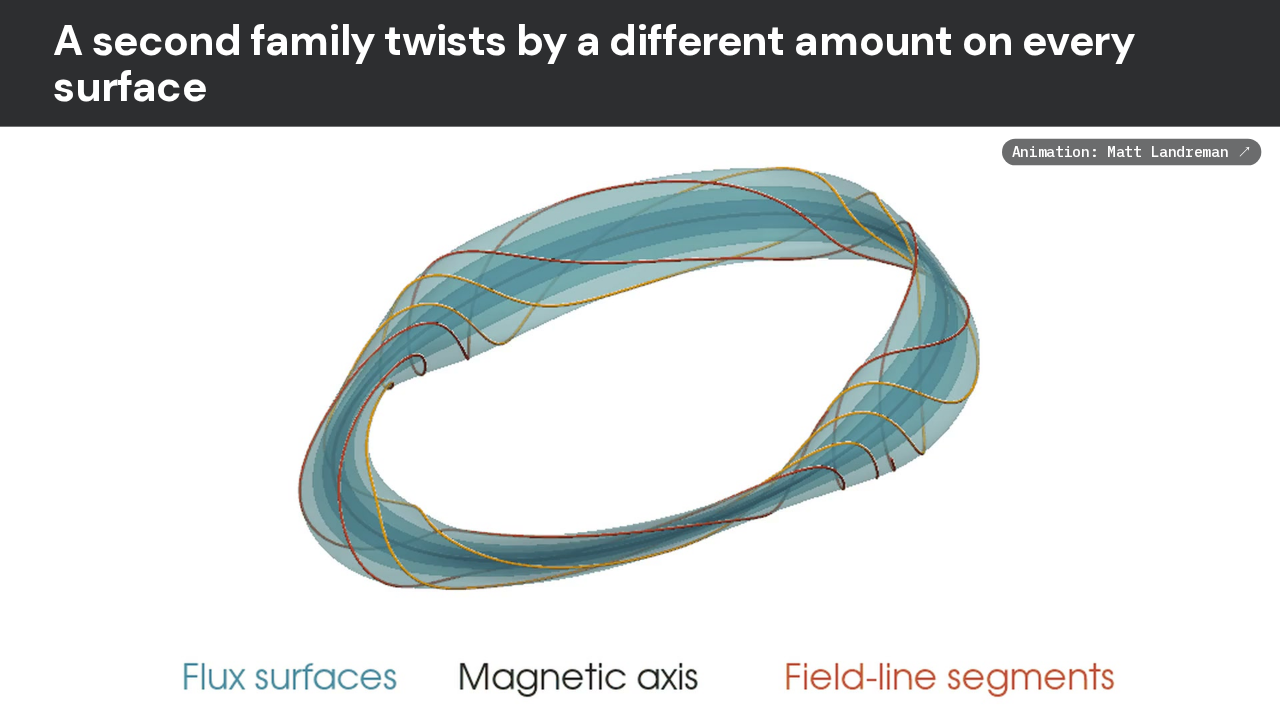
In the first family, every field line closes on itself, with a rotational transform, iota, of exactly 2. The second family, shown here, is different: the twist changes from one surface to the next, a sheared profile, with both rational and irrational values. Both families have two field periods, and both connect continuously to an ordinary symmetric ring.
For stellarators, it's “reassuring to know with certainty” these fields exist

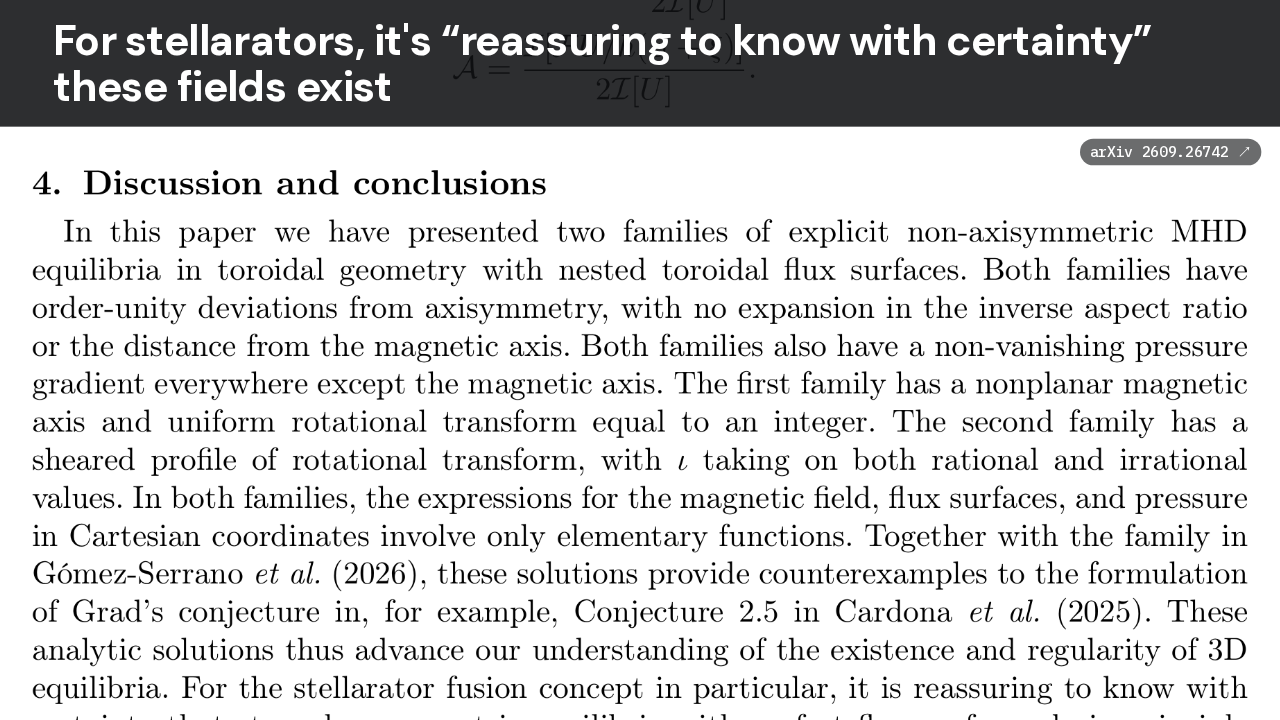
Neither paper is a reactor design. Landreman puts it this way: for the stellarator concept, it's reassuring to know with certainty that strongly asymmetric fields with perfect nested surfaces exist in principle. Exact solutions also give simulation codes an answer to check themselves against. And there's more to find: nobody knows yet whether exact solutions like these exist for vacuum or force-free fields.
Grad's 1967 conjecture now has three families of counterexamples
Gómez-Serrano, Liehr and Taylor, arXiv 2609.24739, 21 September 2026. Landreman, arXiv 2609.26742, 22 September 2026, revised 28 September. Grad, Physics of Fluids 10, 1967.
So a question open since 1967 now has three families of counterexamples: one proved, with its proof checked by machine, and two written out in full. The papers were posted on September 21 and 22, 2026. Both repositories are linked below: the Lean proof, and the formulas with the chats that found them.