BAAI's AREX-2 is an open 27B model trained to keep improving its own answer
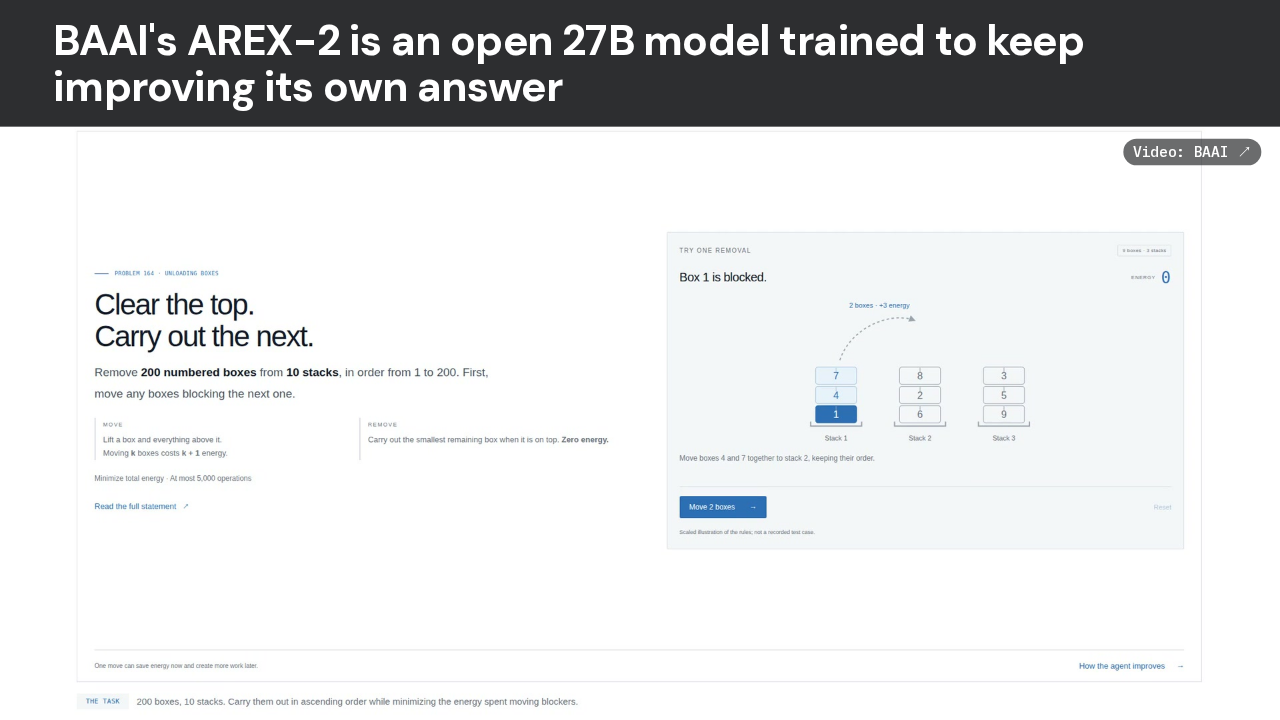
On September 29th, BAAI, the Beijing Academy of Artificial Intelligence, released AREX-2, an open model with 27 billion parameters. In BAAI's demo, the puzzle is to carry 200 numbered boxes out of 10 stacks, in order, spending as little energy as possible moving the boxes in the way. Most chat models answer once. This one is trained to keep going: try a solution, read the score, and fix what's weak.
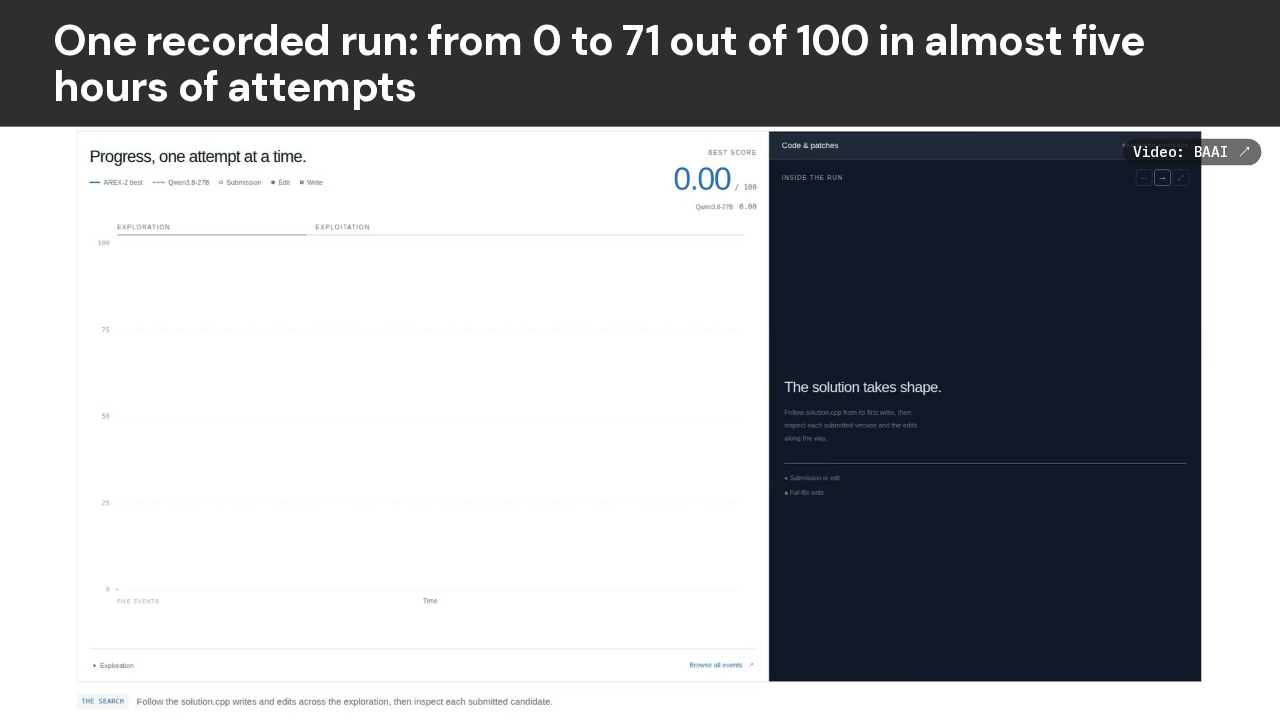
One recorded run: from 0 to 71 out of 100 in almost five hours of attempts
Here's the recorded run, sped up. The first version that scores at all gets about 19. Then 31. The dashed line is the model it was trained from, Qwen 3.8, on the same problem. It tops out at about 41. AREX-2 keeps going. Moving whole runs of boxes at once reaches 48. Searching over how many to move reaches 65, then 68. And by the 21st submission, almost five hours in, a beam search scores about 71 out of 100.
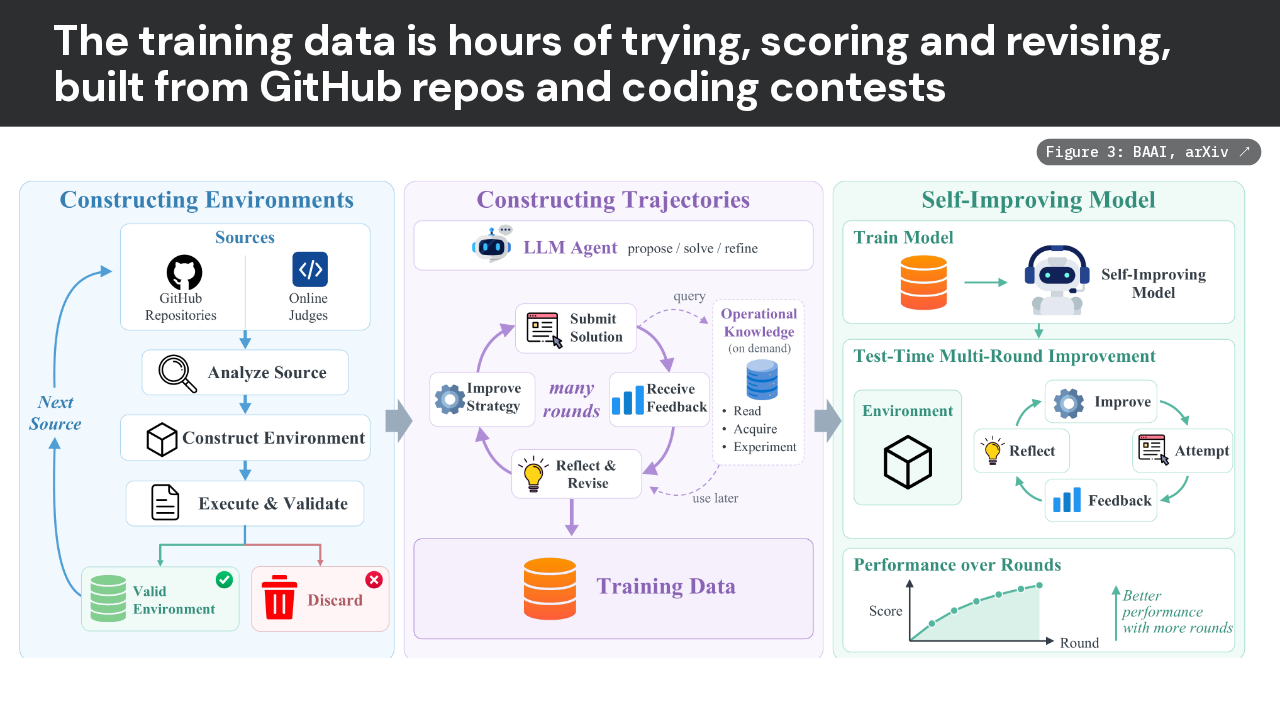
The training data is hours of trying, scoring and revising, built from GitHub repos and coding contests

How do you teach that? BAAI turned GitHub repositories and online coding contests into tasks that a program can score, and kept only the ones that actually run. Then an agent worked on each one for many rounds: submit, get feedback, reflect, revise. Those long, messy records, failures included, became the training data. The goal is a model that gets better the more rounds you give it.
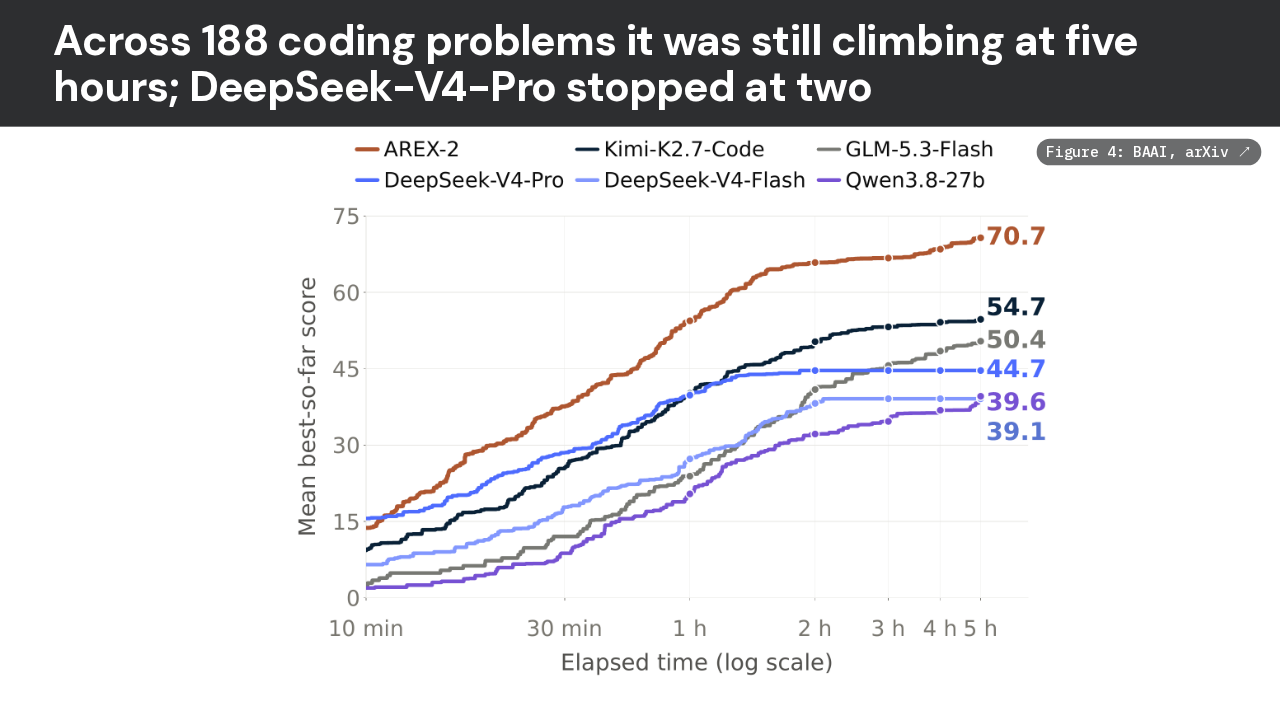
Across 188 coding problems it was still climbing at five hours; DeepSeek-V4-Pro stopped at two

BAAI gave it 188 hard programming problems and five hours each. This chart shows the average best score so far, over time. AREX-2 doesn't start on top, but it keeps going: about 54 after one hour, 66 after two, and 71 after five. DeepSeek V4 Pro stops improving at about 45 after two hours. And Qwen 3.8, the same size and the model AREX-2 started from, ends near 40.
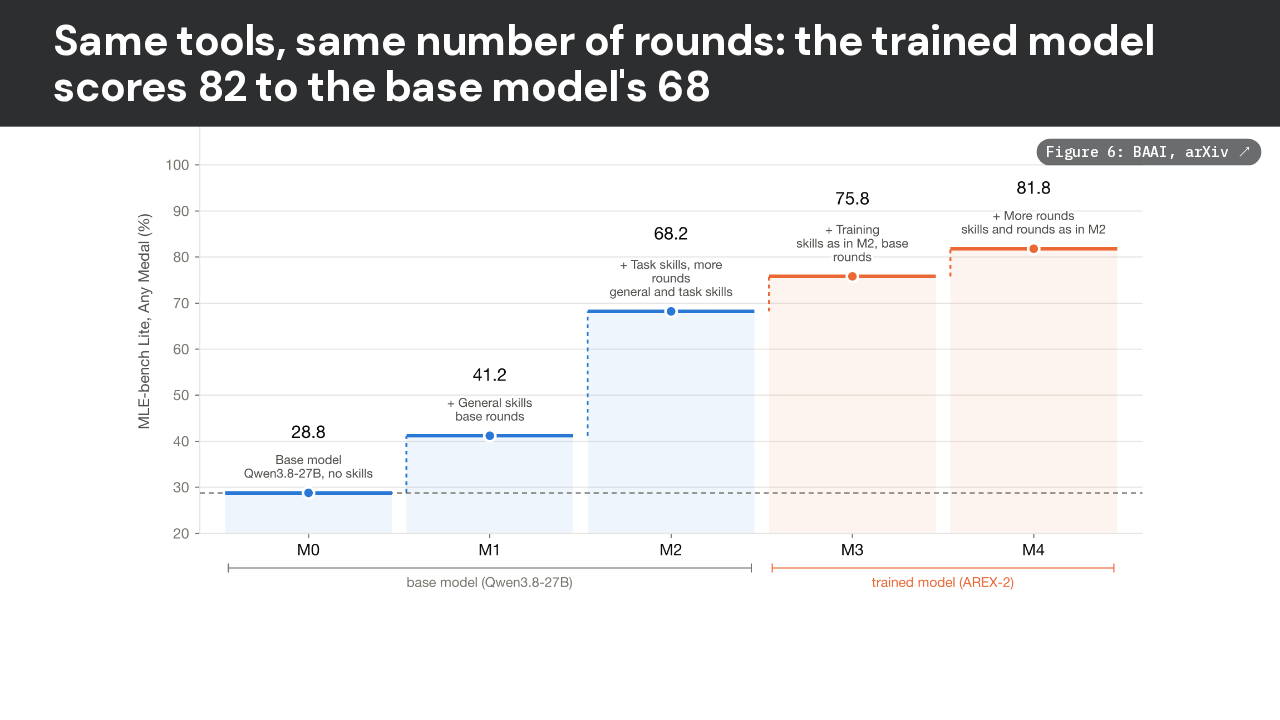
Same tools, same number of rounds: the trained model scores 82 to the base model's 68

Is it the training, or just the extra tries? BAAI tested that on MLE-bench Lite, a set of machine learning competitions, counting how often the model earns a medal. The base model alone gets about 29 percent. Give it general skills and it reaches 41. Task skills and more rounds lift it to 68, with no training at all. Now swap in AREX-2, with the same skills: 76 percent with fewer rounds, and 82 with the same rounds. So training adds about 14 points on top.
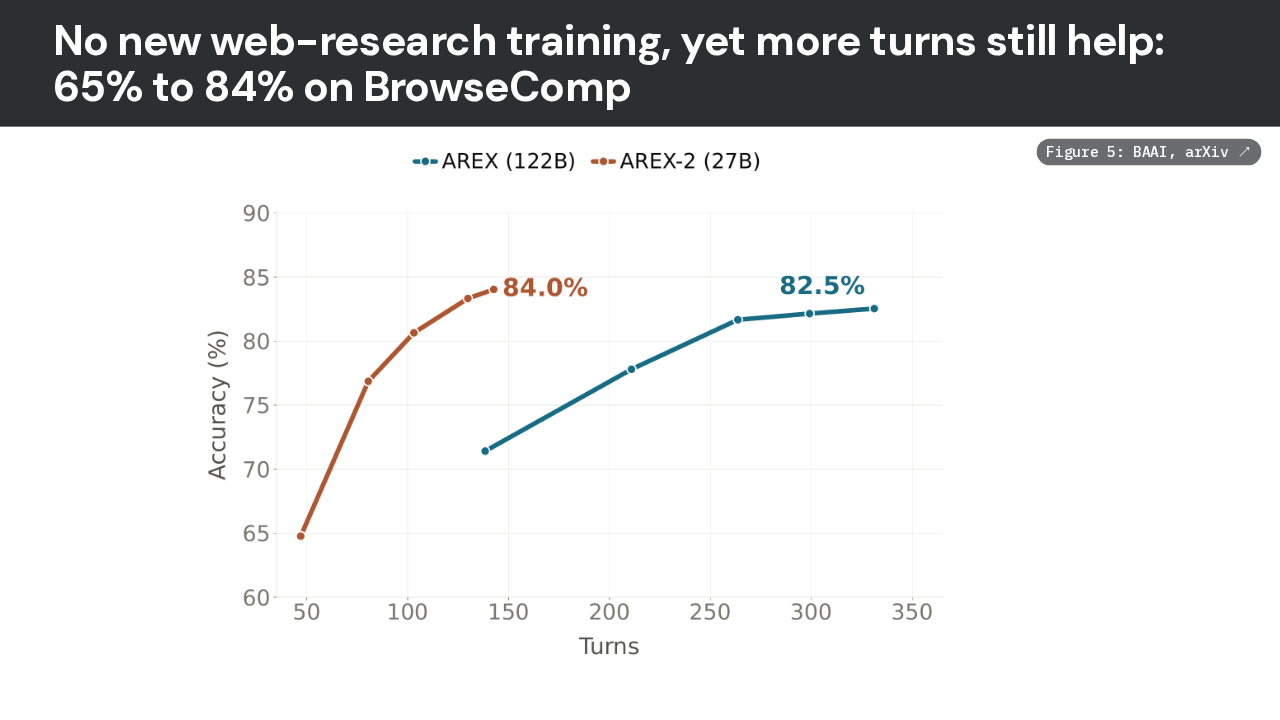
No new web-research training, yet more turns still help: 65% to 84% on BrowseComp

Here's the surprise. None of the new training data was web research. But on BrowseComp, where it hunts down hard-to-find facts with no one telling it whether it's right, more turns still help. It goes from about 65 percent at 47 turns to 84 percent at 143. BAAI's previous model, AREX, at 122 billion parameters, needs over 300 turns to reach 83.
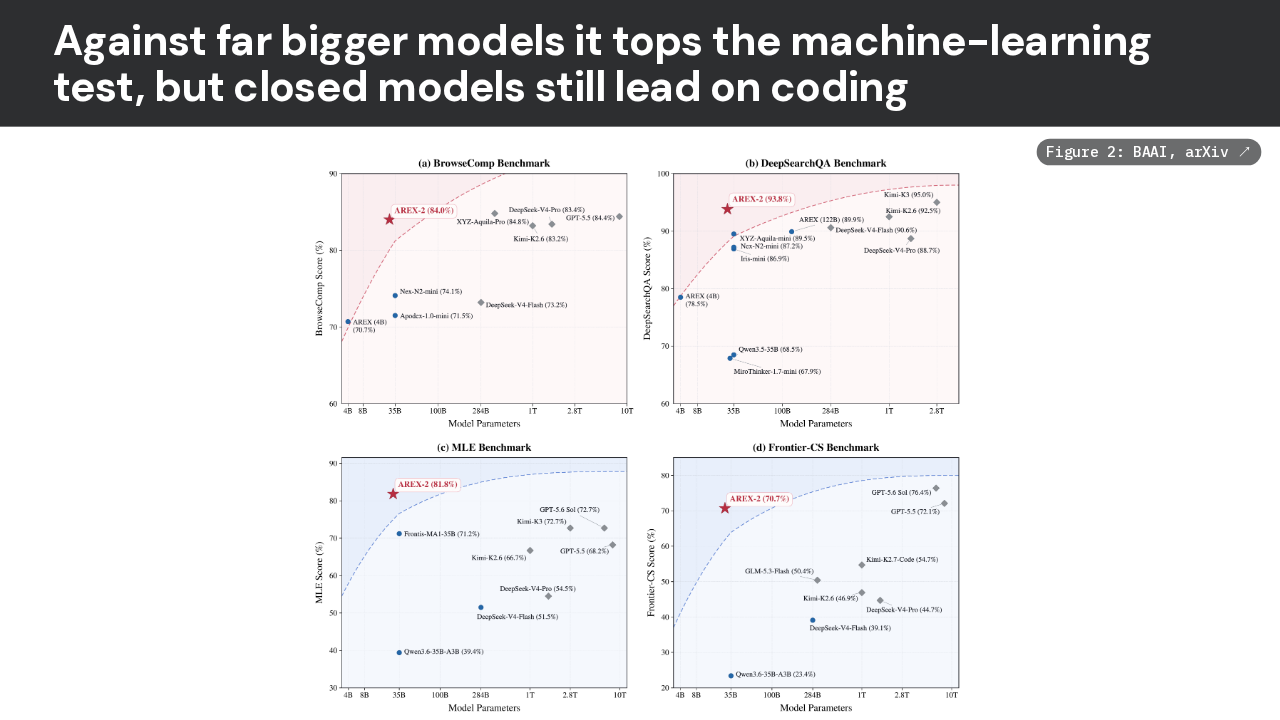
Against far bigger models it tops the machine-learning test, but closed models still lead on coding

How does 27 billion parameters stack up? These charts plot score against size, from 4 billion to 10 trillion. On the machine learning test, AREX-2 is on top at about 82, ahead of GPT-5.6 Sol, and of Kimi K3 at 2.8 trillion parameters. On coding, it beats every open model in the paper, by 16 points. But three closed models score higher: GPT-5.6 Sol, Claude Opus 4.8 and GPT-5.5. These are BAAI's own numbers, from its paper.
AREX-2's weights are on Hugging Face under Apache 2.0
Paper (arXiv 2609.38288v1) and weights published 29 September 2026. A 27B model built on Qwen3.8-27B, reading up to 262,144 tokens. Every score here is BAAI's own.
AREX-2's paper and weights went up on September 29th, 2026, under the Apache 2.0 licence. It's built on Qwen 3.8 27B, and reads up to about 260 thousand tokens at once. The paper, the weights and BAAI's demo are linked below.