MiLMMT-46-v1.0 · Xiaomi finished training an open translator on sentences that had no translation attached, and the scores it now leads on are produced by the two models that graded it

1 month ago

To teach a machine to translate, you normally show it the English and the French side by side. Xiaomi's translation team finished this translator, MiLMMT-46, on sentences that had no translation attached. Two other AI models did the grading instead.

Ask

Ask about this presentation

Answers are generated from this presentation.

Chapters

  1. 0:00MiLMMT-46-v1.0
  2. 0:1423 of the 46 languages have the most training text behind them
  3. 0:34The training set kept the source sentences and threw the translations away
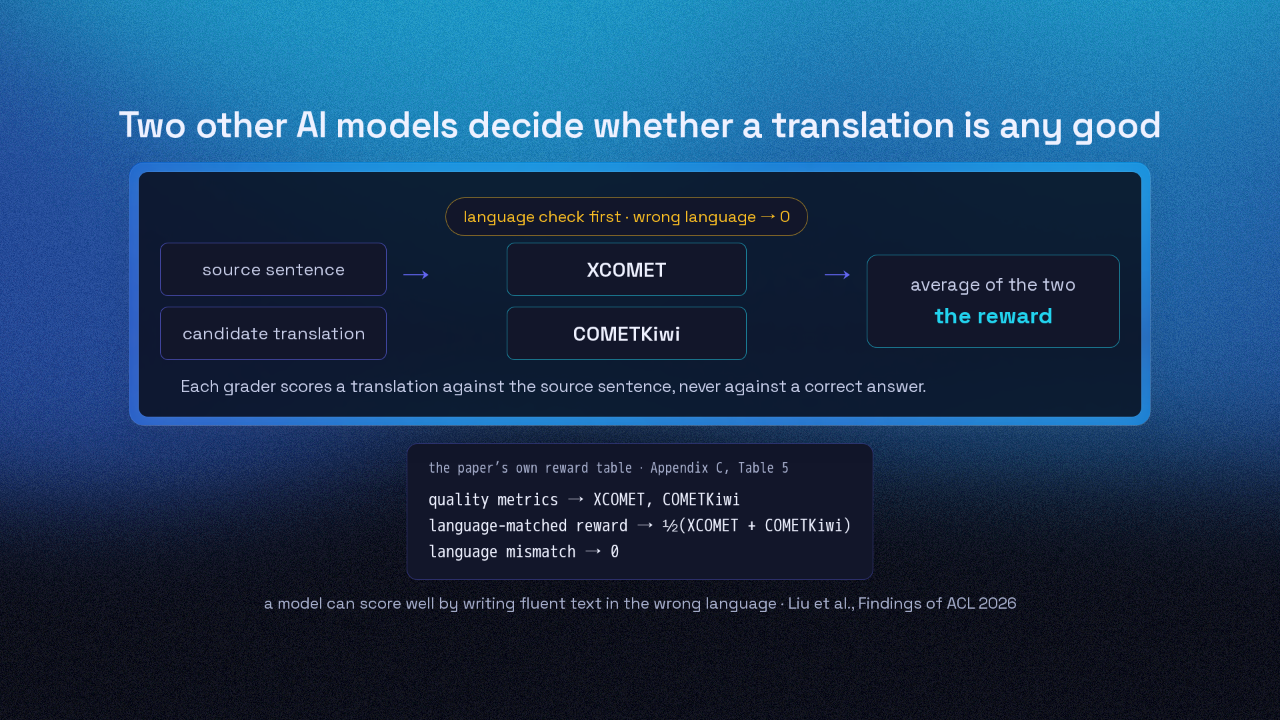
  4. 0:50Two other AI models decide whether a translation is any good
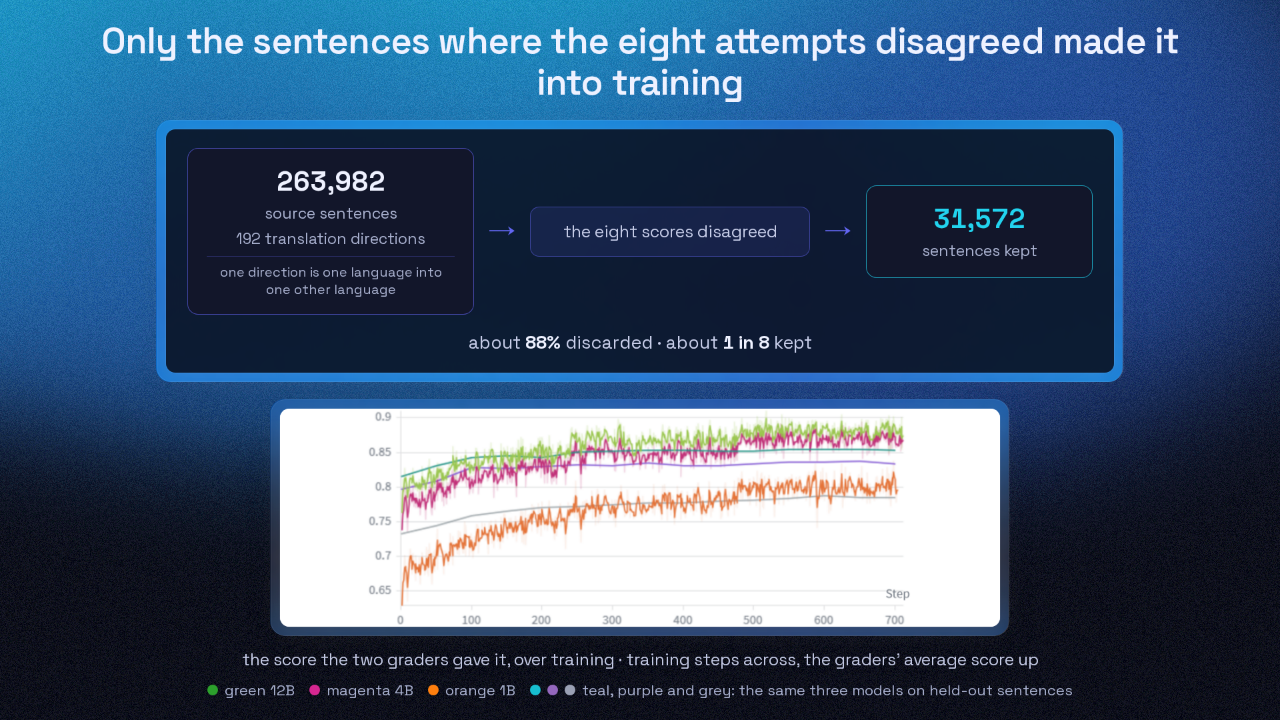
  5. 1:19Only the sentences where the eight attempts disagreed made it into training
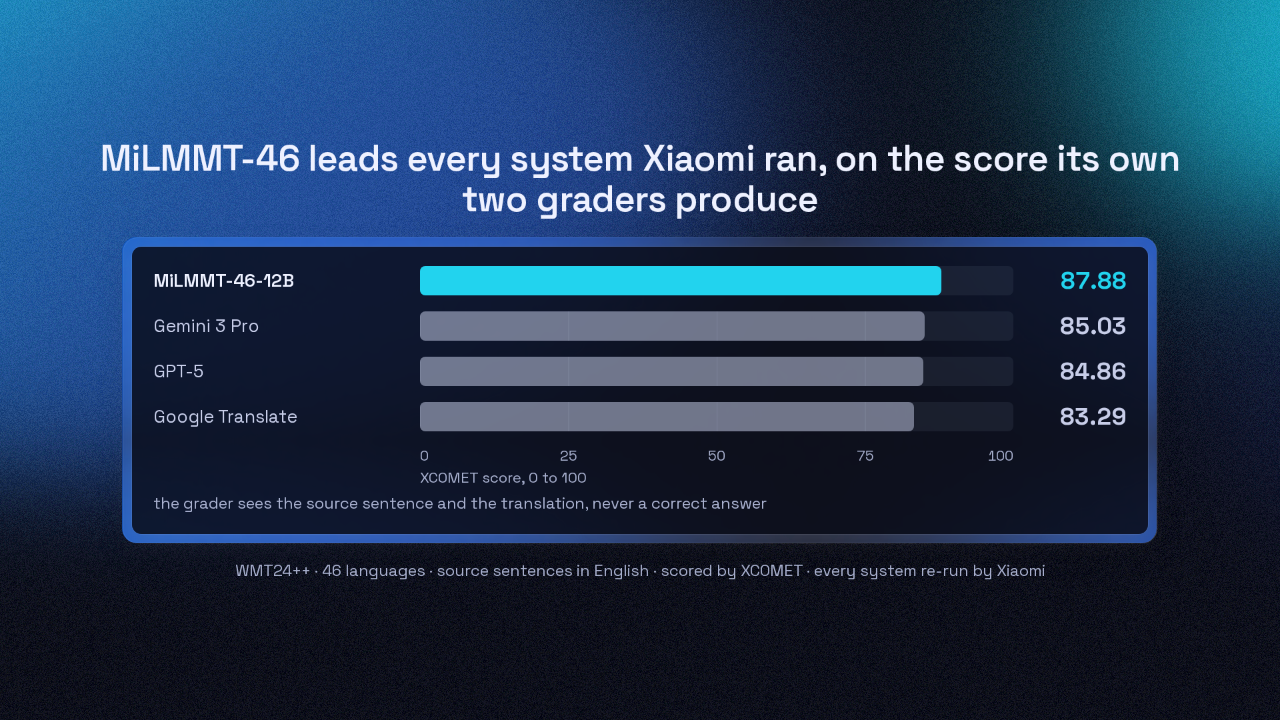
  6. 1:46MiLMMT-46 leads every system Xiaomi ran, on the score its own two graders produce
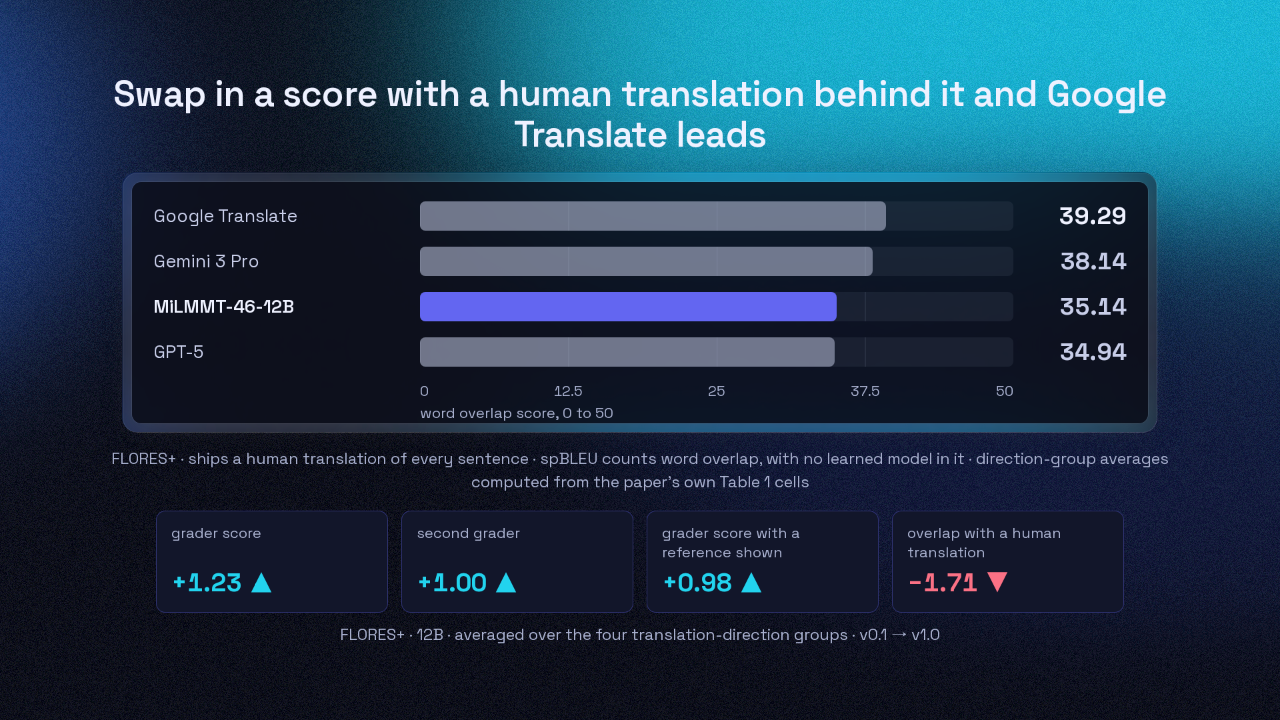
  7. 2:03Swap in a score with a human translation behind it and Google Translate leads
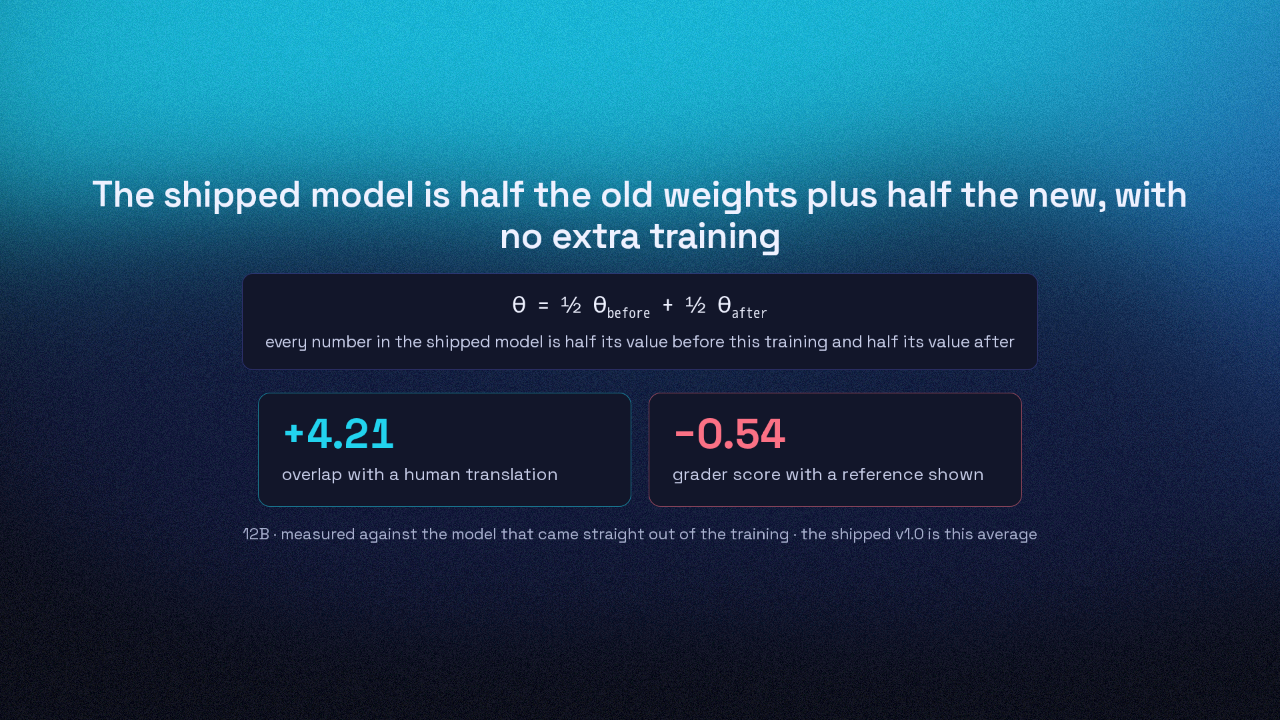
  8. 2:32The shipped model is half the old weights plus half the new, with no extra training
  9. 2:57MiLMMT-46 learned from two graders standing in for an answer key
Show transcript

MiLMMT-46-v1.0

Xiaomi’s open translator, and a training run with the answers taken out.
Xiaomi 46 languages three model sizes open weights, Gemma terms

To teach a machine to translate, you normally show it the English and the French side by side. Xiaomi's translation team finished this translator, MiLMMT-46, on sentences that had no translation attached. Two other AI models did the grading instead.

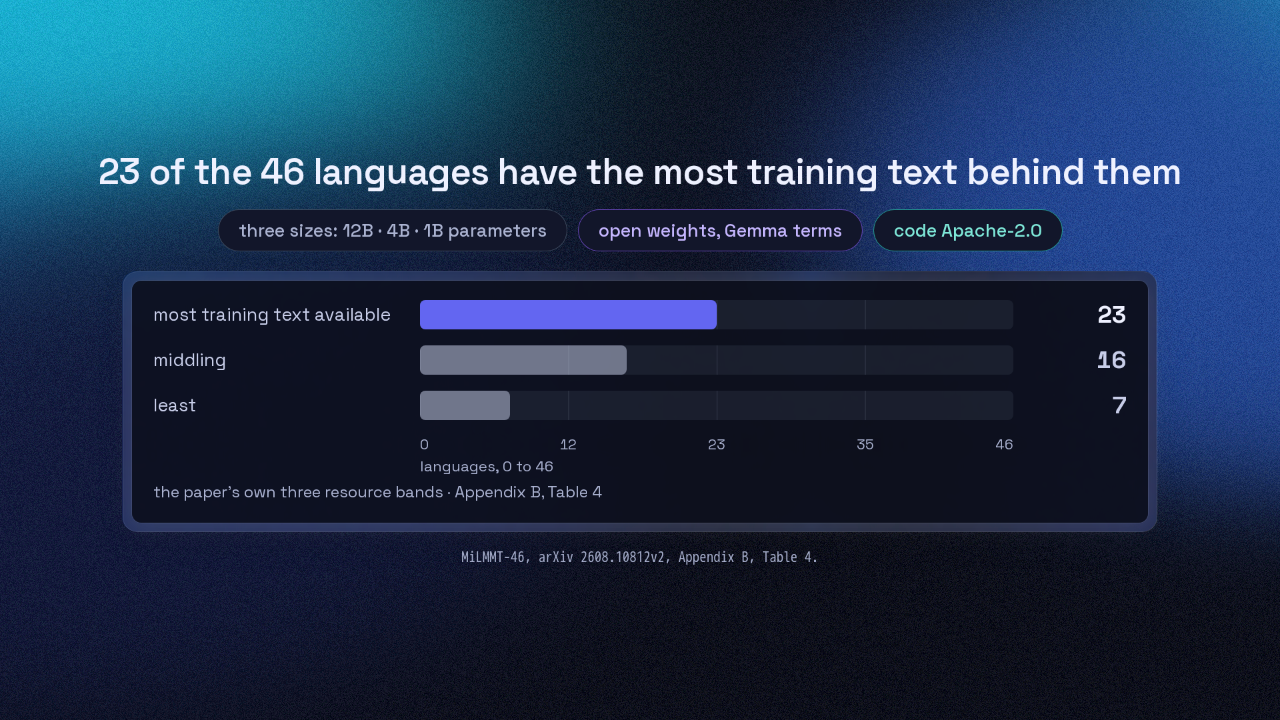
23 of the 46 languages have the most training text behind them

three sizes: 12B · 4B · 1B parameters open weights, Gemma terms code Apache-2.0
most training text available 23
middling 16
least 7
0 12 23 35 46 languages, 0 to 46
the paper’s own three resource bands · Appendix B, Table 4
MiLMMT-46, arXiv 2608.10812v2, Appendix B, Table 4.

MiLMMT-46 takes a sentence and a target language, and writes the translation, in forty six languages. Xiaomi released three sizes, the biggest one twelve billion parameters, the adjustable numbers a model is made of. Those forty six languages came out of Xiaomi's earlier work. What this paper adds is the last stretch of training. Sentence pairs written by a person run out fast past the biggest languages.

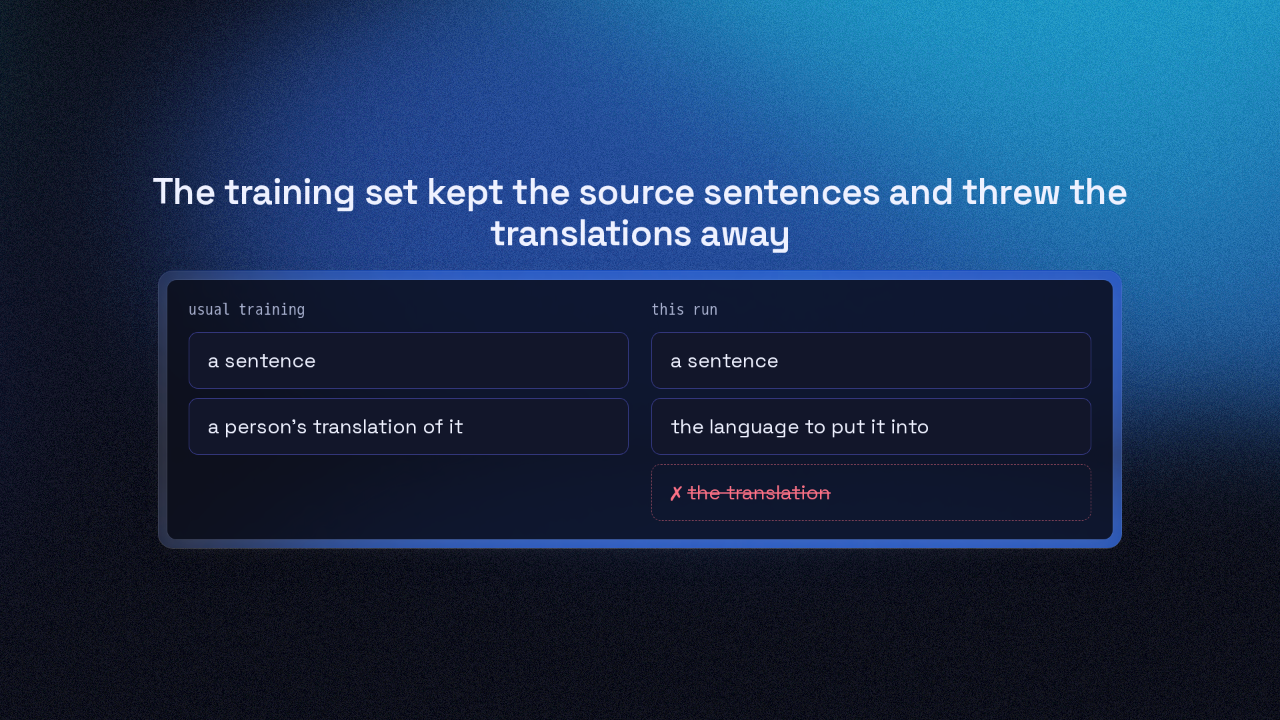
The training set kept the source sentences and threw the translations away

usual training
a sentence
a person’s translation of it
this run
a sentence
the language to put it into
✗ the translation

So Xiaomi deleted the translations out of its own training data. Each example kept its source sentence and the target language, and lost the answer. A translation has no single right answer. Ten good translators produce ten different sentences, and all ten can be right.

Two other AI models decide whether a translation is any good

source sentence
candidate translation
→
language check first · wrong language → 0
XCOMET
COMETKiwi
→
average of the two
the reward
Each grader scores a translation against the source sentence, never against a correct answer.
the paper’s own reward table · Appendix C, Table 5
quality metrics → XCOMET, COMETKiwi
language-matched reward → ½(XCOMET + COMETKiwi)
language mismatch → 0
a model can score well by writing fluent text in the wrong language · Liu et al., Findings of ACL 2026

The grade comes from two other AI models, called XCOMET and COMETKiwi. Each one reads the original sentence and a candidate translation, and scores how good the translation is. Xiaomi never shows either model a correct answer, because there isn't one. Xiaomi averages the two numbers, and that average is the whole reward. A language detector checks the output first. If the translation is in the wrong language, the score is zero. That gate blocks a known shortcut, where a model wins points for beautiful text in the wrong language.

Only the sentences where the eight attempts disagreed made it into training

263,982
source sentences
192 translation directions
one direction is one language into one other language
→
the eight scores disagreed
→
31,572
sentences kept
about 88% discarded · about 1 in 8 kept
the score the two graders gave it, over training · training steps across, the graders’ average score up
green 12B magenta 4B orange 1B teal, purple and grey: the same three models on held-out sentences

For one source sentence, the model writes eight different translations. All eight get scored, and the model shifts toward the ones that beat the average of the eight. Those other seven attempts are the only yardstick. Xiaomi started with two hundred and sixty three thousand source sentences, across a hundred and ninety two translation directions. If all eight are excellent, or all eight are hopeless, there is nothing to push toward, so Xiaomi dropped those sentences. That left thirty one thousand five hundred sentences, about one in eight.

MiLMMT-46 leads every system Xiaomi ran, on the score its own two graders produce

MiLMMT-46-12B 87.88
Gemini 3 Pro 85.03
GPT-5 84.86
Google Translate 83.29
0 25 50 75 100 XCOMET score, 0 to 100
the grader sees the source sentence and the translation, never a correct answer
WMT24++ · 46 languages · source sentences in English · scored by XCOMET · every system re-run by Xiaomi

On that same grade from the two graders, the twelve billion version scores eighty seven point eight eight across forty six languages. Gemini 3 Pro comes closest, nearly three points behind, then GPT-5 and Google Translate. Xiaomi ran all four of those systems itself, so every number here is its own measurement.

Swap in a score with a human translation behind it and Google Translate leads

Google Translate 39.29
Gemini 3 Pro 38.14
MiLMMT-46-12B 35.14
GPT-5 34.94
0 12.5 25 37.5 50 word overlap score, 0 to 50
FLORES+ · ships a human translation of every sentence · spBLEU counts word overlap, with no learned model in it · direction-group averages computed from the paper’s own Table 1 cells
grader score
+1.23 ▲
second grader
+1.00 ▲
grader score with a reference shown
+0.98 ▲
overlap with a human translation
−1.71 ▼
FLORES+ · 12B · averaged over the four translation-direction groups · v0.1 → v1.0

That winning score comes from XCOMET and COMETKiwi, the same two models the training reward was made of. The paper names no separate models for the scoring. The paper reports one number that comes from neither grader, a plain overlap count against a translation a person actually wrote. On that overlap count, Google Translate is ahead, thirty nine point two nine against MiLMMT's thirty five point one four. On Xiaomi's own before and after for the twelve billion model, every grader score went up, and the overlap with a person's translation went down.

The shipped model is half the old weights plus half the new, with no extra training

θ = ½ θbefore + ½ θafter
every number in the shipped model is half its value before this training and half its value after
+4.21
overlap with a human translation
−0.54
grader score with a reference shown
12B · measured against the model that came straight out of the training · the shipped v1.0 is this average

Xiaomi's fix for that lost overlap is simple. A model is a big pile of numbers. The team averaged the pile from before this training with the pile from after, half from each, and ran no extra training. Set against the model straight out of that training, the average gives back four point two one points of overlap with a person's translation. That average costs half a point of grader score, this time with the graders shown a correct translation.

MiLMMT-46 learned from two graders standing in for an answer key

MiLMMT-46 learned from two graders standing in for an answer key, and the scores that rose are the graders’ own

arxiv.org/abs/2608.10812 huggingface.co/xiaomi-research
Xiaomi open weights, Gemma terms code Apache-2.0 12B · 4B · 1B

So the training used two AI graders where an answer key would normally go. Anyone can download all three sizes, under Google's Gemma terms, which carry use restrictions. Xiaomi scored every system with automatic metrics, and ran no human evaluation at all. Xiaomi's own stated next step is reward models that line up better with human judgment.


Up next

2:58

Apodex 1.1 mini · the same file, run alone and run as a team

@ai-ml-today · 1 month ago

3:09

Ornith-1.5 · an open model trained on problems it wrote for itself

@ai-ml-today · 1 month ago

3:08

MOSS-VL · an open 11B video model trained to decide, after every frame, whether to speak or stay silent

@ai-ml-today · 1 month ago

3:29

Qwen3.8-27B · a 27B open model anyone can download averages 84.3 across real desktop jobs on Qwen’s own run, and loses the widest row on its own card by nine points

@ai-ml-today · 1 month ago

3:31

BDH-CQ — a 150M-parameter system that learns a puzzle rule from the worked examples in front of it and does its thinking as numbers, never as words

@ai-ml-today · 2 months ago

3:29

Muse Glimmer 30B, Meta’s open agent model, and the second tiny model that guesses sixteen words ahead so it runs fast on one consumer graphics card

@ai-ml-today · 2 months ago

3:05

JoyAI-Video-Edit, JD’s open 16B model that edits a video while the video is still playing, at about 30 frames a second on one Nvidia B200

@ai-ml-today · 2 months ago

3:26

Inkling-Small, Thinking Machines’ 12B-active / 276B open mixture-of-experts model that out-reasons its own 3.5× bigger flagship

@ai-ml-today · 2 months ago

3:42

Maple-Preview, DeepGrove’s 20-billion-parameter ternary reasoning model that runs on a Mac mini

@ai-ml-today · 2 months ago

3:16

Hunyuan3D-Buffalo, Tencent’s one model that builds, understands, and edits 3D from words

@ai-ml-today · 2 months ago

3:28

MiniMax H3, an open model that makes a video and its soundtrack in one pass

@ai-ml-today · 2 months ago

3:37

DiffusionGemma, Google’s open model that writes text a whole block at a time

@ai-ml-today · 2 months ago