Norrowmark’s contract renews in February, and the last day to cancel is November 2
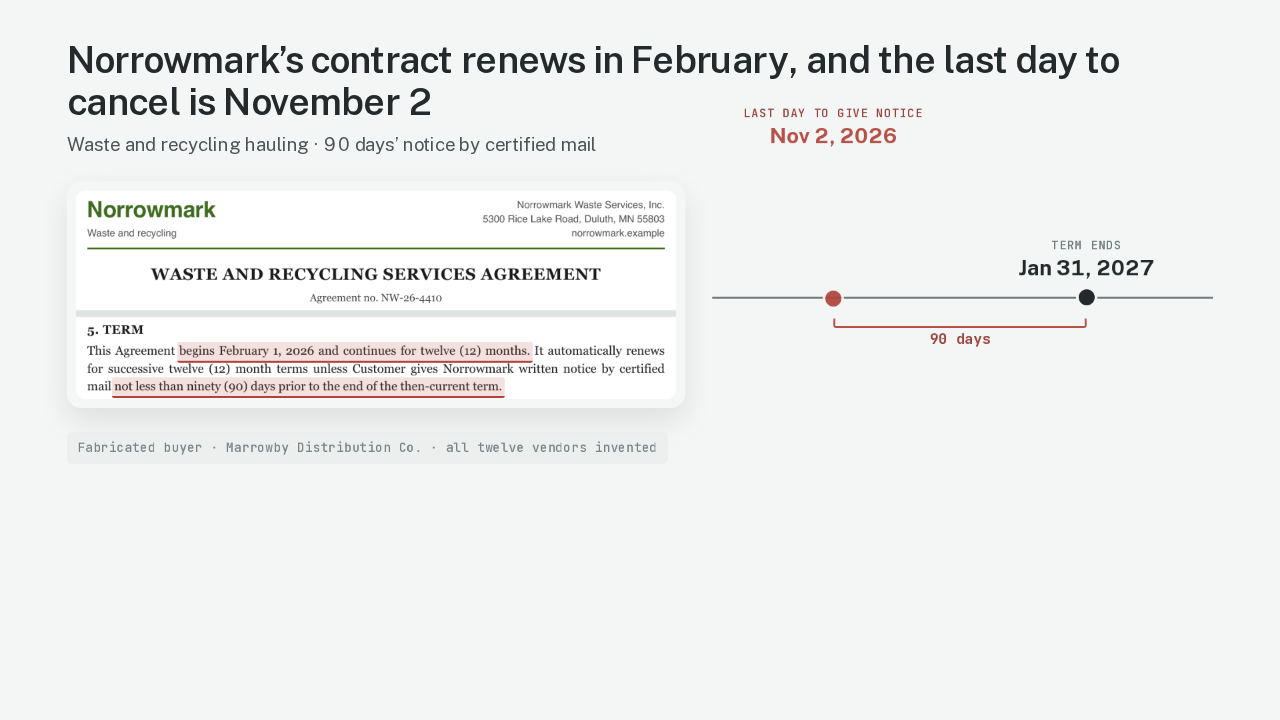
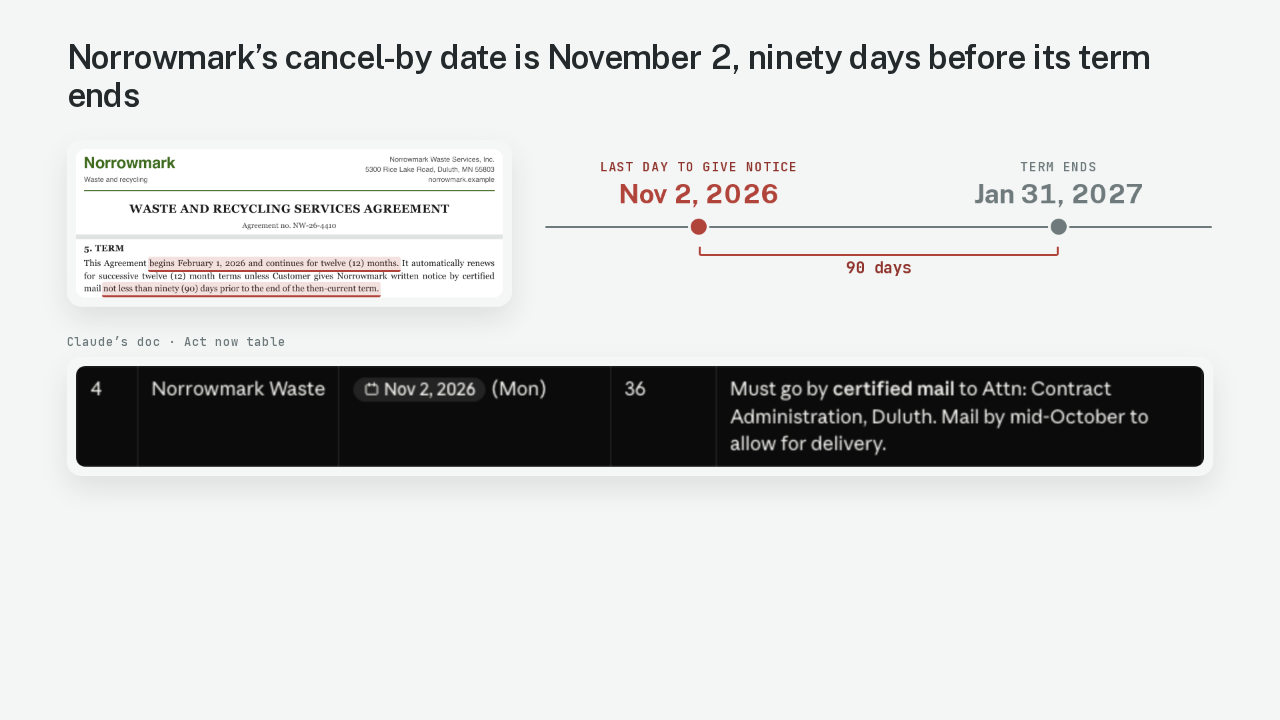
Norrowmark's waste hauling contract renews itself for another year on February first. To stop it, the letter has to arrive by November second. Claude Docs is Anthropic's new document editor inside Claude. You attach files and ask, and Claude writes a doc you can edit. I gave Claude Docs twelve vendor contracts and asked for each contract's notice deadline. If you run operations or purchasing, you check these dates every quarter and again at budget time. Eleven of the twelve contracts auto-renew. An auto-renewing contract rolls into another term unless somebody says no in writing, in time. I made up the buyer, Marrowby Distribution, and all twelve vendors.
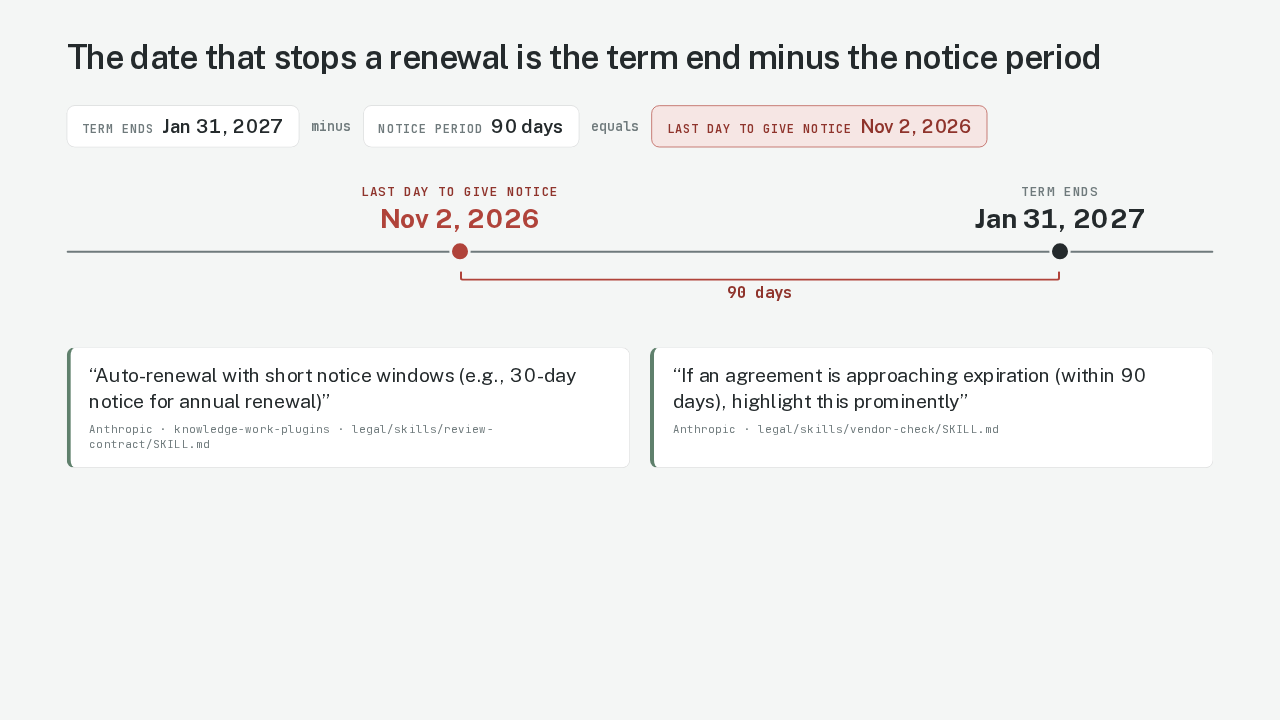
The date that stops a renewal is the term end minus the notice period
The notice period is how far ahead of the end date your letter has to arrive. Norrowmark's is ninety days. Count ninety days back from January thirty-first and you land on November second. The contract prints the start date and the ninety days. November second appears nowhere in it. Anthropic publishes skill files, sets of written instructions Claude can follow for one kind of task. Anthropic's contract review file lists auto-renewal with a short notice window as a common problem, for example thirty days of notice on a yearly renewal. Anthropic's vendor check file says to highlight any agreement within ninety days of expiring. Both files stayed outside my run.
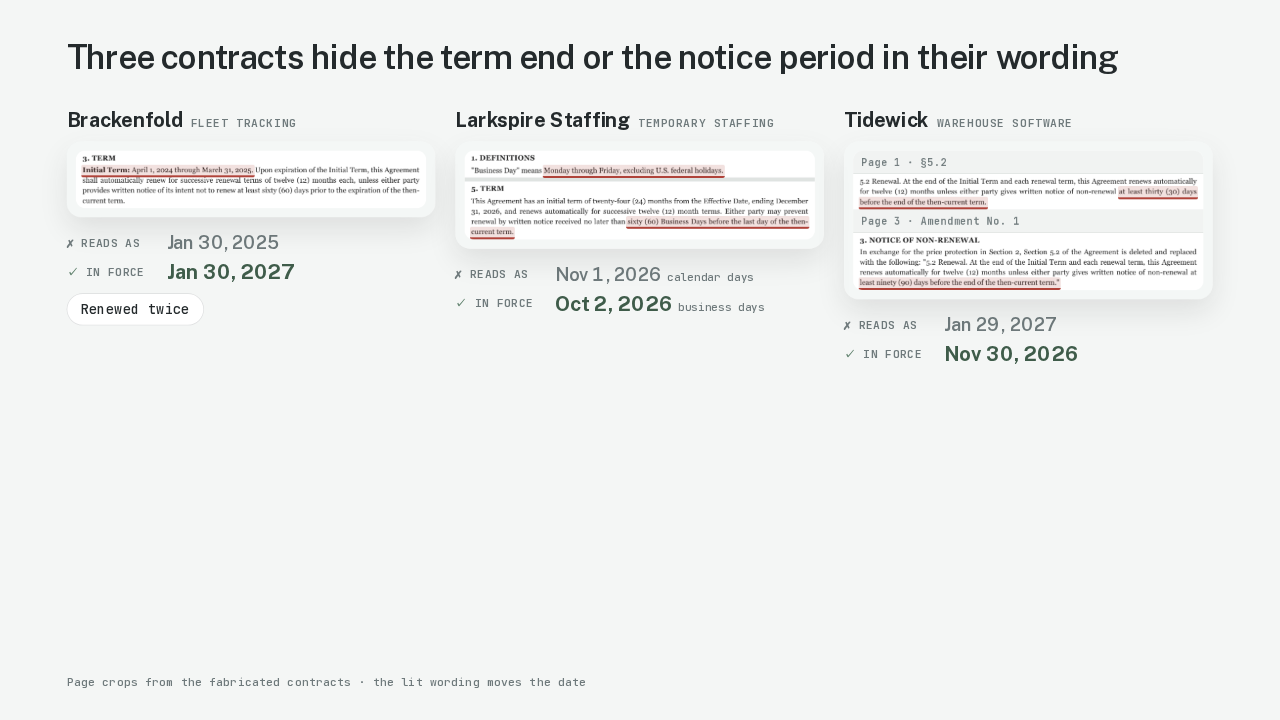
Three contracts hide the term end or the notice period in their wording


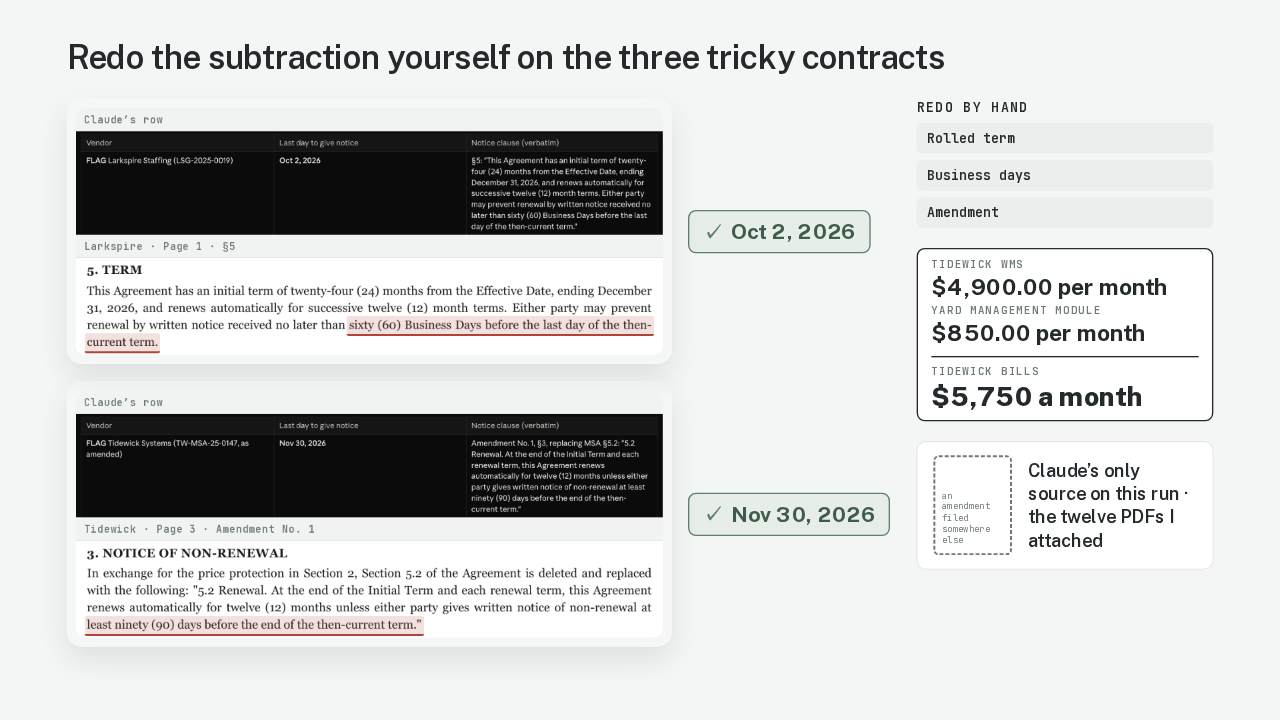
The subtraction is easy. Finding its two inputs takes reading. Brackenfold's fleet tracking contract says its first term ended March thirty-first, twenty twenty-five. The contract has renewed twice since then, so the term in force ends in March twenty twenty-seven, and the deadline is January thirtieth, twenty twenty-seven. Read page one alone and you get a deadline that passed last year. Larkspire, a staffing agency, asks for sixty business days. Larkspire's contract defines a business day as Monday through Friday, skipping federal holidays. Counted that way, the deadline is October second. Counted as sixty calendar days, the deadline would be November first, thirty days too late. Tidewick's warehouse software contract asks for thirty days in section five. Page three of the same file is an amendment, a later change both companies signed. The amendment replaces thirty days with ninety, and that moves Tidewick's deadline from January twenty-ninth to November thirtieth.
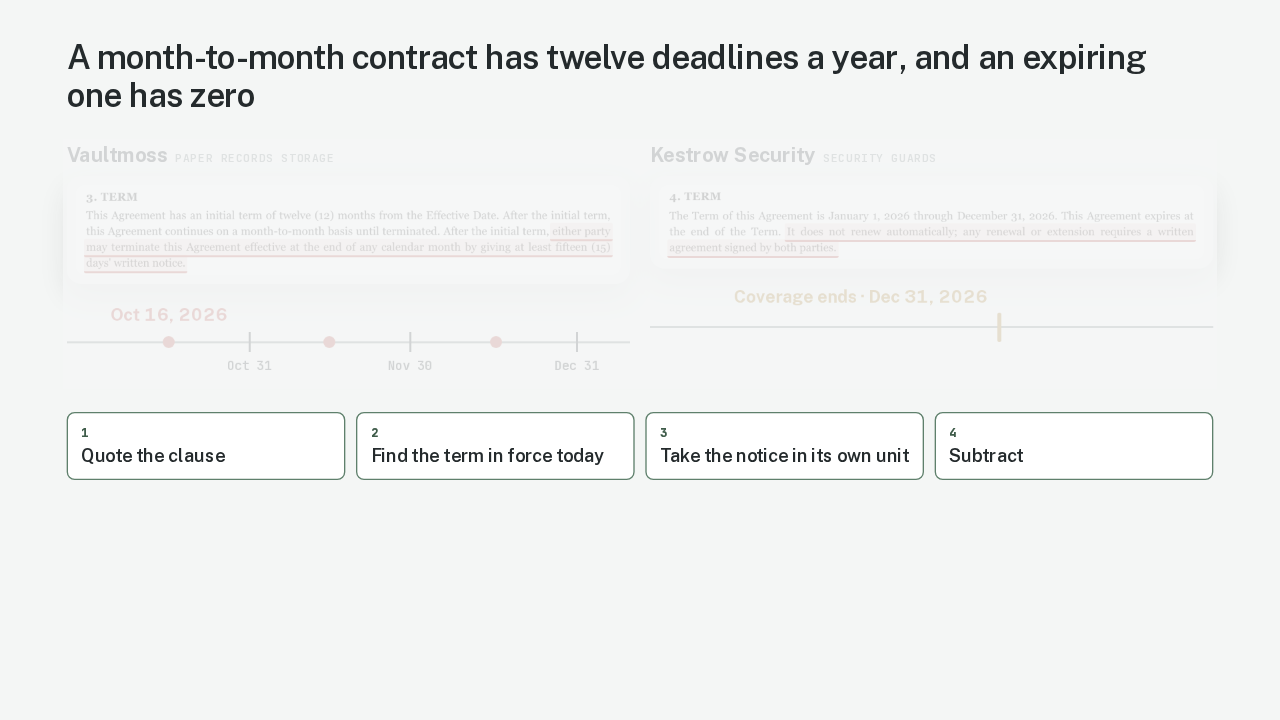
A month-to-month contract has twelve deadlines a year, and an expiring one has zero
Vaultmoss stores Marrowby's old paper records. Vaultmoss's first year ended in February, and the contract now runs month to month. Fifteen days' notice ends it at the end of any month. So Vaultmoss has a deadline every month, and the nearest is October sixteenth, for service that stops October thirty-first. Kestrow Security's contract ends December thirty-first and does not renew by itself, so Marrowby has no letter to send. If Marrowby still wants guards on site in January, somebody has to sign a new agreement first. For every contract, the fix is the same four steps. Quote the clause. Find the term that is in force today. Take the notice period in the unit the contract uses. Then subtract.
Larkspire’s deadline is five days away, and five more follow before December 26
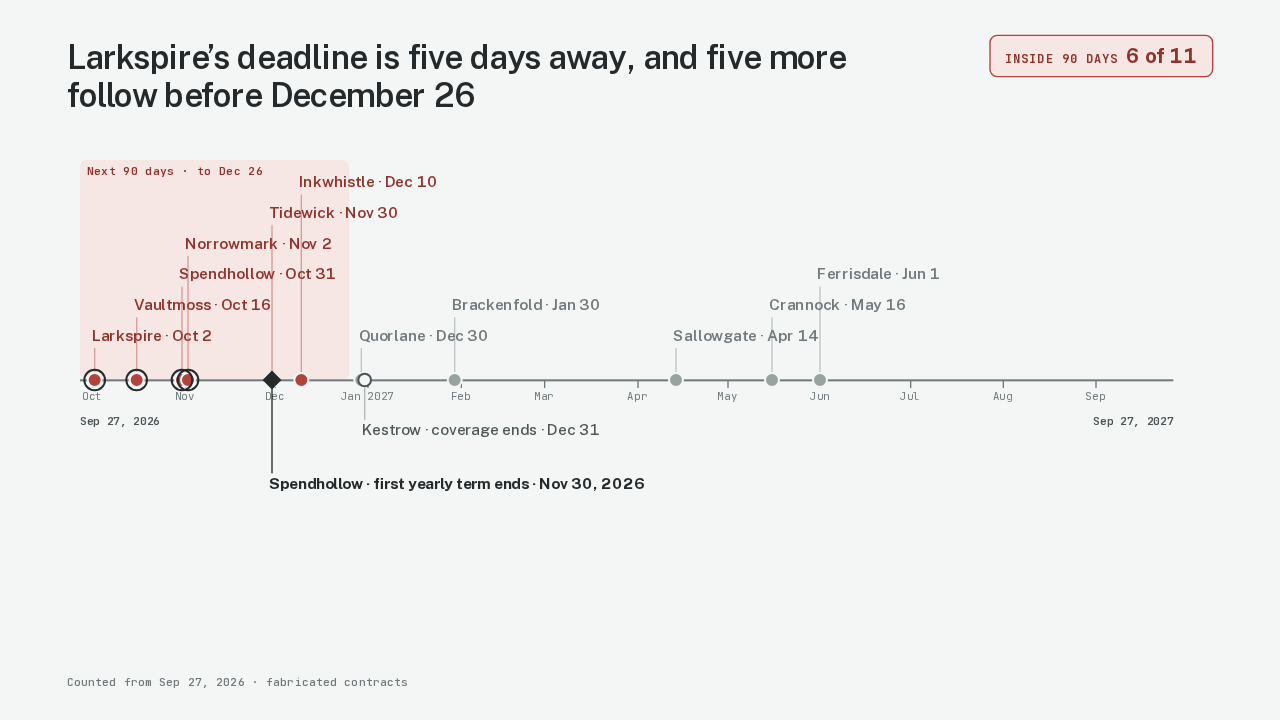
Counting from September twenty-seventh, the day I ran this, eleven of the contracts have a date to send notice by. Six of those eleven dates fall inside the next ninety days, the window my request asked Claude to flag. The first is Larkspire's, the staffing contract. Spendhollow, the expense software, is the first contract to reach the end of a yearly term, on November thirtieth. By then, four deadlines have already passed.
One request names the six columns, and the traps stay out of it
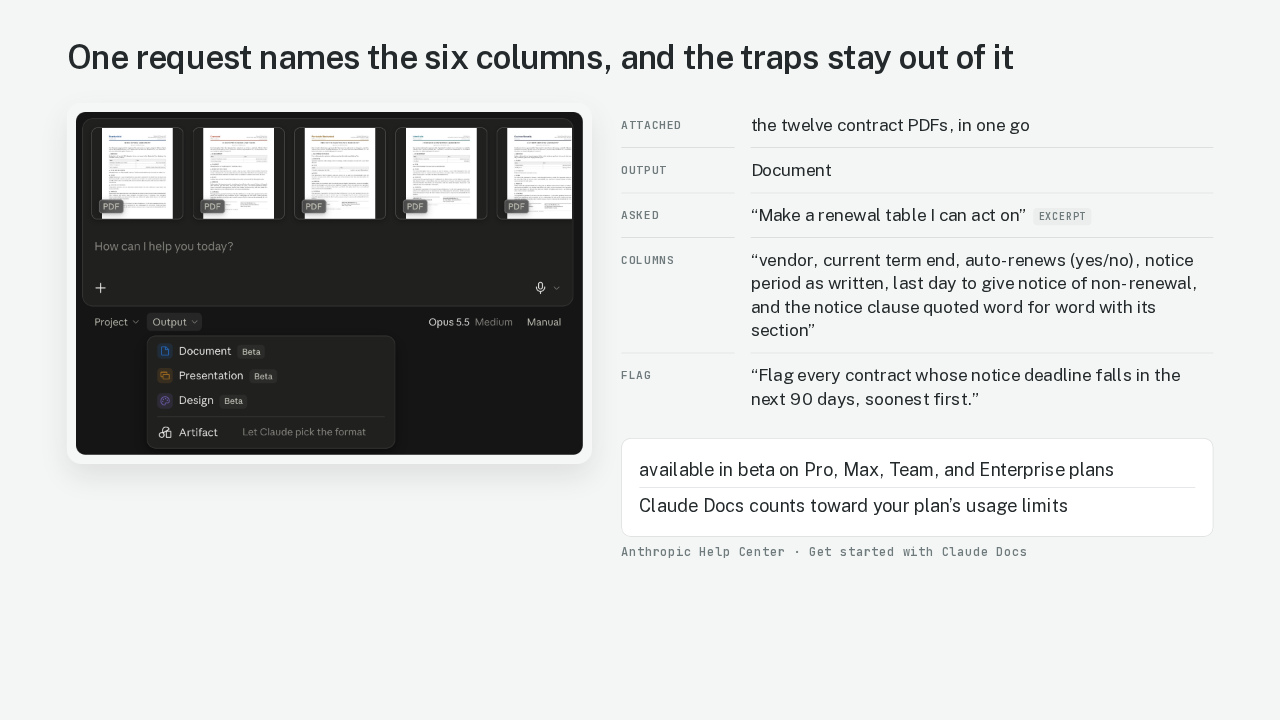
In Claude, I attached all twelve PDFs at once, opened the Output menu and picked Document. Then I typed one request, sixty-one words long. The request lists six columns. They are the vendor, the current term end, whether the contract auto-renews, the notice period as written, the last day to give notice, and the clause quoted word for word. The request gives today's date and asks Claude to flag anything due in the next ninety days. My request left out every trap I planted. Claude Docs is in beta, an early release, on Claude's Pro, Max, Team and Enterprise plans. Each run counts toward your plan's usage limits.
Claude Docs got all eleven deadlines right and caught all six traps
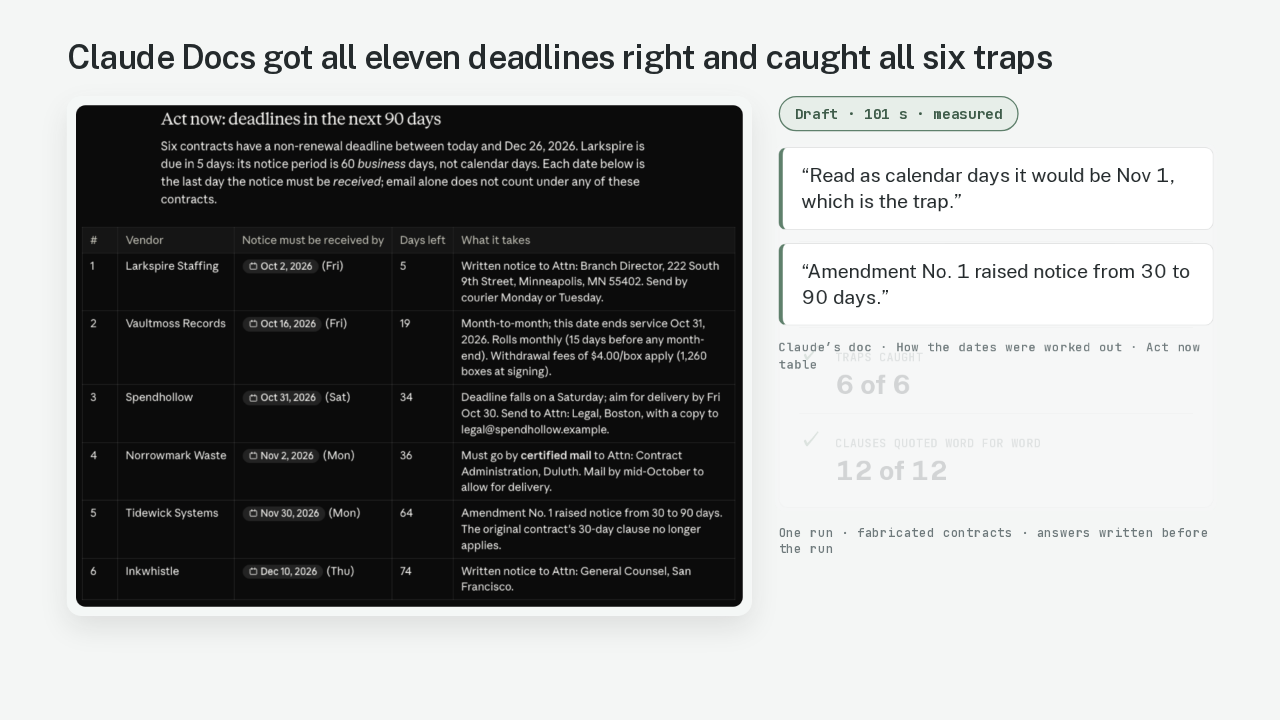
The table took a hundred and one seconds, going by the conversation's own timestamps. Before the run, I wrote down the correct answer for all twelve contracts. On my run, Claude matched all eleven deadlines to the day. Claude also saw that Kestrow has no deadline at all. That makes six traps out of six, and every clause came back quoted word for word. Claude named two of the traps in the doc itself. The doc says Larkspire's sixty business days land on October second, and that the calendar reading, November first, is the trap. The doc also says Tidewick's amendment raised the notice from thirty days to ninety.
Claude’s table sets the date, and you make the renewal call

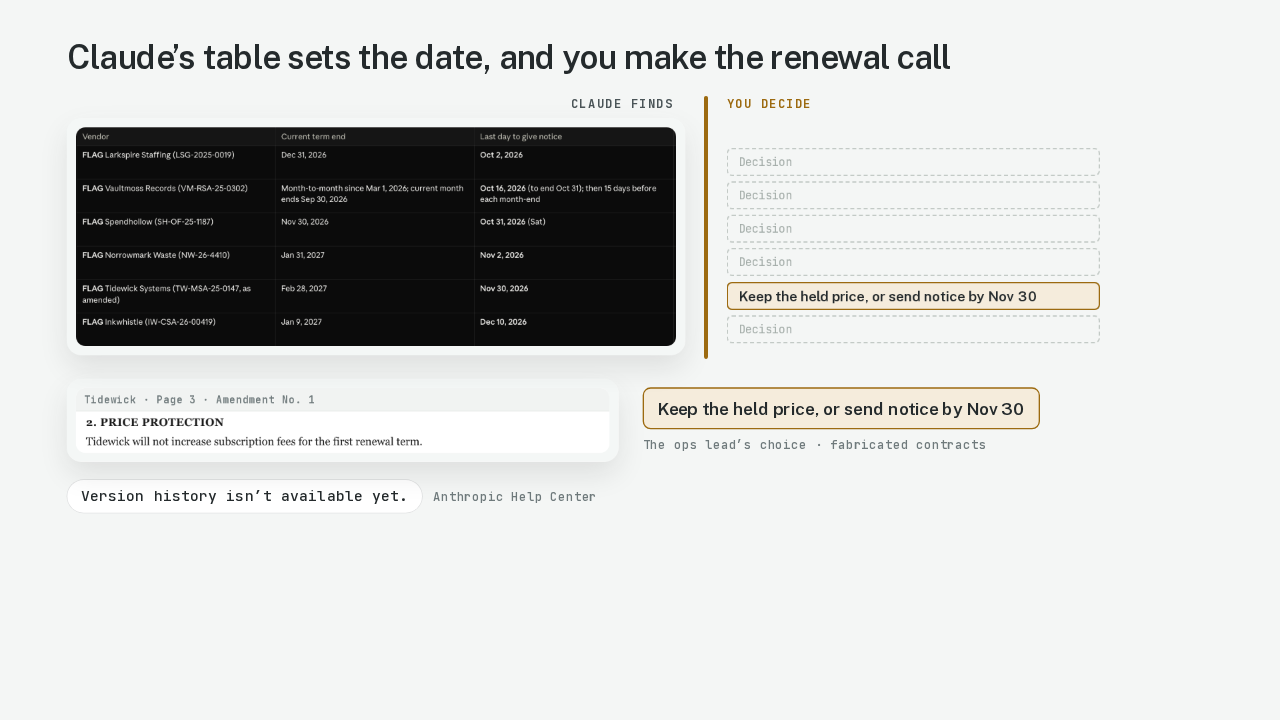
Here is where I'd stop and read it myself. Claude's table says when Marrowby has to decide. Whether to renew, renegotiate or cancel depends on who uses each service, what it costs, and what would replace it. Those answers live outside the contracts. Take Tidewick. In the amendment that raised the notice to ninety days, Tidewick promised to hold its fees flat for the first renewal year. Keeping that price, or walking away by November thirtieth, is your call. Claude Docs has no version history yet, so export the table you act on.
Redo the subtraction yourself on the three tricky contracts


Skip the AI for the last check. On my run, all eleven deadlines were right, and I still do this check. I open the clause beside Claude's row and do the date math again for the rolled term, the business days and the amendment. Claude's table quotes the clause next to each date, so each one takes me about two minutes. Tidewick bills five thousand seven hundred and fifty dollars a month. That covers the warehouse software plus an add-on from the same amendment. If Marrowby meant to leave Tidewick, a letter that arrives one day late buys another twelve months at that price. On my run, Claude's only source was the twelve PDFs I attached. So check that the folder holds every amendment. An amendment filed somewhere else can move a deadline.
Rechecking Claude’s dates is the biggest part of the assisted run
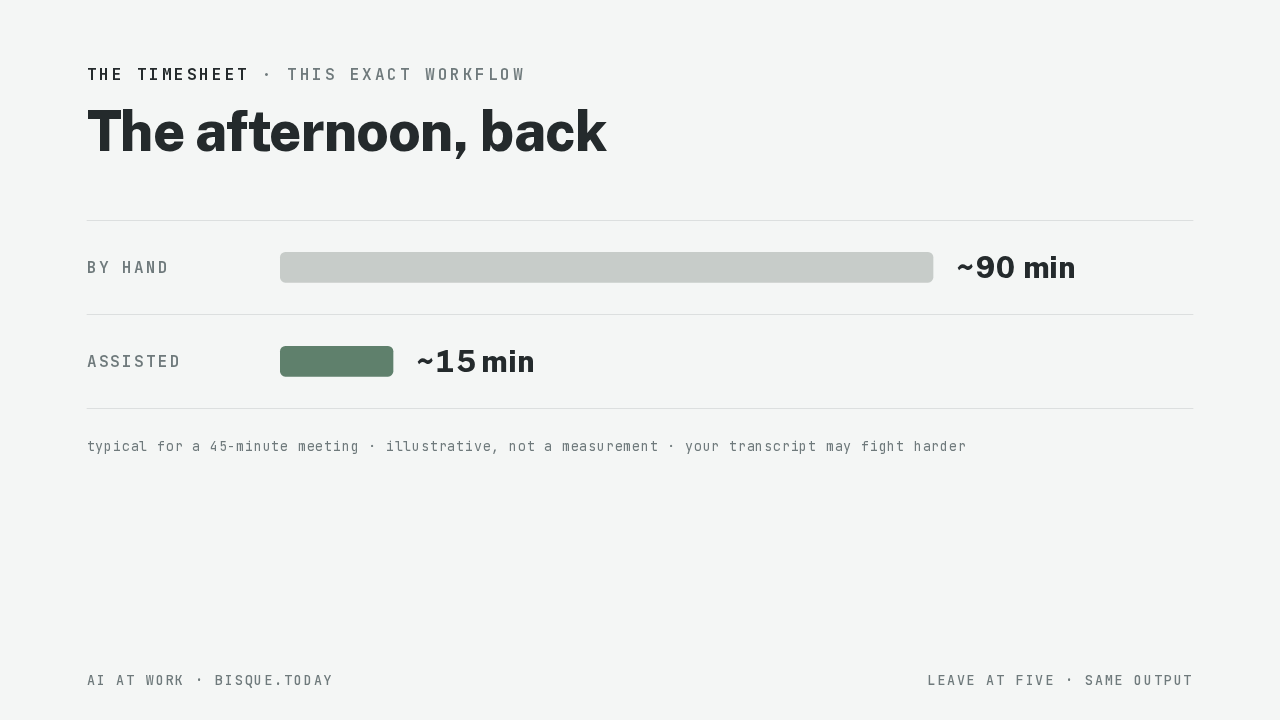
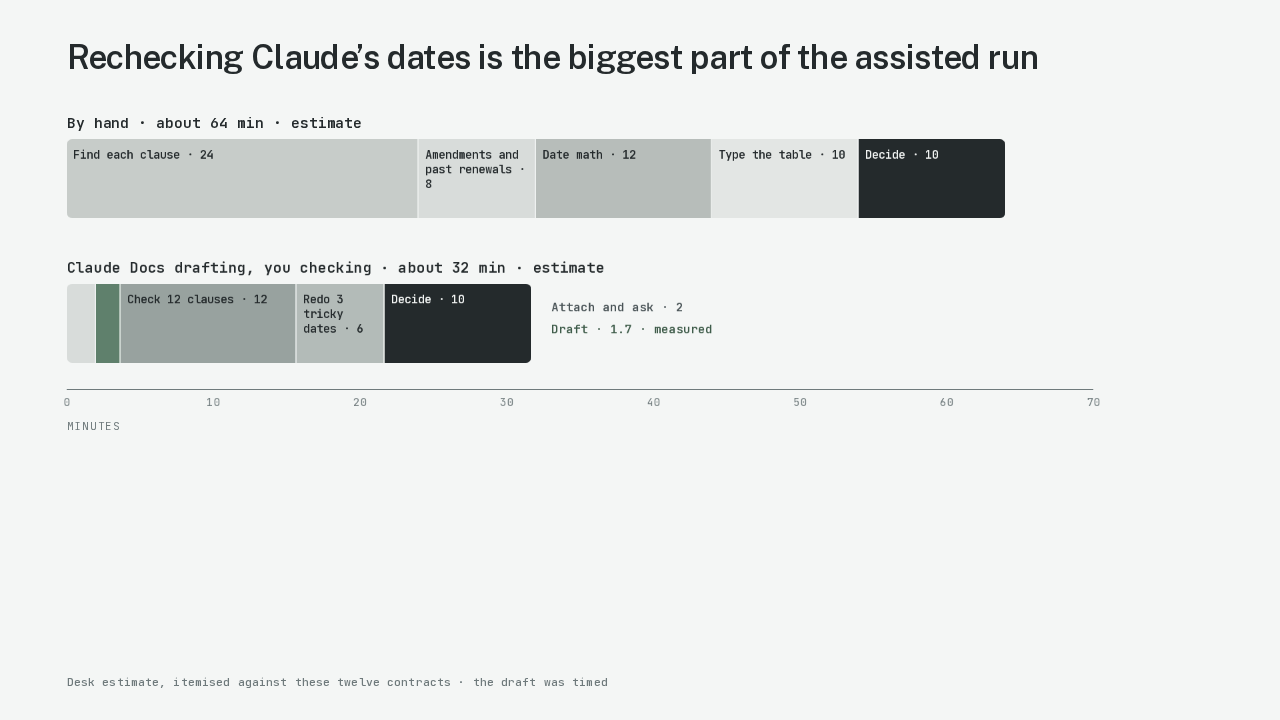
Both totals are desk estimates for these twelve contracts, and only the draft was measured. By hand, reading every contract, finding the clause, doing the date math and typing the table takes about sixty-four minutes. With Claude Docs, the run takes about thirty-two minutes, and the draft is under two of those minutes. Eighteen minutes go to checking every quoted clause and redoing the three tricky dates. The last ten minutes are the decisions, the same ten minutes as by hand.
Norrowmark’s cancel-by date is November 2, ninety days before its term ends
Back to the waste hauling contract. The date that mattered was November second, and Claude pulled it out of a clause about the end of the term. The letter goes by certified mail, which the post office tracks to delivery, and Claude's table says to mail it by mid October. Which contract on your desk has a deadline before the date in your calendar?