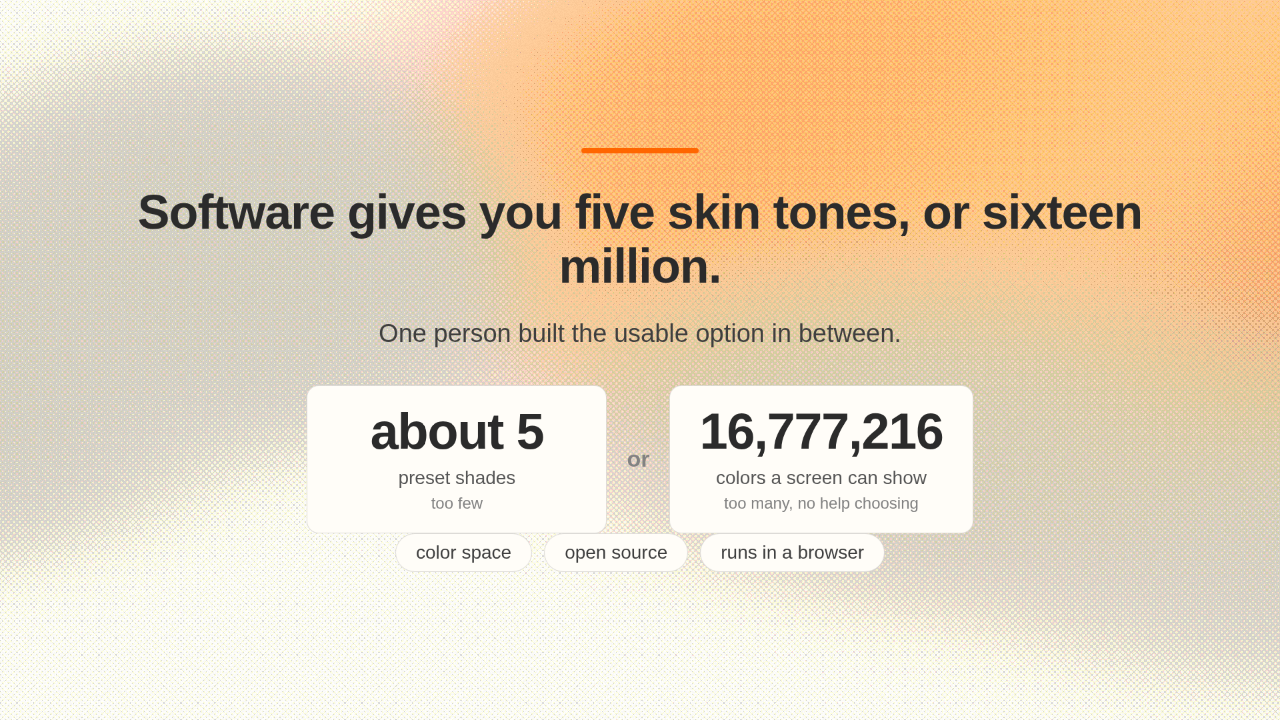
Software gives you five skin tones, or sixteen million
3 months ago
Pick a skin tone in software and you get two bad options. About five preset shades, like an emoji. Or all sixteen million colors a screen can show, with no help choosing.
Ask about this presentation
Chapters
Show transcriptHide transcript
Pick a skin tone in software and you get two bad options. About five preset shades, like an emoji. Or all sixteen million colors a screen can show, with no help choosing.
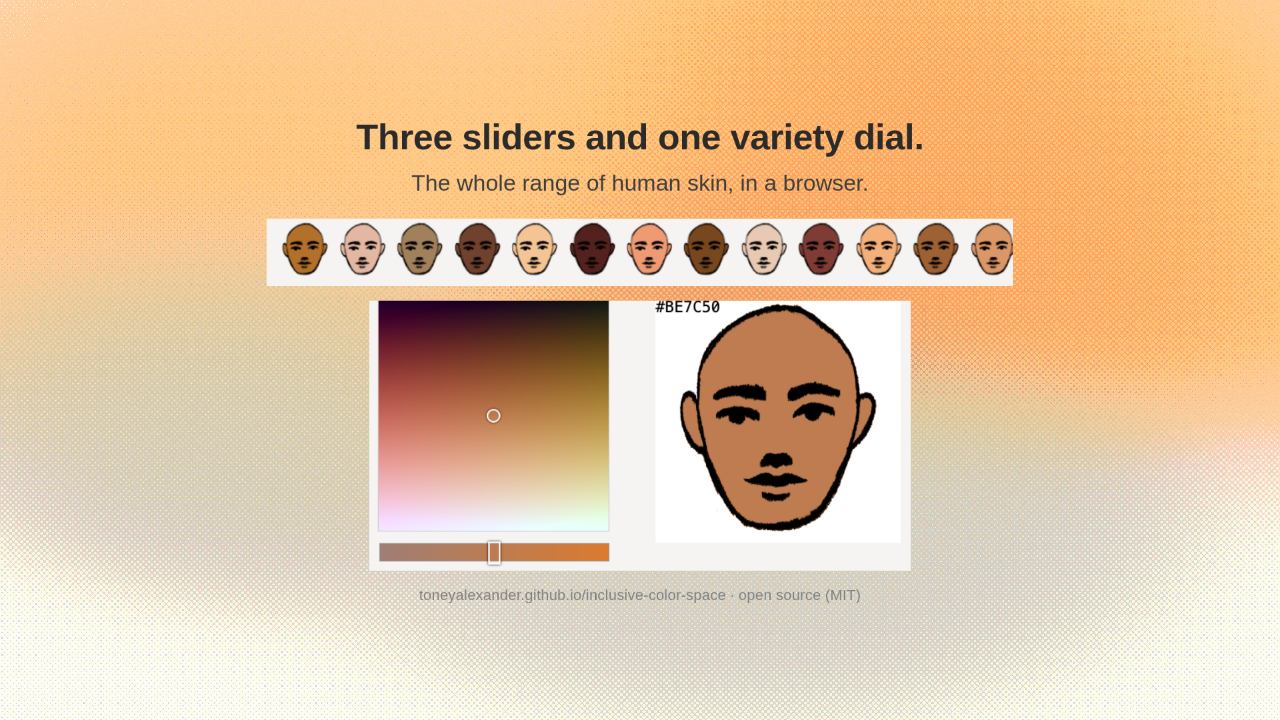
One person built a free tool for this. It turns that whole range of human skin into three simple sliders, plus one dial for how much variety you want. It runs in a browser.
Slide text
Three sliders and one variety dial.
The whole range of human skin, in a browser.
 toneyalexander.github.io/inclusive-color-space · open source (MIT)
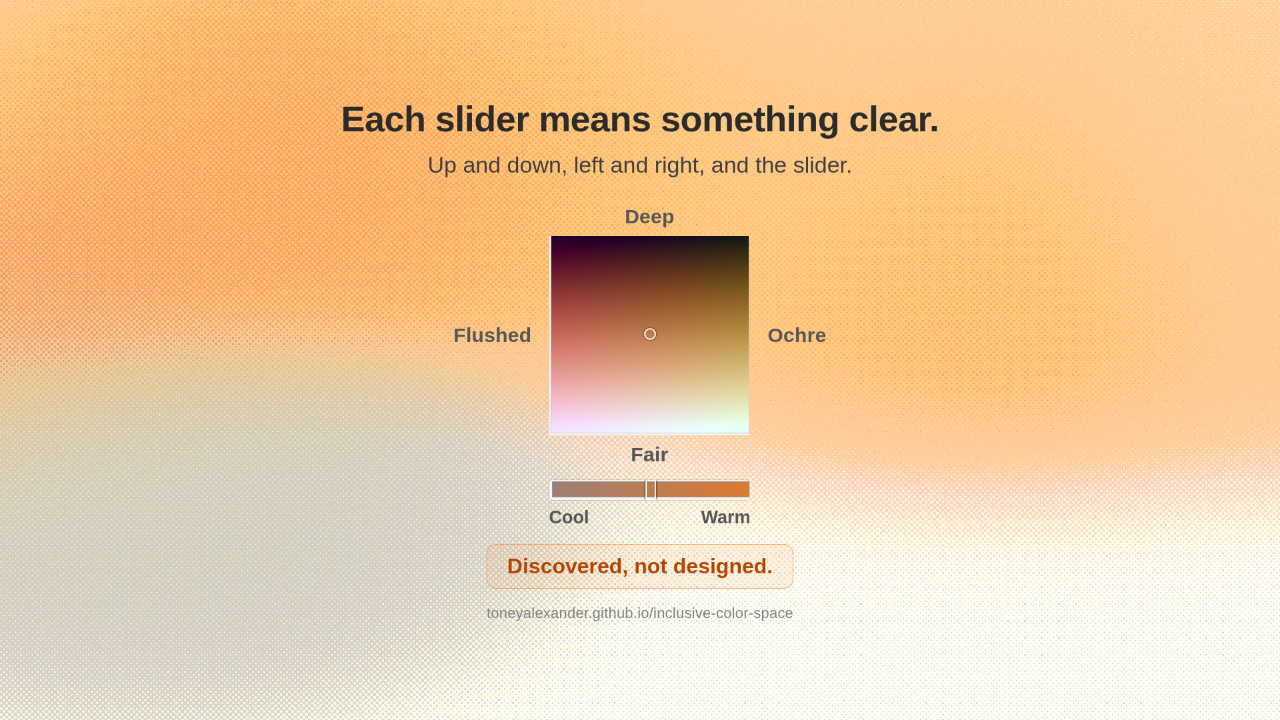
Those three sliders turned out to mean something clear. Deep to fair. Flushed to ochre, a golden tan. Cool to warm. And the builder never chose those meanings.
Slide text
Each slider means something clear.
Up and down, left and right, and the slider.DeepFlushed OchreFair
 Cool WarmDiscovered, not designed.toneyalexander.github.io/inclusive-color-space
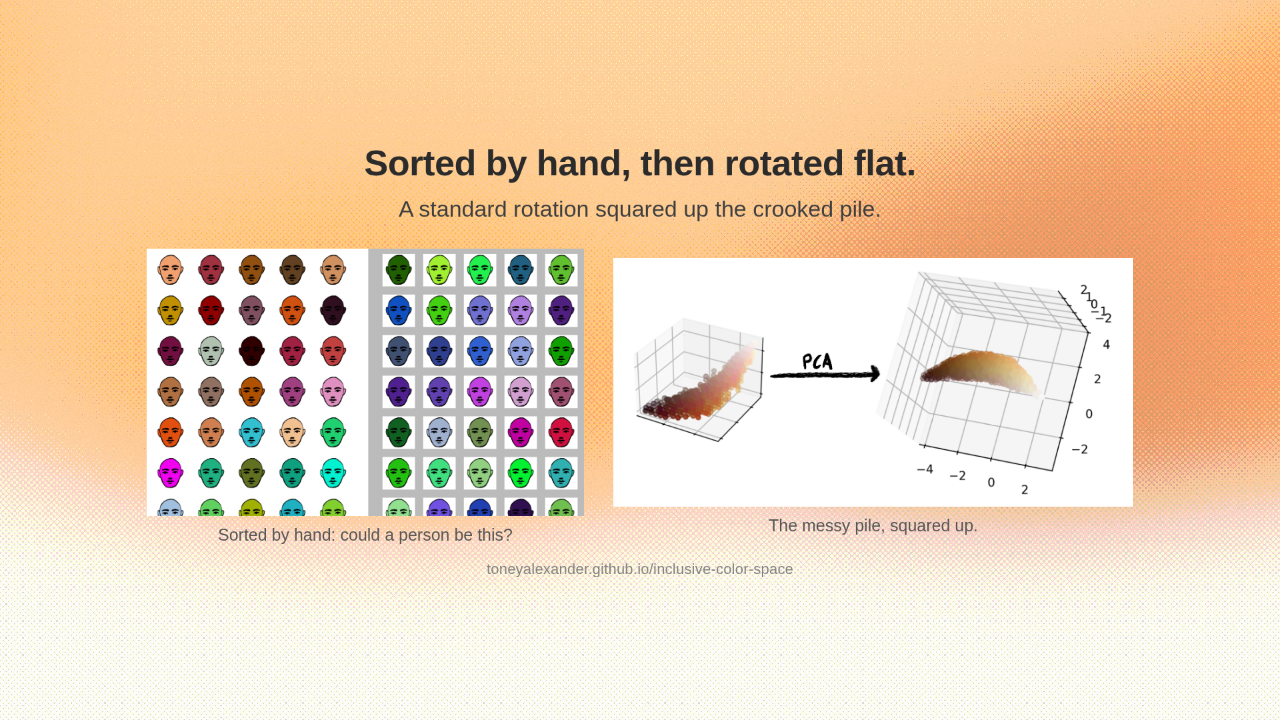
The builder sorted hundreds of colors by hand, into “a person could be this” or not. Every screen color is three numbers: how much red, green, and blue. Plot the yes-colors and they make a lopsided, banana-shaped cloud, sitting crooked. Then a standard piece of math called principal component analysis rotated that cloud flat, until its own natural directions lined up with the sliders. The rotation found the directions the colors vary along. Those directions became the sliders.
Slide text
Sorted by hand, then rotated flat.
A standard rotation squared up the crooked pile. Sorted by hand: could a person be this?
 The messy pile, squared up.toneyalexander.github.io/inclusive-color-space
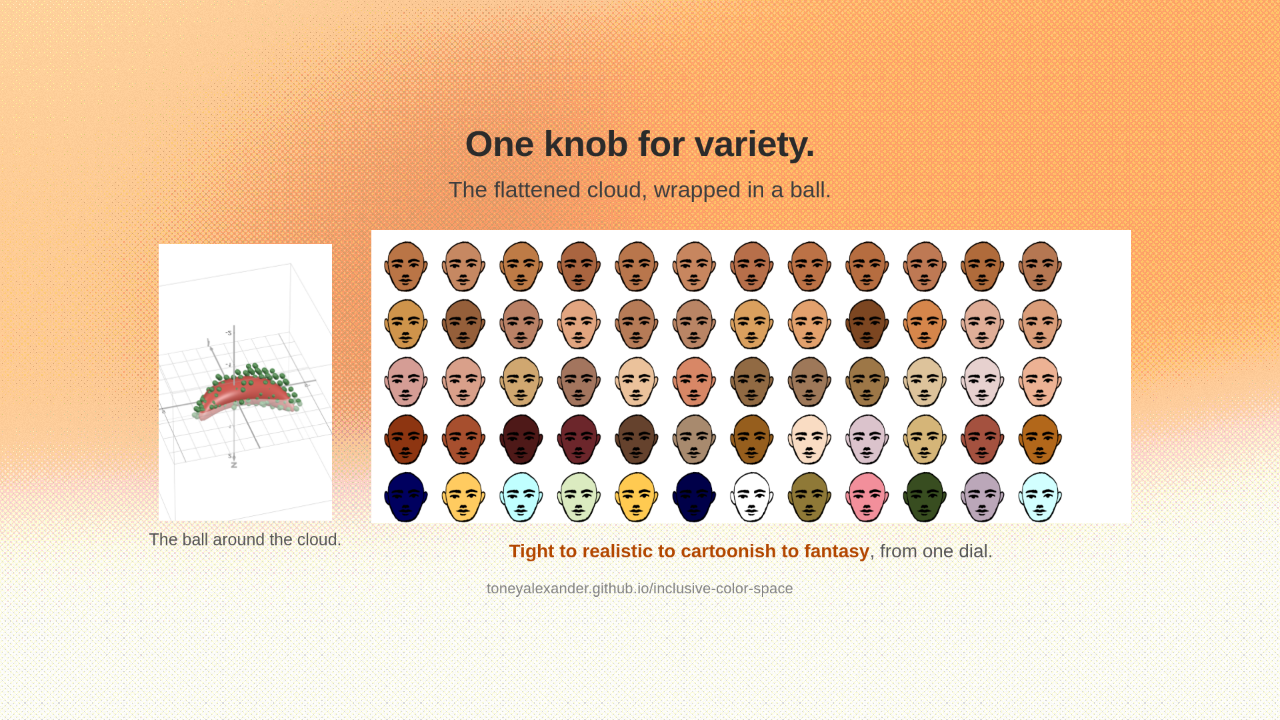
For the last step, the builder wrapped the flattened cloud in a ball. The ball’s size becomes one variety dial. Turn it down and every direction shrinks together, evenly, never lopping off one end. Turn it up and the tones become cartoonish, even fantasy.
Slide text
One knob for variety.
The flattened cloud, wrapped in a ball. The ball around the cloud.
 Tight to realistic to cartoonish to fantasy, from one dial.toneyalexander.github.io/inclusive-color-space
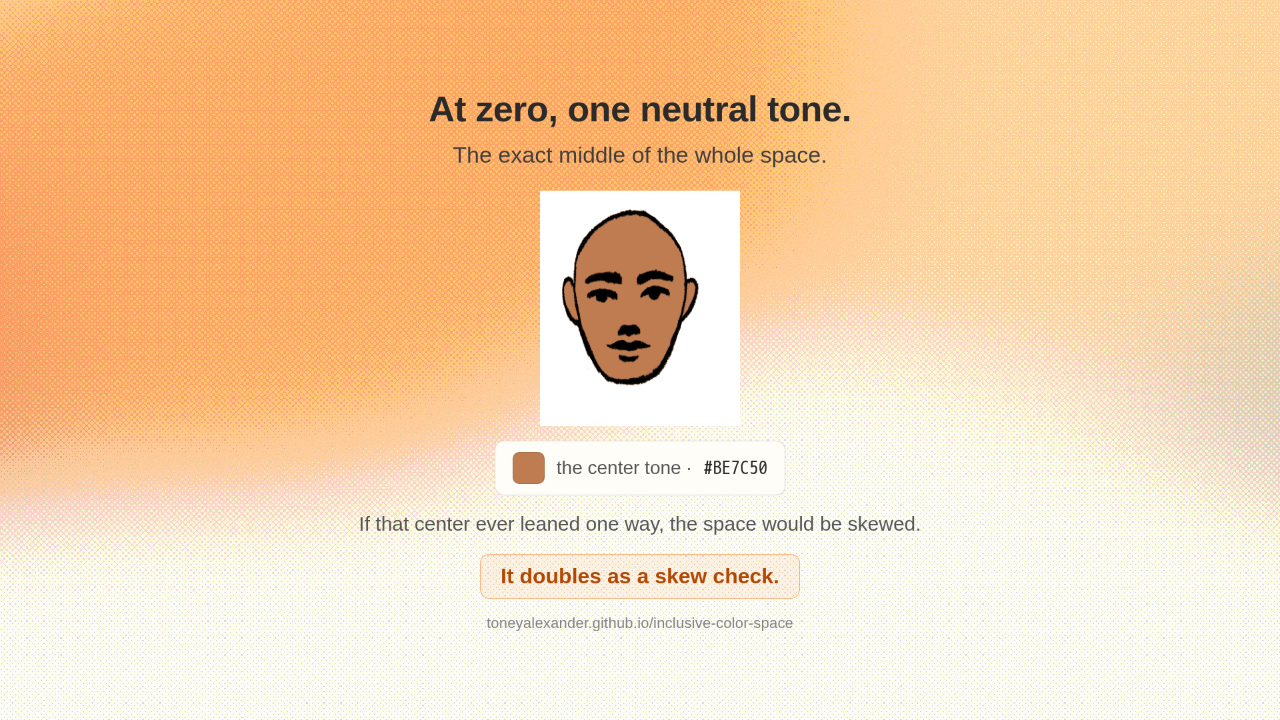
Turn that dial to zero and you land at the exact center: one neutral tone. If that center ever leaned one way, the space would be skewed. So the center checks the space.
Slide text
At zero, one neutral tone.
The exact middle of the whole space. the center tone · #BE7C50If that center ever leaned one way, the space would be skewed.It doubles as a skew check.toneyalexander.github.io/inclusive-color-space
So the choice that was five shades or sixteen million colors is now three sliders and one dial. Sorted by hand, rotated by math, open for anyone to build on.
Up next
 1:48
Writing a note down as one thing is what made it fast
@the-daily-build
3 months ago
 1:51
Nothing on the rig measures speed
@the-daily-build
3 months ago
 1:53
A file gets smaller when you can guess what is in it
@the-daily-build
3 months ago
 1:55
The seal on an AI's private thinking had one key for the whole company
@the-daily-build
3 months ago
 1:50
One row for every sellable unit, and each checkout takes any free one
@the-daily-build
3 months ago
 1:42
A single CPU instruction, stretched from a blink to a full minute
@the-daily-build
3 months ago
 1:44
You can't be best at everything
@the-daily-build
3 months ago
 1:42
How deleting one if-statement made this filter 4x faster
@the-daily-build
3 months ago
 1:43
A Self-Spreading Worm Got Into the Code Behind Billions of Installs
@the-daily-build
3 months ago
 1:34
The AI session you can’t take with you
@the-daily-build
3 months ago
 1:42
He Walked Through His House Before It Was Built, at Full Size, in a Headset
@the-daily-build
4 months ago
 1:38
500 Lines of Code That Draw 3D Without a Graphics Card
@the-daily-build
4 months ago