TencentDB Agent Memory: a memory hub you host yourself
TencentDB Agent Memory
Every time you open a new chat, your AI coding assistant has forgotten your project. TencentDB Agent Memory saves what your assistant just learned, so the next one starts where the last one left off.
Your assistant keeps what it learns, instead of relearning it every session
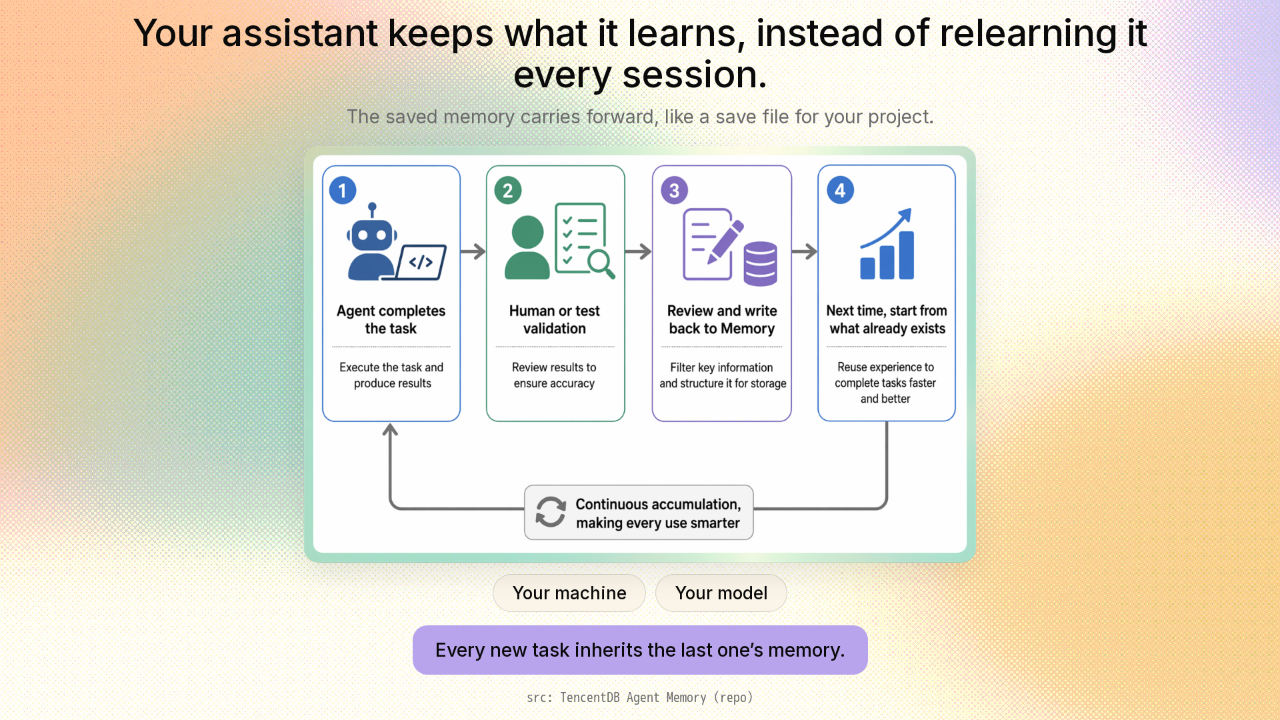
Your assistant keeps what it learns, instead of relearning it every session.
The AI tools you code with, like Claude Code or Cursor, forget everything the second you close the tab. TencentDB Agent Memory sits underneath them and keeps the useful parts: your preferences, your decisions, the shape of your codebase. It all runs on your own machine, on whatever AI model you already use. So every new task picks up that saved memory, and your assistant builds on the last session.
Most of an assistant’s first job is relearning your project
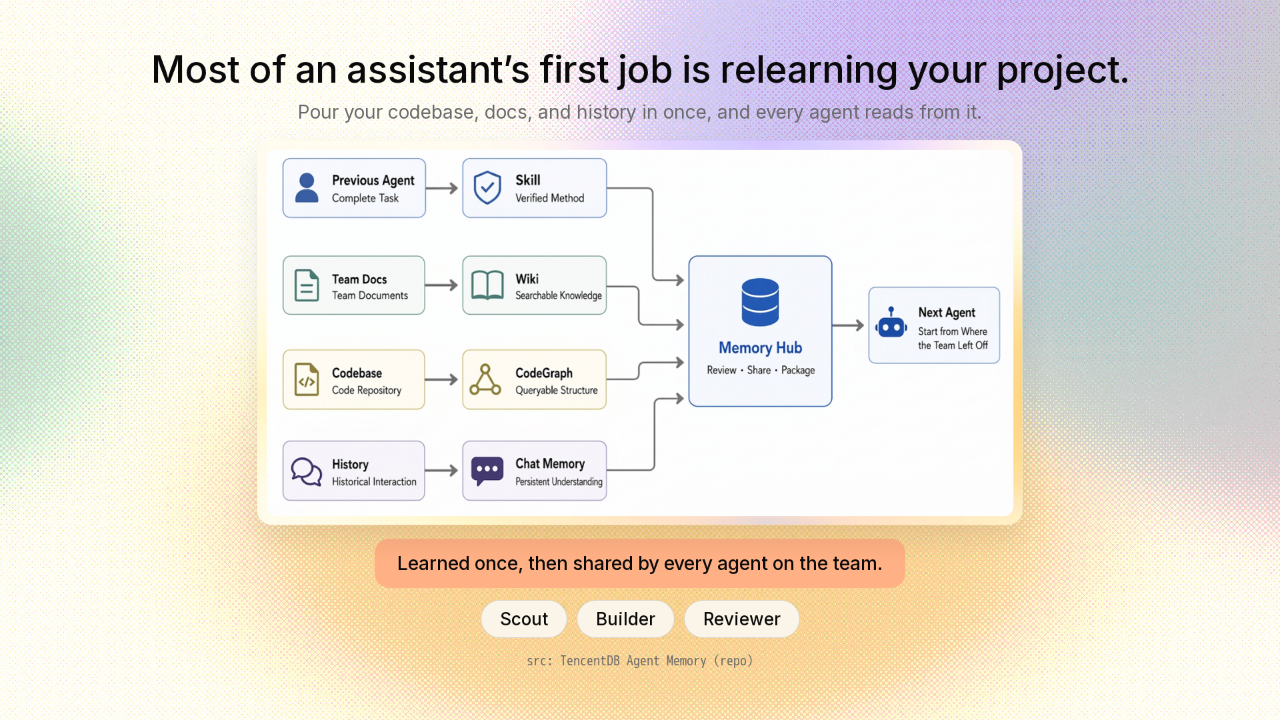
Most of an assistant’s first job is relearning your project.
So much of an assistant’s time goes to just catching up. Before it writes a line, it relearns your codebase, your docs, and the decisions your team already made. You pay that again with every new agent. TencentDB Agent Memory makes that learning something your whole team shares. Pour your codebase, docs, and history in once. After that, a scout, a builder, and a reviewer agent all share one memory, each adding what it learns.
Memory grows in layers, from the raw chat up to a lasting profile
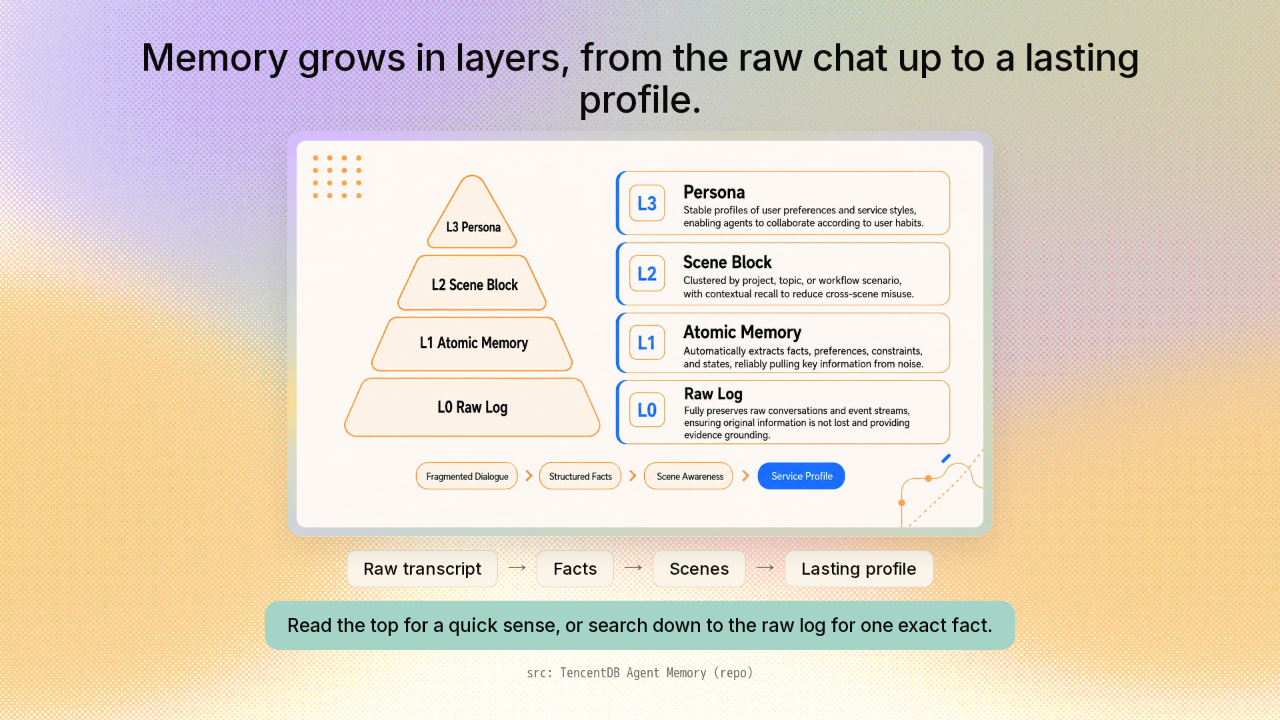
Memory grows in layers, from the raw chat up to a lasting profile.
Here’s the part that makes this clever: your memory isn’t one flat chat log. Every conversation starts as the raw transcript, saved word for word. Then a background process pulls out the key facts: your preferences, your decisions, the limits you set. It groups those facts into scenes, sorted by the project they belong to. Over time, it builds a lasting profile of how your team works. For a quick sense of things, your assistant reads the top of that pyramid. For one exact fact, it searches by keyword and by meaning, then drops back to the raw log to find it.
Four kinds of memory, each a reusable building block
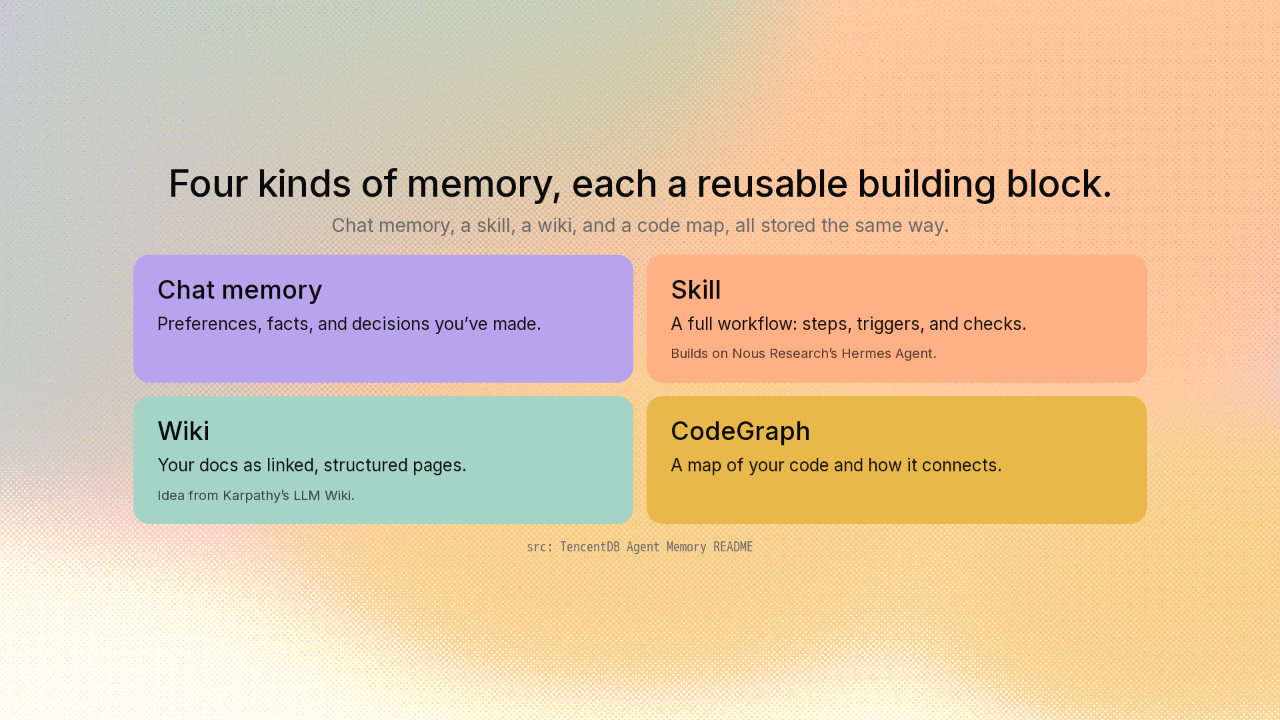
Four kinds of memory, each a reusable building block.
The layered memory you just saw is one of four kinds, all stored the same way, as reusable assets. The first, chat memory, is who you are and what you’ve decided. The second is a skill: not a saved prompt, but a whole worked-out procedure with real steps, triggers, and checks. That part reuses code from Nous Research’s Hermes Agent. The third, a wiki, turns your docs and specs into linked pages, an idea the team borrowed from Andrej Karpathy. And the fourth, CodeGraph, maps your whole codebase and how its pieces connect.
Each memory is owned, versioned, and equipped to the right agent
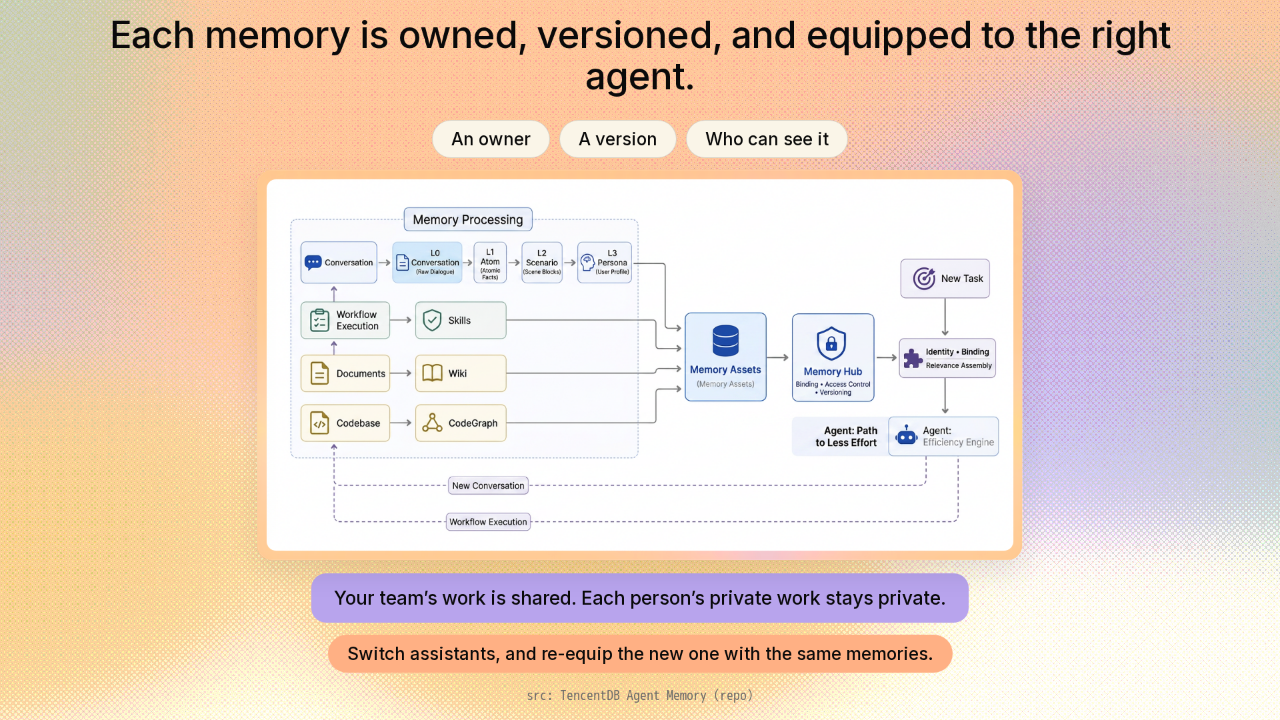
Each memory is owned, versioned, and equipped to the right agent.
None of this gets dumped into one giant prompt. Every memory carries an owner, a version, and a setting for who can see it: just you, your team, or only certain agents. A control panel called the Memory Hub then gives each agent only the memories it should have, like handing a character a loadout. So your team shares what it’s learned, and each person’s private work stays private. Switch to a different assistant, and you re-equip it with the same memories. Your project knowledge comes with you.
The assistant checks what a change will break before it makes it
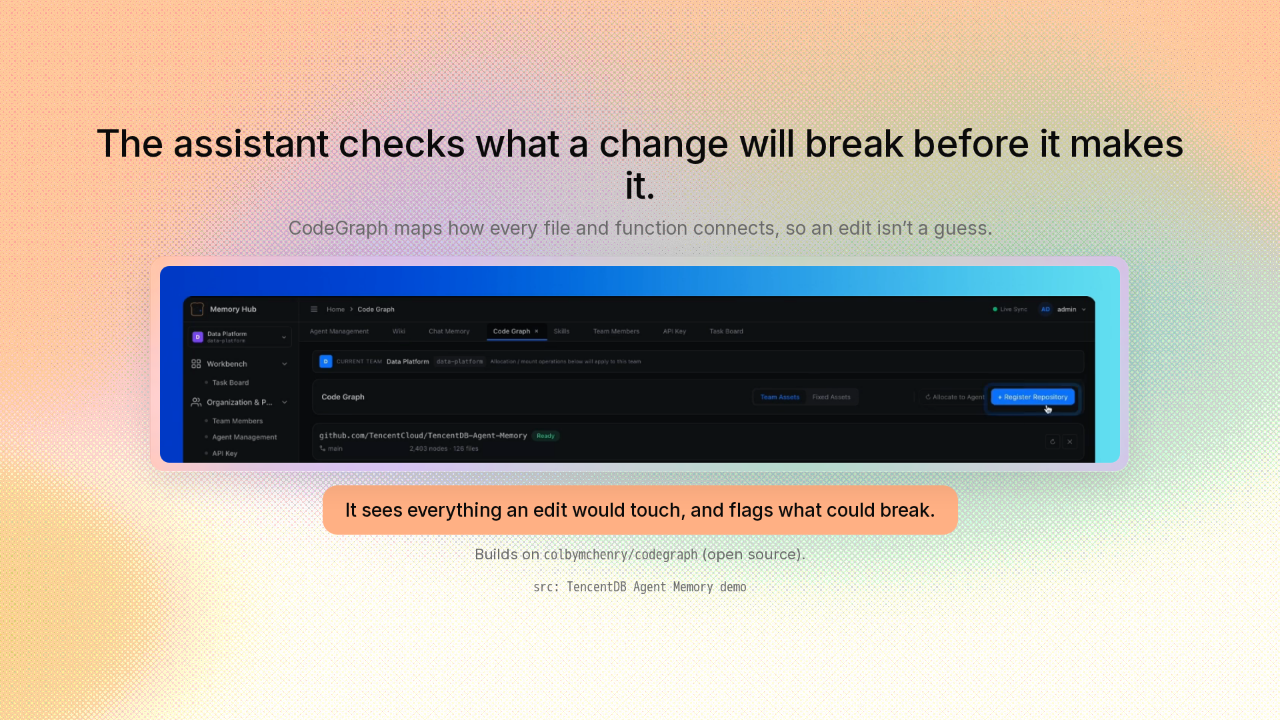
The assistant checks what a change will break before it makes it.
colbymchenry/codegraph (open source).That code map is worth seeing in action. Most tools can only tell your assistant where a function lives. CodeGraph goes further: it maps how every file, symbol, and call in your project connects. So before your assistant edits a function, it sees everything else that touches that function, and warns you what the change will break. And the team didn’t build this from scratch. Their CodeGraph wraps an open-source engine of the same name, made by an outside developer.
Start it with one command, and the panel opens in your browser
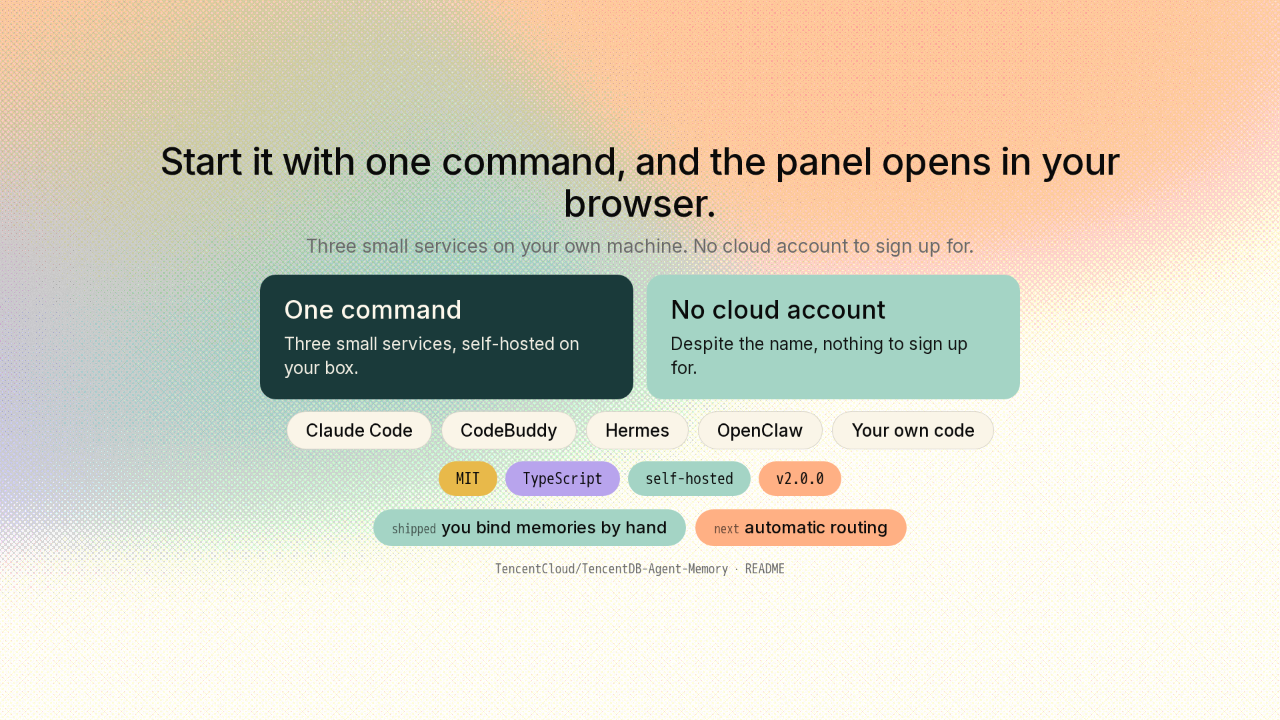
Start it with one command, and the panel opens in your browser.
The whole thing runs as three small services on your own machine, all self-hosted. Despite the name, there’s no cloud account to sign up for. It plugs into the coding tools you already use, from Claude Code to your own scripts. It’s free and open source under the MIT license, and version two point zero landed this week. The team features are a fast-moving beta. Today you bind memories to agents by hand, and automatic routing is what’s coming next.
Your AI stops forgetting, and hands the save file to the next one

Your AI stops forgetting, and hands the save file to the next one.
So that’s TencentDB Agent Memory. Give your assistants one shared memory, hosted on your own machine, and your project stops getting relearned from scratch every session. The link’s on screen. New repo tomorrow.











