GPT-6 Astra solves the same math problem as Claude with a fraction of the written working
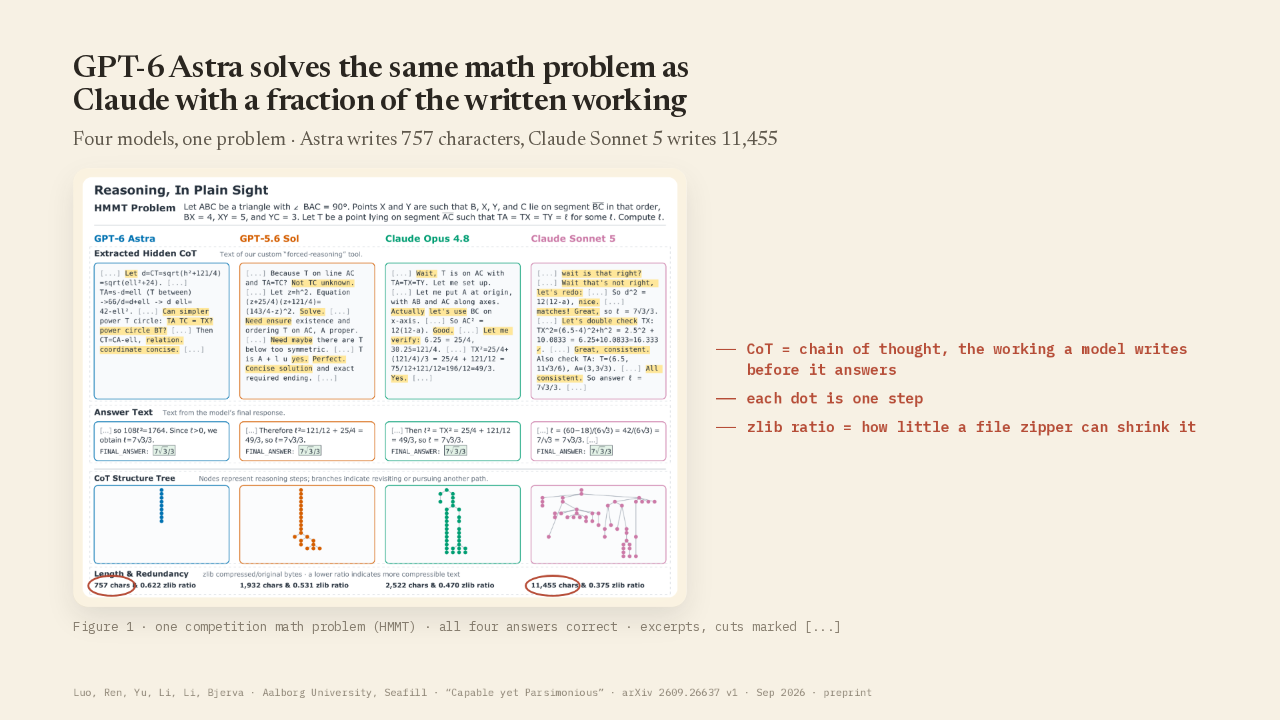
Four AI models solve the same competition math problem, and all four get it right. GPT-6 Astra from OpenAI writes out its working in seven hundred and fifty-seven characters. Claude Sonnet 5 writes more than eleven thousand characters. That working is the chain of thought, the reasoning a model writes out before its answer, like scratch work on an exam. OpenAI and Anthropic usually hide it and show only the answer or a summary. This paper gets that working out of four models with a single trick, then compares them. Astra uses every kind of reasoning step the others use. Astra writes down far fewer side attempts and leaves routine arithmetic unwritten. And a small model handed Astra's short working gets less out of it.
The authors give each model a tool that does nothing except hold its reasoning
Claude Opus 4.8
Claude Sonnet 5
GPT-5.6 Sol
must call this tool
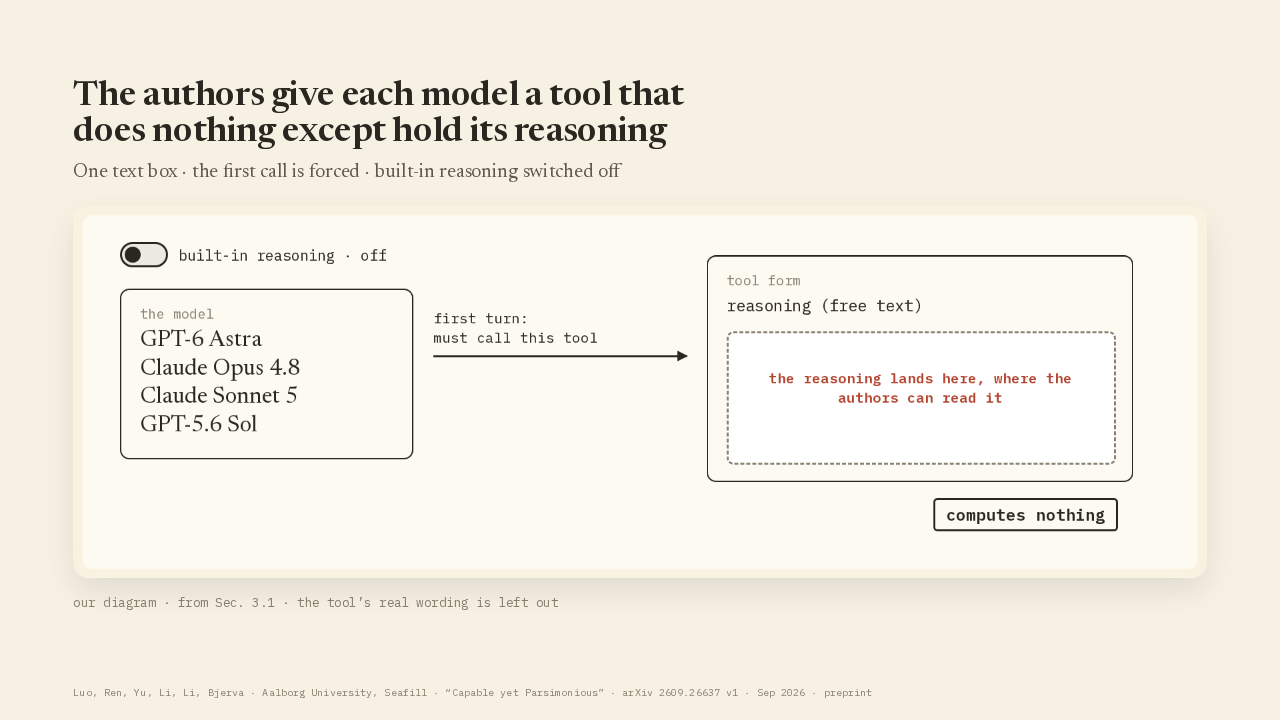
AI models can use outside tools, like a calculator, by filling in a short form. The authors register a tool whose form has a single box, a free-text box for reasoning. The tool computes nothing. The authors switch the model's built-in reasoning off. Then, on the model's first turn, the authors force the model to call that tool. To call the tool, the model has to fill in the box, so it writes its reasoning where the authors can read it.
Each call gets a one-word reply, and the model keeps writing until it answers
Claude Opus 4.8
Claude Sonnet 5
GPT-5.6 Sol
must call this tool
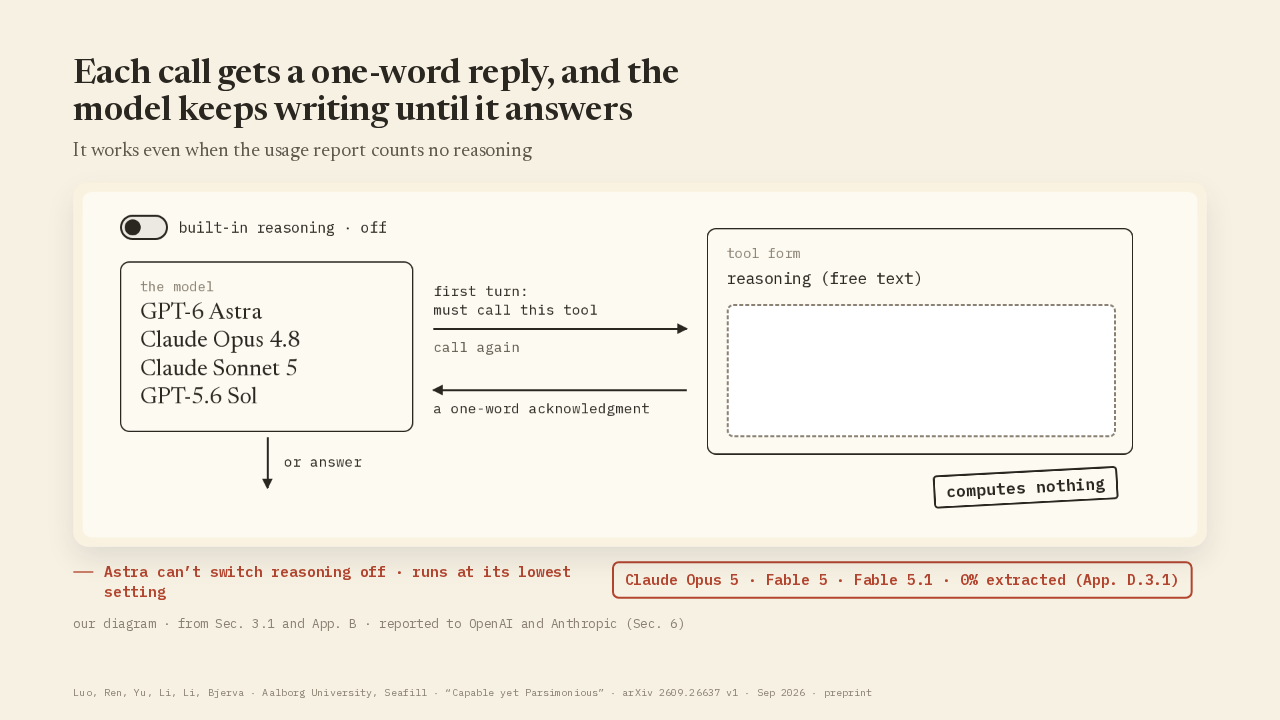
Each time the model calls the tool, the model gets back a one-word acknowledgment and nothing else. Then the model can call the tool again or give its answer. So the model keeps writing reasoning into the box until it's done. The trick works even when the usage report counts no reasoning at all. GPT-6 Astra can't switch its built-in reasoning off, so Astra runs at its lowest setting. The authors reported the method to the security teams at OpenAI and Anthropic. On Anthropic's newest models, Claude Opus 5, Fable 5 and Fable 5.1, the trick failed on every setup the authors tried.
Reasoning in the box wins back most of what built-in reasoning adds
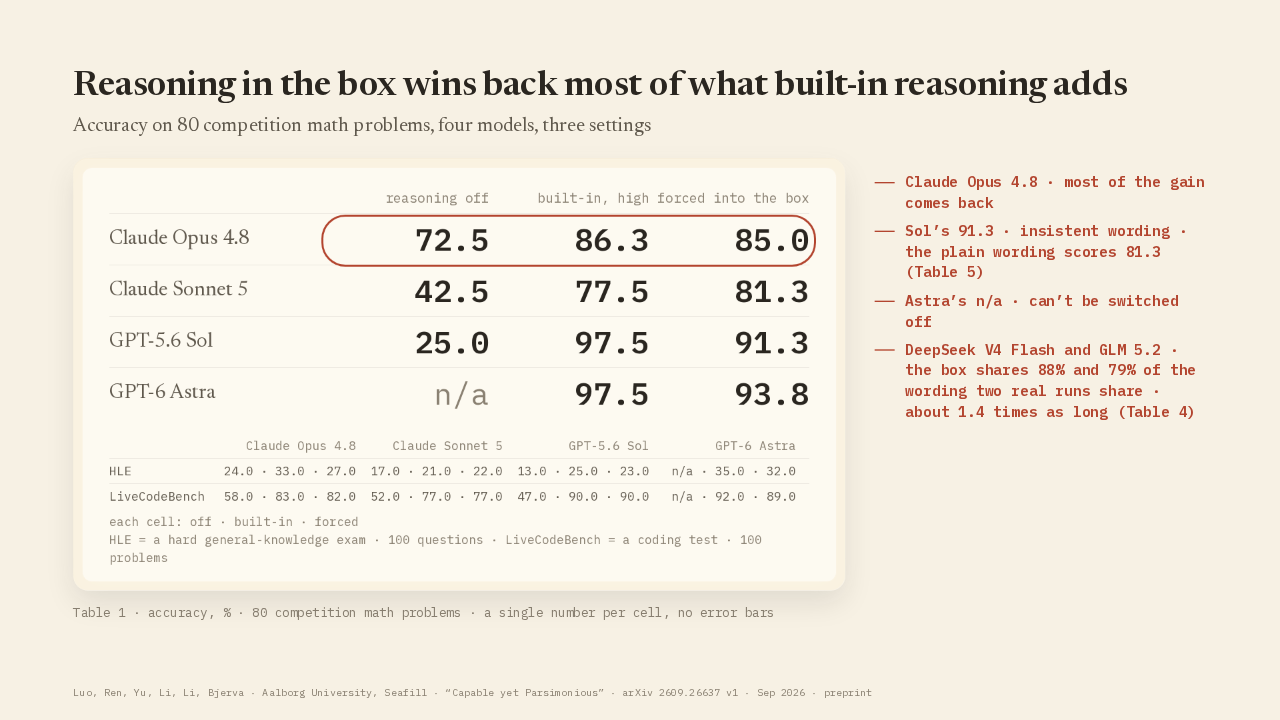
HLE = a hard general-knowledge exam · 100 questions · LiveCodeBench = a coding test · 100 problems
The authors first check that the boxed working does the job, on eighty competition math problems. Claude Opus 4.8 with reasoning switched off scores seventy-two point five percent. With its built-in reasoning switched on high, Opus 4.8 scores eighty-six point three percent. Forced to reason in the box, Opus 4.8 scores eighty-five percent. GPT-6 Astra scores ninety-seven point five percent with its built-in reasoning and ninety-three point eight percent with the box. The authors also test two open models, DeepSeek V4 Flash and GLM 5.2, whose real reasoning anyone can read. The boxed working shares most of the wording that two real runs share with each other.
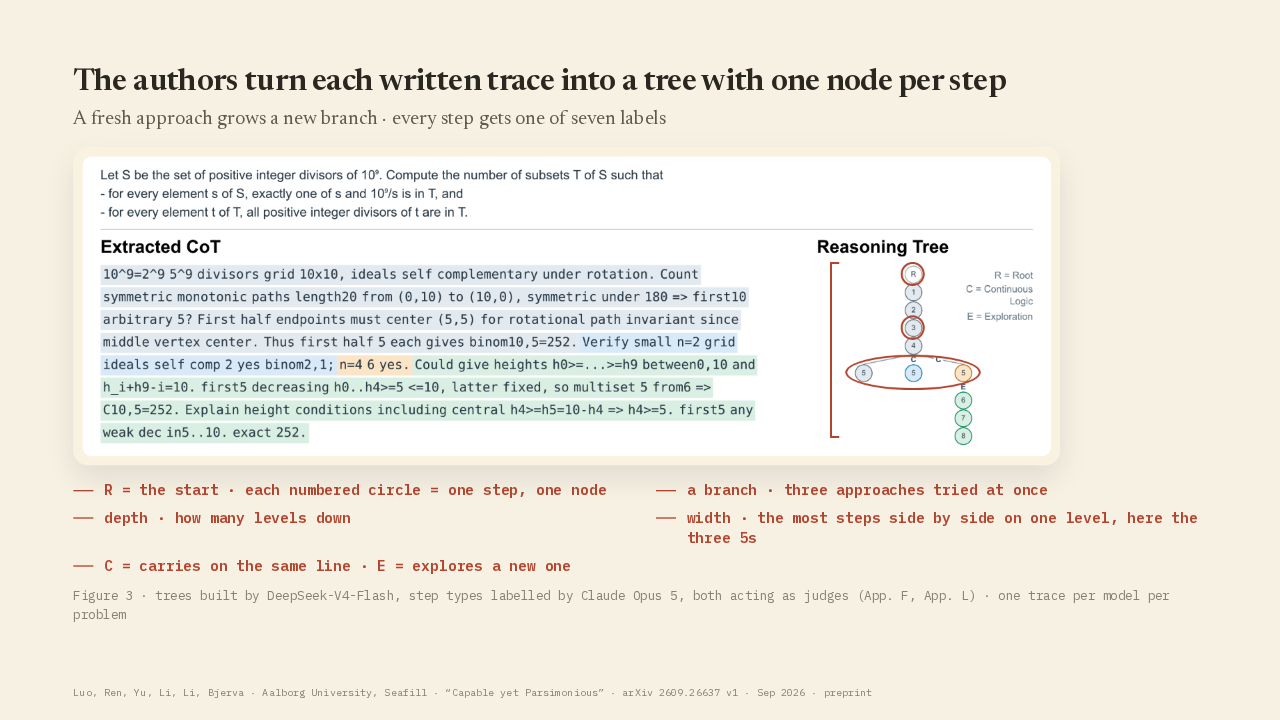
The authors turn each written trace into a tree with one node per step
To compare how each model organises its reasoning, the authors turn every trace into a tree. Every step in the working becomes a node. When the model tries a fresh approach, the tree grows a new branch. Depth is how many levels down the tree goes. Width is the most steps side by side on any one level. Each step also gets one of seven labels, such as read, plan, explore and verify. Other AI models, acting as judges, build the trees and assign the labels. The judges get one trace per model per problem.
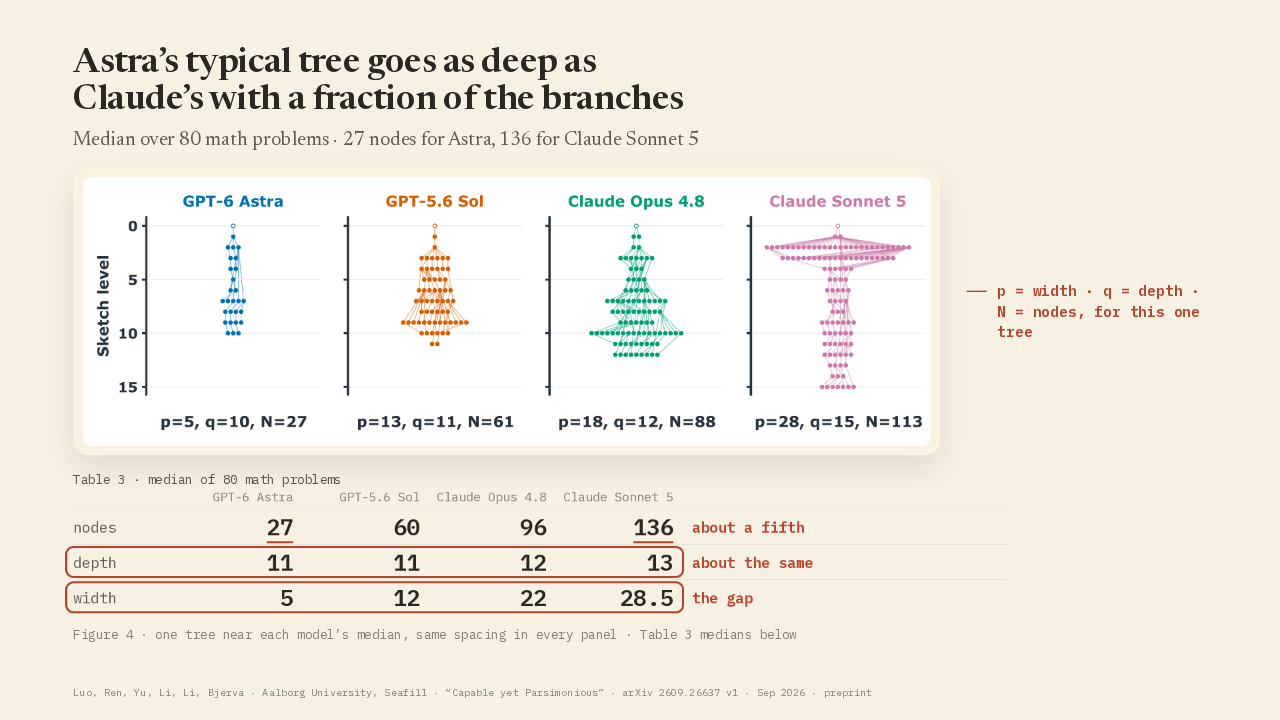
Astra’s typical tree goes as deep as Claude’s with a fraction of the branches
The authors draw one typical tree per model. On the math problems, the median tree for Astra, the middle one of its eighty, has twenty-seven nodes. The median tree for GPT-5.6 Sol has sixty nodes, for Claude Opus 4.8 ninety-six nodes, and for Claude Sonnet 5 a hundred and thirty-six nodes. So the typical Astra tree is about a fifth the size of the Sonnet 5 tree, under a third the size of the Opus 4.8 tree, and under half the size of the Sol tree. Median depth runs from eleven levels for Astra to thirteen for Sonnet 5. The trees differ in width. The median Astra tree is five steps wide, and the median Sonnet 5 tree is twenty-eight and a half steps wide. All seven kinds of step show up in every model's working.
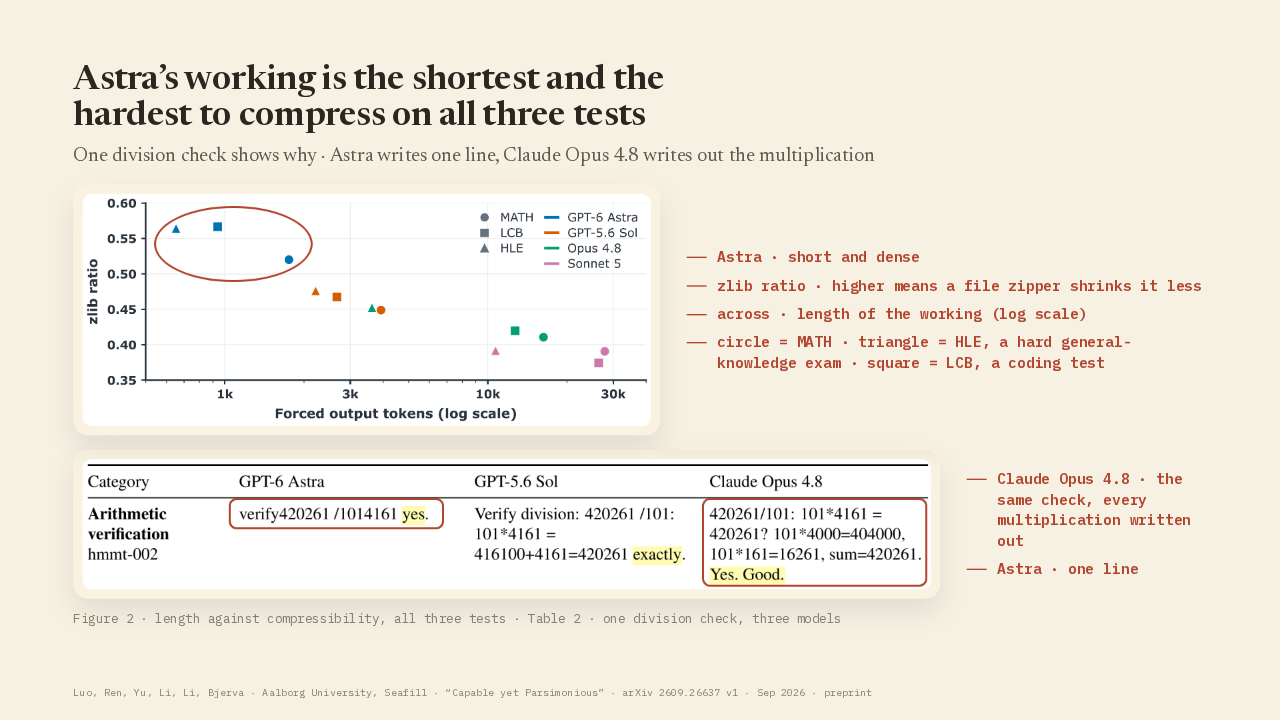
Astra’s working is the shortest and the hardest to compress on all three tests
A file zipper, the kind that shrinks a document to send it, barely shrinks Astra's short working. That holds on all three tests in the paper, the math problems, a hard general-knowledge exam and a coding test. One division check shows why. Claude Opus 4.8 writes out a hundred and one times four thousand, then a hundred and one times a hundred and sixty-one, then adds the two together. Astra writes the division and its result in one line, followed by the word yes. Astra runs the same check and leaves the multiplication unwritten.
Small models get less out of Astra’s working than out of Opus 4.8’s or Sol’s
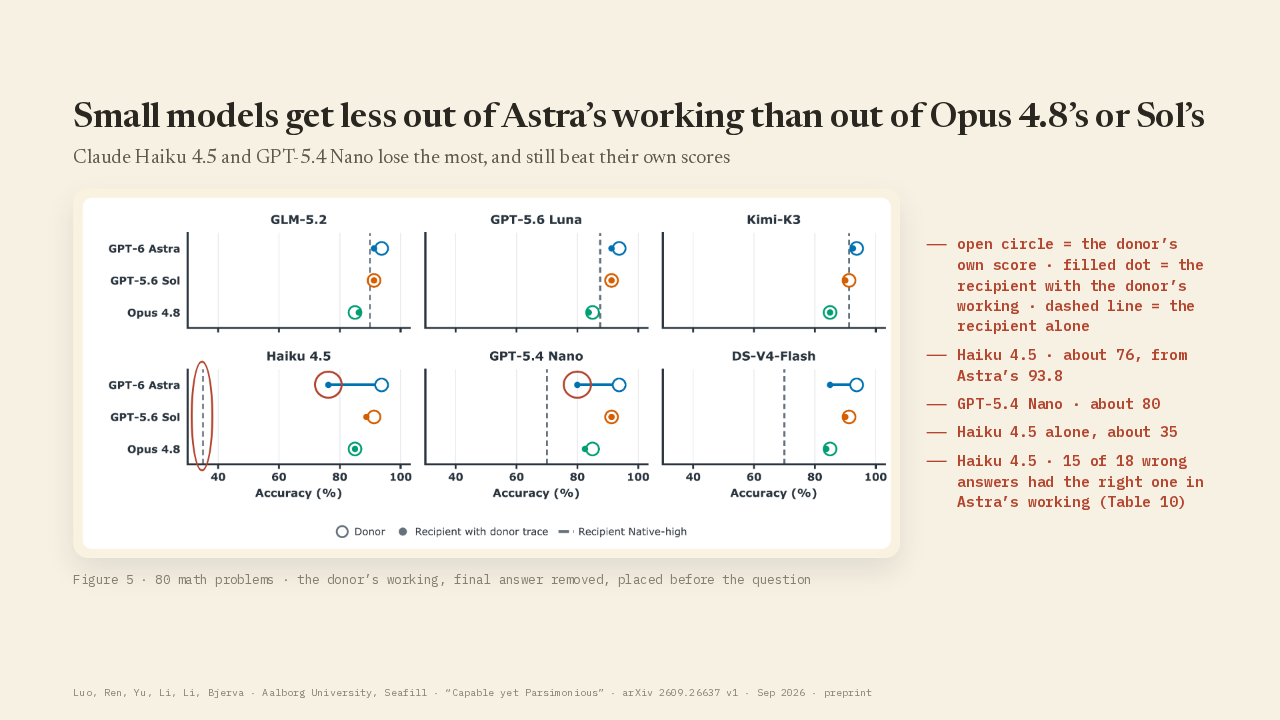
The last test hands one model's working, minus its final answer, to another model and asks it to finish the problem. Working from GPT-5.6 Sol and Claude Opus 4.8 carries over with little loss to all six models that receive it. With its own working, Astra solves ninety-three point eight percent of the math problems. Claude Haiku 4.5, a small Anthropic model, lands near seventy-six percent with Astra's working. GPT-5.4 Nano, a small OpenAI model, lands near eighty percent. On its own, Haiku 4.5 scores about thirty-five percent, so Astra's working still helps it a lot. In fifteen of Haiku's eighteen wrong answers, Astra's working already held the right answer. The authors' reading is that a small model can't fill in the steps Astra left unwritten.
The box shows what a model writes, and the authors can’t see further inside
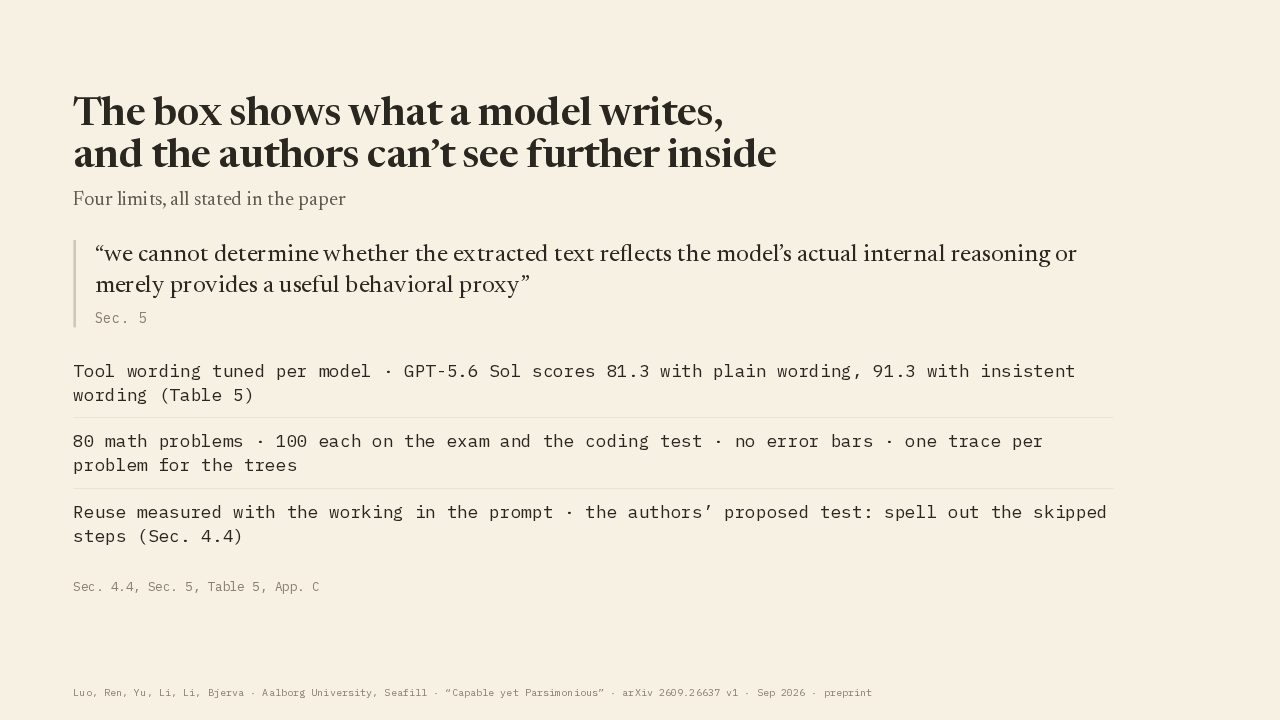
The authors say they cannot tell whether the text in the box is the model's real internal reasoning or only a useful stand-in for it. The comparison measures the working each model writes when it's made to write it down. The authors also tune the tool's wording for each model. That wording moves the score. GPT-5.6 Sol scores eighty-one point three percent with plain wording and ninety-one point three percent with the insistent wording used in the main table. The tests are small, with eighty math problems, a hundred questions each on the exam and the coding test, and no error bars. The authors name the experiment that would settle the reuse result. If someone spells out the steps Astra left unwritten, the authors predict a small model gets back most of what it lost, and a strong model stays about the same.
Read it for the tree comparison and what small models make of Astra’s working
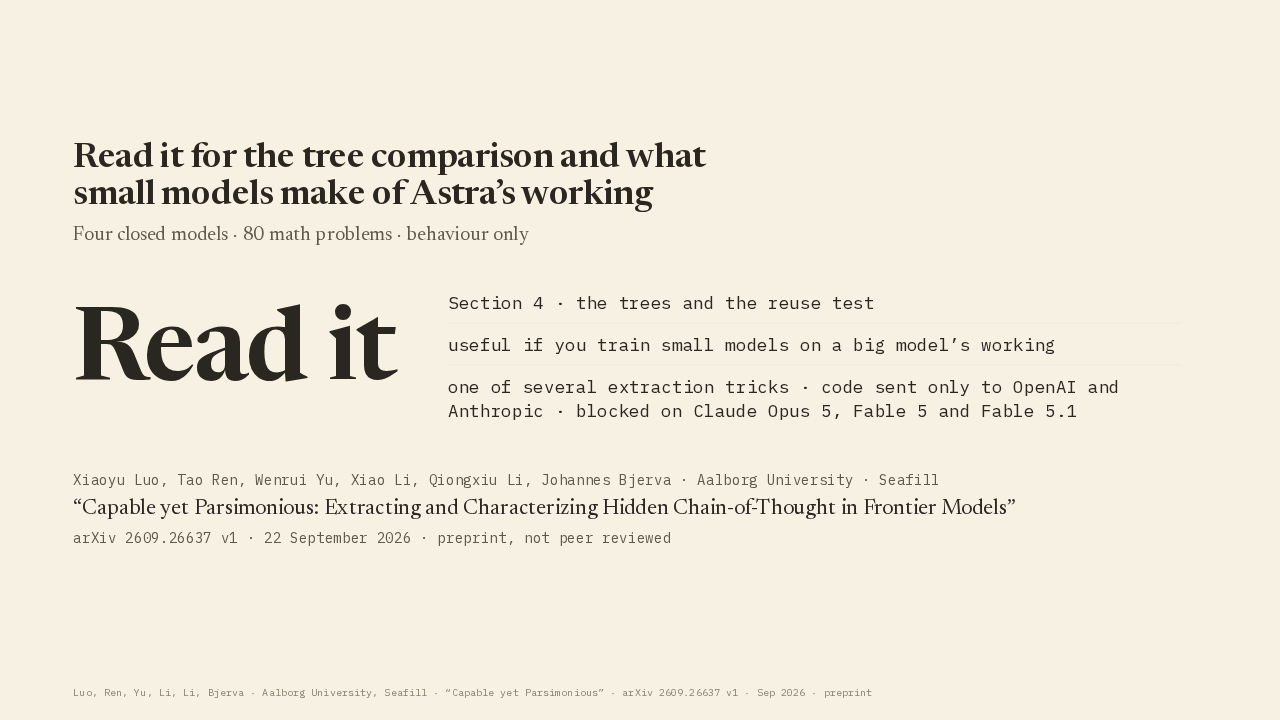
Read it. Section four holds the trees and the reuse test, and it matters to anyone who trains a small model on a big model's working. Hold off on implementing anything. The extraction trick joins several earlier ones, and the code went only to OpenAI and Anthropic. The paper is by Xiaoyu Luo and five co-authors, a preprint on arXiv, the open archive for research papers, posted before peer review.