Kimi Delta Attention can rotate its memory in a single layer

1 hour ago

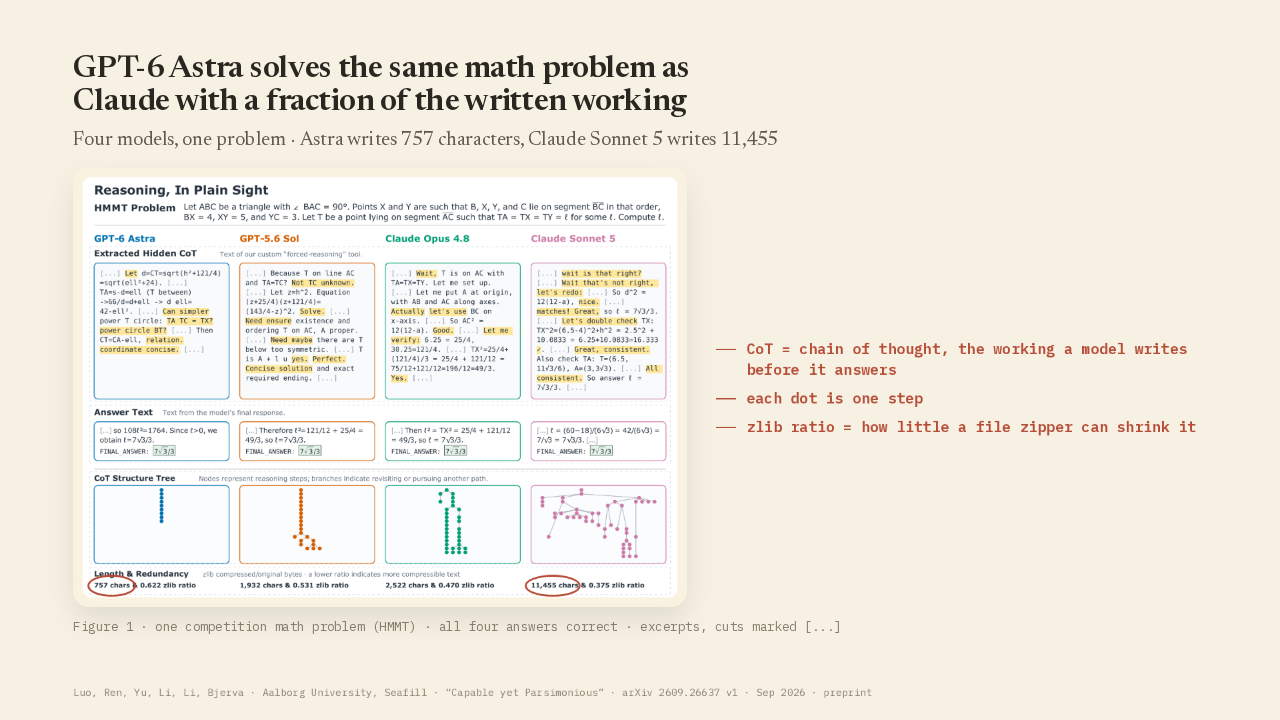
The memory inside Kimi Delta Attention can fade and it can erase, but it can't turn. This paper makes it turn with two mirrors. Kimi Delta Attention, or KDA, is the fast kind of attention layer inside Kimi K3, Moonshot AI's language model. A language model is the kind of AI that writes a chatbot's replies. Kimi K3 uses KDA in sixty-nine of its ninety-three layers, the stages each word passes through in turn. Instead of rereading every earlier word, KDA keeps one running memory and updates it after every word. Turning is what that memory needs to keep track of order, like where a shuffled card ended up. The authors' version, Complex KDA, lets two of KDA's dials go past their usual range, and a single layer can then turn its memory. On language models with 1.3 billion parameters, the adjustable numbers a model learns, the scores come out the same as standard KDA.

Ask

Ask about this presentation

Answers are generated from this presentation.

Chapters

  1. 0:00Two dials past their usual range let Kimi Delta Attention turn its memory
  2. 0:54A forget gate at minus one flips the slot’s sign, and that flip is a mirror
  3. 1:22A write at double strength is a second mirror, and two mirrors make a turn
  4. 2:10Complex KDA needs both dials to turn, and it turns with one write per word
  5. 2:42Only the layer with both dials stretched keeps track of long shuffles
  6. 3:30Complex KDA keeps a sound wave clean at nearly twice its training length
  7. 4:04At 1.3 billion parameters Complex KDA ties standard KDA, and training still uses the turns
  8. 4:42One layer can hold a puzzle it never learns, and it turns in one plane per step
  9. 5:24Read it for the two-mirror argument in Section 3
Show transcript

Two dials past their usual range let Kimi Delta Attention turn its memory

Two dials past their usual range let Kimi Delta Attention turn its memory
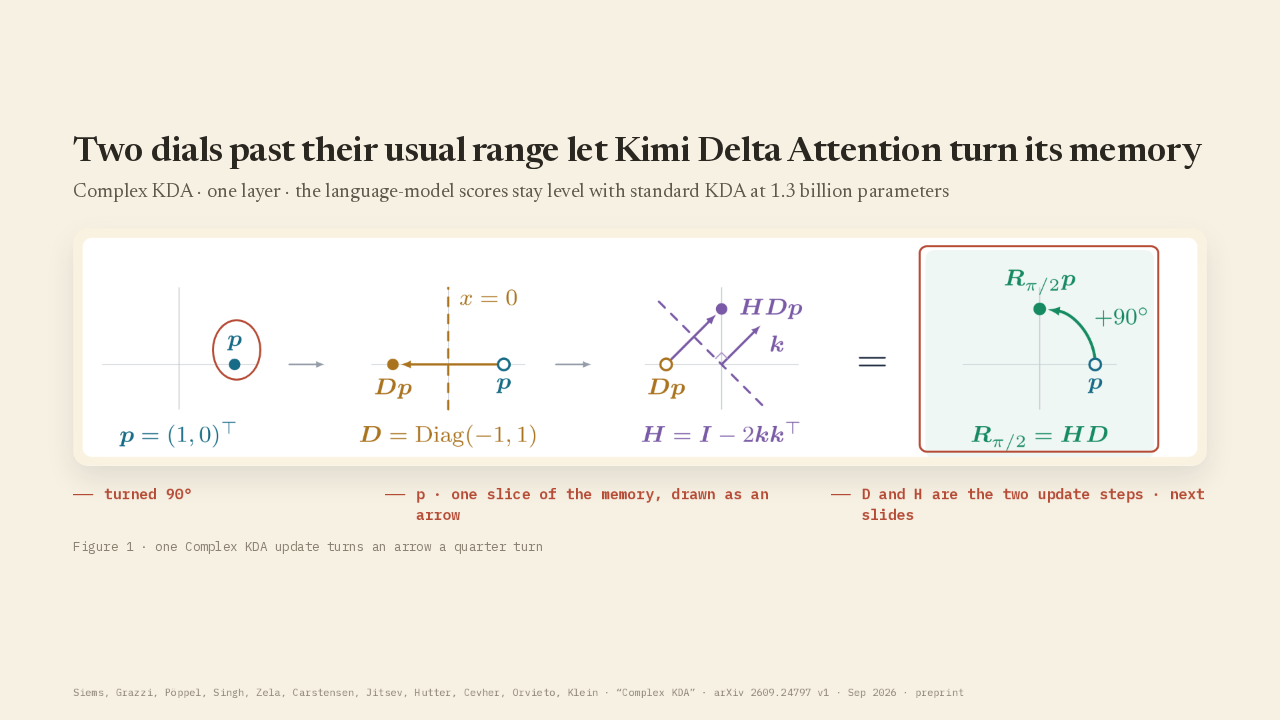
Complex KDA · one layer · the language-model scores stay level with standard KDA at 1.3 billion parameters
turned 90°
p · one slice of the memory, drawn as an arrow
D and H are the two update steps · next slides
Figure 1 · one Complex KDA update turns an arrow a quarter turn
Siems, Grazzi, Pöppel, Singh, Zela, Carstensen, Jitsev, Hutter, Cevher, Orvieto, Klein · “Complex KDA” · arXiv 2609.24797 v1 · Sep 2026 · preprint

The memory inside Kimi Delta Attention can fade and it can erase, but it can't turn. This paper makes it turn with two mirrors. Kimi Delta Attention, or KDA, is the fast kind of attention layer inside Kimi K3, Moonshot AI's language model. A language model is the kind of AI that writes a chatbot's replies. Kimi K3 uses KDA in sixty-nine of its ninety-three layers, the stages each word passes through in turn. Instead of rereading every earlier word, KDA keeps one running memory and updates it after every word. Turning is what that memory needs to keep track of order, like where a shuffled card ended up. The authors' version, Complex KDA, lets two of KDA's dials go past their usual range, and a single layer can then turn its memory. On language models with 1.3 billion parameters, the adjustable numbers a model learns, the scores come out the same as standard KDA.

A forget gate at minus one flips the slot’s sign, and that flip is a mirror

A forget gate at minus one flips the slot’s sign, and that flip is a mirror
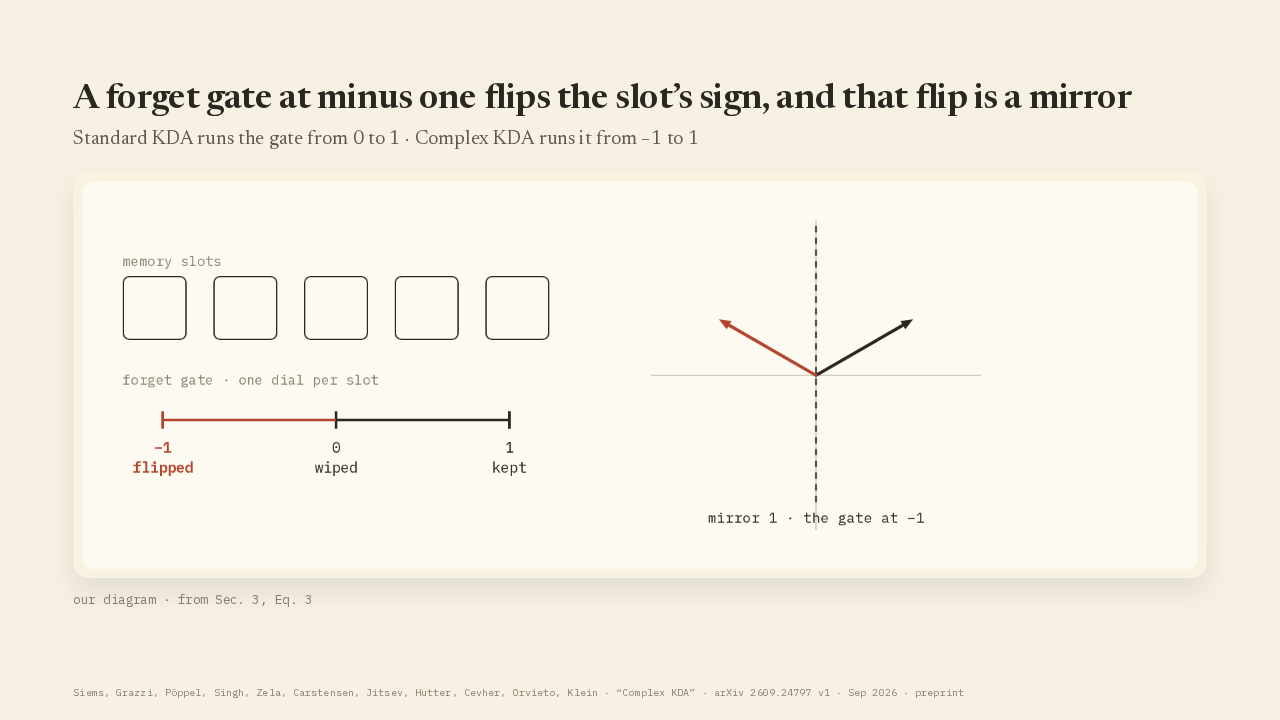
Standard KDA runs the gate from 0 to 1 · Complex KDA runs it from −1 to 1
memory slots
forget gate · one dial per slot
0
wiped
1
kept
−1
flipped
mirror 1 · the gate at −1
our diagram · from Sec. 3, Eq. 3
Siems, Grazzi, Pöppel, Singh, Zela, Carstensen, Jitsev, Hutter, Cevher, Orvieto, Klein · “Complex KDA” · arXiv 2609.24797 v1 · Sep 2026 · preprint

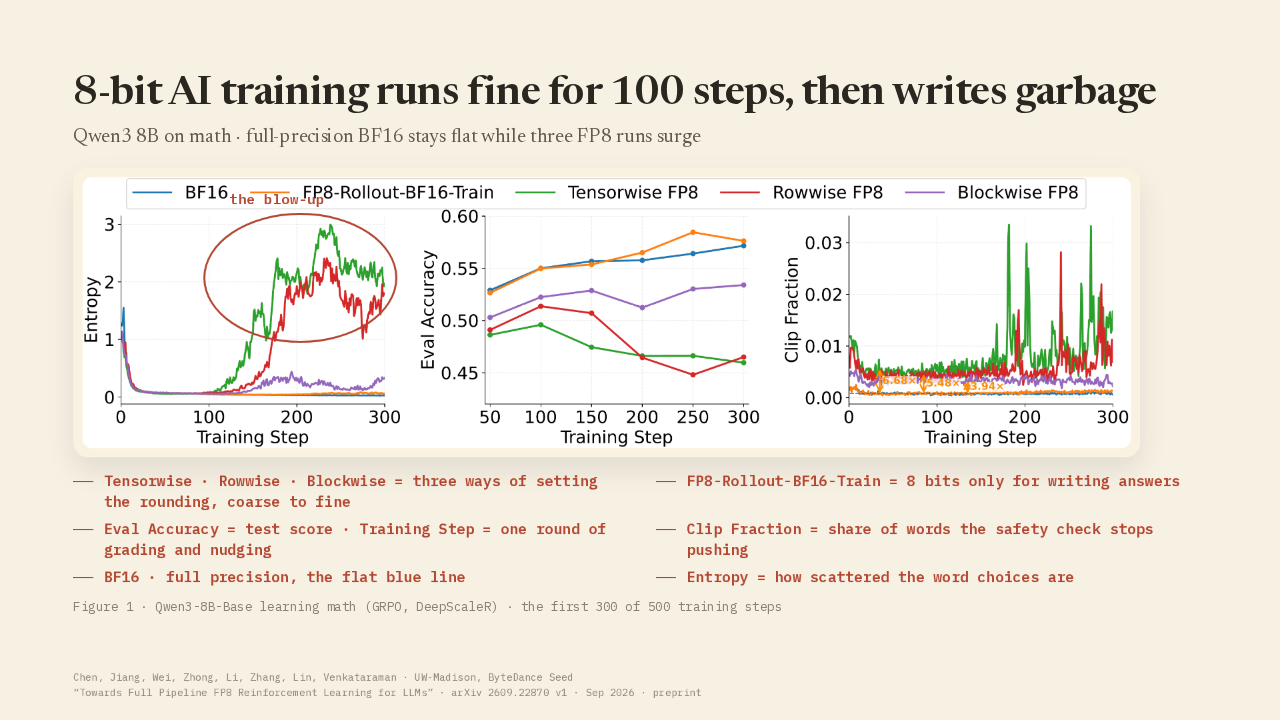
Every word, KDA updates its memory in two moves. The first move is the forget gate, a dial on each slot of the memory. At one, the slot keeps its value. At zero, the slot is wiped. Standard KDA keeps every dial between zero and one. The authors let the dial reach minus one. At minus one, the slot keeps its value with the sign flipped. Picture one slice of the memory as an arrow. Flip one side of the arrow and you get its mirror image. So a gate at minus one is a mirror.

A write at double strength is a second mirror, and two mirrors make a turn

A write at double strength is a second mirror, and two mirrors make a turn
Mirror 1 from the gate · mirror 2 from the write · the angle between them sets the turn
write strength · set for each word
0
keeps
1
erases
2
mirrors
mirror 2 · the write at strength 2 · set by the current word
turned by twice the angle between the mirrors
a memory that turns is a clock hand · enough turns bring it back to the start
mirror 1 · the gate at −1
mirror 2
90°
our diagram · from Sec. 3, Eq. 2 · “Their composition is a rotation by 2θ”
Siems, Grazzi, Pöppel, Singh, Zela, Carstensen, Jitsev, Hutter, Cevher, Orvieto, Klein · “Complex KDA” · arXiv 2609.24797 v1 · Sep 2026 · preprint

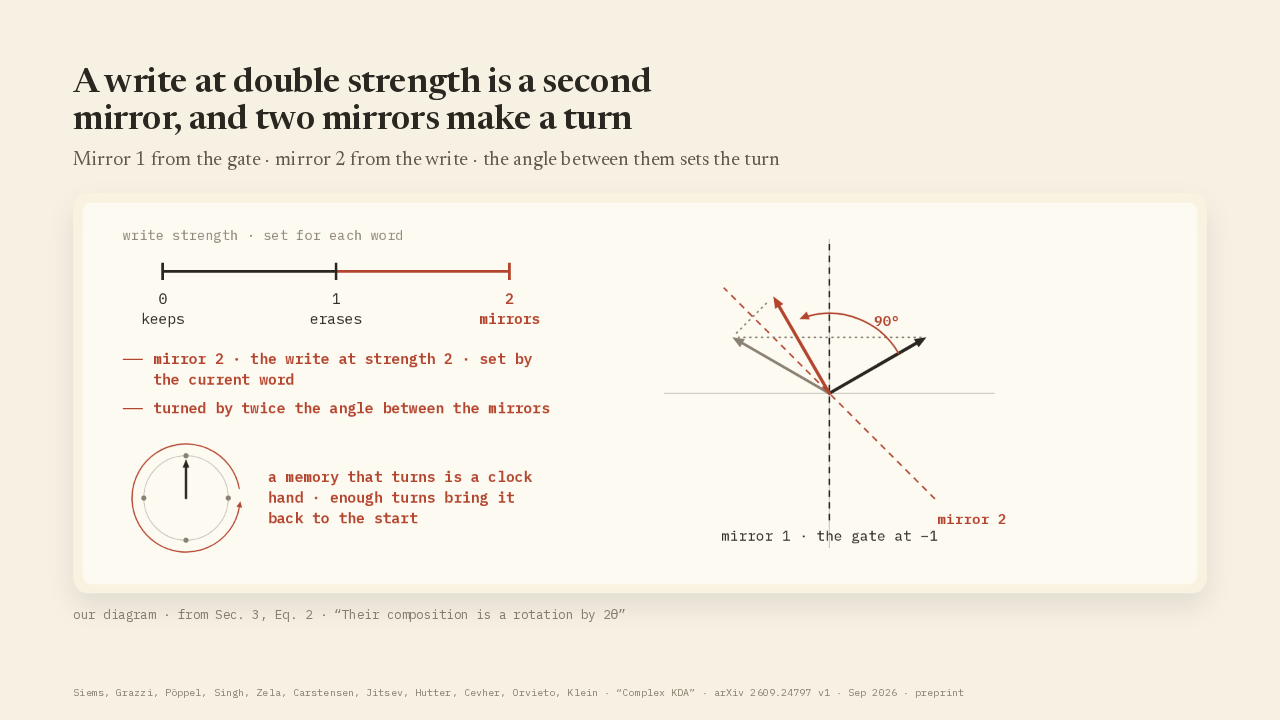
The second move is the write, called the delta rule. Before KDA writes a new fact, it subtracts what the memory already says about the current word. The write strength sets how hard it writes. At one, the write wipes the old answer for that word. Standard KDA stops the write strength at one. The authors let it reach two. At two, the write overshoots by the same distance again, and the arrow lands on its mirror image. The current word decides where that mirror stands. So one step can now hold two mirrors, the gate's mirror and the write's mirror. Reflect an arrow in one mirror, then in a second mirror tilted against the first, and the arrow ends up turned, by twice the angle between the two mirrors. A memory that can turn works like a clock hand. Each word moves the hand by some angle, and after enough moves the hand comes back to where it started. That is how a single layer keeps count around a cycle.

Complex KDA needs both dials to turn, and it turns with one write per word

Complex KDA needs both dials to turn, and it turns with one write per word
One stretched dial only flips · DeltaProduct gets the same turn from two writes per word
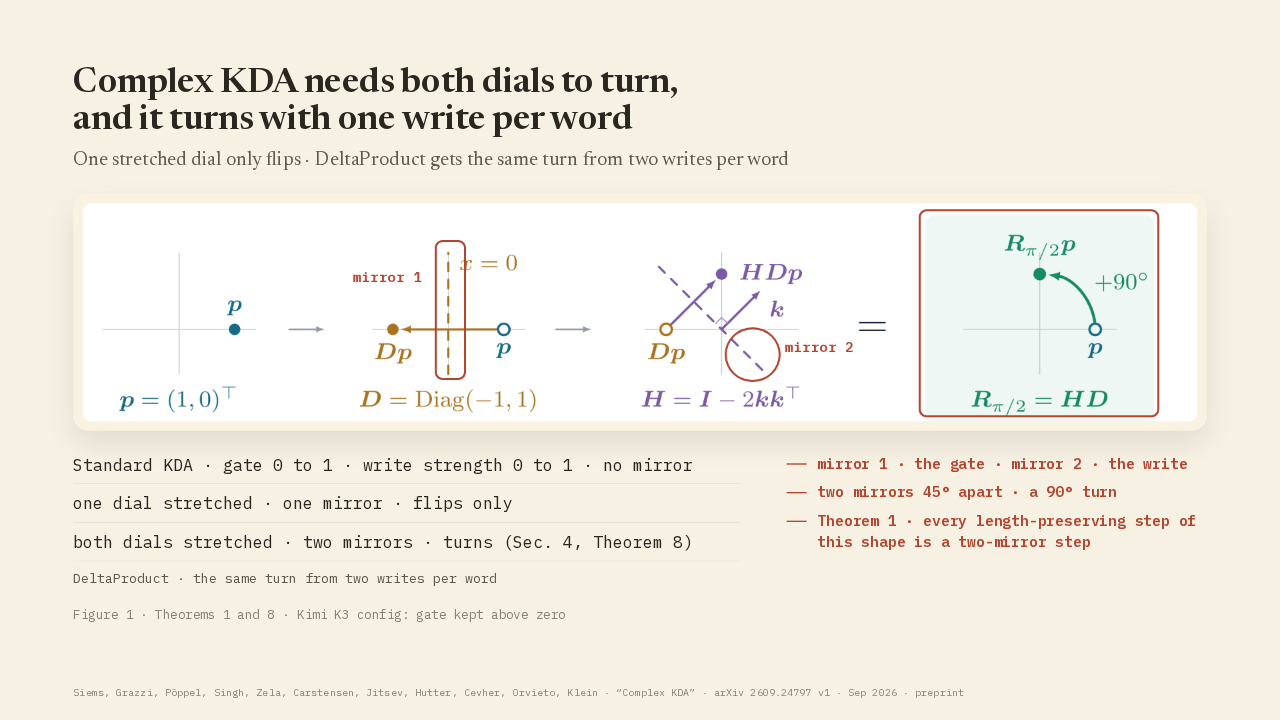
Figure 1 from the paper: a point p is flipped across the line x = 0 by D, reflected by H across a line perpendicular to k, and the result equals p rotated by plus 90 degrees
mirror 1
mirror 2
Standard KDA · gate 0 to 1 · write strength 0 to 1 · no mirror
one dial stretched · one mirror · flips only
both dials stretched · two mirrors · turns (Sec. 4, Theorem 8)
DeltaProduct · the same turn from two writes per word
mirror 1 · the gate · mirror 2 · the write
two mirrors 45° apart · a 90° turn
Theorem 1 · every length-preserving step of this shape is a two-mirror step
Figure 1 · Theorems 1 and 8 · Kimi K3 config: gate kept above zero
Siems, Grazzi, Pöppel, Singh, Zela, Carstensen, Jitsev, Hutter, Cevher, Orvieto, Klein · “Complex KDA” · arXiv 2609.24797 v1 · Sep 2026 · preprint

Standard KDA holds neither mirror, because both of its dials stop at one. Kimi K3, for one, keeps its gate above zero. Stretch only one dial and you get one mirror, and a single mirror can only flip. The paper proves that the turn appears only when both dials are stretched. An earlier design called DeltaProduct already gets the turn by doing two writes for every word. Complex KDA gets the same turn with one write per word. The authors also prove the fit is exact. Every step of this shape that keeps the arrow's length the same is one of these two-mirror steps.

Only the layer with both dials stretched keeps track of long shuffles

Only the layer with both dials stretched keeps track of long shuffles
One layer · trained on lists up to 32 · tested up to 512 · DeltaProduct level on 3 items, ahead on 4 to about 450
S3 = shuffles of 3 items · S4 = shuffles of 4 items
A5 = the 60 shuffles of 5 items made with an even number of swaps · brown line = theory start, not learned from scratch
0 = guessing · 1 = perfect · dashed line at 32 = longest training list
alpha = forget gate · beta = write strength · yellow = standard KDA
orange, green = one dial · about 0.2 on 3 items
blue = both dials · about 0.6 at 512 on 4 items
purple dashed = DeltaProduct · ahead to about 450
Figure 7 · one head, one of the layer’s parallel memories, trained on 3 items · write strength near 2, gate near ±1
Figure 6 · one layer · trained on lists up to 32, tested to 512 · best of 3 runs
Siems, Grazzi, Pöppel, Singh, Zela, Carstensen, Jitsev, Hutter, Cevher, Orvieto, Klein · “Complex KDA” · arXiv 2609.24797 v1 · Sep 2026 · preprint

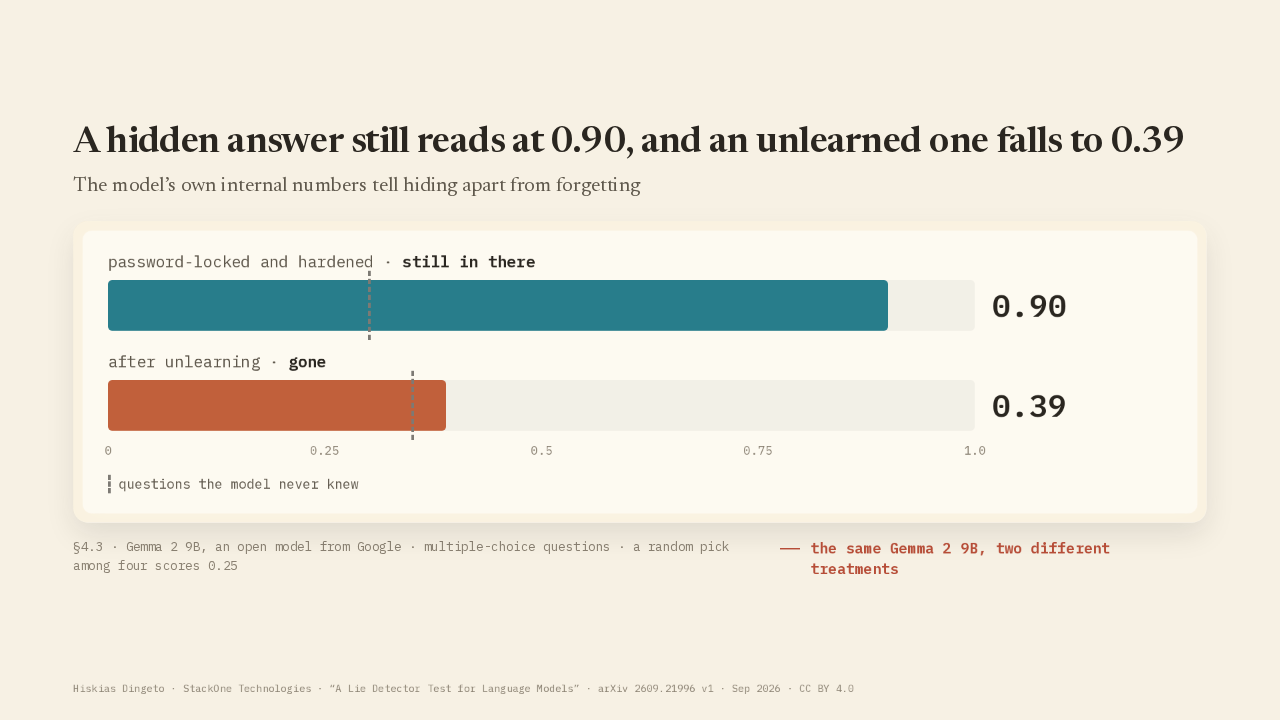
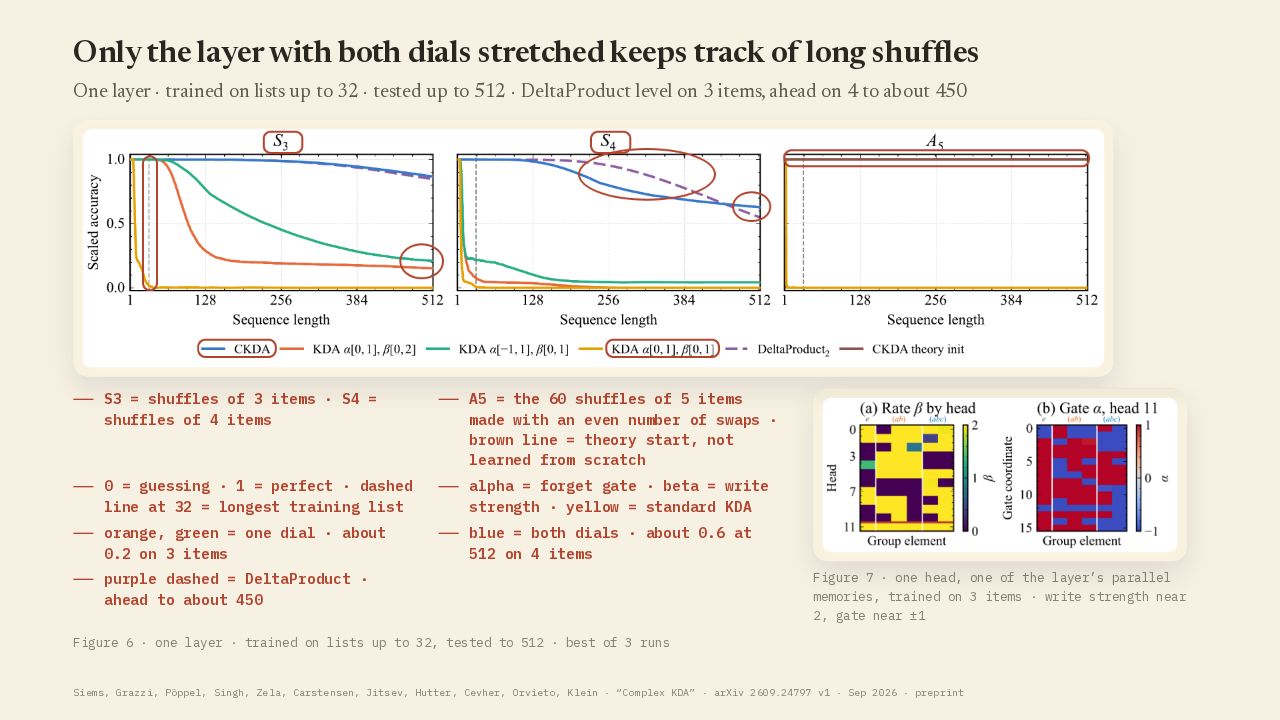
The first test is a shuffle puzzle. A single-layer model reads a list of shuffles of three or four items and says where everything ends up. Training lists run up to thirty-two shuffles, and test lists up to five hundred and twelve shuffles. Scores run from zero for guessing to one for perfect, best of three training runs. Standard KDA scores near zero, even on short lists. With one dial stretched, the three-item score falls to about zero point two on long lists, and the four-item puzzle fails even on short lists. With both dials stretched, Complex KDA stays near perfect on three items to two hundred and fifty-six shuffles. On four items, it stays near perfect to a hundred and twenty-eight shuffles and ends near zero point six. DeltaProduct matches it on three items and leads on four items until about four hundred and fifty shuffles.

Complex KDA keeps a sound wave clean at nearly twice its training length

Complex KDA keeps a sound wave clean at nearly twice its training length
Length 264 after training to 136 · 38.1 dB against a Transformer’s 2.8 dB · a GRU is more accurate still
at length 264 · signal over noise
Complex KDA
38.1 dB
Transformer
2.8 dB
Sec. 6.2
dashed line at 136 · longest training length
MSE = average error · lower is better · log scale
Transformer breaks down
GRU · lowest error
Figure 8 · single-layer models · trained to 136 steps · the dB values are from the text
Siems, Grazzi, Pöppel, Singh, Zela, Carstensen, Jitsev, Hutter, Cevher, Orvieto, Klein · “Complex KDA” · arXiv 2609.24797 v1 · Sep 2026 · preprint

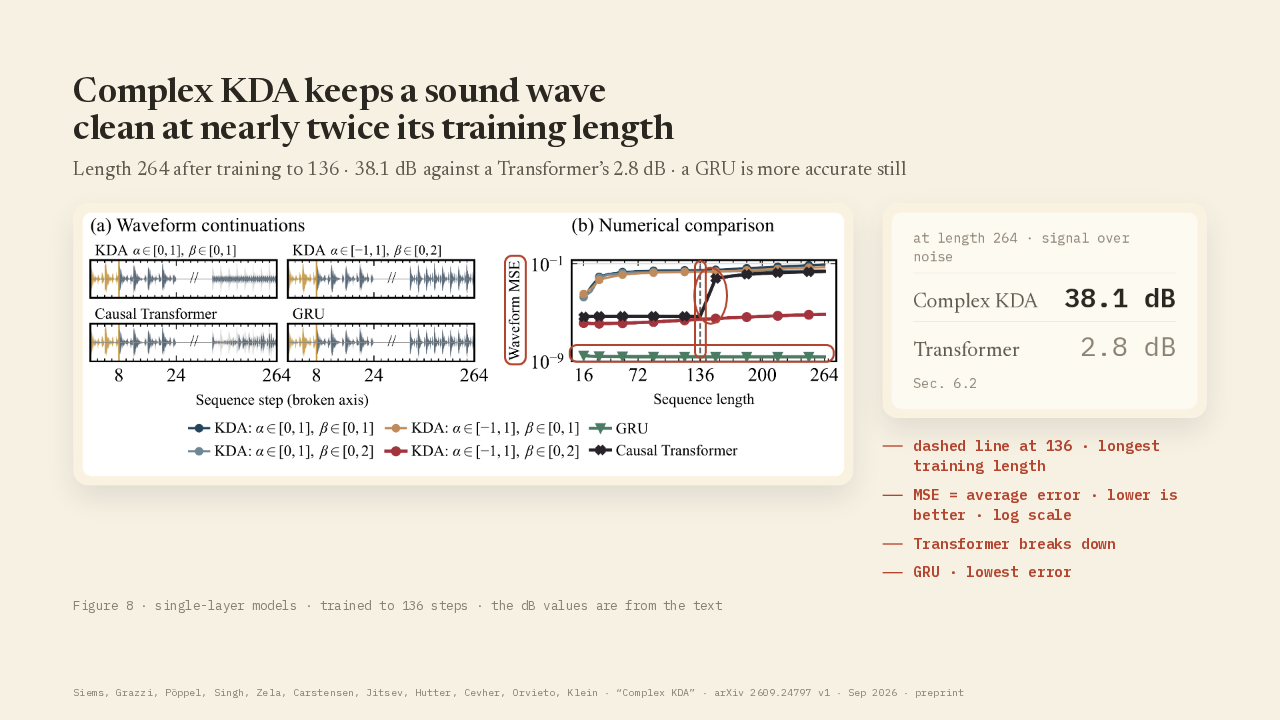
In the second test, a single-layer model hears the first half bar of a synthetic repeating groove, a short looped sound wave, then keeps the groove going on its own. Training uses sequences up to a hundred and thirty-six steps long. At two hundred and sixty-four steps, Complex KDA's continuation still has thirty-eight point one decibels of signal over noise, where higher means cleaner. A standard Transformer, the design behind most chatbots, falls to two point eight decibels. A GRU, an older kind of step-by-step network, stays more accurate than all of them.

At 1.3 billion parameters Complex KDA ties standard KDA, and training still uses the turns

At 1.3 billion parameters Complex KDA ties standard KDA, and training still uses the turns
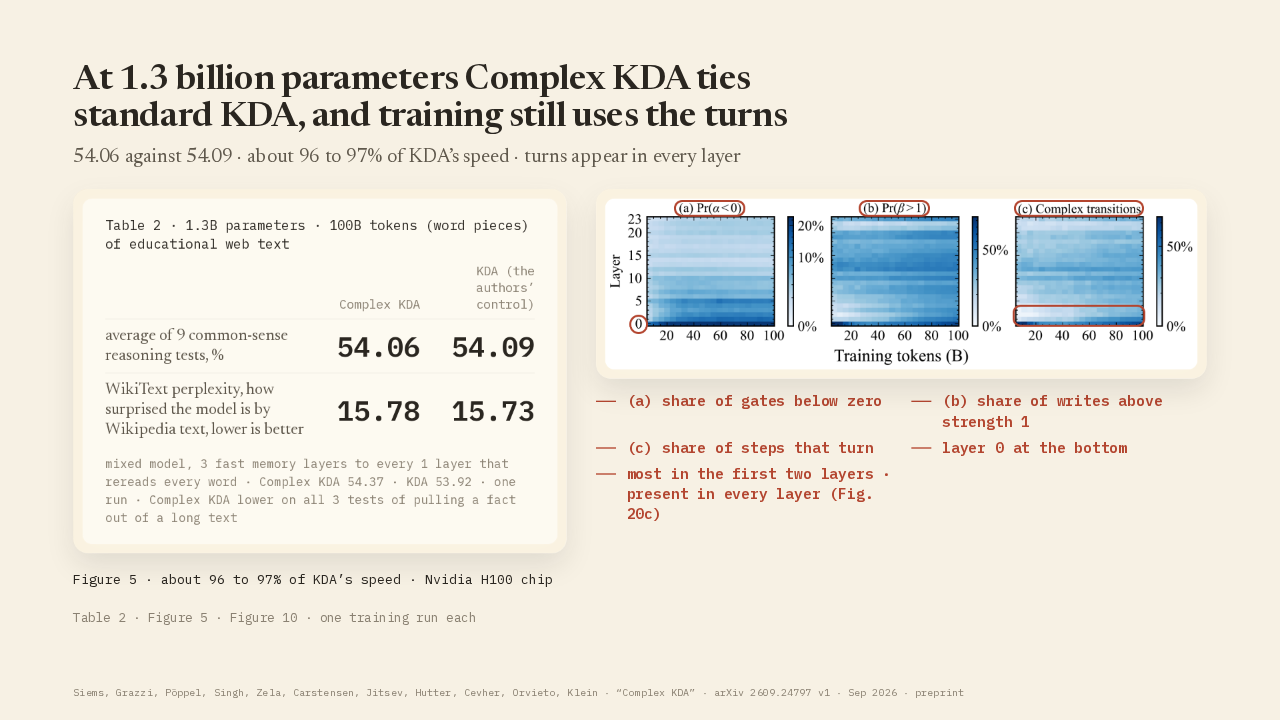
54.06 against 54.09 · about 96 to 97% of KDA’s speed · turns appear in every layer
Table 2 · 1.3B parameters · 100B tokens (word pieces) of educational web text
Complex KDA
KDA (the authors’ control)
average of 9 common-sense reasoning tests, %
54.06
54.09
WikiText perplexity, how surprised the model is by Wikipedia text, lower is better
15.78
15.73
mixed model, 3 fast memory layers to every 1 layer that rereads every word · Complex KDA 54.37 · KDA 53.92 · one run · Complex KDA lower on all 3 tests of pulling a fact out of a long text
Figure 5 · about 96 to 97% of KDA’s speed · Nvidia H100 chip
(a) share of gates below zero
(b) share of writes above strength 1
(c) share of steps that turn
layer 0 at the bottom
most in the first two layers · present in every layer (Fig. 20c)
Table 2 · Figure 5 · Figure 10 · one training run each
Siems, Grazzi, Pöppel, Singh, Zela, Carstensen, Jitsev, Hutter, Cevher, Orvieto, Klein · “Complex KDA” · arXiv 2609.24797 v1 · Sep 2026 · preprint

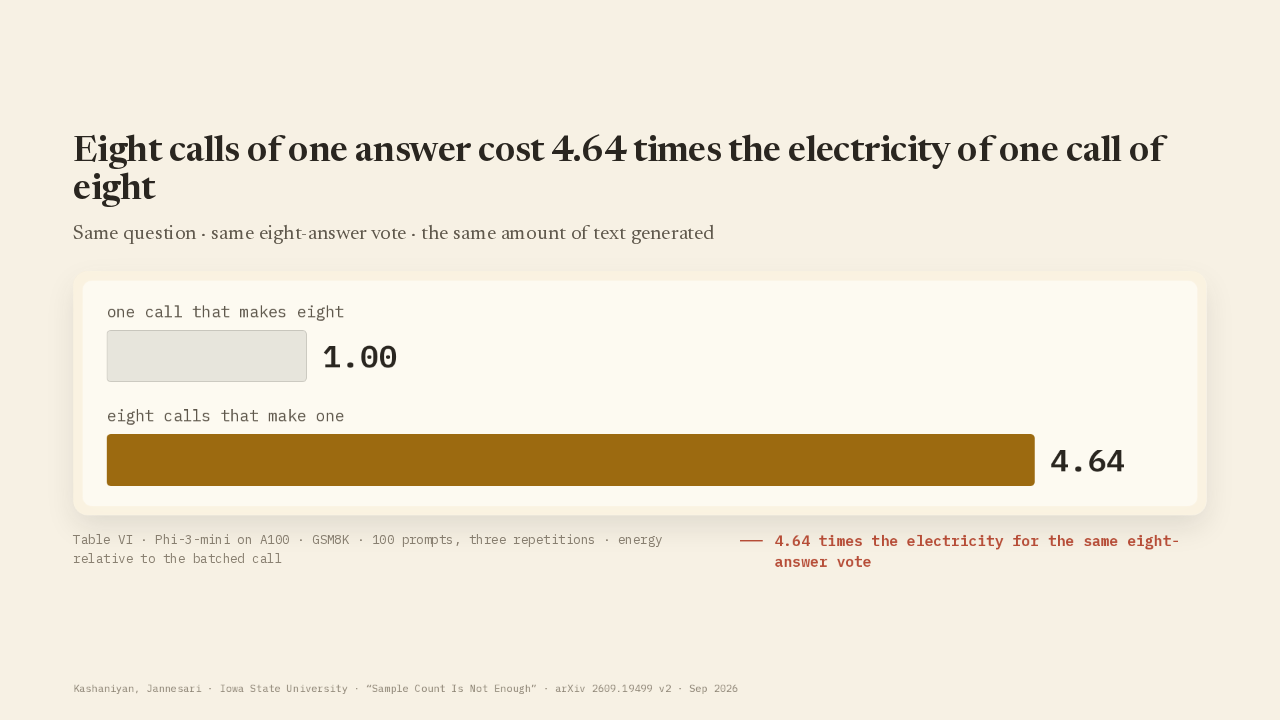
The last test trains language models. The authors train Complex KDA and standard KDA at 1.3 billion parameters, on a hundred billion tokens of educational web text. Tokens are the word pieces a model reads. Across nine common-sense reasoning tests, Complex KDA averages fifty-four point oh six percent and standard KDA fifty-four point oh nine. That is a tie. On an Nvidia H100 chip, Complex KDA runs at about ninety-six to ninety-seven percent of KDA's speed. During training, the model starts to use the new range, and turns show up in every layer, most often in the first two.

One layer can hold a puzzle it never learns, and it turns in one plane per step

One layer can hold a puzzle it never learns, and it turns in one plane per step
Four limits from the paper’s Limitations section
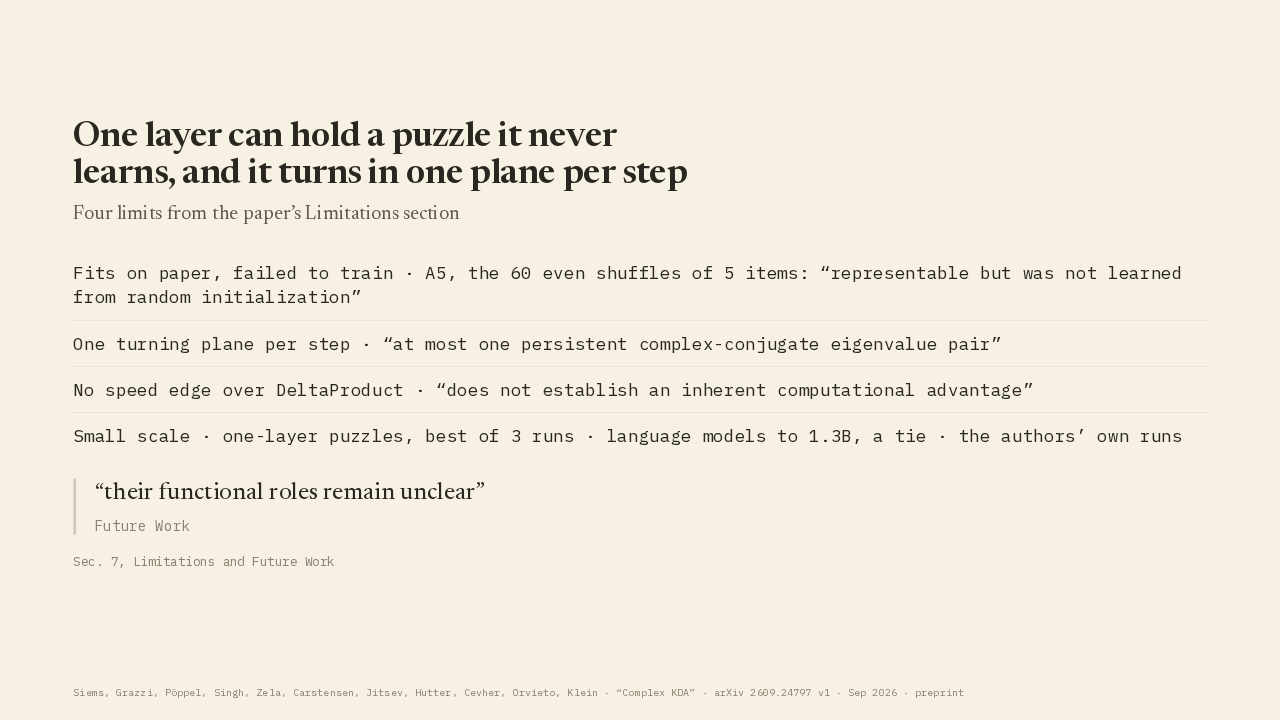
Fits on paper, failed to train · A5, the 60 even shuffles of 5 items: “representable but was not learned from random initialization”
One turning plane per step · “at most one persistent complex-conjugate eigenvalue pair”
No speed edge over DeltaProduct · “does not establish an inherent computational advantage”
Small scale · one-layer puzzles, best of 3 runs · language models to 1.3B, a tie · the authors’ own runs
“their functional roles remain unclear”Future Work
Sec. 7, Limitations and Future Work
Siems, Grazzi, Pöppel, Singh, Zela, Carstensen, Jitsev, Hutter, Cevher, Orvieto, Klein · “Complex KDA” · arXiv 2609.24797 v1 · Sep 2026 · preprint

The first limit is learning. A harder puzzle uses the sixty even shuffles of five items, the ones you can make with an even number of swaps. That puzzle fits inside one Complex KDA layer on paper, and the layer failed to learn it from scratch. Second, each write touches one direction of the memory, so each step can turn in one plane at most. Third, Complex KDA has no speed edge over DeltaProduct, which already had this power at competitive speed. Fourth, the scale is small. The puzzles use one layer and the best of three runs, the language models stop at 1.3 billion parameters, and every result so far is the authors' own. The authors say the language model uses the turns in every layer, and what those turns do there is still unclear.

Read it for the two-mirror argument in Section 3

Read it for the two-mirror argument in Section 3
A tie on language at 1.3 billion parameters · DeltaProduct already had the turn
Read it
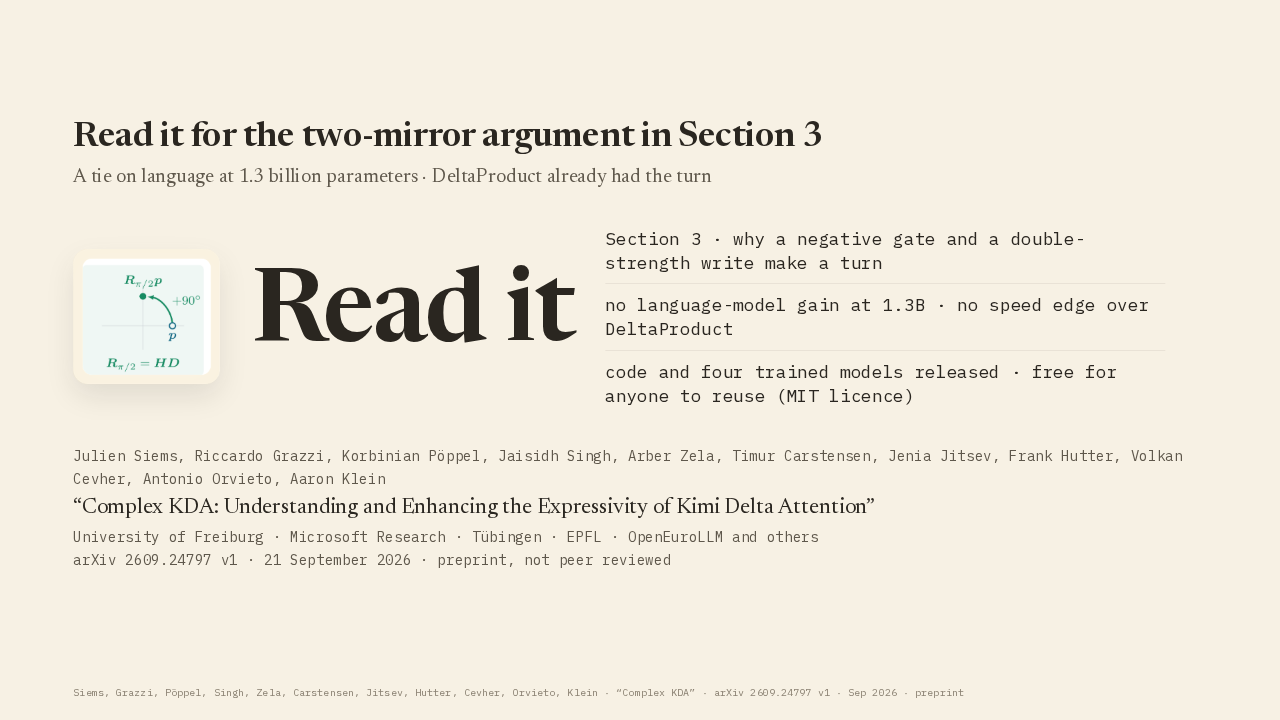
Section 3 · why a negative gate and a double-strength write make a turn
no language-model gain at 1.3B · no speed edge over DeltaProduct
code and four trained models released · free for anyone to reuse (MIT licence)
Julien Siems, Riccardo Grazzi, Korbinian Pöppel, Jaisidh Singh, Arber Zela, Timur Carstensen, Jenia Jitsev, Frank Hutter, Volkan Cevher, Antonio Orvieto, Aaron Klein
“Complex KDA: Understanding and Enhancing the Expressivity of Kimi Delta Attention”
University of Freiburg · Microsoft Research · Tübingen · EPFL · OpenEuroLLM and others
arXiv 2609.24797 v1 · 21 September 2026 · preprint, not peer reviewed
Siems, Grazzi, Pöppel, Singh, Zela, Carstensen, Jitsev, Hutter, Cevher, Orvieto, Klein · “Complex KDA” · arXiv 2609.24797 v1 · Sep 2026 · preprint

Read it. Section three shows exactly why a negative gate and a double-strength write make a turn. Hold off on implementing it. At 1.3 billion parameters, Complex KDA ties standard KDA on language, and DeltaProduct already offers the same turn at similar speed. The code and four trained models are public. The paper is a preprint on arXiv, the open archive for research papers, posted before peer review.