Self-consistency costs 4.64x the energy split across eight calls

1 hour ago

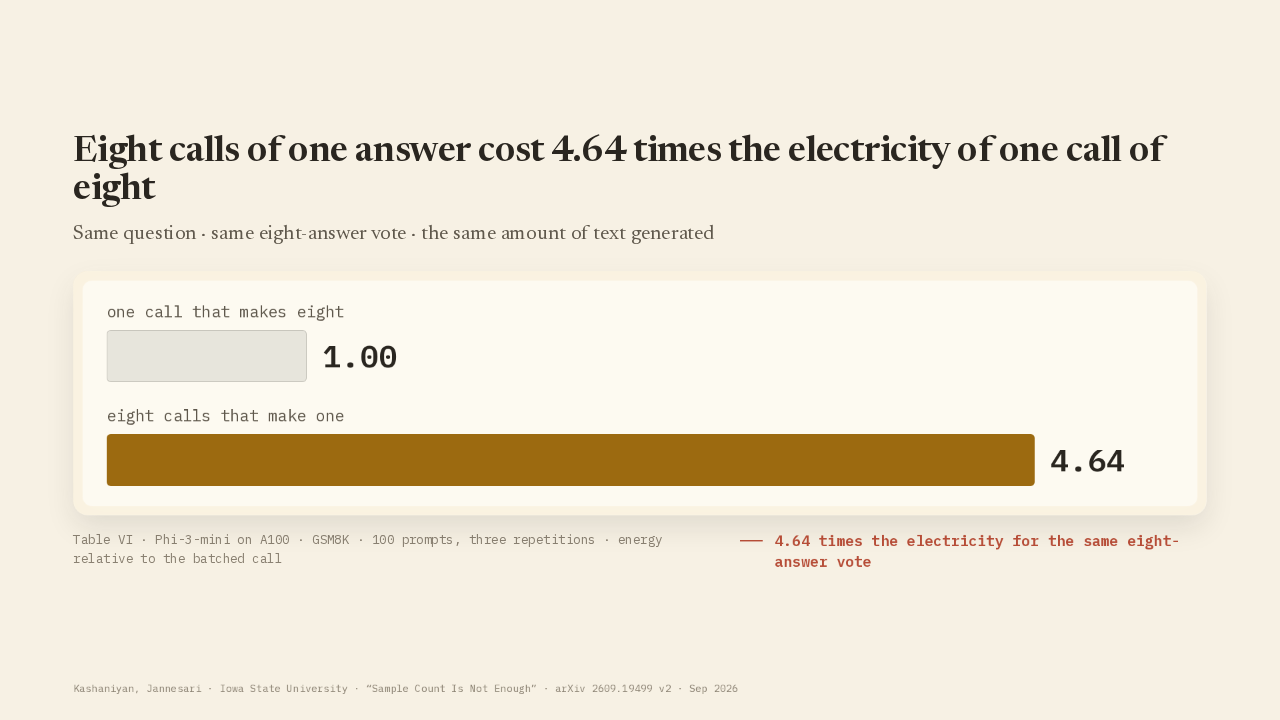
There is a standard way to make a small model more accurate. Ask it the same question eight times, then keep the answer that came up most. That is self-consistency. Those eight answers can arrive in one call that makes all eight side by side, or in eight calls that make one each. On A100s, the datacentre graphics chips that run these models, the eight-call version burned four point six four times the electricity. And the eight-call version drew less power while doing it.

Ask

Ask about this presentation

Answers are generated from this presentation.

Chapters

  1. 0:00Eight calls of one answer cost 4.64 times the electricity of one call of eight
  2. 0:25Eight answers lift Phi-3-mini from 81.4% to 89.8% on grade-school maths
  3. 0:55Four ways of getting eight answers generate the same amount of text, within 1%
  4. 1:23The serial schedule draws less power and still costs 4.64 times as much
  5. 2:02A bigger batch costs less for each piece of text and more for each query
  6. 2:37Energy climbs at every split, 1.00 to 1.63 to 2.71 to 4.64
  7. 3:07All four answer-length groups pay between four and five times the energy
  8. 3:45A live serving stack already batches for you, so this bill lands on offline jobs
  9. 4:29The rule this paper hands you is one line and it costs nothing to apply
Show transcript

Eight calls of one answer cost 4.64 times the electricity of one call of eight

Eight calls of one answer cost 4.64 times the electricity of one call of eight
Same question · same eight-answer vote · the same amount of text generated
one call that makes eight
1.00
eight calls that make one
4.64
Table VI · Phi-3-mini on A100 · GSM8K · 100 prompts, three repetitions · energy relative to the batched call
4.64 times the electricity for the same eight-answer vote
Kashaniyan, Jannesari · Iowa State University · “Sample Count Is Not Enough” · arXiv 2609.19499 v2 · Sep 2026

There is a standard way to make a small model more accurate. Ask it the same question eight times, then keep the answer that came up most. That is self-consistency. Those eight answers can arrive in one call that makes all eight side by side, or in eight calls that make one each. On A100s, the datacentre graphics chips that run these models, the eight-call version burned four point six four times the electricity. And the eight-call version drew less power while doing it.

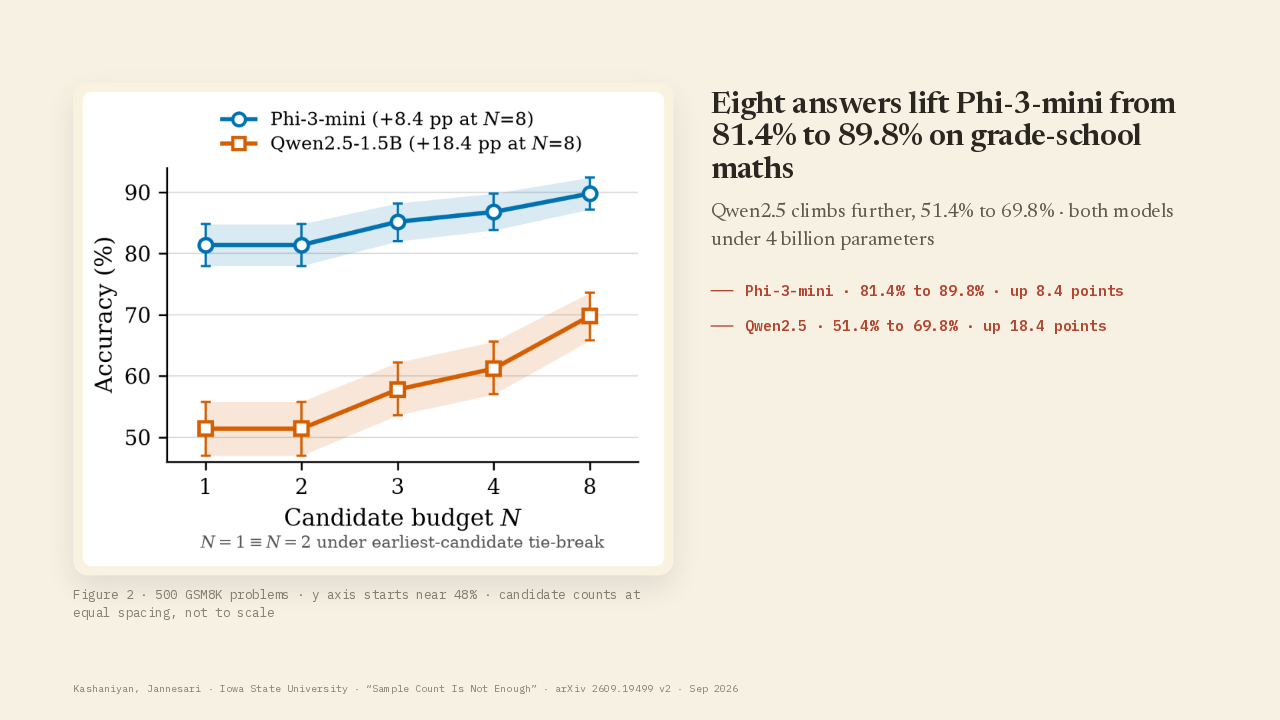
Eight answers lift Phi-3-mini from 81.4% to 89.8% on grade-school maths

Figure 2 · 500 GSM8K problems · y axis starts near 48% · candidate counts at equal spacing, not to scale
Eight answers lift Phi-3-mini from 81.4% to 89.8% on grade-school maths
Qwen2.5 climbs further, 51.4% to 69.8% · both models under 4 billion parameters
Phi-3-mini · 81.4% to 89.8% · up 8.4 points
Qwen2.5 · 51.4% to 69.8% · up 18.4 points
Kashaniyan, Jannesari · Iowa State University · “Sample Count Is Not Enough” · arXiv 2609.19499 v2 · Sep 2026

Asking more than once buys real accuracy. Over five hundred grade-school maths word problems from GSM8K, going from one answer to eight lifted Phi-3-mini from eighty-one point four percent correct to eighty-nine point eight. Qwen two point five went from fifty-one point four percent to sixty-nine point eight. Those are the paper's two models, three point eight billion parameters and one point five billion. Nothing larger was tested. So eight answers earn their place. What changes the bill is how they arrive.

Four ways of getting eight answers generate the same amount of text, within 1%

Four ways of getting eight answers generate the same amount of text, within 1%
The paper calls them schedules · the published number, eight, is identical across all four
Figure 1 · the four schedules for eight candidates · 1 call of 8 · 2 of 4 · 4 of 2 · 8 of 1
same text generated, within 1%
Kashaniyan, Jannesari · Iowa State University · “Sample Count Is Not Enough” · arXiv 2609.19499 v2 · Sep 2026

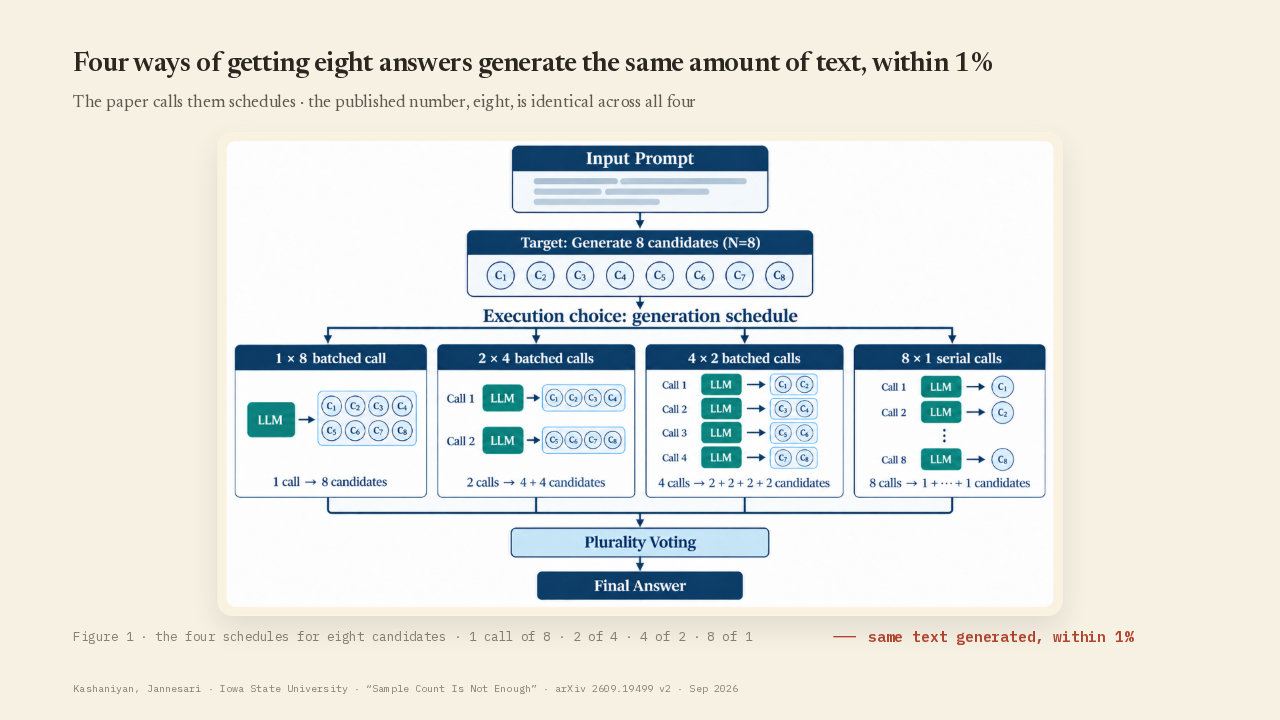
Eight answers, four ways to get them. One call that makes all eight side by side. Two calls of four. Four calls of two. Eight calls of one, each waiting for the one before it to finish. The paper calls these schedules. The number everybody publishes, eight, is identical across all four. So is the work. The total amount of text generated varies by zero point eight percent across Phi-3-mini's four schedules, and one percent across Qwen two point five's. The only thing that changed is how many times you asked.

The serial schedule draws less power and still costs 4.64 times as much

The serial schedule draws less power and still costs 4.64 times as much
It holds the GPU 5.97 times as long, and the bill is power multiplied by time
mean GPU power
177.8 W asking for all eight at once · 139.8 W asking one at a time
mean latency
5.97 times as long
GPU energy
4.64 times as much
chip time per 1,000 questions
2.09 GPU-hours to 12.49
Phi-3-mini on A100 · §V-C and §VI-A · 100 prompts, three repetitions
watts multiplied by hours is the bill
Kashaniyan, Jannesari · Iowa State University · “Sample Count Is Not Enough” · arXiv 2609.19499 v2 · Sep 2026

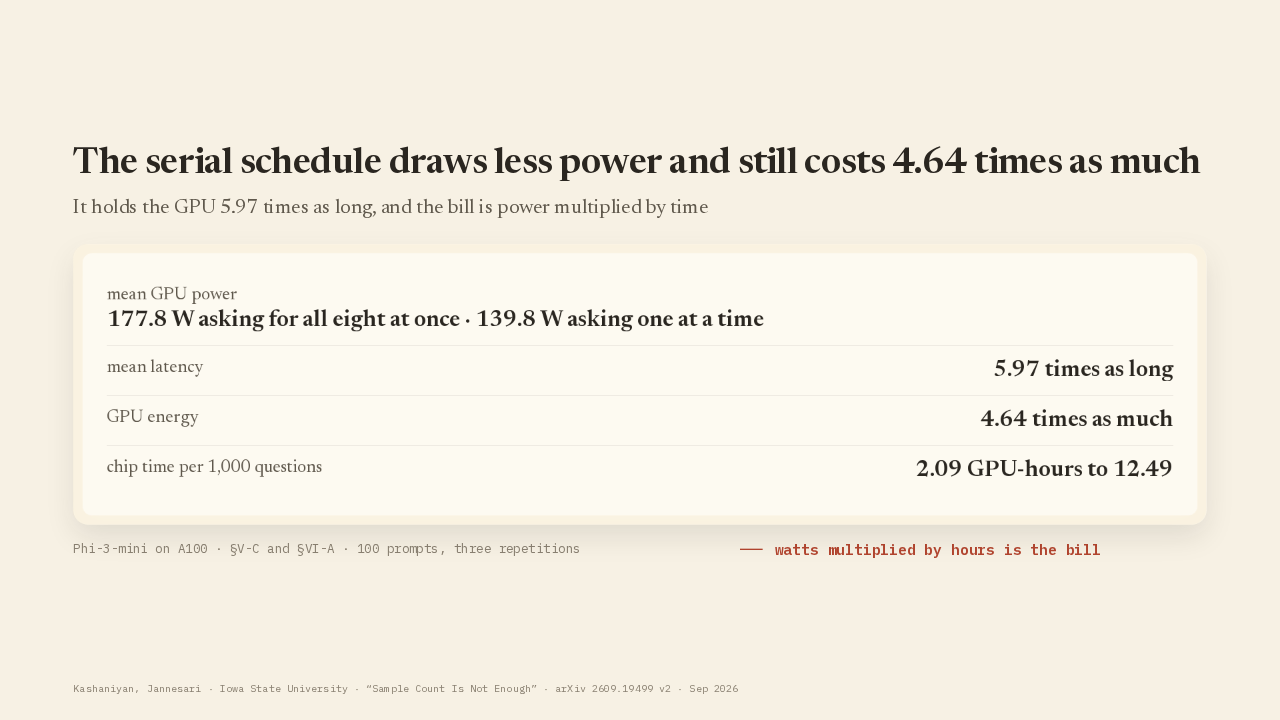
Watts is how hard the chip is working right now. Joules is watts multiplied by how long you worked it, and the electricity bill is joules. Put a meter on both runs and the serial one looks gentler. Mean power on the A100 falls from one hundred and seventy-seven point eight watts, when all eight answers are asked for at once, to one hundred and thirty-nine point eight watts when the eight answers are asked one at a time. Drawing less power did not help. Eight calls hold the chip five point nine seven times as long as one call does, so the joules pile up four point six four times over. In chip time, a thousand questions go from two point zero nine GPU-hours to twelve point four nine.

A bigger batch costs less for each piece of text and more for each query

A bigger batch costs less for each piece of text and more for each query
Qwen2.5 on A100 · batched budget 1 to 8 · Table V
joules per query
596 to 975 · rising
joules per generated token
2.222 to 0.459 · falling
Table V
“Phi-3 uses a V100 and Qwen uses an A100, so absolute values are not compared across models.”
Qwen2.5 on A100, the same chip as the power reading · Phi-3-mini’s column in this table is a V100 and is not shown
up per question
down per token
a token is the chunk of text a model writes at a time
Kashaniyan, Jannesari · Iowa State University · “Sample Count Is Not Enough” · arXiv 2609.19499 v2 · Sep 2026

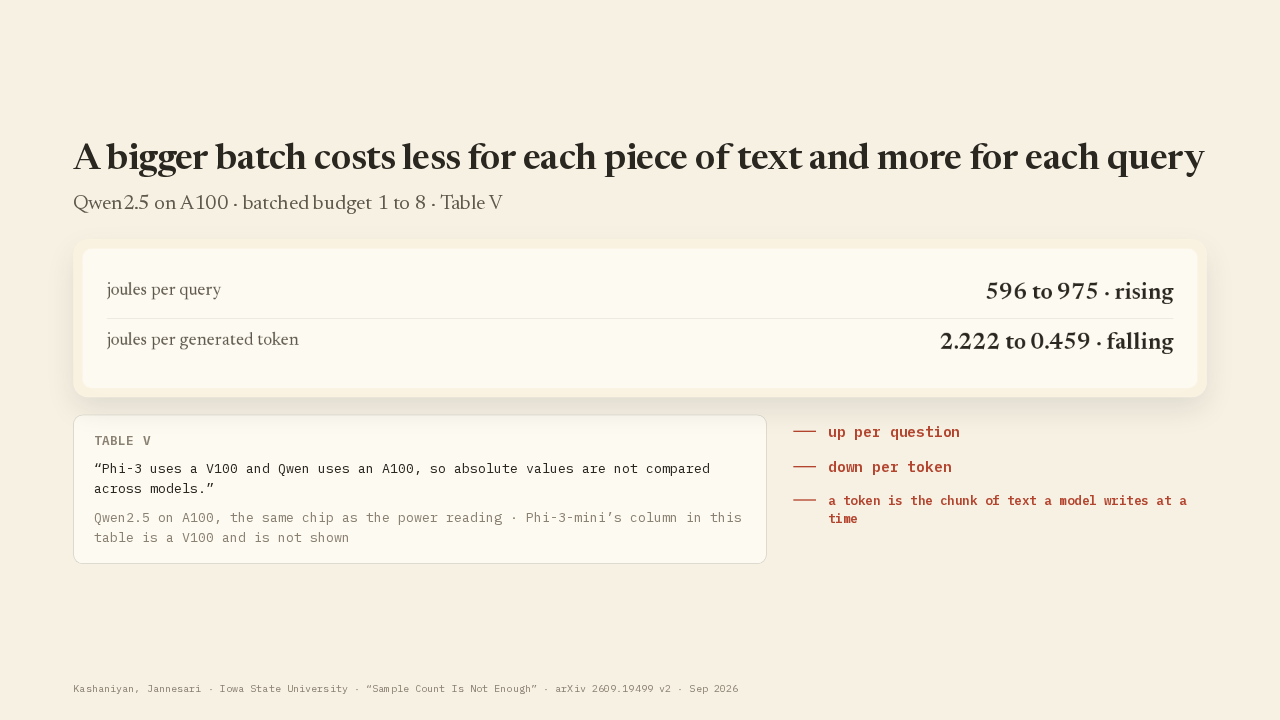
A bigger batch puts more candidates through the chip at once. Split that same work across more calls, and the paper names four costs. Each call re-reads the question from the start. Each call pays the software's own setup cost. Each call waits for the chip to finish and report back. And each call hands the chip less work to do at once. Which of those four costs most, the paper does not say, and it says so. A token is the chunk of text a model writes at a time. On Qwen two point five, on the same A100, as the batch grows from one to eight, the energy spent on each question rises. The energy spent on each token falls.

Energy climbs at every split, 1.00 to 1.63 to 2.71 to 4.64

Energy climbs at every split, 1.00 to 1.63 to 2.71 to 4.64
The wait climbs faster than the energy does · questions per hour fall to a sixth
1
2
3
4
5
6
1 call of 8
2 of 4
4 of 2
8 of 1
energy · Phi-3-mini
energy · Qwen2.5
the slowest answer in twenty · Phi-3-mini
the slowest answer in twenty · Qwen2.5
Table VI · both models on A100-SXM4 80 GB, 500 W cap, fixed 1275 MHz clock (§IV-C) · GSM8K · 100 prompts, three repetitions · relative to the batched call, no absolute joules reported
Phi-3-mini energy · 1.00 · 1.63 · 2.71 · 4.64
questions per hour at 8 calls of 1 · Phi-3-mini 16.7% to 17.1% of the batched run (Table VII)
Kashaniyan, Jannesari · Iowa State University · “Sample Count Is Not Enough” · arXiv 2609.19499 v2 · Sep 2026

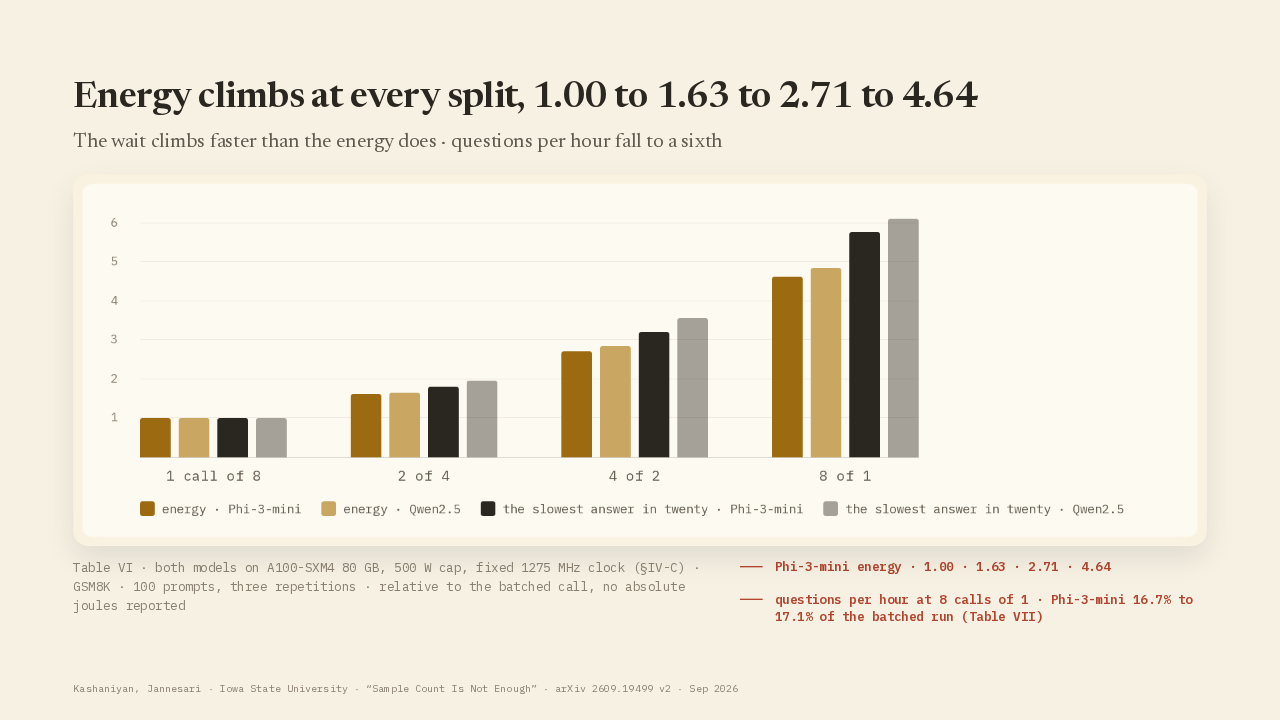
The penalty is gradual. Relative energy runs one, one point six three, two point seven one, and four point six four across the four schedules for Phi-3-mini. Qwen two point five tracks that same curve and ends at four point eight six. Every split you add costs. The wait gets worse faster than the electricity does. At eight calls of one, the slowest answer in twenty takes five point seven seven times as long as the batched one for Phi-3-mini, and six point one two times for Qwen two point five.

All four answer-length groups pay between four and five times the energy

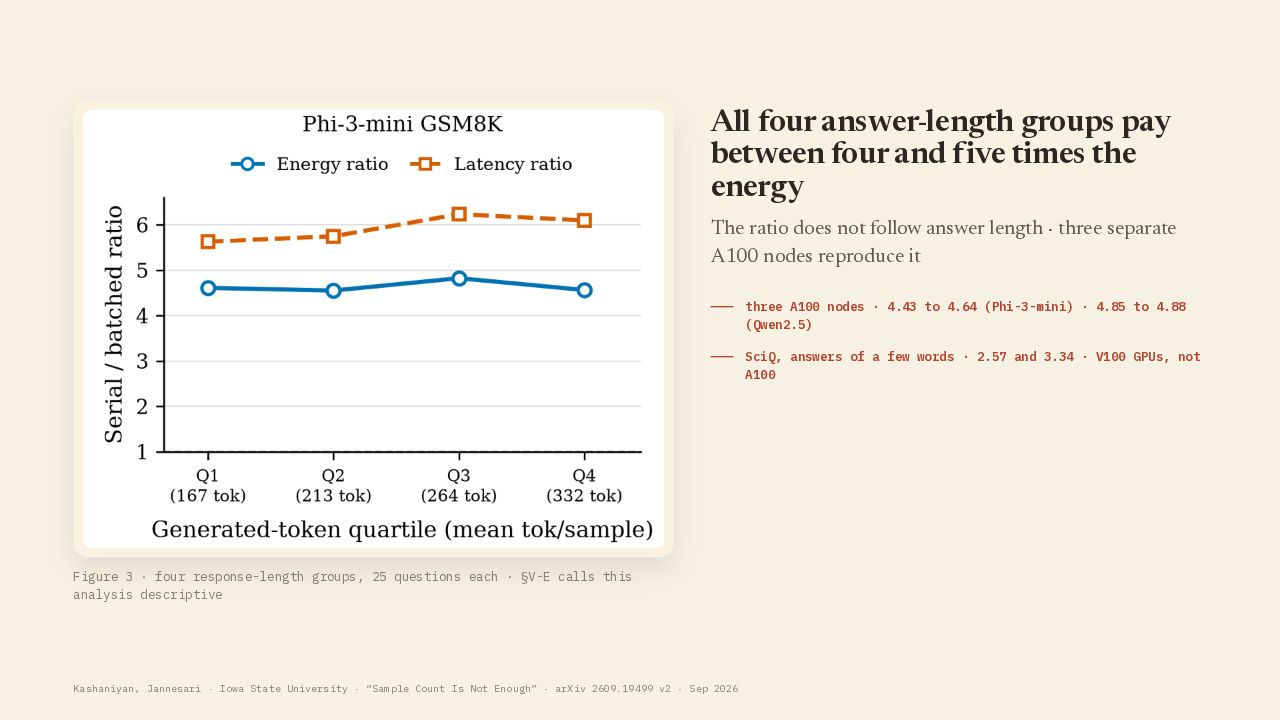
Figure 3 · four response-length groups, 25 questions each · §V-E calls this analysis descriptive
All four answer-length groups pay between four and five times the energy
The ratio does not follow answer length · three separate A100 nodes reproduce it
three A100 nodes · 4.43 to 4.64 (Phi-3-mini) · 4.85 to 4.88 (Qwen2.5)
SciQ, answers of a few words · 2.57 and 3.34 · V100 GPUs, not A100
Kashaniyan, Jannesari · Iowa State University · “Sample Count Is Not Enough” · arXiv 2609.19499 v2 · Sep 2026

Three separately scheduled jobs per model, on different A100 nodes, reproduce the gap. The Phi-3-mini energy ratio lands between four point four three and four point six four. The Qwen two point five ratio lands between four point eight five and four point eight eight. Sort the same questions into four groups by how long their answers ran, twenty-five questions a group. Every group lands between four and five times. The ratio does not follow length. On SciQ, school science questions answered in a handful of words, the penalty holds at two point five seven times and three point three four times. The chips changed there too, so the paper will not call that a length effect.

A live serving stack already batches for you, so this bill lands on offline jobs

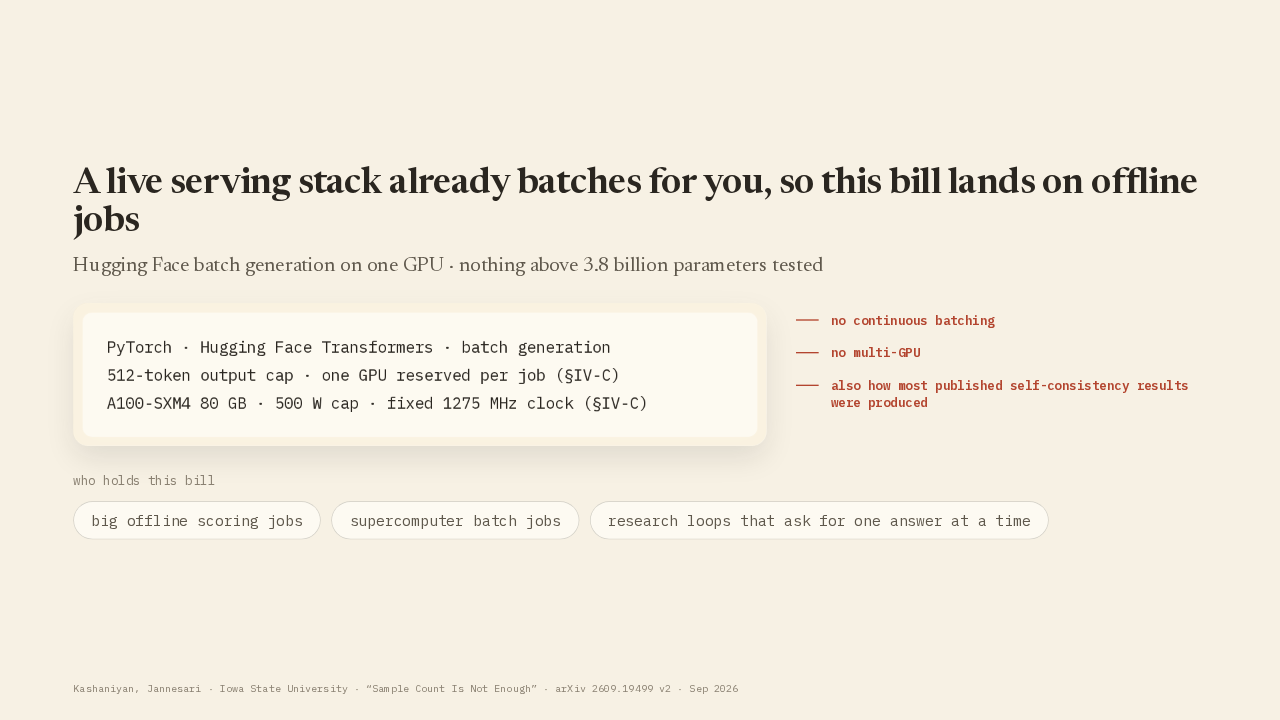
A live serving stack already batches for you, so this bill lands on offline jobs
Hugging Face batch generation on one GPU · nothing above 3.8 billion parameters tested
PyTorch · Hugging Face Transformers · batch generation
512-token output cap · one GPU reserved per job (§IV-C)
A100-SXM4 80 GB · 500 W cap · fixed 1275 MHz clock (§IV-C)
no continuous batching
no multi-GPU
also how most published self-consistency results were produced
who holds this bill
big offline scoring jobs
supercomputer batch jobs
research loops that ask for one answer at a time
Kashaniyan, Jannesari · Iowa State University · “Sample Count Is Not Enough” · arXiv 2609.19499 v2 · Sep 2026

Every number here was measured on one inference stack, Hugging Face Transformers batch generation on a single GPU. That stack has no continuous batching, a serving system that mixes many different people's requests into shared batches. The people holding this bill run big offline scoring jobs, supercomputer batch jobs, and research loops that ask for one answer at a time. Nothing above three point eight billion parameters was tested. And the energy is what the chip itself reports, with idle power left in and the processor, memory and cooling around it left out. The boundary is the graphics chip. The authors say plainly that these ratios should not be assumed to hold on a continuous-batching server or on larger models. That sweep is the one somebody can run next.

The rule this paper hands you is one line and it costs nothing to apply

The rule this paper hands you is one line and it costs nothing to apply
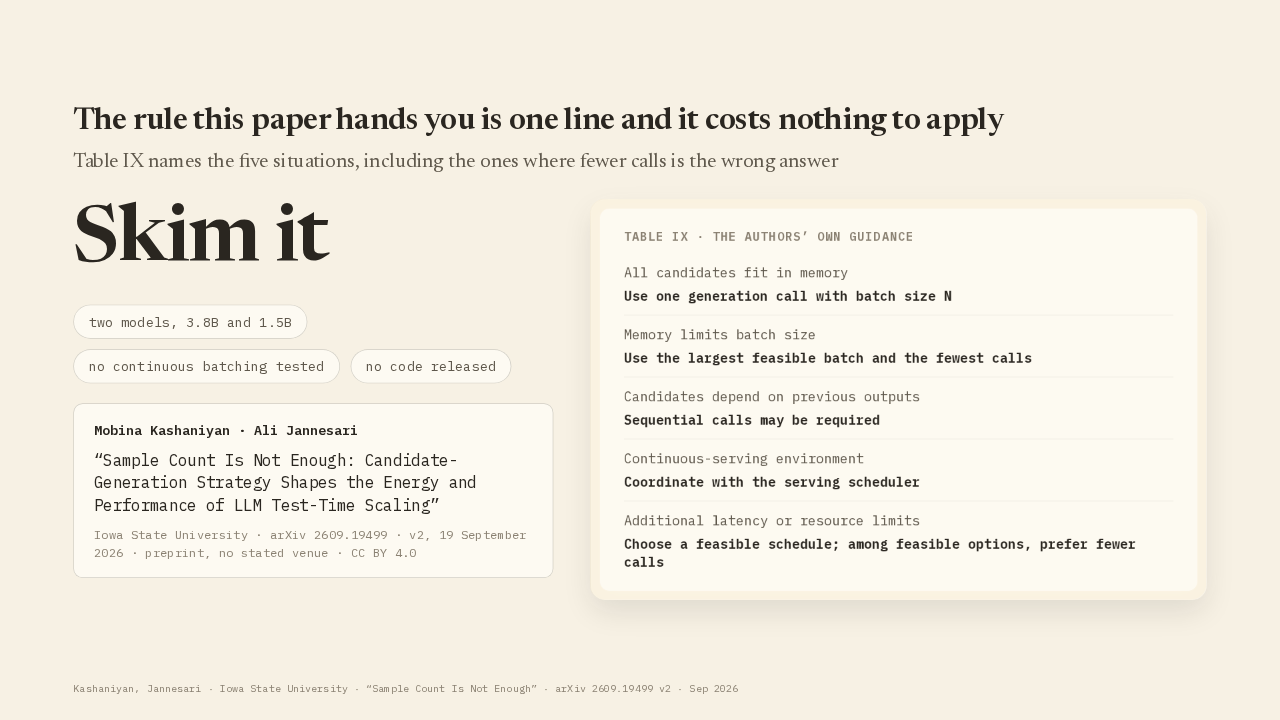
Table IX names the five situations, including the ones where fewer calls is the wrong answer
Skim it
two models, 3.8B and 1.5B
no continuous batching tested
no code released
Mobina Kashaniyan · Ali Jannesari
“Sample Count Is Not Enough: Candidate-Generation Strategy Shapes the Energy and Performance of LLM Test-Time Scaling”
Iowa State University · arXiv 2609.19499 · v2, 19 September 2026 · preprint, no stated venue · CC BY 4.0
Table IX · the authors’ own guidance
All candidates fit in memory
Use one generation call with batch size N
Memory limits batch size
Use the largest feasible batch and the fewest calls
Candidates depend on previous outputs
Sequential calls may be required
Continuous-serving environment
Coordinate with the serving scheduler
Additional latency or resource limits
Choose a feasible schedule; among feasible options, prefer fewer calls
Kashaniyan, Jannesari · Iowa State University · “Sample Count Is Not Enough” · arXiv 2609.19499 v2 · Sep 2026

Skim it. The finding is one table, and the rule is one line. Use the biggest batch that fits in memory, and as few calls as you can. Self-consistency is exactly the case where answers do not depend on each other. A paper that tells you only how many answers it sampled has not told you what they cost. That reporting gap is what outlives these numbers. The paper's own first table names six earlier studies, including Self-Consistency and Large Language Monkeys. All six leave the call count and the energy blank. Sample Count Is Not Enough, by Mobina Kashaniyan and Ali Jannesari at Iowa State University. An arXiv preprint, twenty six zero nine point one nine four nine nine, version two. The paper ships no code.