Hacker News, September 19
 Hacker News
Saturday, September 19, 2026
Hacker News
Saturday, September 19, 2026
AI-generated posters don’t have to be horrible — Hacker News, September 19
The front page for Saturday, September nineteenth, two thousand twenty six. At the top, with about nineteen hundred points, a blog post arguing that the flood of identical AI event posters is a prompting failure, not a limit of the tools.
The problem is the sameness
Hacker News
Saturday, September 19, 2026
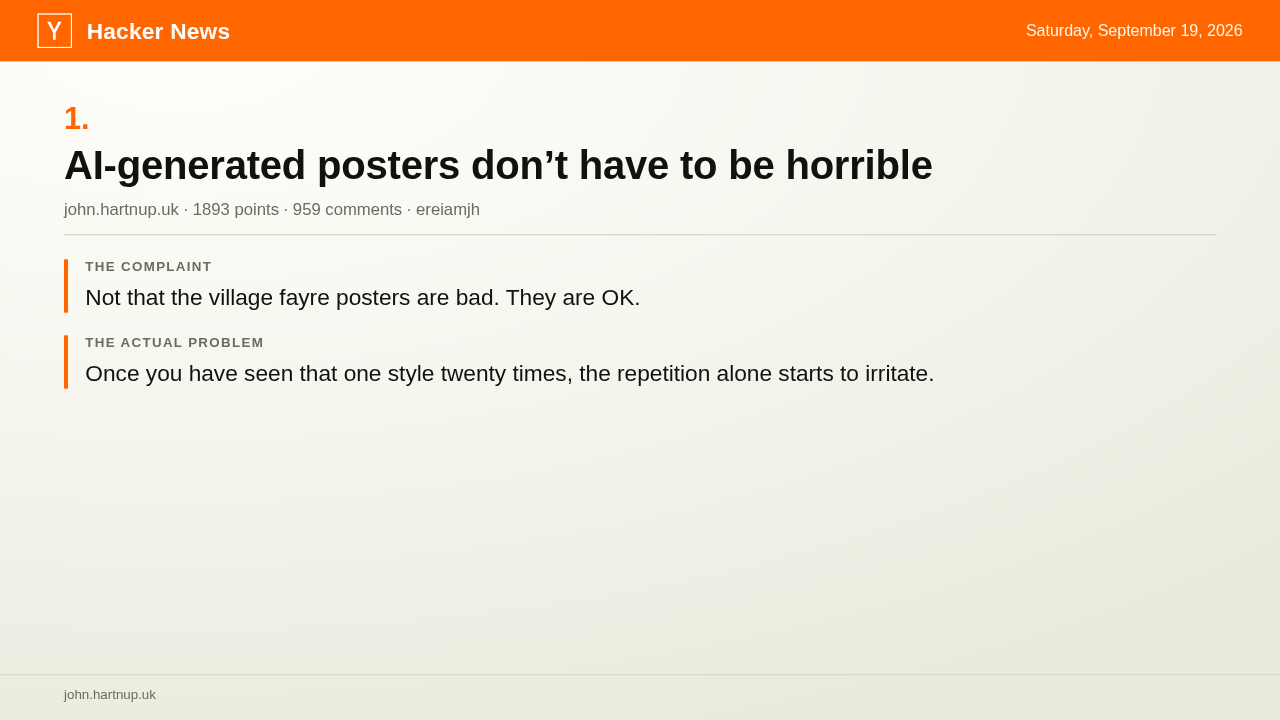
AI-generated posters don’t have to be horrible
The author starts with the village fayre posters everyone has seen: pastel airbrush, bunting, cartoon crowds. The complaint is not that they are bad. They are fine. They are all the same, and the repetition on its own is what grates.
One instruction broke the template
Hacker News
Saturday, September 19, 2026
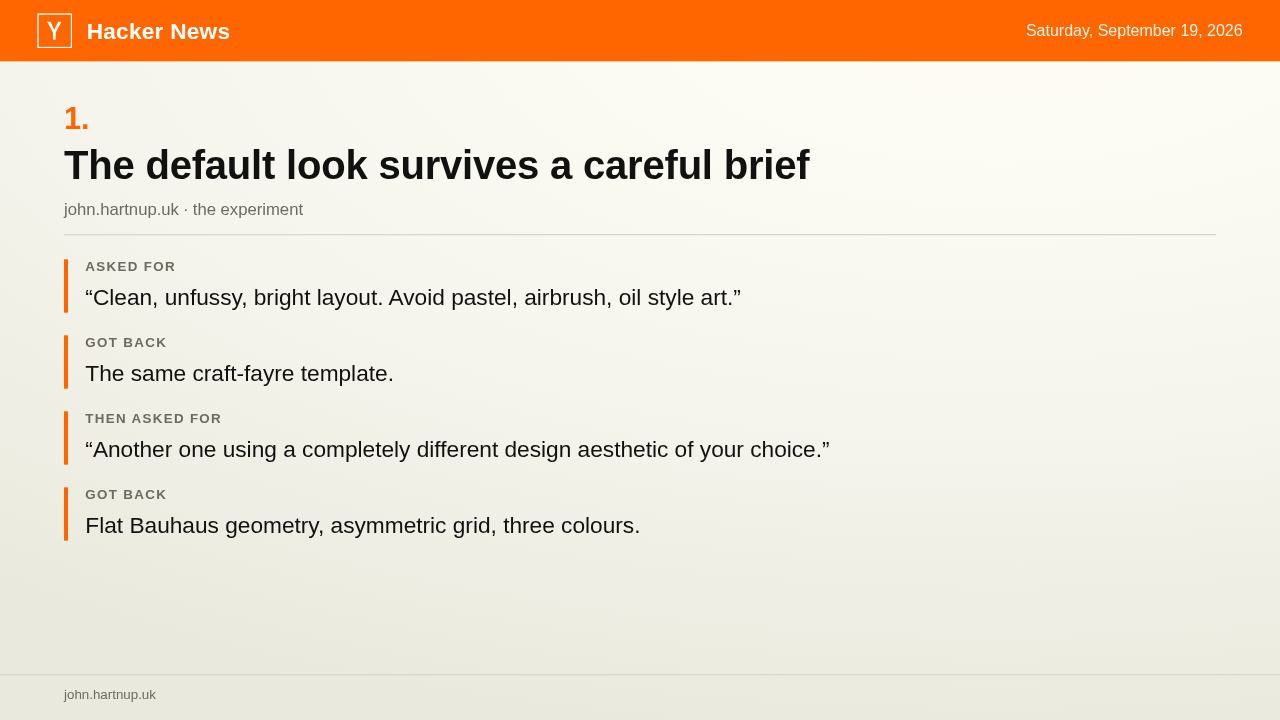
The default look survives a careful brief
So they tried. A careful brief, asking for clean, unfussy and bright, still came back as the same craft fayre template. What broke the loop was blunter: make another using a completely different design aesthetic of your choice. Out came flat Bauhaus geometry.
Ask the model to name the style
Hacker News
Saturday, September 19, 2026
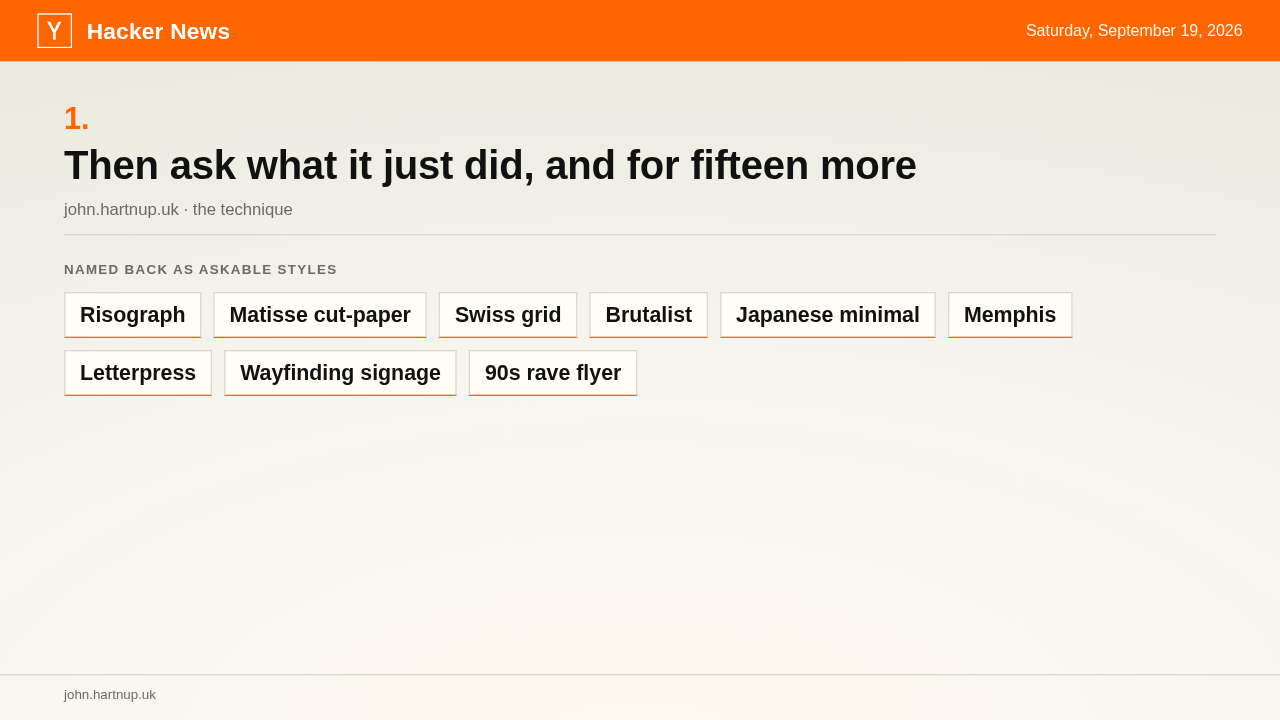
Then ask what it just did, and for fifteen more
The second move is to ask the model what it just did. It named the style, then offered fifteen more. Risograph misregistration, Matisse cut paper, wayfinding signage, Memphis squiggles. Naming an aesthetic out loud is the whole technique.
The pushback in the thread
Hacker News
Saturday, September 19, 2026
In the thread
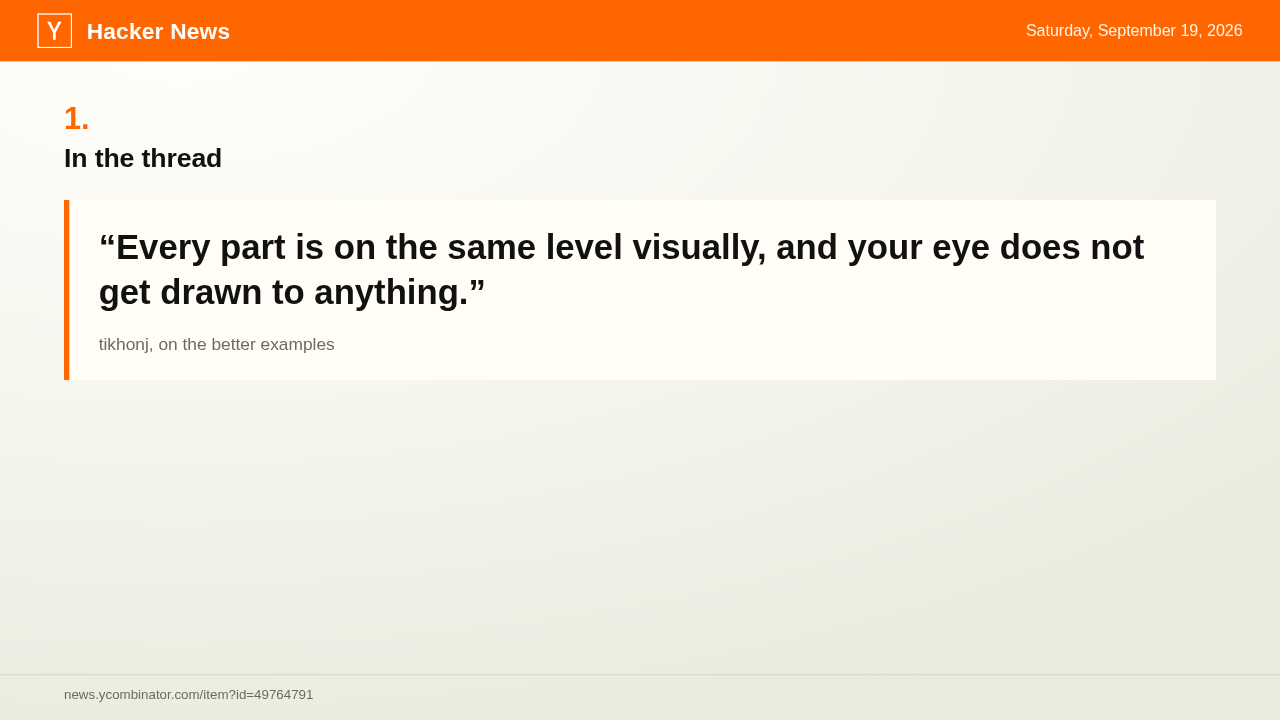
“Every part is on the same level visually, and your eye does not get drawn to anything.”
Not everyone was convinced. Commenter tikhonj argues the better examples are still flat in attention. Every part sits at the same visual level and nothing pulls your eye, which is their complaint about generated code as well.
Credit for motivated explanations
Hacker News
Saturday, September 19, 2026
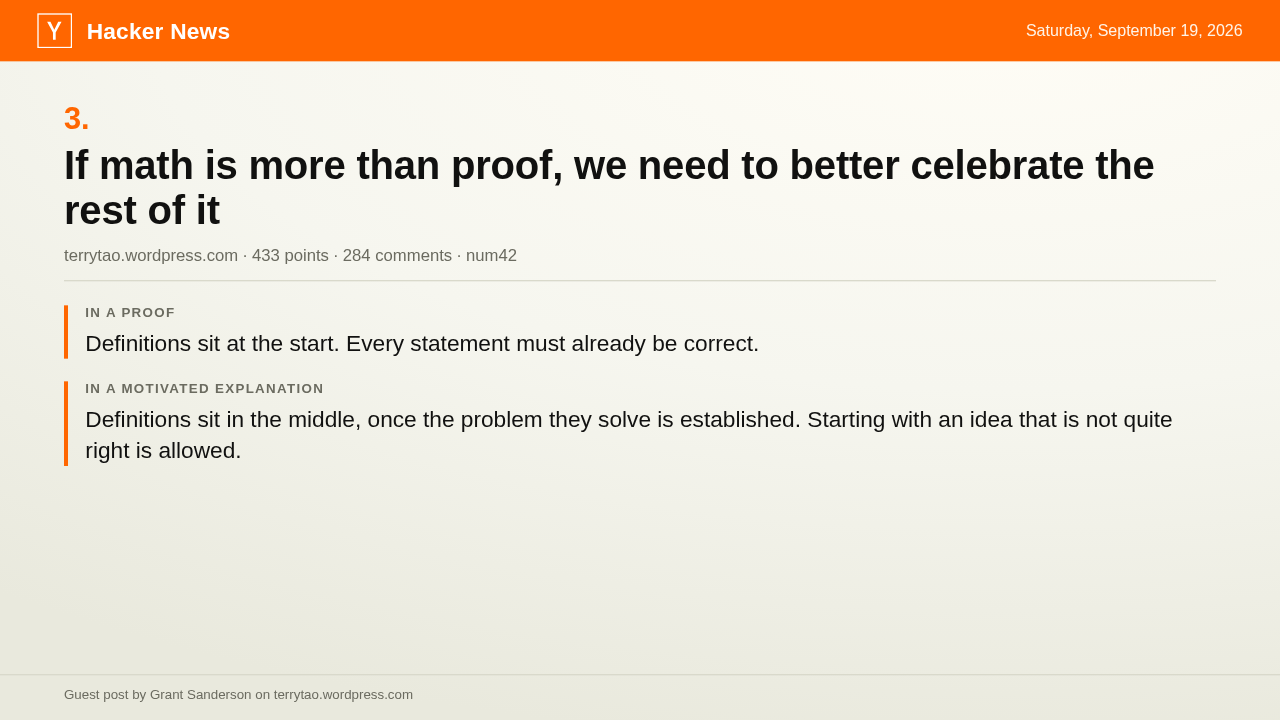
If math is more than proof, we need to better celebrate the rest of it
Rank three, a guest post by Grant Sanderson on Terence Tao's blog. If machines generate proofs without understanding, proofs stop being a good proxy for what mathematicians contribute. His proposal: give academic credit to motivated explanations, where definitions arrive in the middle, once the problem they solve is clear.
Where the value sits
Hacker News
Saturday, September 19, 2026
In the thread
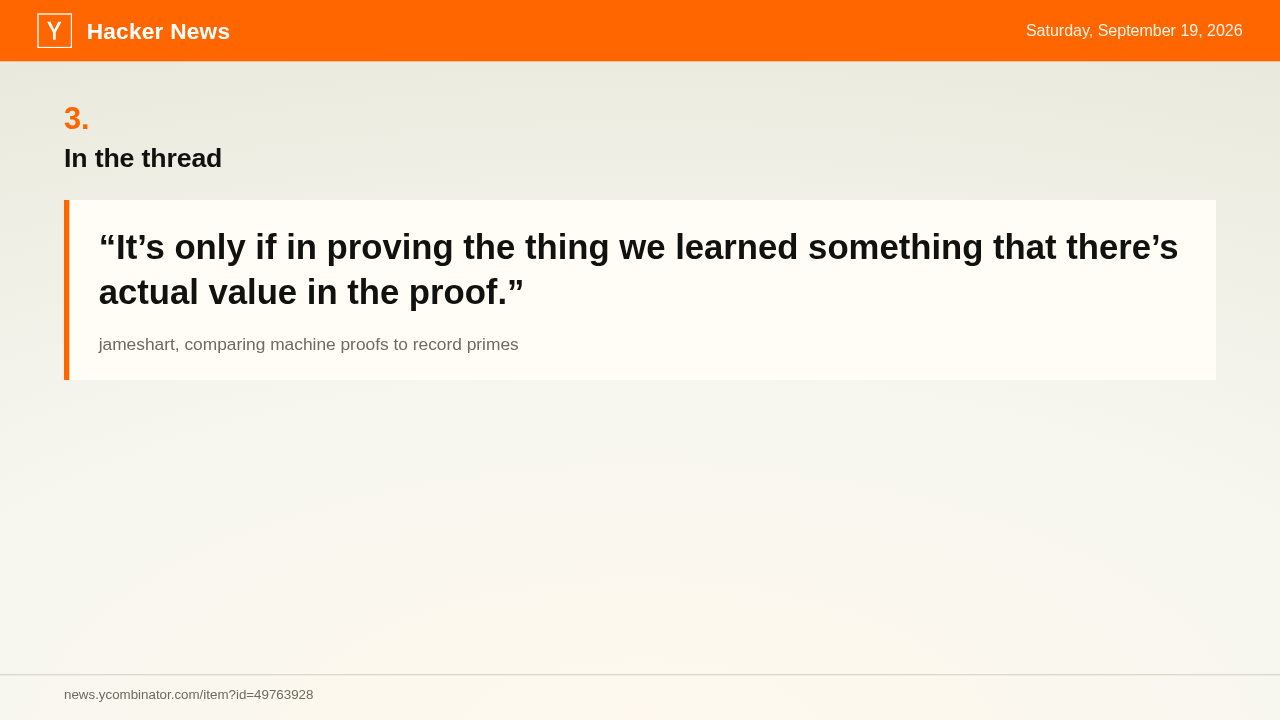
“It’s only if in proving the thing we learned something that there’s actual value in the proof.”
Commenter jameshart carries that further. A machine proof of a famous conjecture would land the way a bigger Mersenne prime does. Another one existing is unsurprising, so the value is only in what proving it taught you.
Copyeditor, not ghostwriter
Hacker News
Saturday, September 19, 2026
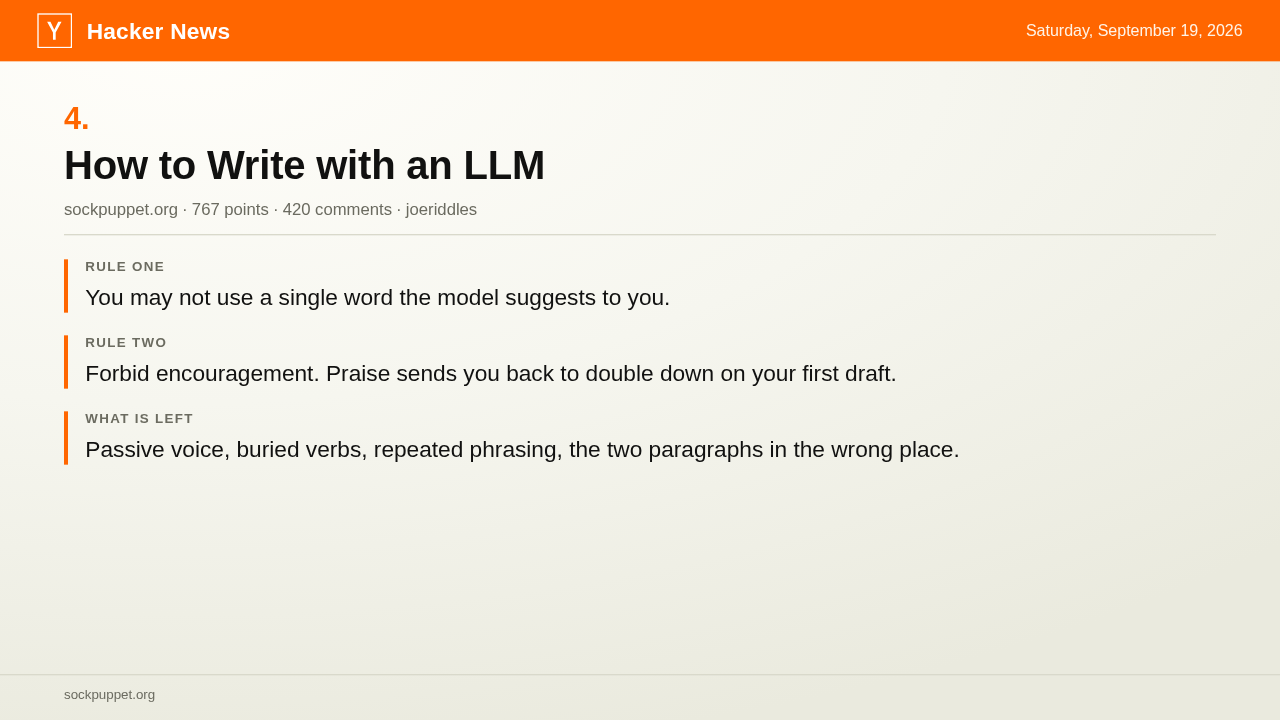
How to Write with an LLM
Rank four is a method. Write the piece yourself, then hand it over to find flaws, never to produce prose. Rule one: use no phrase it suggests. Rule two: forbid encouragement, since praise sends you back to your first draft. Then let it do the tedious catching.
Taking the commit messages back
Hacker News
Saturday, September 19, 2026
In the thread
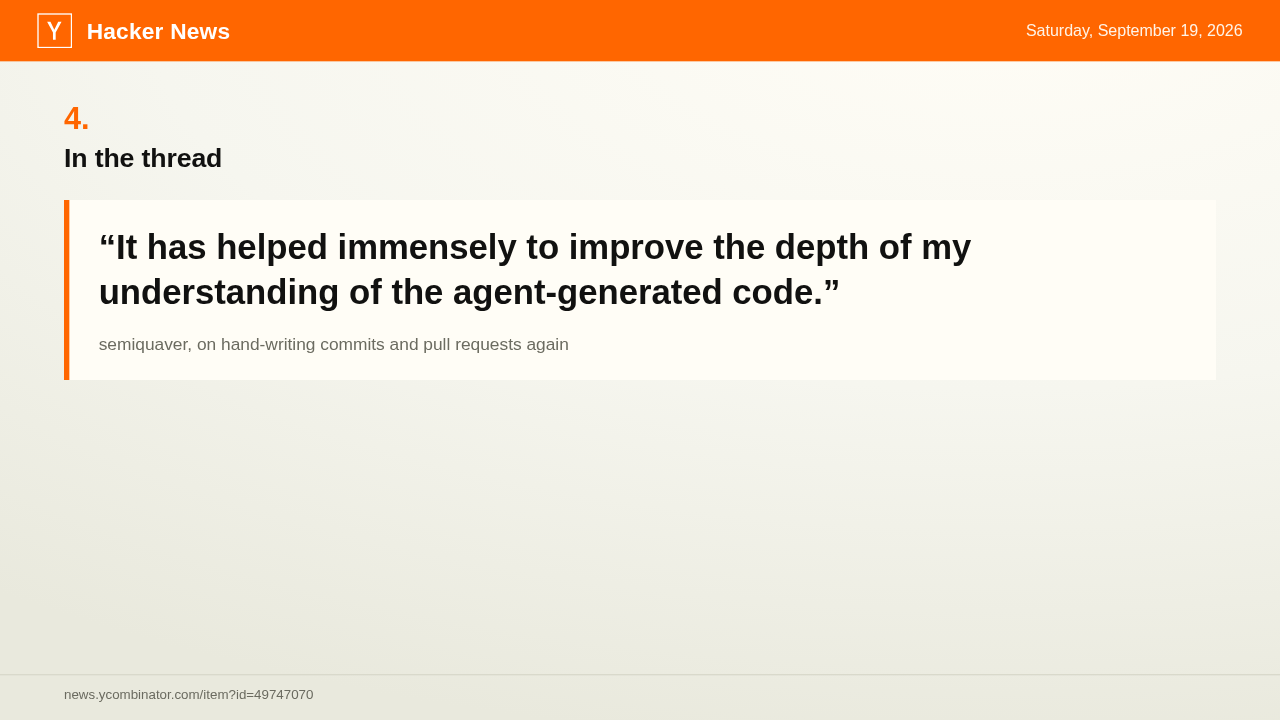
“It has helped immensely to improve the depth of my understanding of the agent-generated code.”
Commenter semiquaver takes it further and writes every commit message and pull request description by hand again, letting an agent check the facts but never rephrase. Skimming agent-written diffs had been costing them their grasp of the code.
Two progenitors, never overlapping
Hacker News
Saturday, September 19, 2026
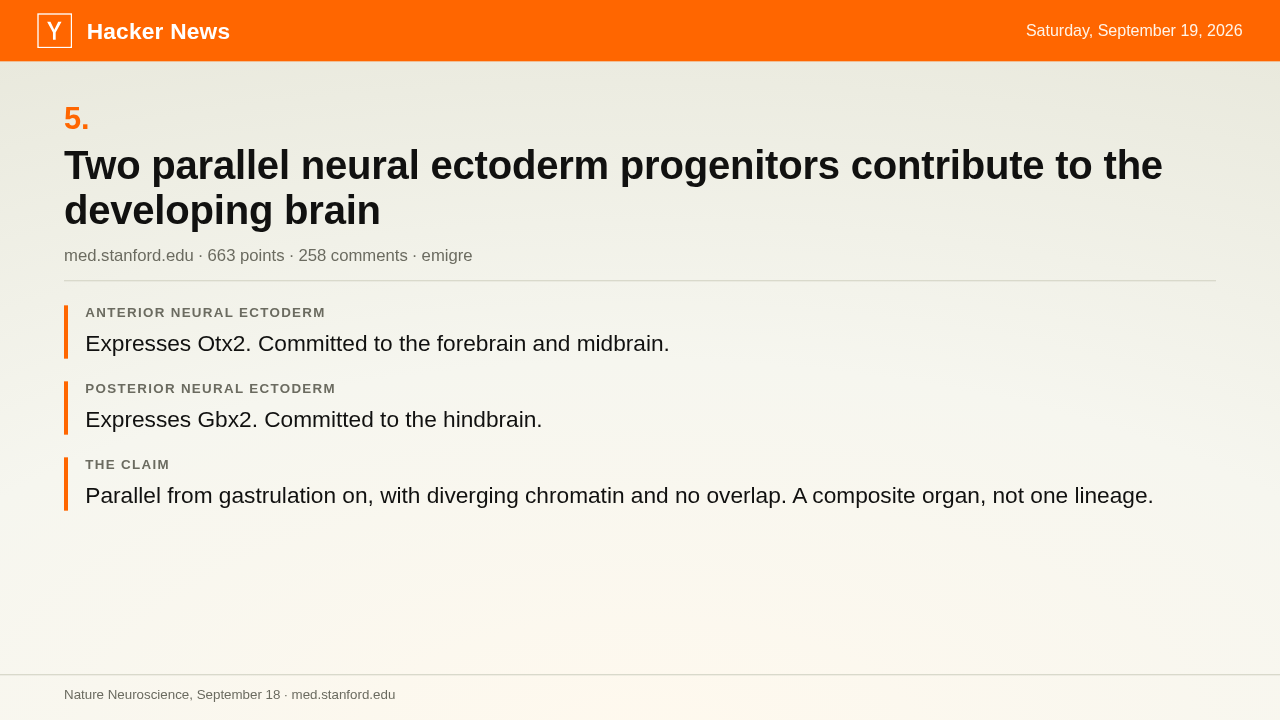
Two parallel neural ectoderm progenitors contribute to the developing brain
Rank five, Stanford Medicine in Nature Neuroscience. Lineage tracing in mouse embryos found two brain progenitor populations that emerge together and never overlap. One is committed to the forebrain and midbrain, the other to the hindbrain. The paper calls the brain a composite organ.
The part under the headline
Hacker News
Saturday, September 19, 2026
In the thread
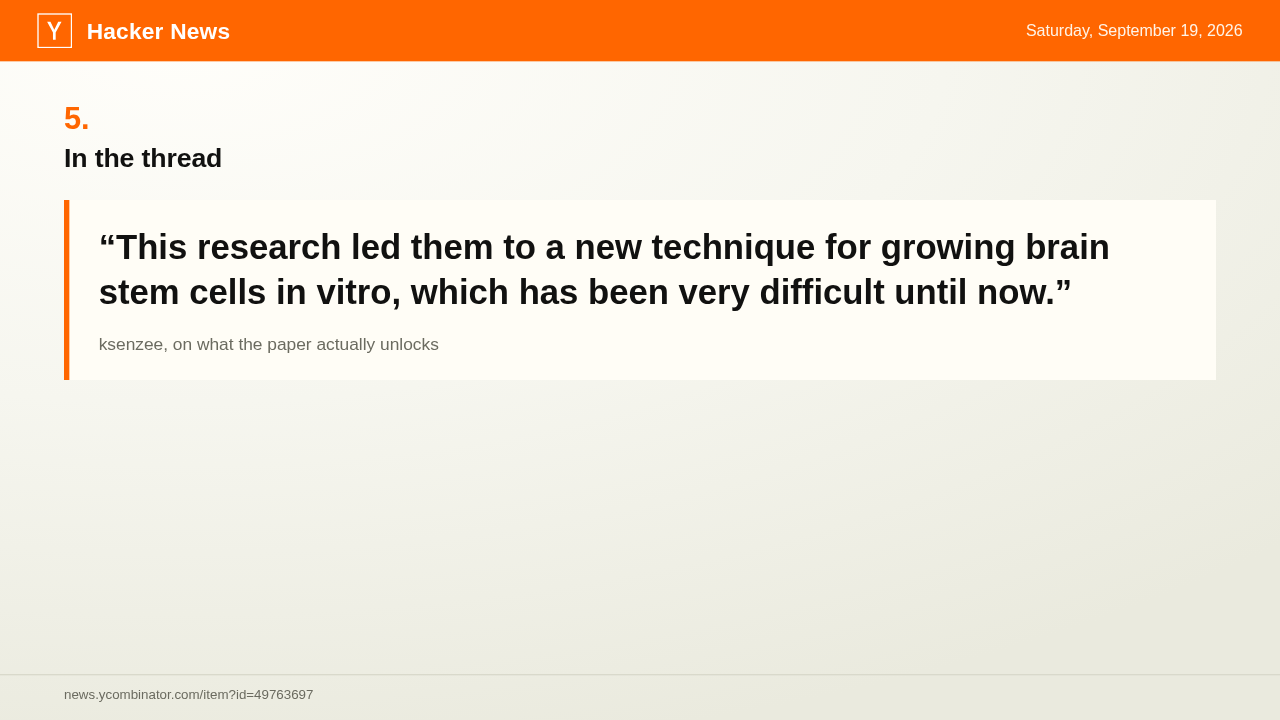
“This research led them to a new technique for growing brain stem cells in vitro, which has been very difficult until now.”
Commenter ksenzee points past the headline, and the paper backs it. Because the lineages are separate, the team grew human hindbrain motor neurons in a dish for the first time, the cells that ALS and SMA destroy.
Thinking costs real time
Hacker News
Saturday, September 19, 2026
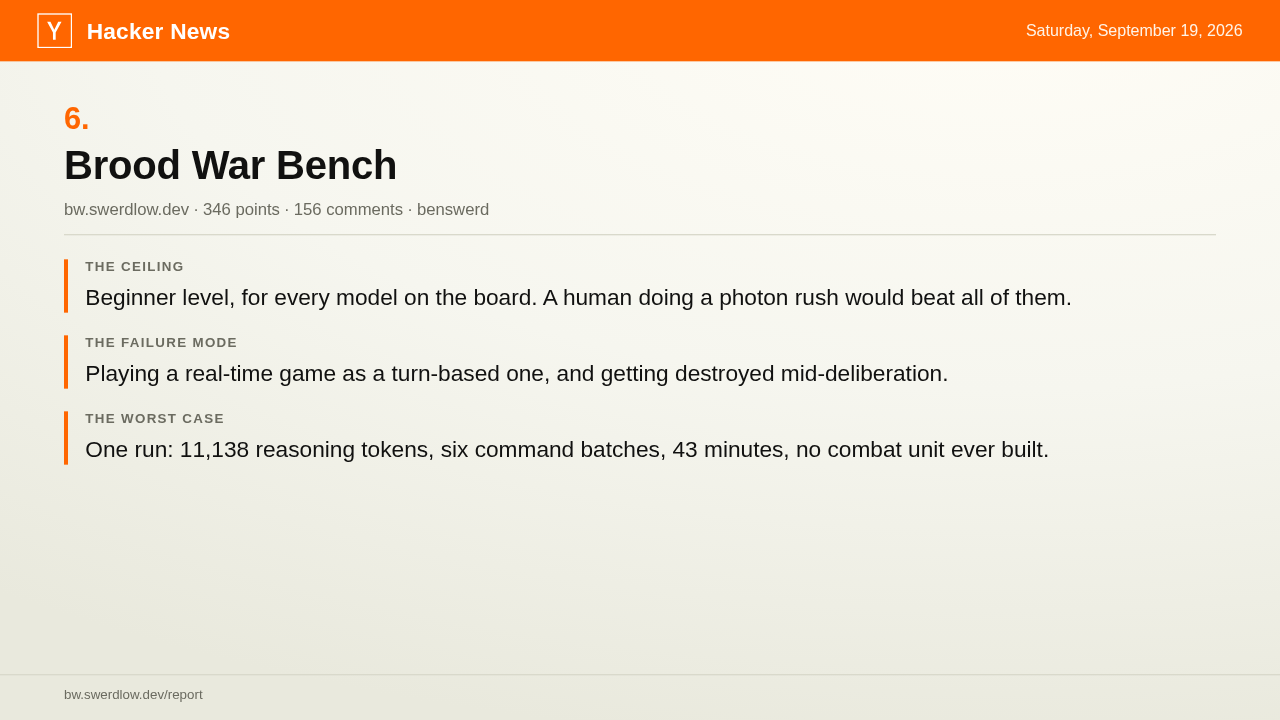
Brood War Bench
Rank six: a build of Brood War that models can only play through an agent. The leaderboard's verdict is blunt. Beginner level was the ceiling for all of them. Deliberation costs real time. One run spent eleven thousand reasoning tokens, issued six batches of commands, and never built a fighting unit.
Bots have been playing since 2010
Hacker News
Saturday, September 19, 2026
In the thread
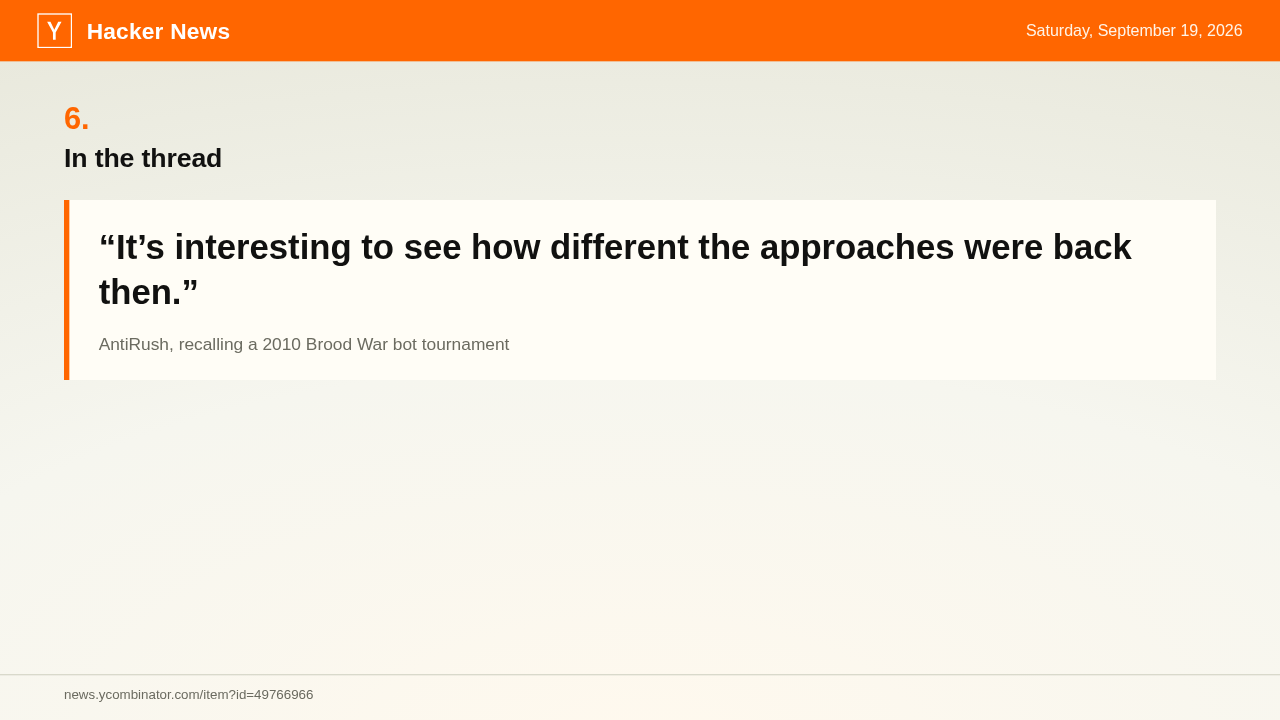
“It’s interesting to see how different the approaches were back then.”
Commenter AntiRush remembers a Brood War bot tournament run at U C Santa Cruz in two thousand ten, in the early days of the game's scripting interface. Purpose built bots then, general models improvising now.
Sources
Hacker News
Saturday, September 19, 2026
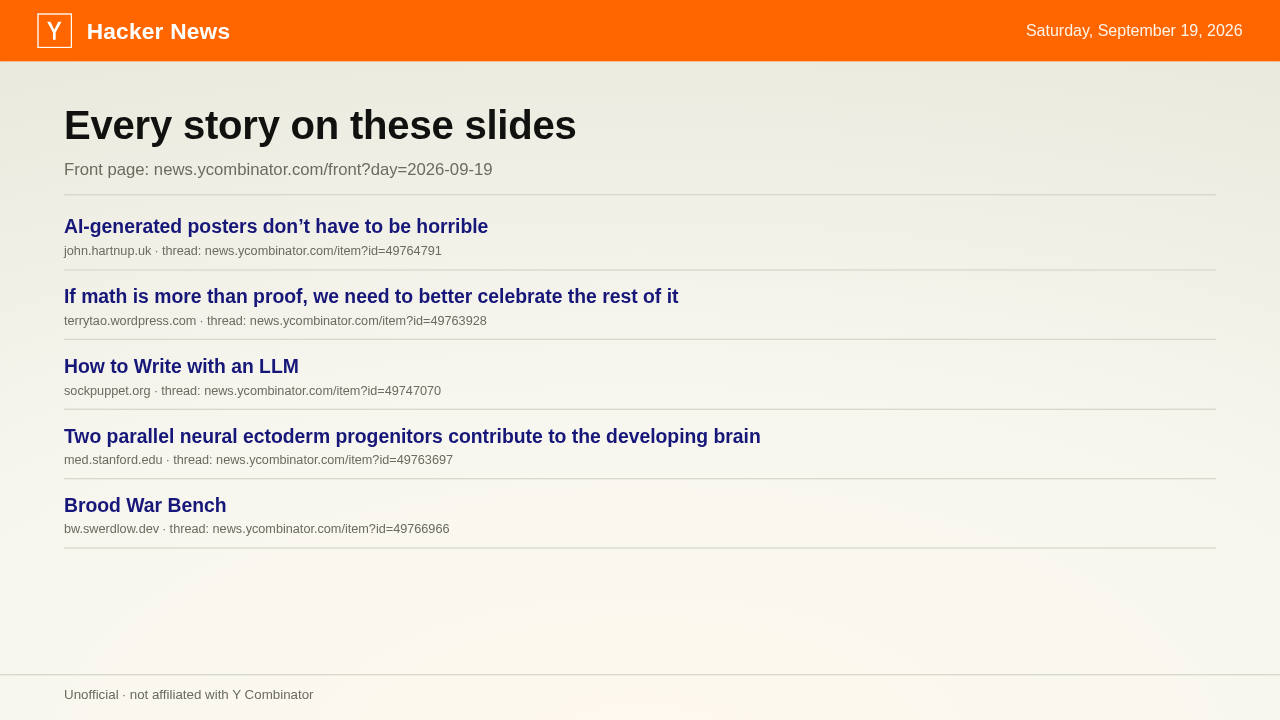
Every story on these slides
- AI-generated posters don’t have to be horriblejohn.hartnup.uk · thread: news.ycombinator.com/item?id=49764791
- If math is more than proof, we need to better celebrate the rest of itterrytao.wordpress.com · thread: news.ycombinator.com/item?id=49763928
- How to Write with an LLMsockpuppet.org · thread: news.ycombinator.com/item?id=49747070
- Two parallel neural ectoderm progenitors contribute to the developing brainmed.stanford.edu · thread: news.ycombinator.com/item?id=49763697
- Brood War Benchbw.swerdlow.dev · thread: news.ycombinator.com/item?id=49766966
That is the five. Each one is linked here beside its thread, with the front page they all came from. Point and comment counts are the ones showing when the list was read.