


The Wire — Wednesday, September 16
It's Wednesday, September 16th. One story today, and it's a fund. Standard Capital, San Francisco, a year old. Four hundred twenty five million dollars in its first fund. And fifteen Series A rounds led since last November, every one of them listed on its own website. This is The Wire.
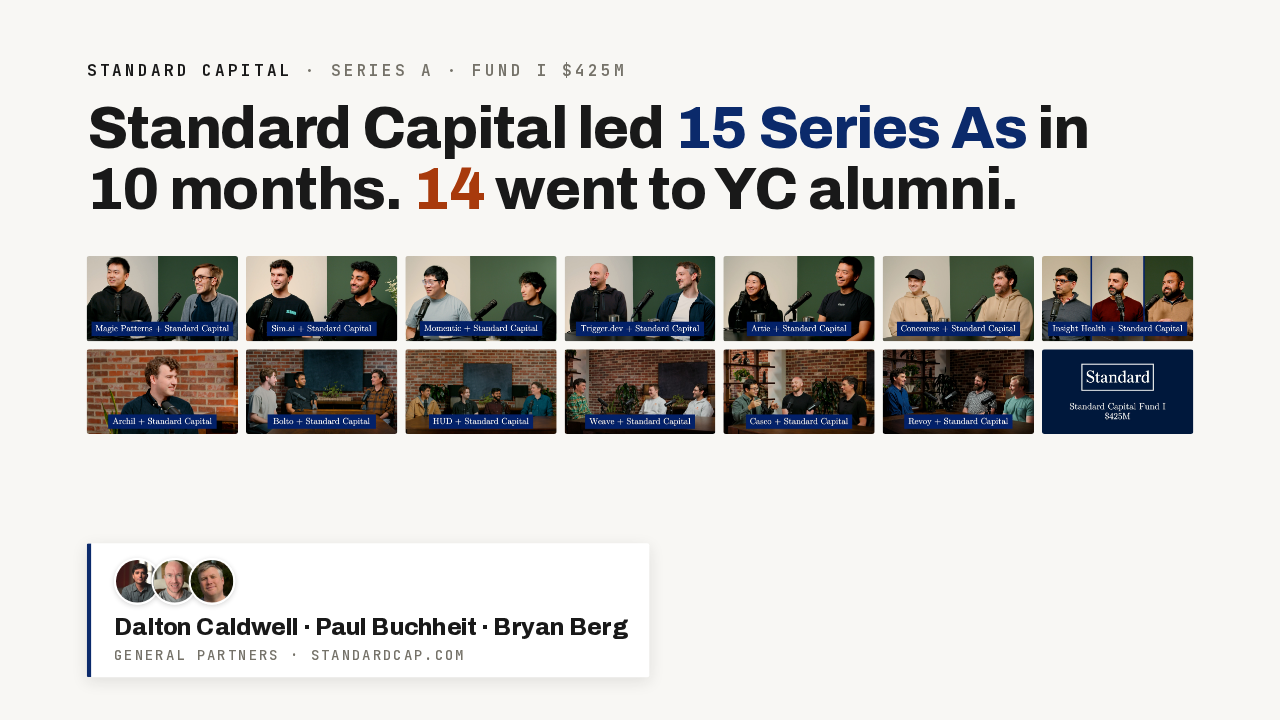
Standard Capital led 15 Series As in 10 months


Dalton Caldwell left Y Combinator, raised four hundred twenty five million dollars, and started leading Series A rounds in November. Ten months later there are fifteen companies on the portfolio page, each card carrying the round size. Fourteen of the fifteen went through Y Combinator, and the firm publishes the paperwork that says exactly how each deal works.
What you will know in eight minutes
By the end you will know three things. What Standard's published term sheet fixes before a founder ever talks to them, including the clause that puts seventy five percent of founder equity back on a three year schedule. Where the 2026 checks went: a surgical robot company and a hybrid truck company, beyond the AI-native tagline. And whether you should apply, if you run the kind of company they say they want.
01 · Standard's offer
Standard's offer.
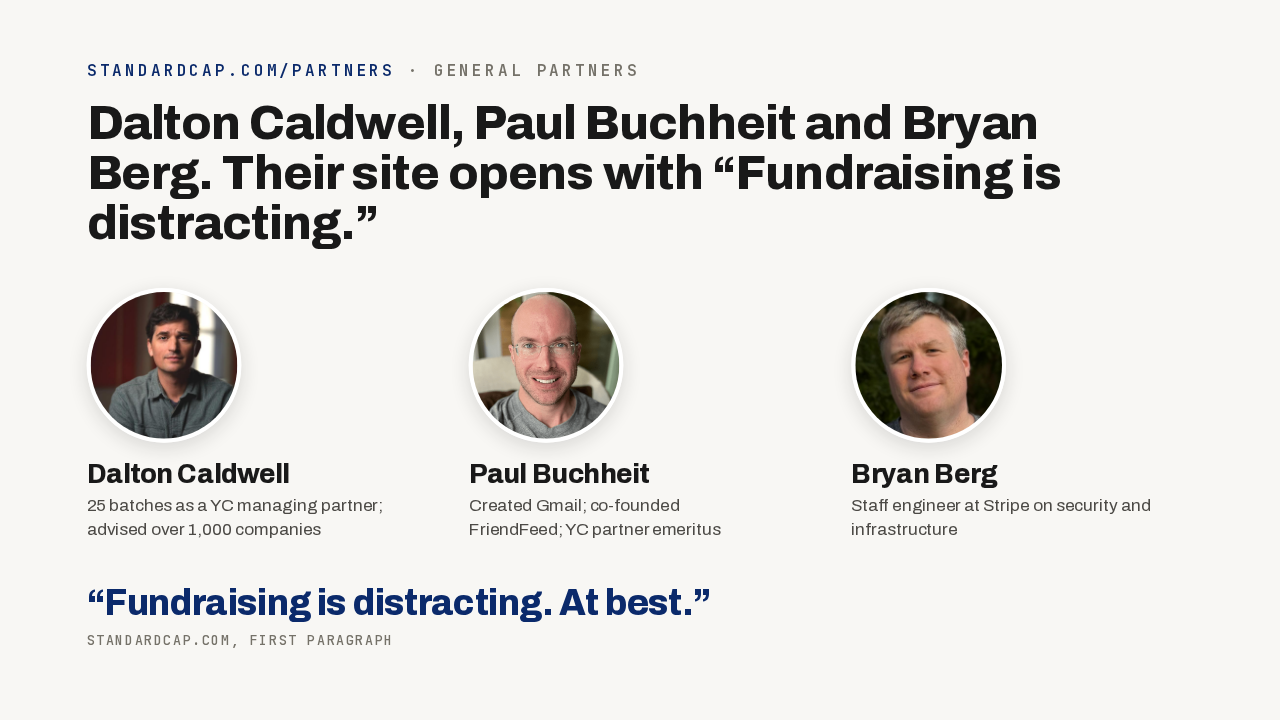
Dalton Caldwell, Paul Buchheit and Bryan Berg
The firm is three people. Dalton Caldwell ran twenty five batches at Y Combinator and advised over a thousand companies there. Paul Buchheit built Gmail. Bryan Berg was a staff engineer at Stripe. And the first thing the site says is a complaint. Fundraising is distracting, at best. A fast no is fine. The investor who hurts you is the one who seems interested and passes after months of coffee.
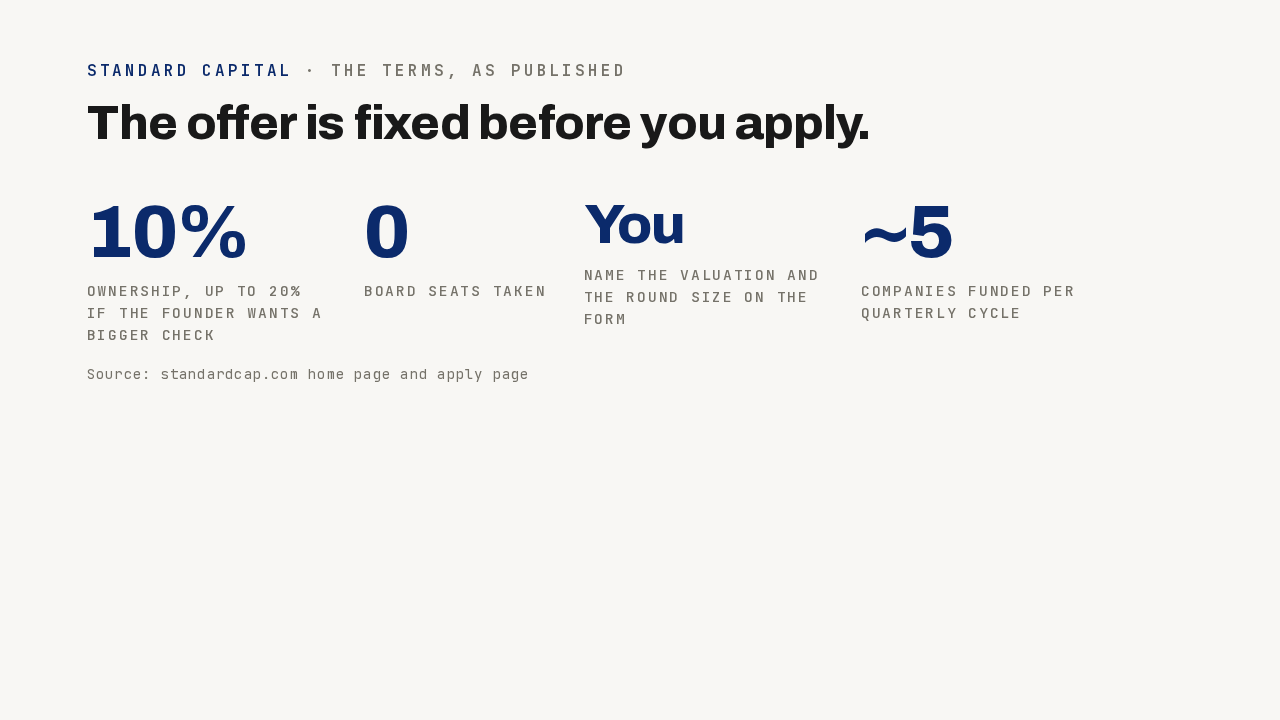
The offer is fixed before you apply
Here is the offer, and it does not move. Standard takes ten percent of the company, up to twenty if the founder wants more money. It takes no board seat. The founder names the valuation and the round size on the application form, and the firm pays its own legal fees. Decisions come in quarterly cycles of about five companies, after an application and an interview, with no warm introduction required.
The model is Facebook's Series A
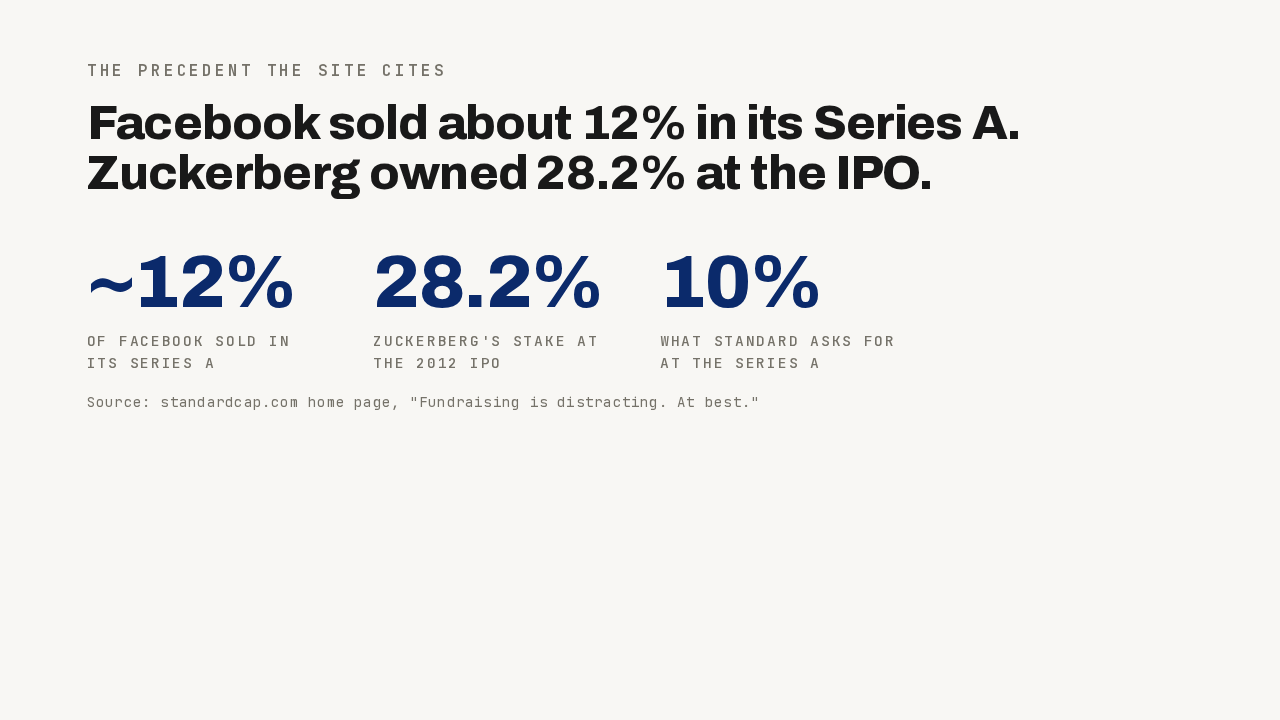
The model they point to is Facebook. Its Series A sold about twelve percent of the company, and Mark Zuckerberg still owned twenty eight point two percent when it went public. Standard's argument is that the Series A is usually the most dilutive round a founder ever does. So cap it at ten percent, keep the board, and raise bigger money later at a bigger price.
Every document is on GitHub, unnegotiated

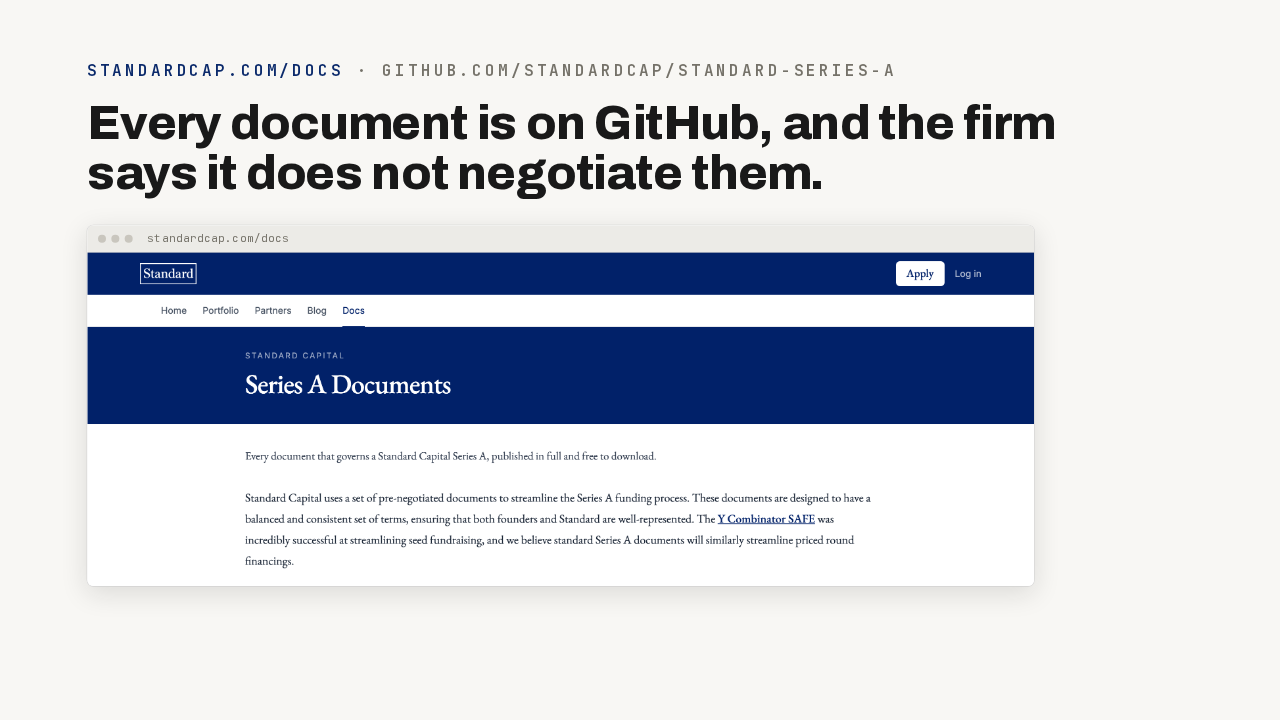
Every document that governs the round is published. Term sheet, stock purchase agreement, charter, investors' rights, side letter, two certificates, all in a public GitHub repository. The docs page says plainly that they do not negotiate them, and that a founder should see the full set before signing any term sheet. The comparison they draw is to the SAFE, which Y Combinator introduced to standardize seed rounds. This is the same move, one round later.
02 · The 15 deals
The fifteen deals.
15 companies, two cycles, every round on the card

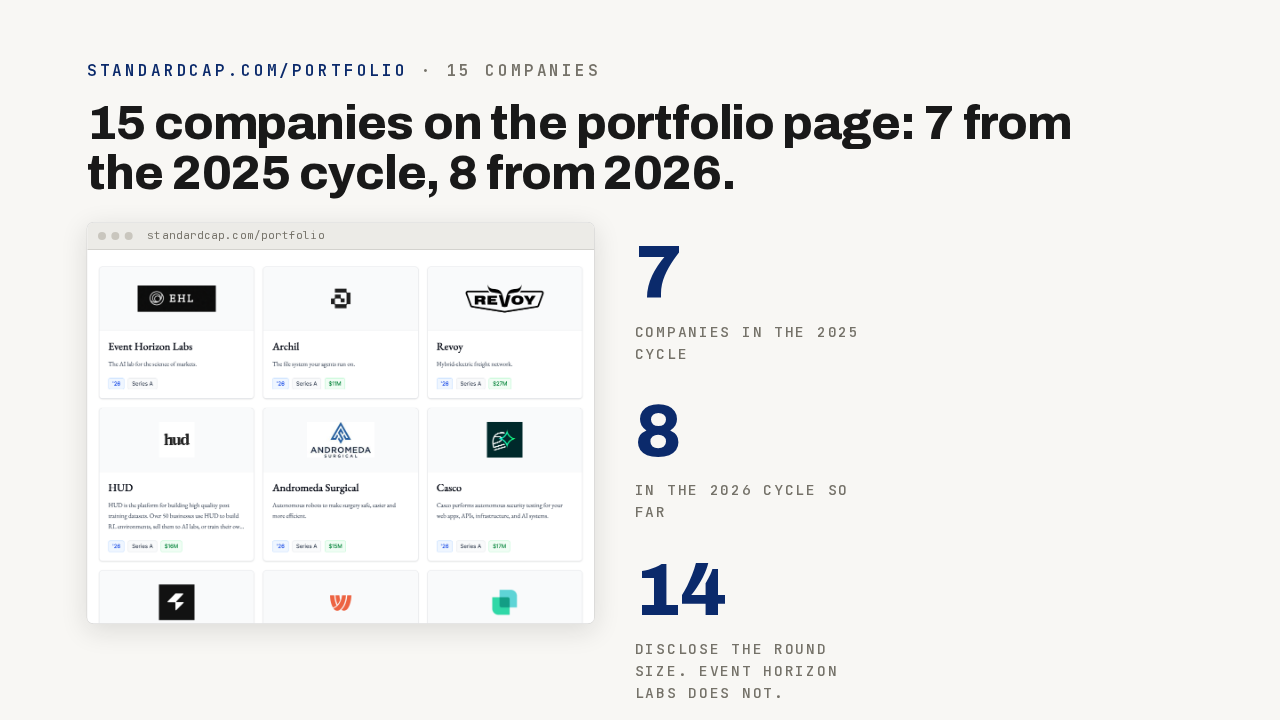
The portfolio page is the whole record. Fifteen cards, each with a cycle year, the round, and the size. Seven companies in the 2025 cycle. Eight so far in 2026. Fourteen of them show the round size. Event Horizon Labs, the AI lab for the science of markets, is the one card without a number.
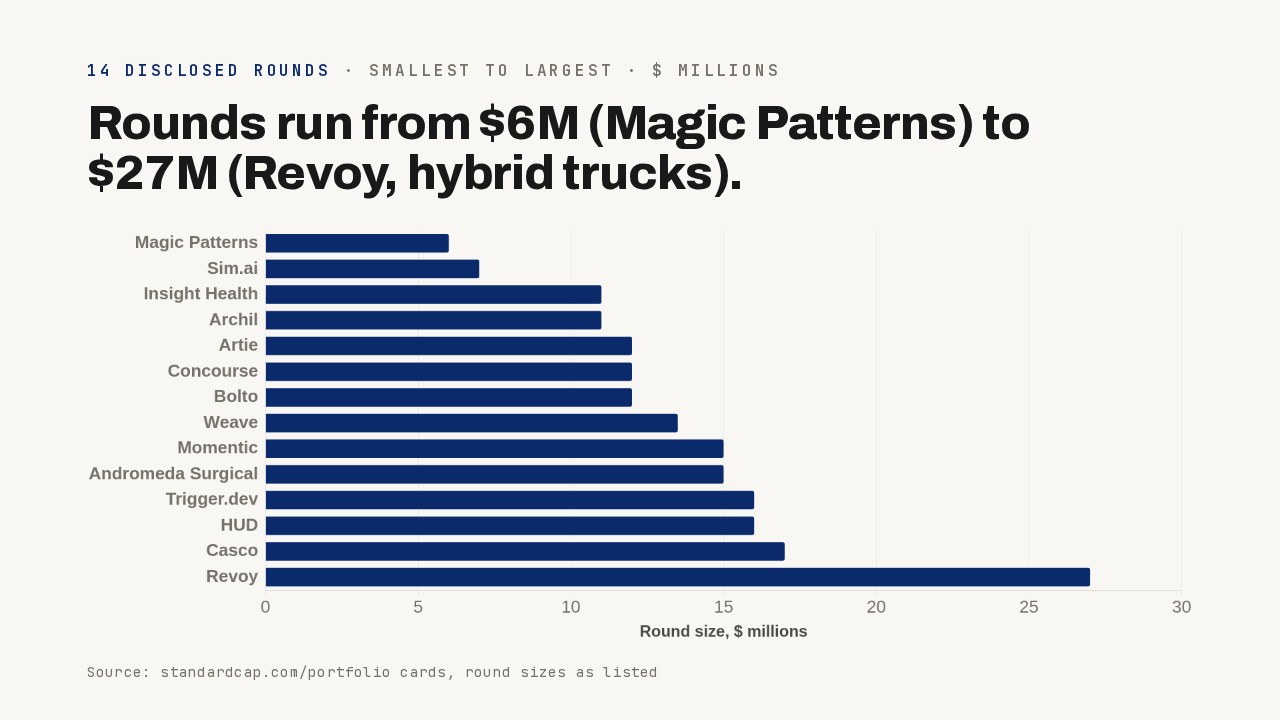
Rounds run $6M to $27M
Every bar is a round Standard led, smallest to largest, in millions of dollars. On the left, Magic Patterns at six million, a company that was already profitable at a million dollars of annual revenue when it raised. The middle of the chart sits between eleven and sixteen million. Then the bar on the far right. Revoy, twenty seven million, the biggest round in the portfolio, and it's a battery dolly for diesel trucks. Together the fourteen disclosed rounds come to about one hundred ninety million dollars.
A $15M round is not a $15M check from Standard
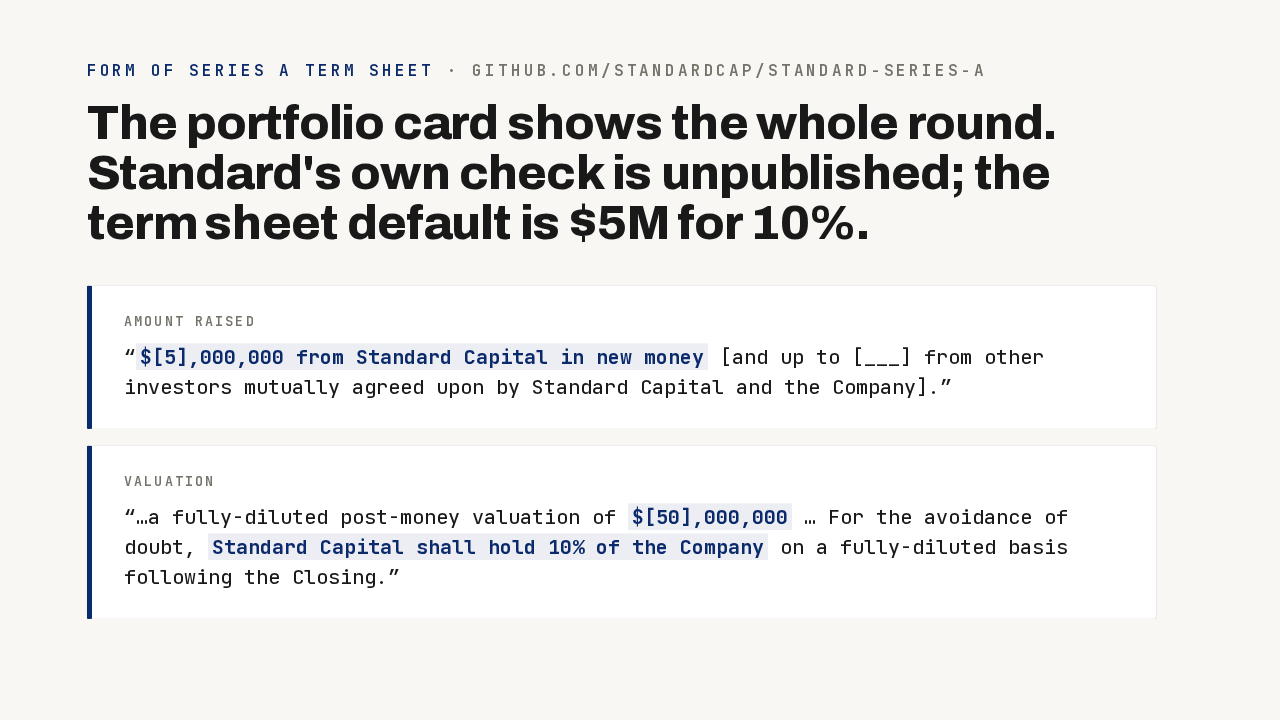
One thing those bars hide. The card shows the round, and the round is bigger than Standard's check. The published term sheet is written with a bracketed default of five million dollars from Standard in new money, plus a blank for other investors the founder brings in. The default valuation is fifty million post-money, and the sentence that matters says Standard holds ten percent after the closing. So the firm's own money per deal is unpublished, and I'm not going to guess it.
Sort the fifteen yourself
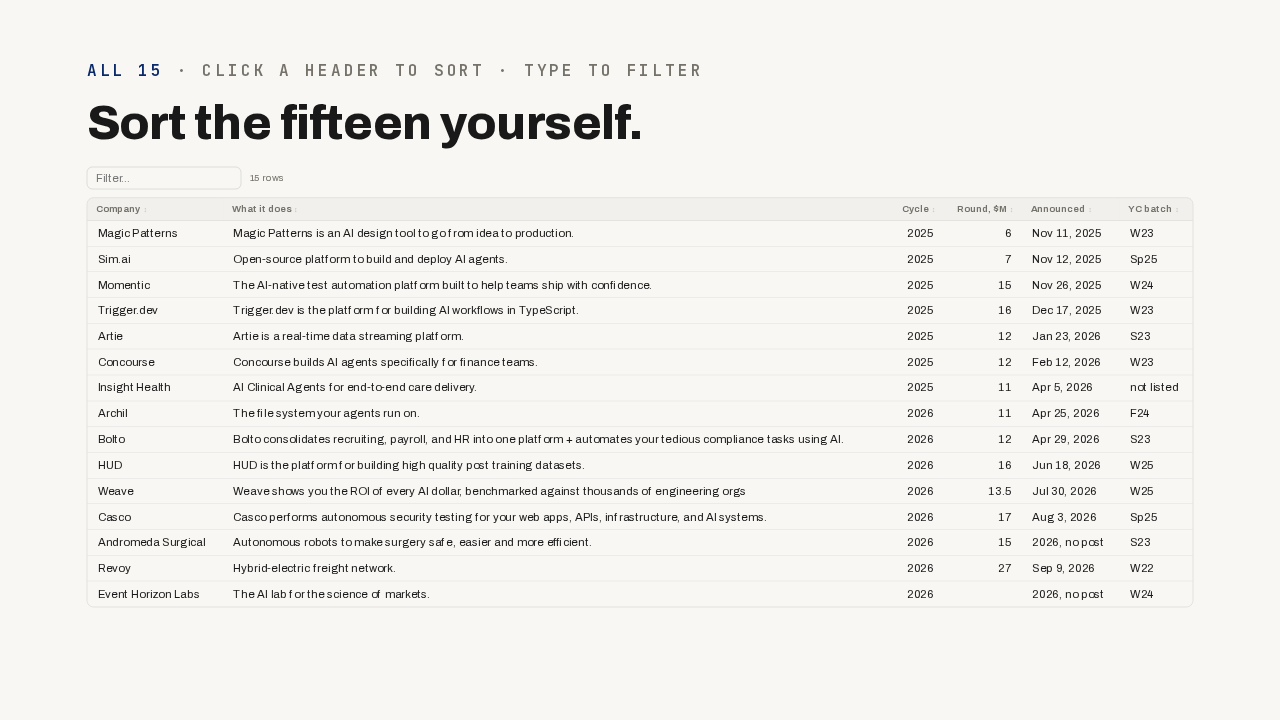
Here is the full list, with what each company does and the batch it came from. Let me sort it by round size. Revoy, Casco, Trigger.dev and HUD at the top, all infrastructure or hardware. Now just the 2025 cycle. Seven companies, and every one of them is software. Go ahead and sort it any way you like. Whichever way you cut it, the 2026 rows are where the fund changed.
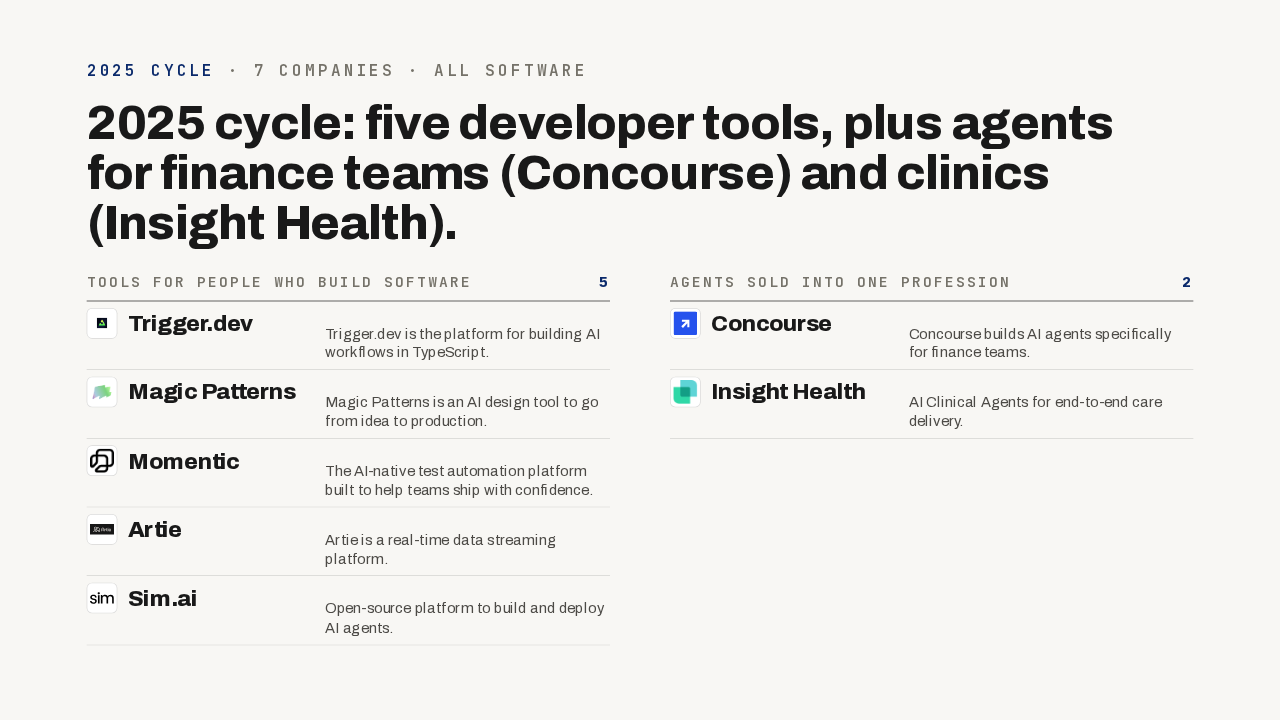
2025 cycle: five developer tools, Concourse, Insight Health
 Trigger.devTrigger.dev is the platform for building AI workflows in TypeScript.
 Magic PatternsMagic Patterns is an AI design tool to go from idea to production.
 MomenticThe AI-native test automation platform built to help teams ship with confidence.
 ArtieArtie is a real-time data streaming platform.
 Sim.aiOpen-source platform to build and deploy AI agents.
 ConcourseConcourse builds AI agents specifically for finance teams.
 Insight HealthAI Clinical Agents for end-to-end care delivery.
Take the 2025 cycle first. Five of the seven are tools for people who build software. Trigger.dev runs long agent workflows in TypeScript. Magic Patterns turns a prompt into production React. Momentic writes end to end tests in plain English. Artie streams database changes in seconds. Sim is an open source canvas for agents, at seventeen thousand GitHub stars. The other two sell agents into one profession each. Concourse to finance teams, Insight Health to specialty medical practices.
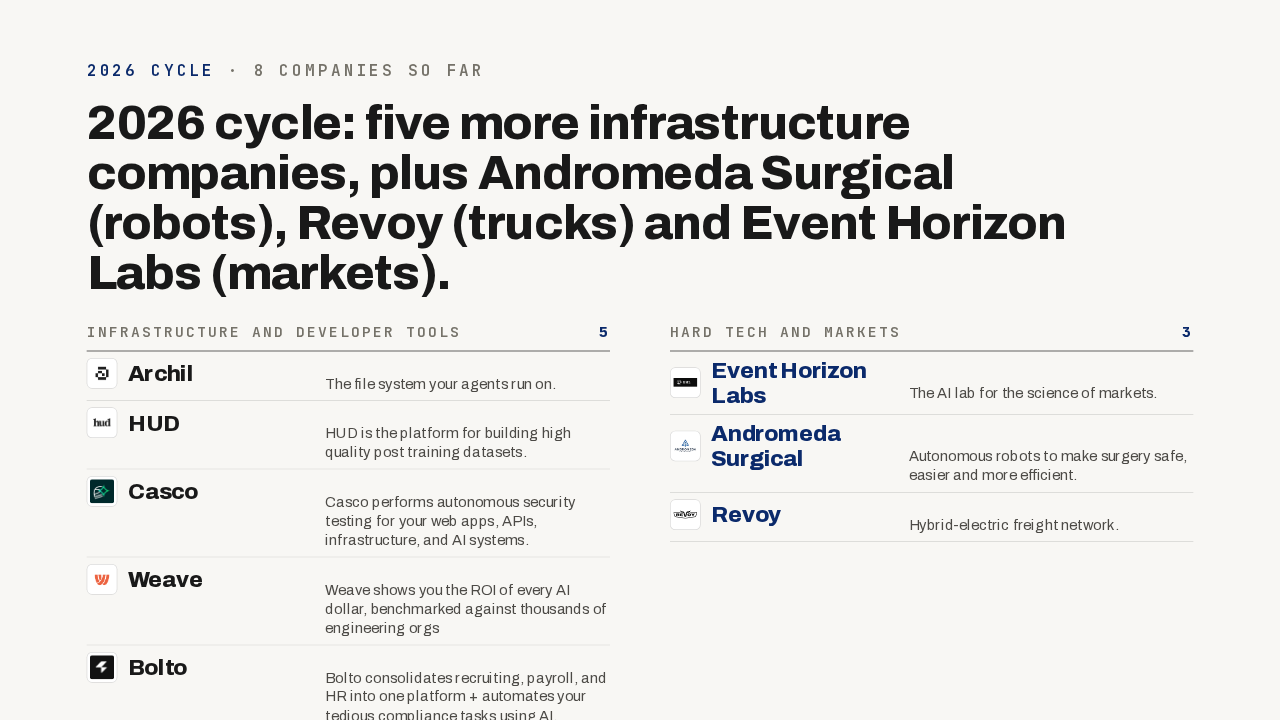
2026 cycle: infrastructure, plus Andromeda Surgical, Revoy, Event Horizon Labs
 ArchilThe file system your agents run on.
 HUDHUD is the platform for building high quality post training datasets.
 CascoCasco performs autonomous security testing for your web apps, APIs, infrastructure, and AI systems.
 WeaveWeave shows you the ROI of every AI dollar, benchmarked against thousands of engineering orgs
 BoltoBolto consolidates recruiting, payroll, and HR into one platform + automates your tedious compliance tasks using AI.
 Event Horizon LabsThe AI lab for the science of markets.
 Andromeda SurgicalAutonomous robots to make surgery safe, easier and more efficient.
 RevoyHybrid-electric freight network.
The 2026 cycle still leans on infrastructure. Archil is a file system for agents. HUD builds reinforcement learning environments and sells them to labs. Casco runs autonomous penetration tests. Weave measures what a company gets for each AI dollar. Bolto folds recruiting into payroll. Then three that break the pattern. Event Horizon Labs is an AI lab for markets. Andromeda Surgical builds autonomous surgical robots. And Revoy converts a diesel semi to hybrid with a battery dolly between the tractor and the trailer.
Twelve days before the Revoy round, a post on funding hard tech

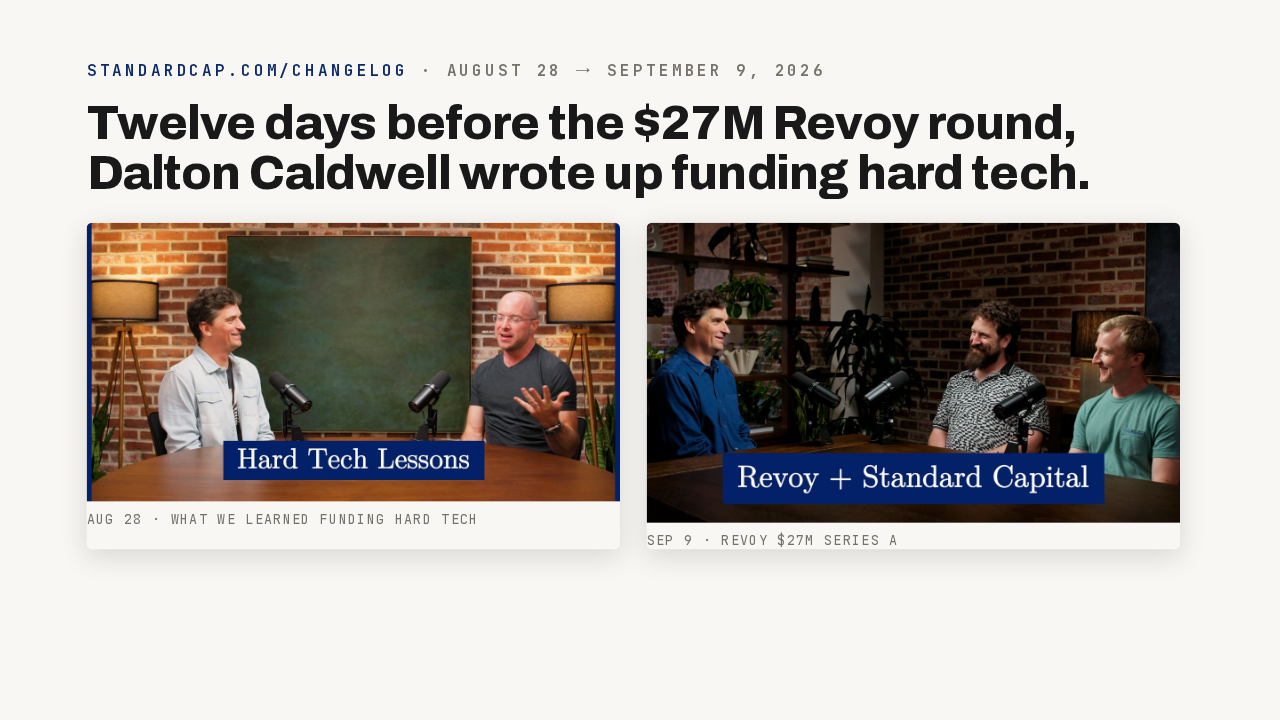
The sequence on the changelog says this was deliberate. August 28th, Dalton Caldwell publishes What We Learned Funding Hard Tech. It's about Ginkgo, Oklo, Rigetti and Helion at Y Combinator, and one rule: set up the next proof, perform the next miracle, earn the right to keep going. September 9th, the firm leads Revoy's twenty seven million dollar round, its largest. The tagline still reads the AI-native Series A firm. The checks read wider than that.
03 · The catches: YC, re-vesting, fixed termses: YC, re-vesting, fixed terms
The catches: YC, re-vesting, and fixed terms.
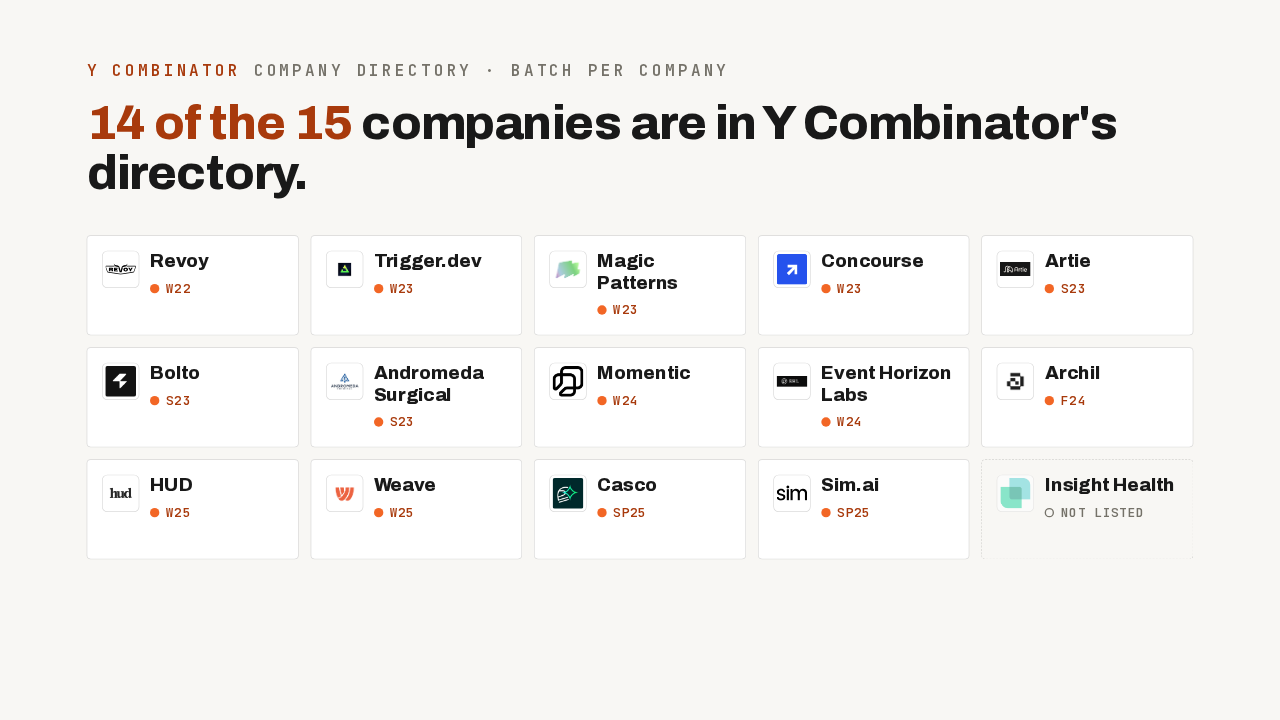
14 of the 15 are in Y Combinator's directory
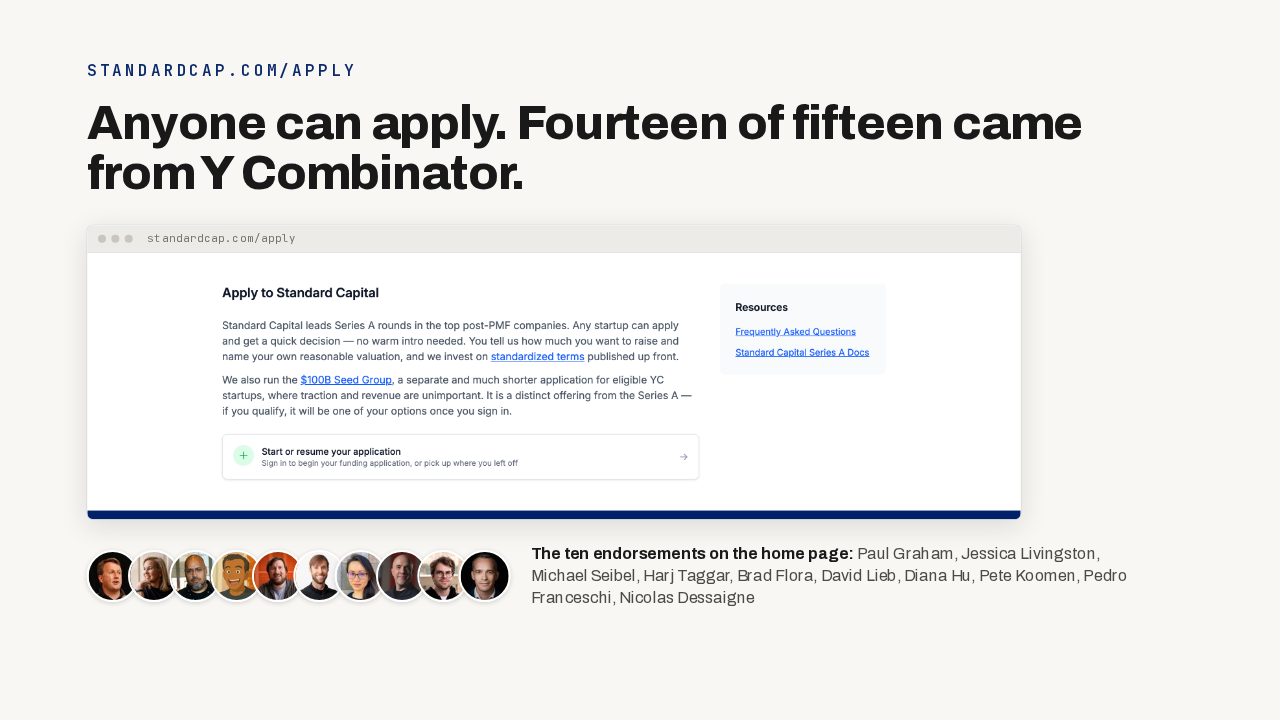
Now the pattern under the pattern. Check each of the fifteen against Y Combinator's public company directory and fourteen are there, from Revoy in the winter 2022 batch to Casco and Sim in spring 2025. The one I could not find is Insight Health. The firm is open about the relationship. The apply page runs a separate seed program only for eligible YC startups, and Dalton spent twenty five batches choosing companies for YC.
Anyone can apply. Fourteen of fifteen came from Y Combinator.


So is no warm intro needed an honest line? Yes, as a rule. Anyone can sign in and fill out the form. But a company with product market fit that Dalton has watched since demo day skips the part where a stranger has to prove traction from zero. I read that as the edge, and also as the limit. If you didn't do YC, you are competing for one of about five slots a quarter against founders the partners already know.
75% of each founder's equity re-vests over at least three years
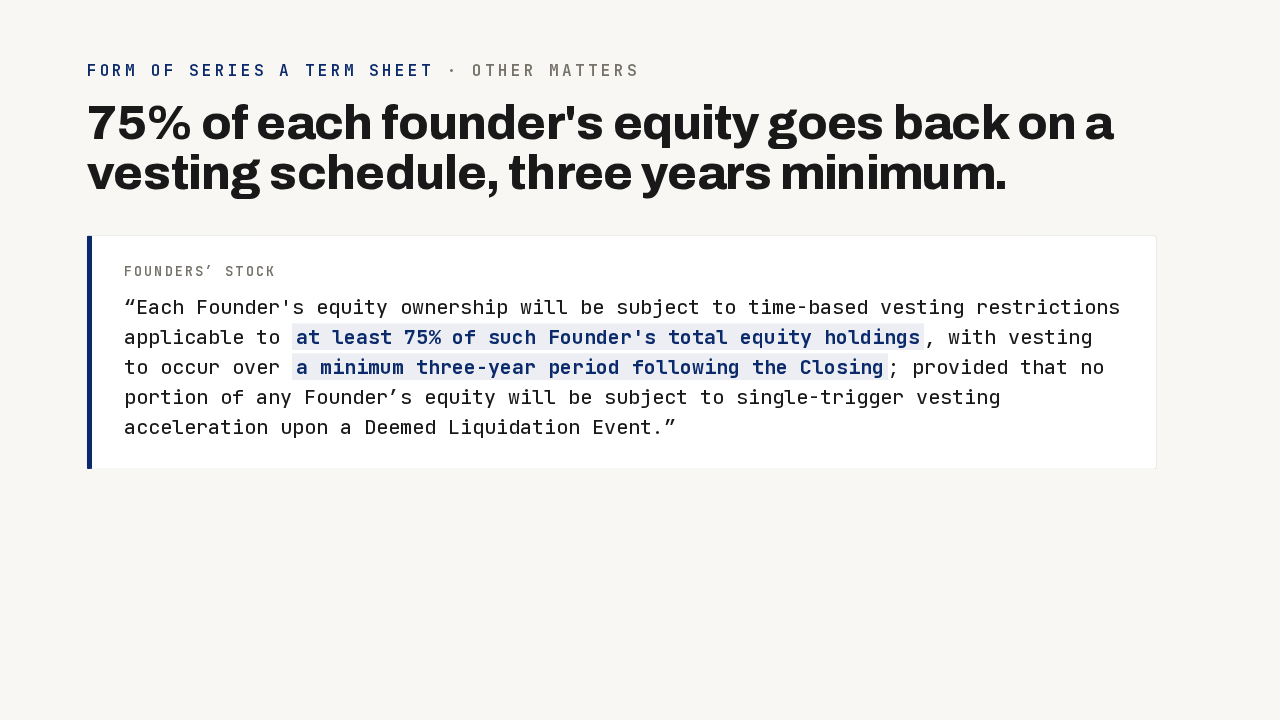
Here is the clause I would read twice. Founders' stock. At least seventy five percent of each founder's total equity goes back on a vesting schedule, over a minimum of three years from the closing, and none of it accelerates on a single trigger if the company is sold. A founder who started in 2022 and has fully vested gets re-locked for three more years. Plenty of Series A term sheets ask for this. This one does not let you argue about it, because the docs page says none of it is negotiated.
Five days to sign, ten days of no-shop, and you name the valuation
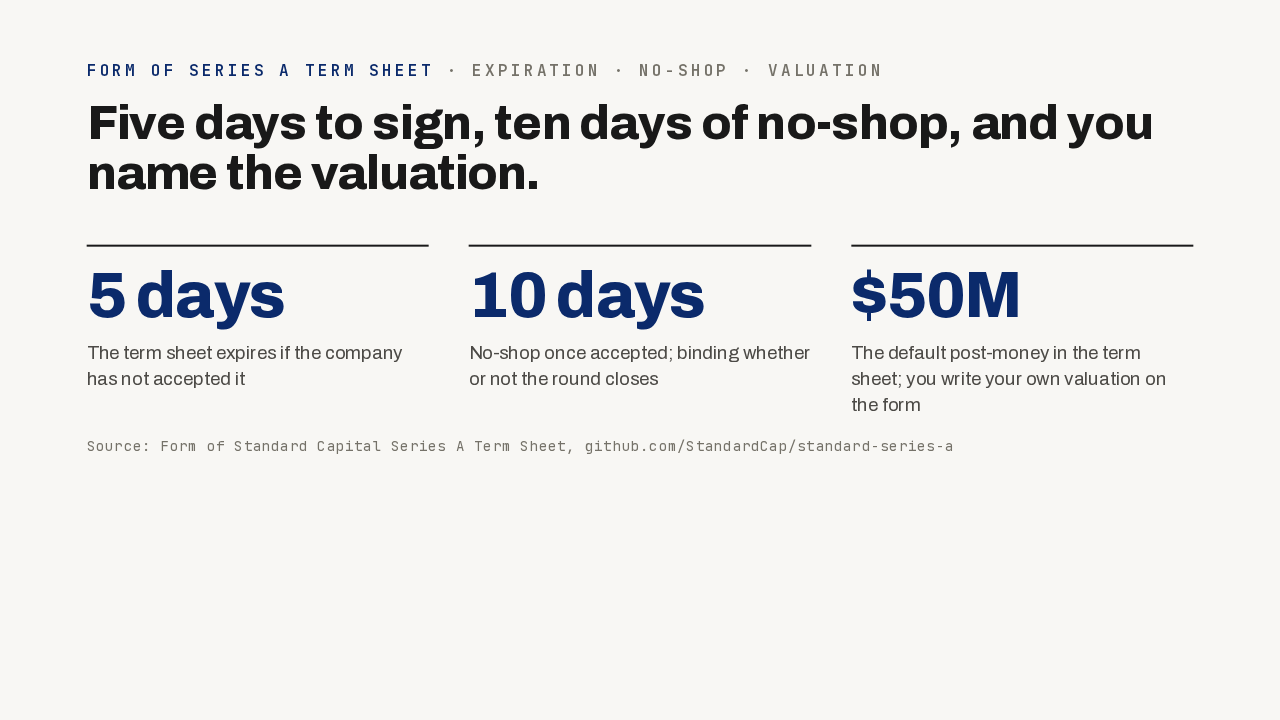
The rest of the paper is a clock. The term sheet expires five days after it is issued. Accepting it starts a ten day no-shop, and that clause binds the company whether or not the round closes. The founder chooses the valuation and the round size on the application; the document's bracketed default is fifty million post-money. You name the valuation and the round size, and you take the rest as written.
Revenue and usage from the announcement posts
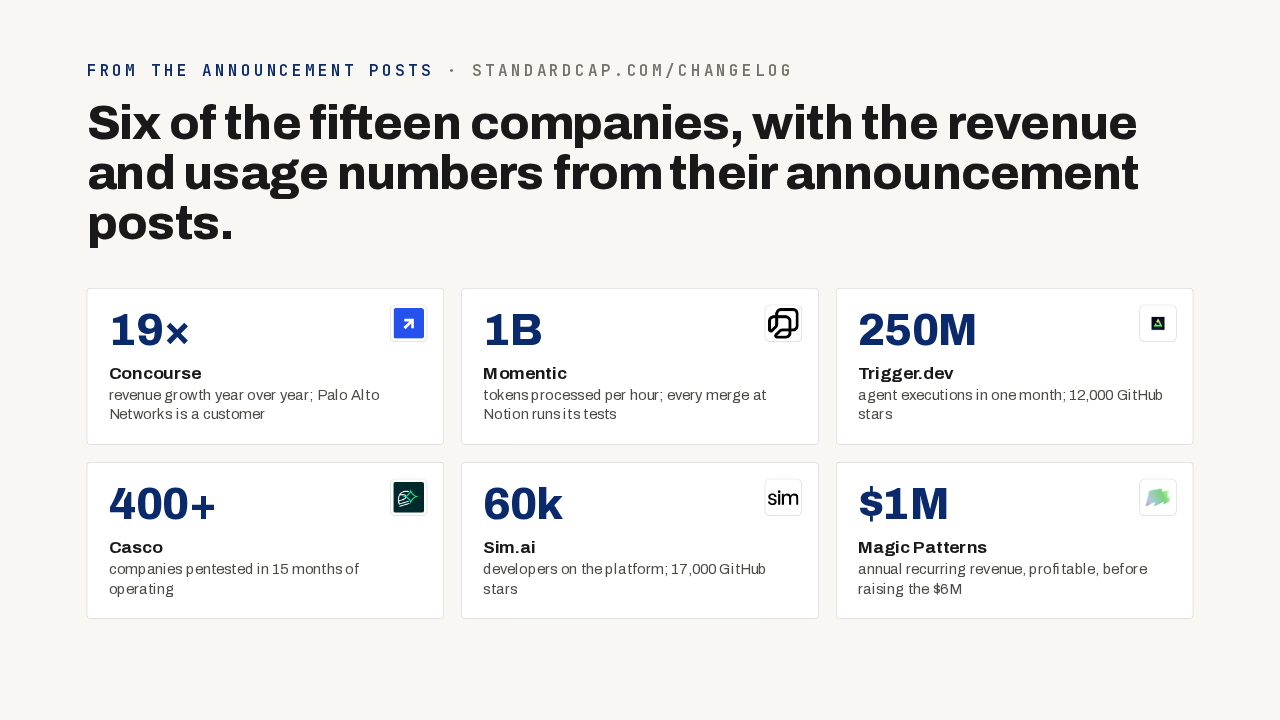
What post product market fit means in practice is in the announcement posts. Concourse grew revenue nineteen times year over year, with Palo Alto Networks as a customer. Momentic processes over a billion tokens an hour and every merge at Notion runs its tests. Trigger.dev ran two hundred fifty million agent executions in one month. Casco has tested more than four hundred companies in fifteen months. Magic Patterns was profitable at a million dollars of revenue before it took six. Each of these came to Standard with paying customers.
04 · Should you apply?
Should you apply?
Should you apply?
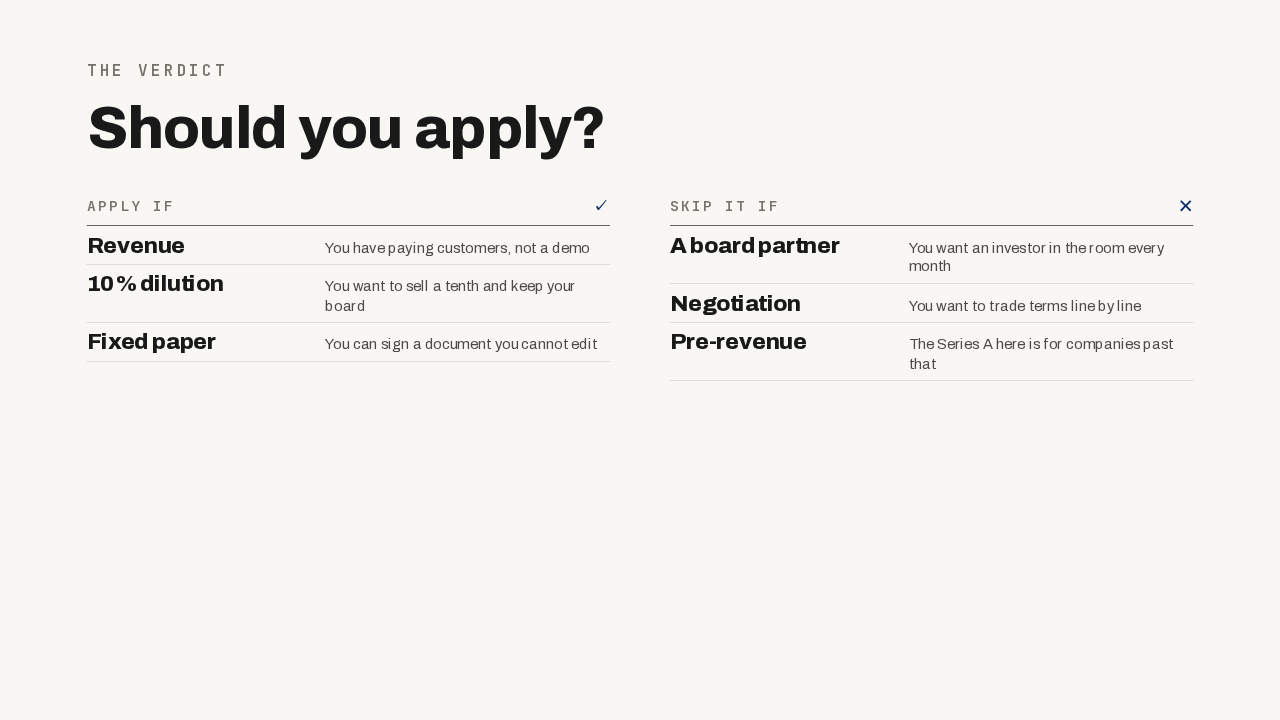
Should you apply? If you have real revenue, you want to sell ten percent and keep your board, and you're fine signing paper you cannot edit, I'd apply, and I'd do it before the cycle deadline rather than emailing. If you want an investor who negotiates, sits on your board, and shows up in your Slack, this is the wrong firm on purpose. Their support model is a quarterly founder meetup in San Francisco and office hours on request.
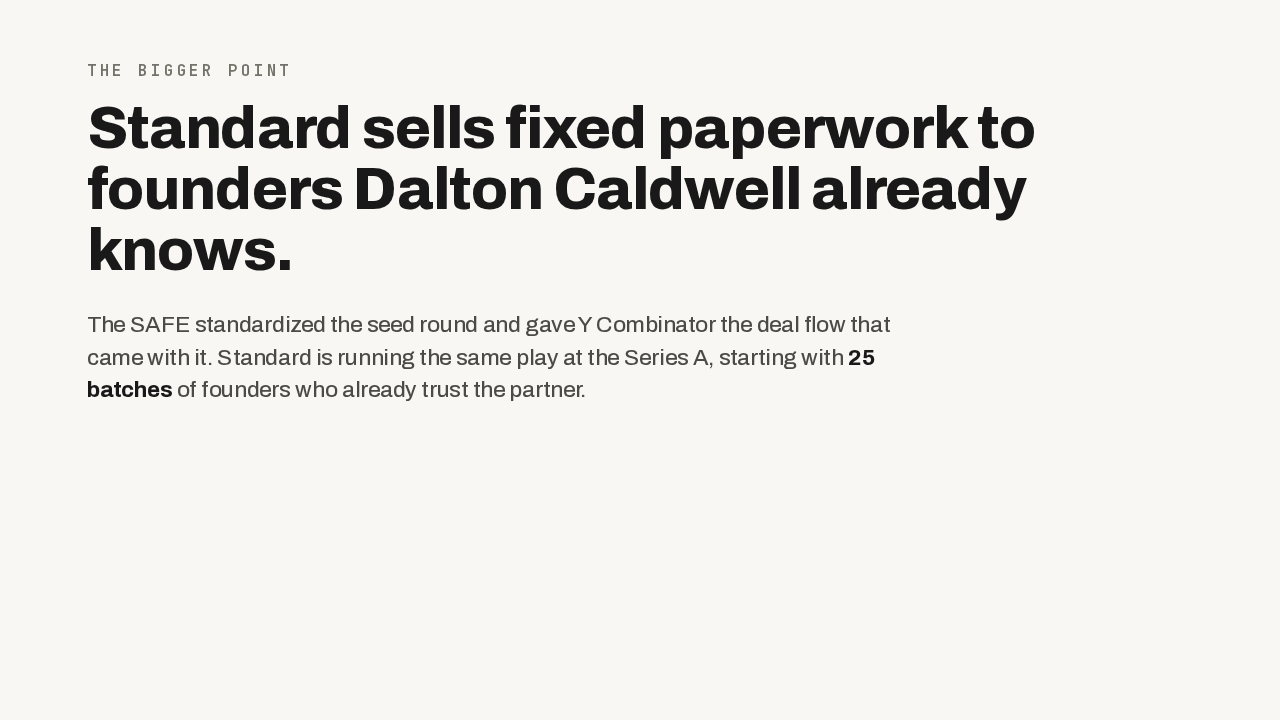
Fixed paperwork sold to founders Dalton already knows
The bigger point. Y Combinator standardized the seed round with the SAFE and won the deal flow that came with it. Standard is trying to do the same to the Series A, and it starts with a sourcing advantage most new funds would kill for: twenty five batches of founders who already trust the partner. The AI-native label is the marketing. Fixed terms plus that network is the business.
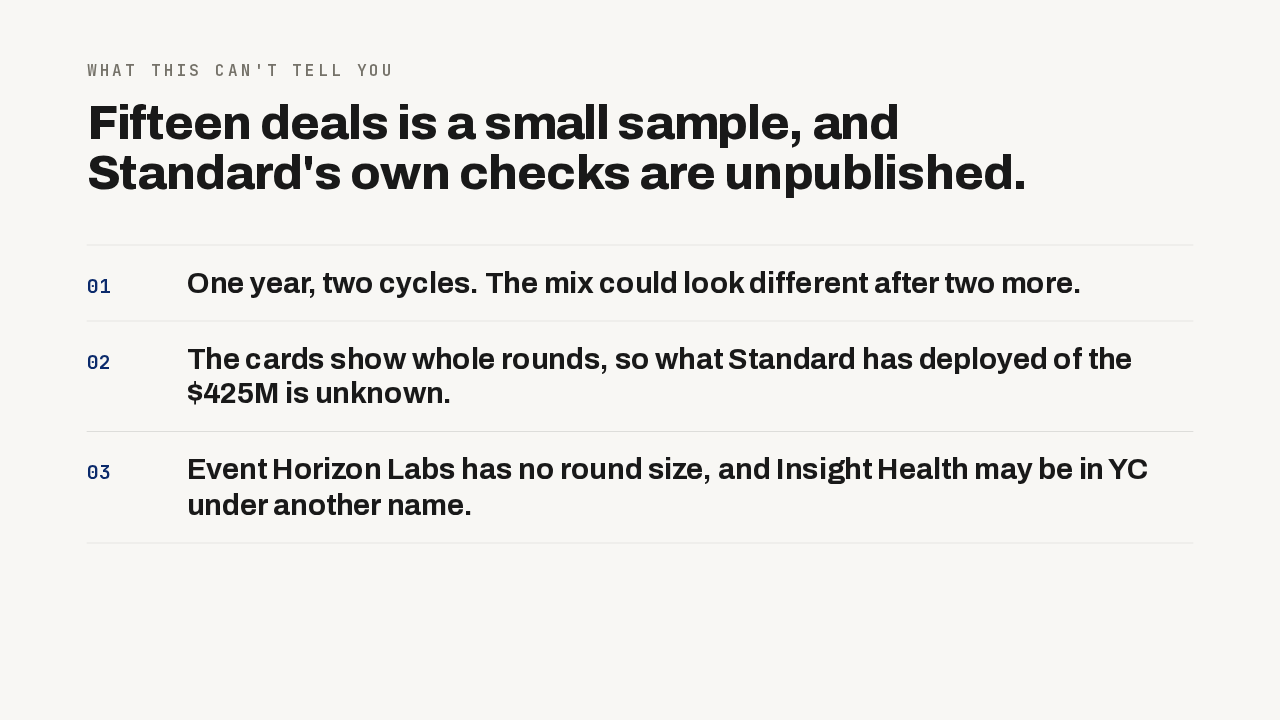
Fifteen deals is a small sample, and the checks are unpublished
Two limits on everything I just said. Fifteen deals is a small sample and the fund is a year old. The mix could look different after two more cycles. And the sizes on the cards are whole rounds, so I cannot tell you how much of the four hundred twenty five million Standard itself has deployed. Event Horizon Labs has no size at all, and Insight Health might be a YC company under a name the directory doesn't match.
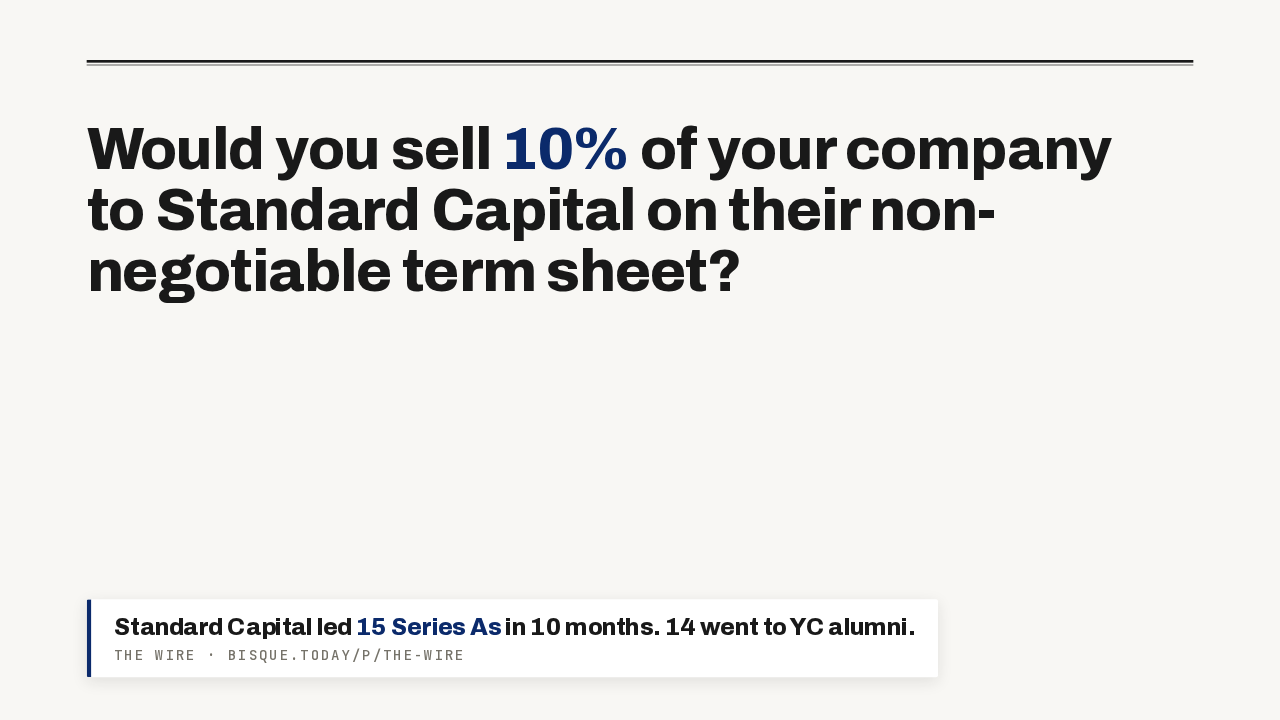
Would you sell 10% to Standard Capital on their non-negotiable term sheet?
So the question for you, if you're running a company with revenue. Would you sell ten percent of your company to Standard Capital on their non-negotiable term sheet, with no board seat, instead of doing a negotiated round with a partner on your board? Standard Capital led fifteen Series As in ten months, and fourteen went to YC alumni. This is the first fund portfolio The Wire has read end to end. Tell me whose to read next.
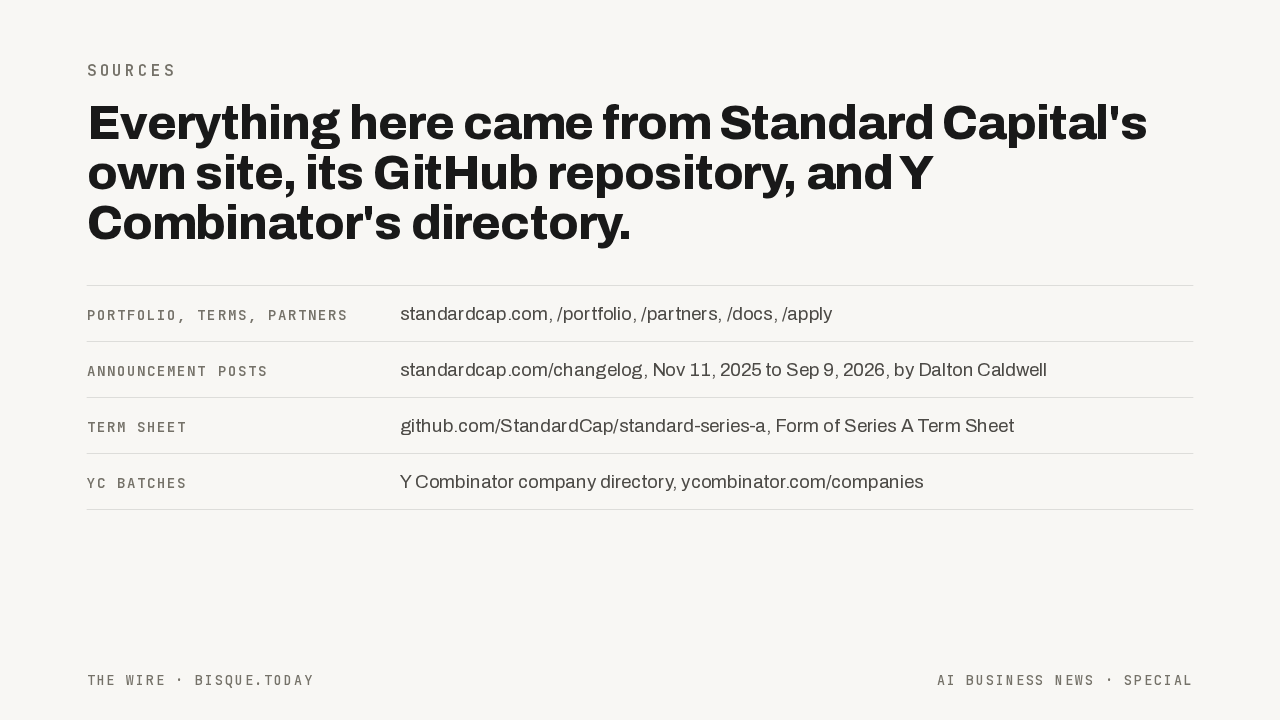
Sources
Everything on screen came from Standard Capital's own site and GitHub repository, and the batch years from Y Combinator's company directory. That's The Wire.