

Pipecat v1.14.0
 PipecatNemotron Omni
Pipecat v1.14.0 lets NVIDIA Nemotron Omni hear your users directly
One request transcribes and answers each spoken turn, in place of your STT service
Pipecat v1.14.0 runs NVIDIA's Nemotron Omni, which hears the user itself. It transcribes and answers each spoken turn in one request, replacing your speech-to-text service. You still need a TTS.
Omni modes
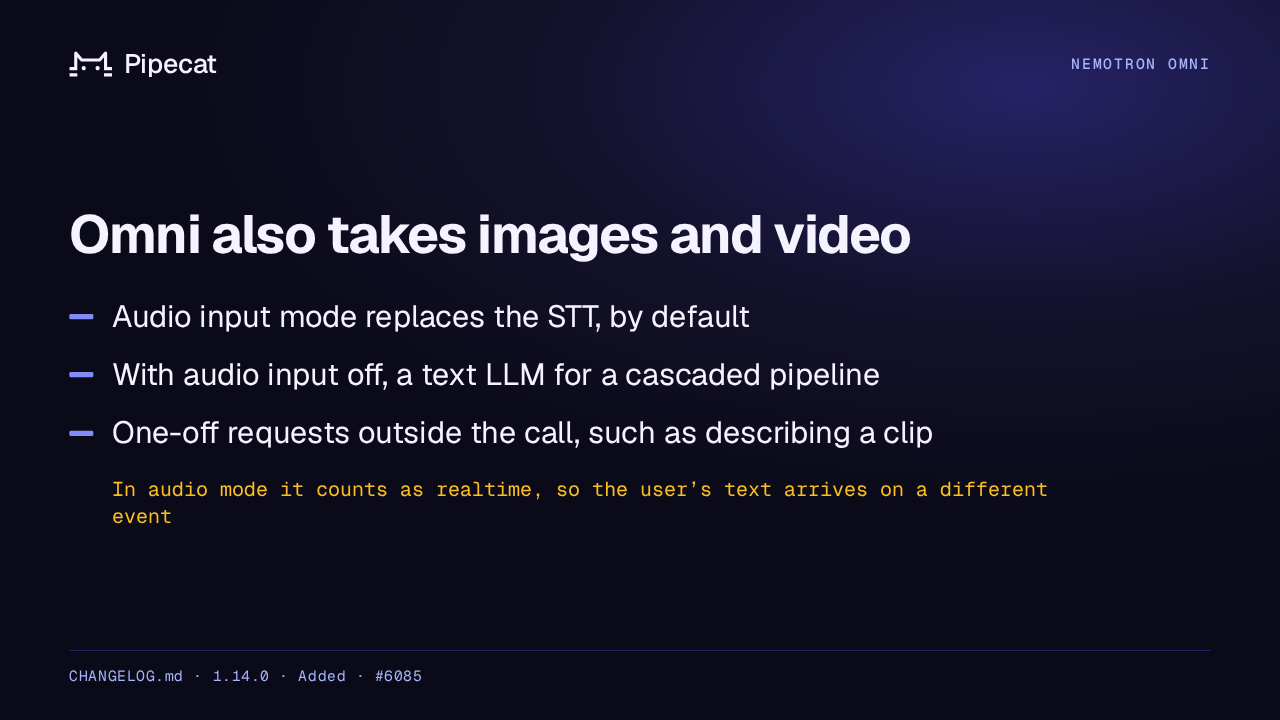
PipecatNemotron OmniOmni also takes images and video
- Audio input mode replaces the STT, by default
- With audio input off, a text LLM for a cascaded pipeline
- One-off requests outside the call, such as describing a clip
In audio mode it counts as realtime, so the user’s text arrives on a different event
Omni reads images and video as well as speech. Turn audio input off and it works as a text LLM. In audio mode it counts as a realtime service, so the user's text arrives on a different event.
New services
PipecatNew services.
Perplexity Agent API
Pipecat01 · New servicesPerplexity’s Agent API brings web search and function calls
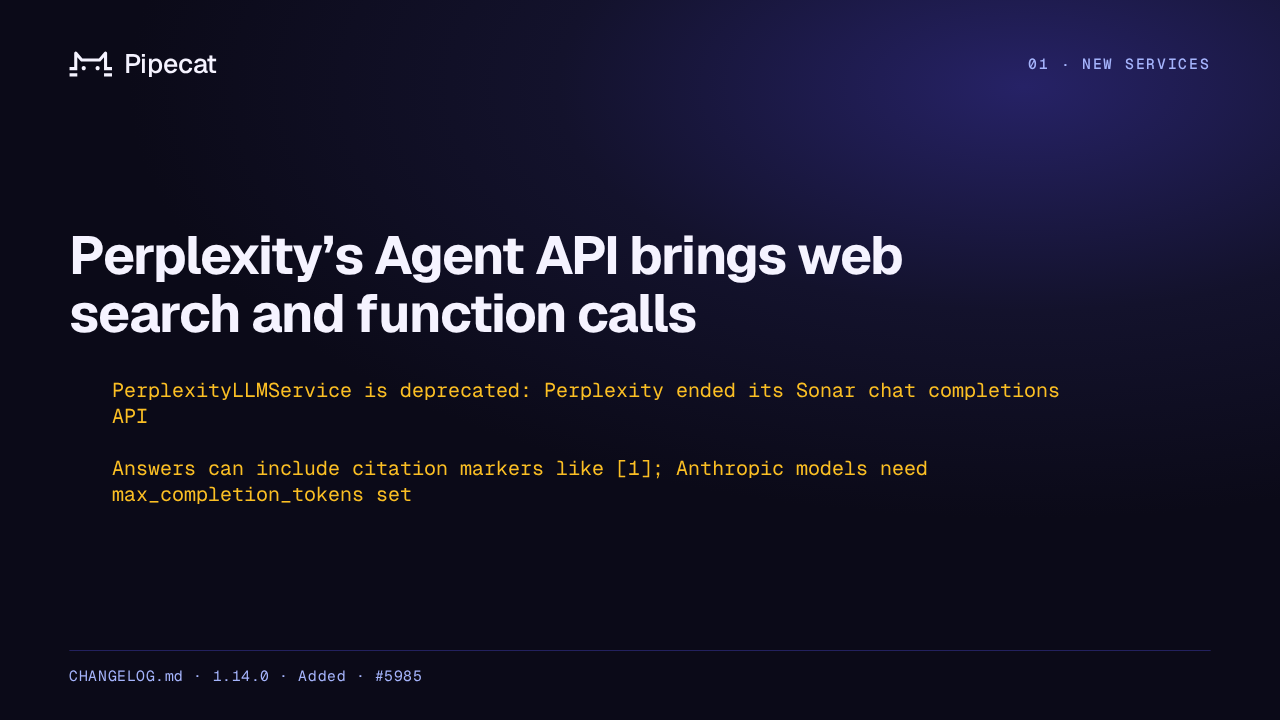
PerplexityLLMService is deprecated: Perplexity ended its Sonar chat completions API
Answers can include citation markers like [1]; Anthropic models need max_completion_tokens set
A new Perplexity service runs on the Agent API, which searches the web and calls your functions. Answers can carry citation markers, and the old Perplexity service is deprecated, because Perplexity ended its Sonar API.
Zoom Scribe Live
Pipecat01 · New servicesZoom Scribe Live streams speech-to-text into Pipecat
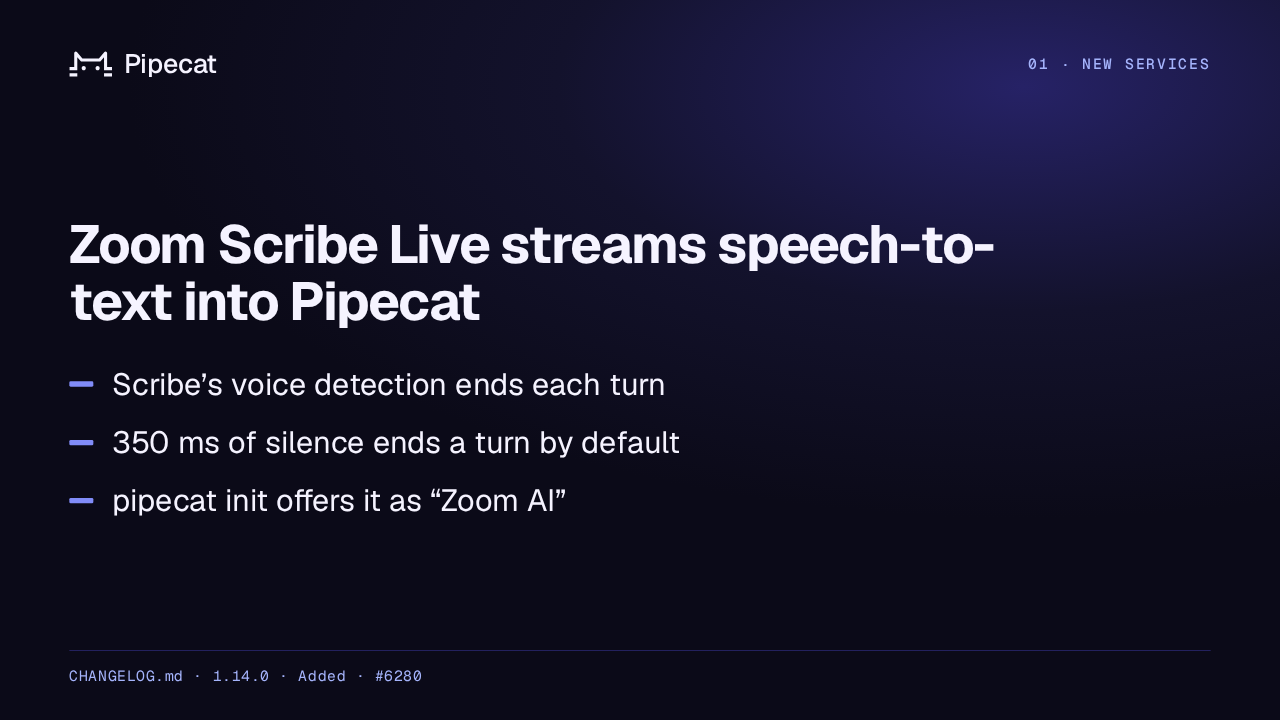
- Scribe’s voice detection ends each turn
- 350 ms of silence ends a turn by default
- pipecat init offers it as “Zoom AI”
Zoom's Scribe Live now streams transcripts into Pipecat. Scribe's own voice detection decides when a turn ends, after 350 milliseconds of silence by default, and pipecat init offers it as Zoom AI.
NVIDIA diarization
Pipecat01 · New servicesNVIDIA speech-to-text now says who is speaking
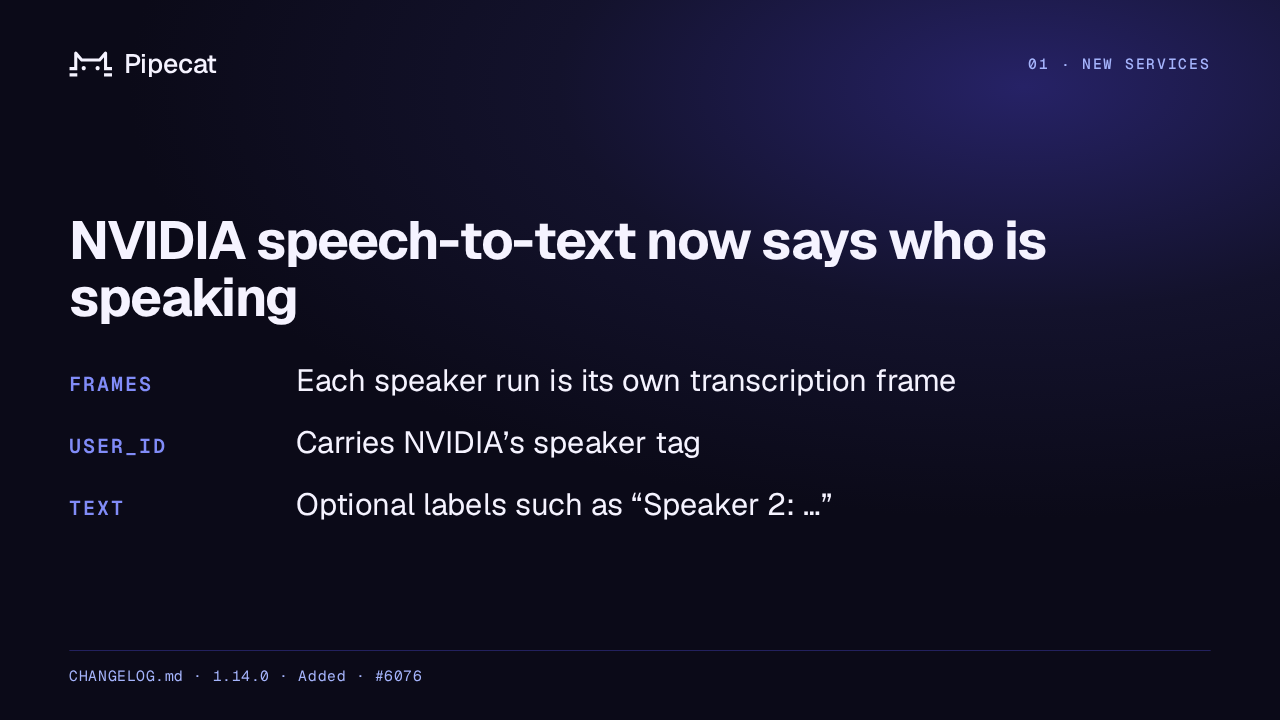
Turn on diarization and NVIDIA's speech-to-text splits each final result by speaker. Every speaker run becomes its own transcription frame, tagged with that speaker, and the transcript can carry speaker labels too.
Speechmatics, Smallest, Twilio
Pipecat01 · New servicesSpeechmatics now takes 8 kHz phone audio
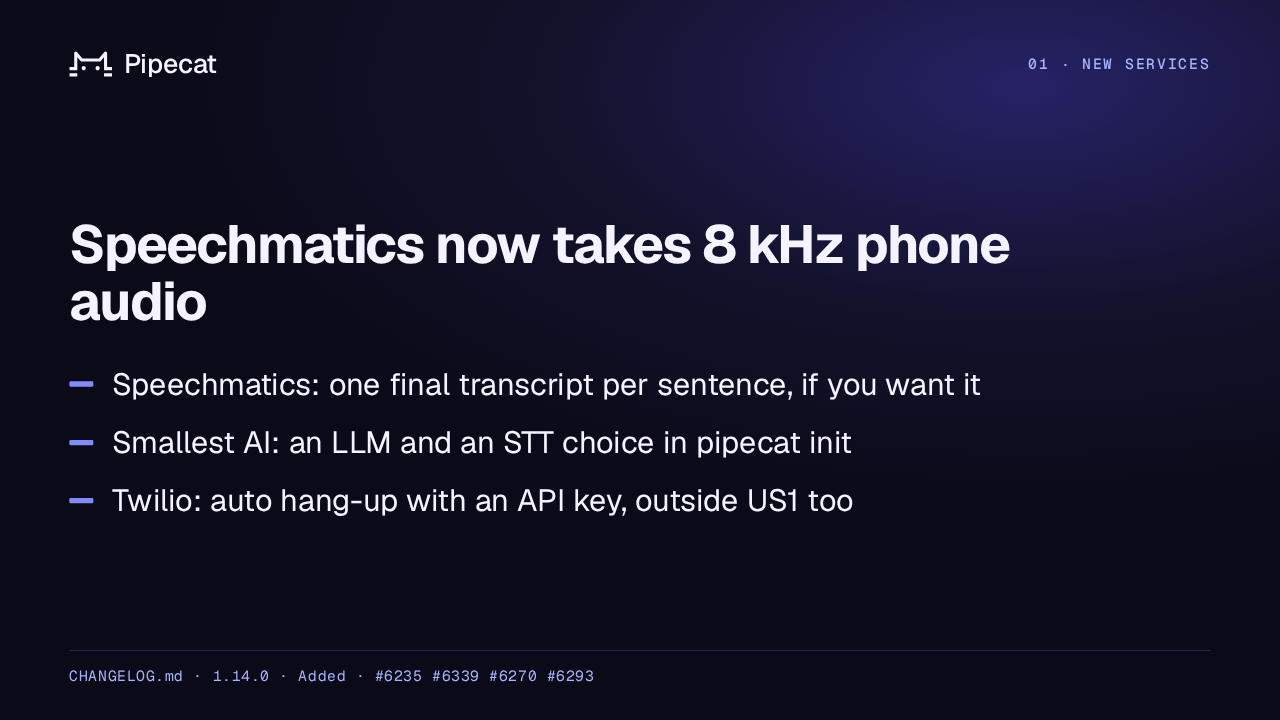
- Speechmatics: one final transcript per sentence, if you want it
- Smallest AI: an LLM and an STT choice in pipecat init
- Twilio: auto hang-up with an API key, outside US1 too
Speechmatics now accepts 8 kilohertz phone audio alongside 16. It can also emit each sentence as its own final. Smallest AI joins as an LLM and STT choice, and Twilio hang-up works with an API key.
What the bot says
PipecatWhat the bot says.
Text transforms
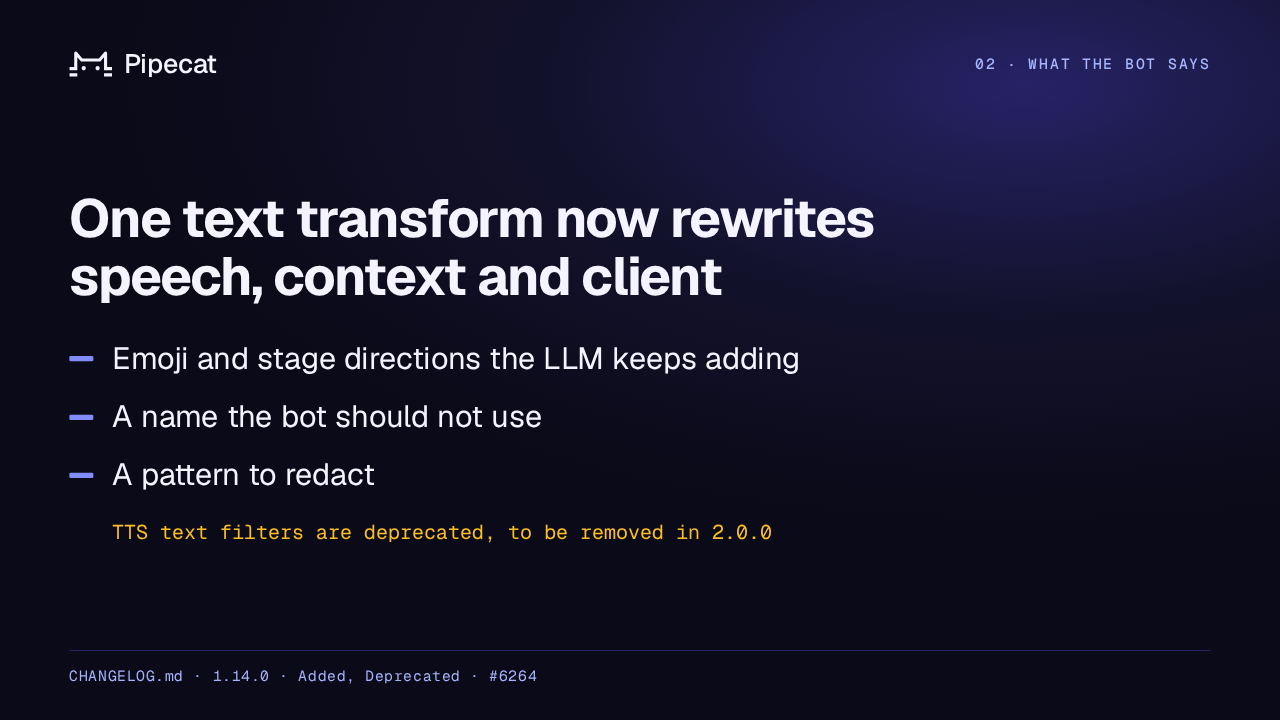
Pipecat02 · What the bot saysOne text transform now rewrites speech, context and client
- Emoji and stage directions the LLM keeps adding
- A name the bot should not use
- A pattern to redact
TTS text filters are deprecated, to be removed in 2.0.0
Text transforms now run on the LLM's reply before it splits toward the voice, the context and the client. Rewrite a habit or redact a name once, and all three get it.
Staying connected
PipecatStaying connected.
Websocket send timeout
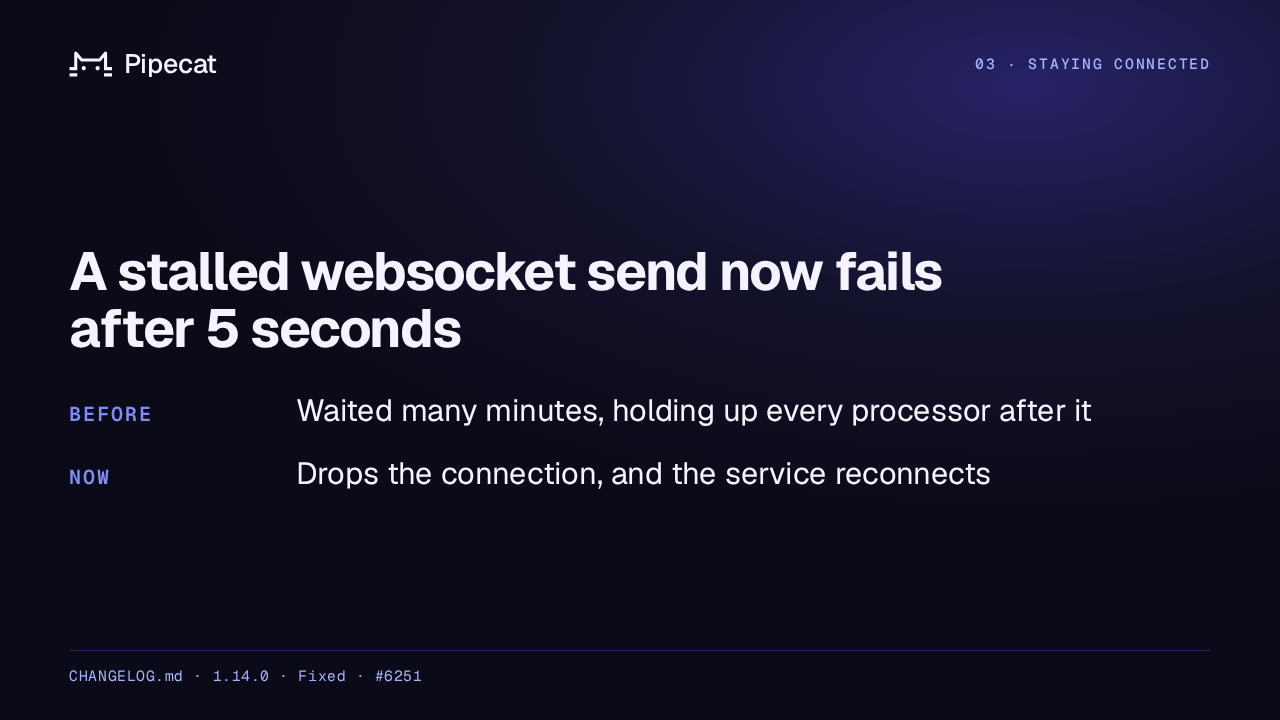
Pipecat03 · Staying connectedA stalled websocket send now fails after 5 seconds
A websocket send to a peer that stopped reading could stall the pipeline for many minutes, with no error. Each send now gives up after 5 seconds, and the service reconnects.
Dropped connections
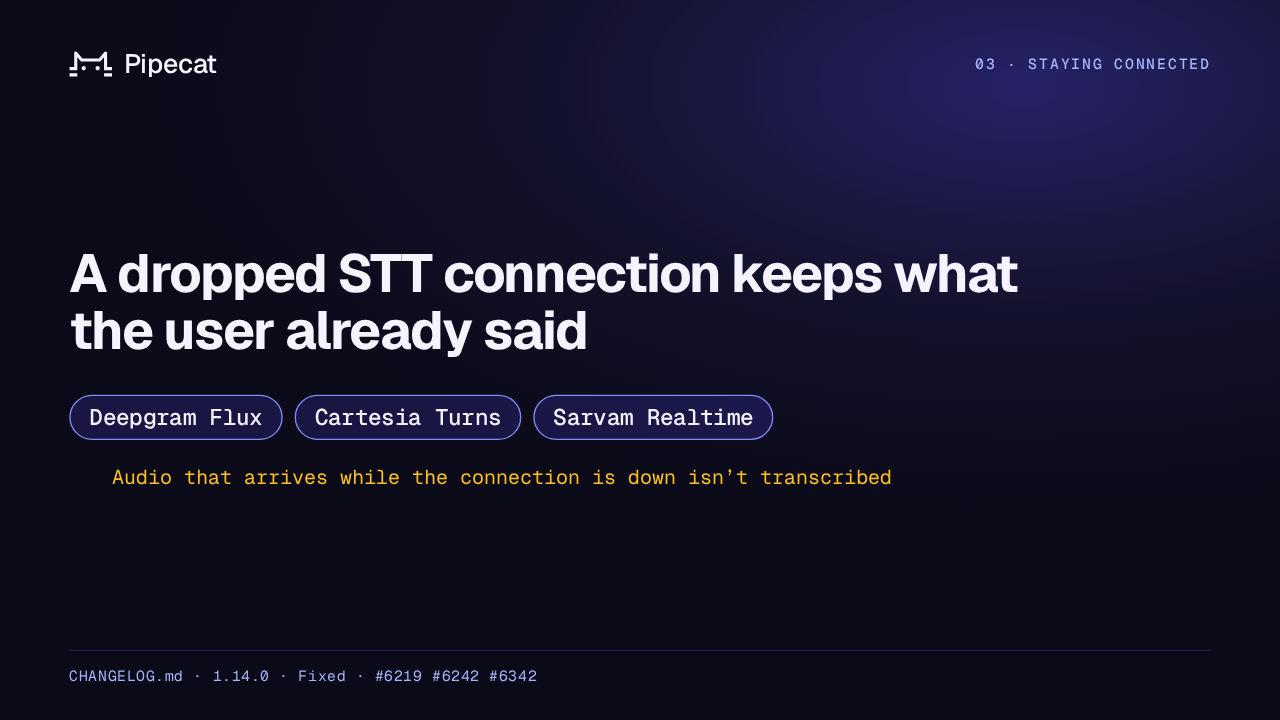
Pipecat03 · Staying connectedA dropped STT connection keeps what the user already said
Audio that arrives while the connection is down isn’t transcribed
When Deepgram Flux, Cartesia Turns or Sarvam lose their connection mid-turn, the turn now ends with the transcript so far. Flux and Cartesia reconnect in the background, but audio sent while they're down isn't transcribed.
Deepgram refusals
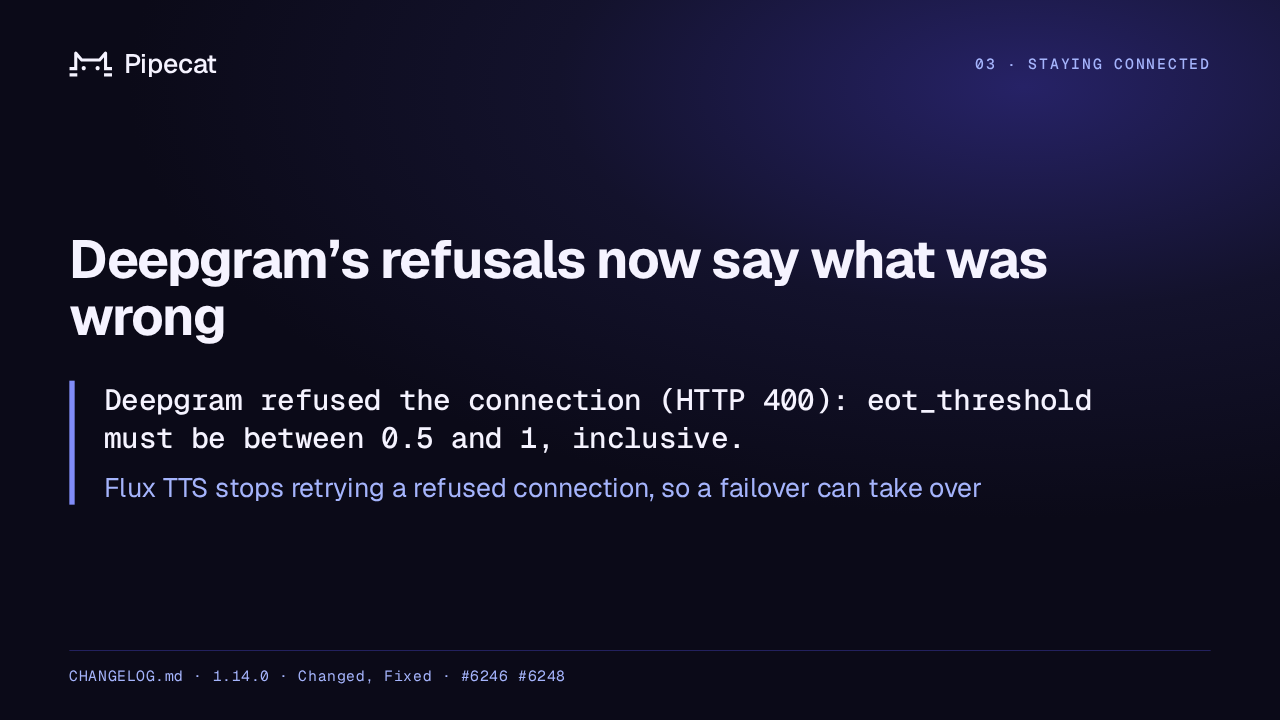
Pipecat03 · Staying connectedDeepgram’s refusals now say what was wrong
Deepgram's refusals now carry its reason, such as a setting out of range or a bad key. And Flux TTS stops retrying a refused connection, so a configured failover can take over.
Before you upgrade
PipecatBefore you upgrade.
New default models
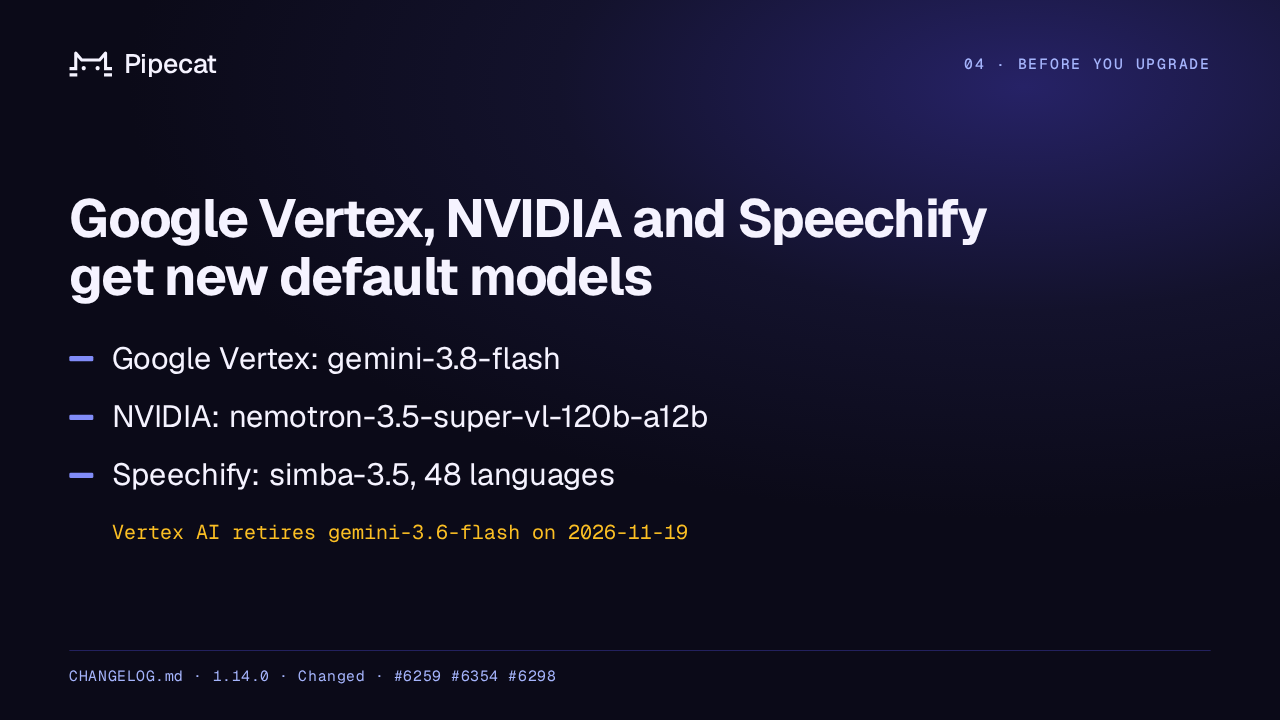
Pipecat04 · Before you upgradeGoogle Vertex, NVIDIA and Speechify get new default models
- Google Vertex: gemini-3.8-flash
- NVIDIA: nemotron-3.5-super-vl-120b-a12b
- Speechify: simba-3.5, 48 languages
Vertex AI retires gemini-3.6-flash on 2026-11-19
Google Vertex now defaults to Gemini 3.8 Flash, since Vertex retires 3.6 Flash on November 19th. NVIDIA moves to Nemotron 3.5 Super, and Speechify to Simba 3.5.
Needs attention
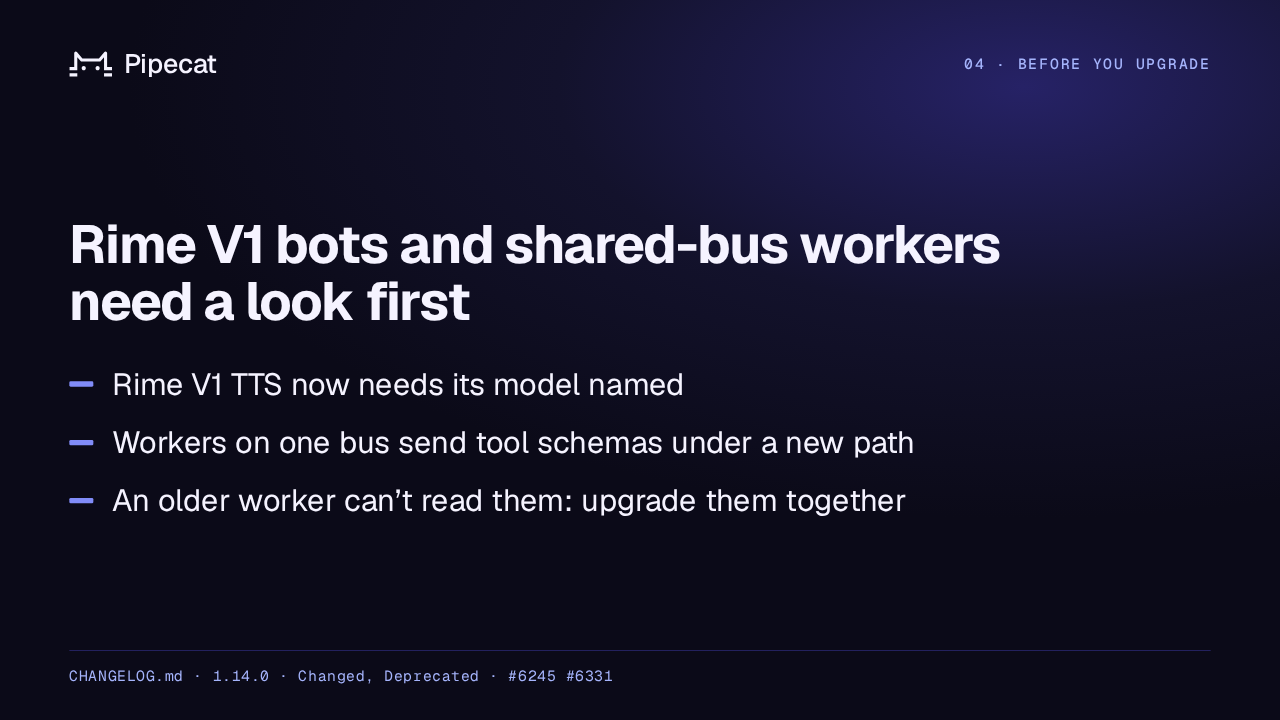
Pipecat04 · Before you upgradeRime V1 bots and shared-bus workers need a look first
- Rime V1 TTS now needs its model named
- Workers on one bus send tool schemas under a new path
- An older worker can’t read them: upgrade them together
Rime's V1 TTS service now requires you to name the model. Workers on a shared bus send tool schemas under a new module path, which an older worker can't read, so upgrade those workers together.
Security
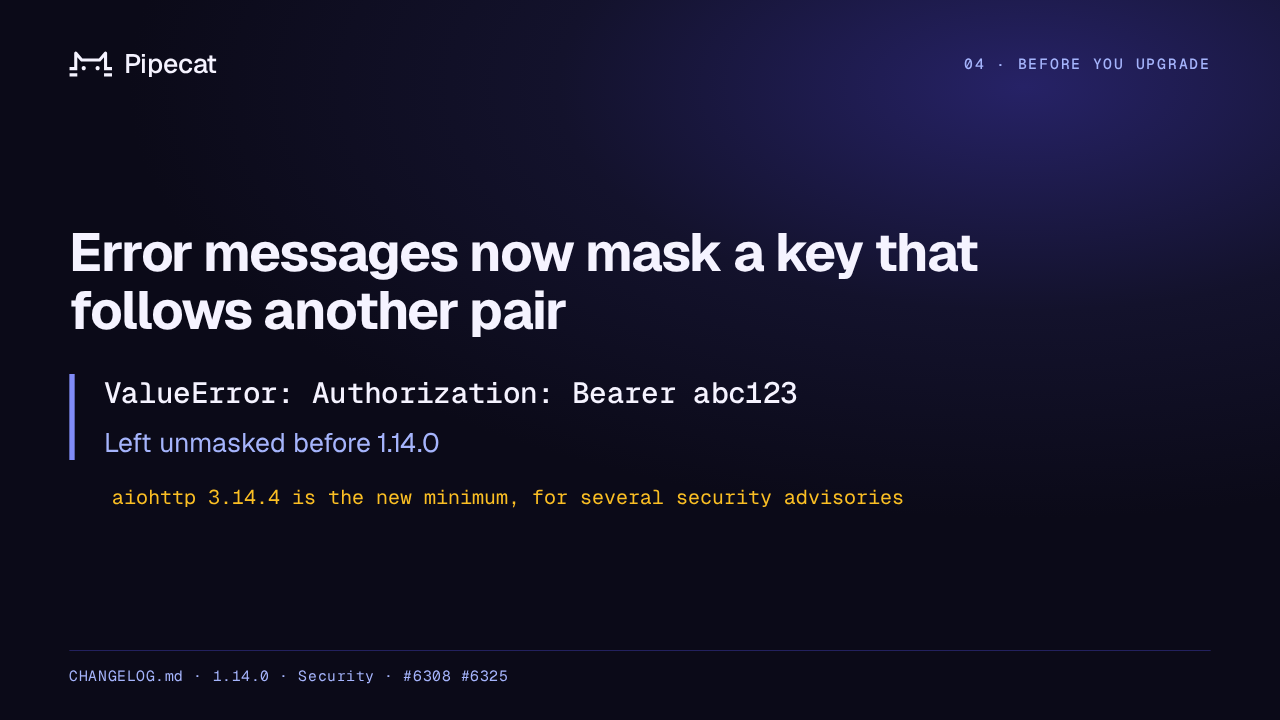
Pipecat04 · Before you upgradeError messages now mask a key that follows another pair
aiohttp 3.14.4 is the new minimum, for several security advisories
Error messages could leave a key showing when it followed another pair, like this authorization header. That key is masked now, and Pipecat requires a newer aiohttp with several security fixes.
Your turn
Pipecat04 · Before you upgradeWhich speech-to-text service does your Pipecat bot run on?
The upgrade steps for each change are in the Pipecat v1.14.0 release notes. So, which speech-to-text service does your Pipecat bot run on?