
Pipecat v1.13.0
 Pipecat01 · Files from the client
Pipecat v1.13.0 lets users send files and images to your voice bot
A new RTVI message, send-file, puts them in the LLM context
Pipecat v1.13.0 lets a user hand your voice bot a file or an image mid-call. The new send-file message puts it in the LLM context, for Anthropic, Bedrock, Gemini and OpenAI.
Files from the client
PipecatFiles from the client.
FileResolver
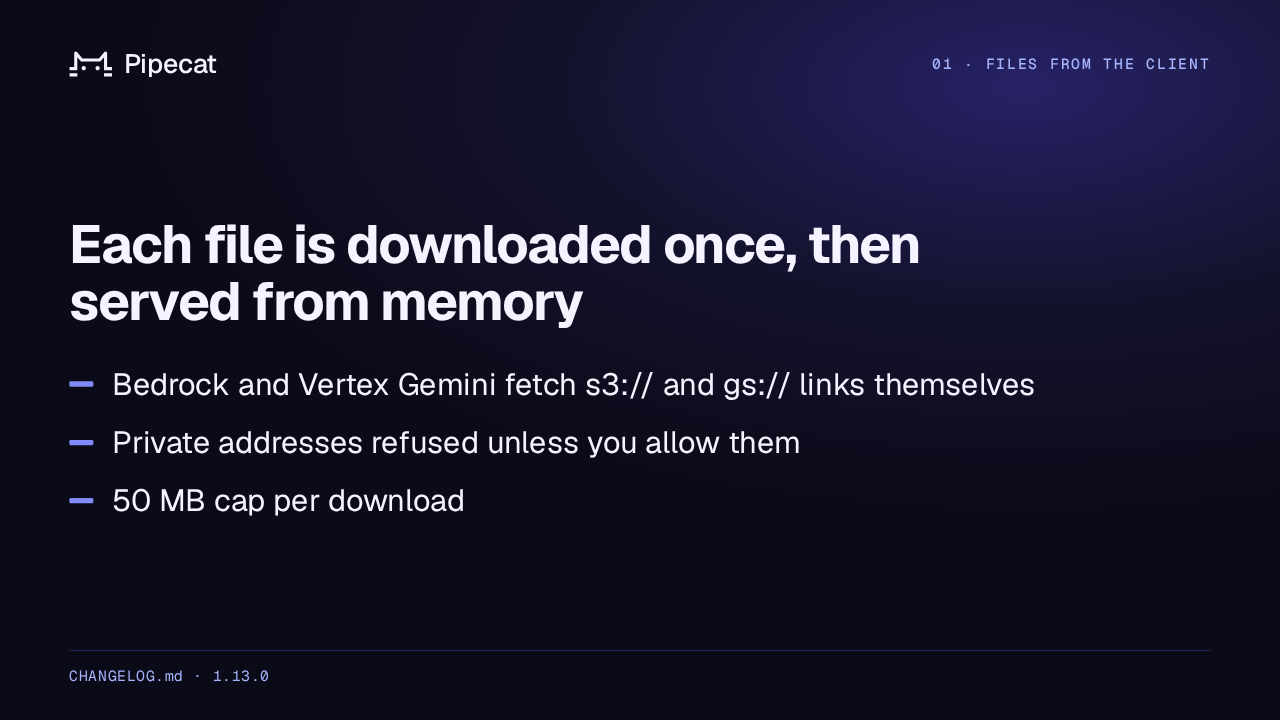
Pipecat01 · Files from the clientEach file is downloaded once, then served from memory
- Bedrock and Vertex Gemini fetch s3:// and gs:// links themselves
- Private addresses refused unless you allow them
- 50 MB cap per download
Pipecat fetches a file link right before each completion and caches the bytes, so a long call downloads it once. Bedrock and Vertex Gemini pull cloud storage links themselves.
Rejected files
Pipecat01 · Files from the clientA file the model rejects no longer jams the conversation
Clients send files only to bots on RTVI protocol 2.2.0
When a provider rejects a request, Pipecat drops the oldest file added since the last good reply, and the call carries on. Clients send files only to bots on RTVI 2.2.
Turn-taking
PipecatTurn-taking.
LLMWithBackend
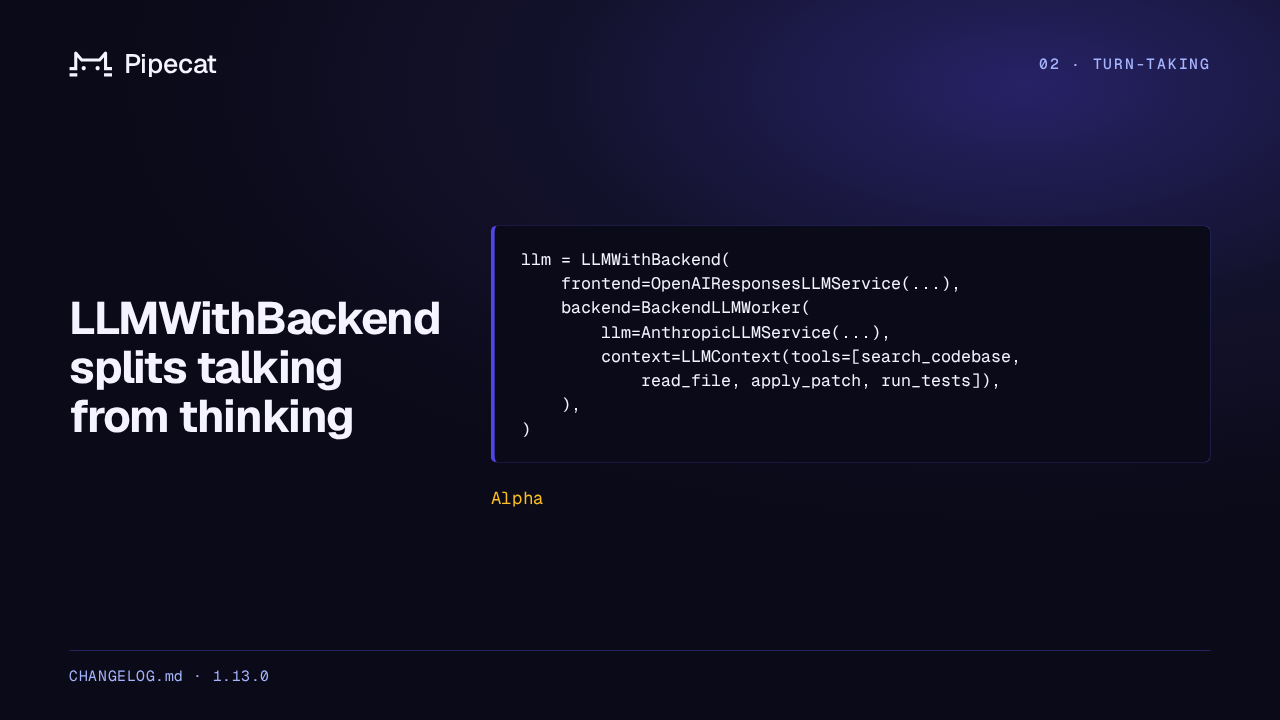
Pipecat02 · Turn-takingLLMWithBackend splits talking from thinking
llm = LLMWithBackend(
    frontend=OpenAIResponsesLLMService(...),
    backend=BackendLLMWorker(
        llm=AnthropicLLMService(...),
        context=LLMContext(tools=[search_codebase,
            read_file, apply_patch, run_tests]),
    ),
)
Alpha
LLMWithBackend, in alpha, pairs two models. The frontend keeps the conversation moving, while the backend does the deeper thinking and the tool calls and reports back as it works.
Backchannels
Pipecat02 · Turn-takingA user’s “mhm” can now let the bot keep talking
A user's mhm while the bot talks can now arrive as a backchannel instead of a transcription. The bot keeps talking, the LLM context stays clean, and the bot can say its own Mm-hmm too.
Silero VAD 6.2
Pipecat02 · Turn-takingSilero VAD 6.2 hears quiet voices and phone audio
Speech stop events can arrive slightly later than with v6
The bundled Silero voice activity model moves to version 6.2, and catches quiet voices and low-quality phone audio more reliably. In exchange, speech stop events can land slightly later.
Azure Voice Live
Pipecat02 · Turn-takingAzure Voice Live arrives as a speech-to-speech service
- Function calling and caller transcription
- Azure’s semantic VAD, multilingual too
- Noise suppression and echo cancellation
Azure Voice Live now runs in Pipecat as a speech-to-speech model. It calls tools, transcribes the caller and speaks in Azure's own voices. Azure OpenAI Realtime keeps its existing service.
Video and classifiers
PipecatVideo and classifiers.
Classifiers see images
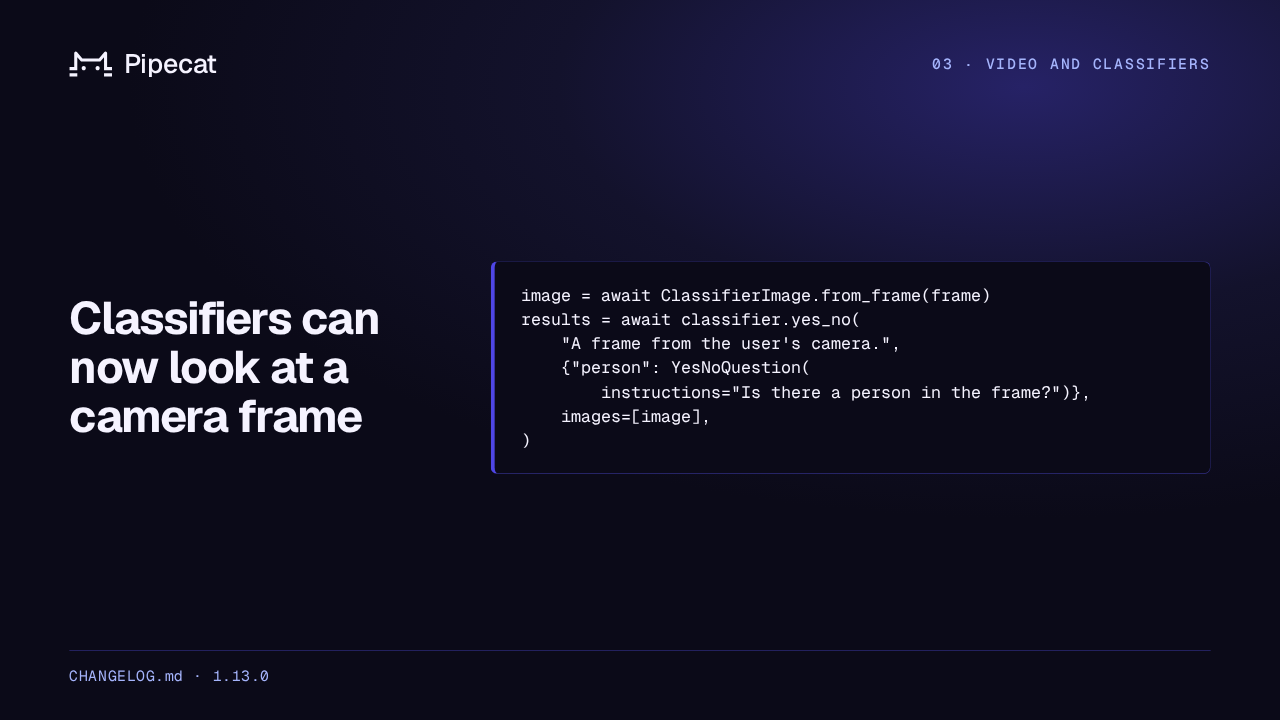
Pipecat03 · Video and classifiersClassifiers can now look at a camera frame
image = await ClassifierImage.from_frame(frame)
results = await classifier.yes_no(
    "A frame from the user's camera.",
    {"person": YesNoQuestion(
        instructions="Is there a person in the frame?")},
    images=[image],
)Pipecat classifiers now take images. Ask whether a person is in the camera frame and get a yes or no. OpenAI Decisions and Cloudflare's Clef join as new backends.
Video capture
Pipecat03 · Video and classifiersCamera and screen capture is now a transport setting
- video_in_sources captures as people join
- pipecat init offers LiveKit
- bot-ready tells the client what the bot can do
List the camera and screen in video_in_sources, and Daily or SmallWebRTC captures them without a connect handler. pipecat init now offers LiveKit, and bot-ready tells the client which panels to show.
Evals and security
PipecatEvals and security.
pipecat eval judge
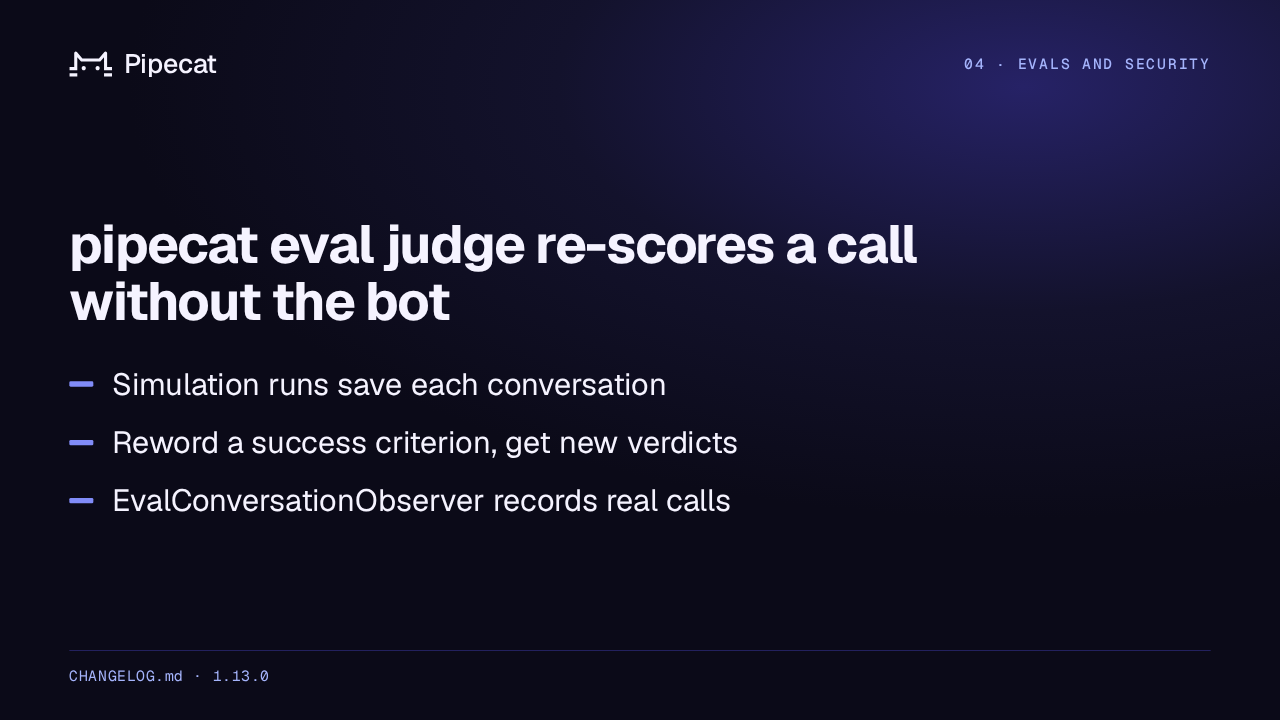
Pipecat04 · Evals and securitypipecat eval judge re-scores a call without the bot
- Simulation runs save each conversation
- Reword a success criterion, get new verdicts
- EvalConversationObserver records real calls
Tune an eval without running the bot again. Simulation runs save their conversation for the judge to score again, and EvalConversationObserver records real calls the same way.
Credential redaction
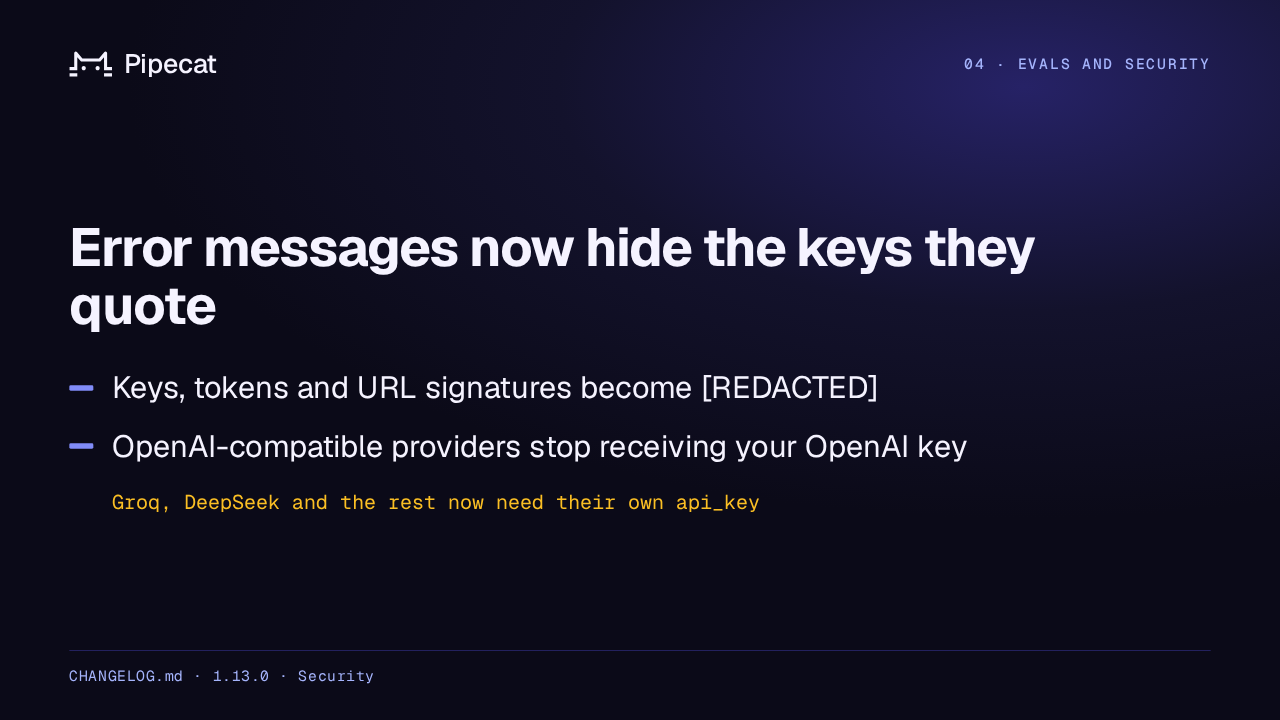
Pipecat04 · Evals and securityError messages now hide the keys they quote
- Keys, tokens and URL signatures become [REDACTED]
- OpenAI-compatible providers stop receiving your OpenAI key
Groq, DeepSeek and the rest now need their own api_key
Errors now mask API keys, tokens and signed links. A rejected Sarvam connection used to log its key. Groq, DeepSeek and other OpenAI-compatible services stop sending your OpenAI key, and need their own.
Token counts
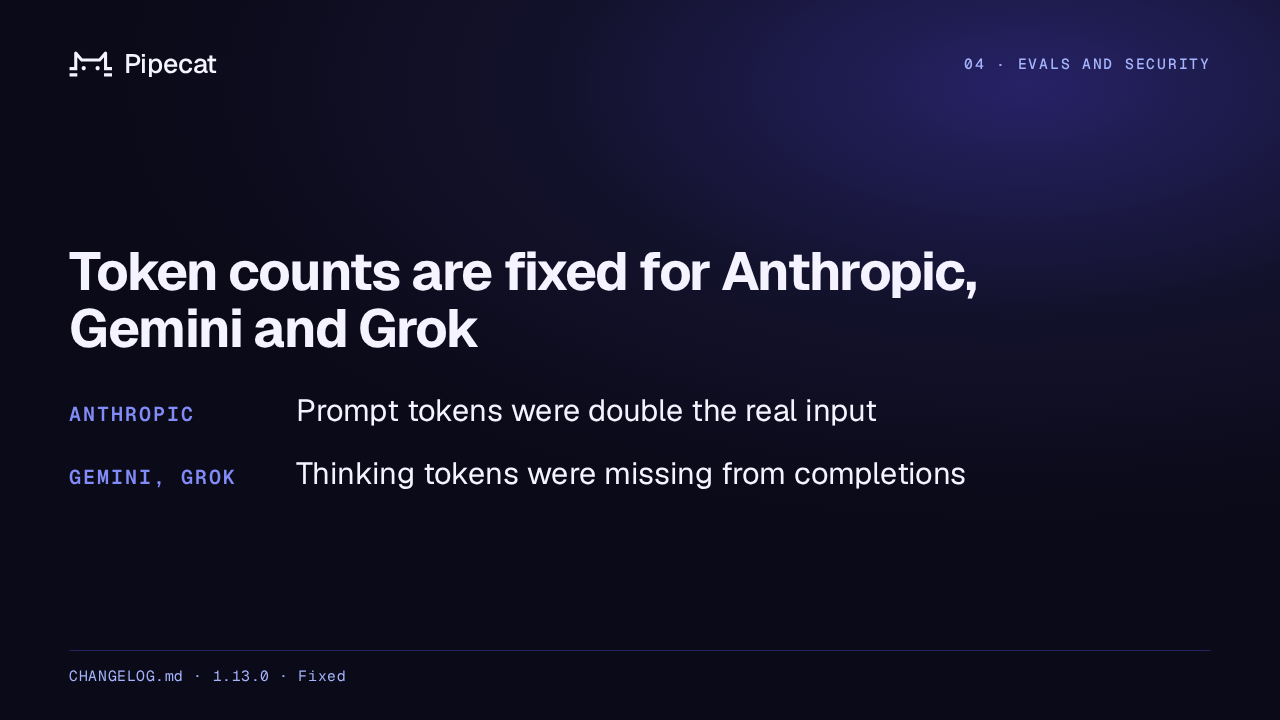
Pipecat04 · Evals and securityToken counts are fixed for Anthropic, Gemini and Grok
If you track usage, expect your numbers to move. Anthropic prompt tokens were counted twice, and Gemini, Gemini Live and Grok left thinking tokens out of completion counts.
Before you upgrade
PipecatBefore you upgrade.
New default models
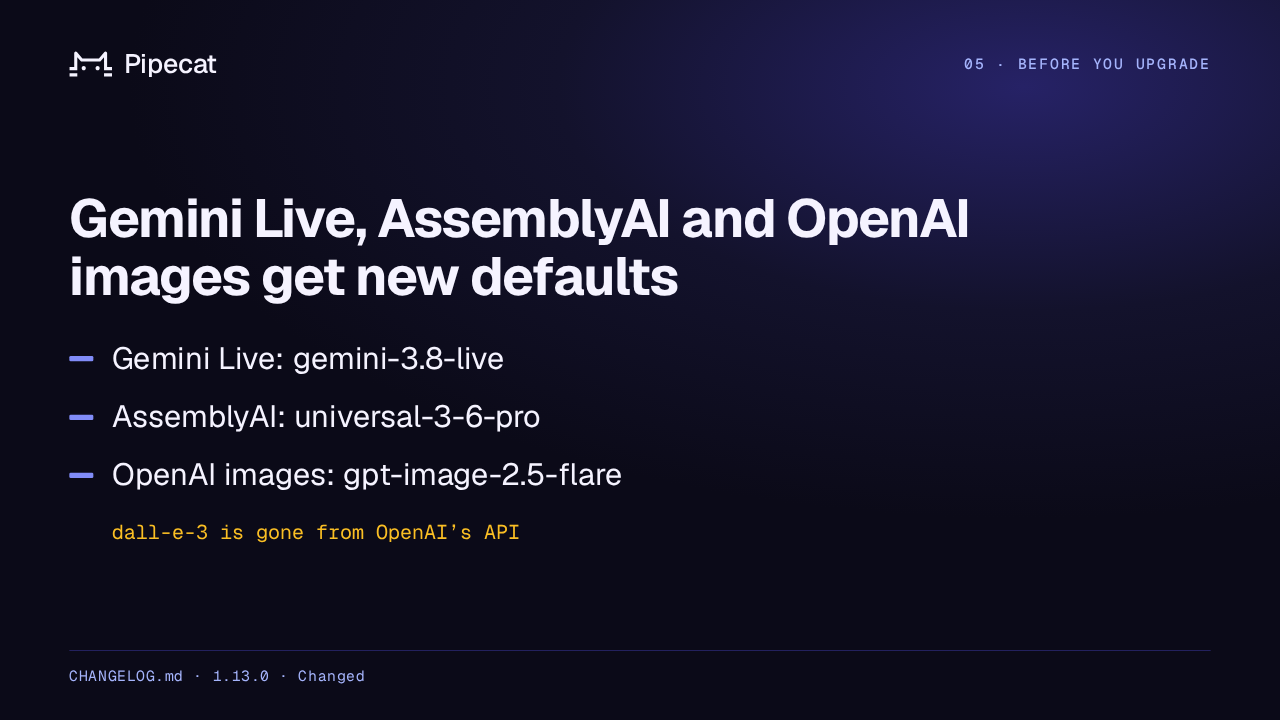
Pipecat05 · Before you upgradeGemini Live, AssemblyAI and OpenAI images get new defaults
- Gemini Live: gemini-3.8-live
- AssemblyAI: universal-3-6-pro
- OpenAI images: gpt-image-2.5-flare
dall-e-3 is gone from OpenAI’s API
Gemini Live now defaults to Gemini 3.8 Live, and AssemblyAI to Universal 3.6 Pro. OpenAI images move to GPT Image 2.5 Flare, since OpenAI removed DALL-E 3.
Requirements
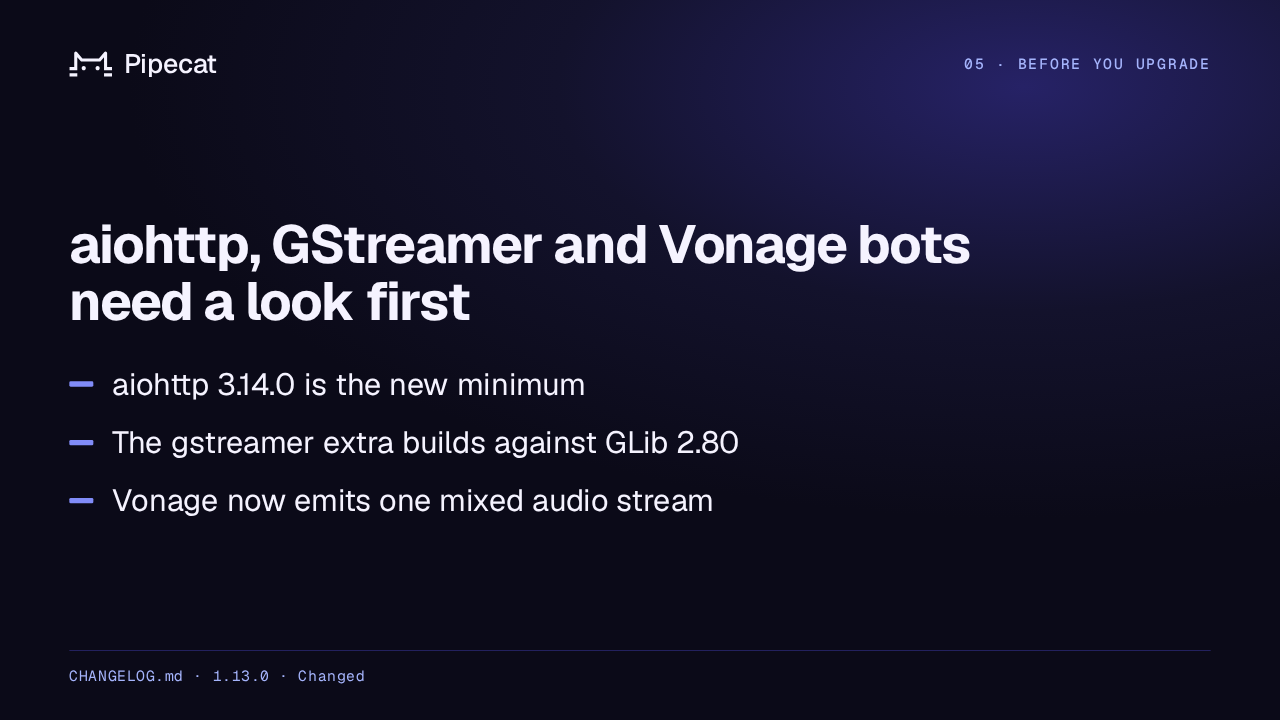
Pipecat05 · Before you upgradeaiohttp, GStreamer and Vonage bots need a look first
- aiohttp 3.14.0 is the new minimum
- The gstreamer extra builds against GLib 2.80
- Vonage now emits one mixed audio stream
Pipecat now needs aiohttp 3.14, so an older pin blocks the upgrade. GStreamer needs GLib 2.80, and Vonage now sends one mixed audio stream instead of one per person.
Your turn
Pipecat05 · Before you upgradeWhich LLM service does your Pipecat bot run on?
The steps for each change are in the Pipecat v1.13.0 release notes. So, which LLM service does your Pipecat bot run on? Tell me in the comments.