GPT-6 Sol and GPT-6 Luna

OpenAI releases GPT-6 Sol and GPT-6 Luna
On September 22nd, OpenAI released two new models, GPT-6 Sol and GPT-6 Luna. They're the smaller members of the GPT-6 family, which started with GPT-6 Astra at the beginning of the month. OpenAI trained them with similar methods to Astra, and priced them for everyday work at scale.
Astra, Sol and Luna
GPT-6 Sol and LunaThree GPT-6 models, three price points
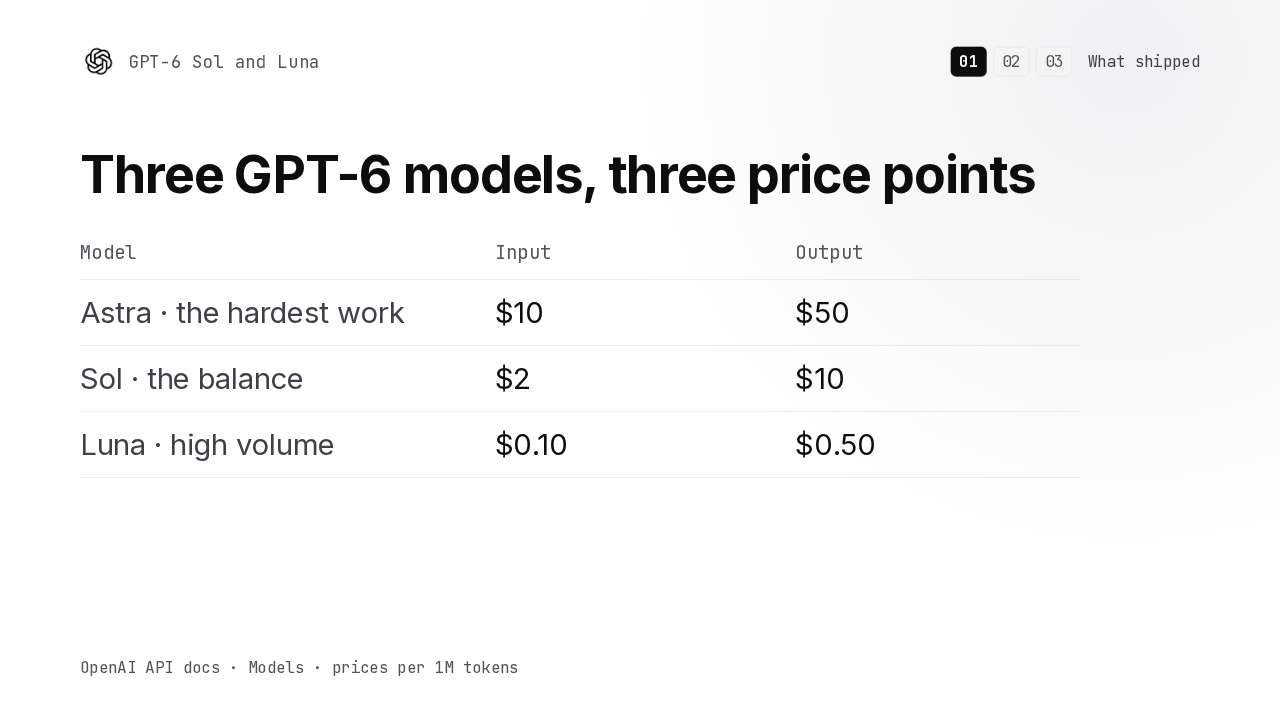
Here's how the family fits together, priced per million tokens. Astra is still OpenAI's most capable model, for the hardest work, at ten dollars in and fifty out. Sol is the balance of capability and cost, at two dollars in and ten out. And Luna is for focused, high volume tasks, at ten cents in and fifty cents out. All three read text and images, and take up to about a million tokens of context.
Half the price of the GPT-5.6 versions
GPT-6 Sol and LunaHalf the API price of the GPT-5.6 versions
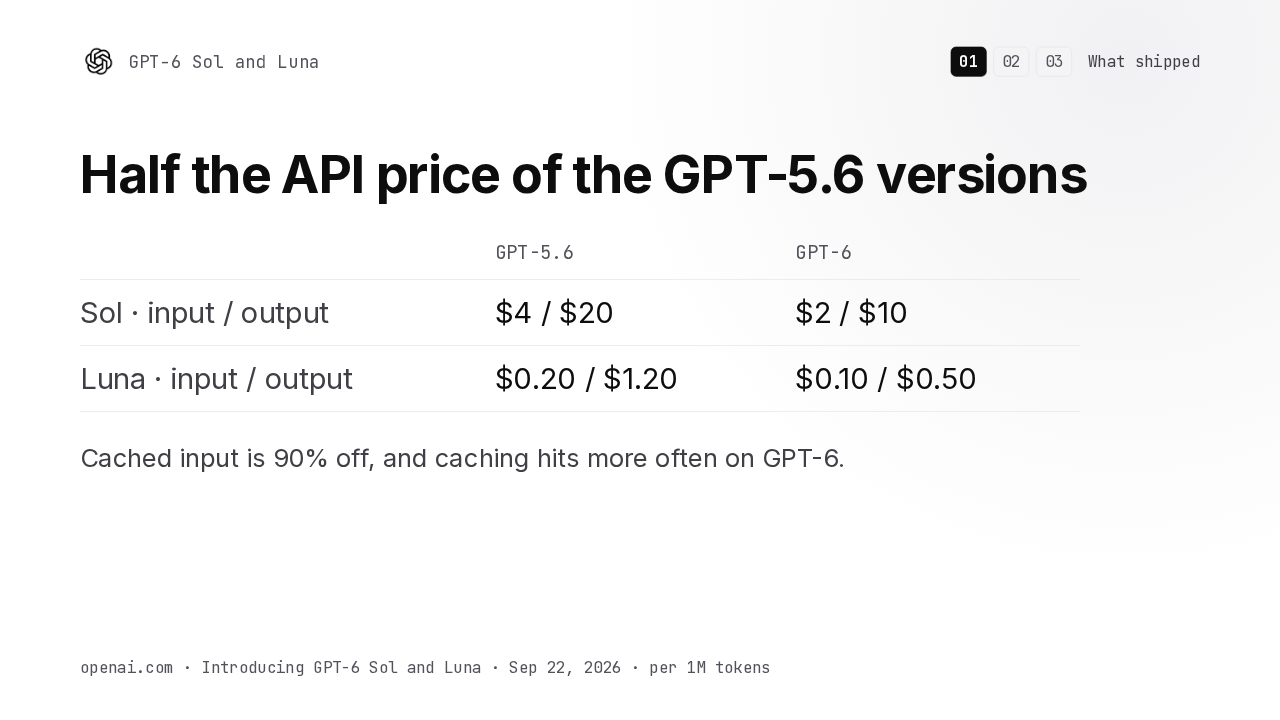
Cached input is 90% off, and caching hits more often on GPT-6.
The headline for anyone paying for the API is price. Sol and Luna cost half what their GPT-5.6 versions did at those models' promotional prices. OpenAI puts that down to better caching and cheaper serving. Repeated context is billed at a tenth of the normal input price, and OpenAI says caching now hits more often by default on GPT-6, which matters most for agents that resend long conversations.
What OpenAI claims
GPT-6 Sol and LunaNext, what OpenAI says they can do.
Close to the top models for much less per task
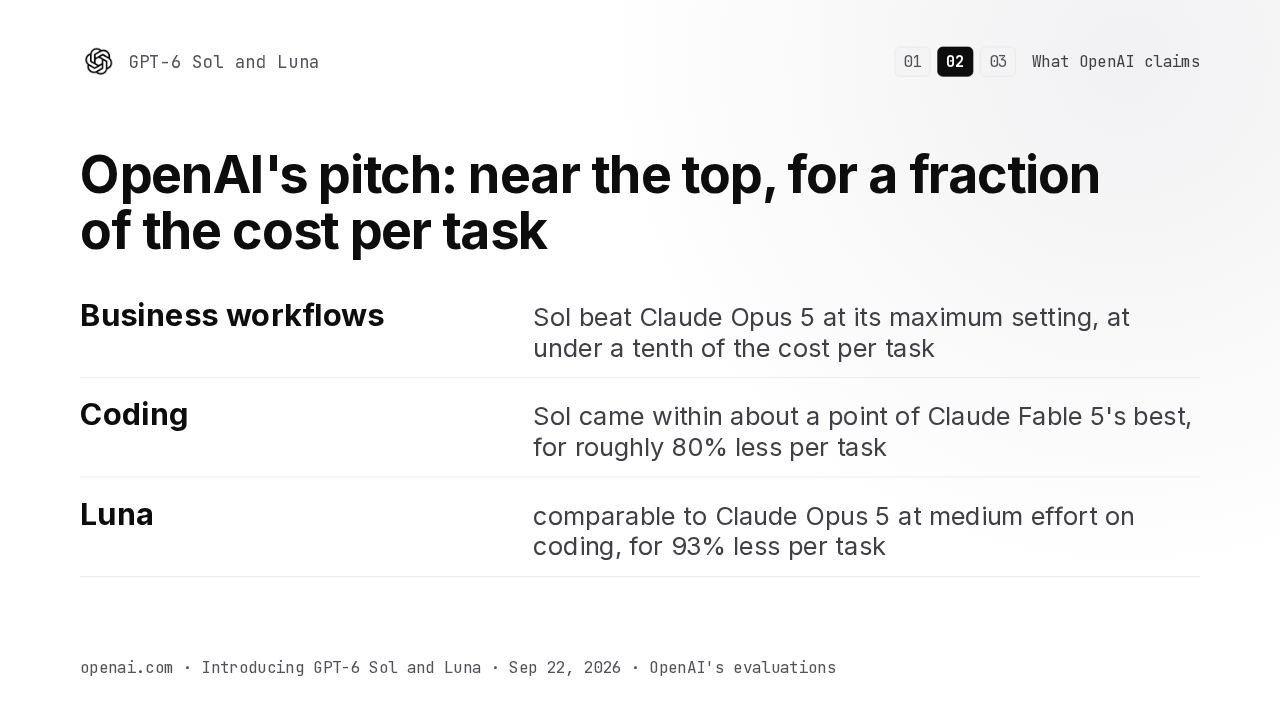
GPT-6 Sol and LunaOpenAI's pitch: near the top, for a fraction of the cost per task
These are OpenAI's own evaluations, and the competitor scores come from other companies' published reports, so treat them as OpenAI's claims. On a test of business workflows across apps, Sol on its extra high setting beat Claude Opus 5 on its maximum setting, at under a tenth of the cost per task. On a test of long software engineering tasks, it came within about a point of the best score from Claude Fable 5, for roughly eighty percent less per task. And Luna, the cheap one, was comparable to Claude Opus 5 at medium effort on that coding test, for ninety three percent less.
Fewer factual mistakes, shorter answers
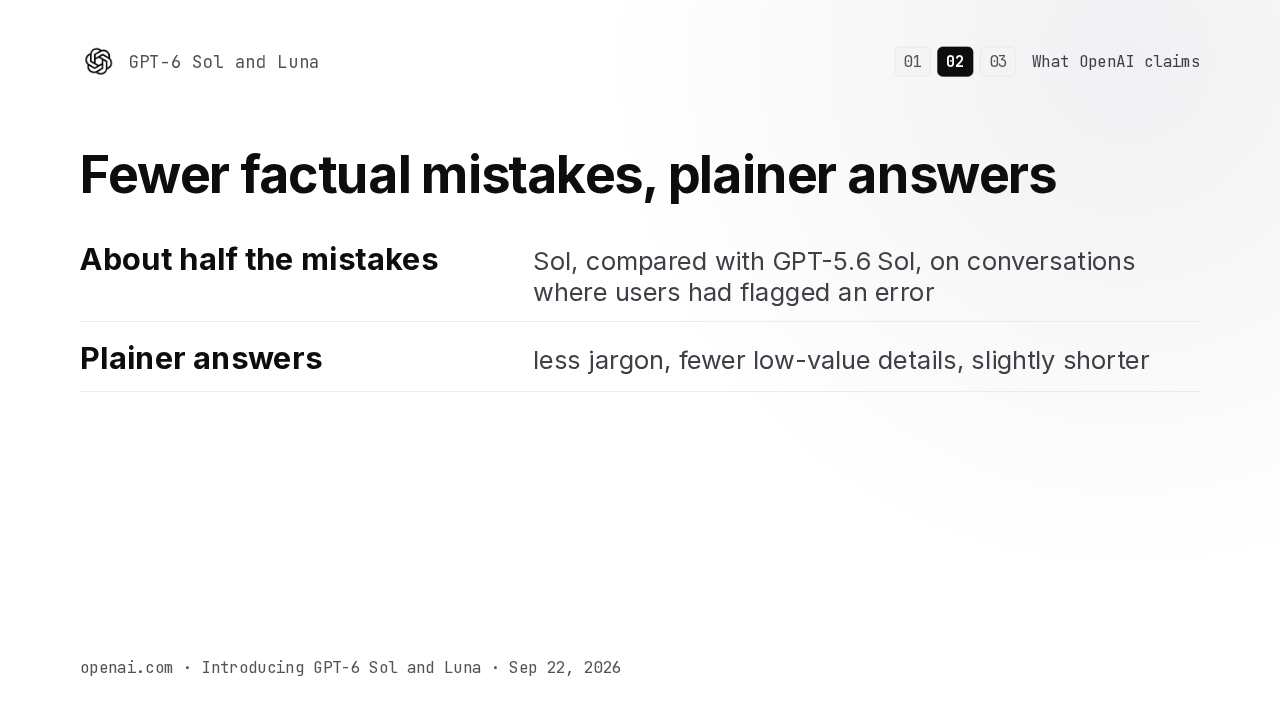
GPT-6 Sol and LunaFewer factual mistakes, plainer answers
Two changes you'd notice in conversation. On conversations where people had flagged a factual error from an earlier model, Sol made about half as many mistakes as GPT-5.6 Sol. OpenAI says those conversations are harder than typical use. And both models pick up the way Astra talks: clearer, with less jargon, fewer details you didn't need, and slightly shorter answers.
Who gets it
GPT-6 Sol and LunaFinally, who can use them.
Who can use them
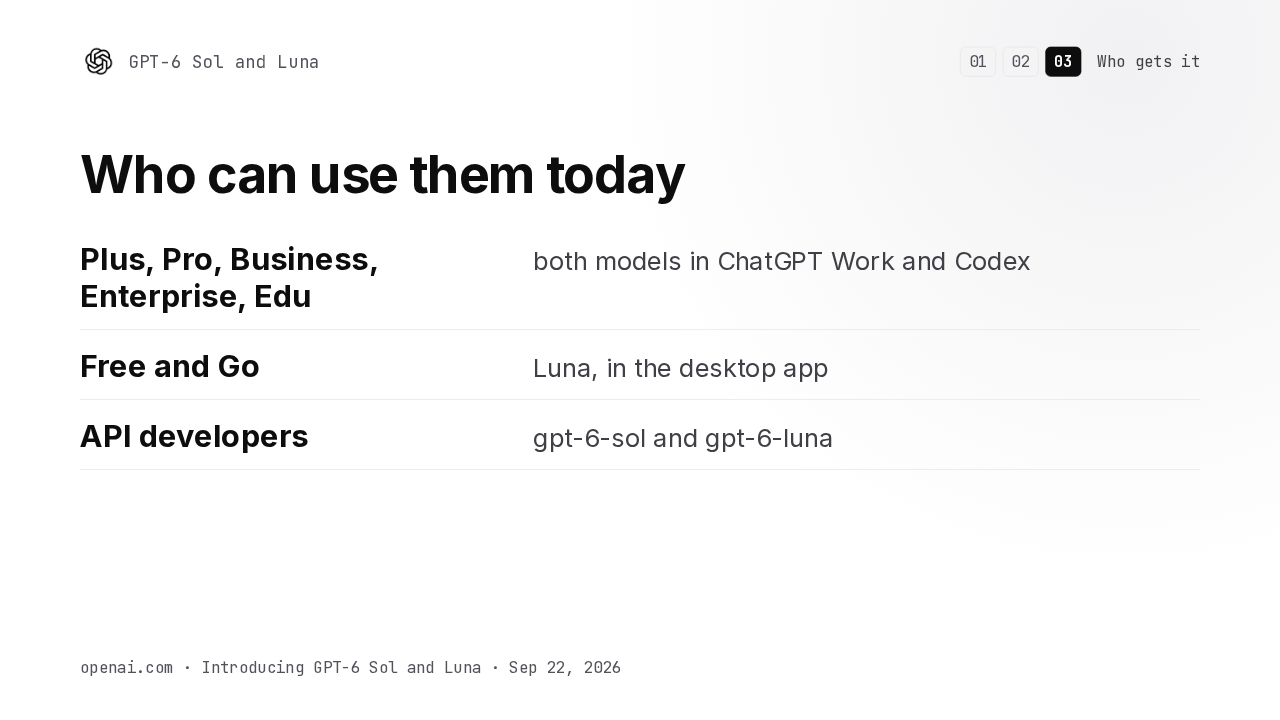
GPT-6 Sol and LunaWho can use them today
If you pay for ChatGPT, on Plus, Pro, Business, Enterprise or Edu, both models are in ChatGPT Work and in Codex. They aren't in regular ChatGPT chat yet. On the Free or Go plans, you can try Luna in the desktop app. And developers can call both through the API now.
An image fix on September 25
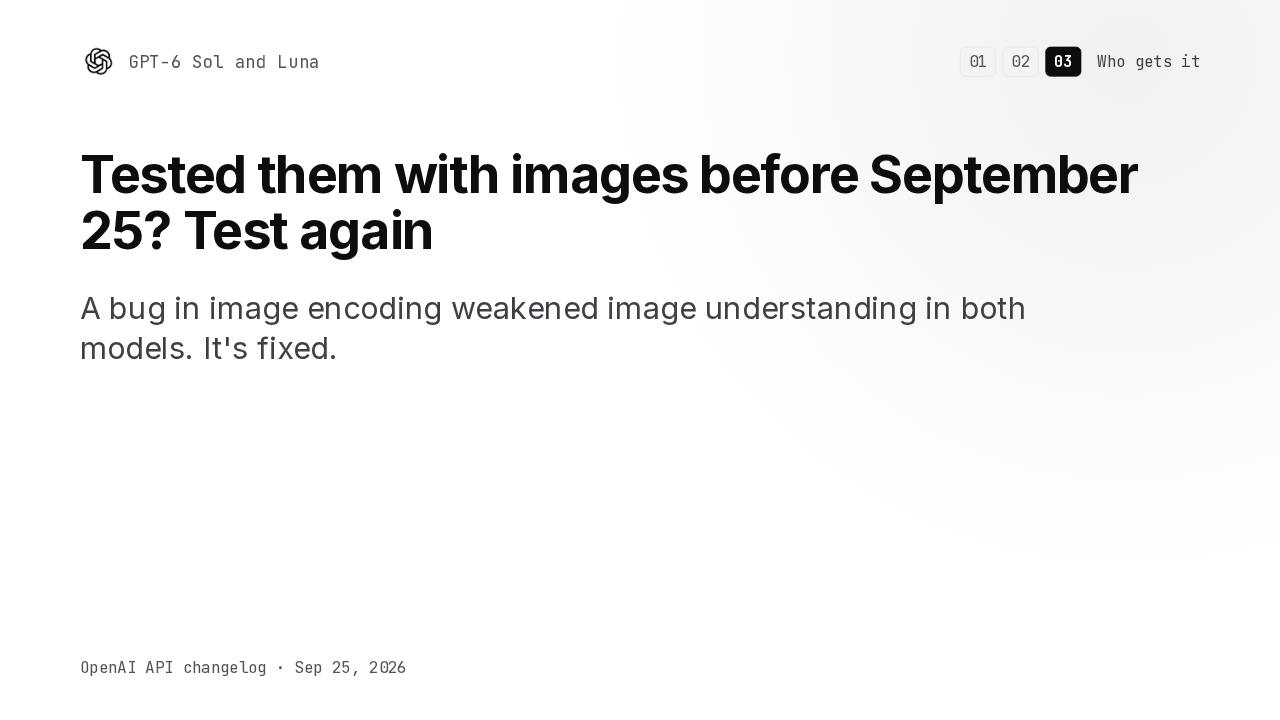
GPT-6 Sol and LunaTested them with images before September 25? Test again
A bug in image encoding weakened image understanding in both models. It's fixed.
One thing to know if you tried them in the first few days. On September 25th, OpenAI fixed a bug in how images were encoded, which had weakened image understanding in Sol and Luna, in the API and in Codex, including computer use. If your work involves images, OpenAI recommends running your evaluations again.
Where to read more
GPT-6 Sol and LunaAstra is still the top model. Sol and Luna are the affordable ones.
openai.com › Introducing GPT-6 Sol and Luna · developers.openai.com › Changelog
OpenAI is clear that Astra is still its best model, and the one to use when results matter most. The announcement and the API changelog have the full numbers. That's GPT-6 Sol and Luna: OpenAI's new generation, at half the API price of GPT-5.6.