
mlx-lm 0.32.2
mlx-lm 0.32.2 loads Muse Spark from its Hugging Face checkpoint
Also fixed: MiMo-V2-Flash attention value scaling, and padded prompts in state-space models.

Version 0.32.2 of mlx-lm is a small release, and Muse Spark users need to know about it. Muse Spark now loads from its Hugging Face checkpoint, using the Hugging Face names. The release also fixes attention value scaling in MiMo-V2-Flash, and padded prompts in state-space models.
Hugging Face names
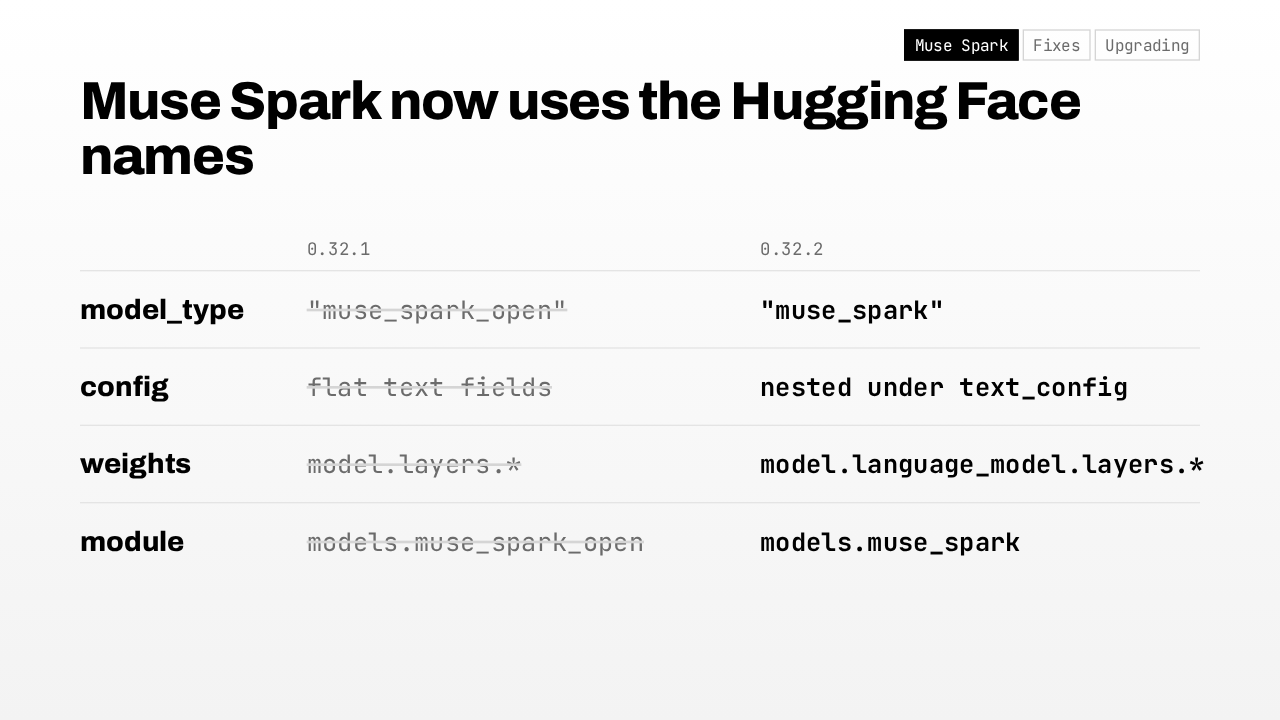
Muse Spark now uses the Hugging Face names
Until this release, Muse Spark support used its own names for the model type, the config and the weights. Now they match the Hugging Face checkpoint. The model type drops the word open. Text settings move under text config, with the Hugging Face field names. The language model weights load from model dot language model, and the module is renamed to match.
Images and tool calls
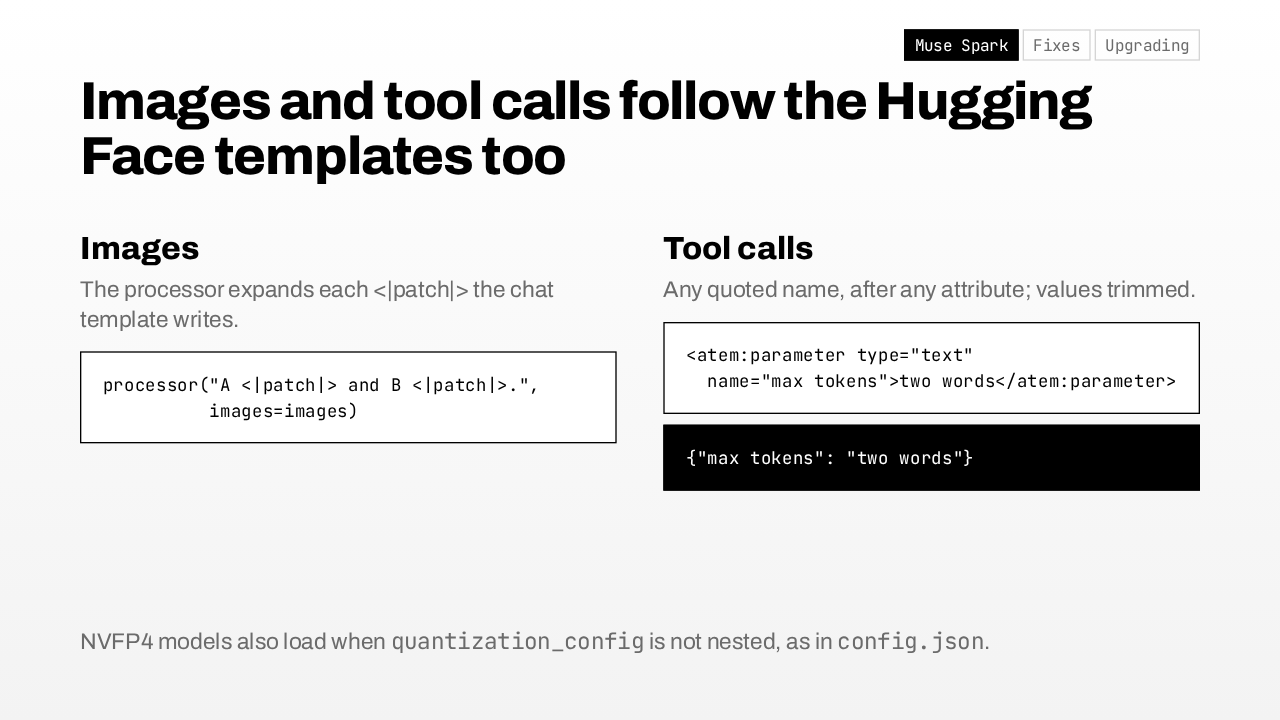
Images and tool calls follow the Hugging Face templates too
The processor expands each <|patch|> the chat template writes.
processor("A <|patch|> and B <|patch|>.",
images=images)Any quoted name, after any attribute; values trimmed.
<atem:parameter type="text"
  name="max tokens">two words</atem:parameter>
{"max tokens": "two words"}NVFP4 models also load when quantization_config is not nested, as in config.json.
The inputs follow the same templates. The image processor now expands each patch token that the chat template writes, where it used to look for an image placeholder. The tool-call parser takes any parameter name inside double quotes, even after another attribute, and trims whitespace from text values. And NVFP4 models load when the quantization settings sit directly in the model config.
2 · Fixes
Two output fixes
Next, two fixes to model outputs.
MiMo-V2-Flash
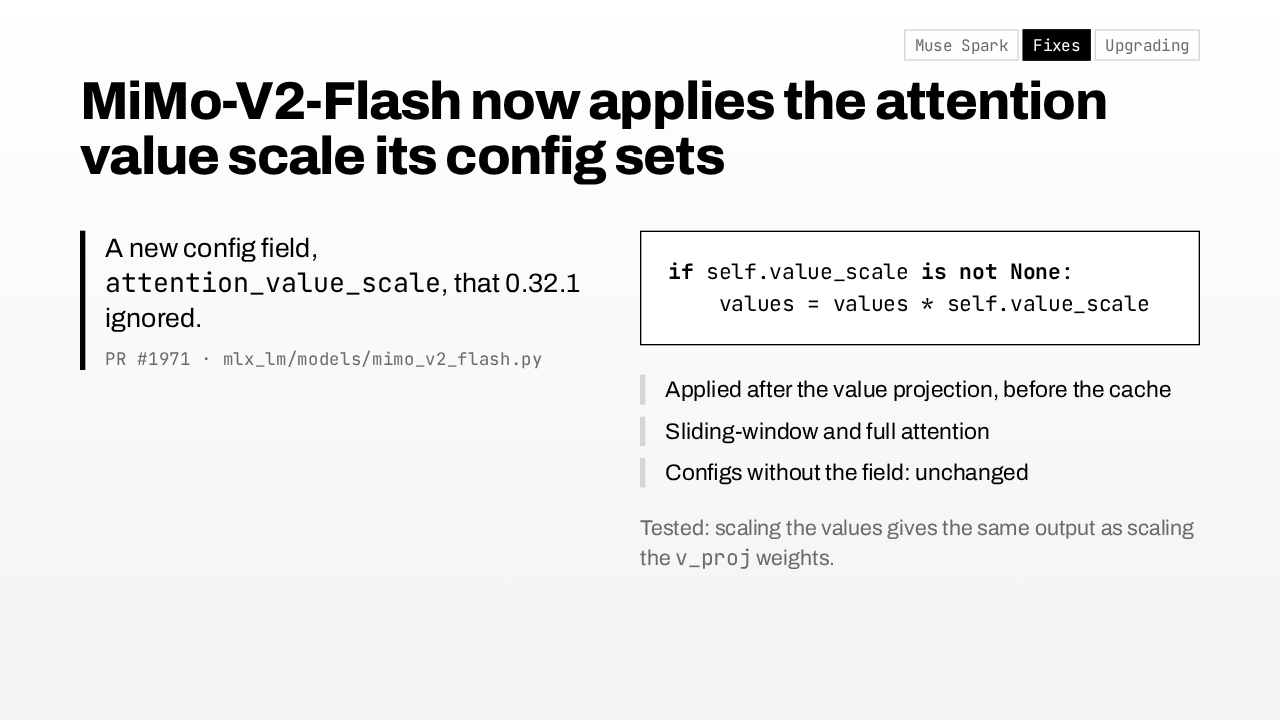
MiMo-V2-Flash now applies the attention value scale its config sets
A new config field, attention_value_scale, that 0.32.1 ignored.PR #1971 · mlx_lm/models/mimo_v2_flash.py
if self.value_scale is not None:
values = values * self.value_scaleTested: scaling the values gives the same output as scaling the v_proj weights.
MiMo-V2-Flash configs can carry a scale for the attention values, and until this release that field was ignored. Now the scale is read from the config and applied right after the value projection, before the cache, in both sliding-window and full attention layers. A new test checks that scaling the values gives the same output as scaling the value projection weights. Configs without the field behave as before.
Padded SSM prompts
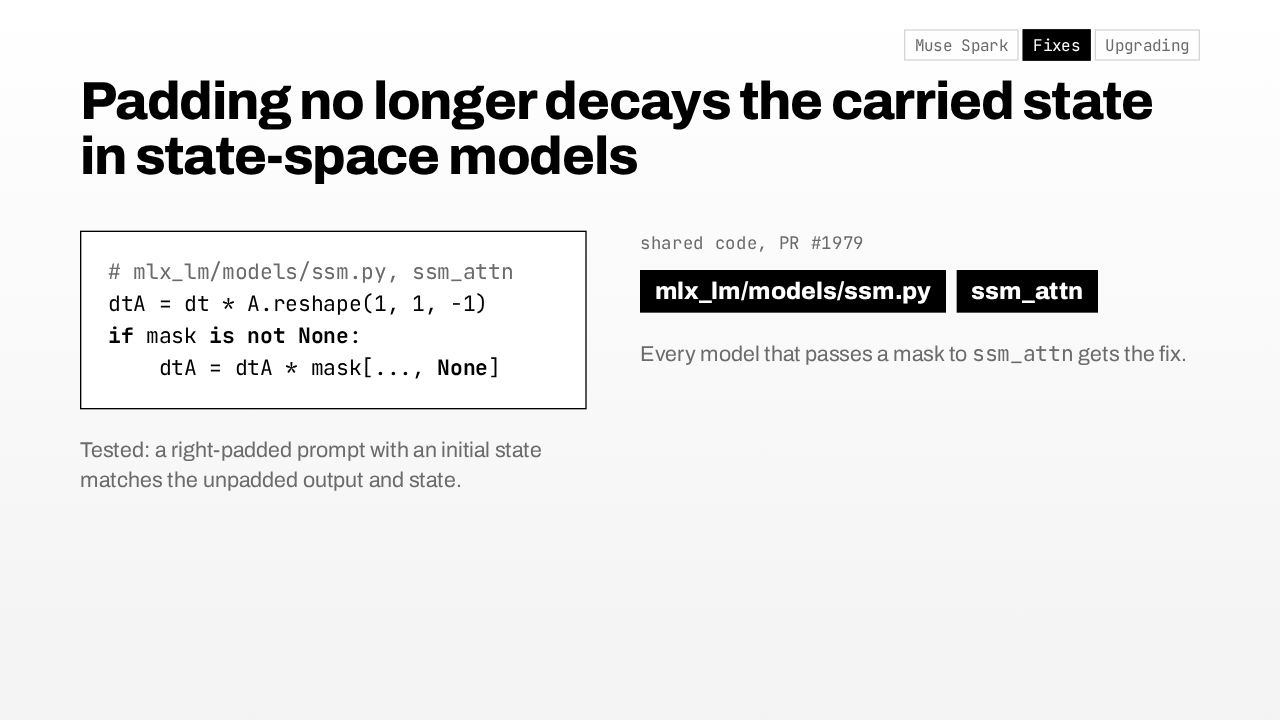
Padding no longer decays the carried state in state-space models
# mlx_lm/models/ssm.py, ssm_attn
dtA = dt * A.reshape(1, 1, -1)
if mask is not None:
    dtA = dtA * mask[..., None]
Tested: a right-padded prompt with an initial state matches the unpadded output and state.
Every model that passes a mask to ssm_attn gets the fix.
The second fix is in the shared state-space code. When a prompt was padded and the model already carried state from earlier tokens, the padded positions still decayed that state. Now the decay is multiplied by the mask, so padding leaves the state alone, and a right-padded prompt matches the unpadded one. Every model that passes a mask through that code gets the fix.
3 · Upgrading
Upgrading
Now, upgrading.
Breaking: Muse Spark names
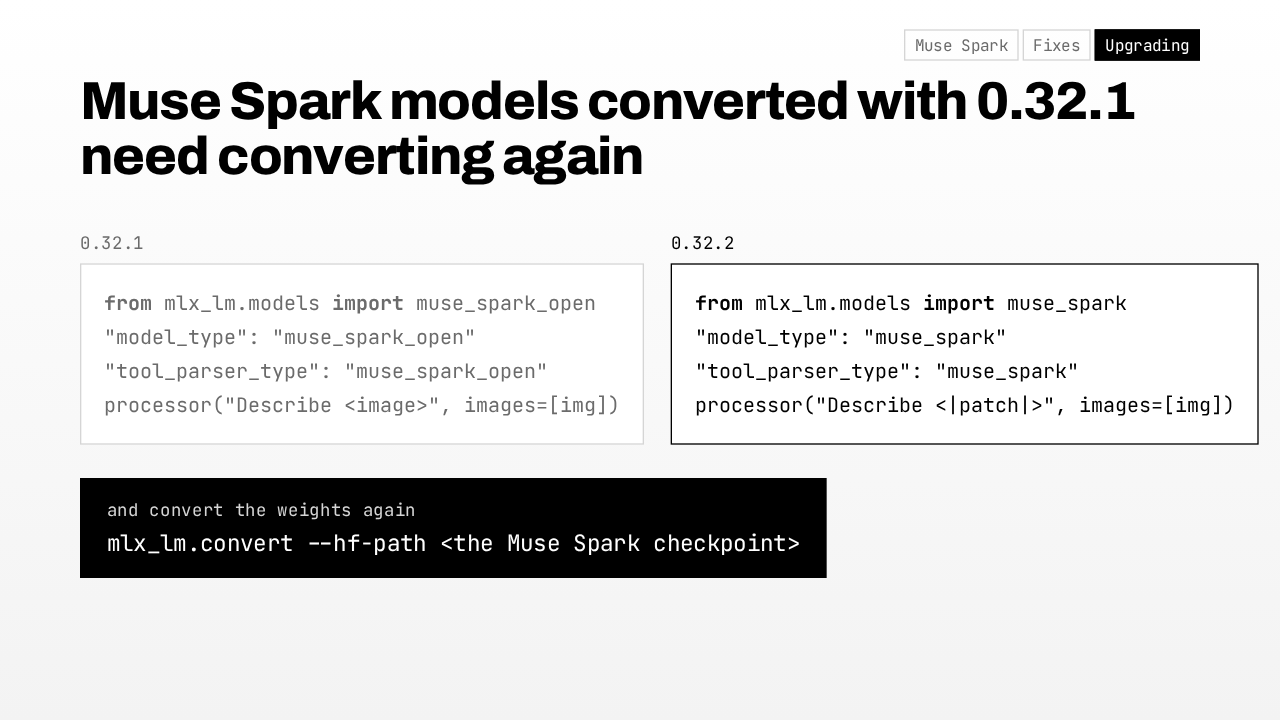
Muse Spark models converted with 0.32.1 need converting again
from mlx_lm.models import muse_spark_open
"model_type": "muse_spark_open"
"tool_parser_type": "muse_spark_open"
processor("Describe <image>", images=[img])from mlx_lm.models import muse_spark
"model_type": "muse_spark"
"tool_parser_type": "muse_spark"
processor("Describe <|patch|>", images=[img])There's one breaking change, and it only affects Muse Spark. Version 0.32.2 drops the muse spark open model type, module and tool parser, and the processor stops looking for an image placeholder. So a Muse Spark model converted with 0.32.1 won't load. Convert it again from the Hugging Face checkpoint, and point any imports or prompts at the new names. Everyone else has nothing to migrate.
Upgrade
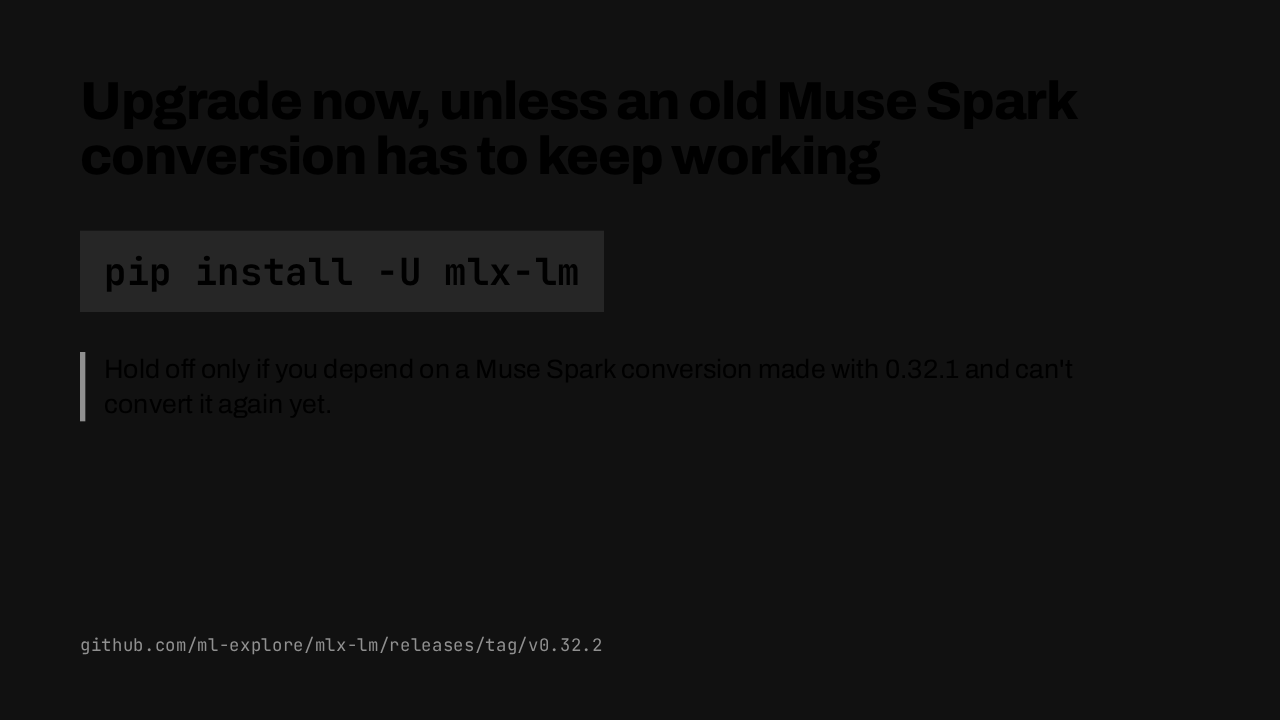
Upgrade now, unless an old Muse Spark conversion has to keep working
Hold off only if you depend on a Muse Spark conversion made with 0.32.1 and can't convert it again yet.
To upgrade, run pip install with the upgrade flag. The one reason to wait is a Muse Spark conversion made with 0.32.1 that you can't convert again yet. Everyone else gets the MiMo-V2-Flash value scale and correct padded prompts in state-space models. And mlx-lm 0.32.2 loads Muse Spark from its Hugging Face checkpoint.