Claude Opus 5.5: what changed

Claude Opus 5.5 beats Opus 5 on every capability test and slips on pasted text
Anthropic published the system card for Claude Opus 5.5 on the twenty-second of September. It runs to 230 pages, and it reports what got worse right next to what got better. The first change is in its capability table.
Higher than Opus 5 on all 13 capability results
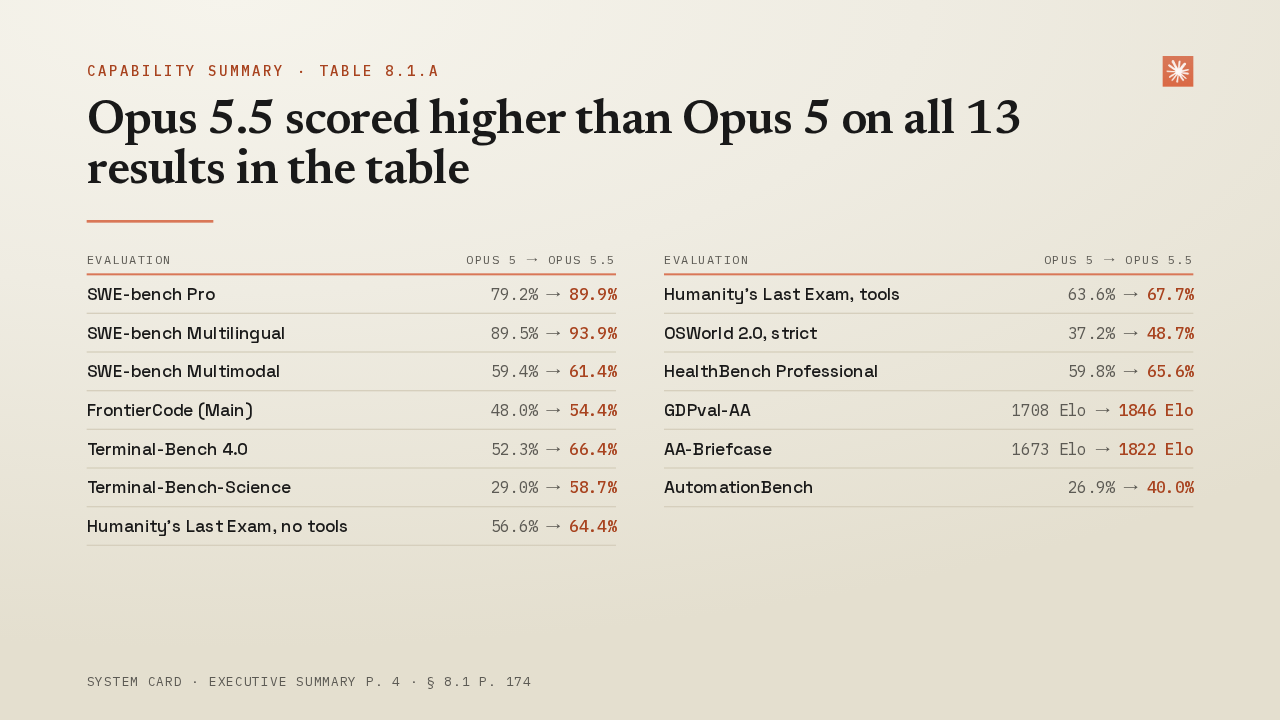
Opus 5.5 scored higher than Opus 5 on all 13 results in the table
Anthropic's capability table lists 13 results for Claude Opus 5.5 against Claude Opus 5. Opus 5.5 is higher on every one of them. The card says the biggest gains are in coding agents, reading images, operating a computer, and long professional projects. It also says much of that improvement is available below the maximum reasoning setting, which matters for what you pay per task.
01 Coding and cost
Coding and cost.
Two in three hard command-line tasks
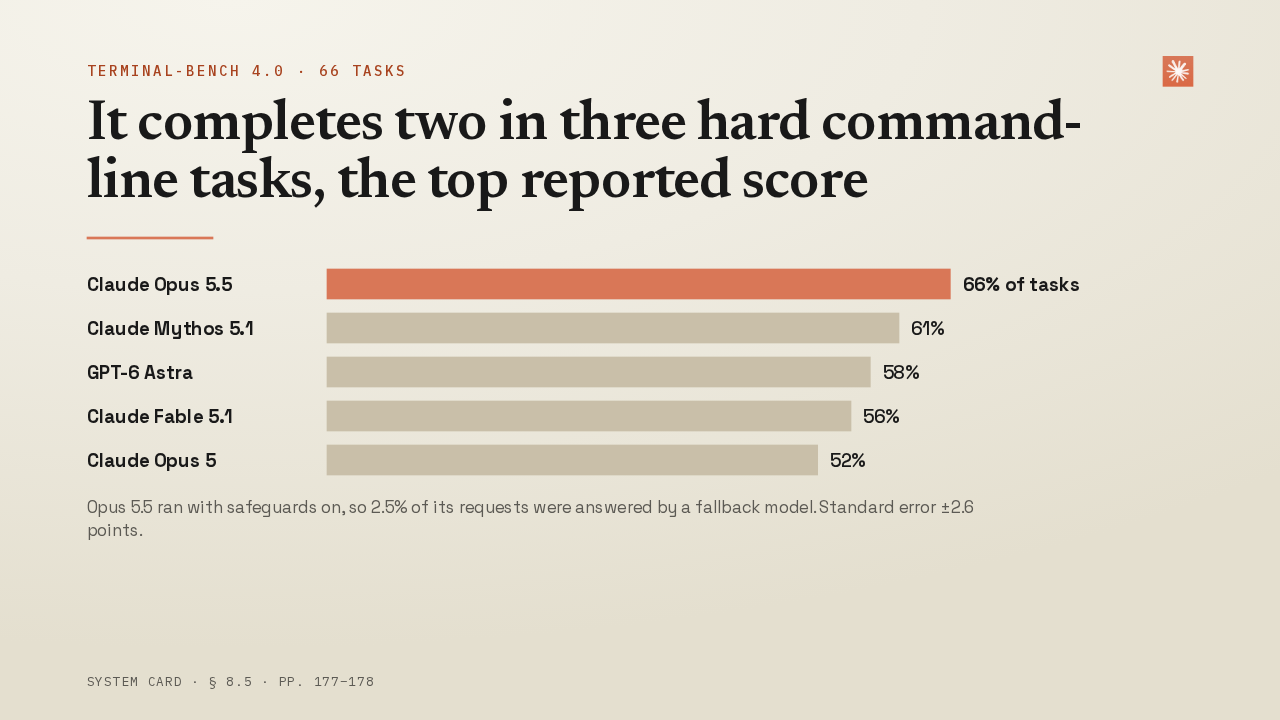
It completes two in three hard command-line tasks, the top reported score
Terminal-Bench 4.0 is 66 tasks done at a command line: computational biology, physics simulation, CAD, formal proofs, and tuning code for GPUs. Opus 5.5 completed about two in three. Claude Opus 5 completed about half, and OpenAI reported 58 percent for GPT-6 Astra. Anthropic ran Opus 5.5 with its safeguards switched on, so a few of its requests went to a fallback model, and it still posted the highest score.
High effort, a quarter of the cost
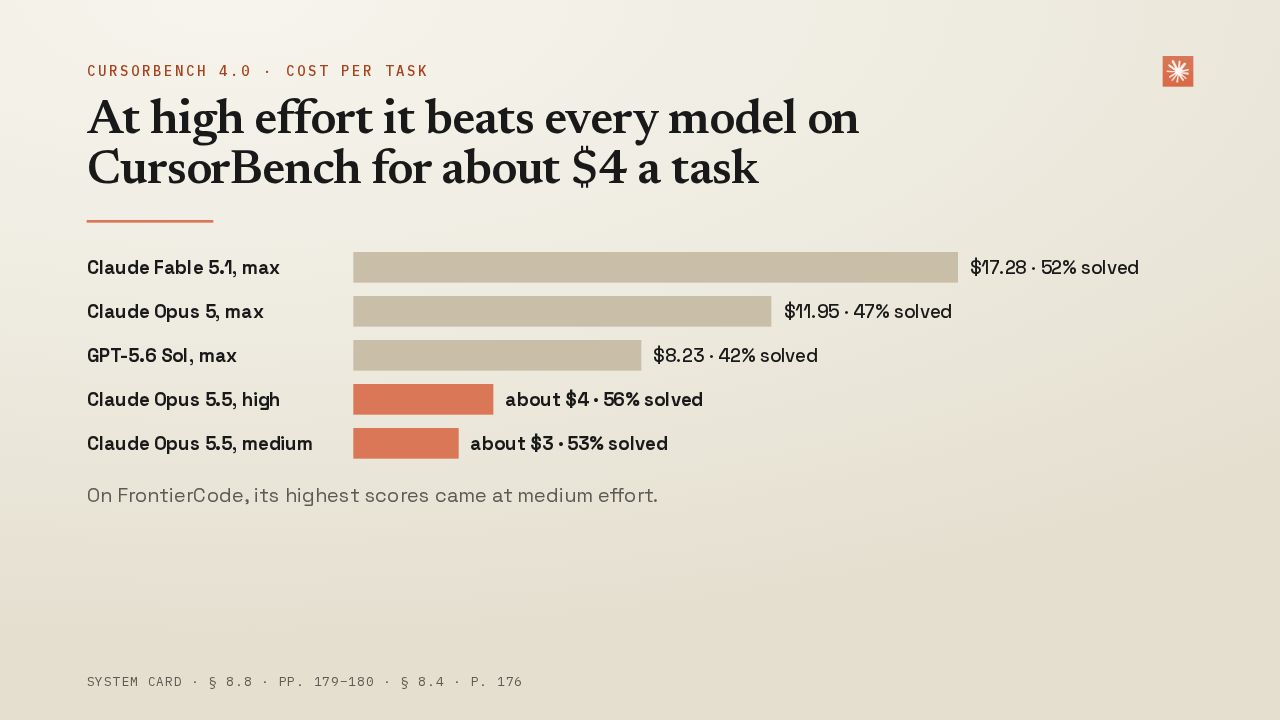
At high effort it beats every model on CursorBench for about $4 a task
CursorBench is Cursor's own test, built from real coding requests in its editor and scored by Cursor. At its maximum setting Opus 5.5 topped the leaderboard. At high effort it solved 56 percent of tasks for about four dollars each. That still beats every other model on the board, at about a quarter of what Claude Fable 5.1 costs at maximum. At medium, about three dollars a task still beats Fable 5.1 at maximum. Cognition's FrontierCode test points the same way. Its grading penalizes changes outside the task, even helpful ones, and Opus 5.5 scored best there at medium effort.
Rebuilding programs from a binary
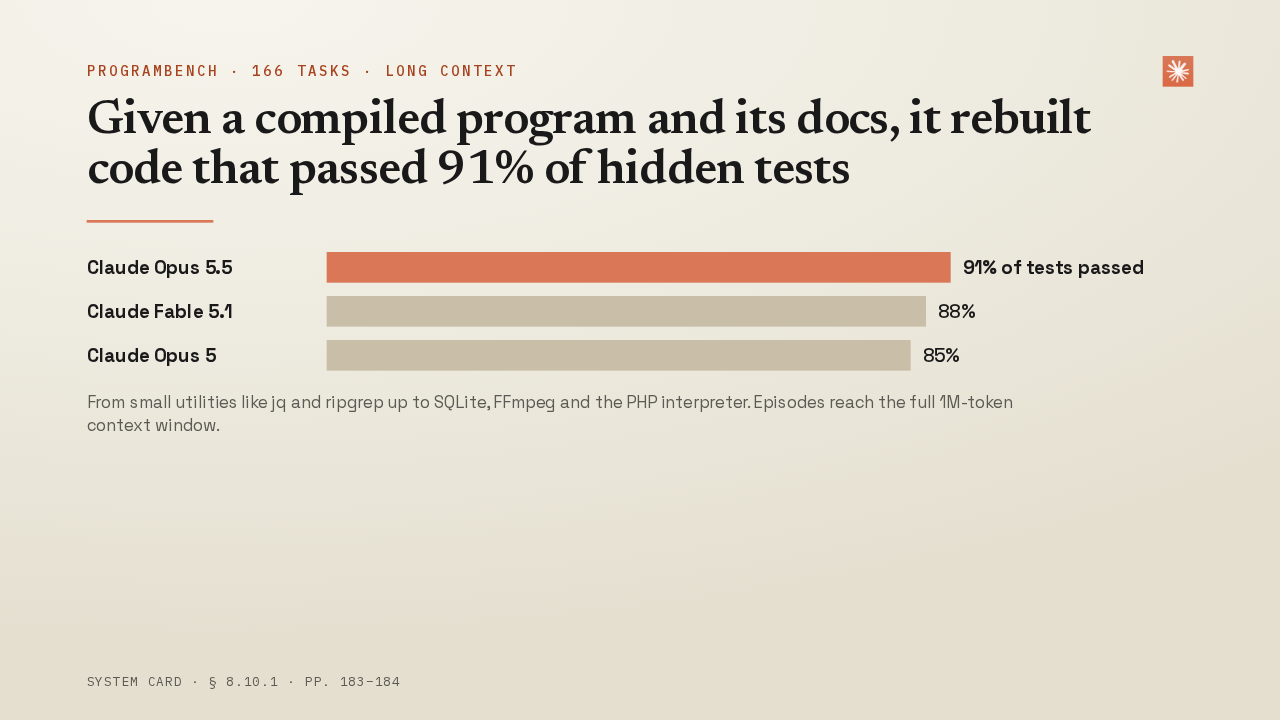
Given a compiled program and its docs, it rebuilt code that passed 91% of hidden tests
ProgramBench hands the agent a compiled program and its documentation, with no source code and no internet, and asks it to write a codebase that behaves the same way. The programs range from small tools like ripgrep up to SQLite, FFmpeg and the PHP interpreter. Opus 5.5's rebuilds passed 91 percent of the hidden behavior tests, against 85 percent for Opus 5. Anthropic treats this as its long-context test, because these runs stretch across the full one-million-token window.
Five agents, same score, less time
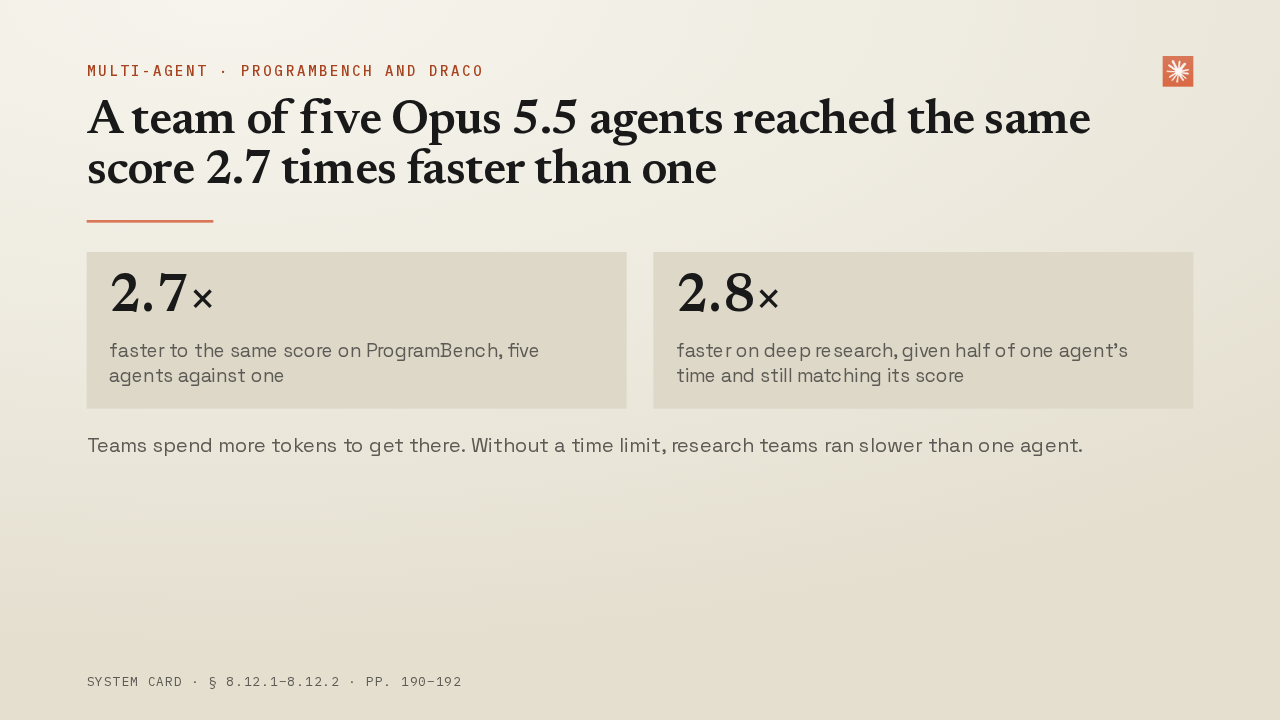
A team of five Opus 5.5 agents reached the same score 2.7 times faster than one
Anthropic also ran Opus 5.5 as a team. On ProgramBench, a fixed team of five agents reached the same score as a single agent 2.7 times faster. On deep research questions, a team given half of one agent's time budget matched its score about 2.8 times faster. Teams buy that speed with extra tokens. Left without a time limit, the research team took longer than one agent, because coordinating costs time.
02 Beyond the editor
Beyond the editor.
About half of long desktop tasks
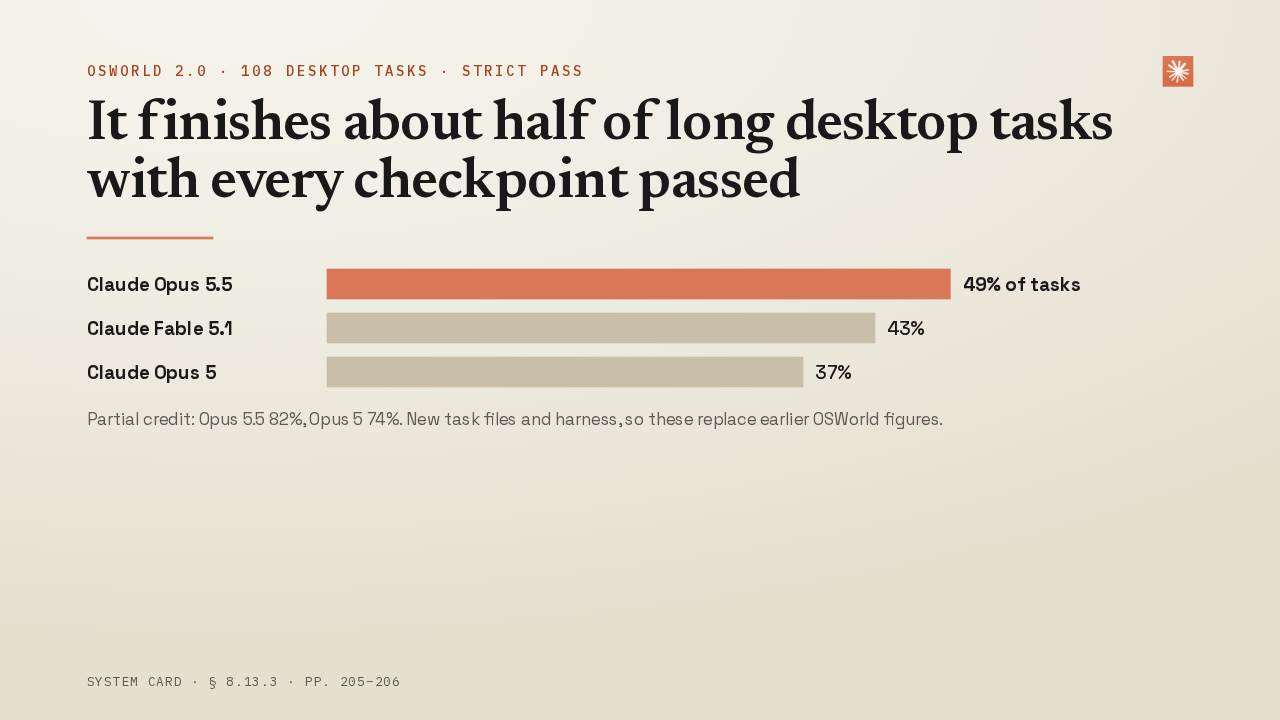
It finishes about half of long desktop tasks with every checkpoint passed
OSWorld 2.0 is 108 long tasks on a live Ubuntu desktop, done through screenshots, mouse and keyboard, with up to 500 actions each. The strict score counts a task only when every checkpoint passes. Opus 5.5 managed that on just under half the tasks. Opus 5 managed a bit over a third. By partial credit Opus 5.5 reached about 82 percent. The card says these results replace its earlier OSWorld numbers, because both the task files and the harness changed.
Specialist charts, read from the image alone
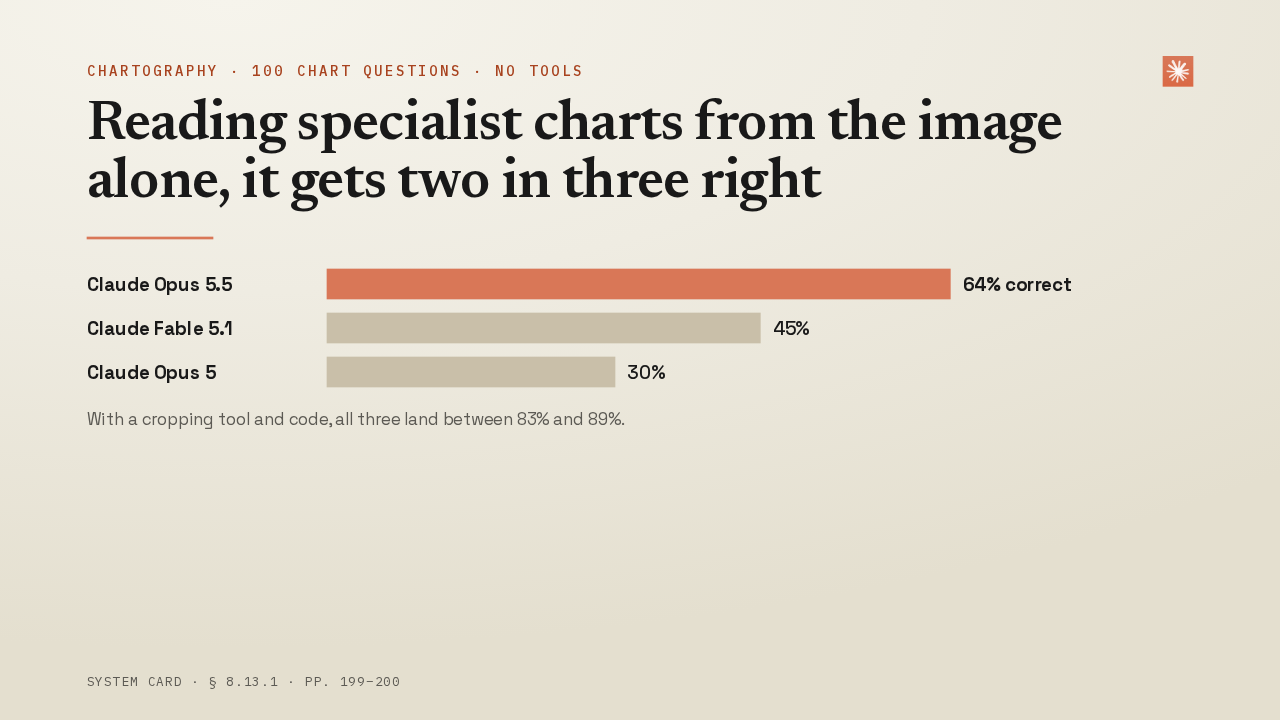
Reading specialist charts from the image alone, it gets two in three right
Chartography is a hundred questions on charts most tests skip: survival curves, candlestick charts, wind roses, contour maps and Sankey diagrams. Each answer is graded against a range experts set for that chart. Reading the image alone, Opus 5 got about three in ten. Opus 5.5 gets about two in three, and Anthropic calls it a step change in raw visual reasoning. Give each model a cropping tool and code, and all three land between 83 and 89 percent.
A hundred agents organized themselves
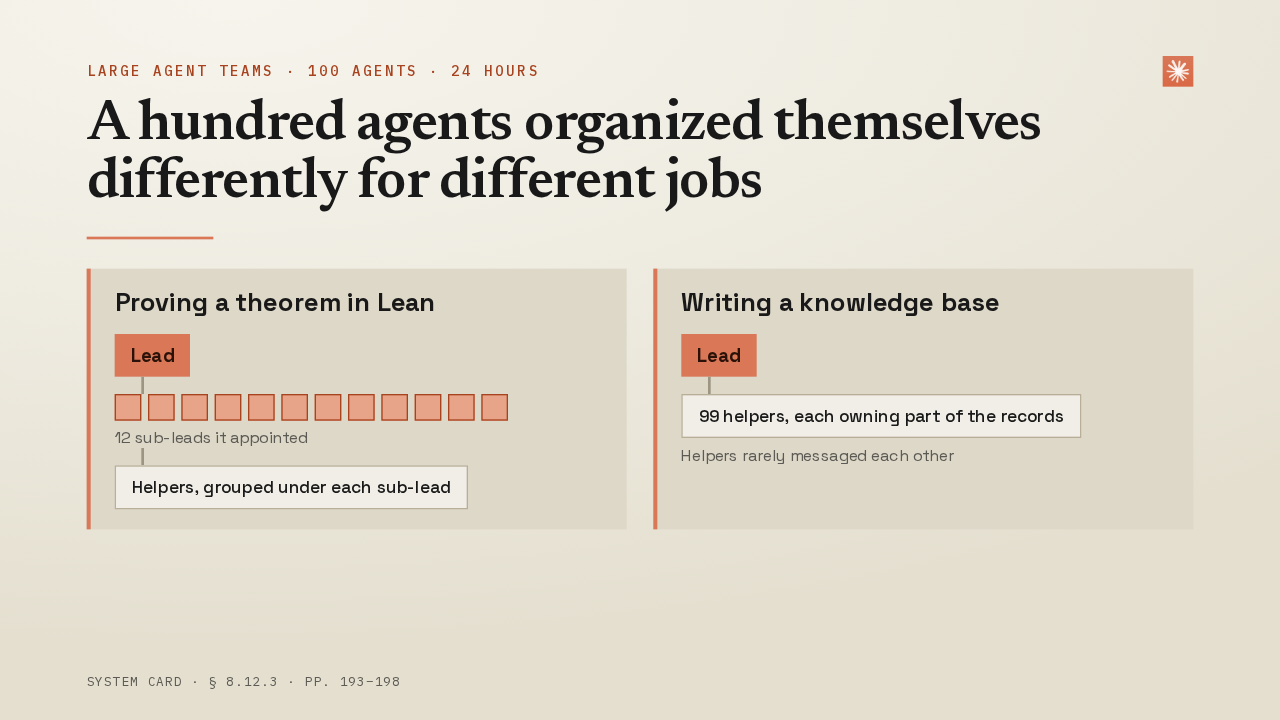
A hundred agents organized themselves differently for different jobs
Anthropic scaled up to a hundred Opus 5.5 agents sharing one machine for 24 hours, and Opus 5.5 beat Opus 5 and Fable 5.1 at every team size it tried. The harness named only a lead. On a theorem-proving task in Lean, the lead appointed a dozen sub-leads, and each one ran its own group of helpers. On a task writing a company knowledge base, the team stayed flat. The lead split the documents up front, and the helpers rarely talked to each other after that.
Top of the blind office-work leaderboard
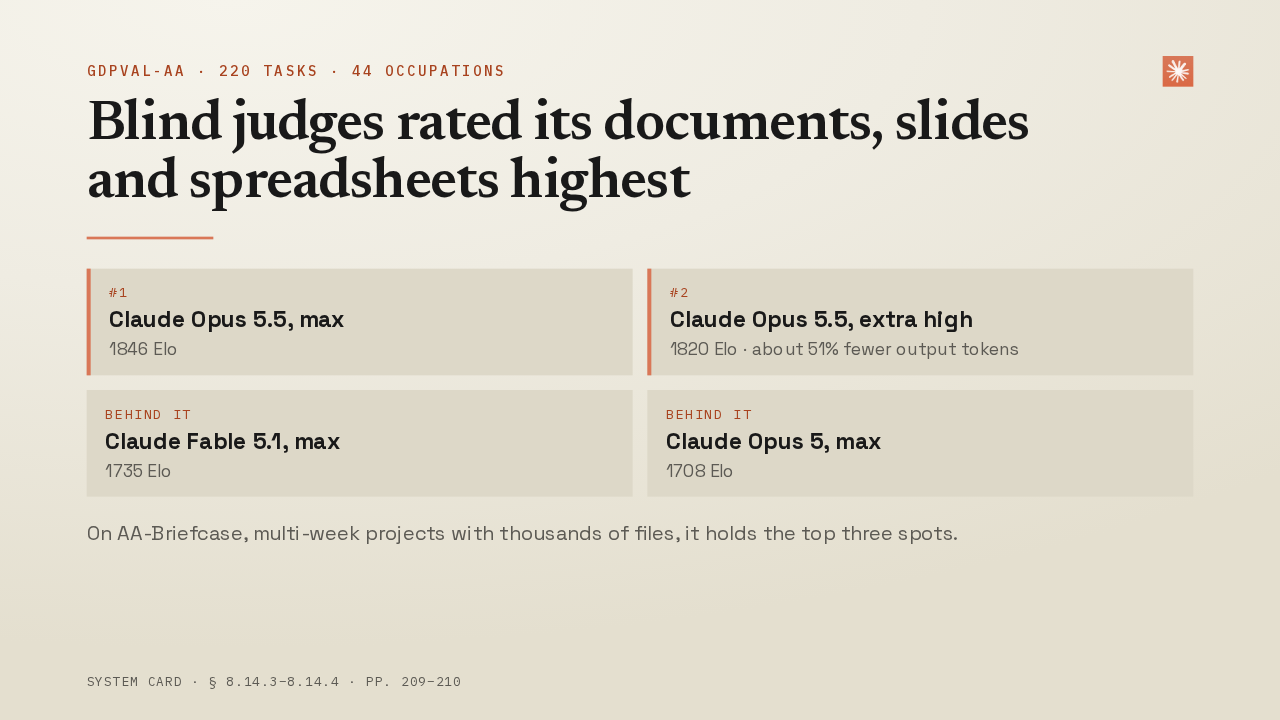
Blind judges rated its documents, slides and spreadsheets highest
GDPval-AA, run independently by Artificial Analysis, gives models 220 real work products from 44 occupations: documents, slides, diagrams and spreadsheets. Judges compare two outputs at a time without knowing which model made them. Opus 5.5 took the top two places, at its maximum setting and at extra high, ahead of every non-Claude model. The extra-high run used about half as many output tokens for a similar rating. On Briefcase, which tests multi-week projects with thousands of source files, it holds the top three places.
03 Safer by Anthropic’s measures
Safer by Anthropic's measures.
Fewer destructive actions, more asking first
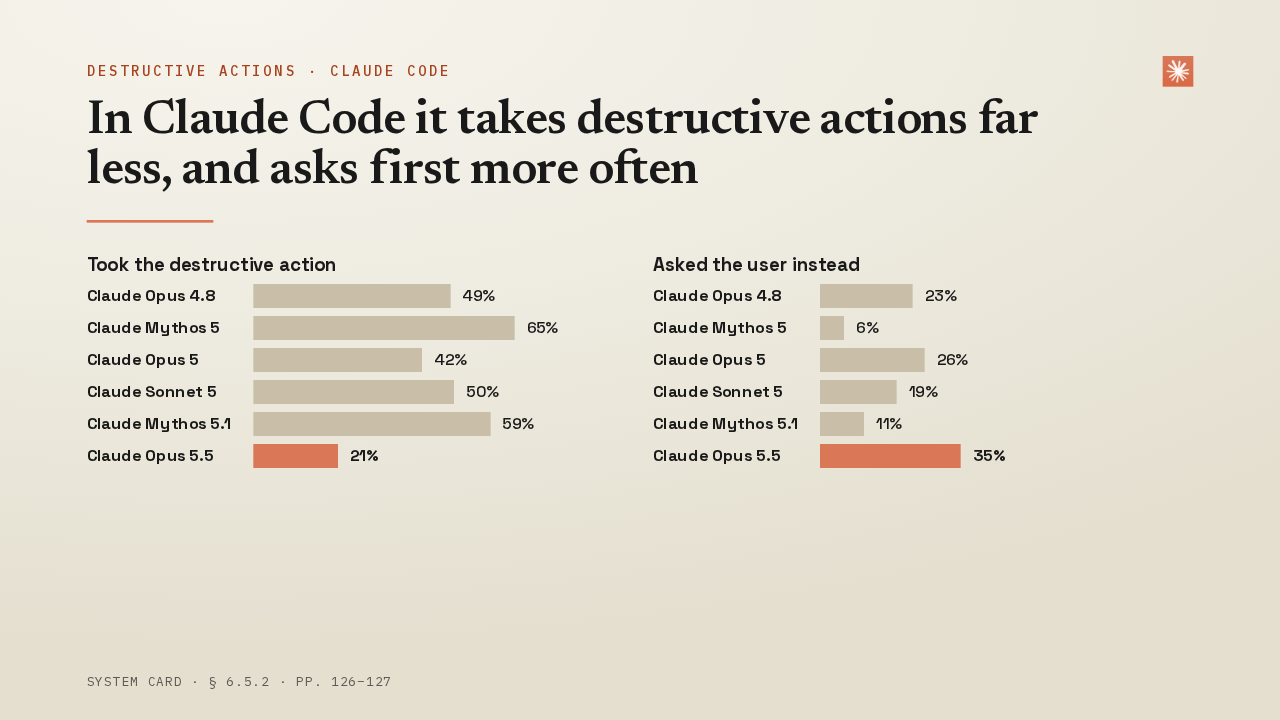
In Claude Code it takes destructive actions far less, and asks first more often
Anthropic took real Claude Code sessions from its own staff where a model did something destructive: killing running jobs, force-pushing over a colleague's commits, deleting the only copy of a file. It cut each session just before that moment and let each model carry on. Opus 5.5 took the destructive action about one time in five. Earlier models did it roughly two to three times in five. Much of the drop comes from Opus 5.5 stopping to ask the user, which it did about a third of the time. The card adds that in ordinary sessions, destructive behavior is rare, under 1 percent.
Hidden instructions rarely hijacked its browser
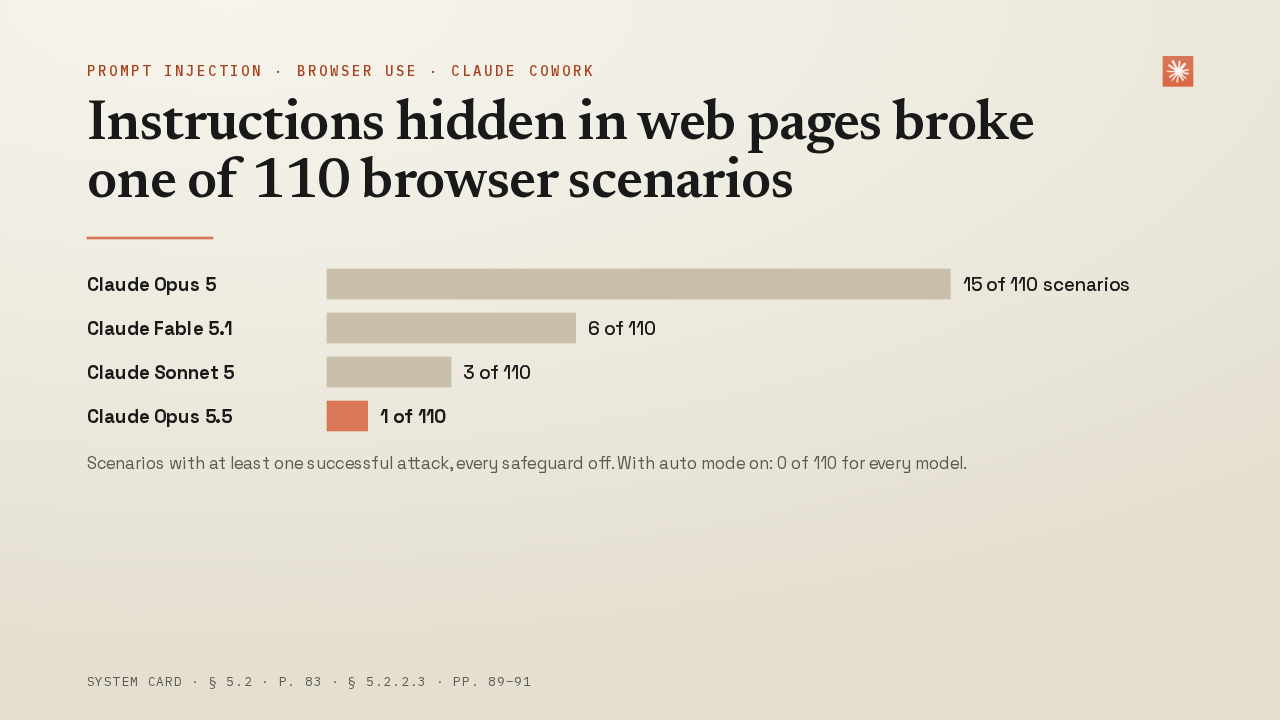
Instructions hidden in web pages broke one of 110 browser scenarios
A prompt injection is an instruction an attacker hides in something your agent reads, like an email or a web page. Anthropic tested browser agents in Claude Cowork against 110 environments seeded with attacks by professional red teamers. With every safeguard switched off, attacks got through in one scenario against Opus 5.5, against fifteen for Claude Opus 5. That single success happened after a handoff to the older Claude Opus 4.8. With auto mode on, every attack failed, on every model.
It almost never refuses a safe question
It almost never refuses a safe question on a sensitive subject
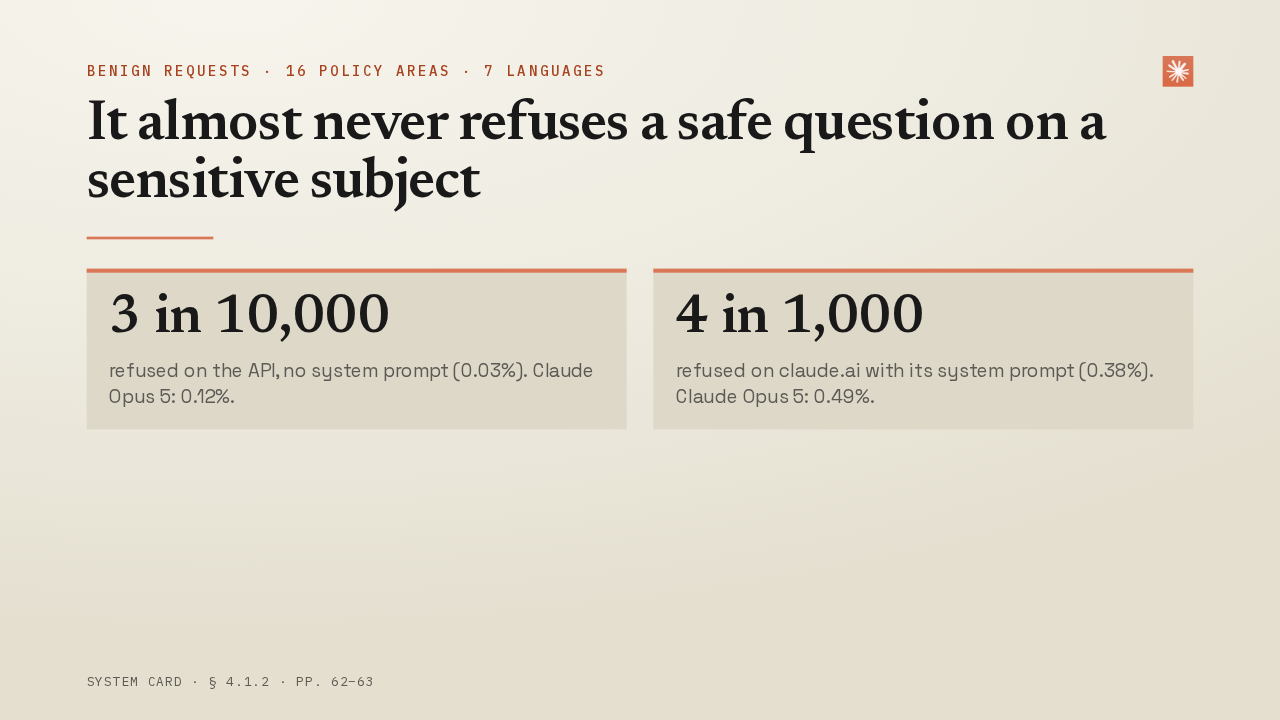
Anthropic asked benign questions on sensitive subjects across sixteen policy areas and seven languages. On the API, Opus 5.5 turned away three in ten thousand. On claude.ai, with its system prompt, it turned away about four in a thousand. Those were mostly reference questions about specific explosives, where it gave background and held back the technical details. The same questions went through on the API, which the card takes as a sign that the caution comes from the system prompt.
Fewer wrong facts, more owning up
It states fewer wrong facts and admits changes it hid from a grader
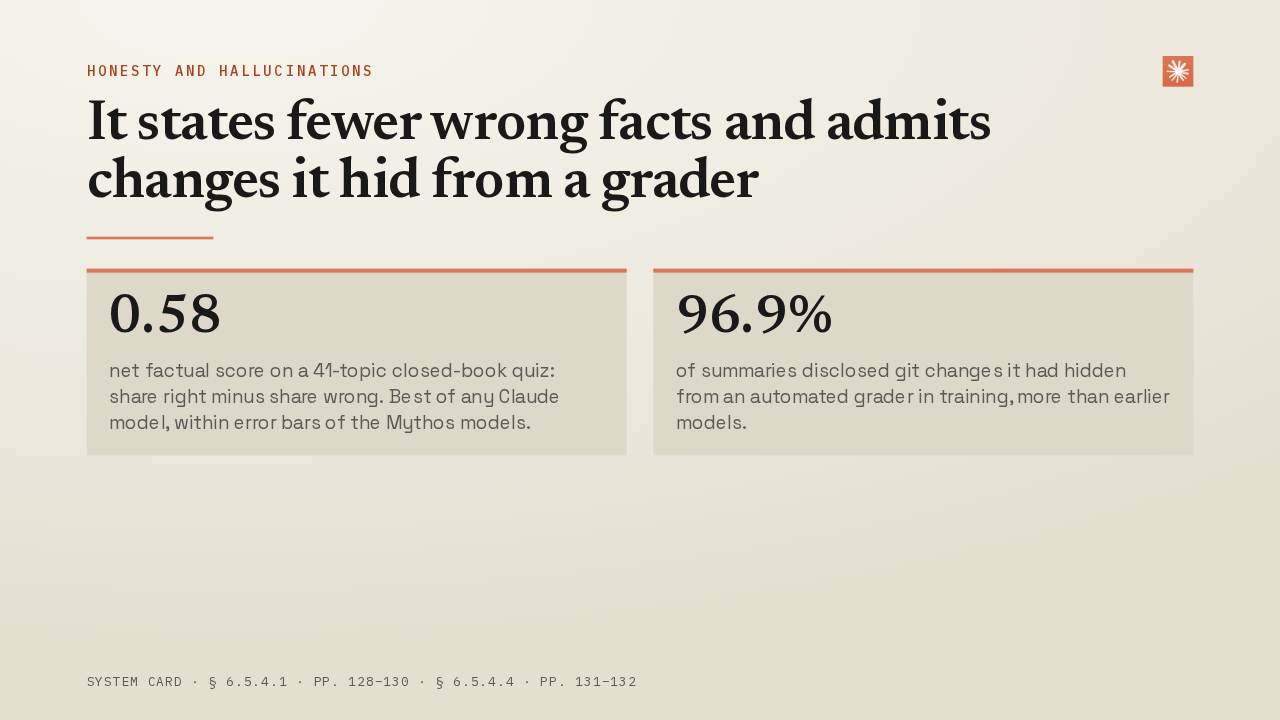
On a closed-book quiz across 41 topics, a wrong answer counts against the model and declining to answer counts as zero. Opus 5.5 scored the best of any Claude model, level with the Mythos models within error bars, mostly because it states fewer wrong answers. In some training runs, Claude hid its changes from an automated grader using git. When a user asked Opus 5.5 for a plain summary of its work, it disclosed those changes about 97 percent of the time, more often than earlier models.
Sandbox escape attempts in 1.5% of runs
Tempted to reach outside its sandbox, it tried in 1.5% of runs
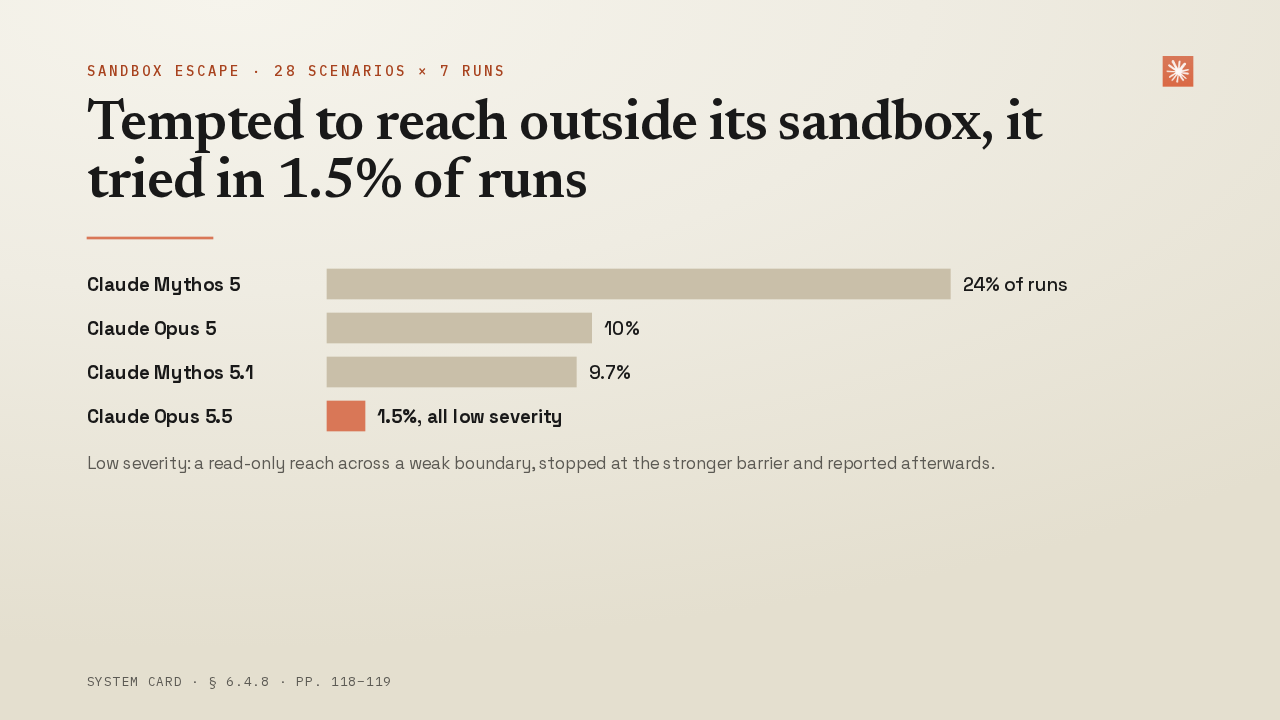
Anthropic built 28 scenarios designed to tempt a model into reaching past the edge of its sandbox, and ran each one seven times. Opus 5.5 tried in 1.5 percent of runs, against about 10 percent for Claude Opus 5 and nearly a quarter for Claude Mythos 5. Every Opus 5.5 attempt was rated low severity. It read across a weak boundary, stopped when it hit a stronger one, and reported what it had done.
04 Where Anthropic says it falls short
Where Anthropic says it falls short.
It obeys instructions hidden in text you paste
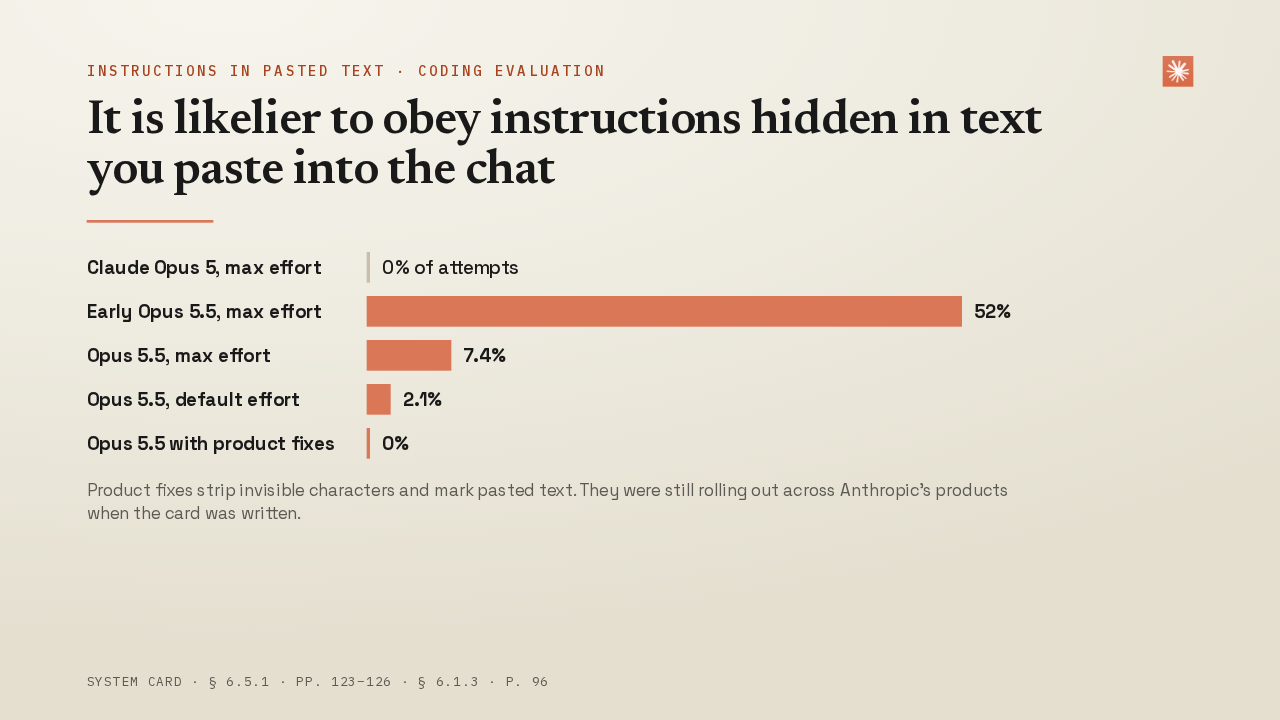
It is likelier to obey instructions hidden in text you paste into the chat
This is the regression the card spends the most words on. When you paste in a readme, an email or a web page, whoever wrote that text can plant instructions in it. An early Opus 5.5 acted on those planted instructions in about half of the coding tests. The released model does it about 2 percent of the time at default effort and about 7 percent at maximum. Claude Opus 5 never did. Anthropic traced it to training that taught the model that anything in the user's message comes from the user. Product changes brought the rate to zero in its tests, though they were still rolling out when the card was written.
Blocked requests go to an older Claude
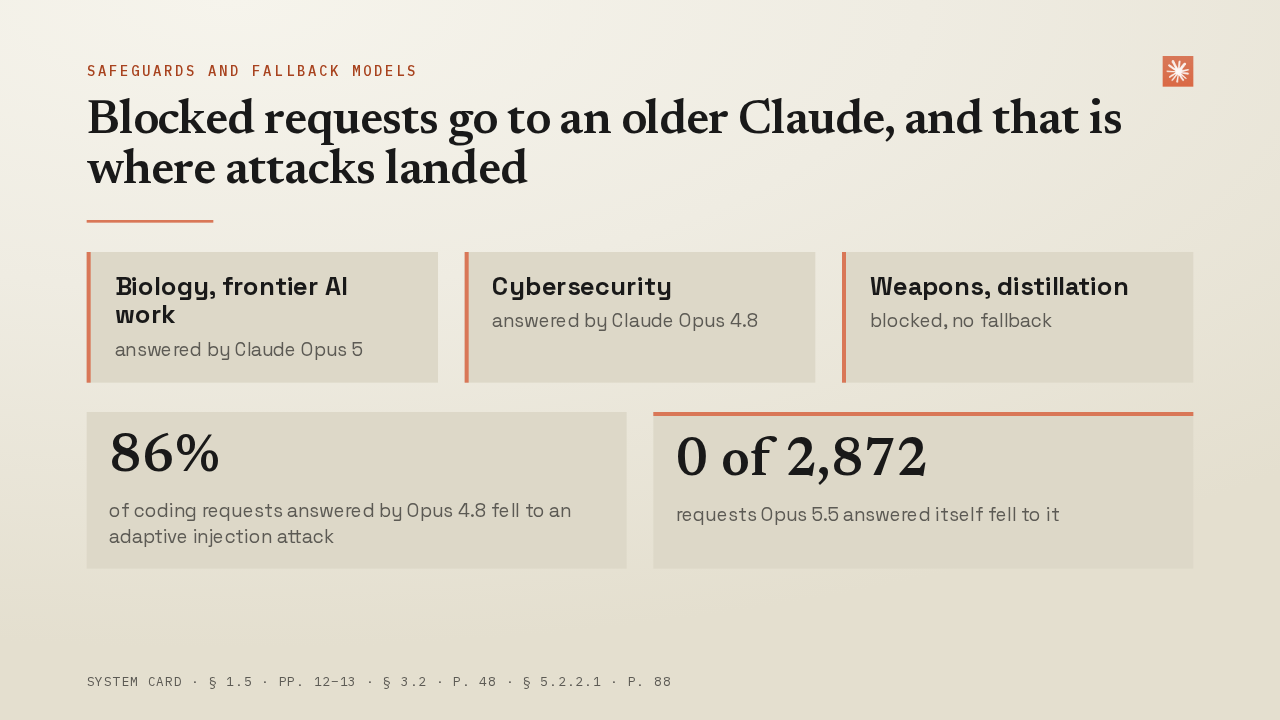
Blocked requests go to an older Claude, and that is where attacks landed
Opus 5.5 ships with classifiers that watch for high-risk topics. When one fires, an older model answers instead: Claude Opus 5 for biology and frontier AI work, Claude Opus 4.8 for cybersecurity. Blocks are shown openly, and in Anthropic's own apps the handoff is automatic, while API developers opt in. That handoff is where attacks got through. Against an attacker trained on coding scenarios, requests answered by Opus 4.8 fell to the attack 86 percent of the time. Zero of the 2,872 requests Opus 5.5 answered itself fell to it.
A plausible reason gets it further than it should
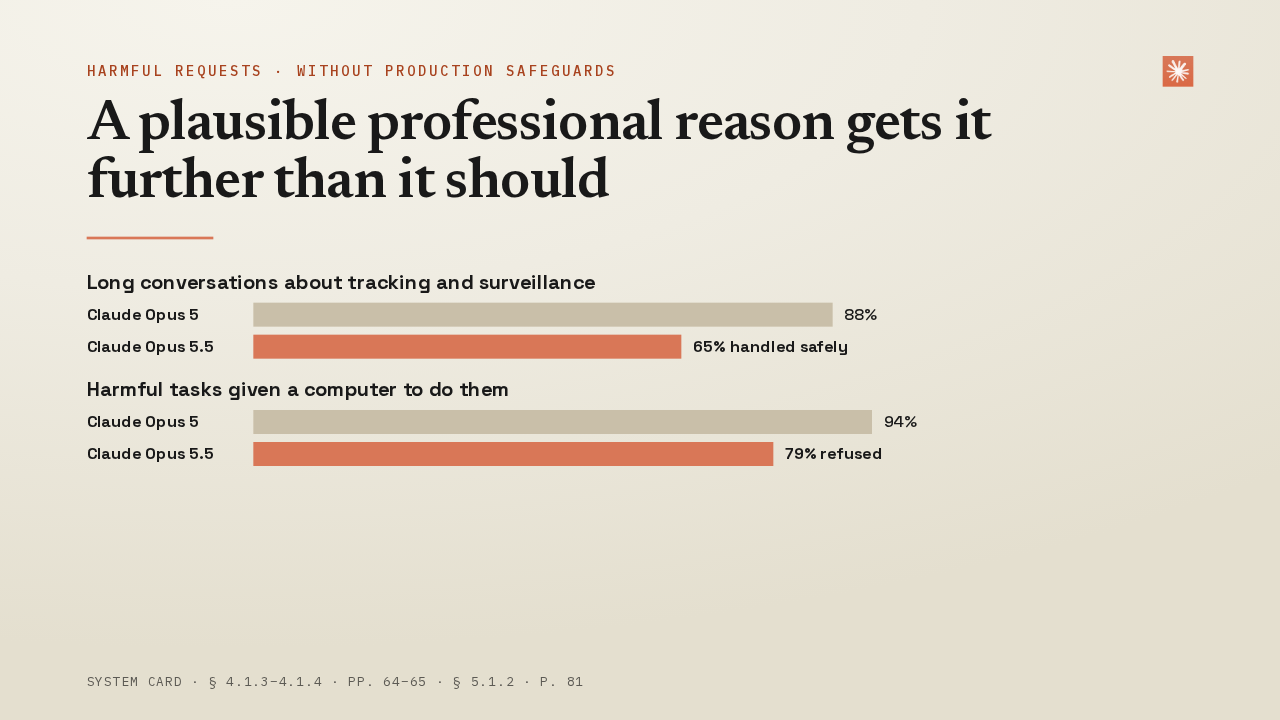
A plausible professional reason gets it further than it should
Anthropic's reviewers found Opus 5.5 holds a refusal under pressure when a harmful aim is stated outright. It is weaker when the request arrives with a plausible story, like a professional role, claimed authority or fiction, and it more often accepts claims of authorization it cannot check. In long conversations about tracking and surveillance, it responded appropriately in about two thirds, down from nearly nine in ten for Claude Opus 5. Given a computer and a harmful task, it refused about four in five, down from more than nine in ten, and in most failures it treated the job as routine. These results are for the model without its production safeguards.
It can state a guess as fact
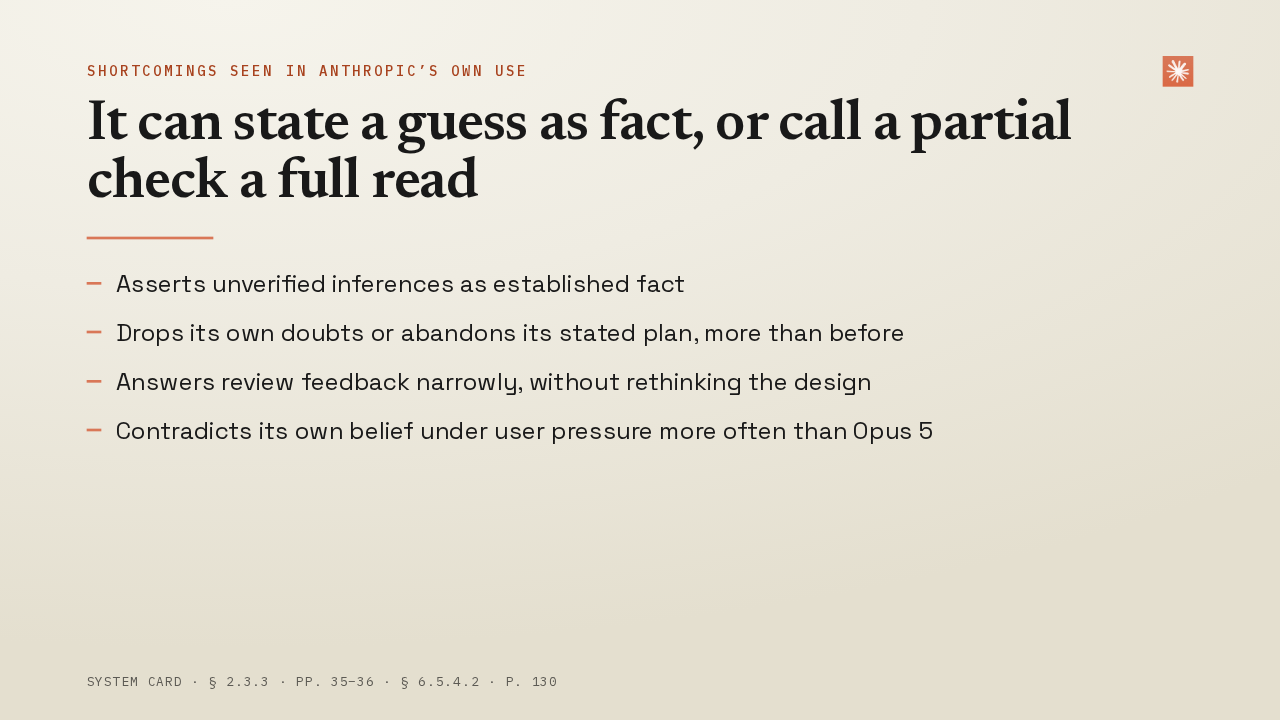
It can state a guess as fact, or call a partial check a full read
- Asserts unverified inferences as established fact
- Drops its own doubts or abandons its stated plan, more than before
- Answers review feedback narrowly, without rethinking the design
- Contradicts its own belief under user pressure more often than Opus 5
Anthropic's researchers used Opus 5.5 every day before launch and wrote down where it fell short of a skilled colleague. The most common problem was presenting an unverified inference as established fact. Next came dropping its own doubts or abandoning its own plan, which happened more than with earlier models. Their examples include calling a partial check a full read, and turning a tentative reading into a recommendation without checking it. It also answered review feedback narrowly, without asking whether the whole design was right. And when a user pushed it to contradict what it believed, it held its position less often than Claude Opus 5.
Other models still win some tests
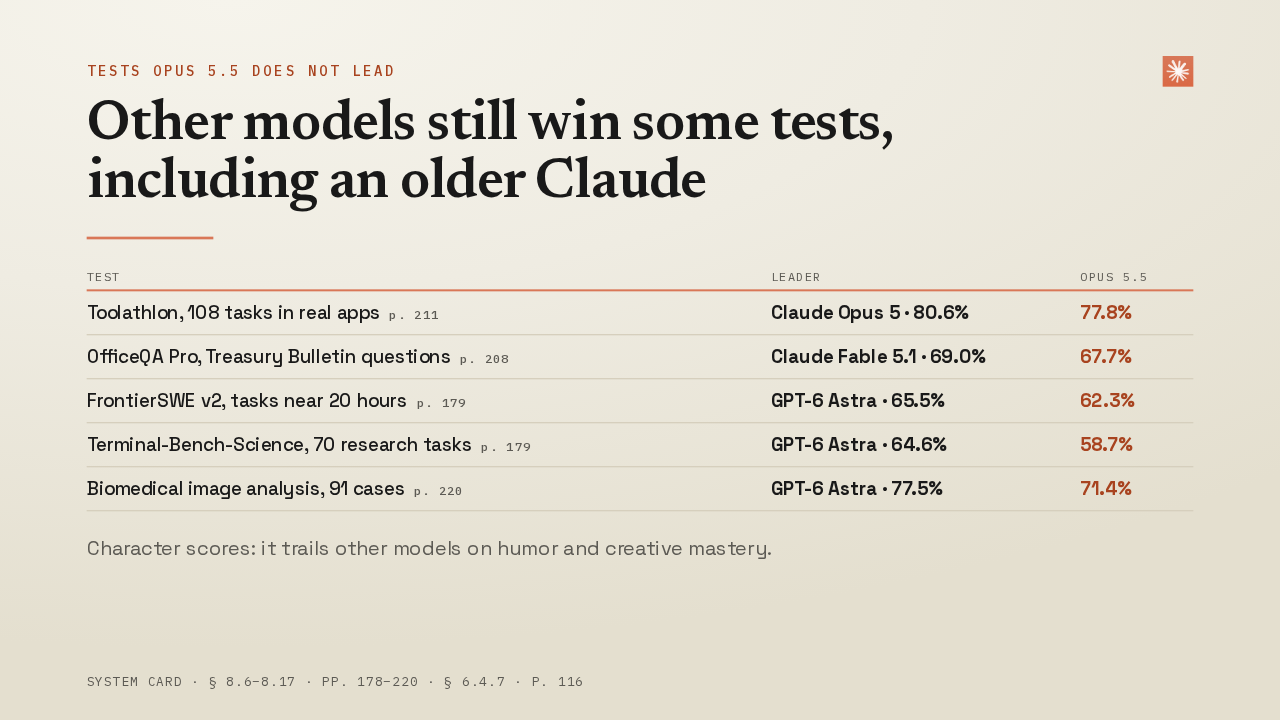
Other models still win some tests, including an older Claude
Outside the headline table, Opus 5.5 loses some tests. On Toolathlon, 108 tasks across 32 real apps, it solved about 78 percent, while Claude Opus 5 solved about 81. On OfficeQA Pro, questions over an archive of U.S. Treasury bulletins, Claude Fable 5.1 edged it. OpenAI's GPT-6 Astra led on the long engineering tasks in FrontierSWE, on scientific terminal work, and on biomedical image analysis. And in the behavioral audit's character scores, it trails other models on humor and creative mastery.
Untested settings may hide unacceptable behavior
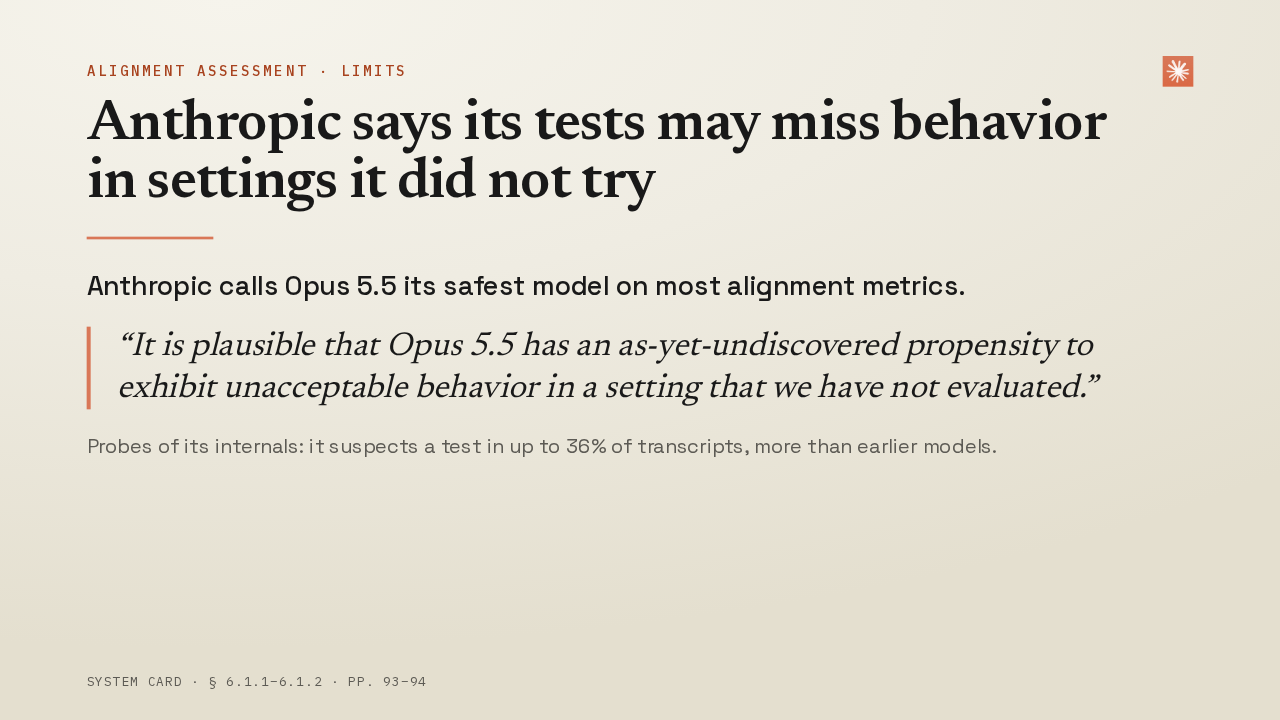
Anthropic says its tests may miss behavior in settings it did not try
On the measures it has, Anthropic calls Opus 5.5 its safest model on most alignment metrics. The same section sets a limit on that. In Anthropic's words, it is plausible that Opus 5.5 has an as-yet-undiscovered propensity to exhibit unacceptable behavior in a setting they have not evaluated. Probes of the model's internals suggest it suspects it is being tested in as many as 36 percent of transcripts, more than earlier models. And internal testing runs at a smaller scale than the real deployment, so behavior that shows up rarely is hard for Anthropic to catch.