Celeste 1.0 brings live voice sessions, transcription and typed decisions to one Python API
3 hours ago
Celeste 1.0 is the first stable release of the Python SDK that puts OpenAI, Anthropic, Google and more than a dozen other providers behind one interface. The headline is live sessions, a realtime voice conversation through the same API you already use for text. Transcription, upscaling and typed decisions come with it, and so do some breaking changes.
Ask about this presentation
Chapters
Show transcriptHide transcript
Celeste 1.0 is the first stable release of the Python SDK that puts OpenAI, Anthropic, Google and more than a dozen other providers behind one interface. The headline is live sessions, a realtime voice conversation through the same API you already use for text. Transcription, upscaling and typed decisions come with it, and so do some breaking changes.
Slide text


Live voice sessions,
in the same Python APICeleste 1.0, the first stable release, also adds transcription, upscaling, segmentation and typed decisions.
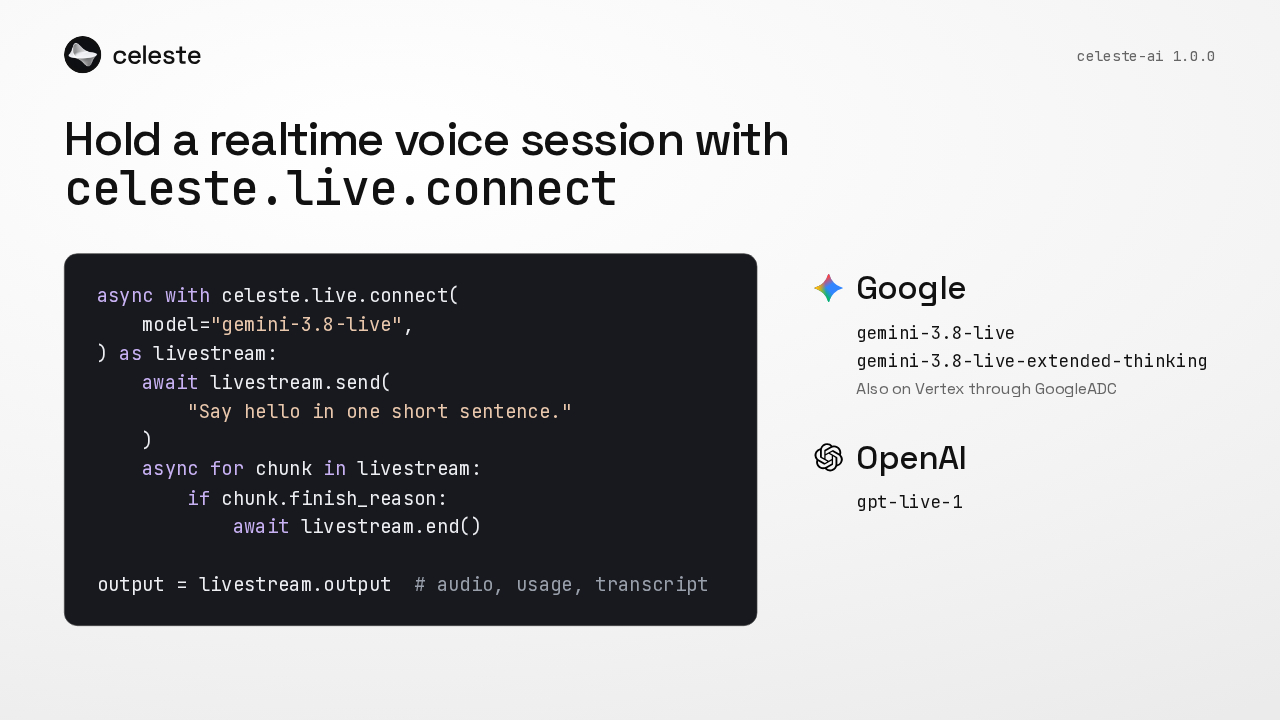
Live is a new modality. You open a session with celeste.live.connect, send it audio, and read chunks that carry the model's audio, a transcript and any tool calls. Gemini Live also takes text and images. It runs on Gemini 3.8 Live, also on Vertex, and on OpenAI's GPT Live 1.
Slide text
 celeste-ai 1.0.0
Hold a realtime voice session with celeste.live.connect
async with celeste.live.connect( model="gemini-3.8-live", ) as livestream: await livestream.send( "Say hello in one short sentence." ) async for chunk in livestream: if chunk.finish_reason: await livestream.end() output = livestream.output # audio, usage, transcriptGooglegemini-3.8-live
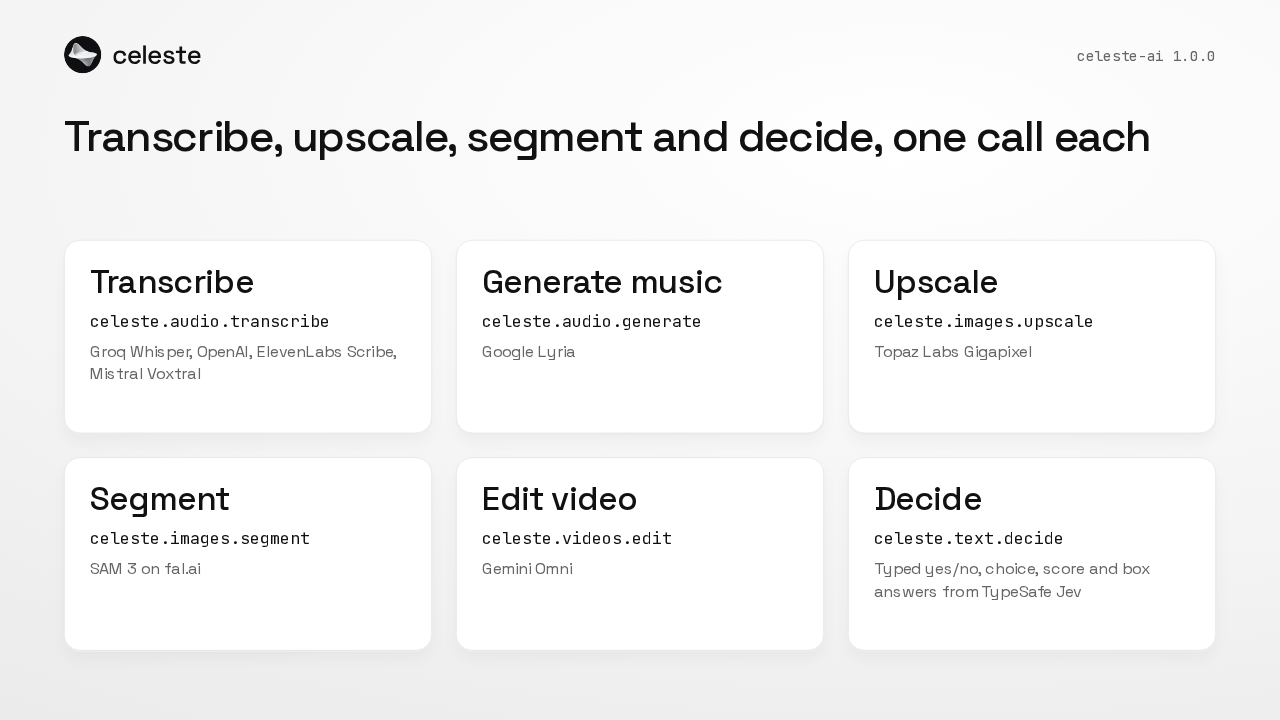
gemini-3.8-live-extended-thinkingAlso on Vertex through GoogleADCOpenAIgpt-live-1Beyond live sessions, 1.0 adds new operations. Transcribe speech with Whisper on Groq, OpenAI's models, ElevenLabs Scribe or Mistral's Voxtral. Generate music with Google's Lyria, upscale images through Topaz Labs, segment them with SAM 3, and edit video with Gemini Omni. And decide answers typed questions about text or an image, with probabilities, using TypeSafe's Jev models.
Slide text
celeste-ai 1.0.0Transcribe, upscale, segment and decide, one call each
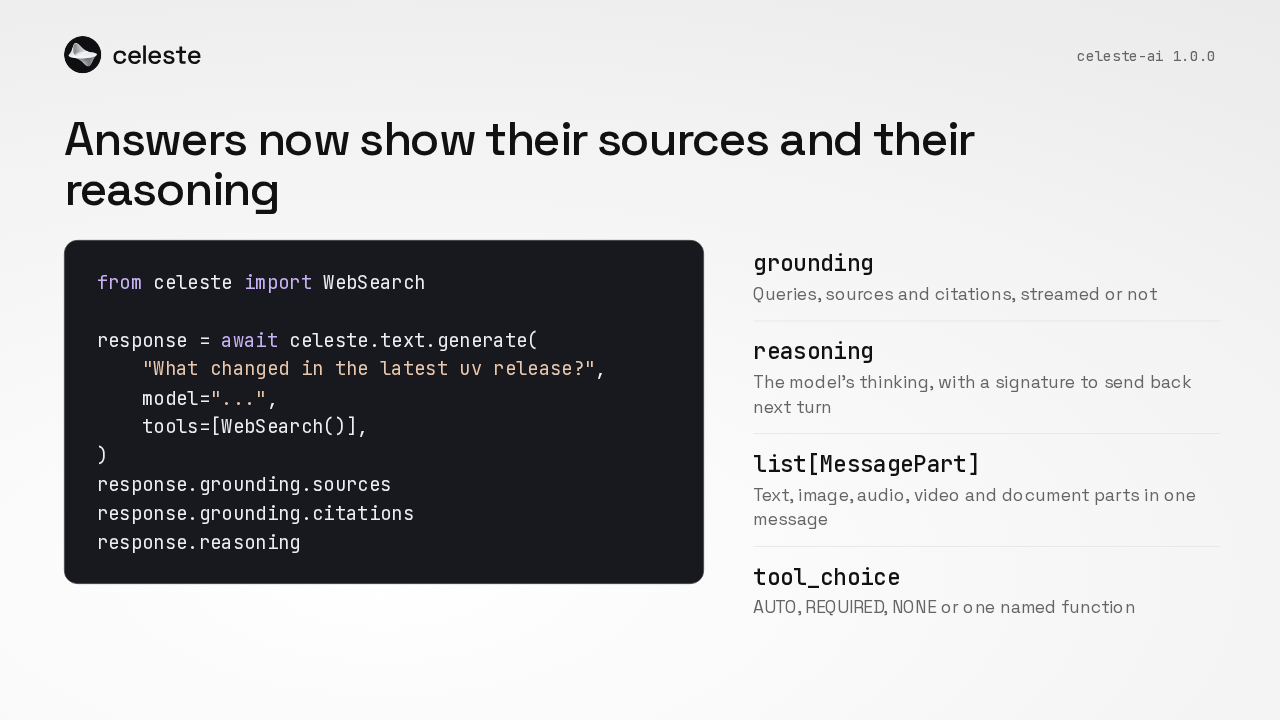
Transcribeceleste.audio.transcribeGroq Whisper, OpenAI, ElevenLabs Scribe, Mistral VoxtralGenerate musicceleste.audio.generateGoogle LyriaUpscaleceleste.images.upscaleTopaz Labs GigapixelSegmentceleste.images.segmentSAM 3 on fal.aiEdit videoceleste.videos.editGemini OmniDecideceleste.text.decideTyped yes/no, choice, score and box answers from TypeSafe JevAnswers now carry their evidence. Pass the WebSearch tool, and the response's grounding field lists the queries, sources and citations, on OpenAI, Anthropic, Google, xAI and Groq. Reasoning models return their thinking in a reasoning field, and one message can now mix text, images, audio, video and documents.
Slide text
celeste-ai 1.0.0Answers now show their sources and their reasoning
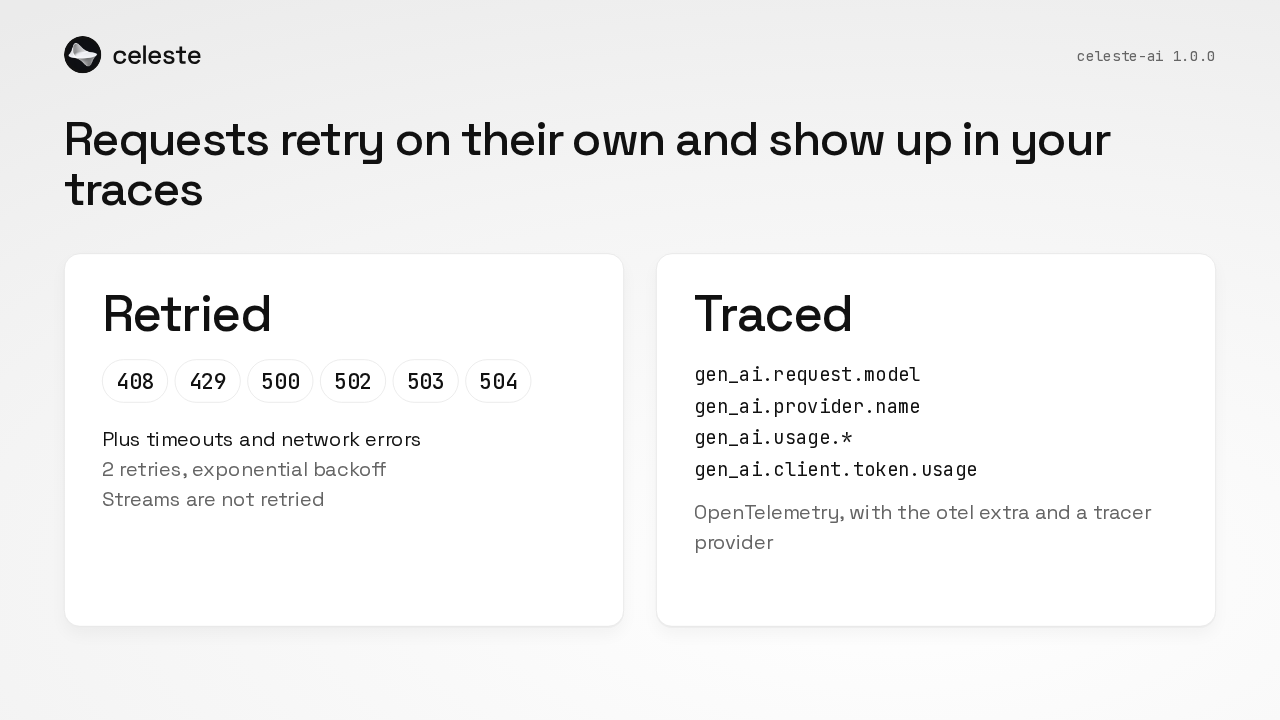
from celeste import WebSearch response = await celeste.text.generate( "What changed in the latest uv release?", model="...", tools=[WebSearch()], ) response.grounding.sources response.grounding.citations response.reasoninggroundingQueries, sources and citations, streamed or notreasoningThe model's thinking, with a signature to send back next turnlist[MessagePart]Text, image, audio, video and document parts in one messagetool_choiceAUTO, REQUIRED, NONE or one named functionTwo changes matter in production. Ordinary requests now retry by themselves, twice, with exponential backoff, on timeouts, rate limits and server errors. Streams are not retried. And with the new otel extra and a tracer provider, every call emits OpenTelemetry spans with the model, the provider and token usage.
Slide text
celeste-ai 1.0.0Requests retry on their own and show up in your traces
Retried408 429 500 502 503 504Plus timeouts and network errors
2 retries, exponential backoff
Streams are not retriedTracedgen_ai.request.model
gen_ai.provider.name
gen_ai.usage.*
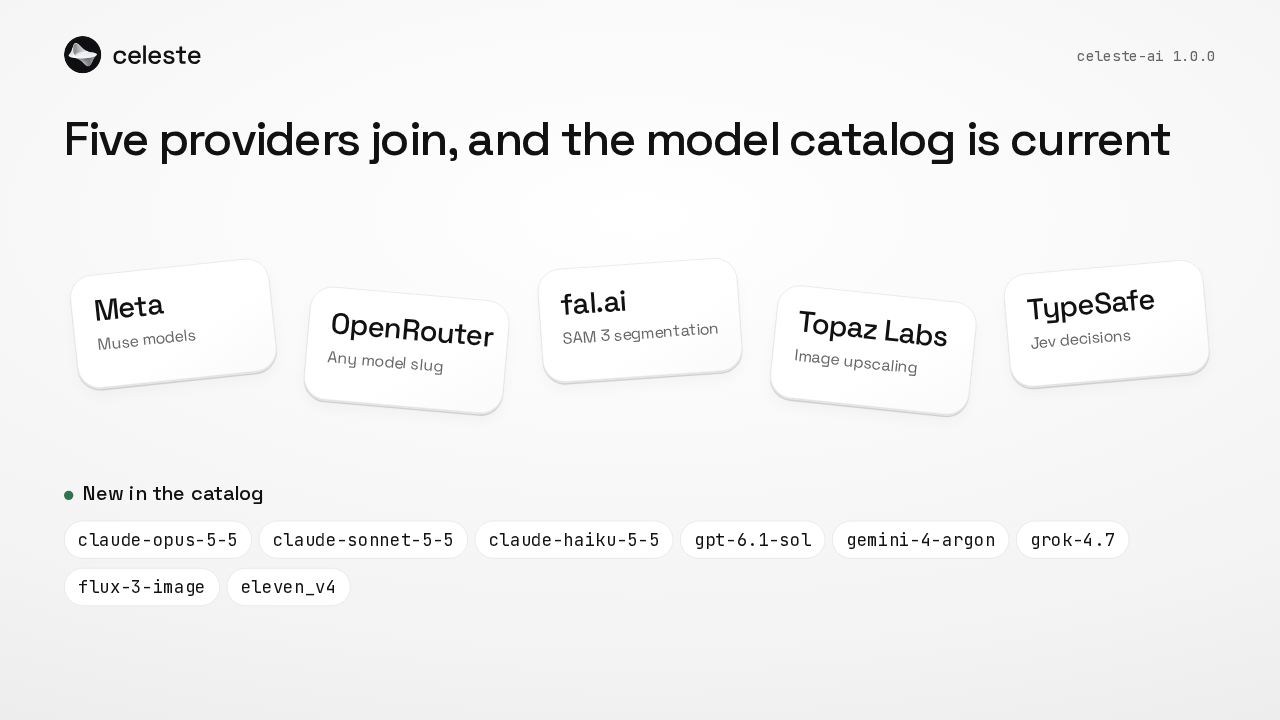
gen_ai.client.token.usageOpenTelemetry, with the otel extra and a tracer providerFive providers join. Meta's Muse models, OpenRouter, fal, Topaz Labs and TypeSafe. The catalog adds Claude Opus, Sonnet and Haiku 5.5, GPT 6.1 Sol, Gemini 4 Argon and Grok 4.7, and models the providers retired are gone from it.
Slide text
celeste-ai 1.0.0Five providers join, and the model catalog is current
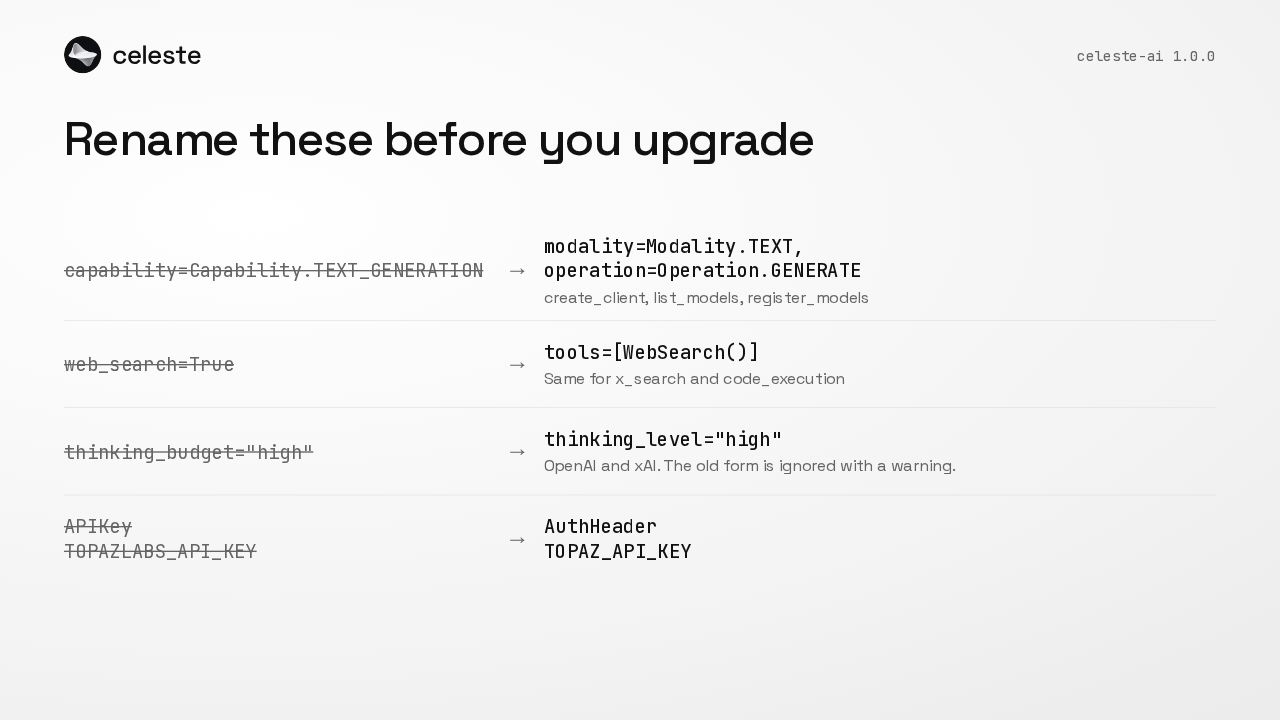
MetaMuse modelsOpenRouterAny model slugfal.aiSAM 3 segmentationTopaz LabsImage upscalingTypeSafeJev decisionsNew in the catalogclaude-opus-5-5 claude-sonnet-5-5 claude-haiku-5-5 gpt-6.1-sol gemini-4-argon grok-4.7 flux-3-image eleven_v4Now the breaking changes. The legacy capability argument is gone, so create clients with a modality and an operation. The web search flag becomes a WebSearch tool. On OpenAI and xAI, named efforts move from thinking budget to thinking level, and the old form only logs a warning, so search for it. APIKey is now AuthHeader, and Topaz reads a renamed environment variable.
Slide text
celeste-ai 1.0.0Rename these before you upgrade
capability=Capability.TEXT_GENERATION→modality=Modality.TEXT,
operation=Operation.GENERATEcreate_client, list_models, register_modelsweb_search=True→tools=[WebSearch()]Same for x_search and code_executionthinking_budget="high"→thinking_level="high"OpenAI and xAI. The old form is ignored with a warning.APIKey
TOPAZLABS_API_KEY→AuthHeader
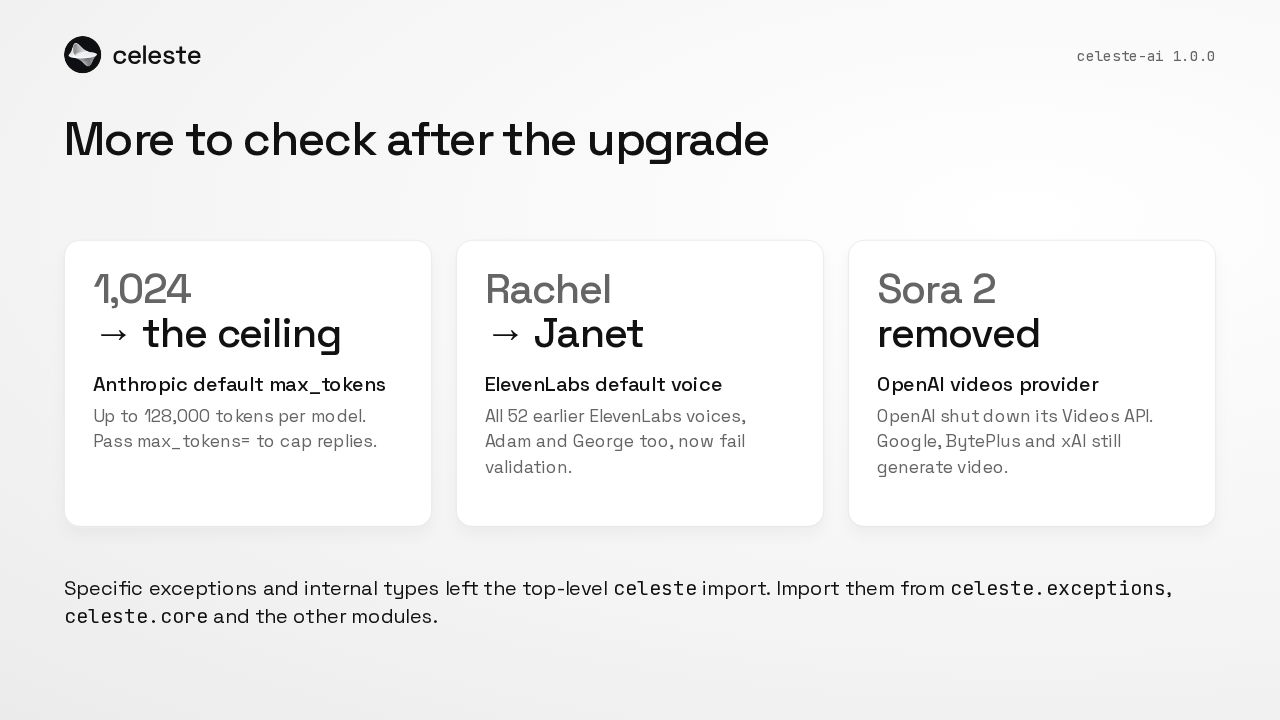
TOPAZ_API_KEYA few more changes to check. On Anthropic, max tokens now defaults to the model's ceiling instead of 1,024, so cap it yourself if you relied on short replies. Every earlier ElevenLabs voice fails validation, and the default is now Janet. OpenAI's video provider is gone, along with Sora 2. And specific exceptions now import from celeste dot exceptions.
Slide text
celeste-ai 1.0.0More to check after the upgrade
1,024
→ the ceilingAnthropic default max_tokensUp to 128,000 tokens per model. Pass max_tokens= to cap replies.Rachel
→ JanetElevenLabs default voiceAll 52 earlier ElevenLabs voices, Adam and George too, now fail validation.Sora 2
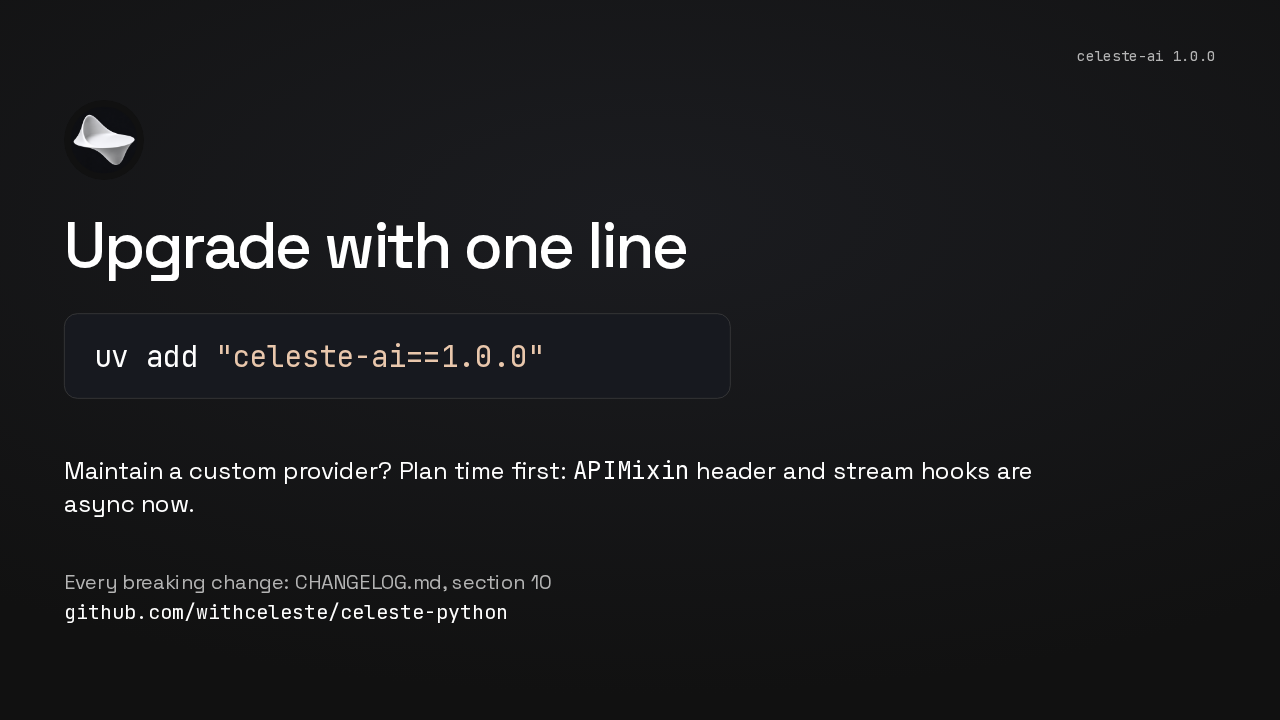
removedOpenAI videos providerOpenAI shut down its Videos API. Google, BytePlus and xAI still generate video.Specific exceptions and internal types left the top-level celeste import. Import them from celeste.exceptions, celeste.core and the other modules.To upgrade, pin 1.0.0 with uv add. If you maintain a custom provider, set aside time first, because the header and stream hooks on APIMixin became async. The full list of breaking changes is in section 10 of the changelog. That's Celeste 1.0, live voice sessions in the same Python API.
Slide text
celeste-ai 1.0.0
Upgrade with one line
uv add "celeste-ai==1.0.0"Maintain a custom provider? Plan time first: APIMixin header and stream hooks are async now.Every breaking change: CHANGELOG.md, section 10
github.com/withceleste/celeste-python