July 2026
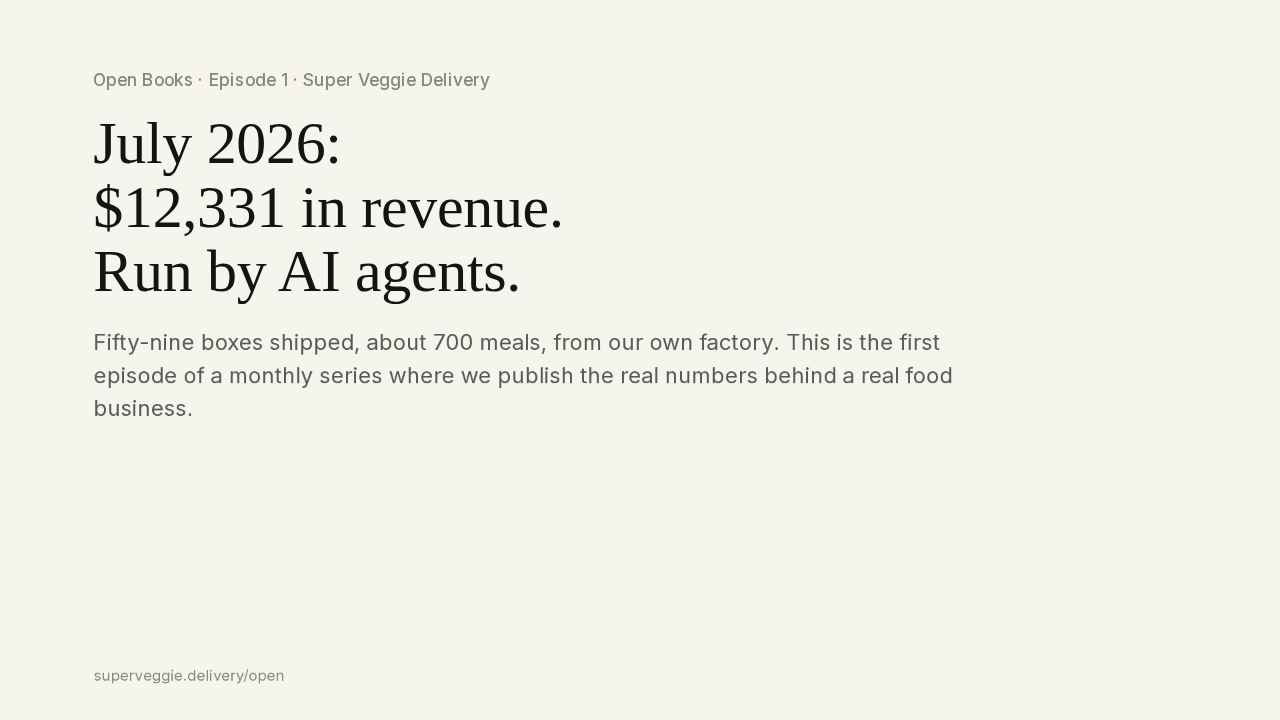
July 2026:
$12,331 in revenue.
Run by AI agents.
In July, Super Veggie Delivery did twelve thousand three hundred thirty one dollars in revenue. Fifty nine boxes, roughly seven hundred meals, made in our own factory and shipped across the country. This is Open Books, a monthly series where we publish the real numbers behind a real food business, the good months and the bad ones, and show the AI system that runs it day to day.
What this is
Two companies, one experiment, full disclosure.
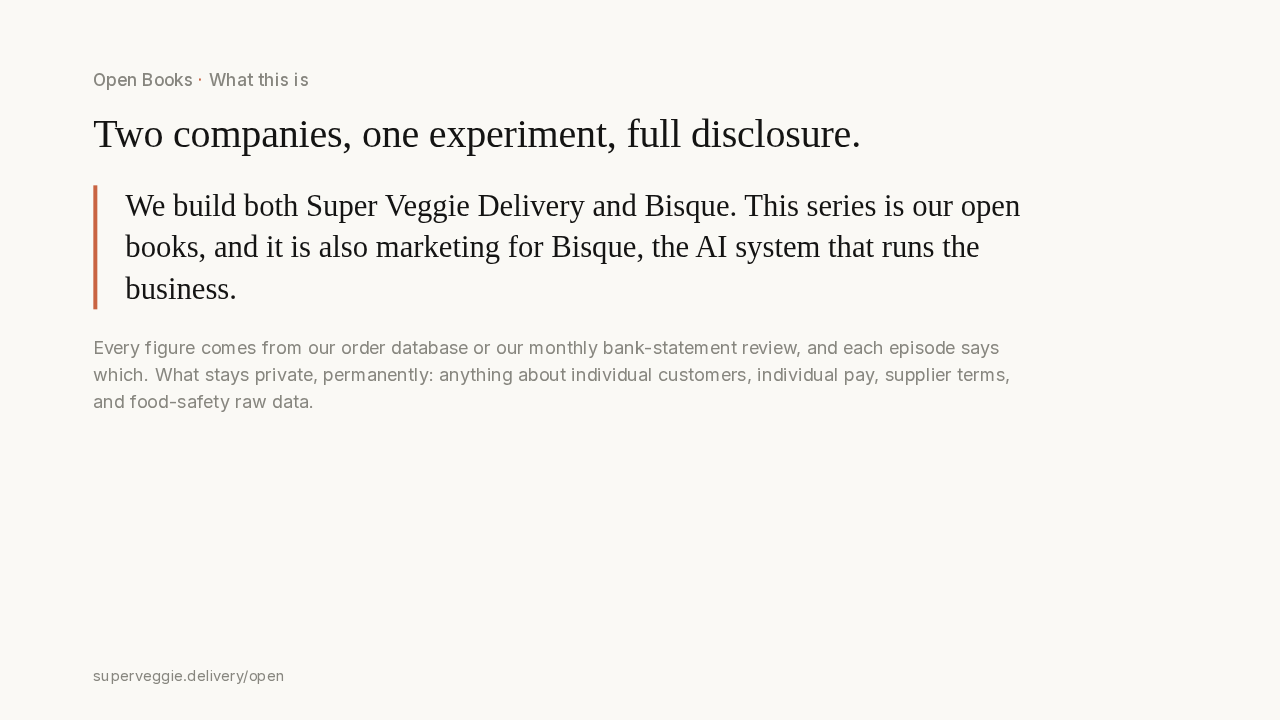
Before any numbers, the disclosure. We build both Super Veggie Delivery and Bisque. This series is our open books, and it is also marketing for Bisque, the AI system that runs the business. Every figure comes from our order database or our monthly bank review, and we will always say which. And some things stay private no matter what: our customers, individual pay, supplier terms, and raw food safety data.
The numbers
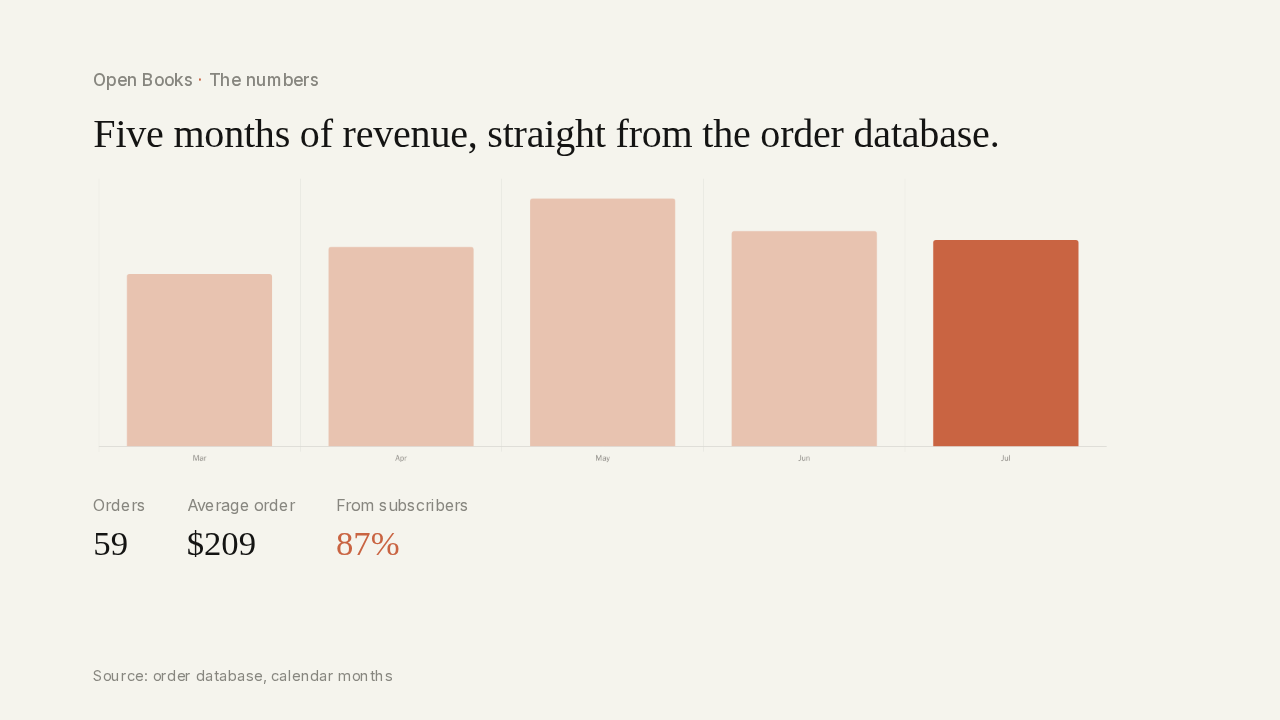
Five months of revenue, straight from the order database.
Here is the revenue picture, calendar months from the order database with refunds removed. The shape matters more than any single bar: a spring climb to a May peak, then a summer drift sideways, still holding above twelve thousand a month. Inside July, fewer but bigger orders, fifty nine boxes averaging two hundred nine dollars. And eighty seven percent of revenue came from subscribers, people on a recurring box. That is the number we care most about, because it means the base renews on its own.
Where a dollar went
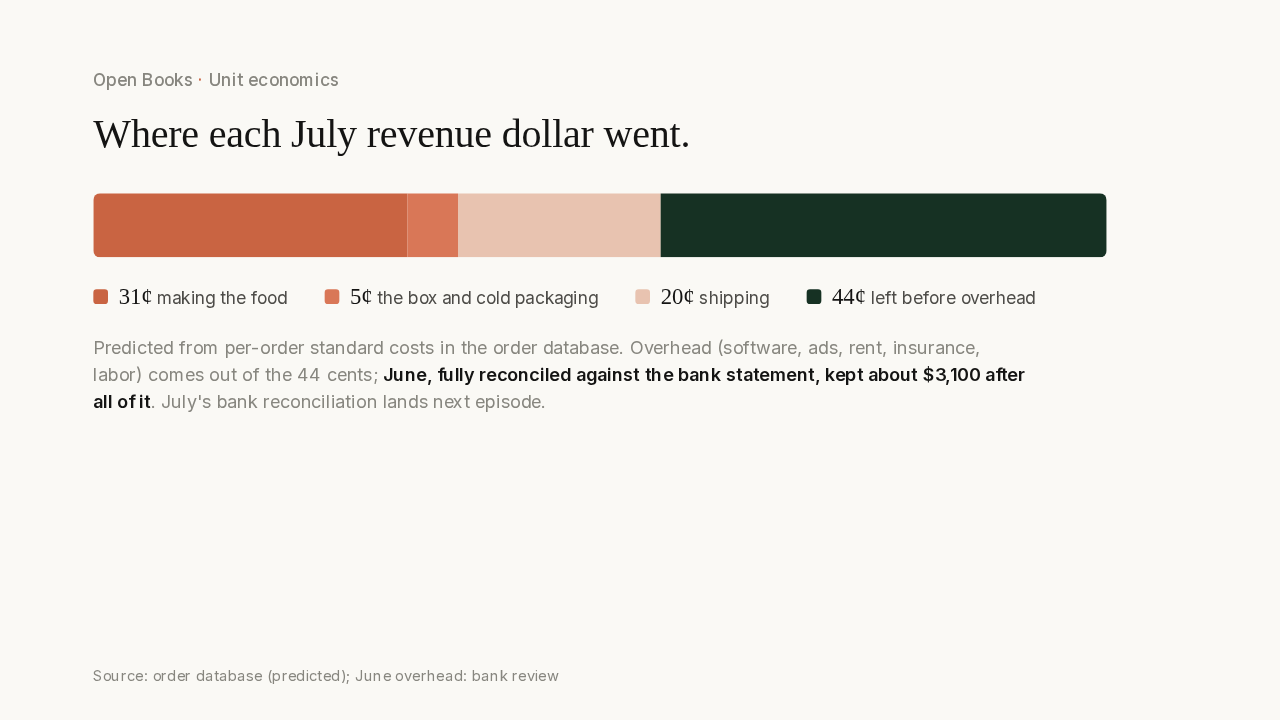
Where each July revenue dollar went.
Now where the money went. Out of each July revenue dollar, about thirty one cents went to making the food, five cents to the box and cold packaging, and twenty cents to shipping. That leaves forty four cents of contribution before overhead. These are predicted numbers from per order standard costs, and overhead still comes out of that forty four cents. For calibration, June, which we fully reconciled against the bank statement, kept about three thousand one hundred dollars after everything, our first clearly profitable month. July's bank reconciliation lands next episode.
The wrinkle
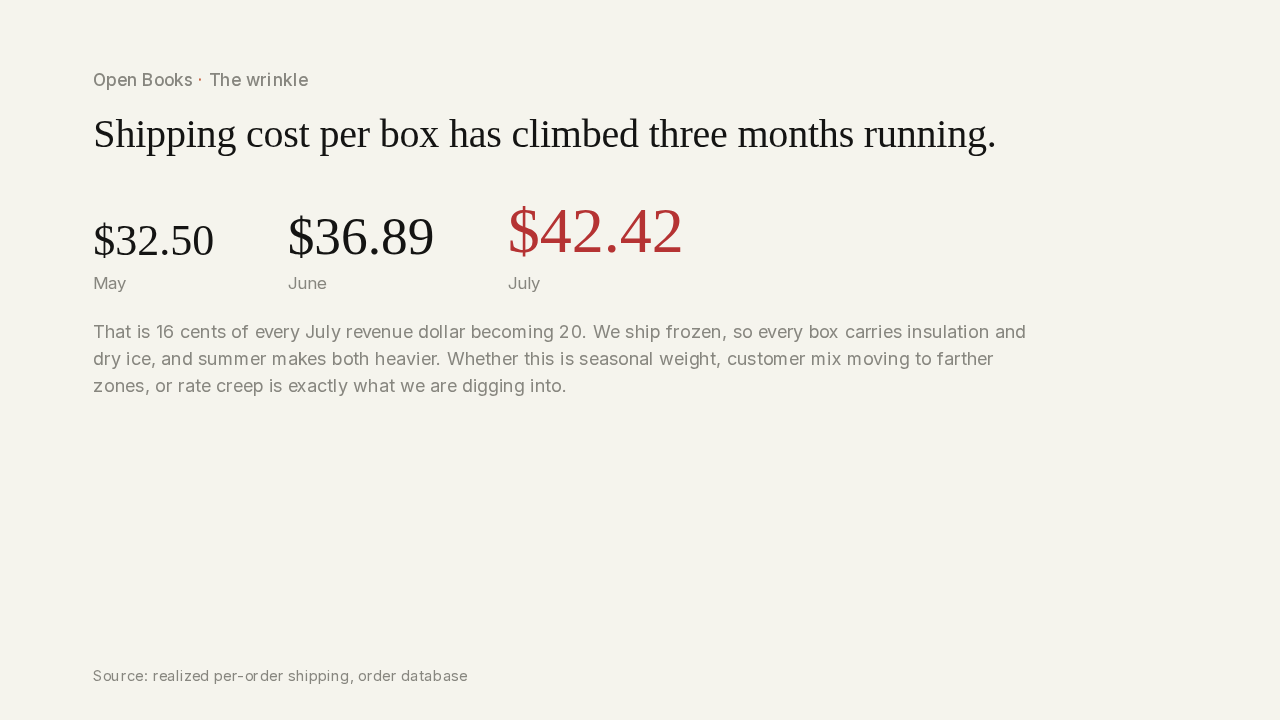
Shipping cost per box has climbed three months running.
Every honest review needs the wrinkle, and July's is shipping. The realized shipping cost per box was thirty two fifty in May, thirty six eighty nine in June, and forty two forty two in July. Three months, one direction. We ship frozen, so every box carries insulation and dry ice, and summer makes both heavier. Whether this is seasonal weight, customers shifting to farther zones, or plain rate creep is what we are digging into now. This is the number to watch next episode.
The AI system
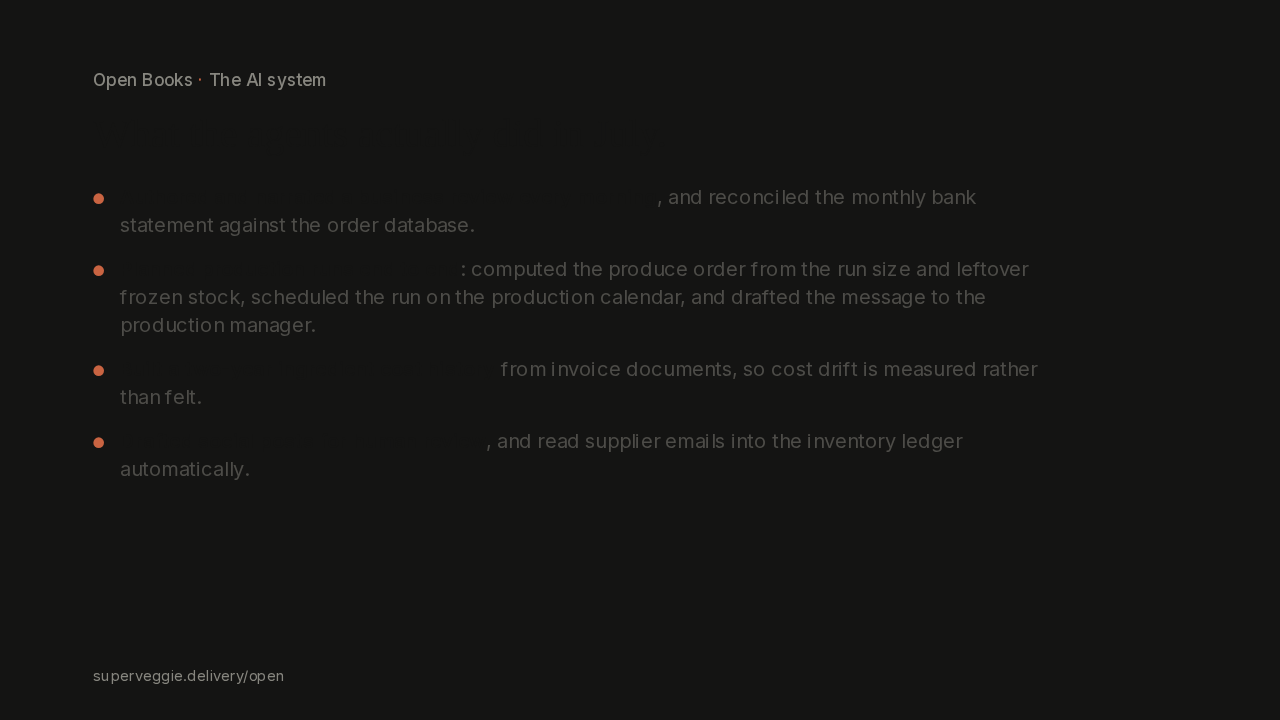
What the agents actually did in July.
- Authored and narrated a business review every morning, and reconciled the monthly bank statement against the order database.
- Planned production runs end to end: computed the produce order from the run size and leftover frozen stock, scheduled the run on the production calendar, and drafted the message to the production manager.
- Built a two-year ingredient cost history from invoice documents, so cost drift is measured rather than felt.
- Drafted social posts for human review, and read supplier emails into the inventory ledger automatically.
Now the part that makes this series different. The business is two founders, and the day to day is run by AI agents on Bisque. In July, concretely: an agent authored and narrated a business review every single morning, and reconciled the monthly bank statement against the order database. An agent planned production runs end to end. It computed the produce order from the run size and the frozen stock left over, scheduled the run on the production calendar, and drafted the message to our production manager. An agent built a two year ingredient cost history from invoice documents, so cost drift is measured, and agents drafted our social posts for human review and read supplier emails straight into the inventory ledger. This presentation was authored and narrated the same way.
What we tried
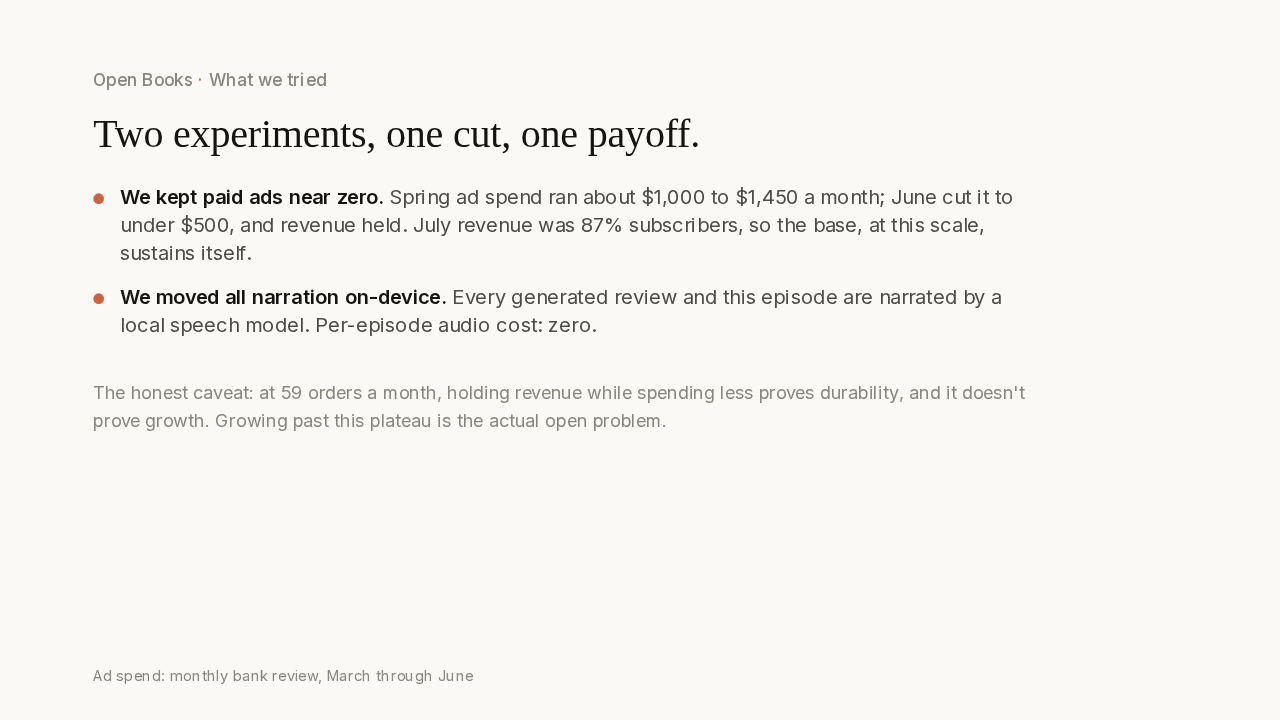
Two experiments, one cut, one payoff.
- We kept paid ads near zero. Spring ad spend ran about $1,000 to $1,450 a month; June cut it to under $500, and revenue held. July revenue was 87% subscribers, so the base, at this scale, sustains itself.
- We moved all narration on-device. Every generated review and this episode are narrated by a local speech model. Per-episode audio cost: zero.
What we tried. First, we kept paid ads near zero. In the spring we were spending roughly a thousand to fourteen hundred fifty dollars a month on ads. In June we cut that to under five hundred, and revenue held, because most of it comes from subscribers. Second, we moved all narration on device. Every generated review, including the one you are hearing, is narrated by a local speech model, so the audio cost per episode is now zero. The honest caveat: at fifty nine orders a month, holding revenue while spending less proves the base is durable. It does not prove growth. Growing past this plateau is the actual open problem.
What we don't know
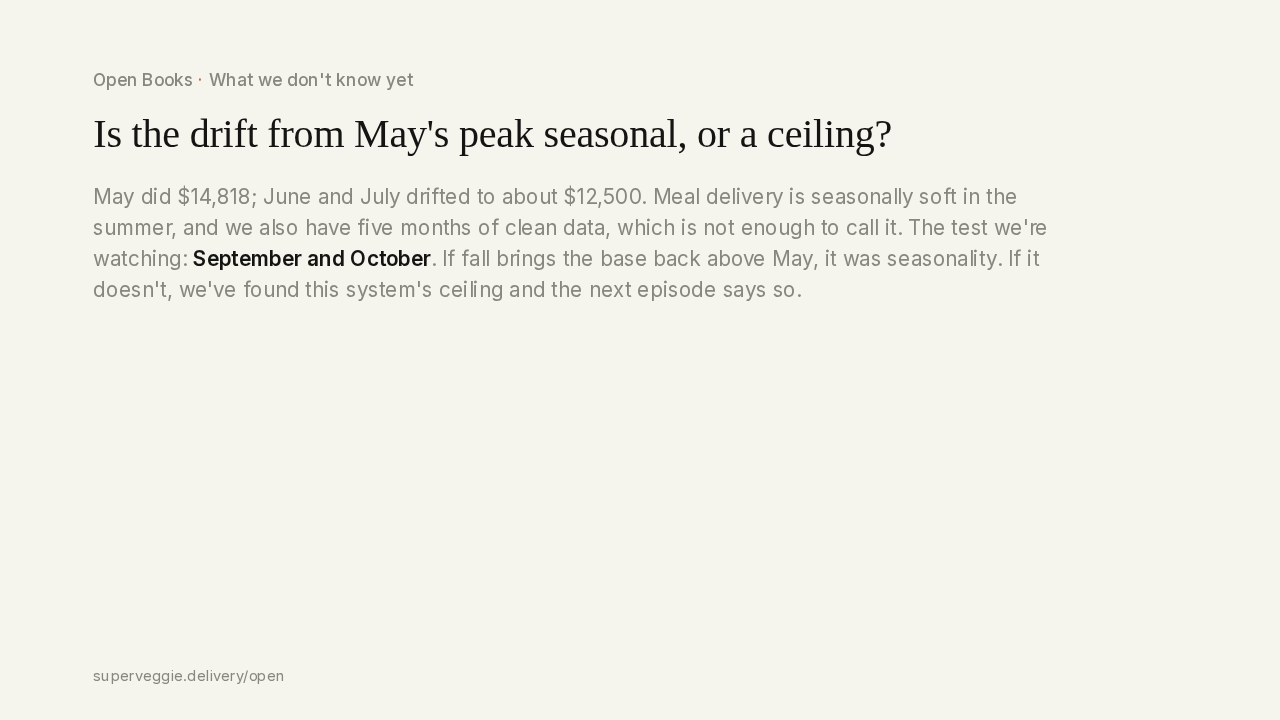
Is the drift from May's peak seasonal, or a ceiling?
And the thing we genuinely don't know yet. May peaked at fourteen thousand eight hundred, then June and July drifted to around twelve and a half. Meal delivery is seasonally soft in the summer, and we only have five months of clean data, so we can't call it yet. The test is September and October. If fall brings the base back above May, it was seasonality. If it doesn't, we have found this system's ceiling, and the next episode will say exactly that.
Follow along
New episode on the 3rd of every month.
That's July. The next episode publishes on the third of the month, same place, including the bank-reconciled July costs and the shipping answer. If you want to taste what fifty nine households ordered in July, the code OPENBOOKS takes ten dollars off a first order. And if you're a founder who wants agents running your operations the way they run ours, that system is called Bisque. Thanks for reading the books with us.