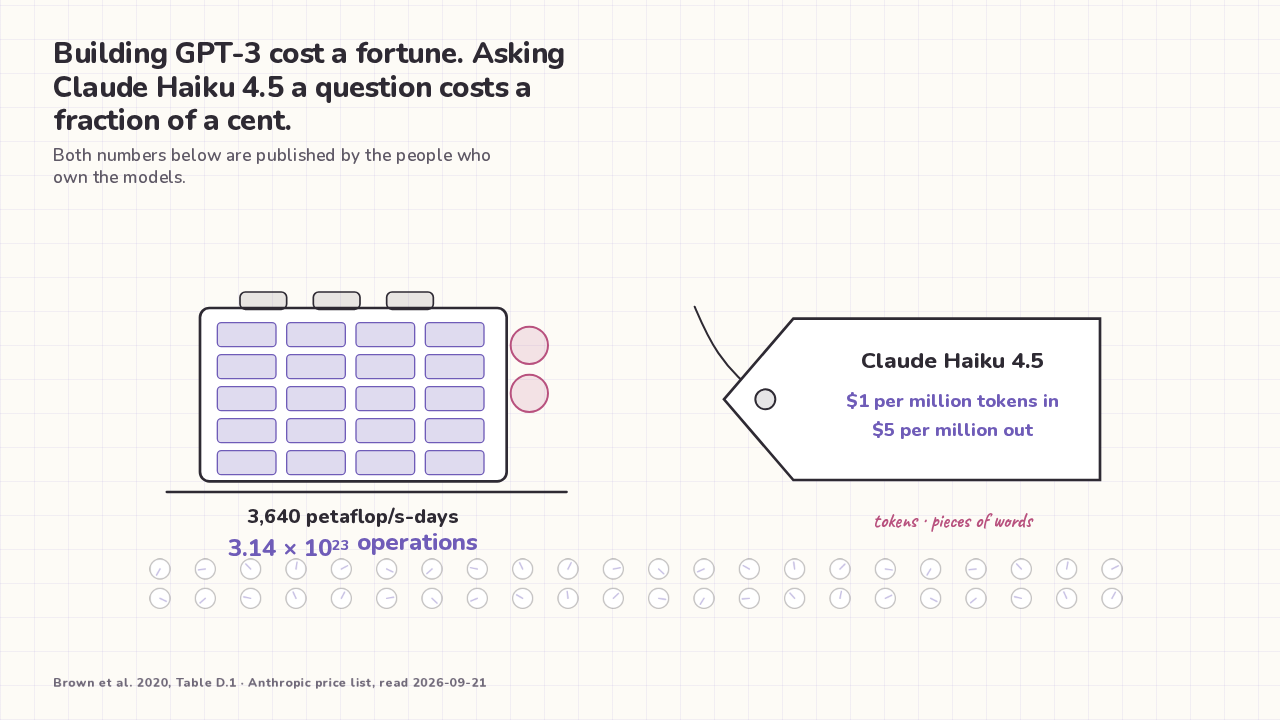
A 2017 model sent the word “its” back to “Law”.
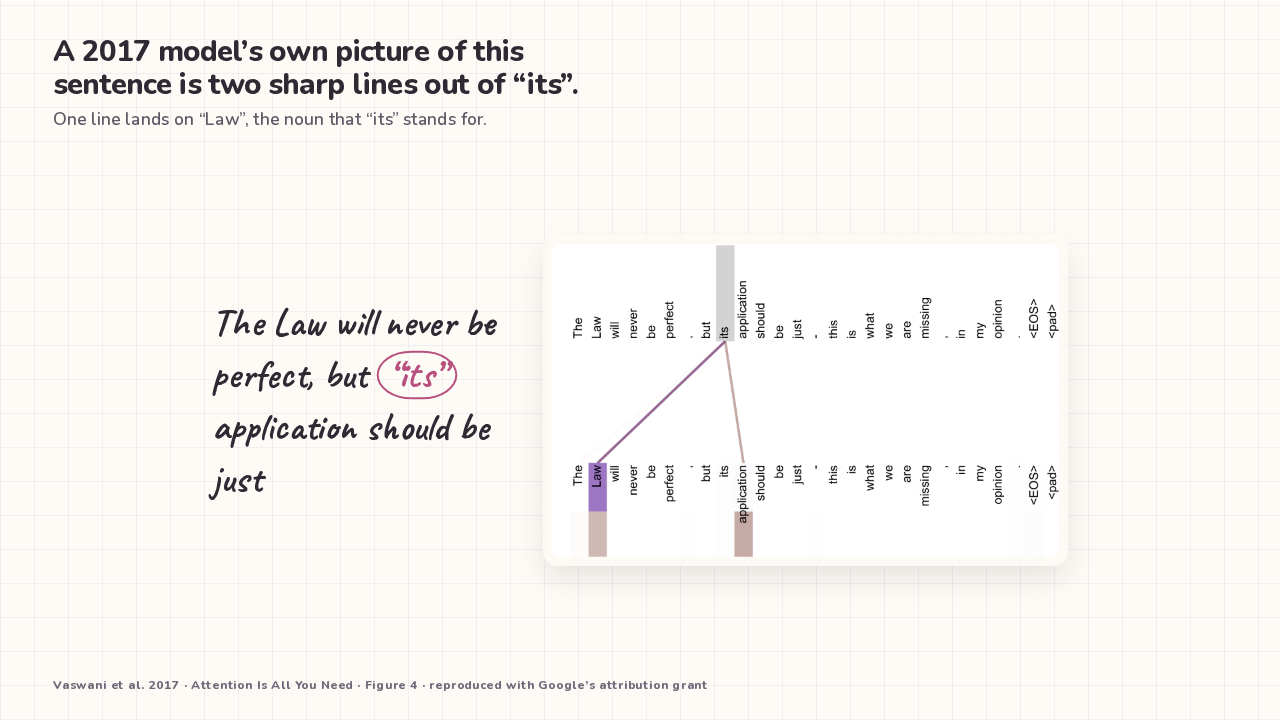
A 2017 model’s own picture of this sentence is two sharp lines out of “its”.
One line lands on “Law”, the noun that “its” stands for.
The Law will never be perfect, but “its” application should be just

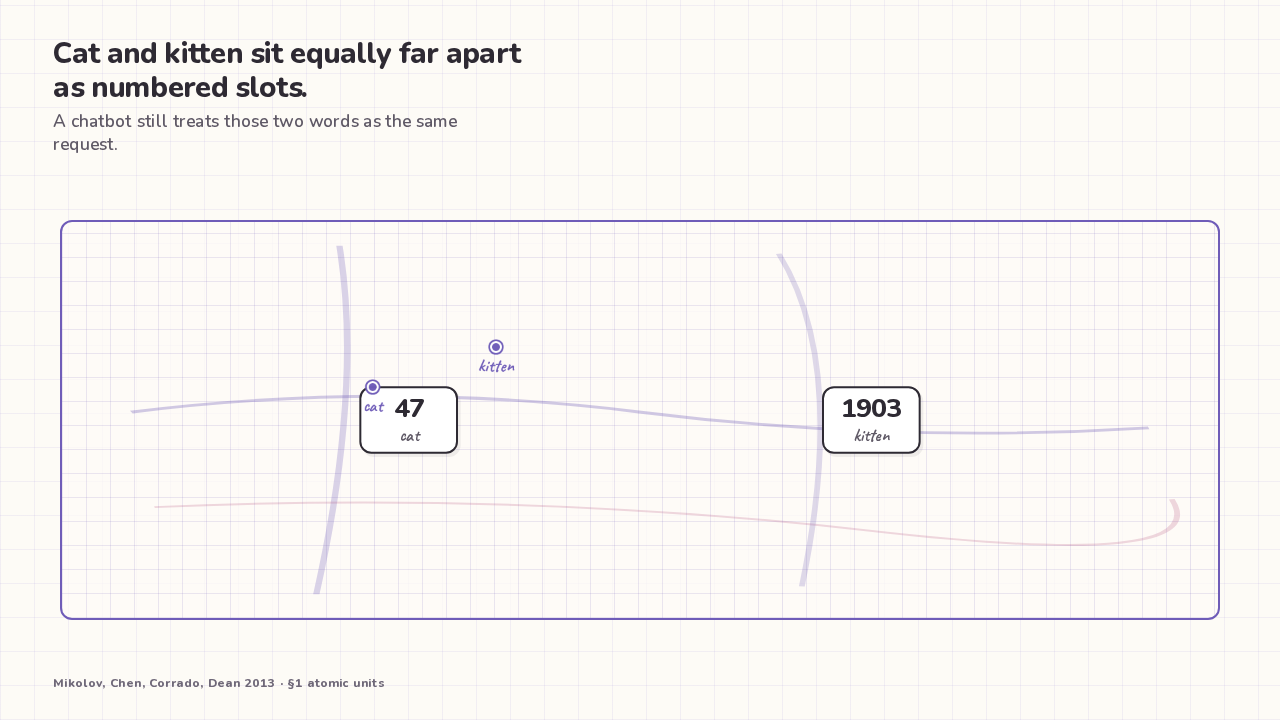
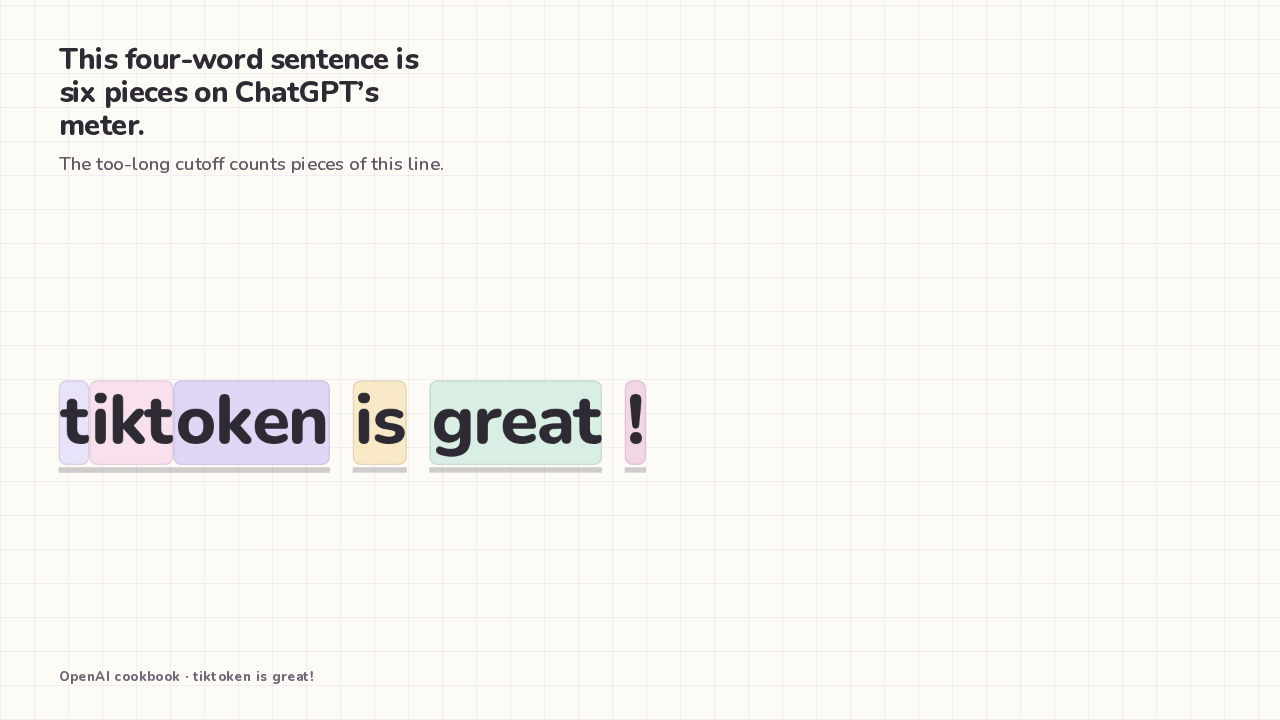
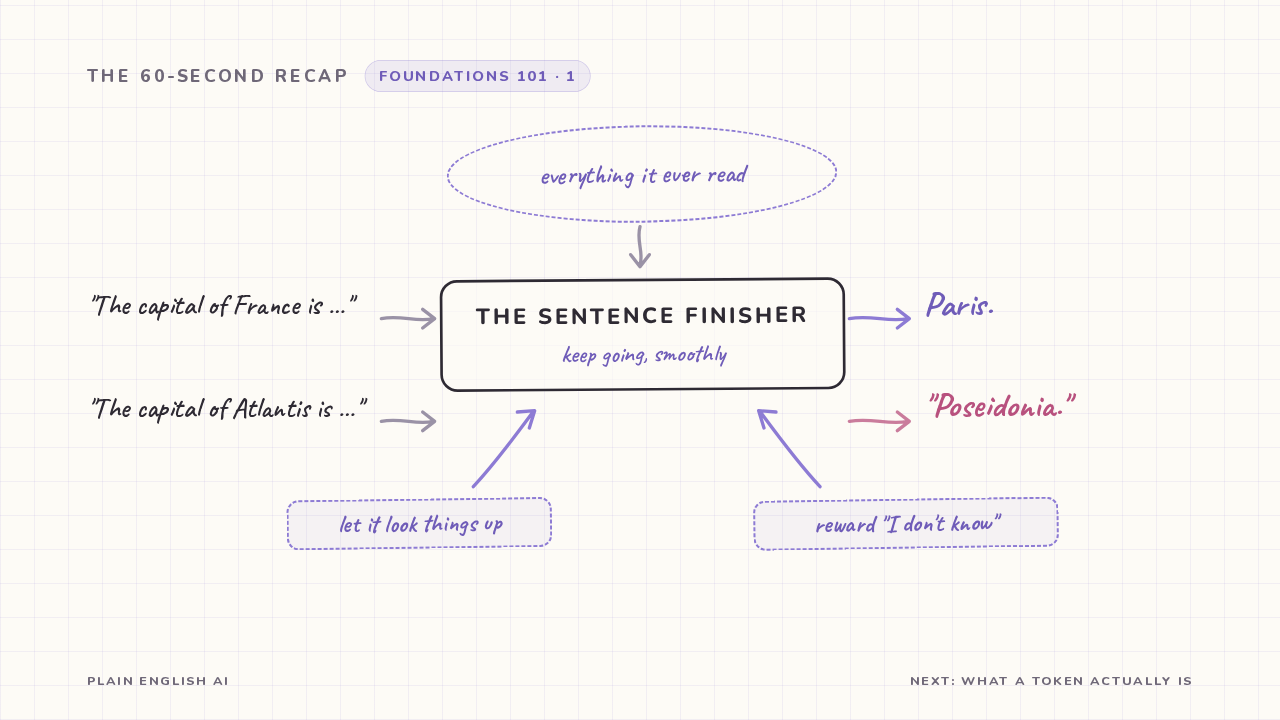
The Law will never be perfect, but its application should be just. The word its there points back to the Law. ChatGPT and Claude make that link every time they read a sentence. The step that makes it is called attention. Attention is how each word decides how much every other word counts toward what that word means. A team mostly at Google published attention in this form in 2017, in a paper called Attention Is All You Need, and that paper prints a picture of their own model making this exact link. Last lesson, every spelling got one pin on a map, and that pin says nothing about which noun a word points back to. So how does a word pick up meaning from the words around it?
Every word stands in one room and holds up a label card.
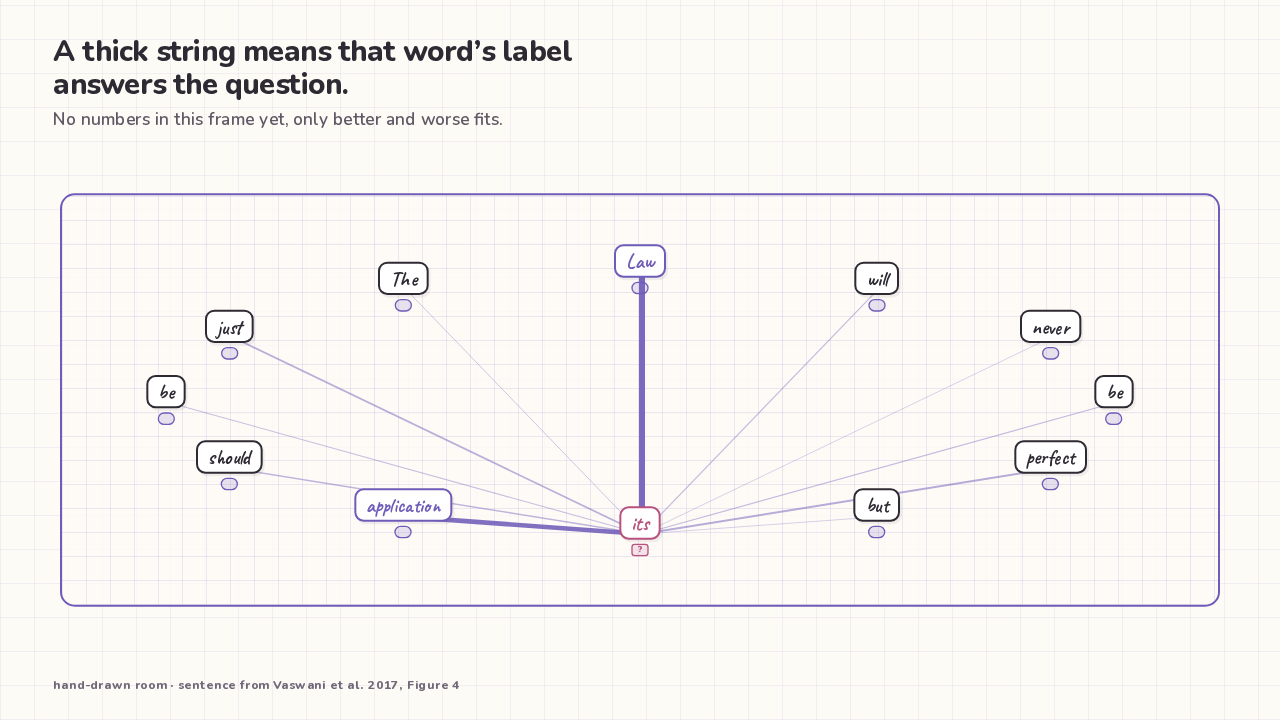
A thick string means that word’s label answers the question.
No numbers in this frame yet, only better and worse fits.
Picture the sentence as a room. Every word in the sentence stands in that room. The word its holds up a question card, and that question asks who this word belongs to. Every word in the room also holds up a label card. A label card says what that word has to offer. Then a string runs from its to every word in the room. The word Law holds up a label about a thing that can have an application, so the string from its to Law is drawn thick. The word never holds up a label about time, so that string stays thin.
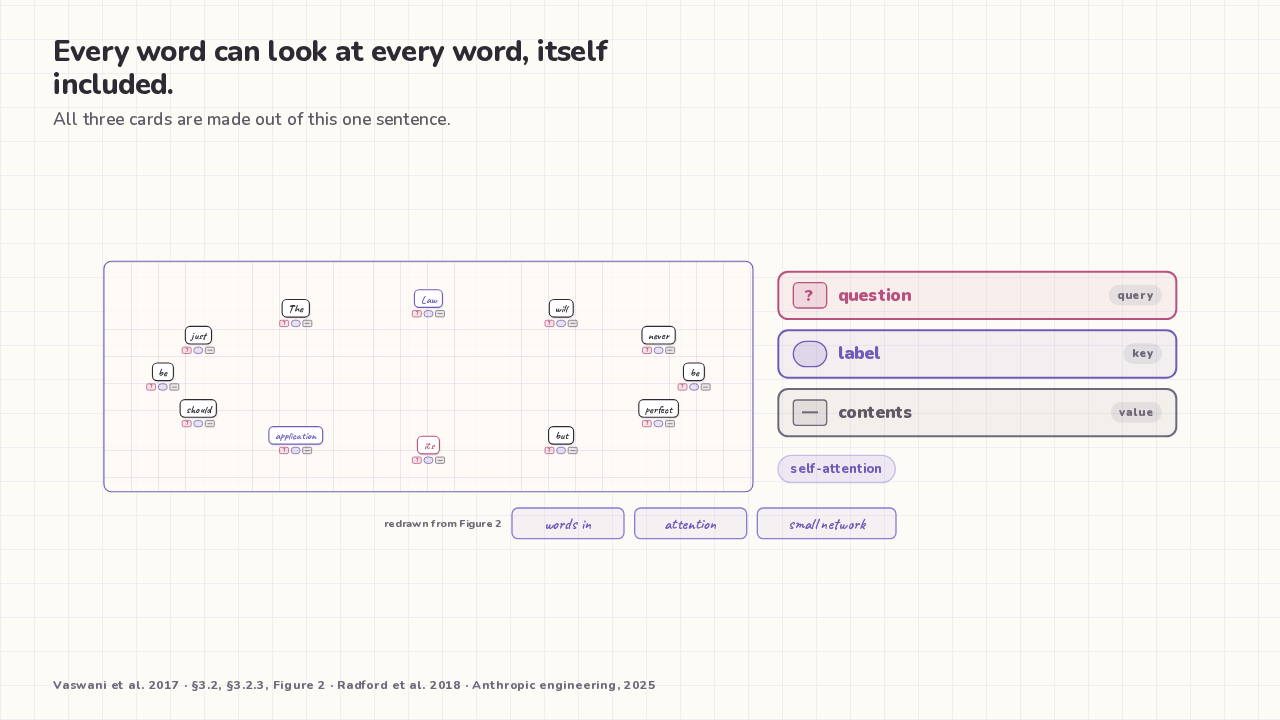
Every word can look at every word, itself included.
All three cards are made out of this one sentence.
Attention Is All You Need describes a design called the Transformer. OpenAI, the company behind ChatGPT, built its 2018 language model on the Transformer. Anthropic, the company behind Claude, writes that the chatbots people use today are built on that same design. Every word in the room carries three cards. The question card says what this word is looking for. The label card says what this word can answer. The box of contents holds what this word hands over to whoever asks. The paper calls those three cards the query, the key and the value, and it calls this version self-attention. Every one of those three cards is cut from the sentence the model is reading.
The meaning of “its” is a blend of what the other words hold.
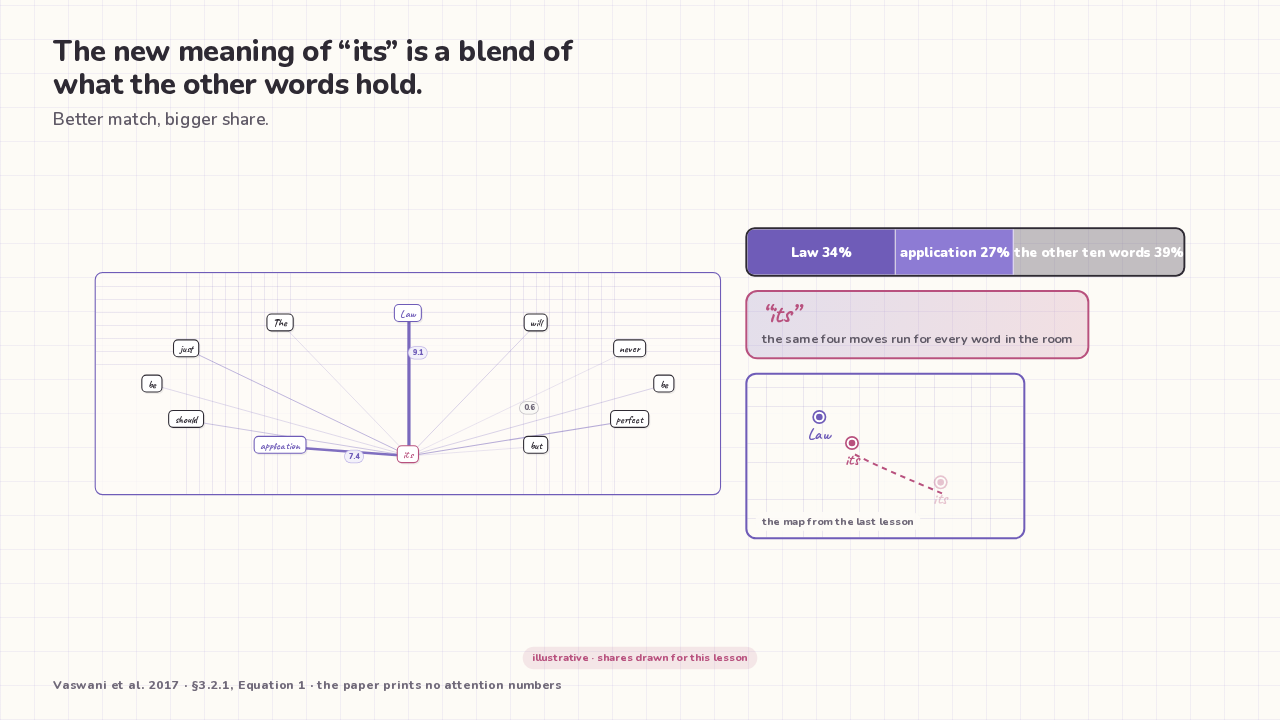
The new meaning of “its” is a blend of what the other words hold.
Better match, bigger share.
The room now makes four moves. First, the question card from its meets every label card in the room, and each meeting gets a match score. A close fit scores high. Second, the model turns those match scores into shares, and the shares add up to a hundred percent. Third, the word its takes that share of the contents each word is holding. A big share of the contents from Law goes in. A sliver of the contents from never goes in. Fourth, the word its adds those pieces together. The percentages in this drawing are made up for the lesson. Then the blend moves the pin. Last lesson that pin never moved. These four moves are what move the pin, and they send the word bank toward rivers in one sentence and toward money in another.
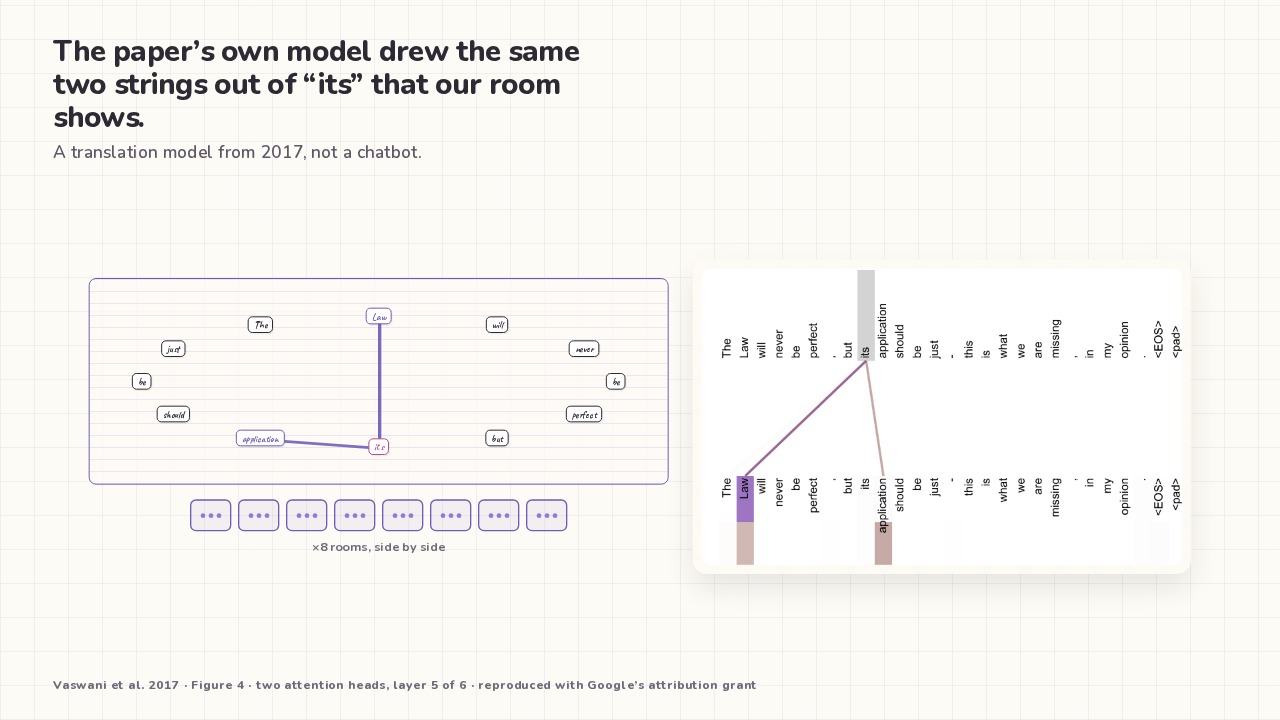
Two rooms on floor five drew sharp lines out of “its”.
The paper’s own model drew the same two strings out of “its” that our room shows.
A translation model from 2017, not a chatbot.
Figure four shows the paper's own model reading that same sentence. The team trained that model to translate between languages, so this picture comes out of a translator. That model runs eight rooms side by side. Each room learns to ask a different kind of question. The model then stacks six floors of rooms, and the paper calls each floor a layer. Figure four shows two of those rooms on floor five. In both rooms, the strongest lines out of the word its land on Law and on application. The authors write that the attention is very sharp for this word. The authors also write that these two rooms are apparently working out what a word like its points back to.
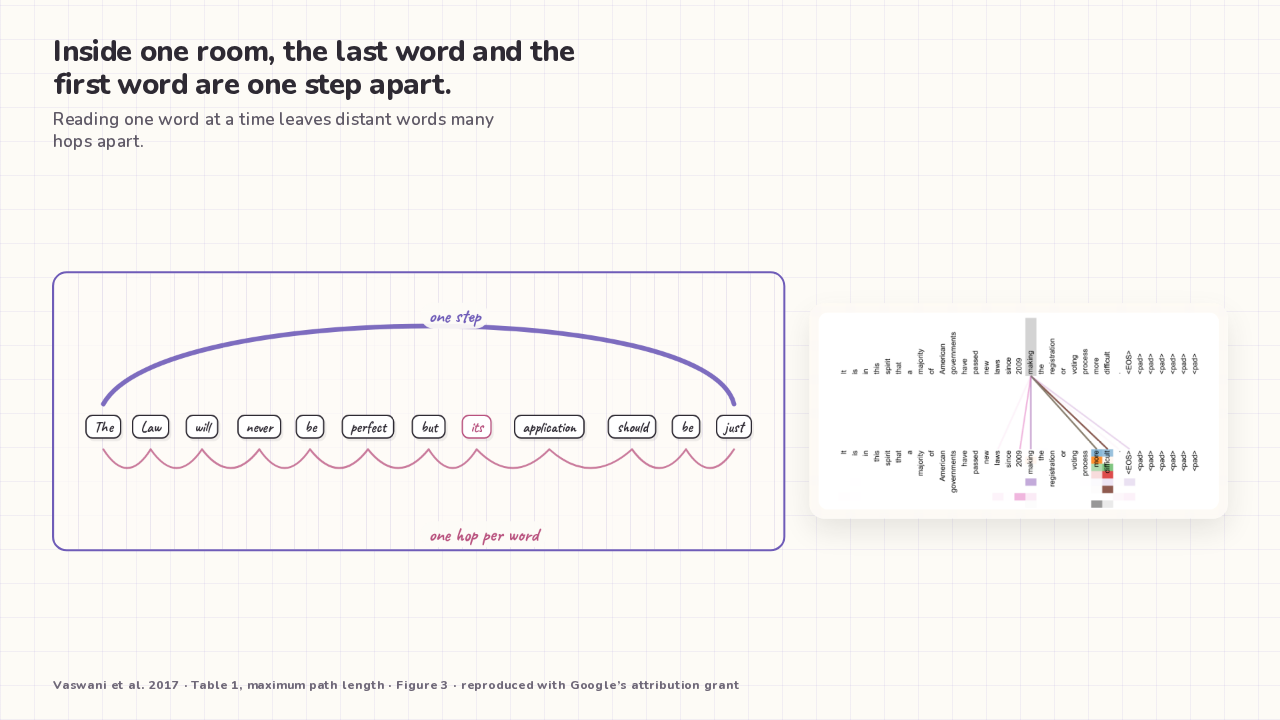
Any word reaches any other word in one step.
Inside one room, the last word and the first word are one step apart.
Reading one word at a time leaves distant words many hops apart.

In the room, a string runs straight from every word to every other word. Table one of the paper counts the steps between two words, and inside a room like this one the count is a single step. That step crosses one room, and the model stacks six floors of rooms. Older translation models read one word at a time. In those models a message between two distant words travelled word by word down the sentence. Figure three of the paper shows the same long reach on floor five, from the word making out to the words more difficult.
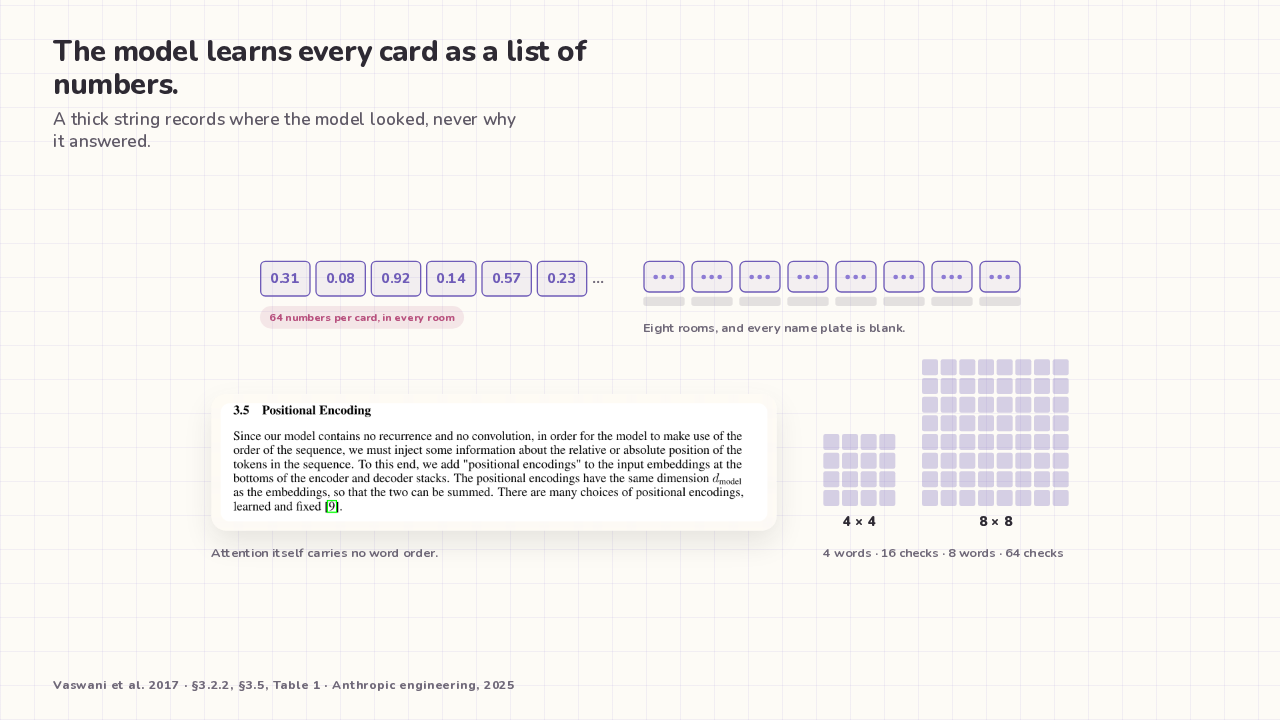
The model learns every card as a list of numbers.
A thick string records where the model looked, never why it answered.

This picture is roughly right. Here is where the picture breaks. The words written on our cards belong to this lesson. The model works out sixty-four numbers for each card in every room, while it trains. Training is the long practice run where the model reads example sentences. The reason a string comes out thick stays inside those numbers. The rooms have blank name plates. The paper shows a handful of examples and does not say how typical they are. The room also carries no sense of which order the words stand in. The paper adds a position to each word before the first room. And every word checks every other word. A sentence twice as long needs four times as many checks, and Table one counts those checks as work for the computer. Anthropic's engineers name a second effect of all that checking. A model's grip on those pairs gets stretched thin as the context window fills. The context window is the working desk from lesson two. How much of a long document a model holds is a separate measurement. Each of those limits sits around the four moves rather than inside them.
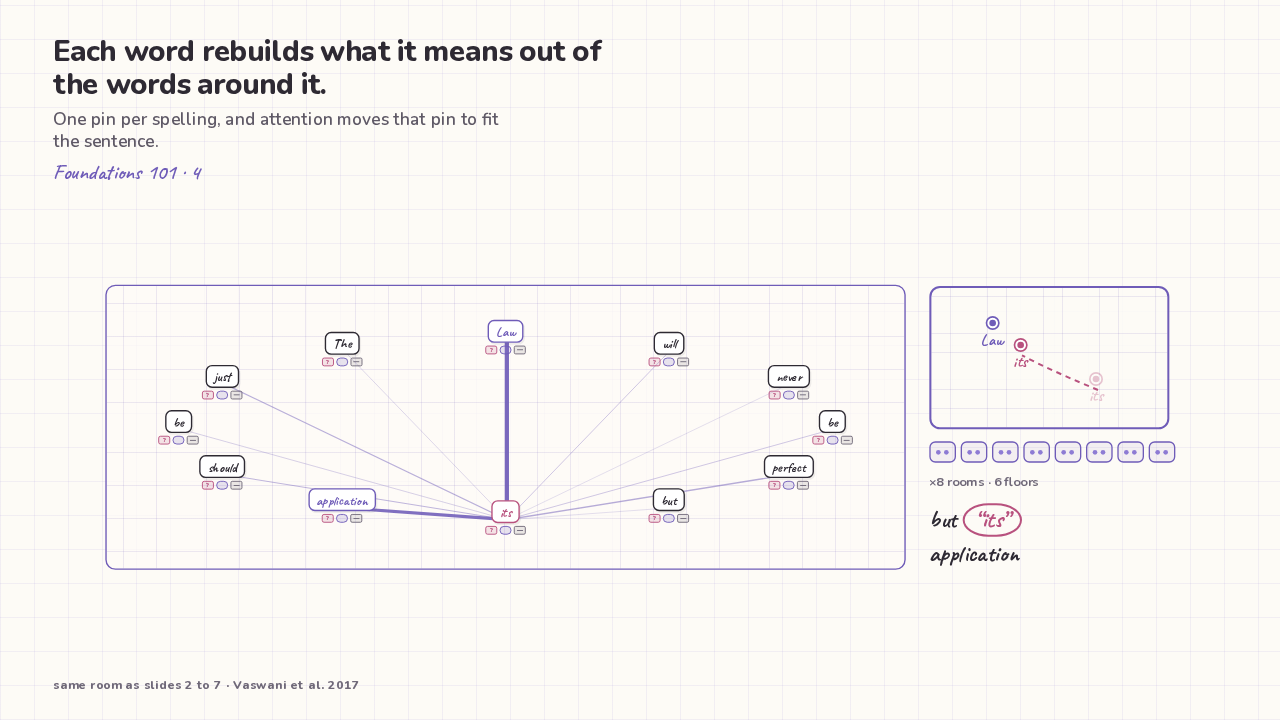
Each word rebuilds what it means out of the words around it.
One pin per spelling, and attention moves that pin to fit the sentence.
Foundations 101 · 4
but “its” application
The Law will never be perfect, but its application should be just. The word its starts with one pin on the map. In the room, the word its holds up a question card. Every word holds up a label card and a box of contents. The question meets every label, and each meeting gets a match score. The match scores become shares that add up to a hundred percent. The word its takes that share of every box of contents. The pieces add up to one blend, and the blend moves the pin for its over toward Law. Eight rooms run those four moves side by side, six floors deep. The cards are learned numbers. The paper's own model drew thick lines from its to Law and to application. That is how the word its finds the Law.