Upgrades from 2026.10.1

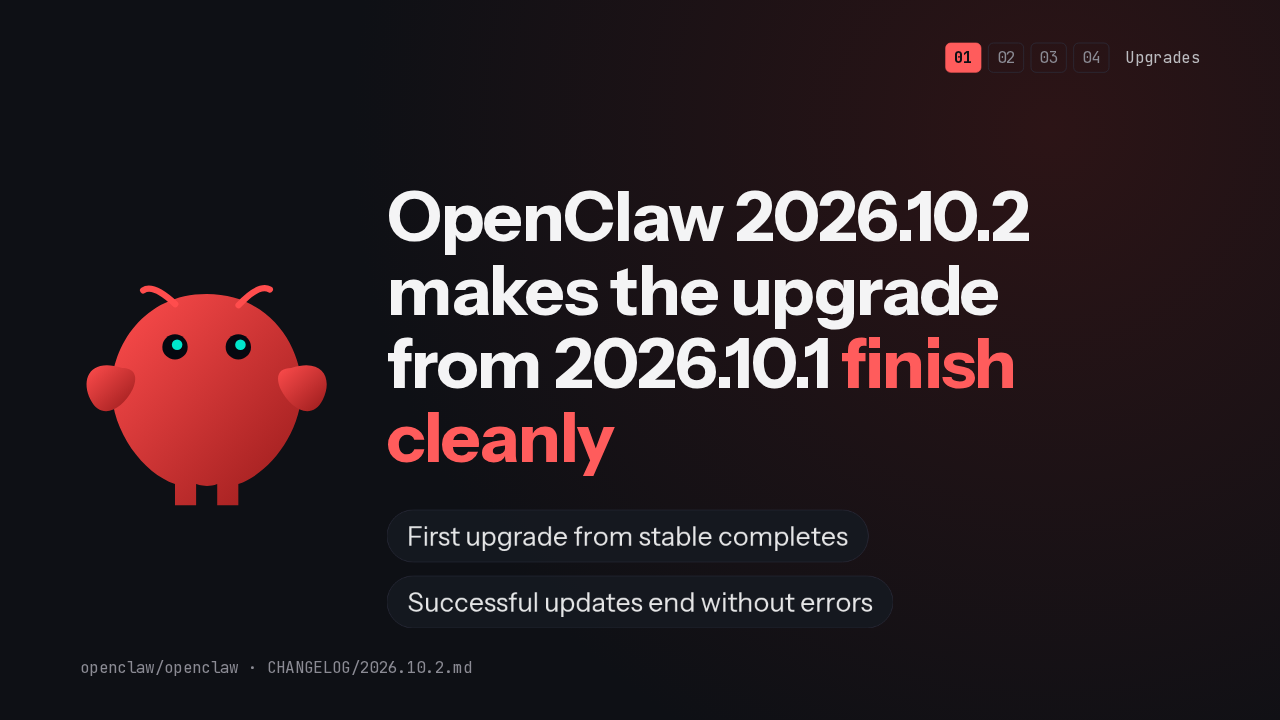
OpenClaw 2026.10.2 makes the upgrade from 2026.10.1 finish cleanly
OpenClaw 2026.10.2 fixes the upgrade from the last stable release. That first upgrade now completes cleanly, and an in-place update that succeeds no longer finishes on an error message.
Update paths that stalled
 OpenClaw 2026.10.2
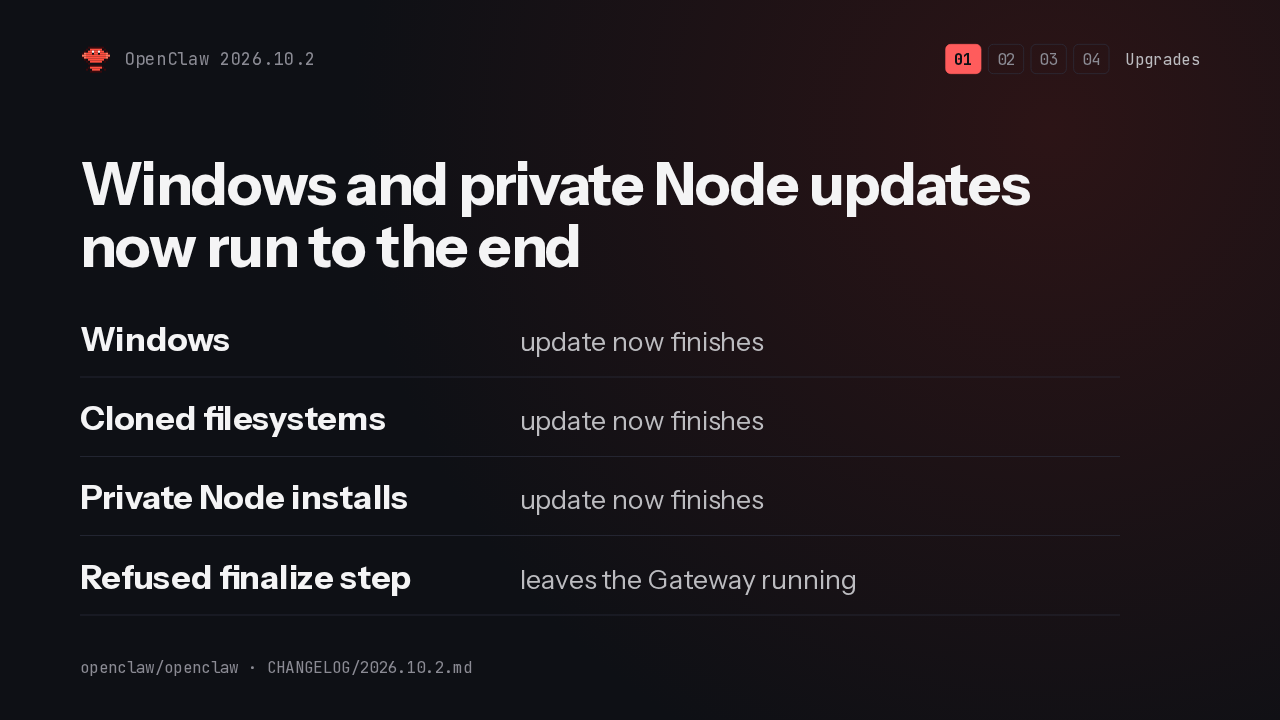
Windows and private Node updates now run to the end
OpenClaw updates on Windows, on a cloned filesystem, or on a private Node install used to stall or roll back, and now they finish. A refused finalize step no longer leaves your Gateway stopped.
Doctor recovery
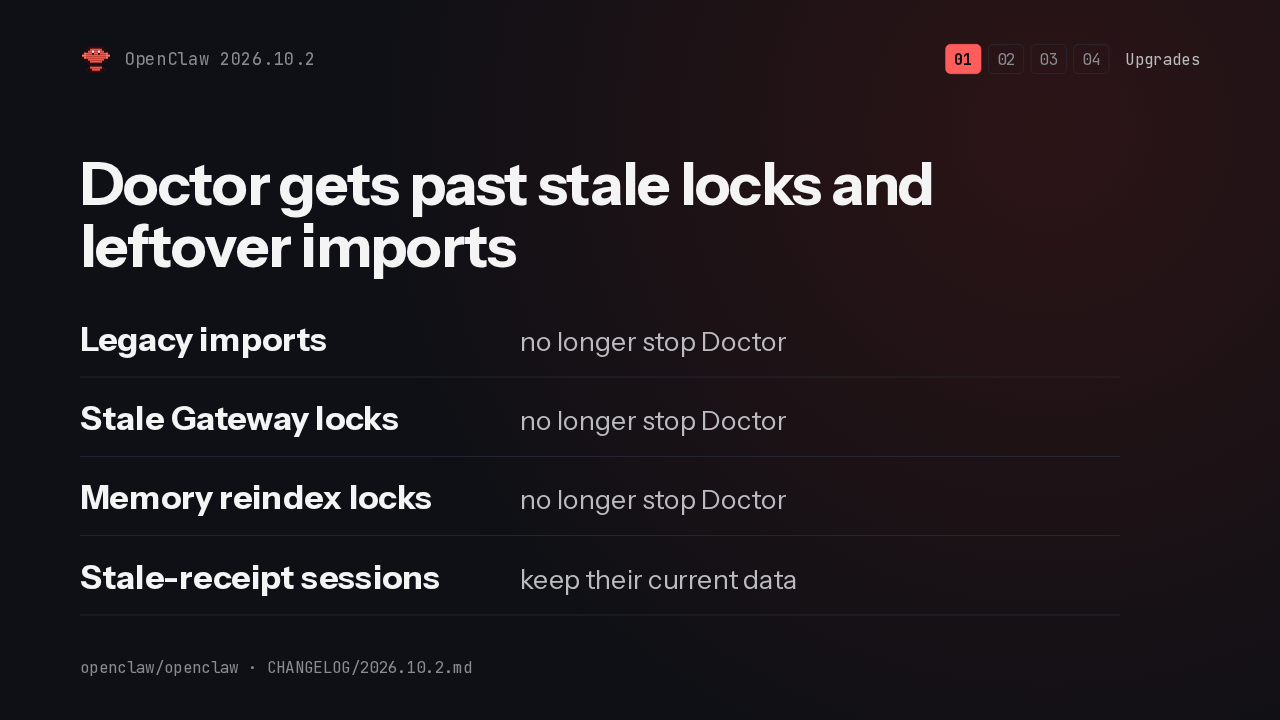
OpenClaw 2026.10.2Doctor gets past stale locks and leftover imports
OpenClaw's Doctor used to stop partway on leftover legacy imports, stale Gateway locks, or a memory reindex lock. Doctor now works past all three. Sessions with a stale receipt keep their current data.
02: Context and secrets
OpenClaw 2026.10.2Context and secrets.
Provider-native compaction
OpenClaw 2026.10.2OpenAI and Anthropic API keys now get the provider’s own compaction
Compaction also recovers while your primary auth profile is cooling down.
If you run OpenAI or Anthropic with an API key, compaction of long conversations now defaults to the provider's own native compaction. And when your primary auth profile is cooling down, compaction recovers.
Prompt-cache stability
OpenClaw 2026.10.2Anthropic’s prompt cache keeps hitting after a Gateway restart
Anthropic conversation checkpoints, tool results and enriched prompts now stay byte-identical from one turn to the next. So through follow-ups, replays, Gateway restarts and subagent completions, the cached prefix keeps hitting.
Secret redaction
OpenClaw 2026.10.2A secret split across two chunks of tool output is now masked
Redacting large text no longer stalls, and runs several times faster.
A credential split across two chunks of long tool output could leak past redaction, and OpenClaw now masks it. Redacting large text also stopped stalling, and runs several times faster.
03: Gateway and agents
OpenClaw 2026.10.2The Gateway and agents.
Gateway responsiveness
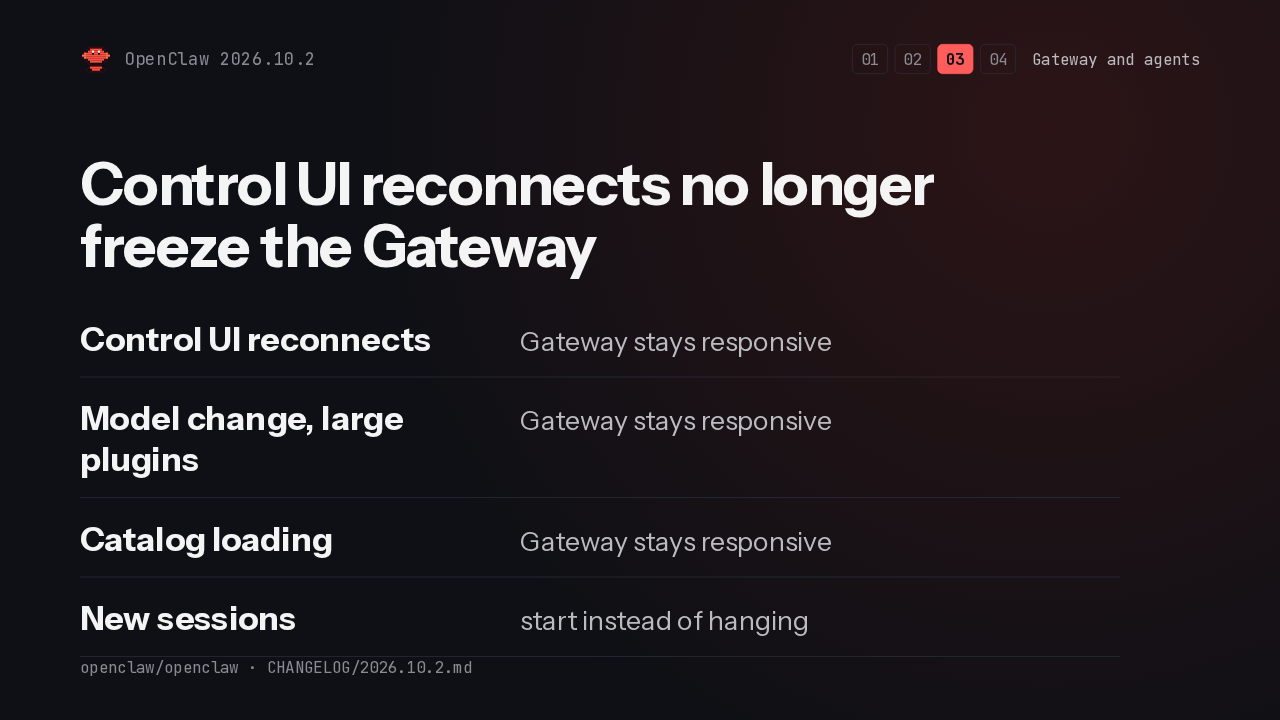
OpenClaw 2026.10.2Control UI reconnects no longer freeze the Gateway
Reconnecting the Control UI, switching models while large plugins are loaded, and loading the catalog could each freeze the OpenClaw Gateway. Now the Gateway stays responsive, and new sessions start instead of hanging.
Lost replies
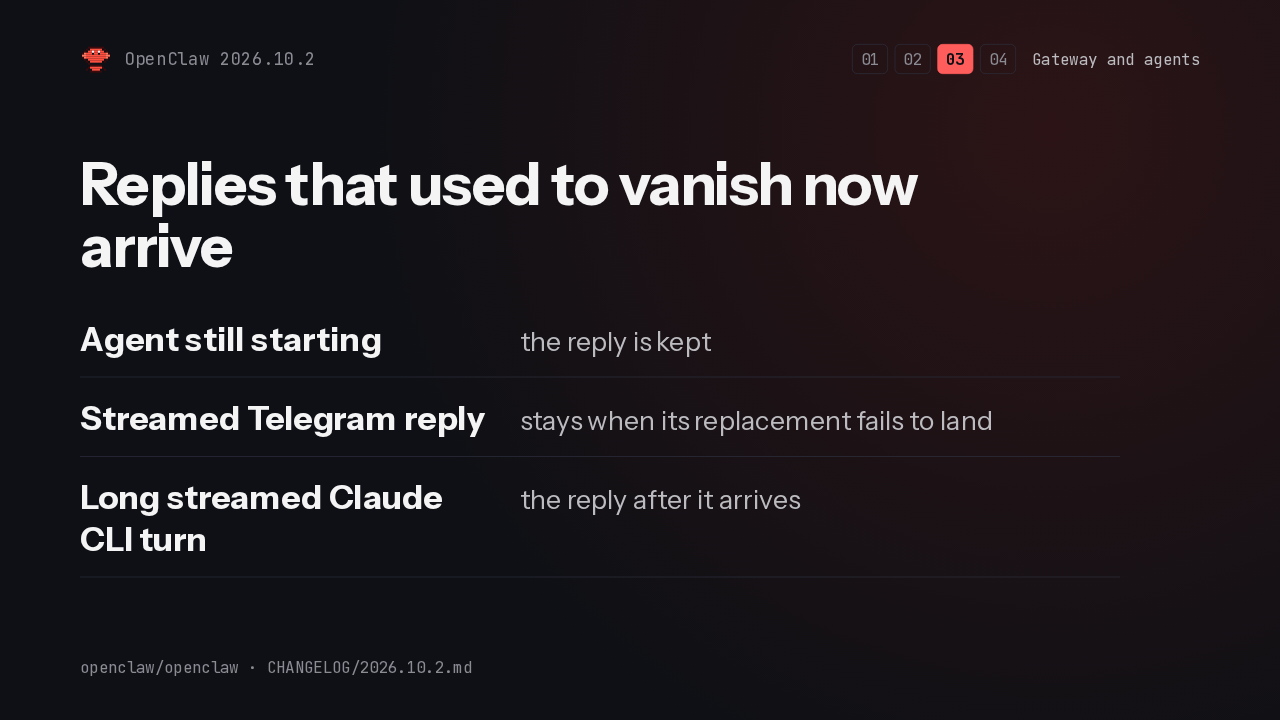
OpenClaw 2026.10.2Replies that used to vanish now arrive
A reply sent while an agent was still starting could get lost. So could a streamed Telegram reply, and the reply after a long streamed Claude CLI turn. All three replies now reach you.
Subagents and stalled runs
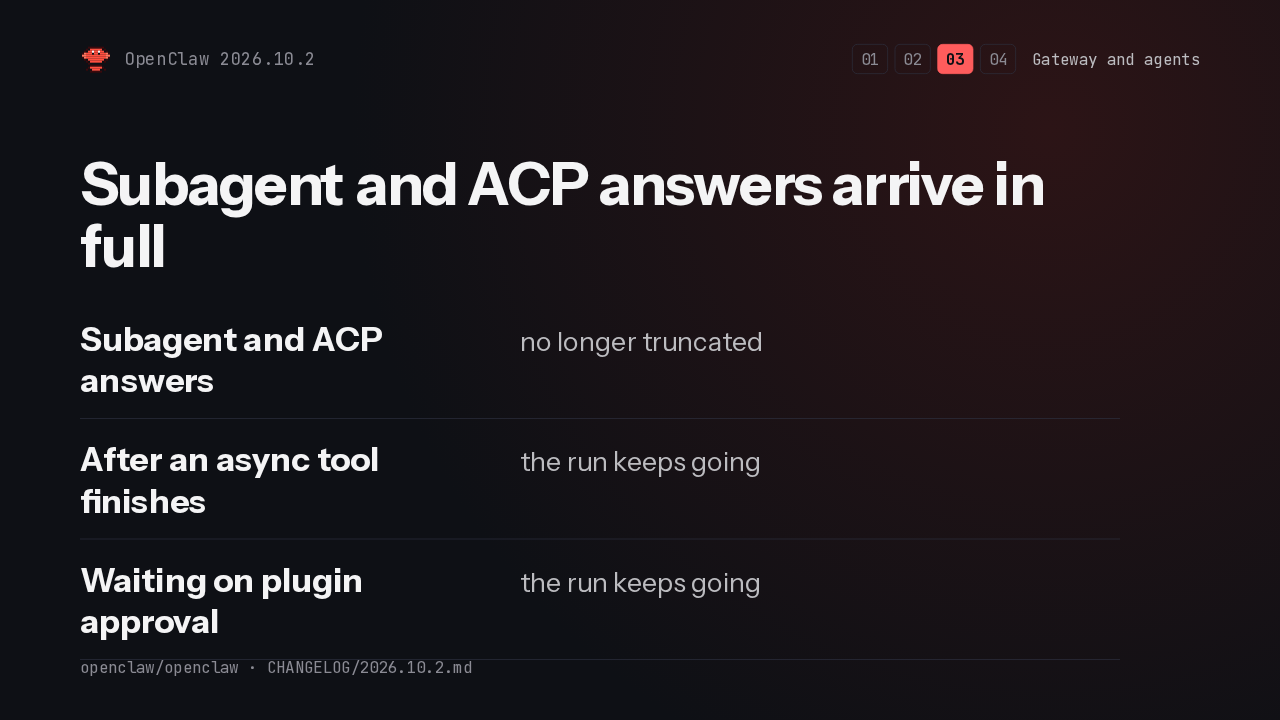
OpenClaw 2026.10.2Subagent and ACP answers arrive in full
Answers from subagents and ACP agents used to arrive truncated, and now come through whole. OpenClaw also stopped aborting runs as stalled after an async tool finished, or while a run waited on plugin approval.
OpenAI and Codex
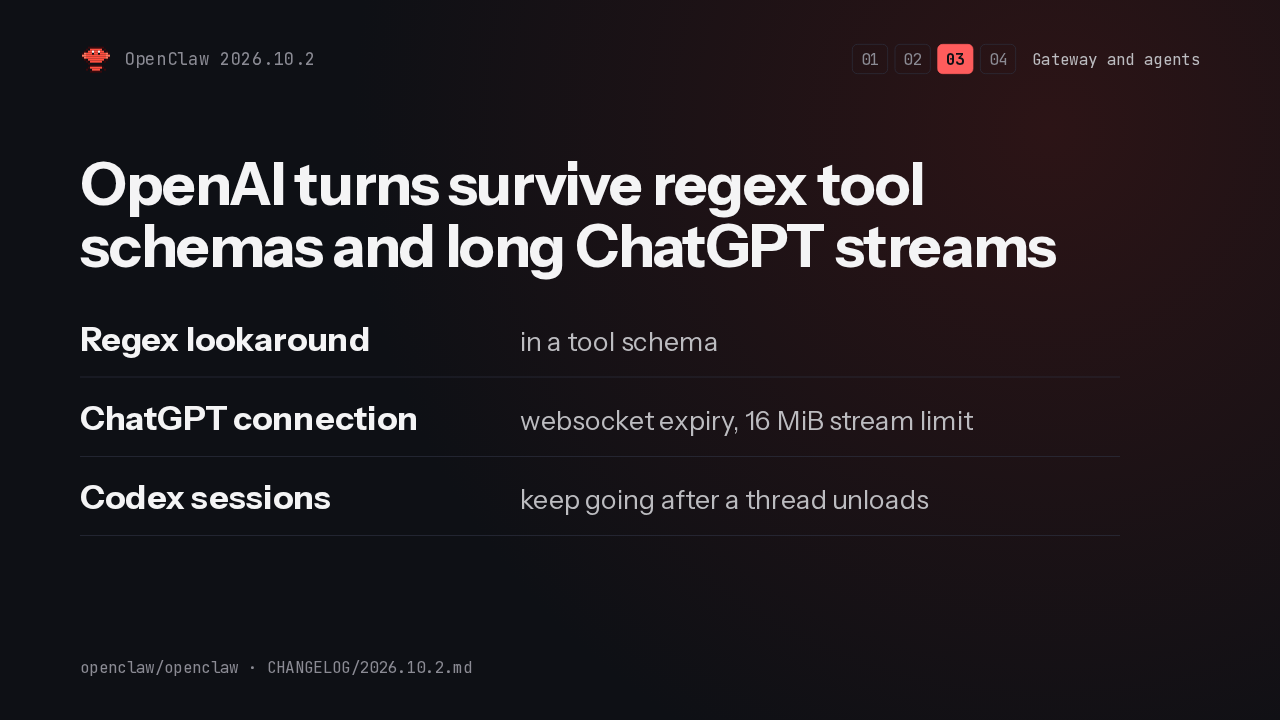
OpenClaw 2026.10.2OpenAI turns survive regex tool schemas and long ChatGPT streams
OpenAI turns now go through when a tool schema uses regex lookaround, or when a ChatGPT websocket expires or a stream hits its size limit. Codex sessions keep running after a thread unloads.
Cron runs
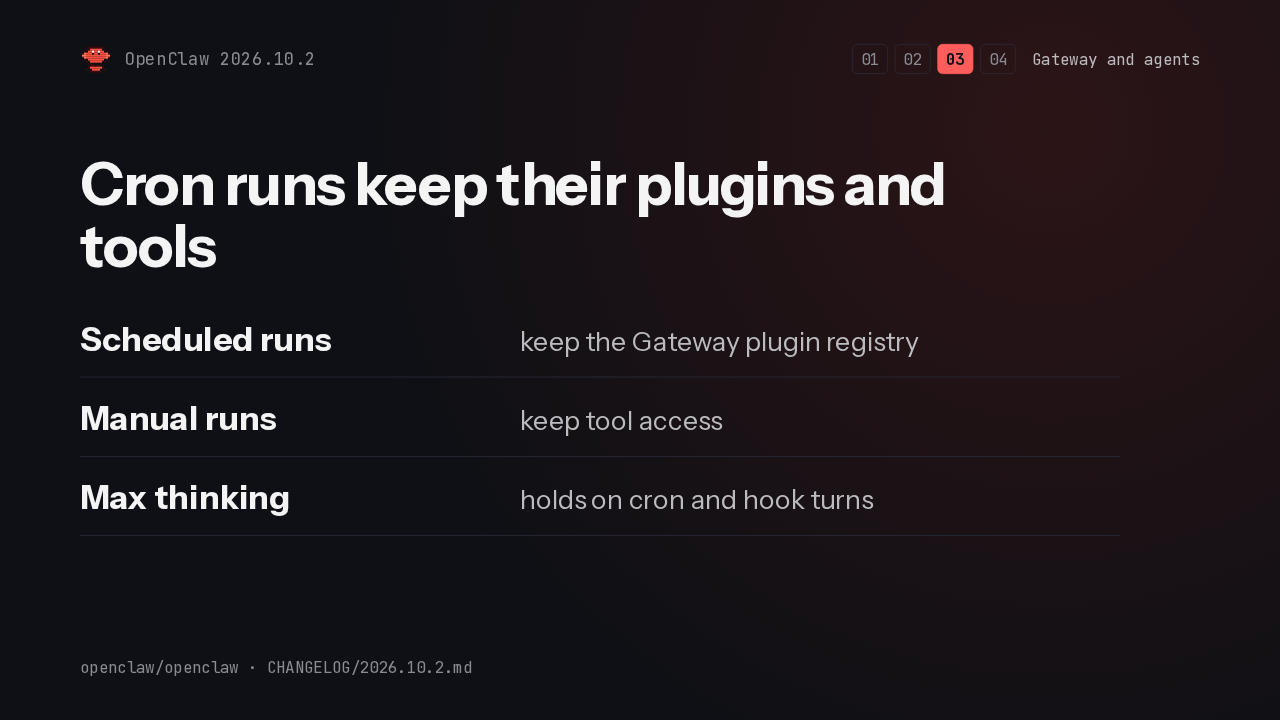
OpenClaw 2026.10.2Cron runs keep their plugins and tools
Scheduled cron runs used to lose the Gateway's plugin registry, and manual cron runs lost tool access. Both now keep them. Max thinking also holds on cron and hook turns.
04: Mac and Android
OpenClaw 2026.10.2Mac and Android.
macOS crashes
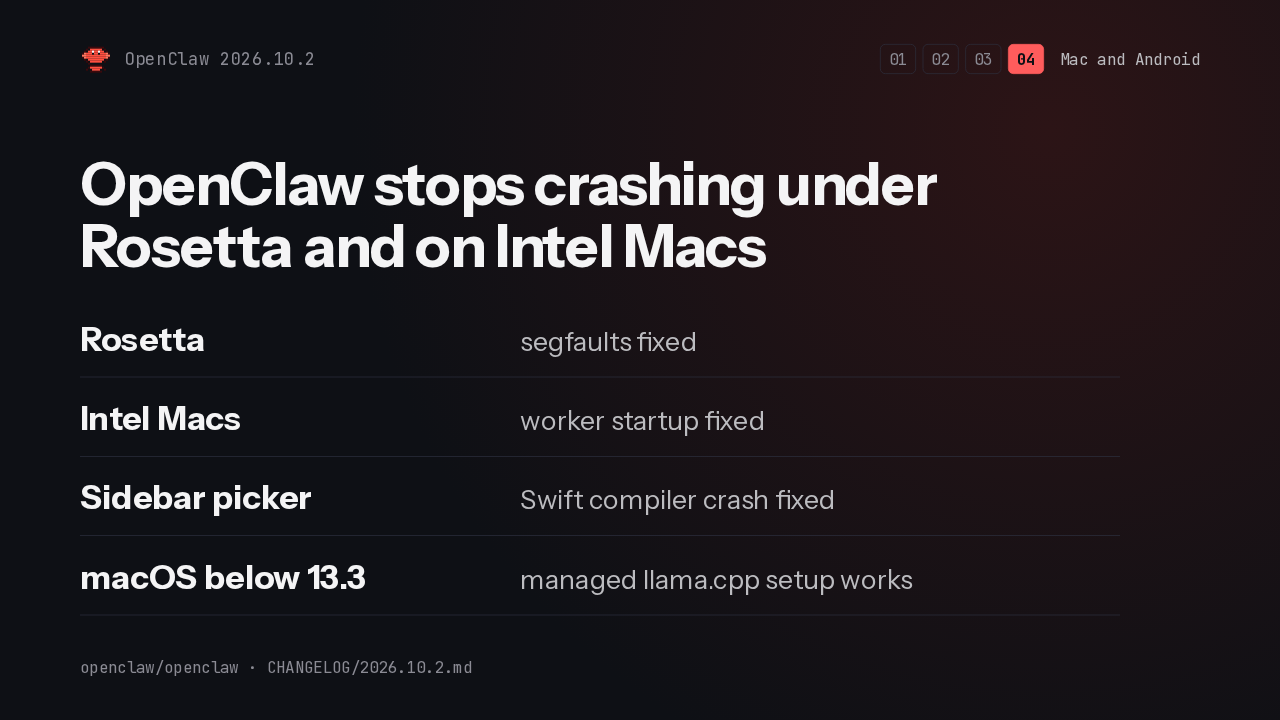
OpenClaw 2026.10.2OpenClaw stops crashing under Rosetta and on Intel Macs
On the Mac, OpenClaw fixes segfaults under Rosetta, worker startup on Intel Macs, and a Swift compiler crash in the sidebar picker. Managed llama.cpp setup now works on macOS older than 13.3.
Android waits
OpenClaw 2026.10.2This release ships without a new Android APK
The Android app’s version stays at 2026.8.2.
If you run OpenClaw on Android, this release skipped the Android APK. The Android app keeps its earlier version, so Android users wait for a later release to get a new APK.
The Updating guide
OpenClaw 2026.10.2Upgrade with OpenClaw’s Updating guide
The steps for your install, and how to roll back, are in OpenClaw's Updating guide. Every other fix in this release is in the release notes.