Up to 2.2× faster MoE decode
 llama.cpp
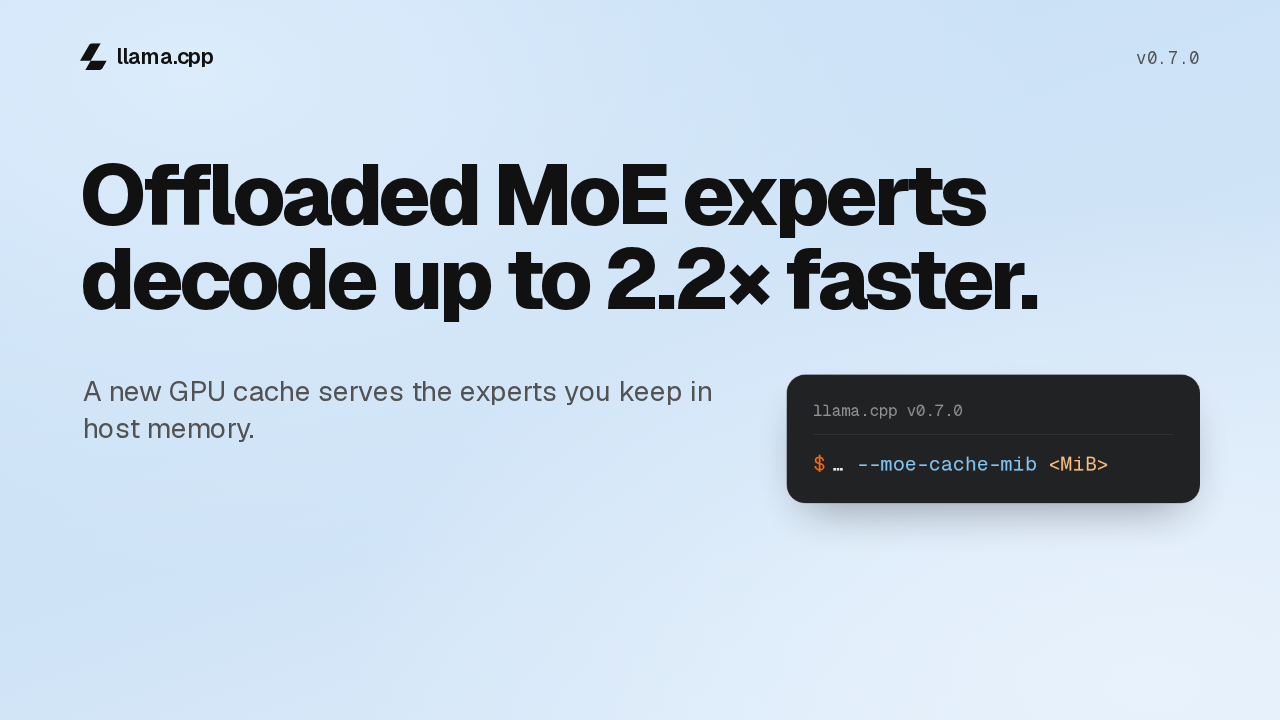
Offloaded MoE experts decode up to 2.2× faster.
A new GPU cache serves the experts you keep in host memory.
The top highlight of llama.cpp v0.7.0 is a cache for mixture of experts models. If you offload a model's experts to host memory, decode gets up to 2.2 times faster. The cache is set with one flag, --moe-cache-mib. And one change to check before you upgrade: the server's default port is now 9931.
How the expert cache works
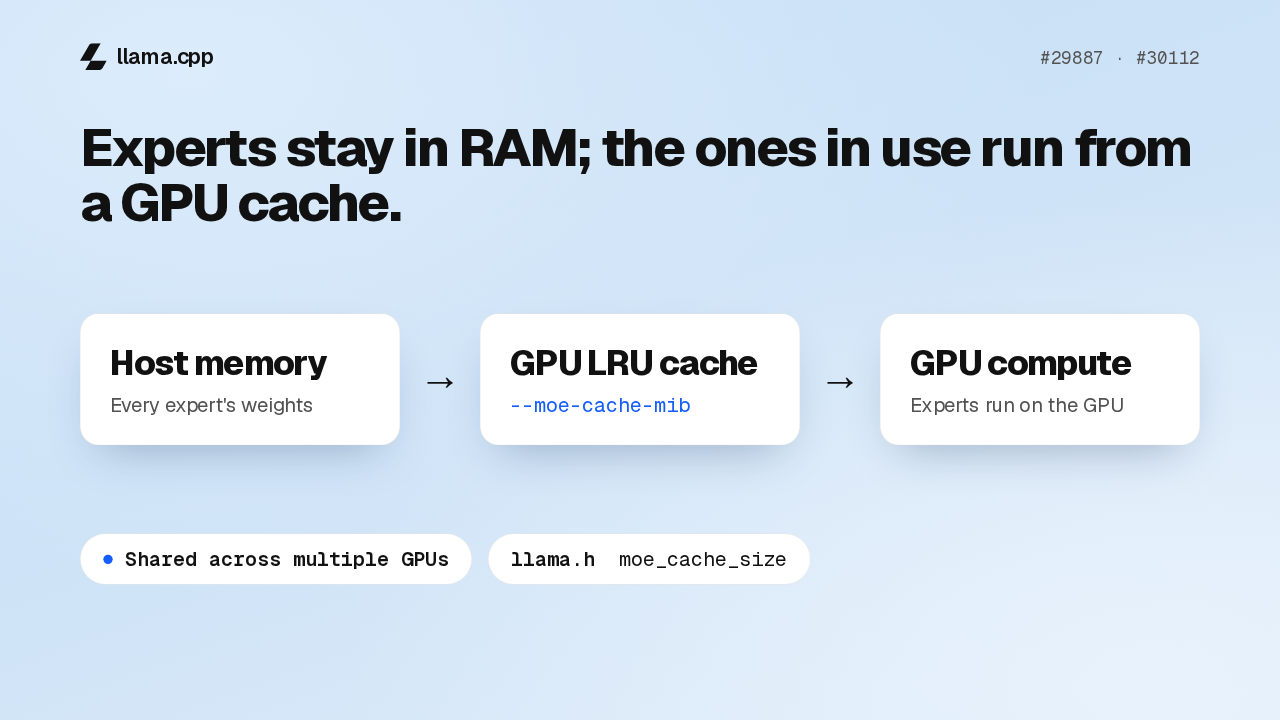
llama.cppExperts stay in RAM; the ones in use run from a GPU cache.
The experts stay in host memory. Now a least recently used cache on the GPU holds the experts in use, and they run there. You size the cache in mebibytes with the flag. The cache is shared across multiple GPUs, and library users get the same setting as moe_cache_size in llama.h.
Speculative decoding
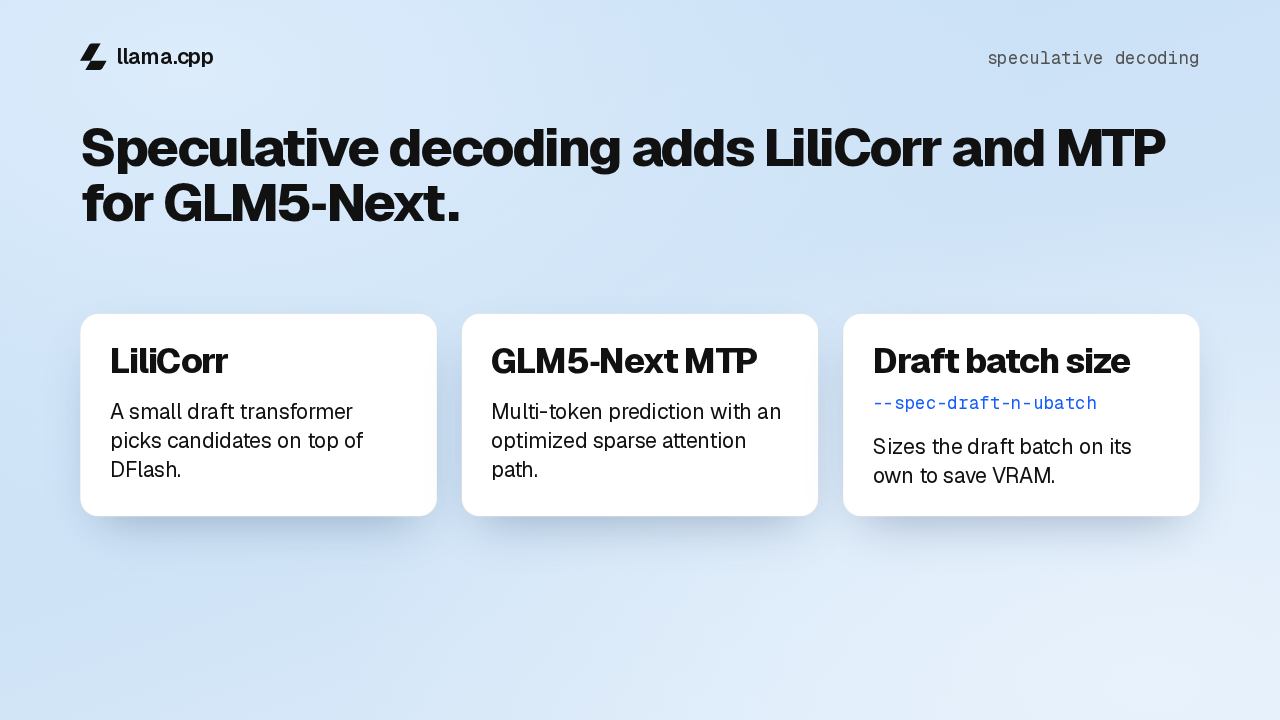
llama.cppSpeculative decoding adds LiliCorr and MTP for GLM5‑Next.
A small draft transformer picks candidates on top of DFlash.
Multi-token prediction with an optimized sparse attention path.
Sizes the draft batch on its own to save VRAM.
Speculative decoding gets two new paths. LiliCorr uses a small draft transformer to pick candidates, built on top of DFlash. GLM5-Next gets multi-token prediction, with an optimized sparse attention path. And a new flag, --spec-draft-n-ubatch, sizes the draft model's batch separately, so the draft takes less VRAM.
New models
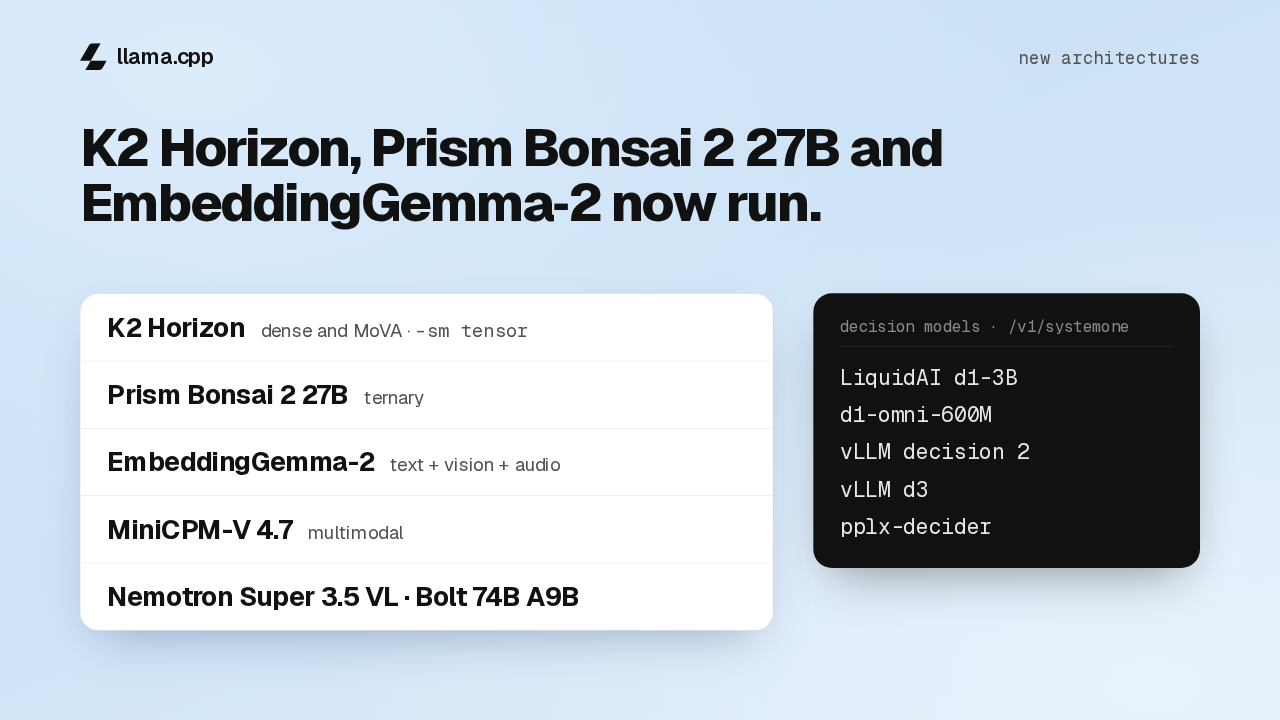
llama.cppK2 Horizon, Prism Bonsai 2 27B and EmbeddingGemma‑2 now run.
d1-omni-600M
vLLM decision 2
vLLM d3
pplx-decider
K2 Horizon arrives in dense and MoVA variants, with tensor splitting. Prism Bonsai 2 27B is a ternary model, and EmbeddingGemma-2 embeds text, images and audio. MiniCPM-V 4.7, Nemotron Super 3.5 VL and Nemotron Bolt join them. And five decision models are served on the /v1/systemone endpoint: two from LiquidAI, vLLM decision 2 and d3, and pplx-decider.
Models Manager
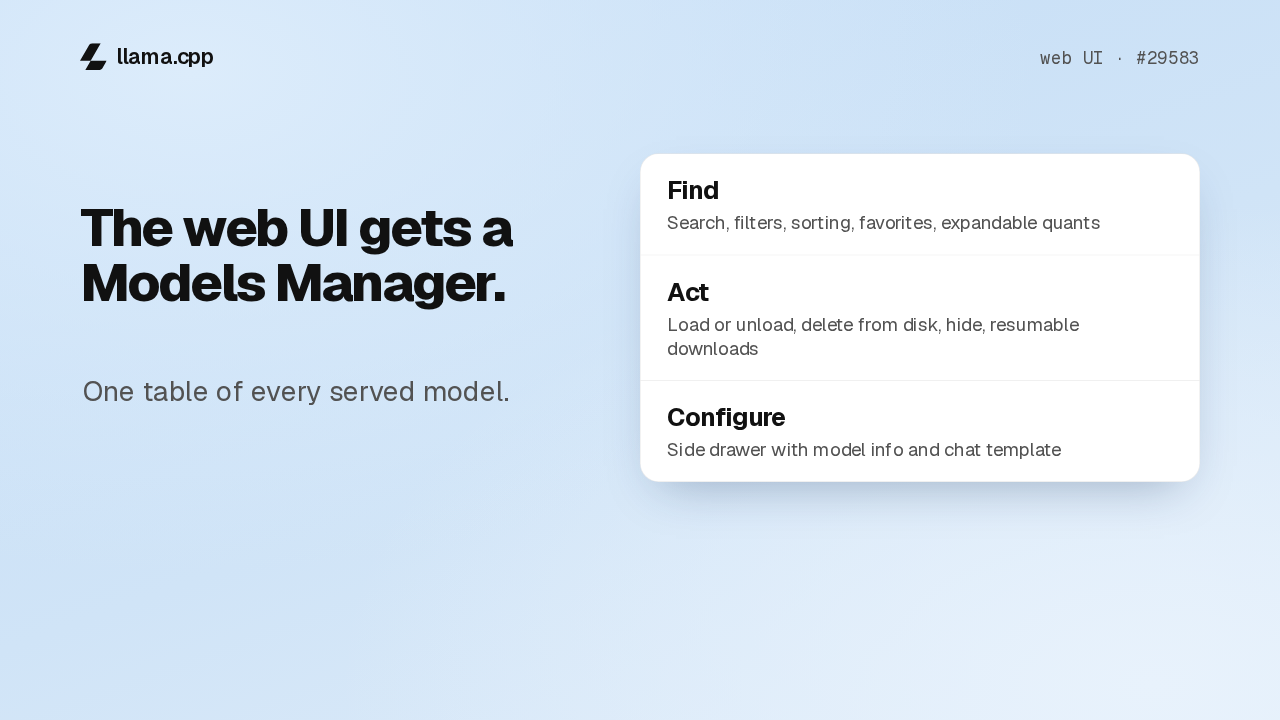
llama.cppThe web UI gets a Models Manager.
One table of every served model.
If you use the built-in web UI, there's a new Models Manager. It's one table of every served model, with search, filters, sorting and favorites. From a row you can load a model, delete it, or resume a download. A side drawer shows its info and chat template.
Fixes you may have hit
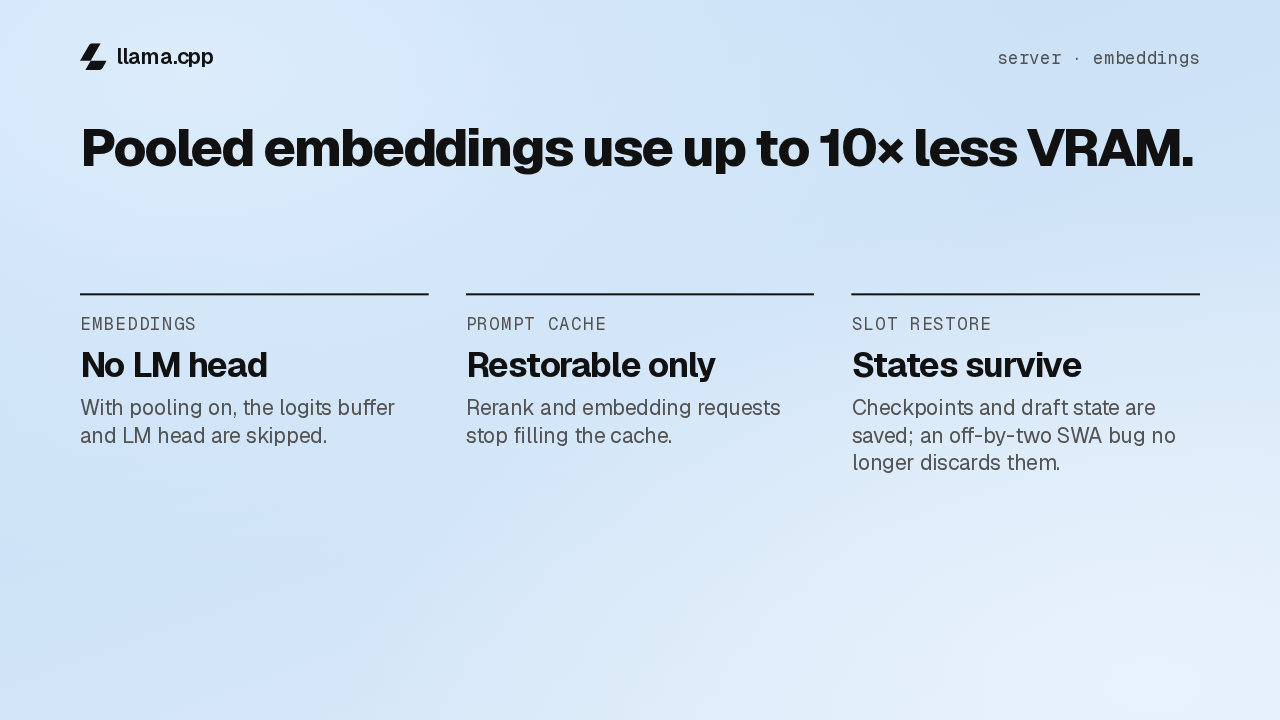
llama.cppPooled embeddings use up to 10× less VRAM.
If you serve embeddings, with pooling on the logits buffer and the LM head are skipped, for up to ten times less VRAM. The prompt cache now saves only states it can restore, so rerank and embedding requests stop filling it. And slot save and restore keeps context checkpoints and the draft state, while an off-by-two fix stops restored states being thrown away.
Breaking: port 9931
 llama.cpp
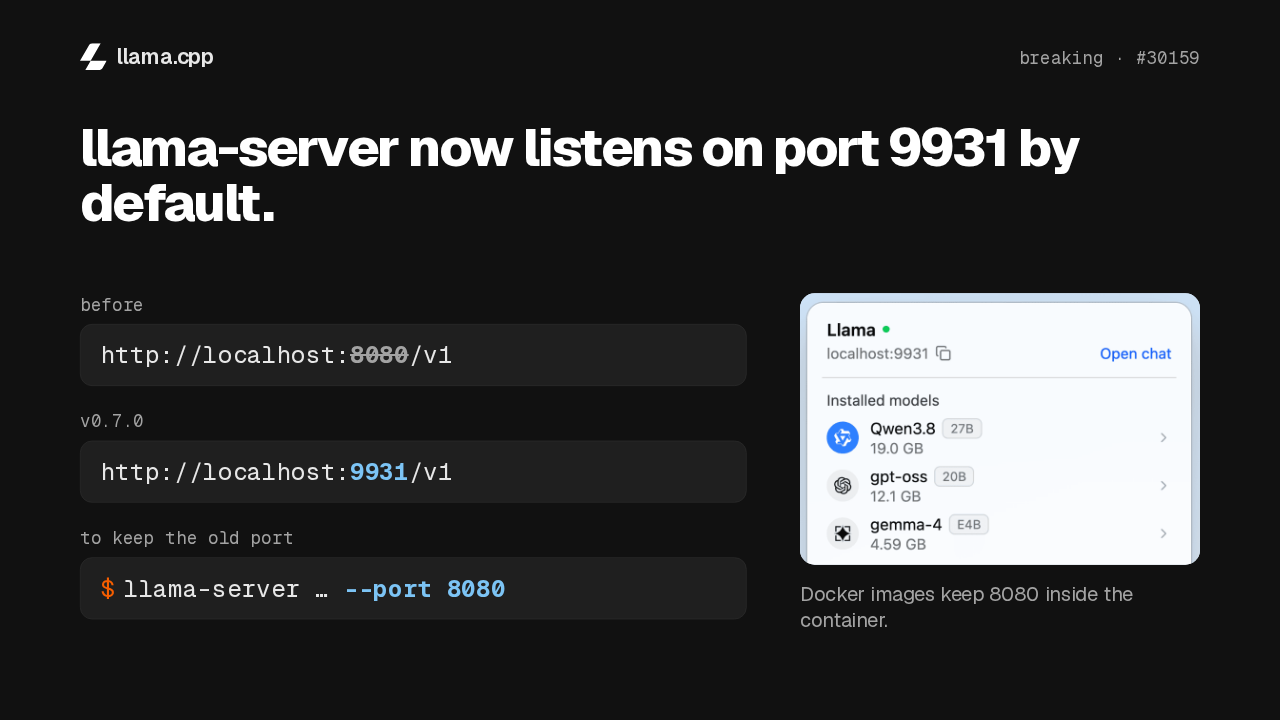
llama-server now listens on port 9931 by default.

Docker images keep 8080 inside the container.
The server now listens on port 9931 instead of 8080, so any client pointed at localhost 8080 stops connecting after you upgrade. The fix is one flag: pass --port 8080, or point your clients at 9931. Docker images keep 8080 inside the container.
API changes
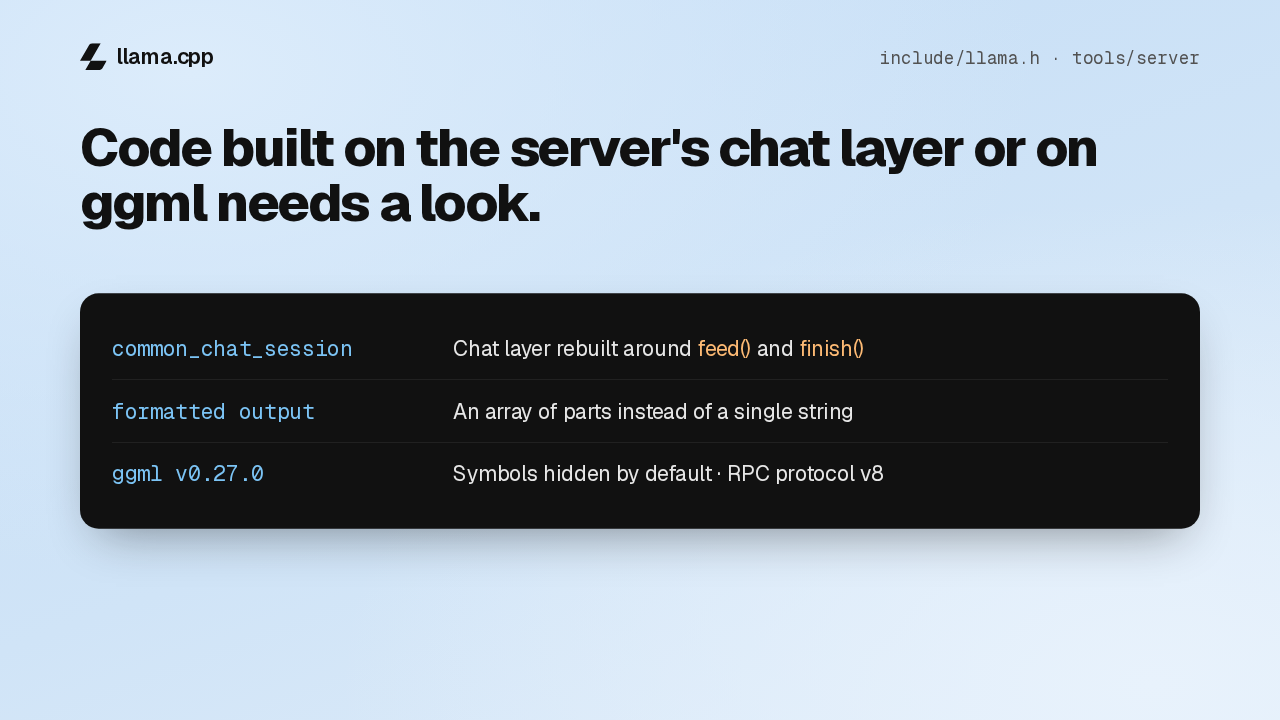
llama.cppCode built on the server's chat layer or on ggml needs a look.
This one is for code built on llama.cpp. If you build on the server's chat code, it is now organised around common_chat_session, with feed and finish. Formatted chat output is an array of parts instead of one string. And ggml 0.27 hides symbols by default and moves RPC to protocol version 8.
Upgrade
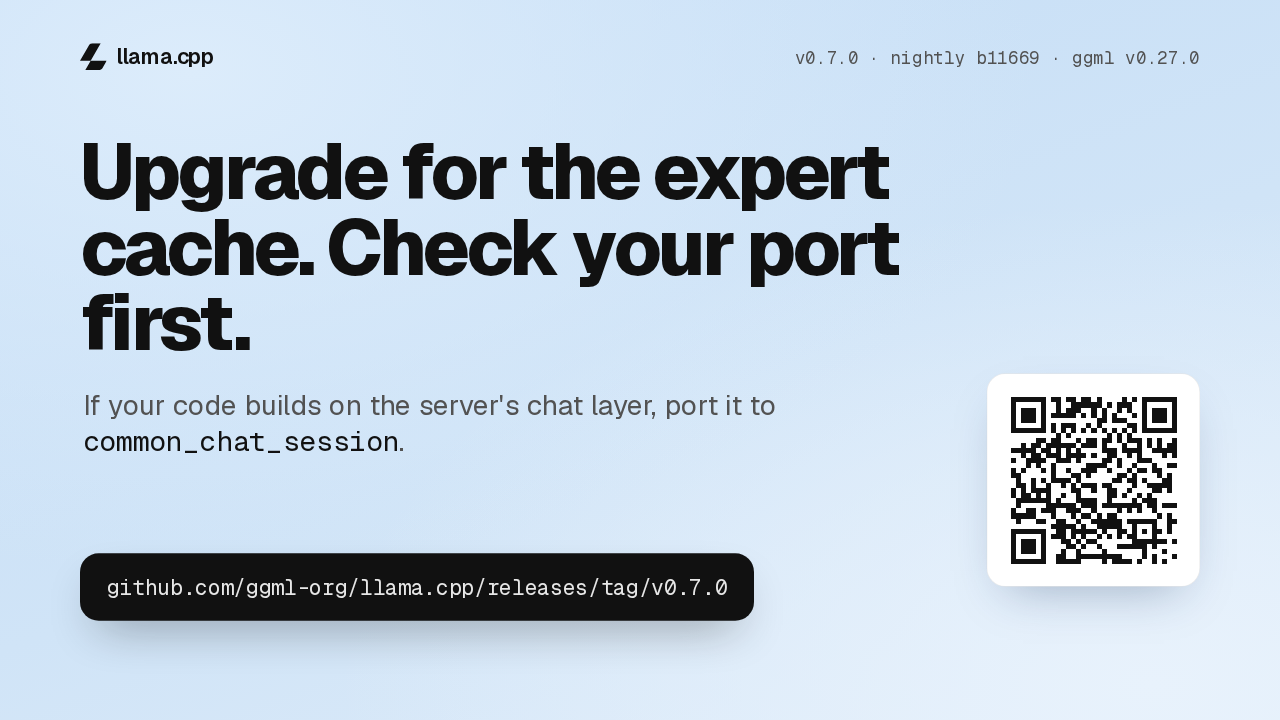
llama.cppUpgrade for the expert cache. Check your port first.
If your code builds on the server's chat layer, port it to common_chat_session.
If your own code builds on the server's chat layer, port it to common_chat_session when you upgrade. Offloaded experts decode up to 2.2 times faster, and the one thing to check first is the port. The release is tagged v0.7.0, matching nightly build b11669.