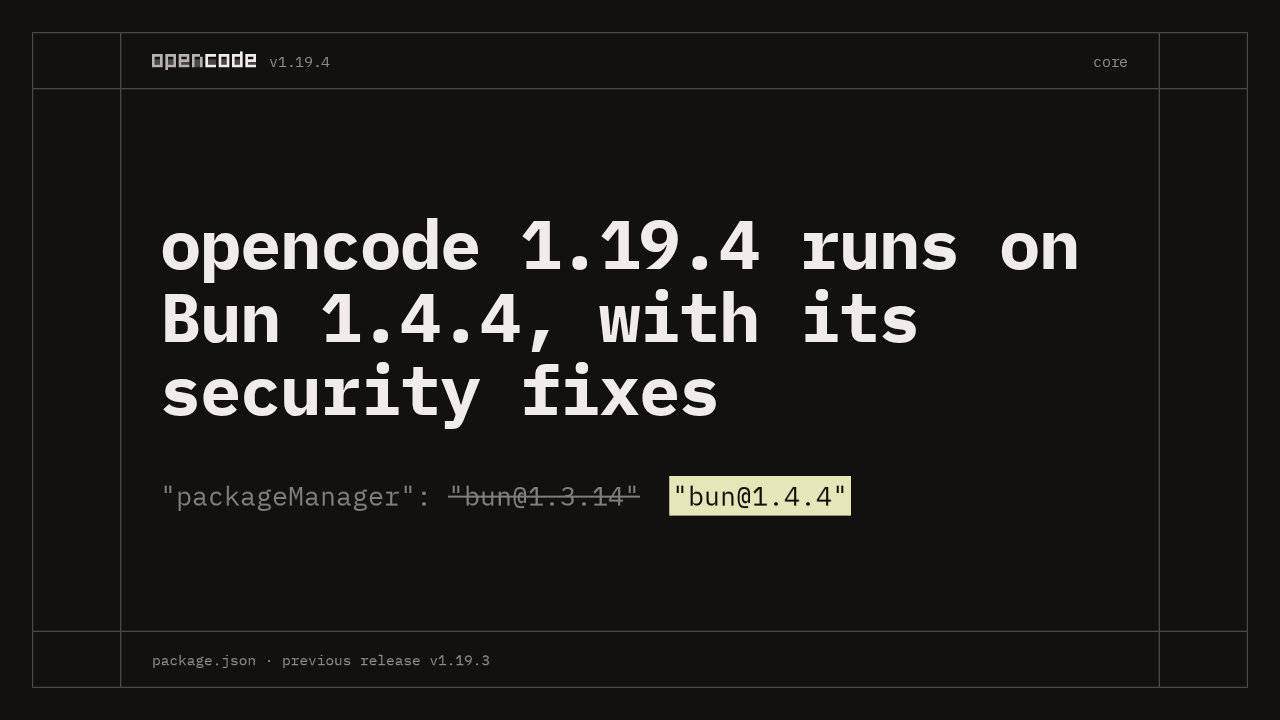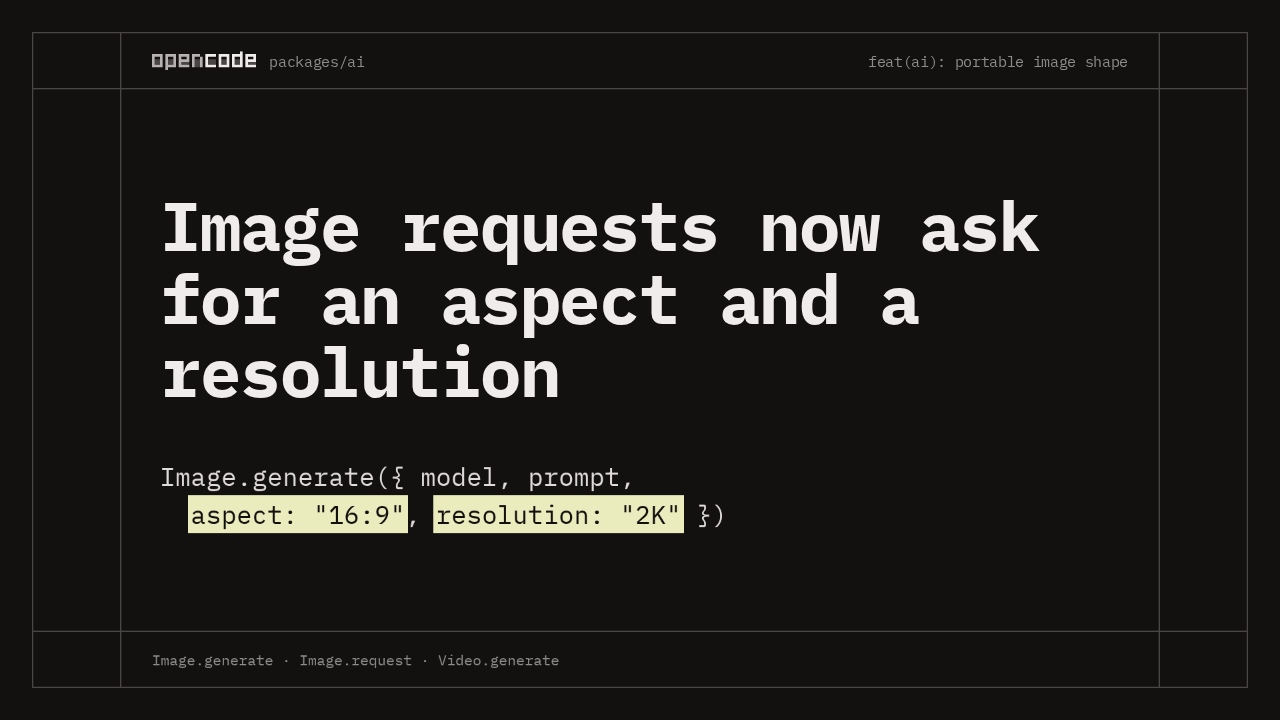
Image requests now ask for an aspect and a resolution
 packages/ai
Image.generate({ model, prompt,
  aspect: "16:9", resolution: "2K" })
This change replaces five fields on the shared image request in the AI package with two that travel between providers, an aspect ratio and a rough resolution tier. You ask for 16:9 at 2K, and each provider lowers it to its own parameters, approximates it with a notice, or fails with a typed error.
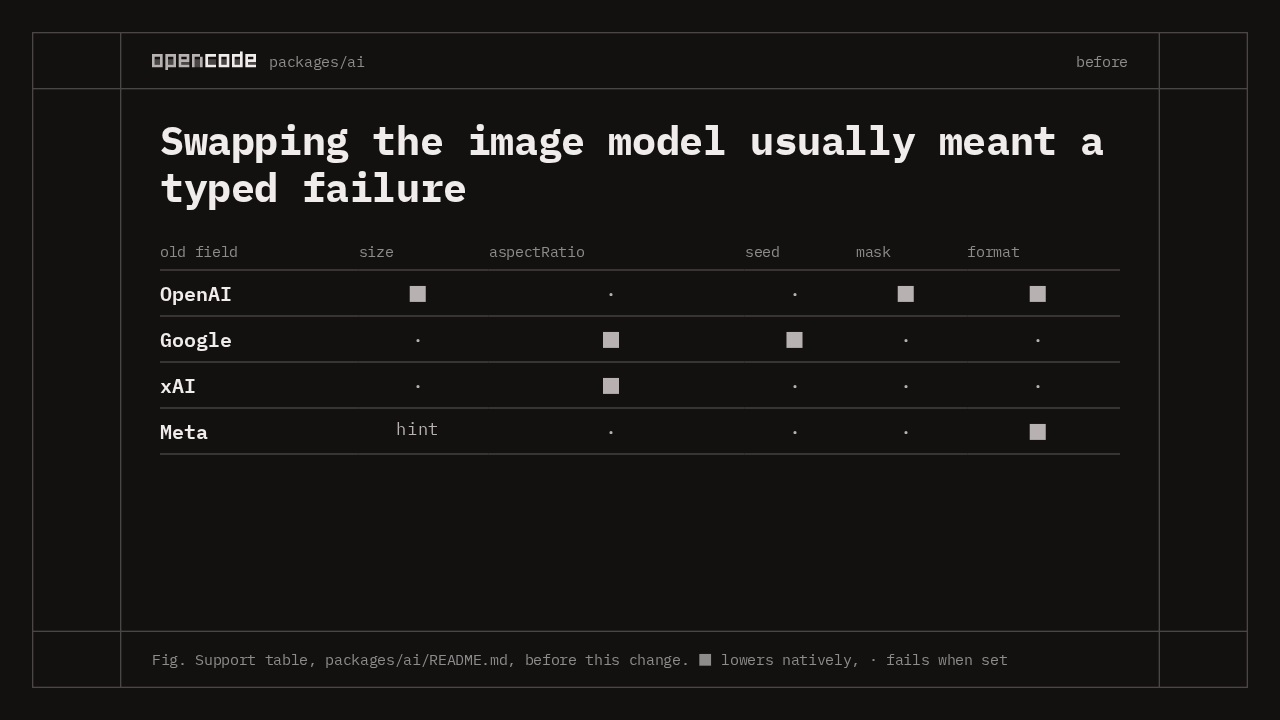
Swapping the image model usually meant a typed failure
packages/ai| old field | size | aspectRatio | seed | mask | format |
|---|---|---|---|---|---|
| OpenAI | ■ | · | · | ■ | ■ |
| · | ■ | ■ | · | · | |
| xAI | · | ■ | · | · | · |
| Meta | hint | · | · | · | ■ |
The old request carried size, aspect ratio, seed, mask and format, and most providers took one or two of them. Here's the support table the README carried for the main four. OpenAI took a size but no aspect ratio, and Google the reverse. So swapping the model usually meant a typed failure. An aspect ratio and a rough size tier are what travel between them.
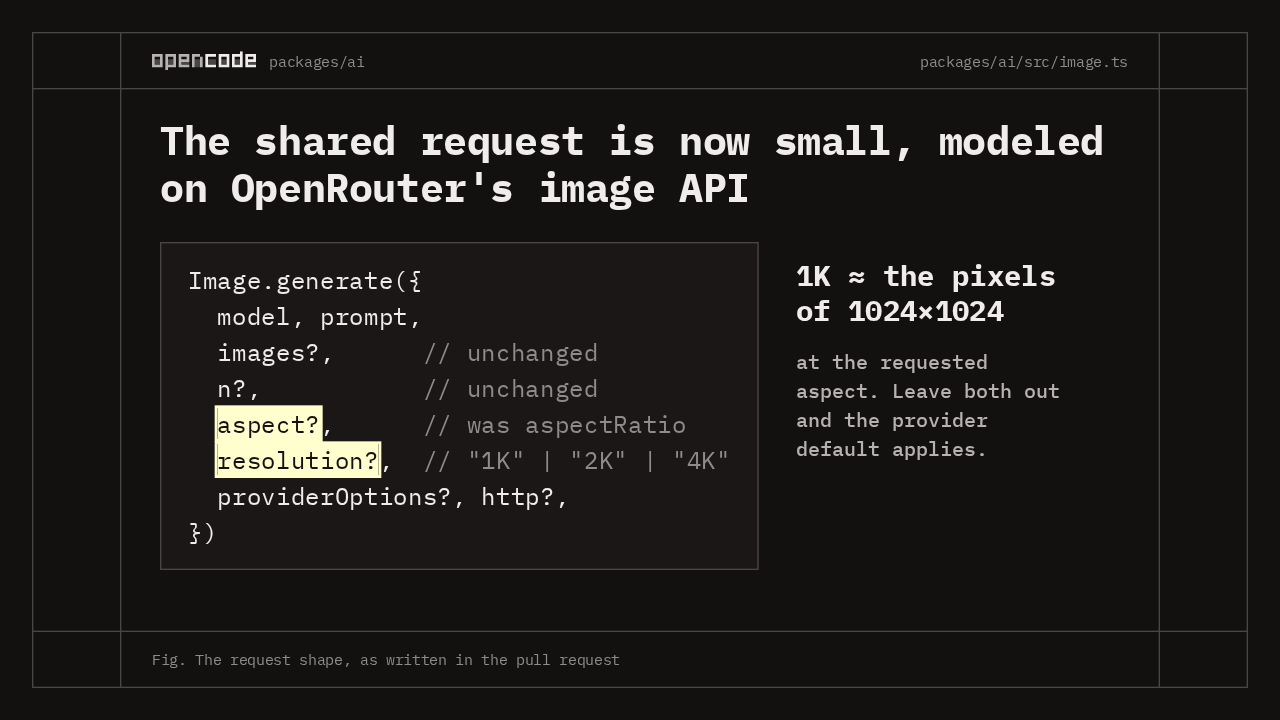
The shared request is now small
packages/aiThe shared request is now small, modeled on OpenRouter's image API
Image.generate({
  model, prompt,
  images?,      // unchanged
  n?,           // unchanged
  aspect?,      // was aspectRatio
  resolution?,  // "1K" | "2K" | "4K"
  providerOptions?, http?,
})
1K ≈ the pixels of 1024×1024
at the requested aspect. Leave both out and the provider default applies.
The new request is small, modeled on OpenRouter's image API. Images and the image count are unchanged. Aspect ratio is now just aspect. Resolution is new, an open string with 1K, 2K and 4K as tiers. 1K means about as many pixels as 1024 by 1024, at your aspect. Leave both out, and the provider default applies.
Each provider lowers aspect and resolution to its own fields
packages/ai| provider | aspect | resolution | when it can't match |
|---|---|---|---|
| imageConfig.aspectRatio | imageConfig.imageSize | passed through as is | |
| xAI | aspect_ratio | resolution 1k / 2k | 4K uses 2k, with a notice |
| OpenAI + AI Gateway | gpt-image-2+: computed size within its limits; gpt-image-1, DALL·E: nearest listed size | same | a notice |
| Meta | size hint, W×H at that ratio | not sent | ignored, with a notice |
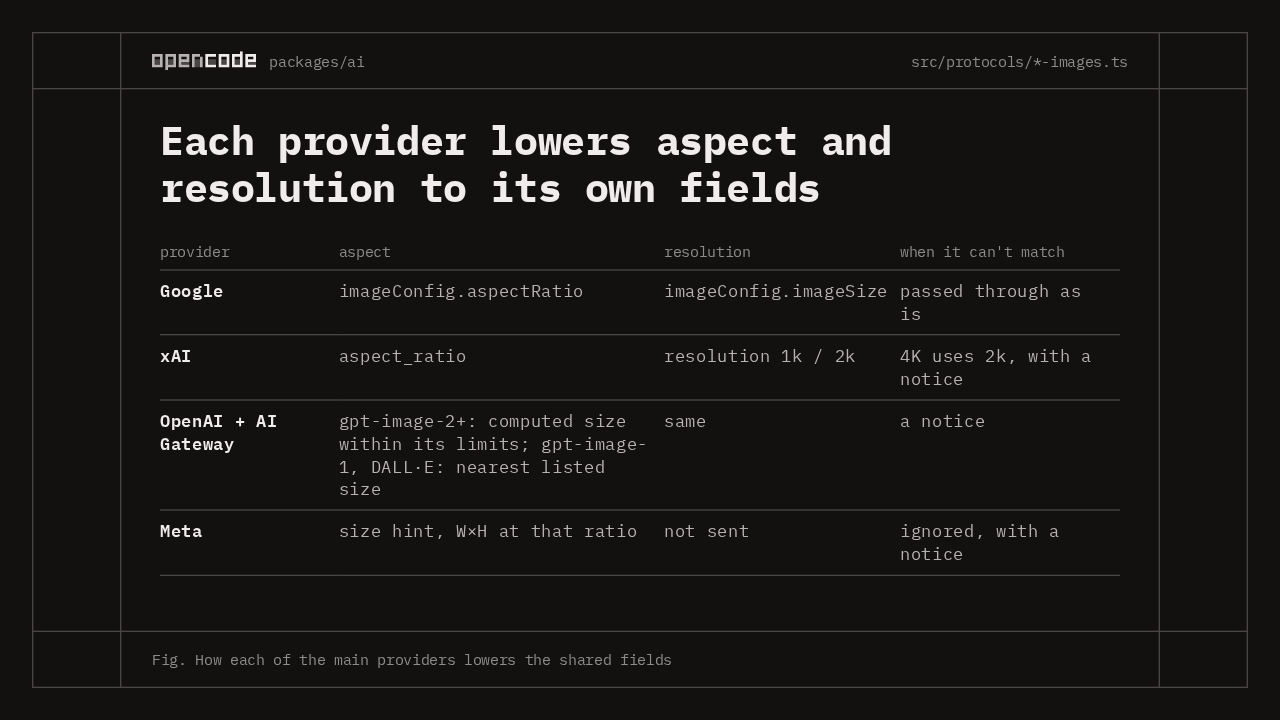
Here's how the main four lower it. Google passes both into its image config. xAI renders 1k or 2k, so a 4K request uses 2k, with a notice. OpenAI and the Vercel gateway compute a size within the model's limits, or take the nearest listed size on older models. Meta always renders about two and a half megapixels, so it ignores resolution and says so.
One helper does the size math for 8 protocols
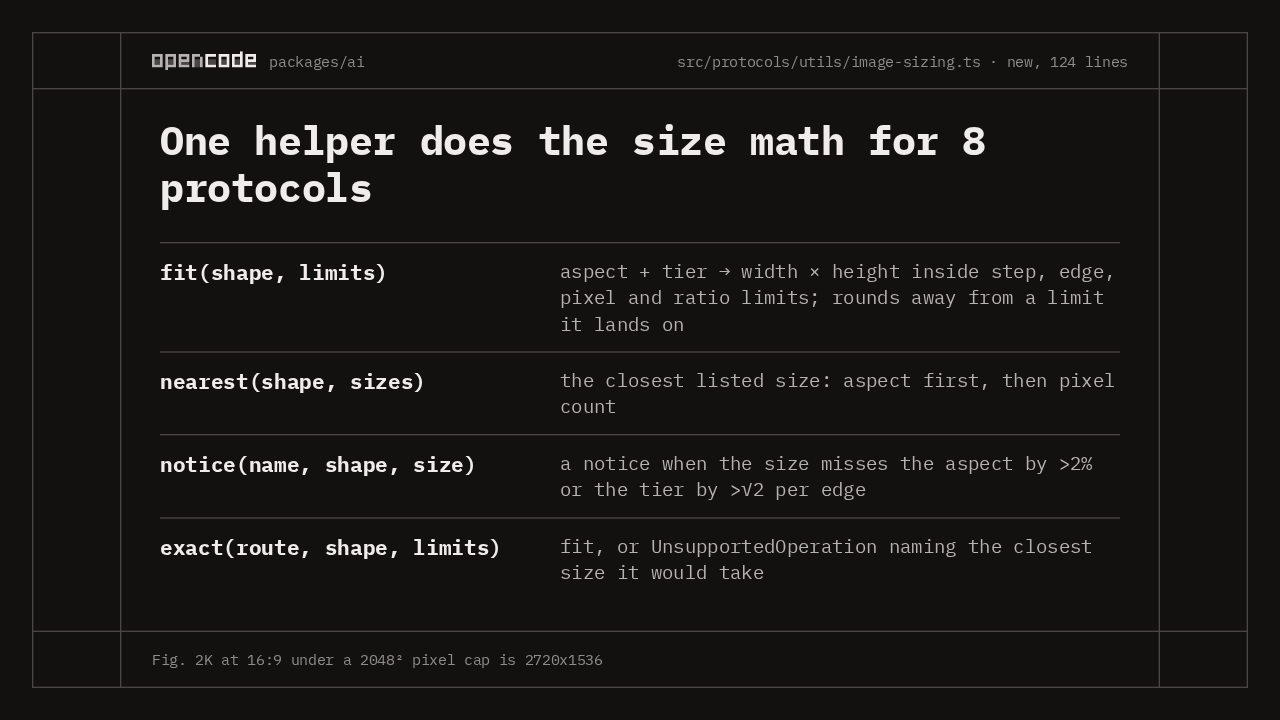
packages/aiThe size math lives in one helper, used by 8 protocols. Fit turns an aspect and a tier into a width and height inside a provider's limits, rounding away from any limit it lands on. Nearest picks the closest listed size, aspect first, then pixel count. Notice flags a size more than 2 percent off the aspect, or more than root two off the tier per edge. Exact fits, or fails naming the closest size it would take.
When a size can't match, the main routes return a notice and the rest fail
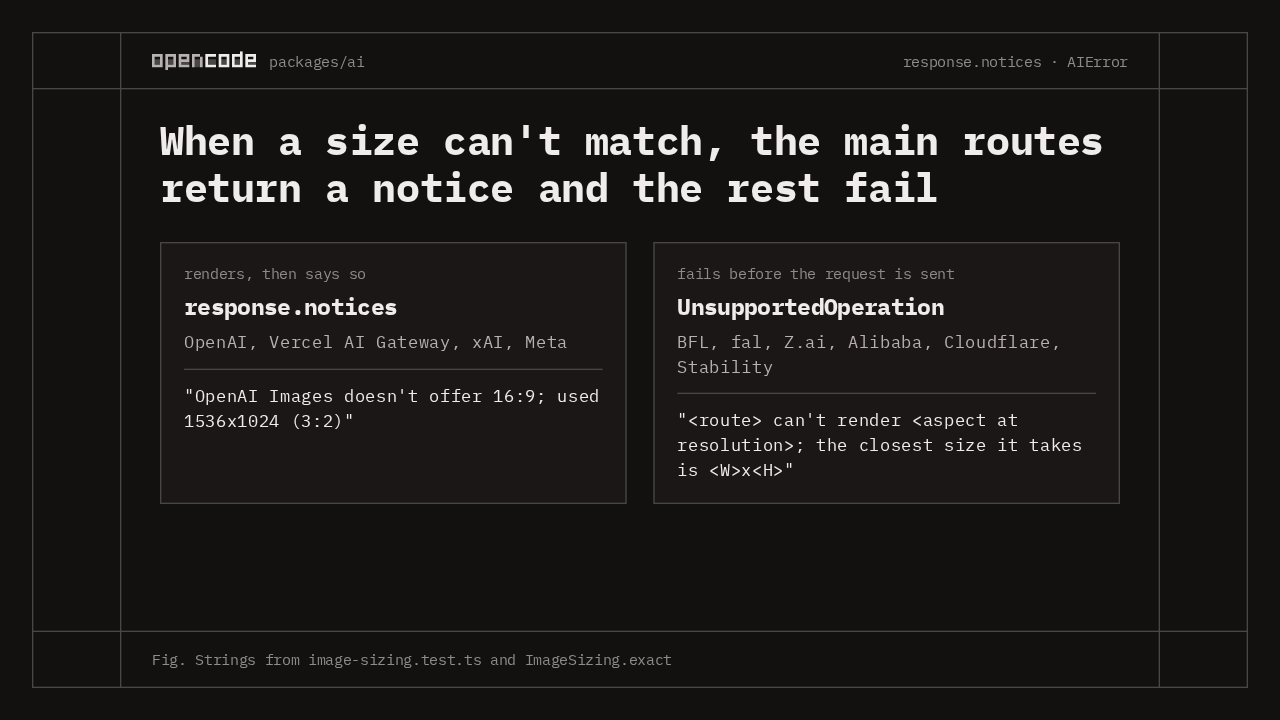
packages/aiWhen a size can't match, OpenAI, xAI and Meta still render. They put what they used in the response notices. BFL, fal, Z.ai, Alibaba, Cloudflare and Stability fail with UnsupportedOperation instead, naming the closest size they take. For the queued routes, Black Forest Labs and fal, that is the only option, because the result is decoded from the resume token alone, without the request.
Callers passing size, seed, mask, format or aspectRatio break
packages/aiImage.generate({
model: google.image(id),
prompt,
aspectRatio: "16:9",
seed: 42,
providerOptions: {
imageSize: "2K",
},
})Image.generate({
model: google.image(id),
prompt,
aspect: "16:9",
resolution: "2K",
providerOptions: {
seed: 42,
},
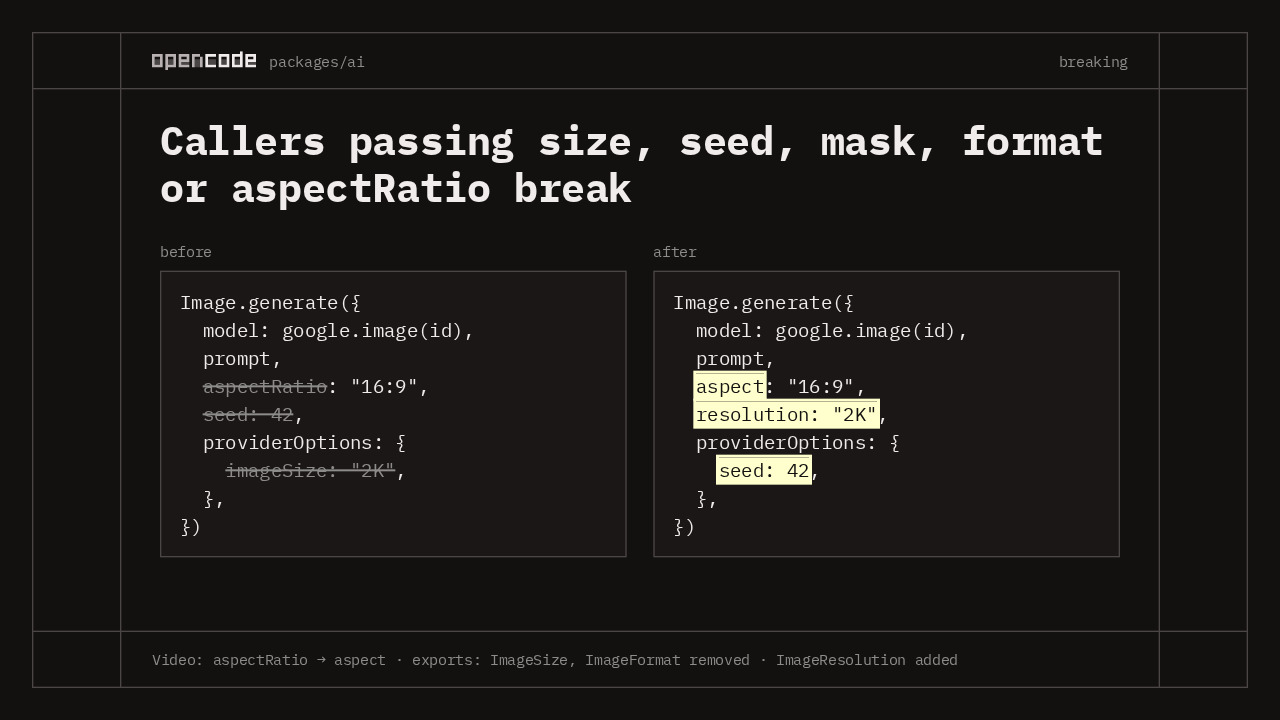
})This breaks callers that pass size, seed, mask, format or aspect ratio. Here's the README's Google example before, and after. Aspect ratio becomes aspect, 2K moves up to the shared resolution field, and seed moves down into provider options. Video gets the same rename, and the ImageSize and ImageFormat exports give way to a new ImageResolution type.
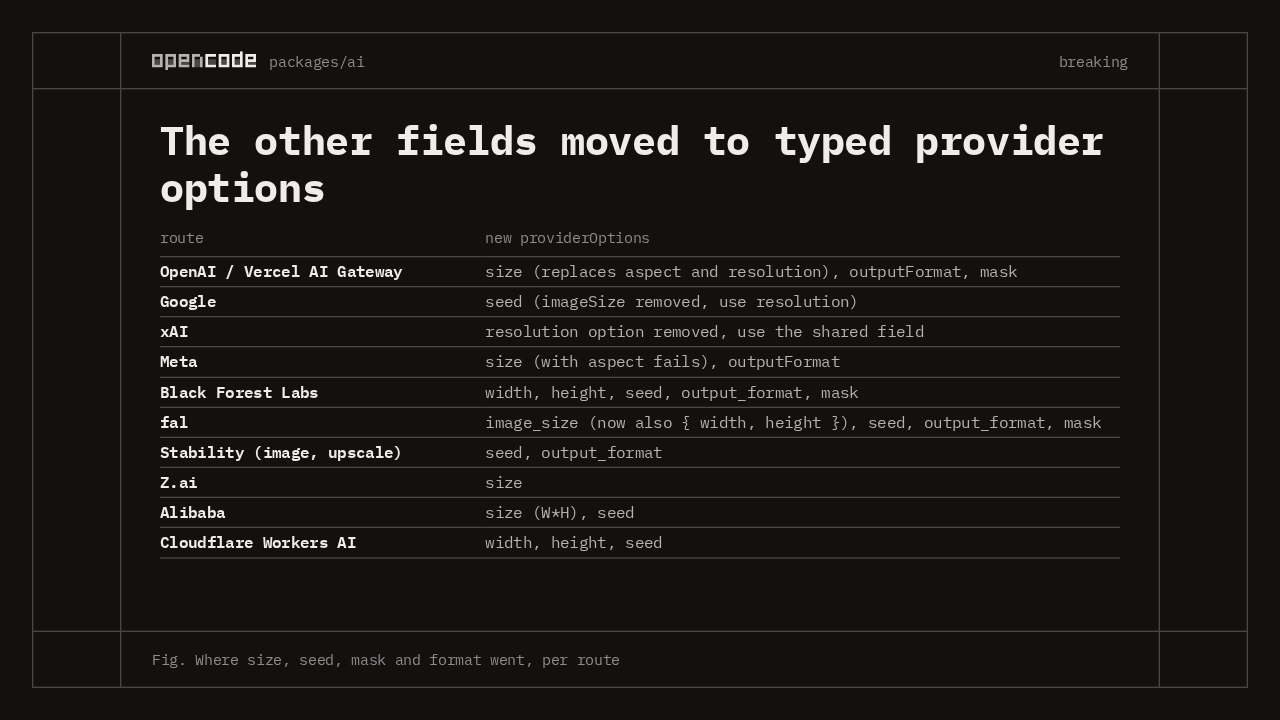
The other fields moved to typed provider options
packages/ai| route | new providerOptions |
|---|---|
| OpenAI / Vercel AI Gateway | size (replaces aspect and resolution), outputFormat, mask |
| seed (imageSize removed, use resolution) | |
| xAI | resolution option removed, use the shared field |
| Meta | size (with aspect fails), outputFormat |
| Black Forest Labs | width, height, seed, output_format, mask |
| fal | image_size (now also { width, height }), seed, output_format, mask |
| Stability (image, upscale) | seed, output_format |
| Z.ai | size |
| Alibaba | size (W*H), seed |
| Cloudflare Workers AI | width, height, seed |
Everything else moved to typed provider options, on the routes that actually supported it. The whole map is on screen. On OpenAI and the gateway, a size option replaces aspect and resolution, so setting both fails. Meta's size works the same way against aspect. And xAI's own resolution option is gone, in favor of the shared field.
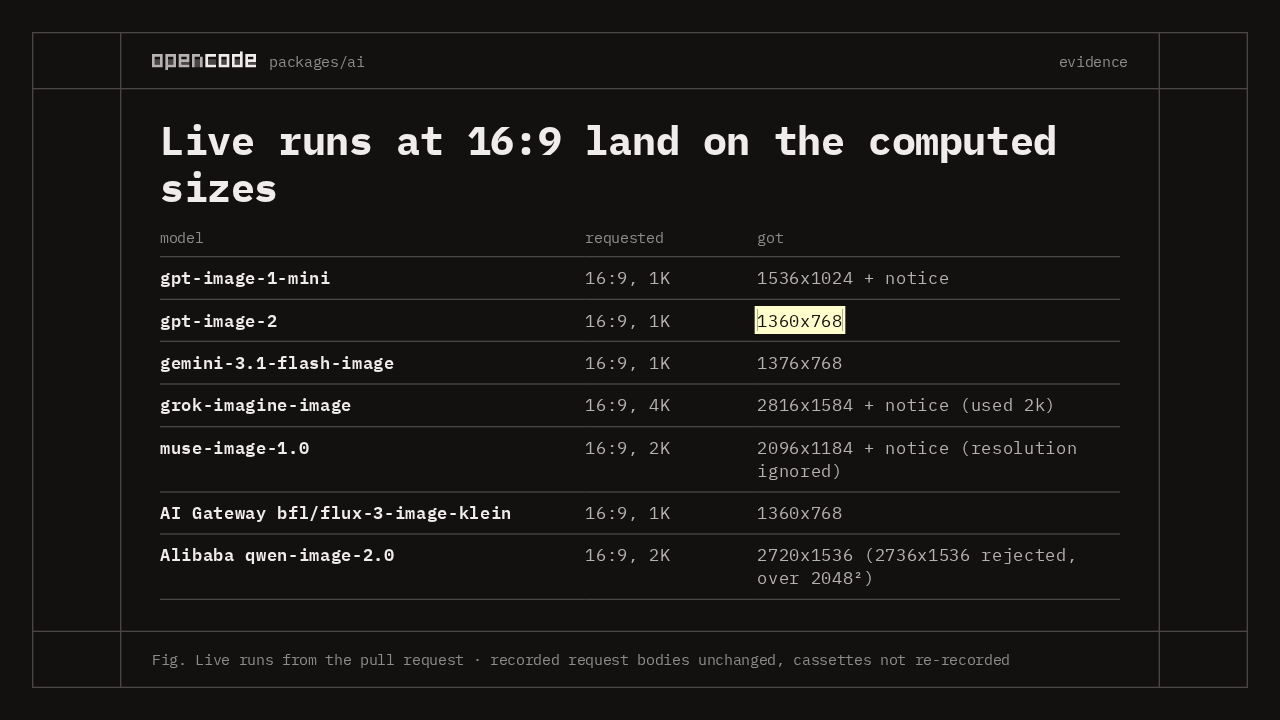
Live runs at 16:9 land on the computed sizes
packages/ai| model | requested | got |
|---|---|---|
| gpt-image-1-mini | 16:9, 1K | 1536x1024 + notice |
| gpt-image-2 | 16:9, 1K | 1360x768 |
| gemini-3.1-flash-image | 16:9, 1K | 1376x768 |
| grok-imagine-image | 16:9, 4K | 2816x1584 + notice (used 2k) |
| muse-image-1.0 | 16:9, 2K | 2096x1184 + notice (resolution ignored) |
| AI Gateway bfl/flux-3-image-klein | 16:9, 1K | 1360x768 |
| Alibaba qwen-image-2.0 | 16:9, 2K | 2720x1536 (2736x1536 rejected, over 2048²) |
The recorded request bodies didn't change, so the test cassettes stayed as they were. Run live at 16:9, GPT Image 2 at 1K got 1360 by 768, the size fit computes. The older OpenAI model, Grok and Muse came back with notices, as designed. And Alibaba at 2K got 2720 by 1536, because 2736 wide is over its pixel cap.
What to change if you call packages/ai
 packages/ai
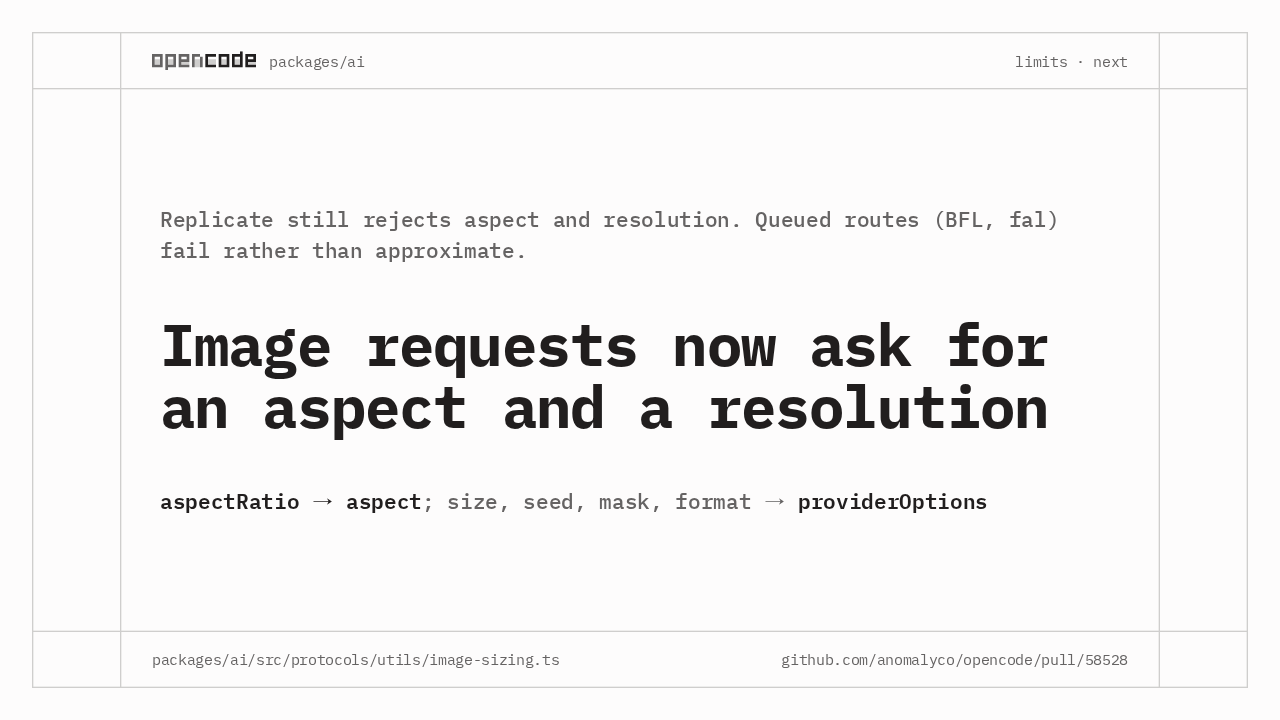
Replicate still rejects aspect and resolution. Queued routes (BFL, fal) fail rather than approximate.
Image requests now ask for an aspect and a resolution
aspectRatio → aspect; size, seed, mask, format → providerOptions
Two limits remain. Replicate still rejects aspect and resolution, because its inputs are defined per model, and the queued routes fail rather than approximate. If you call the AI package, rename aspect ratio to aspect, and move size, seed, mask and format into provider options. The size logic is in image-sizing.ts. Image requests now ask for an aspect and a resolution.